change wheel AUDI S6 2015 User Guide
[x] Cancel search | Manufacturer: AUDI, Model Year: 2015, Model line: S6, Model: AUDI S6 2015Pages: 314, PDF Size: 77.57 MB
Page 175 of 314
M N
0 <.J 'SI: ,...., \!) ..,.,
,...., ..,., ,....,
-Always read and heed all WARNINGS
whenever using a child restraint in ave
hicle
¢ page 136, Safety belts,
¢ page 145, Airbag system and
¢ page 171, Important things to
know.
(D Tips
Always replace child restraints that were
installed in a vehicle during a crash. Dam
age to a child restraint that is not visible
could cause it to fail in another collision
situation.
Advanced front airbag system and children
Your vehicle is equipped with a front "Ad
vanced Airbag System" in compliance with United States Federal Motor Vehicle Safety
Standard (FMVSS) 208 as applicable at the
time your vehicle was manufactured .
T he Advanced Airbag system in your vehicle
has been certified to meet the "low-risk" re
quirements for 3-and 6-year old children on
the passenger side and small adults on the
driver side. The low risk deployment criteria
are intended to reduce the risk of injury
through interaction with the airbag that can
occur, for example , by being too close to the
steering wheel and instrument panel when
the airbag inflates . In addition, the system
has been certified to comply with the "sup
pression" requirements of the Safety Stand
ard, to turn off the front airbag for infants up
to 12 months who are restrained on the front passenger seat in child restraints that are list
ed in the Standard .
Even though your vehicle is equipped with an
Advanced Airbag system, all children, espe
cially those 12 years and younger, should al
ways ride in the back seat properly restrained
for their age and size. The airbag on the pas
senger side makes the front seat a potentially
dangerous place for a child to ride. The front
seat is not the safest place fo r a child in a for
ward-facing child safety seat. It can be a very
Child Safety 173
dangerous place for an infant or a larger child
in a rearward-facing seat.
The vehicle's Advanced Airbag System has a
capacitive passenger detection system in the
front passenger seat cushion that can detect
the presence of a baby or a child in a child re
straint system on this seat.
The capacitive passenger detection system
registers the changes that result in an electri
cal field when a child, a child restraint, and a
baby blanket are on the front passenger seat .
The change in the measured capacitance due
to the presence of a child, a child restraint,
and a baby blanket on the front passenger
seat is related to the child restraint system resting on the seat . The measured capacitance
of a child restraint system varies depending
on the type of system and specific make and
model.
The electrical capacitance of the various
types, makes, and models of child restraints
specified by the U.S.National Highway Traffic
Safety Administration (NH TSA) in the relevant
safety standard are stored in the Advanced
Airbag System control unit together with the capacitances typical of infants and a 1-year
old child. When a child restraint is used on the
front passenger seat with a typical 1 year-old infant, the Advanced Airbag System compares
the capacitance measured by the capacitive passenger detection system with the data
stored in the electronic control unit.
Child restraints and Advanced front
airbag system
Regardless of the child restraint that you use,
make sure that it has been certified to meet
United States Federal Motor Vehicle Safety
Standards and has been certified by its manu
facturer for use with an airbag. Always be sure
that the child restraint is properly installed at
one of the rear seating positions. If in excep
tional circumstances you must use it on the
front passenger seat, ca refully read all of the
information on child safety and Advanced Air-
bags and heed all of the applicable ..,.
•
•
Page 195 of 314
M N
0 <.J 'SI: ,...., \!) ..,.,
,...., ..,., ,....,
@ Tips
Your vehicle may be equipped with Audi
connect. Your use of certain Aud i connect
features req uires wireless serv ices that are
provided by a third party wireless telecom
municat ions provider. For details regard
ing how information obtained through
Aud i connect is collected, processed,
transmitted, used, and shared, please see
your contra ct w ith the wire less telecom
municat ions provider and the "About A udi
connect" tab in your vehicle's MMI:
!MENU !
button > Audi connect > About Audi con·
nect .
Electronic Stabilization
Control (ESC)
Description
ESC helps to improve road holding and vehicle
dynamics to help reduce the probability of
skidd ing and loss of veh icle control. It works
only when the eng ine is running. ESC detects
certain difficult driv ing s ituations, including
when the vehicle is beginning to spin (yaw) out of cont ro l and helps you to get the vehicle
back under control by select ively brak ing the
wheels, and/or red ucing engine powe r and
p roviding steering assistance to help hold the
ve hicle on the driver's intended course . The in
dicator light
m in the instrument cluster
blinks when ESC is taking action to help you
control the vehicle.
ESC has limitations.
It is important to remem
ber that ESC cannot overcome the laws of
phys ics. It will not a lways be able to help out
under all conditions you may come up against.
For example, ESC may not always be able to
h elp you master situat ions where there is a
sudden change in the coefficient of fr iction of
the road surface. When there is a sect io n of
d ry road that is s udden ly cove red with water,
slush o r snow, ESC canno t perform the same
way it would on the dry su rface.
If the vehicle
hydroplanes (rides on a c ush ion of wate r in
stead of the road surface), ESC wi ll not be
ab le to he lp you steer the veh icle because con-
Int ellig ent technolog y 193
tact with the pavement has been interrupted
and the vehicle cannot be braked or steered .
D uring fast corner ing, particular ly on wind ing
roads, ESC cannot always deal as effectively
with difficult dr iv ing s ituations than at lower
speeds. When towing a trailer, ESC is not able
to help you regain control as it would if you
were not tow ing a trailer.
Always adjust your speed and driving style to road, traffic and weather conditions . ESC can
not override the vehicle's physical lim its, in
crease the availab le tract ion, or keep a veh icle
o n the road if road departu re is a result of
driver ina ttent io n. Instead , ESC imp roves the
poss ibility of keep ing the vehicle under con
trol and on the road during extreme maneu
vers by using the driver's steering i nputs to
help keep the vehicle go ing in the intended di
rect ion. If you are traveling at a speed that
causes you to run off the road before ESC can
provide any assistance, you may not experi
ence the benefits of ESC.
ESC includes and/or works together with the
anti-lock brake system (ABS), brake ass ist sys
tem, ant i-slip regu lation (ASR), electron ic dif
ferential lock (EDL), dynam ic steer ing* and
El ectronic interax le differentia l lock* /selective
whee l to rque control*. ESC is switched on a ll
the time. In ce rtain sit uat io ns when yo u need
less traction, you can sw itch off ASR by press
ing the b utton
[fil ¢ page 195, fig. 178. Be
s u re to switch ASR on again when you no lon
ger need less traction .
Anti-lock braking system (ABS )
ABS prevents the whee ls from locki ng up
when b raking. The vehicle can st ill be stee red
even during hard braking . App ly steady pres
su re to the brake peda l. Do not pump the ped
al. A pulsing in the brake pedal indicates that
the system is helping you to brake the vehicle.
Brake a ssis t sy ste m
The brake ass ist system can decrease braking
distance . It increases braking power when the
driver presses the brake peda l quickly in emer
gency s ituations. You must press and hold the
brake pedal unti l the situation is over. In .,,.
•
•
Page 209 of 314

Always apply brakes early. When driving
downhill, shift into a lower gear to use the en
g ine braking effect to slow the vehicle . Use of
the brakes a lone can cause them to overheat
and fail.
Air suspension*
When driving with a trai ler, activate the trailer
mode of the air suspension. Switch the air
suspension trailer mode on when you are tow
ing a trailer. This will limit the regulation by
the air suspension while driving. Select in the
MMI:
! CARI function button> (C ar) * systems
control button > Vehicle settings > Air susp.:
towing > On .
Coolant temperature
The coolant temperature gauge¢ page 11
must be observed carefully. The coolant tem
perature can increase if you drive on long in
clines in a low gear at high engine speeds . Re
duce your speed immed iately if the LEDs in
the top pa rt of the display turn on.
For more information about indicator lights,
refer to. ¢
page 16 .
A WARNING
Anyone no t properly restrained in a mov
ing veh icle is at a much greater ris k in an
accident . Never let anyone ride in your car
who is not properly wearing the restraints
provided by Audi .
Trailer towing tips
Important to know
Your vehicle handles differently when tow ing
a trailer because of the addit ional weight and
d ifferent weight distribution . Safety, perform
ance and economy w ill greatly depend on how
carefully you load your trailer and operate
your rig.
Before you actually tow your trailer, practice
M N turning, stopping and backing up in an area 0
~ away from traffic. Keep practicing until you
~ have become comp lete ly fam iliar with the way 1.1'1 ,...., 1.1'1 ,....,
Trailer towing 207
your vehicle-trai ler combination behaves and
responds.
Backing up is difficult and requires practice .
Backing up with a trailer generally req uires
steering action opposite to that when backing
up your vehicle without a trai ler.
Maintain a greater distance between your ve
hicle and the one in front of you. You will need
more room to stop. To compensate for the
trailer , you wi ll need a larger than normal
turning rad ius.
When passing, remember that you cannot ac
ce lerate as fast as you norma lly would be
cause of the added load. Make sure you have
enough room to pass . After passing, allow
plenty of room for your trailer before chang
ing lanes again .
Avoid jerky starts, sharp turns or rapid lane changes.
(D Tips
- Do not tow a trailer during the break-in
period of your vehicle.
- If you tow a trailer, your Audi may re
quire more frequent maintenance due to
the extra load ¢
page 292.
Parking on a slope
Do not park on a slope with a trailer. If it can
not be avoided, do so only after doing the fol lowing:
When parking:
.,. App ly the foot brake .
.,. Have someone p lace chocks under both the
vehicle and the trailer wheels.
.,. With chocks in place, slowly release the
brakes until the wheel chocks absorb the
load .
.,. Turn the wheels towards the curb.
.,. Apply the parking brake .
.,. Select the P selector lever posit ion.
When re starting after parking:
.,. App ly the foot brake.
.,. Start the engine.
•
•
Page 244 of 314
242 Tires and whee ls
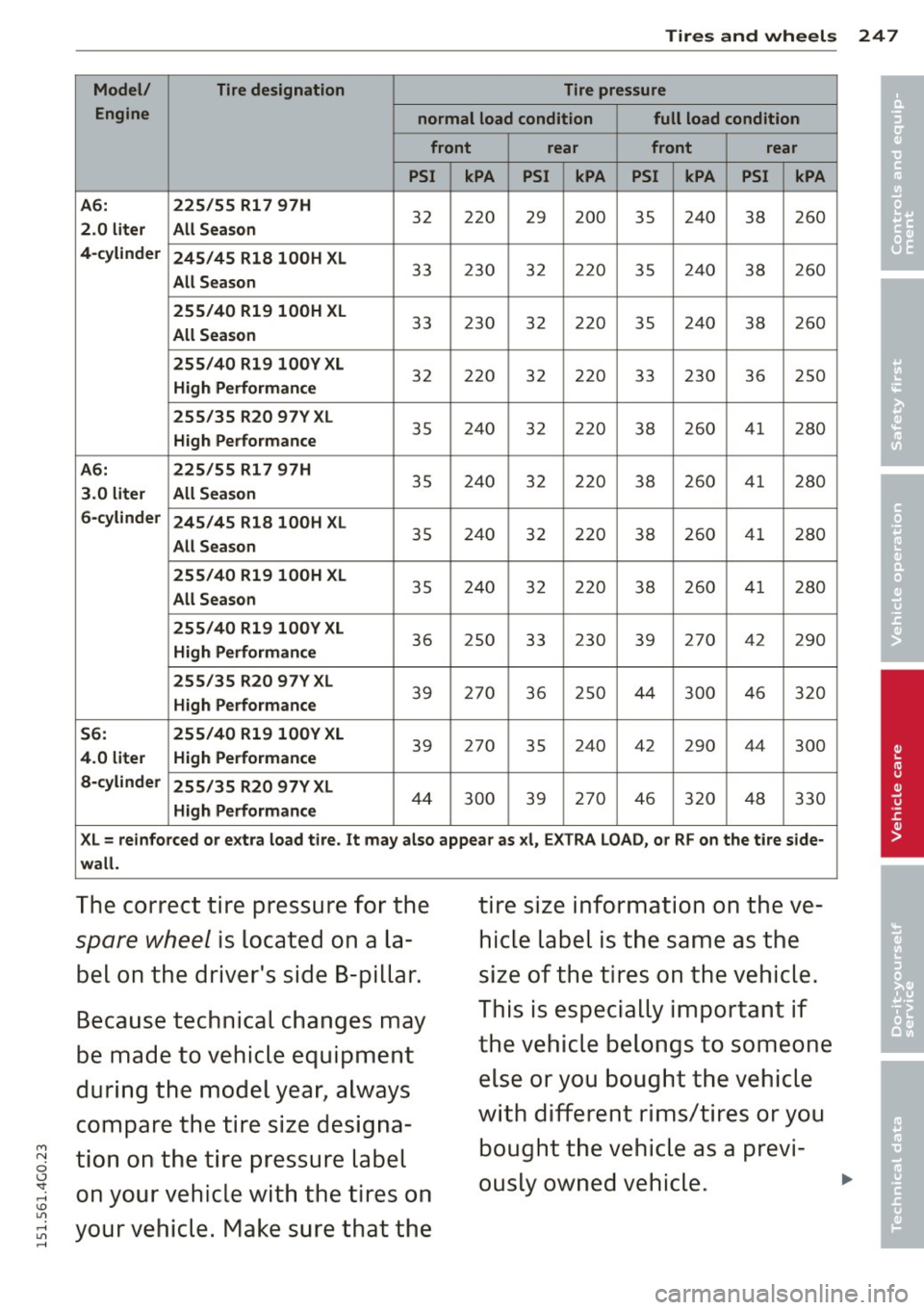
Recommended inflation Sidewall
pressu re
means that portion of a tire be -
see
c:::> page 240, Cold tire infla-tween the tread and bead.
tion pressure.
Spe ed rating (letter code )
Reinforced tire
means the speed at which a tire
means a tire design to operate
is designed to be driven for ex-
at higher loads and at higher tended periods of time. The rat-
inflation pressures than the ings range from 93 mph (150
corresponding standard t ire .
km/h) to 186 mph (298 km/h)
Reinforced tires may be identi -
c:::> page 260. You may not find
fied as "XL", "xl", "EXTRA
this information on all tires be-
LOAD", or "RF" on the sidewall.
cause it is not required by law.
Rim The speed rating letter code,
means a meta l support for a where applicable
, is molded on
tire or a tire and tube assembly the tire sidewall and indicates
upon which the tire beads are the
maximum pe rmissible road
seated . speeds
c:::> A in Winter tires on
Rim diameter
page 264.
means
nominal diameter of the
Tire pressure monitoring
system
bead seat. If yo u change your
means a system that detects
wheel size, you will have to pur-
chase new tires to ma tch the when one or more of a vehicle's
new rim diameter . tires a
re underinflated and illu-
Rim size designation
m inates a low tire pressure
warning telltale.
means rim diameter and width.
Tread
Rim width
means that portion of a tire
means nominal distance be-
that comes into contact with
tween rim flanges. the road.
...
Page 248 of 314
246 Tires and wheel s
If you wish to improve comfort See the illustration ¢ fig. 195
when operating the vehicle at for the locati on of the labe l on
normal load (up to 3 occu -driver's side B -pillar (color of
pants), you can adjust tire the actual label and exact loca-
pressures to those specified tion on the vehic le will vary
for normal vehicle load. Before slight ly) .
operat ing the vehicle at maxi -Note that the following table is
mum load , you must increase accurate at the time of going to
the ti re pressu res to those press and is subject to change .
specified for maximum vehicle In the event of discrepancies,
load¢&. the tire pressure labe l is locat-
Bear in mind that the tire pres- ed on the driver's side 8-pi llar
sure monitoring system can on -always takes precedence .
ly monitor the tire pressures The table below lists the rec-
you have stored . The system
ommended cold tire inflation
does not recogn ize the load
pressures for the Audi model
condition of your vehic le.
covered by your Owner's Litera-
T he effectiveness of the tire ture at the vehicle's capacity
pressure monitoring system weight and the tire sizes instal -
will be impaired if you store led on the respective mode ls as
normal load pressures but then original equipment, or as a fac-
operate the vehicle at its maxi- tory option.
...
mum load¢&.
Page 249 of 314
Tires and wheels 24 7
Model/ Tire designation Tire pressure
• Engine
normal load condition full load condition
•
front rear front rear
PSI kPA PSI
kPA PSI kPA PSI kPA
A6: 225/55 Rl 7 97H
32 220 29 200 35 240
38 260 2.0 liter All Season
4-cylinder 245/45 Rl8 lOOH XL
All Season
33 230 32 220 35 240 38 260
255/40 Rl9 lOOH XL
33 230 32
220
35 240
38 260 All Season
255/40 Rl9 lOOY XL
32 220 32 220 33 230 36 250 High Performance
255/35 R20 97Y XL
35 240 32 220 38 260 41 280 High Performance
A6: 225/55 Rl 7 97H
35 240
32 220 38 260 41
280 3.0 liter All Season
6-cylinder
245/45 Rl8 lOOH XL
All Season
35 240 32 220 38 260 41 280
255/40 Rl9 lOOH XL
35 240
32 220
38 260
41 280 All Season
255/40 Rl9 lOOY XL
36 250 33 230 39 270
42
290
High Performance
255/35 R20 97Y XL
39 270 36 250 44 300 46 320 High Performance
S6: 255/40 Rl9 lOOY XL
39 270
35 240 42 290 44
300 4.0 liter High Performance
a-cylinder 255/35 R20 97Y XL
High Performance
44 300 39 270 46
320 48
330
XL= reinforced or extra load tire . It may also appear as xl, EXTRA LOAD, or RF on the tire side-
wall.
The correct tire pressure for the tire size information on the ve-
spare wheel is located on a la- hicle label is the same as the
bel on the driver's side B-pillar. size of the tires on the vehicle.
Because technical changes may This is especially important if
the vehicle belongs to someone
be made to vehicle equipment
during the model year, always else or you bought the vehicle
with different rims/tires or you
compare the tire size designa-
M
tion on the tire pressure label bought the vehicle as a previ-N
0 <.J ously owned vehicle. ... 'SI: on your vehicle with the tires on ,...., \!) 1.1'1 ,...., your vehicle. Make sure that the 1.1'1 ,....,
Page 254 of 314
252 Tires and wheels
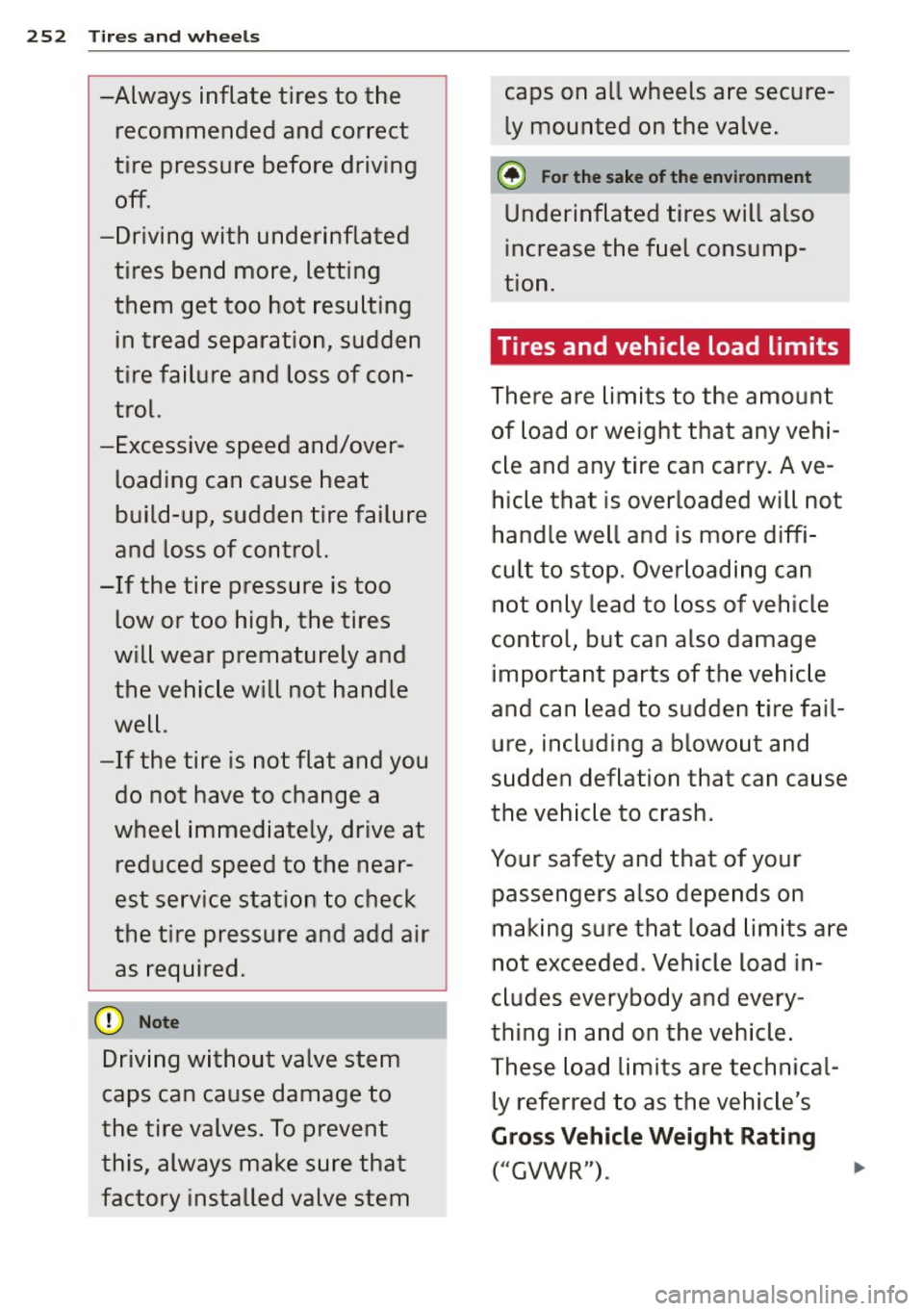
-Always inflate tires to the
recommended and correct
tire pressure before driving
off .
-Driving with underinflated tires bend more, letting
them get too hot resulting
in tread separation, sudden
tire failure and loss of con
trol.
-Excessive speed and/over loading can cause heat
build-up, sudden tire failure
and loss of control.
-If the tire pressure is too low or too high, the tires
will wear prematurely and the vehicle will not handle
well.
- If the tire is not flat and you
do not have to change a
wheel immediately, drive at
reduced speed to the near
est service station to check
the tire pressure and add air
as required.
@ Note
Driving without valve stem
caps can cause damage to
the tire valves. To prevent
this, always make sure that
factory installed valve stem caps on all
wheels are secure
ly mounted on the valve.
@) For the sake of the environment
Underinflated tires will also
increase the fuel consump
tion.
Tires and vehicle load limits
There are limits to the amount of load or weight that any vehi
cle and any tire can carry. Ave
hicle that is overloaded will not
handle well and is more diffi
cult to stop. Overloading can not only lead to loss of vehicle
control, but can also damage
important parts of the vehicle
and can lead to sudden tire fail
ure, including a blowout and
sudden deflation that can cause
the vehicle to crash.
Your safety and that of your
passengers also depends on
making sure that load limits are
not exceeded. Vehicle load in
cludes everybody and every
thing in and on the vehicle.
These load limits are technical
ly referred to as the vehicle's
Gross Vehicle Weight Rating
("GVWR "). .,..
Page 270 of 314
268 Tires and wheels
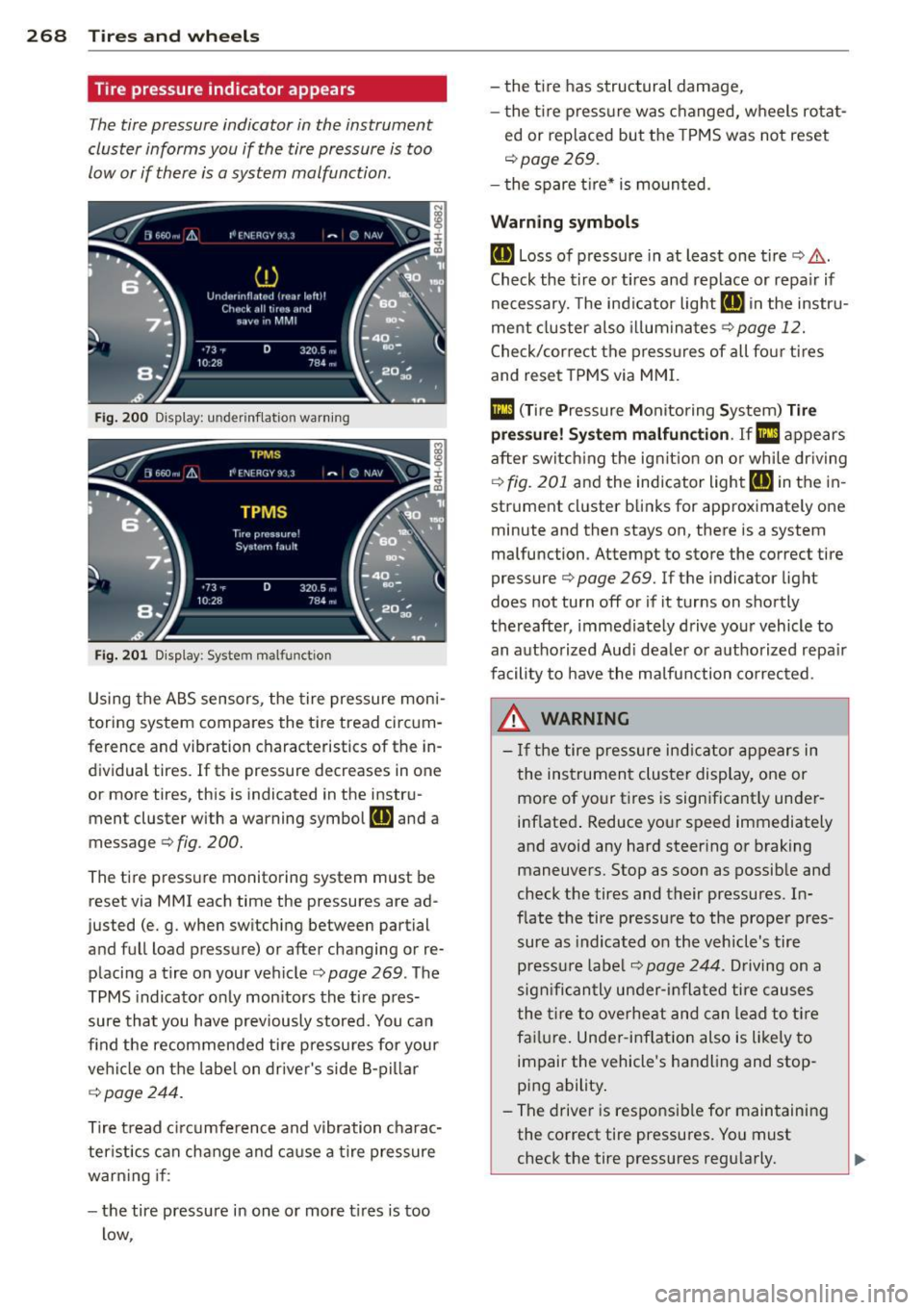
Tire pressure indicator appears
The tire pressure indicator in the instrument
cluster informs you if the tire pressure is too
low or if there is a system malfunction.
Fig. 200 Display : und erinflatio n warn ing
Fig. 201 Display: Syste m malfunction
Using the ABS sensors , the tire pressure moni
toring system compares the tire tread circum
ference and vibration characteristics of the in
dividual tires.
If the pressure decreases in one
or more tires, this is indicated in the instru
ment cluster with a warning symbol
[9] and a
message ¢
fig. 200.
The tire pressure monitoring system must be
reset via MMI each time the pressures are ad
justed (e. g. when switching between partial
and full load pressure) or after changing or re
placing a tire on your vehicle¢
page 269 . The
TPMS indicator only monitors the tire pres
sure that you have previously stored. You can
find the recommended tire pressures for your vehicle on the label on driver's side 8-pillar
¢page 244.
Tire tread circumference and vibration charac
teristics can change and cause a tire pressure
warning if:
- the tire pressure in one or more tires is too
low, -
the tire has structural damage,
- th e tire pressure was changed, wheels rotat-
ed or replaced but the TPMS was not reset
¢page 269.
- the spare tire* is mounted .
Warning symbols
[9] Loss of pressure in at least one tire¢&. .
Check the tire or tires and replace or repair if
necessary. The indicator light
[9] in the instru
ment cluster also illuminates
¢page 12.
Check/correct the pressures of all four tires
and reset TPMS via MMI.
Ill (Tire Pressure Monitoring System ) Tire
pressure! System malfunction . Iflll appears
after switching the ignition on or while driving
¢
fig. 201 and the indicator light [9] in the in
strument cluster blinks for approximately one
minute and then stays on, there is a system
malfunction . Attempt to store the correct tire
pressure ¢
page 269. If the indicator light
does not turn off or if it turns on shortly
thereafter, immediately drive your vehicle to
an authorized Audi dealer or authorized repair
facility to have the malfunction corrected.
A WARNING
- If the tire pressure indicator appears in
the instrument cluster display, one or
more of your tires is significantly under
inflated. Reduce your speed immediately
and avoid any hard steering or braking
maneuvers. Stop as soon as possible and
check the tires and their pressures. In
flate the tire pressure to the proper pres
sure as indicated on the vehicle's tire
pressure label¢
page 244 . Driving on a
significantly under-inflated tire causes
the tire to overheat and can lead to tire
failure. Under-inflation also is likely to
impair the vehicle's handling and stop
ping ability.
- The driver is responsible for maintaining the correct tire pressures. You must
check the tire pressures regularly. ..,
Page 271 of 314

M N
0 <.J 'SI: ,...., \!) 1.1'1 ,...., 1.1'1 ,....,
-Under certain cond itions (such as a spor
ty driving style, w inter condit ions or un
paved roads), the pressure monitor
indicator may be delayed.
- Ask your author ized Audi dealer if run
flat tires may be used on your veh icle.
- The tire pressure monitoring system may
stop working when there is an ESC mal
funct ion.
- Using snow chains may result in a system
malfunction.
- The tire pressure monitoring system on
your Audi was developed using t ires with
the "AO" or "RO" identification on the
tire sidewall
c> page 257. We recom
mend using these t ires.
Reset tire pressure monitoring system
If the tire pressure is adjusted, wheels are ro
tated or changed, the TPMS must be reset via
MMI.
"' Before storing the new tire pressures, check
that the current pressures on all four t ires
correspond to the specified values and
adapt the p ress ures to the current load
c> page 244.
"'Switch on the ignition.
"' Se lect in the MMI:
!CAR ! func tion button>
(Car )* sys tems contro l button > Servicin g &
checks > Tire pre ssure mon ito ring > Store
tire pre ssure s> Y es, sto re now .
Do not store the tire p ress ure if the re a re
snow chains on the tire. Otherwise, a sys
tem ma lf u nction may occu r.
Tires an d wheel s 269
•
•
Page 275 of 314
M N
0 <.J 'SI: ,...., \!) ..,.,
,...., ..,., ,....,
A WARNING 1=
You or your passengers could be injured
while changing a wheel if you do not fol
low these safety precautions:
- If you have a flat tire, move a safe dis
tance off the road. Turn off the engine,
turn the emergency flashers on and use
other warning devices to alert other mo
torists.
- Make sure that passengers wait in a safe
place away from the vehicle and well
away from the road and traffic.
- To help prevent the vehicle from moving
suddenly and possibly slipping off the
jack, always fully set the parking brake
and block the wheel diagonally opposite
the wheel being changed. When one
front wheel is lifted off the ground, plac
ing the Automatic Transmission in P
(Park) will
not prevent the vehicle from
moving.
- Before you change a wheel, be sure the
ground is level and firm. If necessary,
use a sturdy board under the jack.
- Always store the vehicle tool kit, the jack
and the replaced tire in the luggage com
partment
¢ page 132.
{!) Tips
Before changing the wheel, you must acti
vate the jacking mode, so that the auto matic controls for the Adaptive Air Sus
pension* do not make it more difficult to
lift the vehicle with the jack¢
page 2 75.
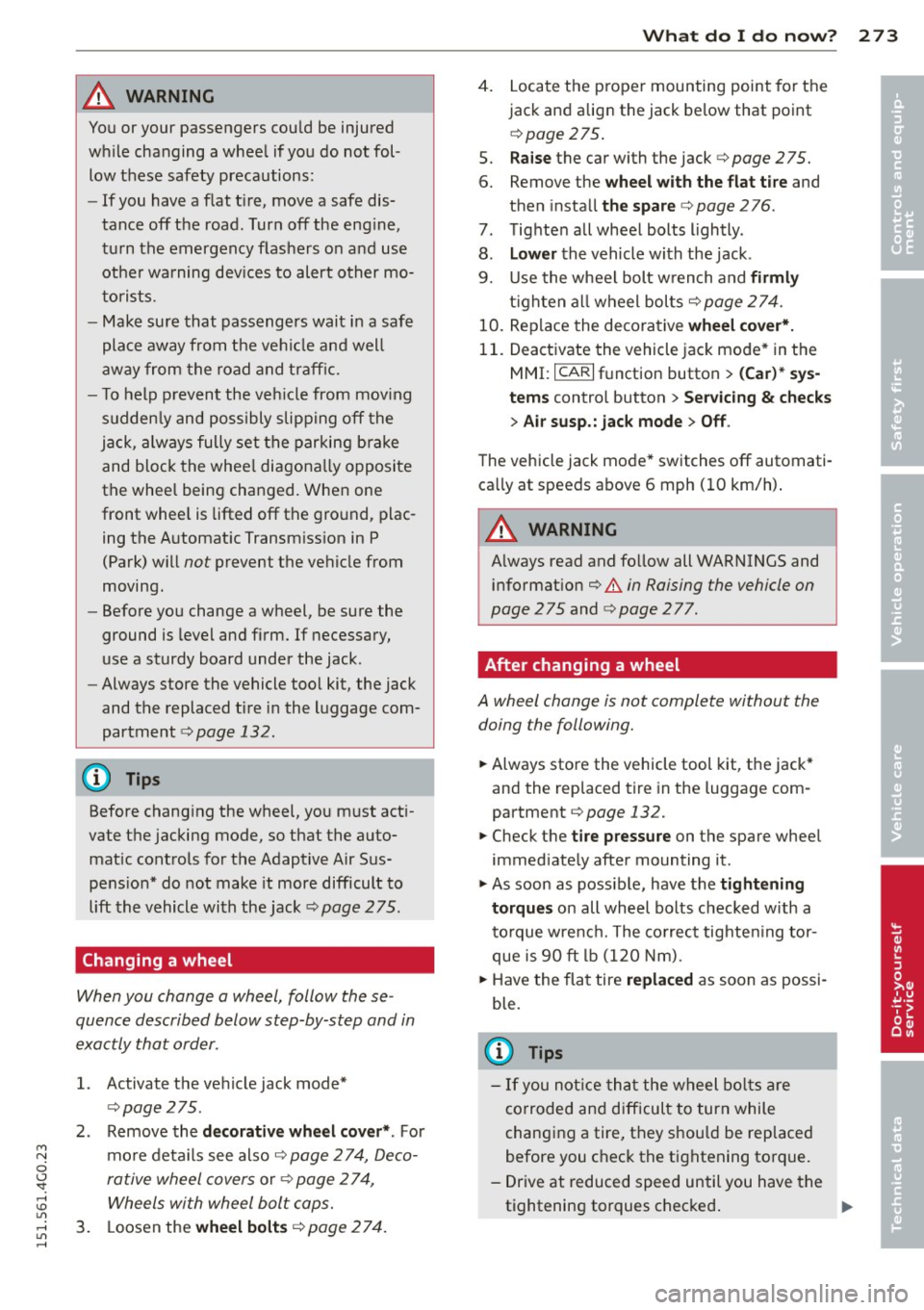
Changing a wheel
When you change a wheel, follow the se
quence described below step-by-step and in
exactly that order .
1. Activate the vehicle jack mode*
c::;. page 275.
-
2. Remove the decorative wheel cover* . For
more details see also
¢page 274, Deco
rative wheel covers
or ¢ page 2 7 4,
Wheels with wheel bolt caps.
3. Loosen the wheel bolts¢ page 274.
What do I do now? 273
4.
5.
6.
7.
8.
9.
Locate the proper mounting point for the
jack and align the jack below that point
¢page 275.
Raise the car with the jack ¢page 275.
Remove the wheel with the flat tire and
then install
the spare <=> page 2 76.
Tighten all wheel bolts lightly.
Lower the vehicle with the jack .
Use the wheel bolt wrench and
firmly
tighten all wheel bolts¢ page 274 .
10. Replace the decorative wheel cover*.
11. Deactivate the vehicle jack mode* in the
MMI:
ICARI function button > (Car)* sys
tems
control button > Servicing & checks
> Air susp.: jack mode > Off .
The vehicle jack mode* switches off automati
cally at speeds above 6 mph (10 km/h).
A WARNING
Always read and follow all WARNINGS and information<=>
A in Raising the vehicle on
page 275
and <=> page 277.
After changing a wheel
A wheel change is not complete without the
doing the following.
.,. Always store the vehicle tool kit, the jack*
and the replaced tire in the luggage com
partment
c::;. page 132.
.,. Check the tire pressure on the spare wheel
immediately after mounting it.
.,. As soon as possible, have the
tightening
torques
on all wheel bolts checked with a
torque wrench. The correct tightening tor
que is
90 ft lb (120 Nm) .
.,. Have the flat tire
replaced as soon as possi
ble.
(D Tips
- If you notice that the wheel bolts are
corroded and difficult to turn while
changing a tire, they should be replaced
before you check the tightening torque.
- Drive at reduced speed until you have the
tightening torques checked.
ll>
•
•