belt AUDI S6 2015 Owner's Guide
[x] Cancel search | Manufacturer: AUDI, Model Year: 2015, Model line: S6, Model: AUDI S6 2015Pages: 314, PDF Size: 77.57 MB
Page 148 of 314
146 Airbag sys te m
Since the cir cumstances will vary considerab ly
between one collision and anot her, it is not
possib le to def ine a range of vehicle speeds
that will cover every possible k ind and angle
of impact t hat will always trigger the airbags.
Important factors include, for example, the
nature (hard or soft) of the object which the
car h its, the ang le of impact, vehicle speed,
etc. The front airbags will also not inflate in
side or rea r collisions, or in ro ll-overs.
Al ways rememb er: Airbags will deploy only
once, and only in certa in k inds of co llisions.
Your safety belts are always there to offer pro
tection in those s ituations in which airbags
a re not supposed to deploy, or when they have
a lready deployed; for example, when your ve
hicle strikes or is struck by another vehicle af
ter the first co llision.
This is just one of the reasons why an airbag is
a supplementary restraint and is not a substi
tute for a safety belt . The airbag system
works most effect ively when used with the
safety belts. Therefore, always properly wear
your safety belts¢
page 136.
A WARNING
Sitting too close to the steer ing wheel or
instrument panel will dec rease the effec
t iveness of the airbags and will increase
the risk of personal injury in a collision.
- Never sit closer than 10 inches (2S cm)
to the stee ring wheel or instrument pan
el.
- If you cannot sit more than 10 inches
( 2 5 cm) from the s teer ing whee l, investi
gate whethe r adaptive equipmen t may
be available to help you reach the pedals
and increase your seating distance from
the steering wheel.
- All veh icle occupants and especia lly chil
dren must be restrained properly when
ever riding in a vehicle. An unrestra ined
or improperly restrained child could be
injured by striking the inter ior or by be
ing ejected from the vehicle during a
sudden maneuver or impact. An unre st rained or imp roperly rest rained child is also at greater risk of injury or death
through contact with an inflating airbag.
- If you are unrestrained, leaning forward,
sitt ing s ideways or o ut of pos ition in any
way, your risk of injury is m uch h igher.
- You will a lso receive serious injuries and
could even be killed if yo u are up aga inst
the airbag or too close to it when it in
flates - even w ith an Advanced A irbag.
- To reduce the risk of injury when an a ir
bag inflates, always wear safety belts
properly ¢
page 139, Safety belts.
-Always make certain that ch ild ren age 12
or younge r always ride in the rear seat. If
children are not properly restrained, they may be severe ly inju red or killed when an
ai rbag inflates.
- Never let children ride un restrained or
improperly restrained in the vehicle. Ad
just the front sea ts prope rly.
- Never ride with the back rest reclined.
- Always sit as far as possible from the
steer ing whee l or the inst rument panel
¢pag e 127.
- Always sit upright with your back against
the backrest of your seat.
- Never p lace your feet on the instrument
panel or on the seat. Always keep both
feet on the floor in front of the seat to he lp preven t serio us in ju ries to the legs
a nd h ip s if the airbag infla te s.
- Never re cline the front passenger 's sea t
to transport ob jects. Items can a lso
move into the area of the s ide airb ag or
the front a irbag du ring bra king or in a
sudden maneuve r. Objects near the air
bags can become projectiles and cause
in jur y when an airbag inflates.
A WARNING
-Airbags that have deployed in a crash must
be replaced.
- Use on ly orig inal equipment airbags ap
proved by Audi and installed by a trained
technician who has the necessary too ls
~
Page 151 of 314
M N
0 I.J ""'. rl I.O
"' rl
"' rl
-Take the child restraint off the front pas
senger seat and install it properly at one
of the rear seat positions if the
PASSEN
GER AIR BAG OFF
light does not stay on .
- Have the airbag system inspected by
your Audi dealer immediately.
- Always carefully follow instructions from
child restraint manufacturers when in
stalling child restraints .
_& WARNING
If, in exceptional circumstances, you must
install a forward or rearward-facing child
restraint on the front passenger's seat:
- Improper installation of child restraints
can reduce their effectiveness or even
prevent them from providing any protec
tion.
- An improperly installed child restraint
can interfere with the airbag as it de
ploys and seriously injure or even kill the
child - even with an Advanced Airbag
System.
- Always carefully follow the manufactur
er's instructions provided with the child
seat or carrier.
- Always make sure that there is nothing
on the front passenger seat that will
cause the capacitive passenger detection
system in the seat to signal to the Airbag
System that the seat is occupied by a person when it is not, or to signal that it
is occupied by someone who is heavier
than the person actually sitting on the
seat . The presence of additional objects
could cause the passenger front airbag
to be turned on when it should be off, or
could cause the airbag to work in a way
that is different from the way it would have worked without the object on the
seat.
Airbag system 149
Front airbags
Description of front airbags
The airbag system can provide supplemen tal
protection to properly restrained front seat occupants.
Fig. 157 Locat io n of drive r airbag : in steering wheel
Fig. 158 Locat ion of fron t pa ssenger' s airbag: in the in·
st rument panel
Your vehicle is equipped with an "Advanced
Airbag System" in compliance with United
States Federal Motor Vehicle Safety Standard
(FMVSS) 208 as applicable at the time your
vehicle was manufactured. The safety belts
for the seats have "pretensioners " that help
to take slack out of the belt system. The pre
tensioners are also activated by the electronic
control unit for the airbag system.
The front safety belts also have load limiters
to help reduce the forces applied to the body
in a crash.
The airbag for the driver is in the steering
wheel hub
~ fig . 157 and the airbag for the
front passenger is in the instrument panel
¢ fig. 158. The general location of the airbags
is marked "AIRBAG".
There is a lot you need to know about the air
bags in your vehicle. We urge you to read the .,..
Page 152 of 314
150 Airbag system
detailed information about airbags, safety
belts and child safety in this and the other
chapters that make up the owner's literature.
Please be sure to heed the WARNINGS -they
are extremely important for your safety and
the safety of your passengers, especially in
fants and small children.
A WARNING
Never rely on airbags alone for protection.
- Even when they deploy, airbags provide only supplemental protection .
- Airbag work most effectively when used
with properly worn safety belts.
- Therefore, always wear your safety belts
and make sure that everybody in your ve
hicle is properly restrained .
- Always hold the steering wheel with both
hands on the outside of the steering
wheel rim at the 9:00 o'clock and 3:00
o'clock positions to help reduce the risk
of personal injury if the driver's airbag in
flates.
- Never hold the steering wheel at the 12
o'clock position or with your hands any
where inside the steering wheel or on the
steering wheel hub. Holding the steering
wheel the wrong way increases the risk of severe injury to the arms, hands, and
head if the driver airbag deploys.
A WARNING
Objects between you and the airbag will
increase the risk of injury in a crash by in
terfering with the way the airbag unfolds
and/or by being pushed into you as the air
bag inflates.
-Always make sure nothing is in the front
airbag deployment zone that could be
struck by the airbag when it inflates.
- Objects in the zone of a deploying airbag
can become projectiles when the airbag
deploys and cause serious personal in
Jury.
- Never hold things in your hands or on
your lap when the vehicle is in use .
-
-Never place accessories or other objects
(such as cup holders, telephone brackets,
note pads, navigation systems, or things
that are large, heavy, or bulky) on the
doors; never attach then to the doors or
the windshield; never place them over or
near or attach them to the area marked
.,AIRBAG" on the steering wheel, instru
ment panel or the seat backrests; never place them between these areas and you
or any other person in the vehicle.
- Never attach objects to the windshield
above the passenger front airbag, such
as accessory GPS navigation units or mu
sic players. Such objects could cause seri
ous injury in a collision, especially when
the airbags inflate.
- Never recline the front passenger seat to
transport objects. Items can also move
into the deployment area of the side air
bags or the front airbag during breaking
or in a sudden maneuver. Objects near
the airbags can fly dangerously through
the passenger compartment and cause
injury, particularly when the seat is re
clined and the airbags inflate.
A WARNING
A person on the front passenger seat, es
pecially infants and small children, will re
ceive serious injuries and can even be kil
led by being too close to the airbag when
it inflates.
- Although the Advanced Airbag System in
your vehicle is designed to turn off the front passenger airbag if an infant or a
small child is on the front passenger
seat, nobody can absolutely guarantee
that deployment under these special
conditions is impossible in all conceiva
ble situations that may happen during
the useful life of your vehicle.
- The Advanced Airbag System can deploy
in accordance with the ,,low risk" option
for 3- and 6-year-old children under the
Page 153 of 314
M N
0 <.J 'SI: ,...., \!) ..,.,
,...., ..,., ,....,
U.S. Federal Standard if a child with elec
trical capac itance greater than the com
bined capacitance of a typical one-year
old infant restrained in one of the for
ward fac ing or rearward-fac ing ch ild
seats w ith which your vehicle was certi
fied is on the front passenger seat and
the other conditions for airbag deploy ment are met.
- Acc ident statist ics have shown that chil
dren are generally safer in the rea r seat
area than in the front seating posit ion .
- For their own safety, all children, espe
cially 12 years and younger, sho uld al
ways ride in the back p roperly rest rained
for their age and size .
Advanced front airbag system
Your vehicle is equipped with a front Advanced
Airbag System in comp liance with Un ited
States Federal Motor Vehicle Safety Standard 208 as applicable at the time your vehicle was
manufactured.
The front Advanced Airbag System supple ments the safety belts to provide add it iona l
protection for the driver's and front passeng
e r's heads and upper bodies in frontal crashes.
The airbags inflate only in frontal impacts
when the vehicle dece le rat io n is high enough.
The front Advanced A irbag System for the
front seat occupants is not a substitute for
your safety belts . Rather, it is part of the over
all occupant rest raint system in your ve hicle.
A lways remember that the airbag system can
only help to pro tect you, if you are s itting up
righ t, wearing your sa fety belt and wearing it
properly. This is why you and yo ur passengers
must always be properly restrained, not just
because the law requires you to be.
The Advanced Airbag System in your vehicle h as been certified to meet the " low r isk" re
q ui rements for 3 and 6 year-o ld children on
the passenger s ide and very small adu lts on
the dr iver side. The low risk deployment crite
ria are intended to he lp reduce the risk of i n
j ury through interaction with the front airbag
A irbag system 15 1
that can occur, for examp le, by being too
close to the steering wheel and instr ument
panel when the airbag inflates .
In add ition, the system has been certified to
comply with the "s uppression" requirements
of the Safety Standard, to turn off the front
airbag for in fants 12 months o ld and younger
who are restrained on the front passenger
seat in child restraints that are listed in the
Standard
c> page 173, Child restraints and
Advanced front airbag system .
"Suppression" requires the front a irbag on the
passenger side to be turned off if:
- a child up to abo ut one year of age is re
strained on the front passenger seat in one
of the rear-fac ing or forward -facing infant
restraints listed in Federal Motor Vehicle
Safety Standard 208 with which the Ad
vanced Airbag System in your ve hicle was
cert ified . For a listing of the chi ld restraints
that were used to certify you r vehicle's com
p lia nce w it h t he US Safety Standa rd
c>page 173,
-When a pe rson is detec ted o n the front pas
senge r seat that has an e lec trica l capa ci
tance t hat is more than the tota l electrical
capacitance of a child that is about 1 year
old restrained in one of the rear-facing or
forward-facing infant restraints (listed in Federal Motor Vehicle Safety Standard 208
w ith which the Advanced A irbag System in
your vehicle was certified), the front airbag
on the passenger side may or may not de
ploy.
The
PASSENG ER AIR BAG OFF light comes on
when the electron ic cont ro l unit detects a to
ta l elect rical capac itance on the front passen
ger seat that requi res the front a irbag to be
turned off. If the
PAS SENGER AIR BAG OFF
light does no t come on, the front airbag on
the passenger side has not been turned off by
the contro l unit and can deploy if the control
u nit senses an impact that meets the condi
tions stored in its memory.
If the total e lectr ica l capacitance registered
on the front passenger seat is more than that
ll>
•
•
Page 154 of 314
152 Airbag sys te m
of a typ ica l 1 year -old, but less than the
weight of a sma ll adult, the front airbag on
the passenger side may deploy (the
PASSEN
GER AIR BAG OFF
li ght does not come on).
For exa mple , the air bag m ay depl oy if:
- a small child that is heavier than a typical 1
year-o ld child is on the front p assenger seat
(regardless of whe ther the child is in one of
the chi ld seats listed
c':> page 173),
-a ch ild who has o utgrown child rest raints is
on the front passenger seat.
If the front passenger airbag is turned off, the
PA SSENGER AIR BAG OFF light in the cente r
of the instrument panel w ill come on and stay
on.
If the front passenger airbag deploys, the Federal Standard requires the a irbag to meet
the "low risk" deployment criteria to help re
duce the risk of injury through interaction
with the airbag. " Low risk" deployment occurs
in those crashes that take place at lower de
celerations as defined in the e lectronic control
un it
c':>page 157.
Alway s remember: Even tho ugh your vehicle
is equipped with Advanced Airbags, the safest
p lace for children is properly restrained on the
back seat. Please be sure to read the impor
tant information i n the sect ions that follow
and be sure to heed a ll of the WARNINGS .
A WARNING
To reduce the risk of injury when an airbag
inf lates, a lways wear safety belts prope rly.
- If you are unrestrained, lean ing forward,
sitting sideways or out of position in any
way, your risk of injury is much higher.
- You w ill also receive serious in juries and
cou ld even be killed if you are up against
the a irbag or too close to it when it in
fla tes -even with an Advanced Airbag
c':> page 145.
A WARNING
A child in a rearward -facing child seat in
stalled on the front passenger seat will be seriously injured and can be killed if the
front airbag inflates - even w
ith an Ad
vanced Airbag System.
- Altho ugh the Advanced Airbag System in
your veh icle is designed to turn off the
front airbag when a rearward-facing
child restraint has been installed on the
front passenge r seat, nobody can abso
lutely guarantee that dep loyment is im
possible in all con ceivable s ituations that
may h appen dur ing the usefu l life of y our
veh icle .
- T he inflating airbag will h it the ch ild seat
or infant carrier wi th grea t force and will
smash the child seat an d child against
the backrest, center armrest, doo r, or
roof.
- Always install rearward-facing chi ld re
straints on the rear seat.
- If you must install a rearward fac ing
child seat on the front passenger seat
because of exceptional circumstances
and the
PASSENGER AIR BAG OFF light
does not come on and stay on, immed i
ately insta ll the rear-facing child seat in a
rea r seat ing pos ition and have the airbag
system inspected by you r Audi dealer.
A WARNING
If, in except iona l circumstances, you must
i nsta ll a forward-facing child restraint on
the front passenge r's sea t:
- Always make sure the forward-facing
seat has been designed and ce rtified by
its manufacture r fo r u se on a fron t seat
with a passenger fron t and s ide a irbag .
- Never p ut the fo rward-facing child re
straint up agains t or ve ry near the instru
ment panel.
- Always move the p assenge r seat into its
rearmost pos ition in the seat's fore and
aft ad justment range, as fa r away from
the airbag as possible, before installing
the forward-facing ch ild restra int. The
backrest must be ad justed to an upright
position.
Page 155 of 314

M N
0 <.J 'SI: ,...., \!) 1.1'1 ,...., 1.1'1 ,....,
-Always make sure that there is nothing
on the front passenger seat that will
cause the capacitive passenger detection
system in the seat to s ignal to the A irbag
System that the seat is occupied by a person when it is not, or to signal that it
is occupied by someone who is heavier
than the person actu ally s itting on t he
sea t. The presence of additiona l objects
cou ld cause the passenger front airbag
to be t urned on when it sho uld be off, or
cou ld cause the airbag to work in a way
that is different from the way it wou ld
have worked without the object on the
seat .
- Make sure that the
PASSENGER AIR BAG
OFF
light comes o n and stays on all the
t ime whenever the ignition is switc hed
on.
Advanced Airbag System components
The front passenger seat in your vehicle has a
l ot of very important parts of the Advanced
Ai rbag System in it. These parts incl ude the
capacitive passenger detect ion system, wir
i n g, brackets, and more . The control unit
monitors the system o n the front passenger
seat when the ign ition is switched on and
turns the airbag indicator light on when a
malfunct ion in the one of the system compo
nents is detected ¢
page 158 . Because the
fro nt passenger seat contains important pa rts
of the Advanced Airbag System, you must
t ake care to p reven t it from being damaged.
D amage to the seat may preven t the Ad
vanced A irbag System for the front passenger
seat from doing its job in a crash .
The front Advanced Airbag System
consists of the following:
-Crash sensors in the fro nt o f the veh icle that
measure vehicle acceleration/dece leration
to provide information to the Advanced Air
bag System about the severity of the crash .
- An electronic co ntrol unit, with integrated
c rash sensors for front and side impacts .
The cont ro l unit "decides" whether to fire
A irbag system 153
the front a irbags based on the in format ion
received from the crash sensors. The contro l
un it also "decides" whether the sa fety be lt
pretens ioners sho uld be activated .
- An Advanced Airbag with gas generator and
contro l valve for the driver ins ide the steer
ing wheel hub.
- An Advanced A irbag w ith gas gene rator and
cont ro l valve inside the instrument pane l for
the front passenger.
- A capacitive passenger detection system un
derneath the front passenger seat cover.
This system measures the electrical capac i
tance of the perso n in the seat. The informa
tion registered is se nt cont inuous ly to the
el ectr onic contro l un it to regu late d eploy
m ent of the front Advan ced A irbag on the
p assenger side .
- An airbag monitoring system and ind icator
light in the instr ument cluster ¢
page 157 .
-A sensor in each front seat registers the dis
t ance be twee n the respec tive seat a nd the
s teer ing whee l or inst rumen t pa nel. The i n
forma tion regis tered is sent cont inuo usly to
the electronic cont ro l unit to regulate de
p loyment of the front Adv a need Airbags.
- The
PASSENGER AIR BAG OFF light comes
on and stays on in the center of the instr u
ment panel ¢
page 158, fig . 160 and tells
you when the front Advanced Airbag on the passenger side has been turned off.
- A sensor in the safety be lt latch for the driv
e r and for the front seat passenger that
senses whether that safe ty belt is latched or
not and transmits this information to the
elect ronic control un it .
.&_ WARNING
D amage to the front passe ng er seat ca n
p revent the front air bag from wor king
p roperly.
- I mp roper repa ir or d isassembly of the
fro nt passenge r and dr iver sea t will pre
vent the Advanced Airbag System from
functioning p roperly.
- Repair s to t he fron t passenge r seat m ust
be pe rformed by qualified an d properly
-
trained workshop person ne l. 111>
•
•
Page 157 of 314
M N
0 I.J "". rl I.O
"' rl
"' rl
How the Advanced Airbag System
components work together
The front Advanced Airbag System and the
side airbags supplement the protection of
fered by the front three -point safety be lts
with pretensioners and load limiters and the
adjustable head restra ints* to help reduce the
risk of injury in a wide range of acc ident and
crash situat ions. Be sure to read the impor
tant information about safety and heed the
WARNINGS i n this chap ter.
Dep loyment of the Advanced Airbag System
and the activat ion of the safety be lt pre ten
sioners depend on the dece lerat ion meas ured
by the c rash senso rs and registered by the
e lectronic control u nit. Cr ash severity depends
on speed and dece leration as well as the mass
and stiffness of the vehicle or object involved
in the crash.
On the passenge r side, reg ard less of safety
be lt use, the fron t passenger fronta l airbag
will be t urned off i f the electrical capacitance
measured by the capac itive passenger detec
tion system on the front passenger seat is less
than the amount programmed in the e lectron
ic control unit. The front passenger frontal air
bag will also be turned off if the capac itance
measured by the system for the front passen
ge r seat equa ls that of an infant of about one
year of age in one of the child seats that was
used to cert ify the Advanced Airbag Sys tem
u nder Fede ral Motor Vehicle Safety Standard
208 . The
PASSENGER AIR BAG OFF light
comes on and stays on to tell you when t he
front Advanced Airbag System on the passen
ger s ide has been turned off¢
page 158.
A WARNING
To reduce the risk of injury when an airbag
inf lates, a lways wear safety belts properly.
- If you are unrestrained, lean ing forward,
sitting sideways or out of position in any
way, yo ur r isk of inj ury is much hig he r.
- You w ill also receive serious injuries and
cou ld eve n be killed if you are up against
the a irbag or too close to it when it in-
A irba g sy stem 155
flates -even w it h an Advanced A irbag
¢page 145.
More important things to know about
front airbags
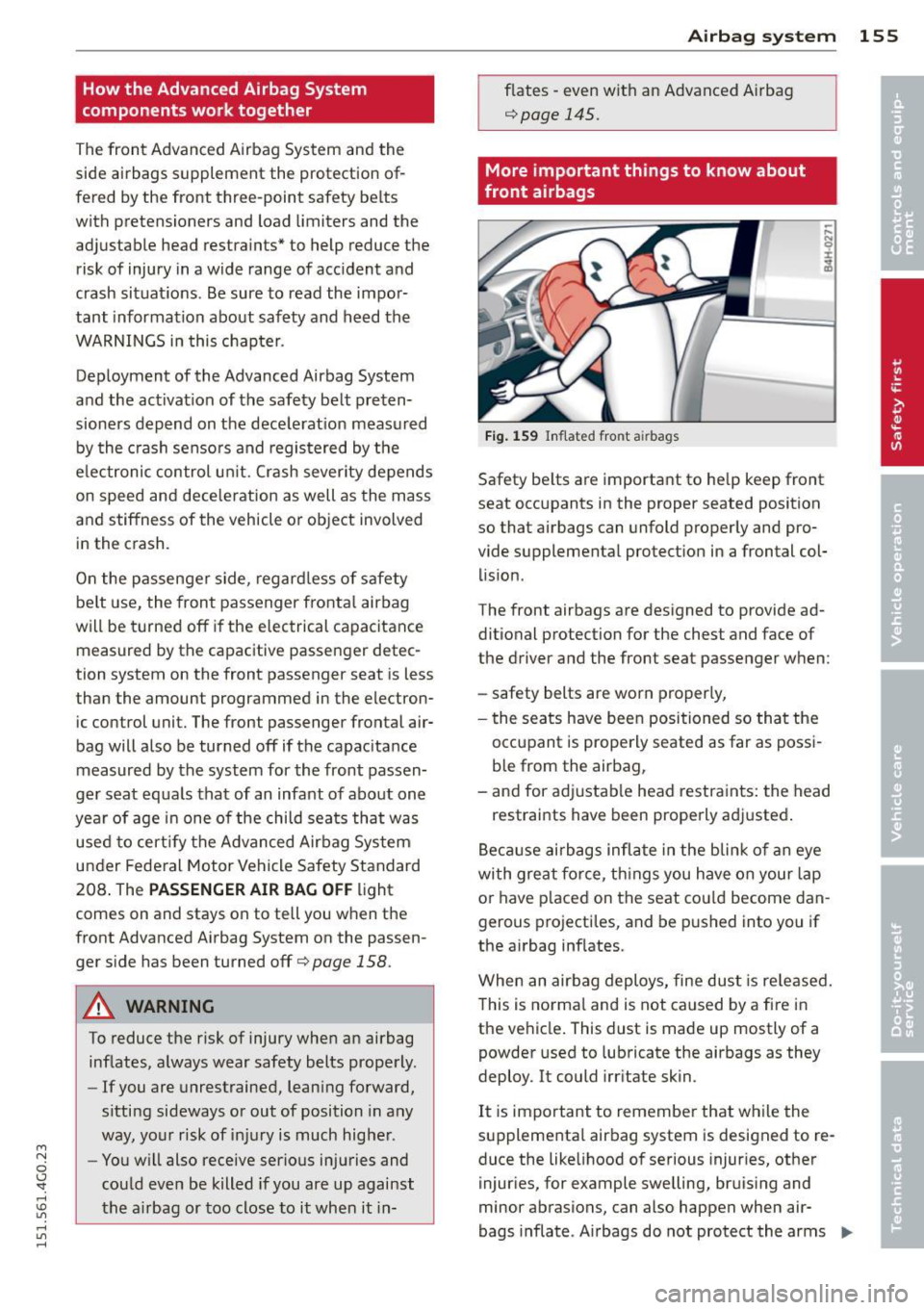
Fi g. 1 59 In flated front airbags
Safety be lts are important to he lp keep front
seat occupants in the proper seated position
so that airbags can unfold properly and pro
vide supplementa l protect ion in a frontal col
li s ion.
The front airbags are des igned to provide ad
ditional protection for the chest and face of
the driver and the front seat passenger when:
- safety belts are worn proper ly,
- t he seats have been positioned so that the
occupant is properly seated as far as poss i
ble from the airbag,
- and for ad justab le head restra ints: the head
restraints have been properly adj usted .
Bec ause airbags infl ate in the bli nk of an eye
wi th great force, th ings you have on your lap
o r have p laced on the seat co uld become dan
gerous projectiles, and be p ushed into you if
the a irbag inf lates.
When an airbag deploys, fine dust is re le ased.
This is norma l and is not caused by a fi re in
the ve hicle . This dust is made up mostly of a
powder used to lubricate the airbags as they
deploy. It could irr itate skin.
It is important to remembe r that wh ile the
supplementa l airbag system is designed to re
duce the like lihood of serious injur ies, other
i njur ies, for example swelling, bruis ing and
minor abrasions, can also happen when air-
bags inflate. A irbags do not protect the arms .,_
Page 158 of 314
156 Airbag sys te m
or the lower parts of the body. Front airbags
supp lement the three-point safety belts only
in some frontal collisions in which the vehicle
dece leration is high enough to deploy the air
bags.
F ront airbag s will not d eplo y:
-if the ignition is switched off when a crash
occurs,
- in side collisions,
- in rear-end collisions,
- in ro llovers,
- when the crash deceleration measured by
the a irbag system is less than the minimum
t h reshold needed for airbag deployment as
registered by the electron ic control uni t.
The f ront pas senger airbag also will not
deploy:
- when the front passenger seat is not occu
pied,
- when the electrical capac itance measured by
the capacitive passenger detect io n sys tem
for the front passenger seat indicates that
the passenger side fronta l airbag must be
switched off by the e lectronic control unit
(the
PA SSENGER AIR BA G OFF light
c> page 158 and how they work comes on
and stays on).
A WARNING
Sitting in the wrong position can increase
the risk of serious injury in crashes.
- To reduce the r isk of injury when the air
bags inflate, the driver and passengers
must always sit in an upright position,
must not lean against or place any part
of the ir body too close to the area where
the a irbags are located.
- Occupants who a re unbelted, out of posi
t ion or too close to the airbag can be se
riously injured by an airbag as it un folds
with great force in the blin k of an eye
i=>page
147.
A WARNING
A child in a rearward-facing child seat in
stalled on the front passenger seat will be
-
seriously injured and can be killed if the
front airbag inflates -even w ith an Ad
vanced Airbag System.
- The inflating airbag will h it the ch ild seat
or infant carrier with great force and will
smash the child seat and child against
the backrest, center armrest, door or
roof.
- Always install rear-fac ing ch ild seats on
the rear seat .
- If you must install a rearward fac ing
child seat on the front passenger seat because of exceptional circumstances
and the
PASSENGER AIR BAG OFF light
does not come on and stay on, immed i
ately insta ll the rear-facing child seat in a
rea r seat ing pos ition and have the airbag
system inspected by yo ur Audi dealer.
A WARNING
c'-----
Objects between you and the airbag will
increase the r isk of injury in a crash by in
terfering with the way the airbag unfolds
or by be ing p ushed into you as the airbag
inflates.
- Never hold things in yo ur hands or on
your lap when the veh icle is in use.
-
- Never transport items on or in the area
of the front passenger seat. Objects
could move into the area of the front air bags during braking or other sudden ma
neuvers and become dangero us projec
tiles that can cause ser ious perso nal in
jury if the a irbags inflate.
- Never p lace or attach accesso ries o r oth
er objects (such as cup holders, te le
p hone bra ckets, large, heavy or bulky ob
jects) on the doors, over o r near the area
marked "AIRBAG" on the steering whee l,
instr ument panel, seat bac krests o r be
tween those areas and yourself. These
objects could ca use in jury in a crash, es
pecially when the airbags inflate.
- Never recline the front passenger 's seat
to transport objects. Items can a lso
move into the a rea of the s ide airbag or
the front airbag during braking or in a
Page 160 of 314
158 Airbag system
& WARNING
An airbag system that is not funct ioning
properly cannot provide supplemental pro
tect ion in a frontal crash.
- If the airbag indicator light
c:> page 19
comes when the vehicle is be ing used,
hav e the system inspected immed iate ly
by you r aut ho rized Aud i dea le r.
It is pos
sible that t he a irbag will inf late when it
i s n ot s upposed to, or w ill not in flate
when it sho uld .
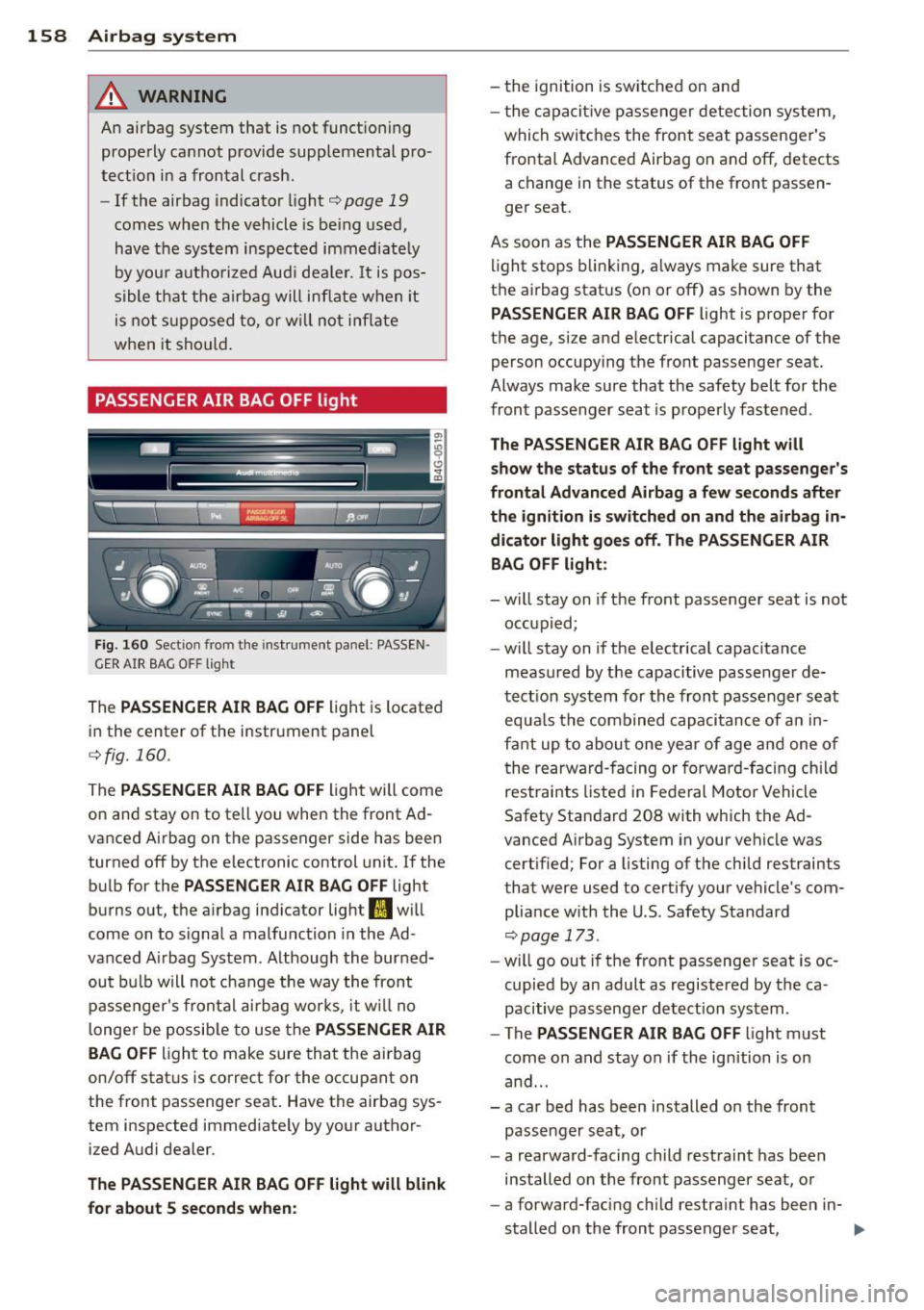
PASSENGER AIR BAG OFF light
Fig . 160 Section from th e in strument panel: PASSEN
GER AIR BAG OFF ligh t
The PASSENGER AIR BAG OFF light is located
i n the center of the instrument panel
c> fig.160 .
The PASSENGER AIR BAG OFF light will come
on and stay on to tell you when the front Ad
vanced A irbag on t he passenger side has been
turned off by the e lectronic control unit. If the
bulb for the
PASSENGER AIR BAG OFF light
bu rns out, the a irbag ind icator light
II w ill
come on to s ignal a malfunction in the Ad
vanced A irbag System . Although the burned
ou t bu lb will no t change the way the front
passenger's frontal ai rbag wor ks, it w ill no
l onger be possib le to use the
PASSENGER AIR
BAG OFF
light to make sure tha t the airbag
on/off stat us is correct for the occupant on
the front passenger seat. Have the airbag sys
tem inspected immed iate ly by your author
ized A udi dealer.
The PASSENGER AIR BAG OFF light will blink
for about S se conds when:
- the ignition is switched on and
- t he capa citi ve passenger detection system,
which switc hes the front sea t passenger's
frontal Advanced Airbag on and off, detects a change in the status of the front passen
ger seat.
As soon as the
PASSENGER AIR BAG OFF
li ght stops b linking, a lways make sure that
the a irbag status (on or off) as shown by the
PASSENGER AIR BAG OF F light is proper for
the age, size and e lectrical capacitance of the
person occupy ing the front passenger seat.
Always make sure that the safety belt for the
front passenger seat is prope rly fastened .
The PASSENGER AIR BAG OFF l ight will
show the status of the front seat passenger 's
frontal Advanced Airbag a few s econds after
th e ignition i s switched on and the airbag in
dicator light goes off. The PASSENGER AIR
BAG OFF light :
- will stay on if the front passenger seat is not
occupied;
- will stay on if the electr ical capacitance
meas ured by the capacitive passenger de
tect ion system for th e front passenger s eat
equa ls the combined capacitance of a n in
fa nt up to abou t one ye ar of age and one o f
the rearward -facing or forw ard-f acin g ch ild
restraints listed i n Fede ral Motor Vehicle
Safety Standard 208 with which the Ad
vanced Airbag System in your vehicle was
cert ified; For a listing of the child restraints
that were used to certify your vehicle's com
pliance w ith the U.S . Safety Standard
c>page 173.
-will go out if the fro nt passenger seat is oc
cupied by an adult as registered by the ca
pacitive passenge r detection system .
- The
PASSENGER AIR BAG OFF light must
come on and stay on if the ignition is on
and . ..
- a car bed has been installed on the front
passe nger seat, or
- a rearward -facing child restraint has been
installed on the front passenger seat, or
- a forward-fac ing ch ild restra int has been in-
stalled on the front passenger seat, ..,_
Page 161 of 314
M N
0 <.J 'SI: ,...., \!) 1.1'1 ,...., 1.1'1 ,....,
-and if the e lectr ica l capacitance registered
on the front passenger seat is equal to or l ess than the combined capacitance of a typ
ical 1 year-old infant and one of the rear
ward-facing or forward-facing child re
stra ints listed in Federal Motor Veh icle Safe
ty Standard 208 w ith which the Advanced
Airbag System in your vehicle was certified.
If the front passenger seat is not occupied,
the front airbag will not deploy, and the
PA S
SENGER AIR B AG OFF
light w ill stay on . Nev
er insta ll a rearward-fac ing ch ild restra int on
the front passenger seat, the safest place for
a child in any kind of child restraint is at one
of the seating positions on the rear seat
¢ page 147, Child restraints on the front seat
- some important things to know
and
¢ page 171, Child Safety.
If the PASSENGER AIR BAG light com es
on ...
If the PASSENGER AIR BAG OFF light comes
on when one of the conditions listed above is met, be sure to check the light regularly to
make certa in that the
PA SSENGER AIR BAG
OFF
light stays on cont inuously whenever the
i gnit io n is on . If the
PASSENGER AIR B AG
OFF
light does not appear on and does not
stay on all the time, stop as soon as it is safe
to do so and
- react ivate the system by turning the ignition
off for more than 4 seconds and then turn
i ng it on again;
- remove and reinstall the child restraint .
Make su re that the child rest raint is prope rly
installed and that the safety be lt fo r the
fron t passenger seat has been corre ct ly
ro uted through the child restraint as descri
bed in the chi ld restraint man ufacturer's in
structions;
- make sure that the convertible locking re
tractor on the safety belt for the front pas
senger seat has been act ivated and that the
safety belt has been pulled tight.
- make sure that no electrica l device (such as
a laptop, CD player, electronic games device,
power inver ter or seat heater for child seats)
is p laced or used on the front passenger
A irbag system 159
seat if the device is connected to the 1 2-volt
socket or the cigarette lighter socket;
- make sure that no seat heater has been ret
rofitted o r otherwise added to the front pas
senger seat;
- make s ure that nothing can interfere with
the safety belt buck les and that they are not
obstructed ;
- make sure that there are no wet objects
(s uch as a wet towe l) and no water or other
liquids on the front passenger seat cushion .
If the PASSENGER AIR BAG light still
doe s not c ome on ...
If the PASSENGER AIR BAG OFF light still
does not come on and does not stay on con
tinuously (when the ignition is switched on),
- take the child rest raint off the front passen -
ger seat and install it proper ly at o ne of the
rear seat positions. Have the airbag system
inspected by your Audi dealer immed iate ly.
- move the child to a rear seat position and
make sure that the child is properly restra in
ed in a ch ild restra int that is appropriate for
its size and age.
Th e PASSENGER AIR BAG light should
NOT come on ...
The PASSENGER AIR BAG OFF light should
NOT come on when the ignit io n is on and an
adult is s itting in a proper seating position on
the front passenge r seat . If the
PASSENGER
AIR BAG OFF
light comes on and stays on o r
flashes fo r about S seconds wh ile d riving, un
der these circumstances, make sure that:
- the adult on the front passenger seat is
prope rly seated on the cente r of the seat
cushion with his o r her back up aga inst the
backrest and the backrest is no t recli ned,
- the adult i s not tak ing weight off the seat by
holding on to the passenger assist handle
above the fron t passenger door or s upport
ing their weight on the armrest,
- the sa fe ty belt is bei ng properly wo rn and
tha t the re is not a lot o f slack in the safety
be lt webbing,
- there are no aftermar ket seat covers or
cushions or other things (s uch as blankets)
IJI>
•
•