flat tire AUDI S6 2016 User Guide
[x] Cancel search | Manufacturer: AUDI, Model Year: 2016, Model line: S6, Model: AUDI S6 2016Pages: 294, PDF Size: 73.88 MB
Page 245 of 294
Wheels
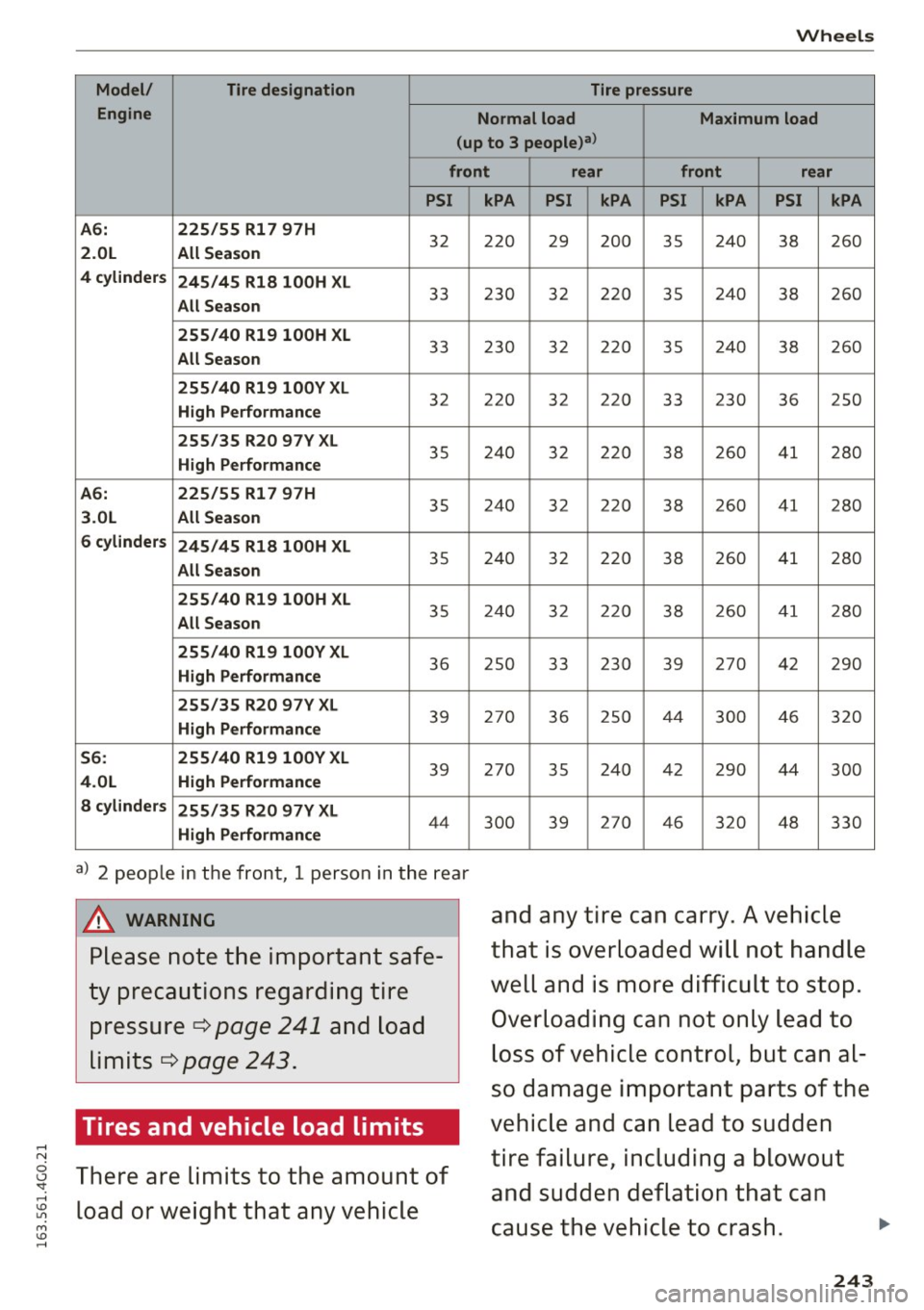
Model/ Tire designation Tire pressure
Engine Normal load Maximum load
(up to 3 people)a)
front rear front rear
PSI
A6: 225/55 Rl 7 97H 2.0L All Season
32
4 cylinders 245/45 Rl8 l00H XL
All Season
33
255/40 Rl9 l00H XL
All Season 33
255/40 Rl9 l00Y XL
High Performance
32
255/35 R20 97V XL
High Performance
35
A6: 225/55 Rl 7 97H
3.0L All Season
35
6 cylinders 245/45 Rl8 l00H XL
All Season
35
255/40 Rl9 l00H XL
All Season
35
255/40 R19 l00Y XL
High Performance
36
255/35 R20 97V XL
High Performance
39
56: 255/40 Rl9 l00Y XL
4.0L High Performance 39
8 cylinders
255/35 R20 97V XL
High Performance
44
a) 2 people in the front, 1 person in the rear
A WARNING
Please note the important safe
ty precautions regarding tire pressure
c::> page 241 and load
limits
c::>page 243.
Tires and vehicle load limits
There are limits to the amount of load or weight that any vehicle
kPA PSI kPA PSI kPA PSI kPA
220 29 200 35 240
38 260
230 32 220 35 240 38 260
230 32 220 35 240 38 260
220 32 220 33 230 36 250
240 32 220 38 260 41 280
240 32 220 38 260
41 280
240 32 220 38 260 41 280
240 32 220 38 260 41 280
250 33 230 39 270 42
290
270 36 250 44
300 46 320
270 35 240 42 290 44 300
300 39 270
46
320 48
330
and any tire can carry. A vehicle
that is overloaded will not handle
well and is more difficult to stop.
Overloading can not only lead to loss of vehicle control, but can al
so damage important parts of the
vehicle and can lead to sudden
tire failure, including a blowout and sudden deflation that can
cause the vehicle to crash.
243
Page 247 of 294
-Tires on a vehicle that has
been overloaded can fail sud
denly, including a blowout and
sudden deflation, causing loss
of control and a crash.
-Always make sure that the to tal load being transported -
including the weight of a trail
er hitch and the tongue
weight of a loaded trailer - does not make the vehicle
heavier than the vehicle's
Gross Vehicle Weight Rating.
Determining correct load
limit
Use the example below to calcu
late the total weight of the pas
sengers and luggage or other
things that you plan to transport so that you can make sure that
your vehicle will not be overload
ed.
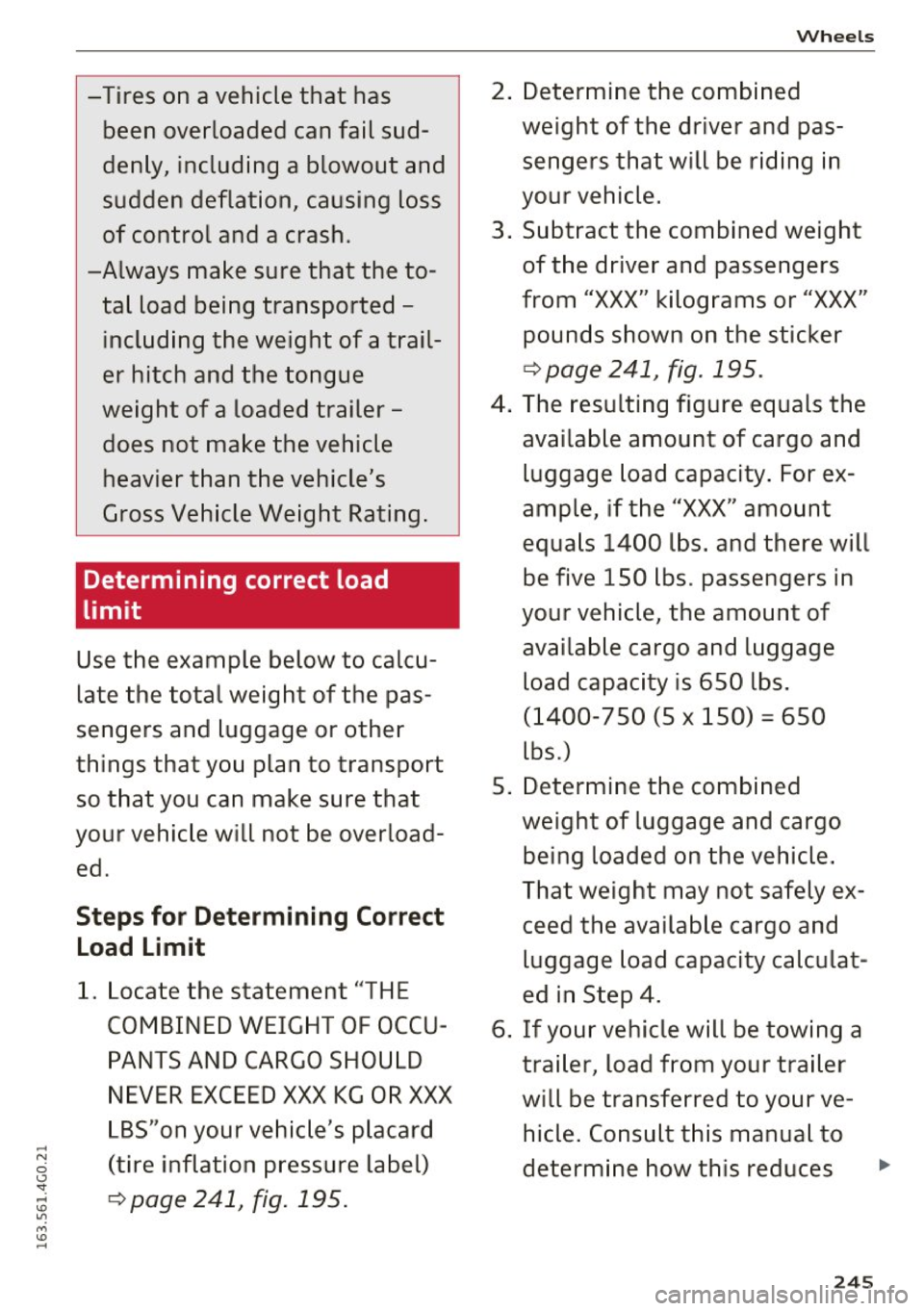
Steps for Determining Correct Load Limit
1. Locate the statement "THE
COMBINED WEIGHT OF OCCU
PANTS AND CARGO SHOULD
NEVER EXCEED XXX KG OR XXX
LBS "on your vehicle's placard
(tire inflation pressure label)
¢ page 241, fig. 195.
Wheels
2. Determine the combined
weight of the driver and pas sengers that will be riding in
your vehicle.
3. Subtract the combined weight of the driver and passengers
from "XXX" kilograms or "XXX"
pounds shown on the sticker
¢ page 241, fig . 195 .
4. The resulting figure equals the
available amount of cargo and
luggage load capacity. For ex
ample, if the "XXX " amount
equals
1400 lbs. and there will
be five
150 lbs . passengers in
your vehicle, the amount of
available cargo and luggage
load capacity is 650 lbs.
(1400-750 (5 X 150) = 650
lbs .)
5. Determine the combined
weight of luggage and cargo
being loaded on the vehicle.
That weight may not safely ex ceed the available cargo and
luggage load capacity calculat
ed in Step 4.
6. If your vehicle will be towing a trailer, load from your trailer
will be transferred to your ve
hicle. Consult this manual to
determine how this reduces ..,
245
Page 249 of 294
~ Check and correc t the seating of the snow
chains if necessary after driving a few feet. Fol
l ow the instructions from the manufacturer .
~ Note the maximum permitted speed when driv
ing with snow chains. Do not exceed 30 mph
(SO km/h) .
Snow chains not only improve the
driving in win
ter road cond itions, but also the
braking.
Use of snow chains is on ly permitted with certain
rim/tire combinations due to tec hnical reasons .
Check with an authorized Audi dealer or author ized repair facility to see if you may use snow
cha ins.
You must remove the chains when driving on roads that are
free of snow. When roads are free
of snow, snow chains can impair handling and
damage the t ires, and the chains w ill quickly be
destroyed .
A WARNING
Using incorrect snow chains o r installing snow
chains incorrect ly can result in loss of vehicle
c ont rol, w hic h in cr eases the risk of a n acci
de nt.
- Snow cha ins can damage the rims/wheel
covers* if the cha ins come into d irect con
tact wi th them . Remove the whee l cove rs*
first. Use coated snow cha ins.
- Usi ng snow chai ns tha t add more than 0.4
i nch (10.5 mm) of he igh t ca n severely dam
age the wheel ho usings and othe r vehicle
components .
- Do no t install and use s now chains if there is
a mal funct ion in the adaptive air suspen
sion*, because the vehicle height wi ll be
very low. If you d rive with snow chains any
way, the wheel ho usings and othe r vehicle
components can be severely damaged.
Low aspect ratio tires
Your Aud i is factory -equipped with low aspect ra
tio tires . These t ires have been tho rough ly tested
and been se lected specifically for yo ur model fo r
Wheel s
their superb performance, road fee l and handling
u nder a variety of driving conditions . Ask your au
thorized Audi dea le r fo r more detai ls.
T he low aspect rat io o f th ese tires is indicated by
a n umeral of
55 or le ss in the tire's size des igna
tion . The numera l represents the ratio of the
t ir e's s idewall height in relation to its tread w idth
expressed in percentage. Conventiona l tires have
a he ight/width ratio of 60 or more.
The performance of low-aspect- ratio tires is par
ticularly sen sitive to imprope r inflat ion pres
s ure. It is the refore important that low aspect
rat io tires are inflated to the speci fied pre ssure
and that the inflation pressure i s regularly
checked and m aintain ed. Tir e pr essures should
be checked at least once a month and always
b efor e a long trip
~ page 241.
What you can do to avo id tire and rim
damage
Low aspect ratio tires can be damaged more eas i
ly by impact w ith po tholes, curbs, gullies or
ridges on the road, particularly if the tire is un
deri nflated.
In orde r to m in imize the occurrence of impact
damage to t he tires of yo ur vehicle , we recom
me nd that you observe the following pre ca u
t ions:
- Always ma intain recommended inflat ion pres
sures. Check yo ur tir e pressure every 2,000
m iles (3 ,00 0 k m) and add air if necessary.
- Dr ive ca refully on roads w it h potholes, deep
gullies o r ridges. T he impact from dr iving
t hrough or over such obstacles can damage
your tires. Impac t wi th a curb may a lso ca use
damage to your tires.
- Afte r any impac t, immed iate ly inspect yo ur
t ires or have them inspected by the nearest au
thorized A udi dealer. Rep lace a damaged tire as
soon as possible.
- Inspect your tires every 2,000 m iles (3,000 km)
for damage and wear. Damage is not a lways
easy to see. Damage can lead to loss of air and
underinflation, wh ich could eventually cause
tire fa ilure. If you believe that a tire may have
been damaged, replace the tire as soon as pos -
sible . .,.
247
Page 250 of 294
Wheels
- These tires may wear more q uickly than othe rs.
- Please also remembe r th at, w hile these tires
deliver responsive handling, they may r ide less
comfortably and make more noise than ot her
cho ices.
Reduced performance in wint er/ cold season
condit ion s
All tires are designed for certain purposes. The low aspect ratio, ultra high pe rformance tires
or iginally insta lled on yo ur vehicle are intended
for maximum d ry and wet road performance and
handling. They are not suitable for cold, snowy or
icy weathe r cond itions .
If you drive under those
circumstances, you should equ ip your ve hicle
with all-season or winter tires, wh ich offe r bette r
traction under those condit ions. We sugges t you
use the recommended snow or all-season tires
specified for yo ur vehicle, or their eq uivalen t.
Refer to¢
page 246 for more deta iled info rma·
tion reg arding w in ter ti res.
Uniform tire quality grading
- Tread we ar
- Tra ction AA A B C
- Temperature ABC
Qua lity grades can be found where app licab le on
the t ire side wall betwee n tread s hou lder and
maximum sect io n w idth ¢
page 231, fig . 193.
For e xample: Tread wear 200 , T raction AA, Tern·
pe rature A.
All passenger car tires must conform to Federa l
Safety Requirements in addition to these grades .
Tread wear
T he
tread wear grade is a compara tive ra ting
b a se d on the wea r rate of the t ire when tes ted
under contro lled conditions on a specified gov ·
ernment test co urse.
F or examp le, a tir e graded 150 would wear one
a nd one ha lf ( 11/2) times as well on t he gove rn·
men t course as a tire graded 100 .
T he rela tive perfo rmance of t ires depends upon
the a ct u a l c ondi tions of their use, howeve r, and
may depart s ignific ant ly from the norm d ue to
248
variations in driving habits, service p ract ices an d
differences in road characteristics and climate.
Traction
The
traction grades , from hig hest to lowest , a re
AA , A, B and
C. Those grades rep resent the tire's
a bility to stop o n wet p avement as measure d un
der controlled conditions on specified govern ·
ment test s urfaces of asphalt an d concrete. A tire
marked C may have poor traction perfo rmance
¢ ,& .
Temperature
The
temp eratur e grades are A ( the highest), B,
and C, representing the tire 's resistance to the
generatio n of heat and its ability to dissipate
heat when tested under contro lled conditions on
a specified indoor laboratory test wheel.
Sustained high temperature can cause the mate·
rial of the tire to degenerate and reduce tire life,
and excessive temperature can lead to s udden
tire failure¢ ,&.
The grade C cor responds to a level of perform ·
ance which all passenger car tires must meet un·
der the Federal Motor Vehicle Safety Standard
No . 109 . Grades Band A represent hig her levels
of performance on the laboratory test wheel than
t h e m inim um requ ired by law .
A WARNING
-
The tract io n grade assigned to this t ire is
based on st raig ht-a head braking tr action
tes ts, and do es not in clude acceler ation, cor·
n erin g, hy droplaning or pe ak traction ch arac
teristics.
A WARNING
T he tem pera ture grade fo r thi s tire is esta b·
lishe d for a tire that is properly inflated and
not ove rloaded . Excessive speed, underinfla ·
tion, o r excessive load ing, either separately or
in comb inat ion, can cause heat bu ildup and
-
possible tire failure . ..,
Page 251 of 294
.... N
0 CJ '
_& WARNING
Temperature grades apply to tires that are properly inflated and not over or underinflat
ed .
Tire pressure monitoring
system
CD General notes
Each t ire, including the spare (if provided),
should be checked monthly when cold and inflat
ed to the inflation pressure recommended by the
veh icle manufac turer on the vehicle placard or
tire inflation pressure label. (If your vehicle has
tires of a different size than the size indicated on
the vehicle placard or tire inf lation pressure la
be l, you should determine the proper tire infla
tion pressure for those tires).
As an added safety feature, your veh icle has been
equipped with a tire pressure monitoring system
(TPMS) that illuminates a low tire press ure te ll
tale when one or more of your tires is significant l y under-inflated. Accordingly, when the low tire
pressure tellta le illuminates, you should stop and
check your tires as soon as possible, and inflate
them to the proper pressure. Driving on a s ignifi
cantly under-inflated tire causes the tire to over
heat and can lead to t ire failure. Unde r-inflation
also reduces fuel efficiency and tire tread life,
and may affect the vehicle's handling and stop
ping ability .
Please note that the TPMS is not a substitute for
proper tire maintenance, and i t is the driver's re
sponsib ility to ma inta in correct tire pressure,
even if under -inflation has not reached the level
to trigger illum inat ion of the TPMS low tire pres
sure telltale.
Your veh icle has also bee n eq uipp ed w ith a TPMS
mal function indicator to indicate when the sys
tem is not operating properly. The TPMS mal
function indicator is combined w ith the low tire
pressure tellta le. When the system detects a
malfunction, the telltale will flash for approxi
mately one minute and then remain cont inuously
illuminated . This sequence will continue upon
Wheels
subsequent vehicle start-ups as long as the mal
function exists .
When the malfunction indicator is illuminated ,
the system may not be able to detect or signal
low tire pressure as intended. TPMS malfunctions
may occur for a variety of reasons, including the
i nsta llation of replacement or alternate tires or
whee ls on the vehicle that prevent the TPMS
from functioning properly. Always check the
TPMS ma lfunction telltale after replac ing one or
more tires or wheels on your vehicle to ensure
that the replacement or a lternate tires and
whee ls allow the TPMS to continue to function
properly.
If the Tire Pressure Monitoring System
indicator appears
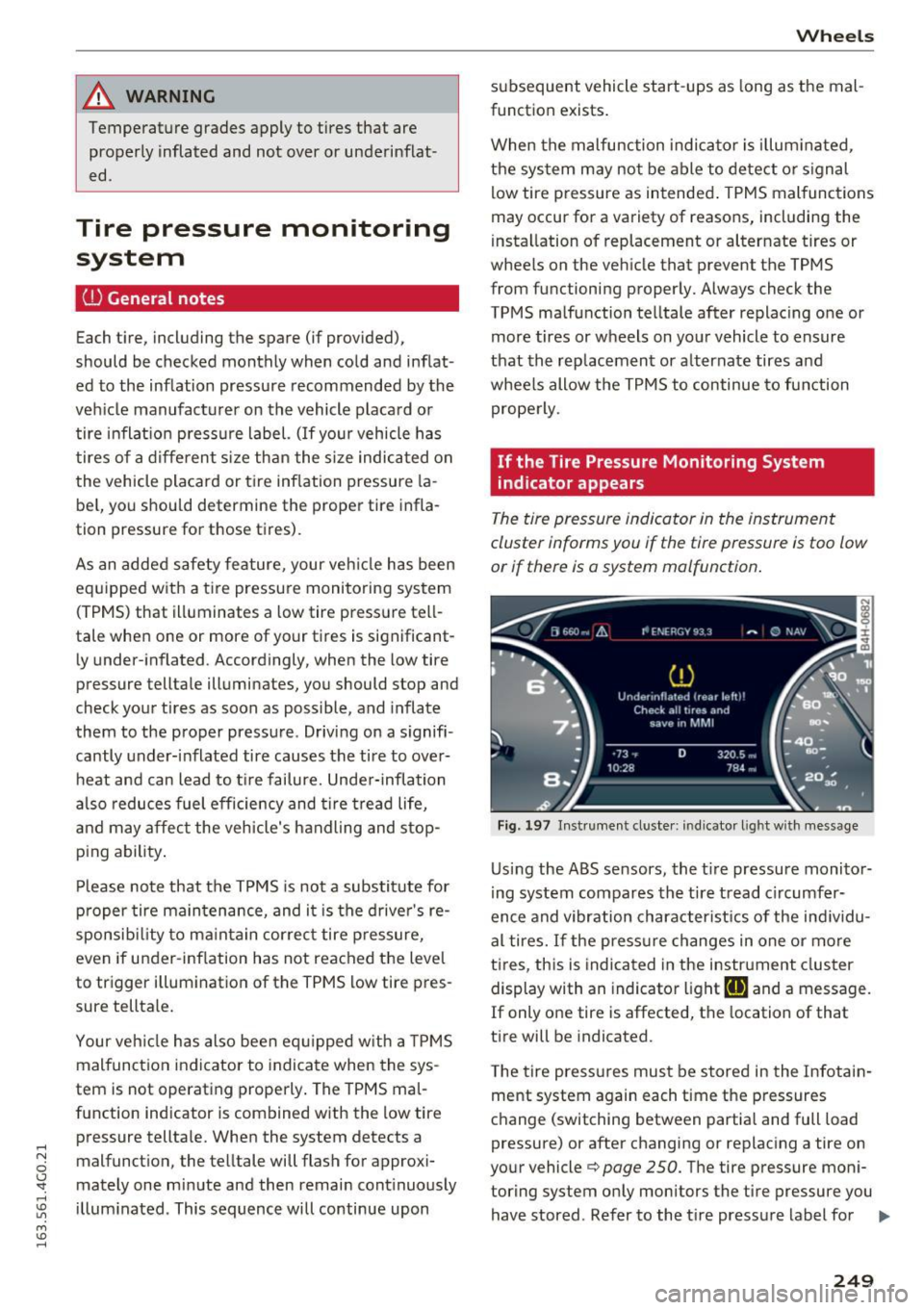
The tire pressure indicator in the instrument
cluster informs you if the tire pressure is too low
or if there is a system mo/function .
Fig. 197 Instrume nt cluste r: indicator light with message
Us ing the ABS sensors, the tir e pressure monitor
ing system compares the tire tread circumfer
ence and vibration characteristics of the individu
al tires. If the press ure changes in one or more
tires , this is indicated in the instrument cluster
display with an indicator light
ti] and a message.
If only one tire is affected, the location of that
tire will be indicated.
T he tire press ures must be stored in the Infotain
ment system again each time the pressures
change (switching between partial and full load
pressure) or after changing or replacing a tire on
your vehicle¢
page 250. The tire pressure moni
toring system only monitors the tire pressure you have stored. Refer to the tire pressure label for ..,.
249
Page 252 of 294
Wheels
the recommended tire pressure for your vehicle
¢ page 241, fig. 196.
Tire tread circumference and vibration character
istics can change and cause a tire pressure warn
ing if:
- the tire pressure in one or more tires is too low.
- the tire has structural damage .
- the tire was replaced or the tire pressure was
changed and it was not stored¢
page 250.
-the spare tire* is installed.
Indicator lights
IE Loss of pressure in at least one tire¢&. .
Check the tires and replace or repair if necessary.
Check/correct the pressures of all four tires and
store the pressure again in the Infotainment sys
tem ¢
page 250 .
mm (Tire Pressure Monitoring System) Tire
pressure: System malfunction!.
Ifmm appears
after switching the ignition on or while driving
and the
IE indicator light in the instrument clus
ter blinks for approximately one minute and then
stays on , there is system malfunction . Try to
store the correct tire pressures¢
page 250. If
the indicator light does turn off or turns on again
after a short period of time, drive to your author
ized Audi dealer or qualified repair facility imme
diate ly to have the malfunction corrected.
A WARNING
- If the ti re pressure indicator appears in the
display, reduce your speed immediately and
avoid any hard steering or braking maneu
vers. Stop as soon as possible and check the
t ir es and their pressure .
- The driver is responsible for maintaining the
correct tire pressure. You must check the
t ir e pressure regularly.
- Under certain conditions (such as a sporty
dr iv ing style, winter cond itions or unpaved
roads), the tire pressure mon itoring system
indicator may be delayed.
- Do not use run-flat tires on your vehicle. Us
ing them when not permitted can lead to
vehicle damage or accidents.
250
(D Tips
-The tire pressure monitoring system can al
so stop working when there is an ESC mal
function.
- Using snow chains may result in a system
malfunction.
- The tires with the identification "AO" or
"RO" ¢
page 2 38 have been matched with
your Audi tire pressure monitoring system.
We recommend that you use these tires.
Storing tire pressures
If the tire pressure changes or a tire is replaced,
it mus t be confirmed in the Infotainmen t sys
tem.
... Make sure before storing that the tire pressures
of all four tires meet the specified values and
are adapted to the load ¢
page 241.
... Switch the ignition on .
... Select: the
I CARI function button > (Car)* Sys
tems
contro l button > Servicing & checks >
Tire pressure monitoring > Store tire pressures
> Yes, store now.
(D Tips
Do not sto re the tire pressures if snow chains
a re installed.
Page 255 of 294
-The spare tire is intended on ly for tempora
ry and short-term use. It shou ld be replaced
as soon as possible with the normal wheel
and t ire.
- After mounting the compact spare tire, the
tire pressure must be checked as soon as
poss ible. The t ire pressure of the compact
spare tire m ust be 4.2 bar; otherwise, you
risk having an accident.
- Do not drive faster than SO mph (80 km/h).
You risk hav ing an accident .
-Avoid full-throttle accelerat ion, heavy brak
ing, and fast cornering . You risk having an
acc ident.
- Never drive us ing more than one spare
wheel and tire . You risk having an acc ident.
- Normal summer or winter tires must not be
mounted on the compact spare wheel rim .
- For technical reasons, the use of tire chains
on the spare tire is not perm itted. If it is
necessary to drive with t ire chains, the spare
wheel m ust be mounted on the front axle i n
the even t of a flat in a rea r tire. The new ly
avail able front wheel m ust then be insta lled
in place of the rear wheel with the flat tire .
Installing the tire chain before mounting
the wheel and tire is recommended .
- Loose items in the passenger compartment
can cause ser ious personal injury during
hard braking or in an acc ident. Never store
the inflatable spare t ire or jack and too ls in
the passenger compartment.
Replacing wheels
Before changing a wheel
Observe the following precautions for your own
and your passenger's safety when changing a
wheel.
• After you experience a tire failure , pull the car
well away from moving t raff ic and try to reach
level ground before you stop¢ A-
• All passengers sho uld leave the car and move
to a safe location (fo r instance, be hind the
guardrail) ¢
A.
• Engage the parking b rake to prevent yo ur vehi
cle from roll ing unintentionally ¢
A-
Em ergenc y ass is tanc e
• Move selecto r lever t o po sit ion P ¢ A .
• If you are towing a trai ler, unhitch the trailer
from yo ur vehicle .
• Take the
jack and the spare tire out of the lug
gage compartment
¢page 251, ¢page 252.
A WARNING
You or your passengers could be injured while
changing a whee l if you do no t follow these
safety precaut ions:
- If you have a flat tire, move a safe distance
off the road. Turn off the eng ine, turn the
emergency f lashers on a nd use other wa rn
ing devices to alert other motorists.
- Make sure that passenge rs wait i n a safe
p la ce away from the vehicle and well away
fr om the road and t raff ic.
- To help preven t the veh icle from moving
suddenly and possib ly slipping off the ja ck,
always fu lly set the park ing brake and bloc k
the wheel diagonally opposite the wheel be ing changed. When one front whee l is lifted
off the ground, placing the Automatic
Transmission in P (Park) wi ll
not prevent the
veh icle from moving.
- Before you change a wheel, be sure the
ground is level and firm. If necessary, use a
sturdy board under the jack.
- Always store the vehicle tool kit, the jack
and the replaced tire in the luggage com
partment
¢ page 131.
(!) Tips
Before changing the wheel, you must activate
the jacking mode, so that the automat ic con
tro ls for the Adaptive Air Suspension* do not
make it more difficult to lift the vehicle with
the jack ¢
page 255.
Changing a wheel
When you change a wheel , follow the sequence
described below step -by -step and in exactly that
order .
l. Activate the vehicle jack mode*¢ page 255. .,.
253
Page 256 of 294
Emergency assistance
2. Remove the decorative wheel cover*. For
mo re deta ils see also
c::> page 254, Decora
tiv e wheel cov ers
or c::> page 2 54, Wheels
with wheel bolt caps.
3. Loosen the wheel bolts c::> page 255 .
4. Locate the proper mounting point for the
jack and align the jack below tha t poi nt
~ pag e 255 .
5. Raise the car w ith the ja ck¢ page 255 .
6. Remove t he wheel with the flat tire an d t hen
install
the spare ¢ page 257.
7. Tighten all wheel bo lts light ly .
8. Lower the veh icle with the jack .
9. Use the whee l bolt wrench and firmly tighten
a ll whee l bolts ¢
page 255 .
10. Replace the decorative wheel cover* .
11. Deactivate the vehicle jack mode * in the
M MI: !CARI function button> ( Car )* systems
control b utton > Servicing & checks > Air
susp.: jack mode > Off .
The vehicle jack mode * switches off automatical
ly a t sp eed s above
6 mph (10 km/h) .
_&. WARNING
Always read and fo llow all WARNIN GS and in
f o rm atio n ¢
A in Raisi ng the vehicle on
p age 256
an d ¢page 258.
After changing a wheel
A wheel change is not complete without th e do
ing the following.
• Always store the veh icle tool kit, the jack* and
the replaced t ire in the luggage compartment
¢ page 131.
• Che ck the tire pressure on the sp are whee l im
med iate ly after mo unt ing it.
• As soon as possible, have t he
tightening tor
ques
on all whee l bo lts checked with a torque
wrench . The correct tightening torque is
90 ft
lb
(120 N m).
• Have the flat tire
replaced as soon as possible.
(D Tips
- If you notice t hat the w hee l bolts are cor
r oded and diffic ult to t urn w hile cha nging a
254
tir e, they s hou ld be re pla ce d b efo re yo u
check the t ightening torque .
- Drive at red uce d spee d unt il yo u ha ve the
t ightenin g torques checked .
- Aft er ch angin g a whee l, the tire pres sure i n
all fou r tires must be che cke d/cor rec ted and
t h e tire pressure mo nito ring ind icator must
be stored in the
MM I ¢ page 25 0.
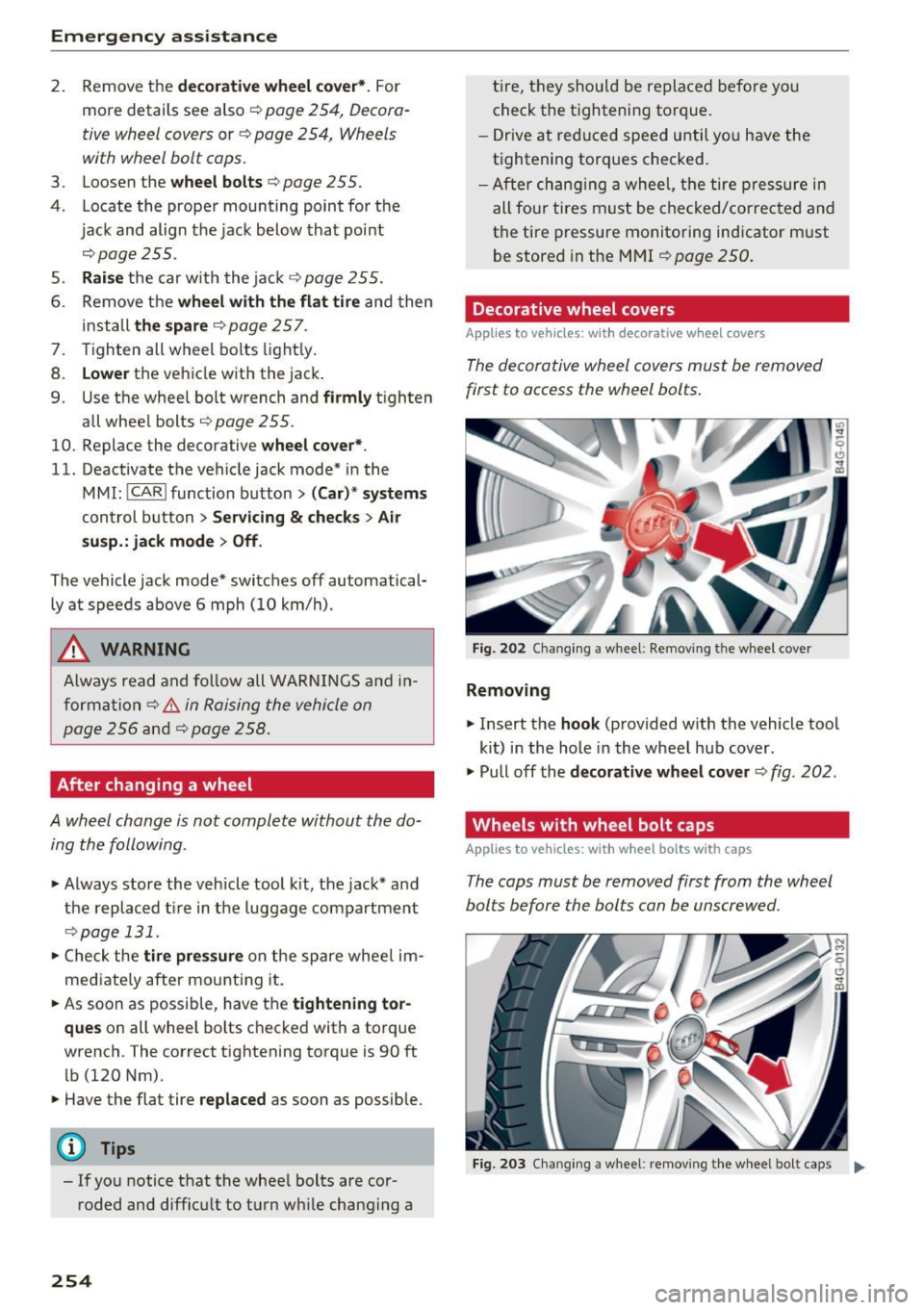
, Decorative wheel covers
Applies to vehicles: with decorative w heel covers
The decorative wheel co vers must be removed
first to access the wheel bolts .
Fig. 202 Cha ng ing a w heel : Re mov ing t he w heel cover
Removing
• Insert the hook (p rovided w ith the vehicle tool
kit) i n the hole in the wheel hub cover.
• Pull off th e
decorative wheel cover ¢ fig. 202 .
Wheels with wheel bolt caps
Applies to vehicles: wit h wheel bolts with caps
The caps must be removed first from the wheel
bolts before the bolts can b e unscrewed .
Fig. 203 Cha ngi ng a w hee l: re m ovin g the w heel bo lt ca ps ..,
Page 258 of 294
Emerg ency assis ta nce
button > Se rvicing & c heck s > Air sus p.: jac k
m od e> On .
.. Engage the pa rking b rake to prevent your vehi
cle from rolling unintentionally.
.. Move the
se lect or l eve r to pos it ion P .
.. Find the mark ing (impr int) on the sill that is
nearest the whee l that will be changed
¢ fig . 205 . Behind the marking, there is a lift
ing p oint on the sill for the vehicle jack.
.,. Vehicles with a sill: remove the cover from the
si ll before lifting the vehicle with a vehicle jack
¢ page 256.
.. Turn the vehi cle j ack located under the lift ing
point on the sill to ra ise the jack until its arm@
c> fig. 206 is located under the designated plas
tic mount
c> .&, c>(D.
.. Al ign the jack so that its arm@ c> fig. 206 en
gages in the des ignated lift ing po int i n the door
si ll and the movable base @ lies flat on the
ground. The base @ must be
vertical under the
l ift ing point @.
.. Wind the jack up further unt il the flat tire
comes off the ground
¢ .&, .
Position the veh icle jack on ly under the designat
ed lifting points on the sill
c> fig. 205 . There is ex
actly
one locat ion for each wheel. The jack must
not be positioned at any other location
c> .&. c>0 .
An un sta ble s urface under the jack can cause the
ve hicle to slip off the jack . Always provide a firm
base for the jack on the ground. If necessa ry
p lace a sturdy board or similar support under th e
jack . On
h ar d, s lippe ry surface s (such as tiles)
use a rubber mat or similar to prevent the jack
from slipping¢ &.
A WARNING
-
- You or your passengers could be injured
wh ile changing a wheel if you do not follow
these safety precaut ions:
- Position the vehicle jack only at the desig
nated lifting points and align the jack.
Otherw ise, the vehicle jack cou ld slip and
cause an injury if it does not have suffi
cient hold on the vehicle.
- A soft or unstable surface under the jack
may cause the vehicle to slip off the jack.
Always provide a firm base for the jack on
256
the ground. If necessary, use a sturdy board under the jack .
- On hard, slippery surface (such as tiles)
use a rubber mat or similar to prevent the
jack from slipping .
- To help prevent injury to yourself and your
passengers:
- Do not raise the veh icle until you are sure
the jack is securely engaged .
- Passengers must not remain in the vehicle
when it is jacked up.
- Make su re that passengers wait in a safe
place away from the vehicle and well away
from the road and traffic.
- Make sure jack position is correct, adjust
as necessary and then continue to ra ise
the jack .
- Changes in temperatu re or load can affect
the height of the vehicle.
(D Note
Do not lift the ve hicle by the si ll. Pos ition the
vehicle jack only at the des ignated l ift ing
po ints on the sill. Othe rwise, your veh icle will
be damaged.
(j) Tips
The vehicle jack mode* switches off automati
cally at speeds above 6 mph (10 km/h) .
Removing and installing the sill extension
cover
Appl ies to vehicles: with sill extension
F ig. 207 S ill: r em ovin g the cover
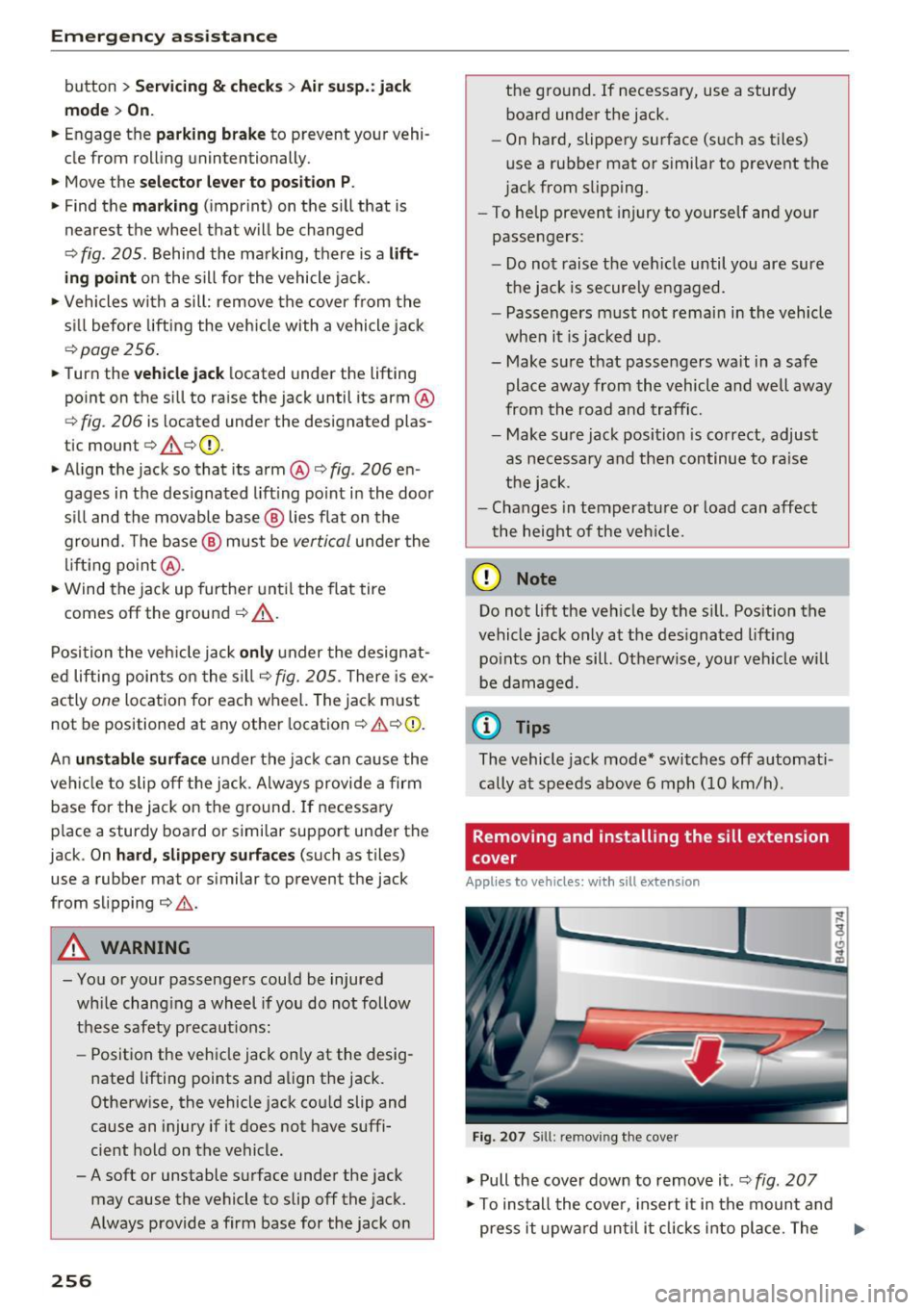
.,. Pull the cover down to remove it . c> fig. 207
.,. To install the cove r, insert it in the mount and
press it upwa rd until it clicks into place . The .,..
Page 260 of 294
Emergency assistance
Tires with unidirectional tread design
Tires with unidirectional tread design must be
mounted with their tread pattern pointed in the
right direction .
Using a spare tire with a tread pattern
intended for use in a specific direction
When using a spare ti re with a tread pa tte rn in
tended fo r use in a spec ific d irection, p lease note
the following:
- The direct io n of rotat io n is marked by an arrow
o n the side of the tire.
- If the spare tire has to be installed in the incor
rect d irection, use the spare tire only tempora
rily s ince the tire w ill not be ab le to achieve its
opt imum pe rformance cha racter istics with re
gard to aq uaplaning, noise and we ar.
- We recommend that you pay particular atten
t ion to this fac t during wet weathe r and t hat
yo u ad just yo ur speed to m atch road condi
t ions.
- R eplace t he flat t ire wi th a new one a nd have it
i nsta lled on yo ur vehicle as soon as pos sible to
res to re t he handling advantages of a unidirec
tiona l tire .
Notes on wheel changing
Please read the information q page 238, New
tires or wheels
if you are going to use a spare tire
which is different from the tires on your vehicle.
After you change a tire:
- Check the tire pressure on the spare immedi
ately after installation .
- Have the wheel bolt tightening torque
che cked with a torque wrench as s oon as pos
sible by your authorized Audi dealer or a
qualified service station.
- With steel and alloy wheel rims , the wheel
bolts are correctly tightened at a torque of 90
ft lb
(120 Nm) .
- If you notice that the wheel bolt s are corroded
and difficult to turn while changing a tire ,
they should be replaced before you check the
tightening torque.
258
- Replace the flat tire with a new one and have
it installed on your vehicle as soon as possi
ble. Remount the wheel cover.
Until then , drive with extra care and at reduced
speeds.
_& WARNING
- If you are going to equip yo ur vehicle with
tires or r ims which differ from those which
were facto ry installed, then be sure to read
the information
q page 238, New tires or
wheels.
- Always make sure the damaged wheel or
eve n a flat tire and the jack and tool kit are
properly secured in the l uggage compart
men t and a re not loose in the passenger
compa rtme nt.
- In an accident or sudde n maneuver they
could fly forward, i njuring anyone i n the ve
hicle .
- Always s to re damaged wheel, jack and tools
secure ly in the luggage comp artment . Oth
e rwi se, in an a cci den t or sudden m aneuve r
t hey could
fly forwar d, causing injury to pas
sen gers in the veh icle.
-