instrument panel AUDI S6 2016 User Guide
[x] Cancel search | Manufacturer: AUDI, Model Year: 2016, Model line: S6, Model: AUDI S6 2016Pages: 294, PDF Size: 73.88 MB
Page 145 of 294
also not inflate in side or rear collisions, or in
ro ll-overs.
A lwa ys rememb er: Airbags will deploy only o nce,
and on ly in certain kinds of coll is ions. Your safety
be lts are always there to offer protection in those
situations in which airbags are not supposed to
deploy, or when they have a lready deployed; for
examp le, when your vehicle str ikes or is struck by
another vehicle after the first collis ion.
This is just one of the reasons why an airbag is a
supp lementary restraint and is not a substitute
for a safety belt. The airbag system works most effect ively when used with the safety belts.
Therefore, always properly wear your safety belts
r:::;,page 134.
A WARNING
Sitting too close to the steer ing whee l or in
st rument panel will decrease the effect ive
ness of the airbags and will inc rease the risk
o f persona l injury in a co llision.
- Never sit closer than 10 inches (25 cm) to
the steering wheel or instrument panel.
- If you cannot sit mo re than 10 inches
( 2 5 cm) from the steering wheel, inves ti
gate whethe r adaptive equipment may be
available to help you reach the pedals and
increase your seating distance from the
steering wheel.
- All veh icle occupants and especially children
must be restrained properly whenever riding
in a vehicle. An unrestrained or improperly
restra ined child could be injured by stri king
the inte rior or by being ejected from the ve
hicle d uring a sudden maneuver or impact.
An unrestrained or imp roperly restrained
child is also at greate r risk of inju ry or death
through contact with an inflating airbag .
-If you are unrest rained, leaning fo rwa rd, s it
t ing s ideways or o ut of pos ition in any way,
yo ur risk of in jury is mu ch h igher.
- Yo u will also receive serious injur ies and
c ou ld even be killed if you are up ag ainst the
airbag or too close to it w hen it inf lates -
even with an Advanced Ai rbag.
-
Airb ag sys tem
-To reduce the r is k of injury when an airbag
inflates, always wear sa fety belts prope rly
r:::;, page 137, Safety belts.
-Always make certain that children age 12 or
younger always ride in the rear seat. If chil
dren are not properly restrained, they may be severely injured or killed when an airbag
inflates.
- Never let children r ide unrestrained or im
p roperly restrained in the vehicle. Ad just the
front seats properly.
- Never ride with the back rest recl ined .
- Always sit as far as possible from the steer-
ing wheel or the instrument panel
r:::;, page 126.
-Always sit upright with your back against
the backrest of your seat .
- Never p lace your feet on the instrument
panel or on t he seat. Always keep both feet
on the floor in front of the seat to help pre
vent ser ious injuries to the legs and hips if
the airbag inflates.
- Never recl ine the front passenger's seat to
transpo rt objects , Items can also mo ve in to
the area of the s ide a irbag or the front air
b ag d uring braking o r in a sudden maneu
ver. Obje cts ne ar the airbags can be come
p roject iles and cause injury when an airbag
inflates .
A WARNING ,.___ -
Airbags that have deployed in a crash m ust be
replaced.
- Use on ly original equipment airbags ap
proved by A udi and installed by a t rained
technician who has the necessary tools and
d iagnostic equipment to properly replace
any airbag in yo ur vehicle and assure system
effect iveness in a crash .
- Never permit salvaged or recycled airbags to
be installed in your vehicle.
Child restraints on the front seat - some
important things to know
.,. Be s ure to read the impo rtan t in format ion and
heed the WARN INGS for important deta ils
143
Page 148 of 294
Airbag syste m
-Always make sure that there is nothing on
the front passenger seat that w ill cause the
capacitive passenger detection system in
the seat to signal to the Airbag System that
the seat is occupied by a person when it is
not, or to signa l that it is occupied by some
one who is heav ier than the person actually
sitting on the seat. The p resence of addi
tional objects could cause the passenger
front airbag to be turned on when it shou ld
be off, or could cause the airbag to work in a
way that is different from the way it would
have worked without the ob ject on the seat.
Front airbags
Description of front airbags
The airbag system can provide supplemental
protection to properly restrained front seat occu
pants.
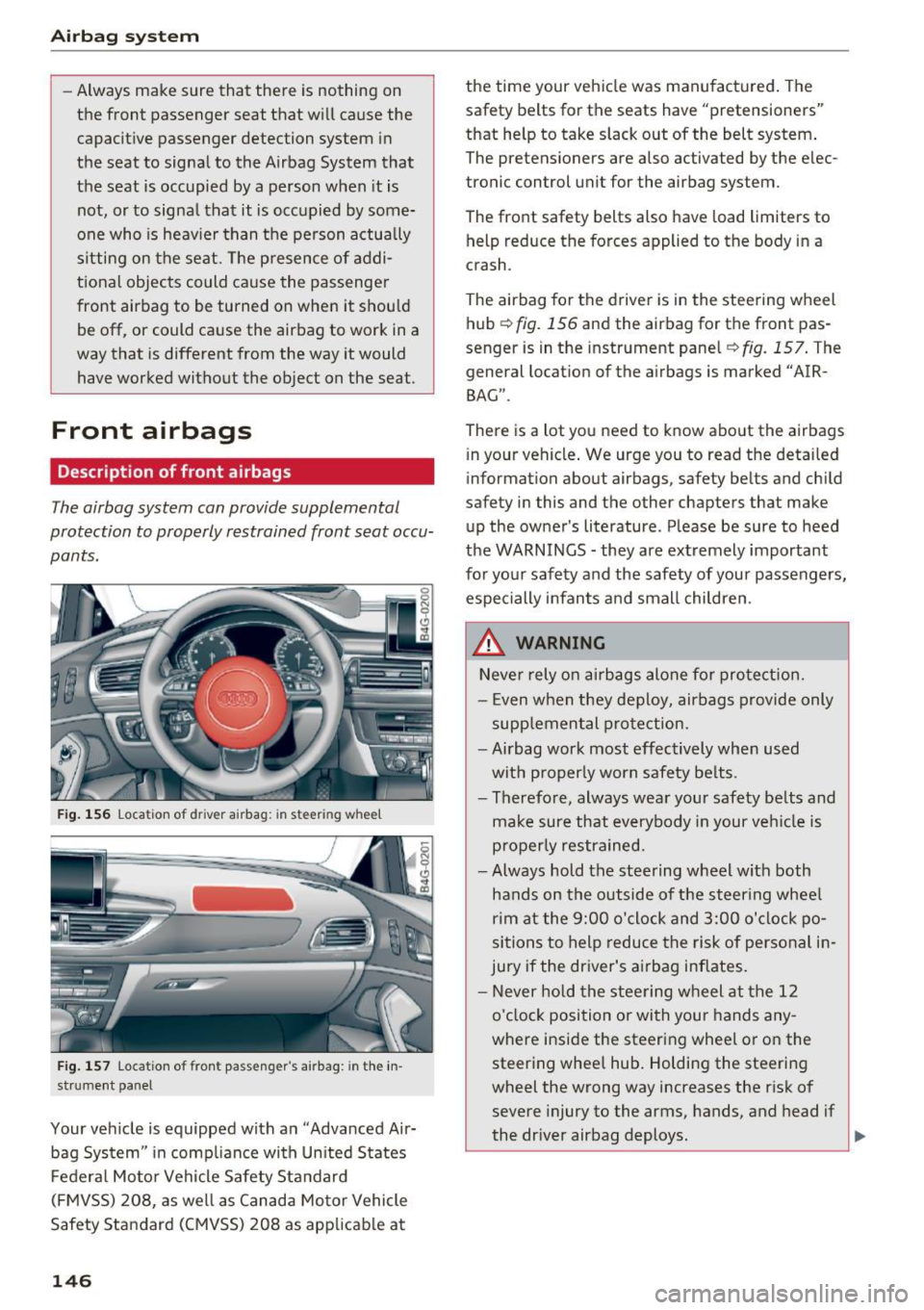
F ig . 1 56 location of driver airbag: in steering w hee l
Fig . 1 57 Location of fro nt passenger's airbag: in the in
st rument panel
Your veh icle is equipped with an "Advanced Air
bag System" in comp liance with Un ited States
Federa l Moto r Vehicle Safety Standard
(FMVSS) 208, as well as Canada Motor Vehicle
Safety Sta ndard (CMVSS) 208 as app licab le at
146
the time your vehicle was manufactured . T he
safety belts for the seats have "pretensioners"
that he lp to take s lack out of the belt system .
The pretensioners are also activated by the elec
tronic control unit for the airbag system.
The front safety belts also have load limiters to help reduce the forces applied to the body in a
crash.
The airbag for the driver is in the stee ring wheel
hub ~
fig. 156 and the airbag for the front pas
senger is in the instrument pane l
~fig. 157 . The
general locat ion of the airbags is marked "AIR
BAG" .
There is a lot you need to know abo ut the airbags
i n your vehicle . We urge you to read the detai led
information about airbags , safety belts and ch ild
safety in this and the other chapters that make
up the ow ner's literature . Please be sure to heed
the WARNINGS -they are extremely important
fo r your safety and the safety of your passengers,
especially i nfants and small children .
.&, WARNING
-
Never rely on a irbags alone for prote ct io n.
- Even when they deploy, airbags p rovide only
supp lemental protection.
- Airbag work most effec tively when used
wit h properly worn safety be lts .
- Therefo re, always wear your safety be lts and
make sure that everybody in your veh icle is
properly restrained.
- Always hold the steering wheel w ith both
hands on the outside o f the steer ing whee l
rim at the 9:00 o'clock and 3:00 o'clock po
si tions to help reduce the risk of personal i n
jury if the driver's a irbag inflates.
- Never hold the stee ring wheel at the 12
o 'clock posi tion or with your hands any
where inside the steering wheel o r on the
steer ing whee l hub. Holding the steeri ng
wheel the wrong way increases the r isk of
severe injury to the arms, hands, and head if
the driver airbag deploys. ..,_
Page 149 of 294
A WARNING
Objects between you and the airbag will in
crease the risk of injury in a crash by interfer
ing with the way the airbag unfolds and/or by
being pushed into you as the airbag inflates.
-Always make sure nothing is in the front air -
bag deployment zone that could be struck
by the airbag when it inflates .
- Objects in the zone of a deploying airbag
can become projectiles when the airbag de
ploys and cause serious personal injury.
- Never hold things in your hands or on your
lap when the vehicle is in use .
-
-Never place accessories or other objects
(such as cup holders, telephone brackets,
note pads, navigation systems, or things
that are large, heavy, or bulky) on the doors;
never attach then to the doors or the wind
shield; never place them over or near or at
tach them to the area marked ,,AIRBAG" on
the steering wheel, instrument panel or the
seat backrests; never place them between these areas and you or any other person in
the vehicle .
- Never attach objects to the windshield
above the passenger front airbag, such as
accessory GPS navigation units or music players. Such objects could cause serious in
jury in a collision, especially when the air bags inflate .
- Never recline the front passenger seat to
transport objects. Items can also move into
the deployment area of the side airbags or
the front airbag during breaking or in a sud den maneuver. Objects near the airbags can
fly dangerously through the passenger com
partment and cause injury , particularly
when the seat is reclined and the airbags in
flate.
A WARNING
A person on the front passenger seat, espe cially infants and small children, will receive
serious injuries and can even be killed by be
ing too close to the airbag when it inflates.
- Although the Advanced Airbag System in
your vehicle is designed to turn off the front
Airbag system
passenger airbag if an infant or a small child
is on the front passenger seat, nobody can
absolutely guarantee that deployment un
der these special conditions is impossible in
all conceivable situations that may happen
during the useful life of your vehicle .
- The Advanced Airbag System can deploy in accordance with the .,low risk" option for 3-
and 6-year-old children under the U.S. Fed
eral Standard if a child with electrical capac
itance greater than the combined capaci
tance of a typical one-year old infant re
strained in one of the forward facing or rear
ward-facing child seats with which your ve
hicle was certified is on the front passenger
seat and the other conditions for airbag de
ployment are met .
- Accident statistics have shown that children
are generally safer in the rear seat area than
in the front seating position.
- For their own safety, all children, especially
12 years and younger, should always ride in
the back properly restrained for their age
and size.
Advanced front airbag system
Your vehicle is equipped with a front Advanced
Airbag System in compliance with United States
Federal Motor Vehicle Safety Standard 208 , as
well as Canada Motor Vehicle Safety Standard (CMVSS) 208 as applicable at the time your vehi
cle was manufactured.
The front Advanced Airbag System supplements
the safety belts to provide additional protection
for the driver's and front passenger 's heads and
upper bodies in frontal crashes. The airbags in
flate only in frontal impacts when the vehicle de
celeration is high enough.
The front Advanced Airbag System for the front seat occupants is not a substitute for your safety
belts. Rather, it is part of the overall occupant re
straint system in your vehicle. Always remember
that the airbag system can only help to protect
you, if you are sitting upright, wearing your safe
ty belt and wearing it properly . This is why you
and your passengers must always be properly ..,.
147
Page 150 of 294
Airbag syste m
restrained, not just because the law requires you
to be.
The Advanced Airbag System in your veh icle has
been cert ified to meet the "low r isk" require
ments for 3 and 6 year-o ld children on the pas
senger side and very sma ll adults on the driver
side . The low risk dep loyment cr iteria are intend
ed to he lp reduce the risk of injury through inter
action with the front airbag that can occur, for
example, by being too close to the steering wheel
a nd instrument panel when the airbag inflates .
In addition, the system has been certified to
comply w ith the "suppression" requirements of
the Safety Standard, to turn off the front a irbag
for i nfants 12 months old and younger who a re
restrained on the front passenger seat in ch ild re
stra ints that are listed in the Standa rd
¢ page 168, Child restraints and Advanced front
airbag system.
" Suppression" requ ires the front a irbag on the
passenger side to be tu rned off if:
- a child up to about one year of age is restra ined
o n the fro nt passenger seat in one of the rear
facing or forward-facing infant restraints listed
in Federal Motor Vehicle Safety Standard 208
with wh ich the Advanced Airbag System in your
vehicle was certified. For a listing of the ch ild
restraints that were used to certify your vehi
cle's compliance with the US Safety Standard
¢ page 168,
-When a person is detected on the front passen
ger seat that has an electrica l capacitance t hat
is more than the tota l electrical capacitance of
a chi ld that is about 1 year old restrained in one
of the rear-facing or forward-fac ing infant re
straints (listed in Federal Motor Vehicle Safety
Standard 208 w ith w hich the Advanced A irbag
System in your veh icle was certified), the front
airbag on the passenge r side may or may not
deploy.
The
P ASS ENGER AIR BAG OFF light comes on
when the e lectron ic cont rol un it detects a total
e lectr ica l capacitance on the front passenger seat
that requires the front a irbag to be turned off. If
the
PAS SENGER AIR BAG OFF light does not
come on, the front airbag on the passenger side
148
has not been turned off by the contro l uni t and
can deploy if the contro l unit senses an impact
that meets the cond itions stored in its memory.
If the total e lectr ica l capacitance registered o n
the front passenger seat is more than that of a
typica l 1 year-old, but less than the weight of a
small adu lt, t he front a irbag on the passenger
s ide may deploy (the
PA SS ENGER AIR BAG OFF
light does not come on).
For e xample , the ai rbag ma y deplo y if:
- a small ch ild that is heav ier than a typica l 1
year-old child is on the front passenger seat
(regard less o f whether the child is in one o f the
child seats listed ¢
page 168),
-a child who has outgrown child restraints is on
the front passenger seat.
If the front passenger a irbag is t urned off, the
PA SSENGER AIR BAG O FF light in the center of
the instr ument pane l will come on and stay on .
If the front passenger a irbag deploys, the Feder
al Standard requ ires the airbag to meet the "low
r isk" dep loyment criteria to he lp reduce the r isk
of inju ry through interaction with the airbag .
"Low risk" deployment occurs in those crashes
that take p lace at lower decelerations as defined
in the electronic contro l unit ¢
page 153.
Alwa ys remembe r: Even though your vehicle is
equipped with Advanced Airbags, the safest place
for children is properly restrained on the back
seat. Please be sure to read the important infor
mation in the sections that fo llow and be sure to
heed all of the WARNINGS.
A WARNING
To reduce the risk of injury when an airbag in
flates, always wea r safety belts prope rly.
- If you are unrestrained, leaning forward, sit
ting sideways or out of position in any way,
your r isk of injury is much highe r.
- You will also receive ser ious injuries and
could even be killed if you are up against the
airbag or too close to it when i t inflates -
even with an Advanced Airbag
¢page 142.
Page 152 of 294
Airbag system
-An Advanced Airbag with gas generator and
control valve for the driver inside the steering
wheel hub.
- An Advanced Airbag with gas generator and
control valve inside the instrument panel for
the front passenger.
- A capacitive passenger detection system under
neath the front passenger seat cover. This sys
tem measures the electrical capacitance of the
person in the seat. The information registered
is sent continuously to the electronic control
unit to regulate deployment of the front Ad
vanced Airbag on the passenger side.
- An airbag monitoring system and indicator
light in the instrument cluster~
page 153.
-A sensor in each front seat registers the dis
tance between the respective seat and the
steering wheel or instrument panel. The infor
mation registered is sent continuously to the
electronic control unit to regulate deployment
of the front Advanced Airbags.
- The
PASSENGER AIR BAG OFF light comes on
and stays on in the center of the instrument
panel
~ pag e 154, fig. 159 and tells you when
the front Advanced Airbag on the passenger side has been turned
off.
- A sensor in the safety belt latch for the driver
and for the front seat passenger that senses
whether that safety b elt is latched or not and
transmits this information to the electronic control unit.
A WARNING
Damage to the front passenger seat can pre
vent the front airbag from working properly .
- Improper repair or disassembly of the front
passenger and driver seat will prevent the
Advanced Airbag System from functioning properly.
- Repairs to the front passenger seat must be
performed by qualified and properly trained
workshop personnel.
- Never remove the front passenger or driver
seat from the vehicle.
- Never remove the upholstery from the front
passenger seat.
- Never disassemble or remove parts from the
seat or disconnect wires from it.
150
- Never carry sharp objects in your pockets or
put them on the seat. The capacitive pas
senger detection mat in the front passenger
seat will not function properly if it is punc
tured .
- Never carry things on your lap or carry ob
jects on the front passenger seat . Such ob
jects can influence the capacitance regis
tered by the capacitive passenger detection
system, so that incorrect information is pro
vided to the airbag control unit.
- Never store items under the front passenger
seat . Parts of the Advanced Airbag System
under the passenger seat could be dam
aged, preventing them and the airbag sys
tem from working properly.
- Never place seat covers or replacement up
holstery that have not been specifically ap
proved by Audi on the front seats.
- Seat covers can prevent the Advanced Air
bag System from recognizing child re
straints or occupants on the front passenger
seat and prevent the side airbag in the seat
backrest from deploying properly.
- If a seat heater has been retrofitted or oth
erwise added to the front passenger seat,
never install any child restraint system on
this seat.
- Never use cushions, pillows, blankets, or
similar items on the front passenger seat.
The additional layers prevent the capacitive
passenger detection system from accurately
measuring the capacitance of the child safe
ty seat and/or the person on the seat and
thus keep the Advanced Airbag System from
working properly.
- Never place or use any electrical device
(such as a laptop, CD player, electronic
games device , power inverter or seat heater
for child seats) on the front passenger seat
if the device is connected to the 12-volt
socket or the cigarette lighter socket. Such
devices can influence the capacitance regis
tered by the capacitive passenger detection
system, so that incorrect information is pro
vided to the airbag control unit.
- If you must use a child restraint on the front
passenger seat and the child restraint
~
Page 156 of 294
Airbag system
T he system must be inspected when the
indica to r light
fl (USA models ) 1m
(Canada models) :
-does not come on when the ignition is switched
o n,
- does not go out a few seconds after you have
switc hed on the ign ition, or
- comes on while driving.
If an airbag system ma lf u nction is detecte d, the
indicator light wi ll first sta rt flashing to catch the
driver's attention and then stay on co ntin uously
to serve as a constant reminder to have the sys tem inspected immediate ly.
If a malfunction occurs th at tur ns the front air
bag on the passenger side off, the
PASSENGER
AIR BAG OFF
light will come on and stay on
whenever the ignit io n is on.
A WARNING
An airbag system that is not functio ning prop
er ly canno t provide supplemen tal p rotection
in a frontal crash.
- If the airbag indicato r light c;, page 18
comes when th e vehicle is being use d, have
t h e sys tem inspec te d imme diate ly by yo ur
au thoriz e d Au di d ealer.
It is p ossible t hat
t h e air bag wi ll inflate w hen it is not sup
posed to, o r will not in fla te when it s hou ld .
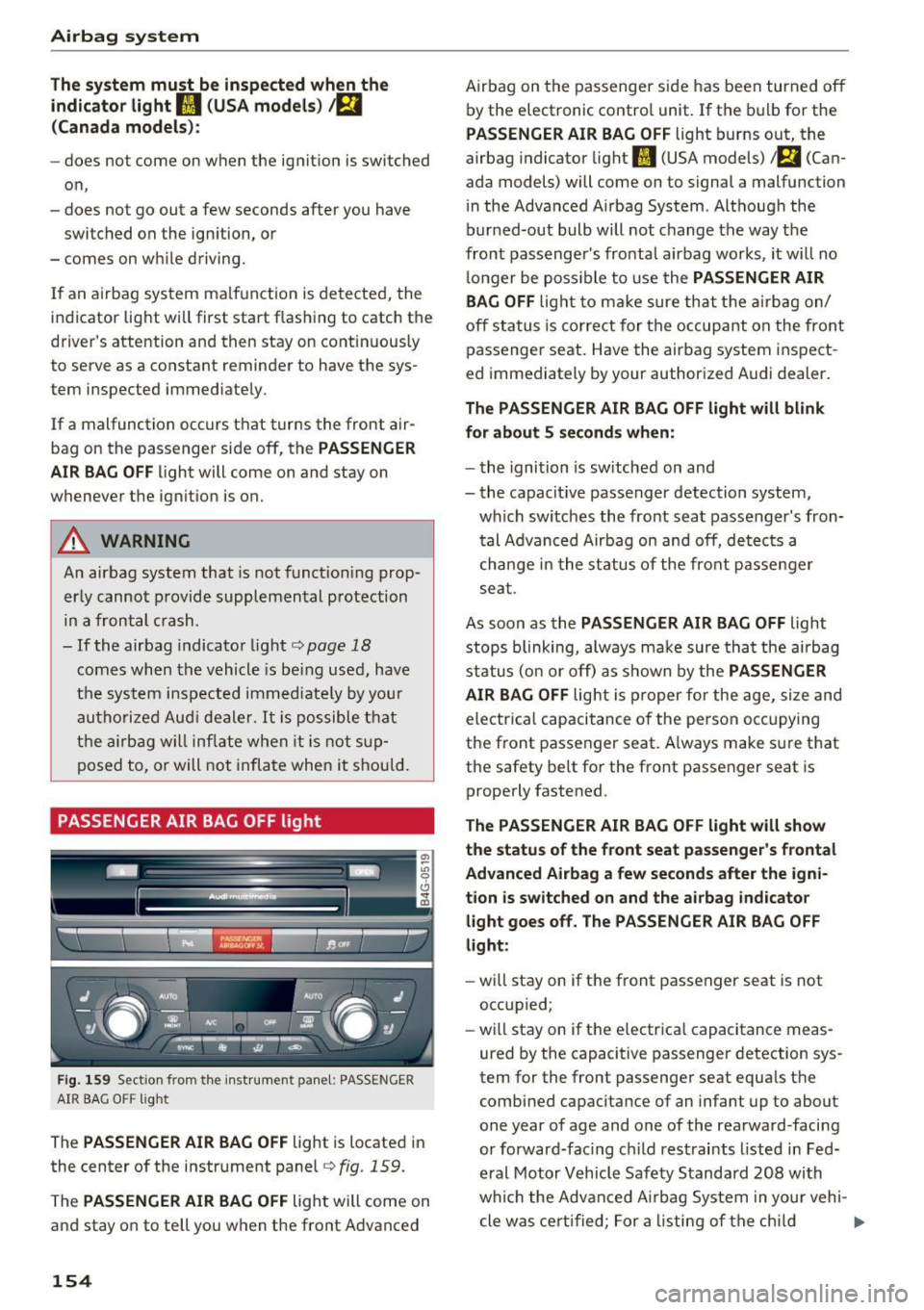
PASSENGER AIR BAG OFF light
Fig . 15 9 Sect io n from th e in st ru m ent pa nel: PASSENGER
AIR BAG OFF lig ht
The PASSENGER AIR BAG O FF light is locate d in
the center o f the instrument panel
c:> fig . 159.
The PASSENGER AIR BAG OFF light will come on
and stay on to tell you when the front A dvanced
154
Airba g on the passenger si de has been turned off
by the electronic contro l unit. If the bulb for the
PASSENGER AIR BAG OFF light b urns o ut, the
airbag indicator light
II (USA models) a (Can
ada models) will come on to signal a malfunction
i n the Advanced A irbag System . Alt houg h the
bur ned-out bulb will not c hange the way t he
front passenger 's fro nta l airbag works, it w ill no
l onger be poss ible to use the
PASSENGER AIR
BAG OFF
lig ht to mak e sure th at th e air bag on/
off st atus is co rre ct for the occupant on the front
passenger seat. Have the air bag system inspect
ed immediately by your authorized Audi dealer .
The PASSENGER AIR BAG OFF light will blink
for about 5 seconds when:
-the ignition is switche d on and
- the capac it ive passenger detection system,
wh ich switches the front seat passenger's fron
t al Advanced Airbag on an d off, de tects a
c h ange in the sta tus of the front pa ssenger
se at .
As soon as the
PASSENGER AIR BAG OFF light
stops blinking, always ma ke sure tha t the ai rbag
st atus (on or o ff) a s sho wn by the
PASSENGER
AIR BAG OFF
lig ht is p roper for the age , size and
ele ctr ica l cap acitance of the person oc cupying
the front passenger seat. A lways make s ure t hat
the safety belt fo r the front passe nger seat is
properly fastened.
The PASSENGER AIR BAG OFF light will show
the status of the front seat passenger's frontal
Advanced Airbag a few seconds after the igni
tion is switched on and the airbag ind icator
light goes off . The PASSENGER AIR BAG OFF
light :
-will stay on if the front passenger seat is not
occupied;
- wi ll stay on if the e lectr ica l capacitance meas
ured by the capacitive passenger detection sys
tem for the front passenger seat equa ls the
comb ined ca pac itance of an infa nt up to about
one year of age and one of the rea rward-faci ng
or forward-fac ing c hild rest ra ints listed in Fed
eral Motor Vehicle Safety S tandard 208 wi th
w hich the Adv anced A irbag Sys tem in you r vehi-
cle was ce rt ified; For a li stin g of the ch ild .,..
Page 159 of 294
(D Tips
If the capacitive passenger detection system
determines that the front passenger seat is
empty, the frontal airbag on the passenger
side will be turned off, and the
PA SSENGER
A IR BAG OFF
light will stay on.
Repair , care and disposal of the airbags
Parts of the a irbag system are installed at many
d ifferent p laces on your Aud i. Installing, remov
ing, servic ing o r repa iring a part in an area of the
vehicle can damage a part of an airbag system
and p revent that system from working properly
in a co llision.
There are some important things you have to
know to make su re t hat the effectiveness of the
system w ill not be impaired and that discarded
components do not cause injury or pollute the
environment .
A WARNING
Improper care, serv icing and repa ir proce
dures can increase the r isk of personal injury
and death by preventing an airbag from de
ploying when needed or deploying an airbag
unexpectedly:
-
- Never cover, obstruct, or change the steer ing wheel horn pad or a irbag cover or the in
strument panel or mod ify them in any way.
- Never attach any objects such as cup holders or te lephone mountings to the su rfaces cov
er ing the airbag units.
- For cleaning the ho rn pad or instrument
pane l, use on ly a soft, dry cloth or one mois
tened with plain water. Solvents or cleaners cou ld damage the a irbag cover or change
the stiffness or strength of the mater ial so
that the airbag cannot dep loy and protect
properly.
- Never repair, adjust, or change any parts of
the airbag system.
- All work on the steering wheel, instr ument
pane l, front seats or electrical system (in
cluding the installation of audio equipment,
cellu lar telephones and CB rad ios, etc.)
must be performed by a qualified technician
Airb ag sys tem
who has the t raining and spec ial equ ipment
necessary.
- For any wo rk on the airbag system, we
strong ly recommend that you see yo ur au
thorized Audi dealer or qualified workshop.
- Never modify the front b umper or parts of
the vehicle body.
- Always make sure that the side a irbag can
inflate w ithout interference:
- Never ins tall seat covers or replacement
u pholste ry ove r the front seatbacks that
have not been specifica lly approved by
Audi.
- Never use addi tional seat cushions that
cove r the areas where the side airbags in
flate.
- Damage to the orig inal se at cove rs or to
the se am in the area of the s ide airbag
module must a lways be repaired immedi
ate ly by an authorize d Aud i dealer.
- The airb ag system can deploy on ly on ce. Af
ter an airbag has been deployed, it must be
replaced with new replacement parts de
signed and approve d espec ially for your
Aud i model version. Replacement of com
p lete airbag systems or airbag components
m ust be performed by qualified workshops
only . Make sure that any airbag service ac
tion is entered in you r A udi Warranty
&
Maintenance boo klet under AIRBAG R E
PLAC EM ENT R ECORD.
- For safety reasons in severe accidents, the
alternator and starte r are separated from
the vehicle ba tte ry with a pyro te chnic cir cui t
interrupter.
- Work on the pyrotechnic c ircuit interrupt
er must on ly be performed by a qualif ied
technic ians who have the exper ience, in
format ion and specia l tools necessa ry to
perfo rm the wor k safely.
- If the vehicle or the circuit interr upte r is
scrapped, all applicable safety p recautions
must be followed.
157
Page 160 of 294
Airbag system
@ For the sake of the environment
Undeployed airbag modu les and pretension
ers might be classified as Perchlorate Materi
al -special handling may apply, see
www.dtsc.ca.gov/hazardouswaste/perchlo
rate . When the vehicle or parts of the re
straint system including airbag modules and
safety belts w ith pretensioners are scrapped,
all applicable laws and regulations must be
observed. Your authorized Audi dealer is fa
m iliar with these requirements and we recom
mend that you have your dealer perform this
service for you.
Other things that can affect Advanced
Airbag performance
Changing the vehicle's suspension system can
cha nge the way that the Advanced Airbag System
pe rforms in a crash. For example, using tire-r im
comb inat ions not approved by Audi, lower ing the
veh icle, changing the stiffness of the suspens ion,
including the spr ings, suspension struts, shock
absorbers etc . can change the forces that are
measured by the airbag sensors and sent to the
electronic control unit . Some suspens ion changes
can, for example, increase the force levels meas
ured by the sensors and make the airbag system
deploy in crashes in wh ich it would not deploy if
the changes had not been made. Other ki nds of
changes may reduce the force levels measured by
the sensors and prevent the airbag from deploy
ing when it should .
A WARNING
Changing the vehicle's suspension including
use of unapproved tire-rim combinations can
change Advanced A irbag performance and in
crease the risk of serious personal injury in a
crash.
- Never install suspension components that
do not have the same performance charac
teristics as the components originally insta l
led on your veh icle.
- Never use tire-rim comb inations that have
not been approved by Audi.
158
Knee airbags
Description of knee airbags
App lies to vehicles: with knee airbags
The knee airbag system can provide supplemen
tal protection to properly restrained front seat
occupants.
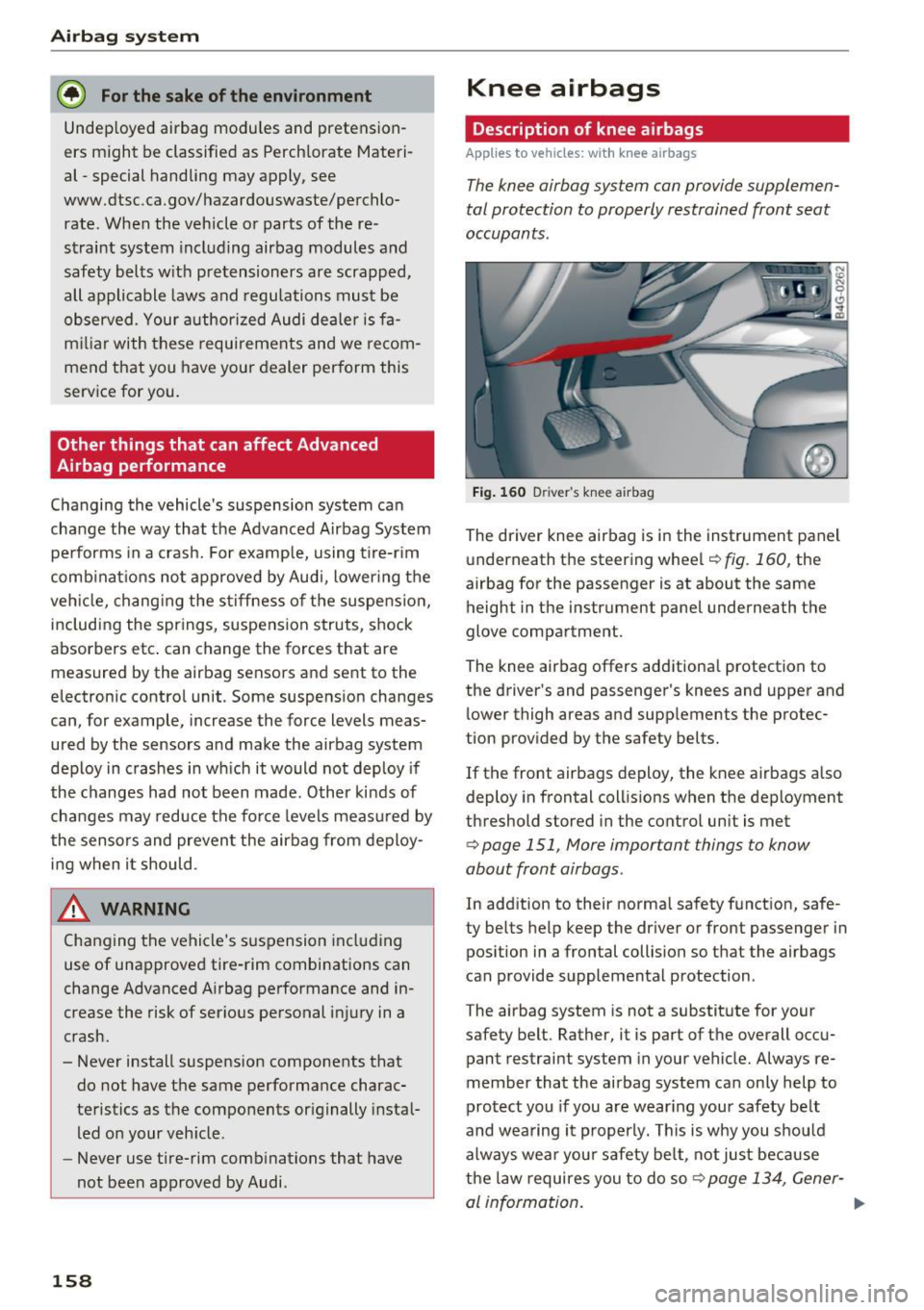
Fig. 160 Driver 's knee airbag
The driver knee airbag is in the instrument panel
underneath the steering whee l
¢fig. 160, the
airbag for the passenger is at about the same
height in the instrument panel underneath the
glove compartment.
The knee airbag offers additiona l protection to
the driver 's and passenger's knees and upper and
lower thigh areas and supplements the protec
tion provided by the safety belts.
If the front airbags deploy, the knee airbags a lso
deploy in frontal collisions when the deployment
threshold stored in the control unit is met
c> page 151, More important things to know
about front airbags .
In addition to their normal safety function, safe
ty belts help keep the dr iver or front passenger in
position in a frontal collision so that the airbags
can provide supplemental protection .
The airbag system is not a substitute for your
safety belt. Rather, it is part of the overall occu
pant restraint system in your vehicle. Always re
member that the airbag system can only help to
protect you if you are wear ing your safety belt
and wearing it p roperly. This is why you shou ld
always wea r your safety be lt, not just because
the law requires you to do so
c> page 134, Gener-
al information. ..,..
Page 161 of 294
.... N
0 CJ -
Remember too, airbags will deploy only once and
only in certain kinds of accidents -your safety
belts are always there to offer protection in those
accidents in which airbags are not supposed to
deploy or when they have already deployed, for
examp le when your vehicle strikes or is struck by
another after the first collis ion.
This is just one of the reasons why an airbag is
not a substitute for the safety belt. The airbag
system works most effectively when used with
the safety belts. Therefore, always wear your
safety belts correct ly .
It is important to remember that while the sup
plemental knee air bag system is designed to re
duce the likelihood of serious injuries, other inju
ries , for example, swelling, bruising and minor
ab rasions and friction burns can also occur when
an airbag inflates.
The knee airbag system basically consists of:
-The electronic control module
- Two inflatable airbags (airbag and gas genera-
tor), one for the driver and one for the front
passenger
- The airbag indicator light in the instrument
panel
The knee airbag system will not deploy:
-when the ignition is switched off
-in frontal collisions when the deceleration
measured by the control unit is too low
- in side collisions
- in rear-end collisions
- in rollovers
- in the event of a system malfunction (warning/
indicator light is on)
cf;> page 18.
A WARNING
-Safety belts and the airbag system can only
provide protection when occupants are in
the proper seating position
cf;> page 151.
- If the airbag indicato r light c:::> page 18
comes when the vehicle is be ing us ed, have
the system inspected immed iately by your
authorized Audi dealer. It is possible that
the airbag will inf late when it is not sup
posed to, or will not inflate when it should.
Airbag system
How knee airbags work
App lies to vehic les : with knee airbags
The risk of injury to the leg area can be reduced
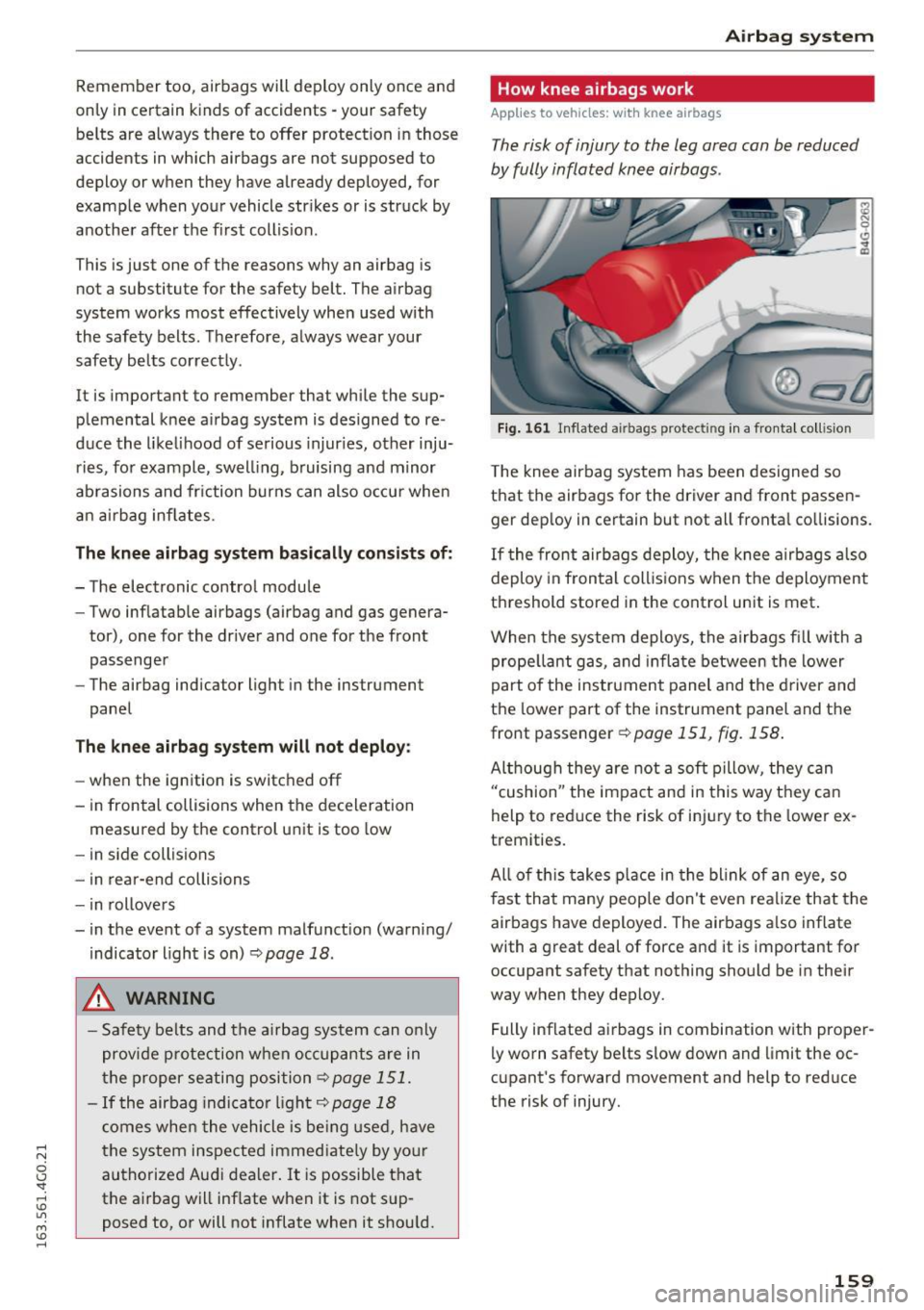
by fully inflated knee airbags .
Fig. 161 Inflated airbags protecting in a fronta l co llision
T he knee airbag system has been designed so
that the airbags for the driver and front passen ger dep loy in certain but not all fronta l co llisions.
If the front airbags deploy, the knee airbags also
deploy in frontal coll isions when the deployment
threshold stored in the control unit is met .
When the system deploys, the airbags fill with a
propellant gas, and inflate between the lower
part of the instrument panel and the driver and
the lower part of the instrument panel and the
front passenger
c:;> page 151, fig. 158.
Although they are not a soft pillow, they can
"cushion" the impact and in this way they can
help to reduce the risk of injury to the lower ex
tremities.
All of th is takes place in the blink of an eye, so
fa st that many people don't even real ize that the
airbags have deployed. The airbags a lso inflate
with a great deal of force and it is important for
occupant safety that nothing should be in their
way when they deploy.
Fully inflated airbags in combination with proper
ly worn safety belts slow down and limit the oc
cupant's forward movement and help to reduce
the risk of injury.
159
Page 162 of 294
Airbag syste m
Important safety instructions on the knee
airbag system
A pplies to veh icles: w ith knee a irbags
Airbags are only supplemental restraints. Always
wear safety belts correctly and ride in a proper
seating position.
There is a lot that you and your passengers must
know and do to help the safety be lts and airbags
to provide supplemental protection .
A WARNING
An inflating knee airbag can cause serious in
jury . Wearing safety belts incorrect ly and im
proper seating pos it ions increase the r isk of
serious personal injury and death whenever a
vehicle is being used.
- The knee airbag system cannot protect you
properly if you are seated too close to any of
the airbag locations. When adjusting their
seat positions, it is important that both the dr iver and the front passenger keep their
upper bod ies and knees at the following
min imum safe distances:
- at least 10 inches (25 cm) between the
chest and the steering wheel/instrument
panel.
- at least 4 inches (10 cm) between the
knees and the lower part of the instru
ment panel.
- The risk of personal injury increases if you
lean forward or to the side, or if the seat is
improperly positioned and you are not wear
ing your safety belt. The risk increases even
more should the a irbag deploy.
- Always make sure that the knee airbag can
inflate without interference. Objects be
tween you and the airbag can increase the
risk of injury in an accident by interfer ing
with the way the a irbag dep loys or by being
pushed into you as the airbag deploys.
- Never let anybody, especially children or
animals ride in the footwell in front of the passenger seat . If the a irbag deploys, this
can result in serious or fatal injuries.
- Never carry objects of any k ind in the foot
well area in front of the driver's or pas
senger's seat . Bulky objects (shopping
1 6 0
bags, for example) can interfere with or
prevent proper deployment of the a irbag.
Small objects can be thrown through the
vehicle if the airbag deploys and injure you
or your passengers.
- Make sure there are no cracks, deep scratch
es or other damage in the area of the i nstru
ment panel where the knee airbags are lo
cated .
-If ch ildren are incorrectly seated, their risk
of injury increases in a coll ision
c::;, page 166, Child safety.
Side airbags
Description of side airbags
The airbag system can provide supplemental
protection to properly restrained occupants.
Fig. 162 Side airbag location in the driver"s seat
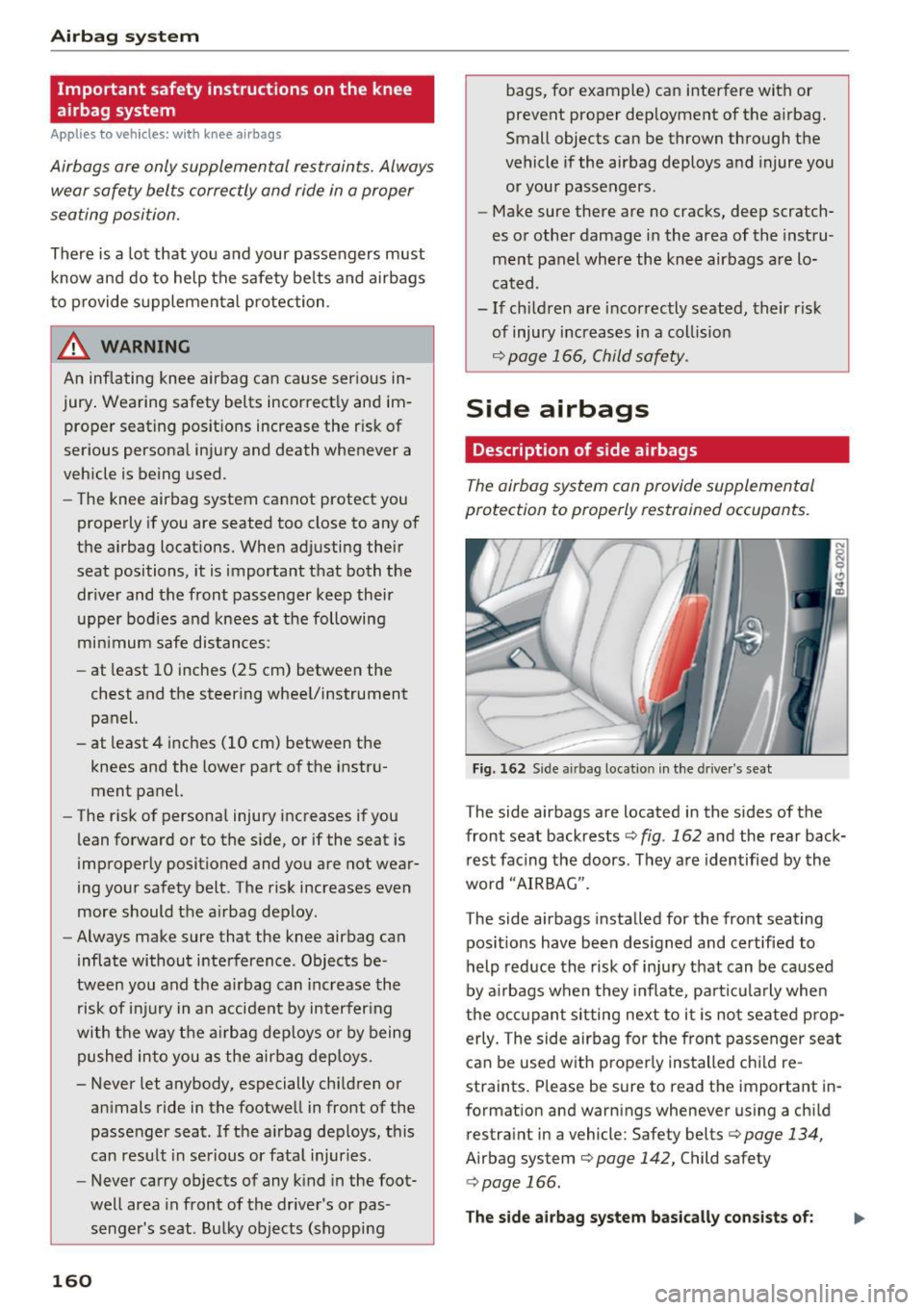
The side airbags are located in the sides of the
front seat backrests
c::;, fig. 162 and the rear back
rest fac ing the doors . They are identified by the
word "AIRBAG".
The side airbags installed for the front seating
positions have been designed and certified to
help reduce the risk of injury that can be caused
by a irbags when they inflate, particu larly when
the occupant sitting next to it is not seated prop
erly. The side airbag for the front passenger seat can be used with properly installed child re
straints . Please be sure to read the important in
formation and warnings whenever using a child
restraint in a vehicle: Safety belts
c::;, page 134,
Airbag system c::;, page 142, Child safety
c::;, page 166 .
The s ide ai rbag sys tem basica lly c onsi st s of: ..,.