mirror AUDI S6 2016 User Guide
[x] Cancel search | Manufacturer: AUDI, Model Year: 2016, Model line: S6, Model: AUDI S6 2016Pages: 294, PDF Size: 73.88 MB
Page 100 of 294
Audi side assist
-Improper reliance on the side assist system
can cause collisions and serious personal in
jury:
- Never rely only on side assist when chang
ing lanes.
- Always check rear view mirrors to make
sure that it is safe to change lanes.
- Side assist cannot detect all vehicles under
all conditions- danger of accident!
- Please note that side assist indicates there
are approaching vehicles, or vehicles in your blind spot, only after your vehicle has
reached a driving speed of at least 19 mph
(30 km/h).
- In certain situations, the system may not
function or its function may be limited. For
example:
- if vehicles are approaching or being left
behind very quickly . The display may not
turn on in time .
- in poor weather conditions such as heavy
rain, snow or heavy mist .
- on very wide lanes, in tight curves or if
there is a rise in the road surface . Vehicles
in the adjacent lane may not be detected
because they are outside of the sensor
range.
(D Note
The sensors can be displaced by impacts or damage to the bumper, wheel housing and
underbody . This can affect the system . Have
your authorized Audi dealer or authorized
Audi Service Facility check their function.
(D Tips
-If the window glass in the driver's door or
front passenger's door has been tinted, the
display in the exterior mirror may be misin
terpreted.
- For Declaration of Compliance to United
States FCC and Industry Canada regulations
¢page 276.
98
Switching on and off
Applies to vehicles: with A udi side assist
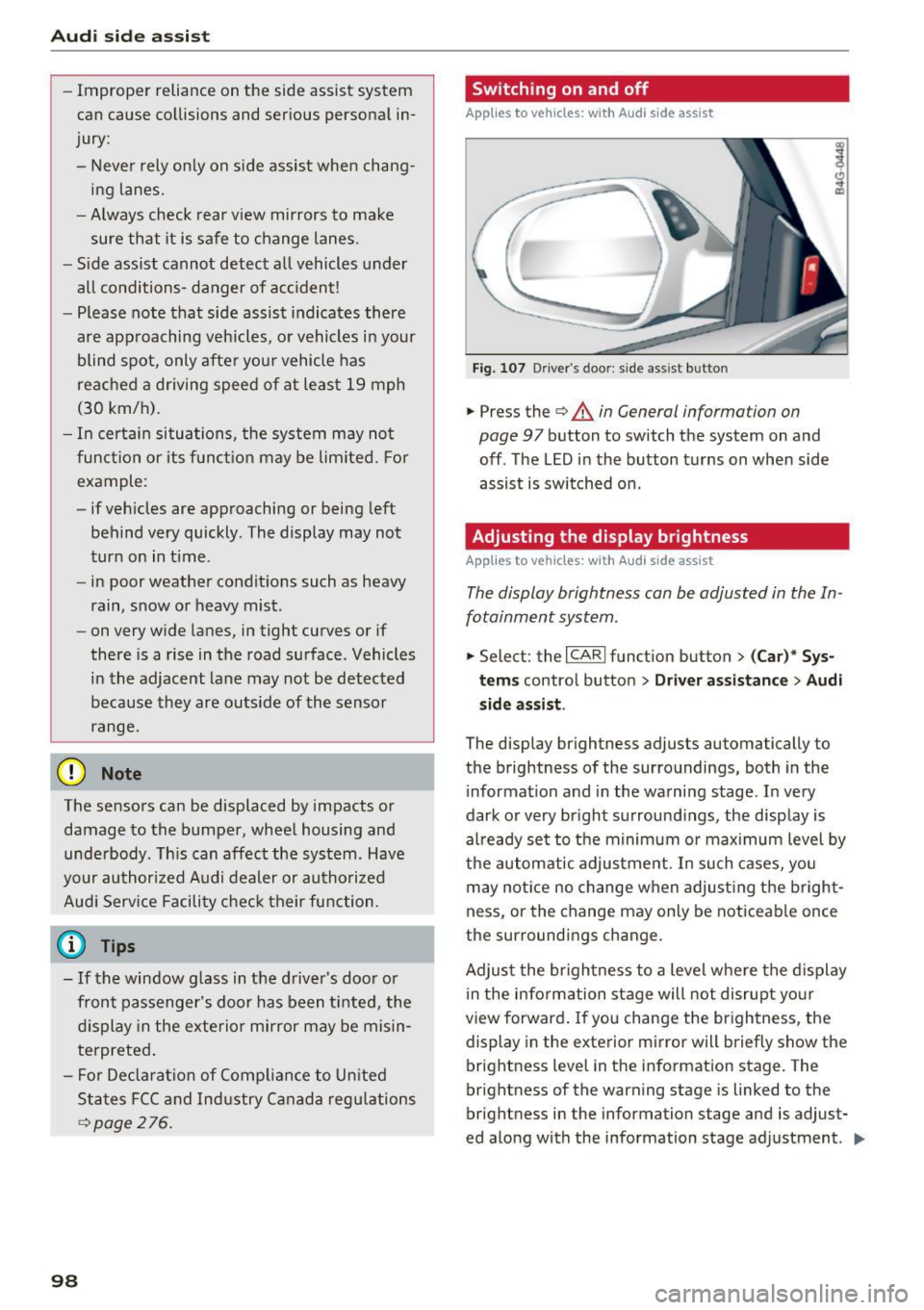
Fig. 107 D river 's doo r: side assi st but ton
.,.. Press the ¢&. in General information on
page
97 button to switch the system on and
off . The LED in the button turns on when side
assist is switched on .
Adjusting the display brightness
Applies to vehicles: with A udi side assist
The display brightness can be adjusted in the In
fotainment system .
.,.. Select: the I CARI function button > (Car)* Sys
tems control button > Driver assistance> Audi
side assist .
The display brightness adjusts automatically to
the brightness of the surroundings, both in the
information and in the warning stage . In very
dark or very bright surroundings, the display is
already set to the minimum or maximum level by
the automatic adjustment. In such cases, you
may notice no change when adjusting the bright
ness, or the change may only be noticeable once
the surroundings change.
Adjust the brightness to a level where the display
in the information stage will not disrupt your
view forward. If you change the brightness, the
display in the exterior mirror will briefly show the
brightness level in the information stage. The
brightness of the warning stage is linked to the
brightness in the information stage and is adjust
ed along with the information stage adjustment . ..,.
Page 118 of 294
Parking systems
-The camera lens enlarges and distorts the
field of vision. The object appears both al
tered and inaccurate on the screen.
- In certain situations, people or objects in
the display appear closer or farther away:
- For objects that do not touch the ground,
such as the bumper of a parked vehicle, a
trailer hitch or the rear of a truck. Do not
use the help lines in this case.
- If driven from a level surface onto an in
cline, or a downward slope.
- If driven toward protruding objects.
- If the vehicle is carrying too much load in
the rear.
(D Note
- Always read and follow the applicable warn
ings r::!>(D
in General information on
page 113 .
-The orange colored orientation lines in the
Infotainment display show the vehicle path
depending on the steering wheel angle. The
front of the vehicle front swings out more
than the rear of the vehicle . Maintain plenty
of distance so that your outside mirror or a
corner of your vehicle does not collide with
any obstacles.
Switching on/off
Applies to vehicles: with rearview camera
Switching on
.,. Shift into reverse, or
.,. Press the
P,,, A button in the center console
r:=> page 114, fig. 121. A short confirmation
tone sounds and the LED in the button turns
on.
Switching between the rearview camera and
optical display
.,. Press the Graphic control button ®
r:=> page 116, fig. 126 to see the optical display .
.,. Press the
Rear view control button to see the
. . rearv1ew camera image.
Switching off
.,. Drive forward faster than 10 km/h, or
.,. press the
P,1
1.A button, or
116
.,. Switch the ignition off.
@ Tips
- The visual display in the left part of the dis
play should help you detect the critical vehi
cle areas.
- You can change the volume and pitch of the
signals as well as the dis play
r:=> page 123.
Cross parking
Applies to vehicles: with rearview camera
This view may be used when parking in a garage
or in a parking space.
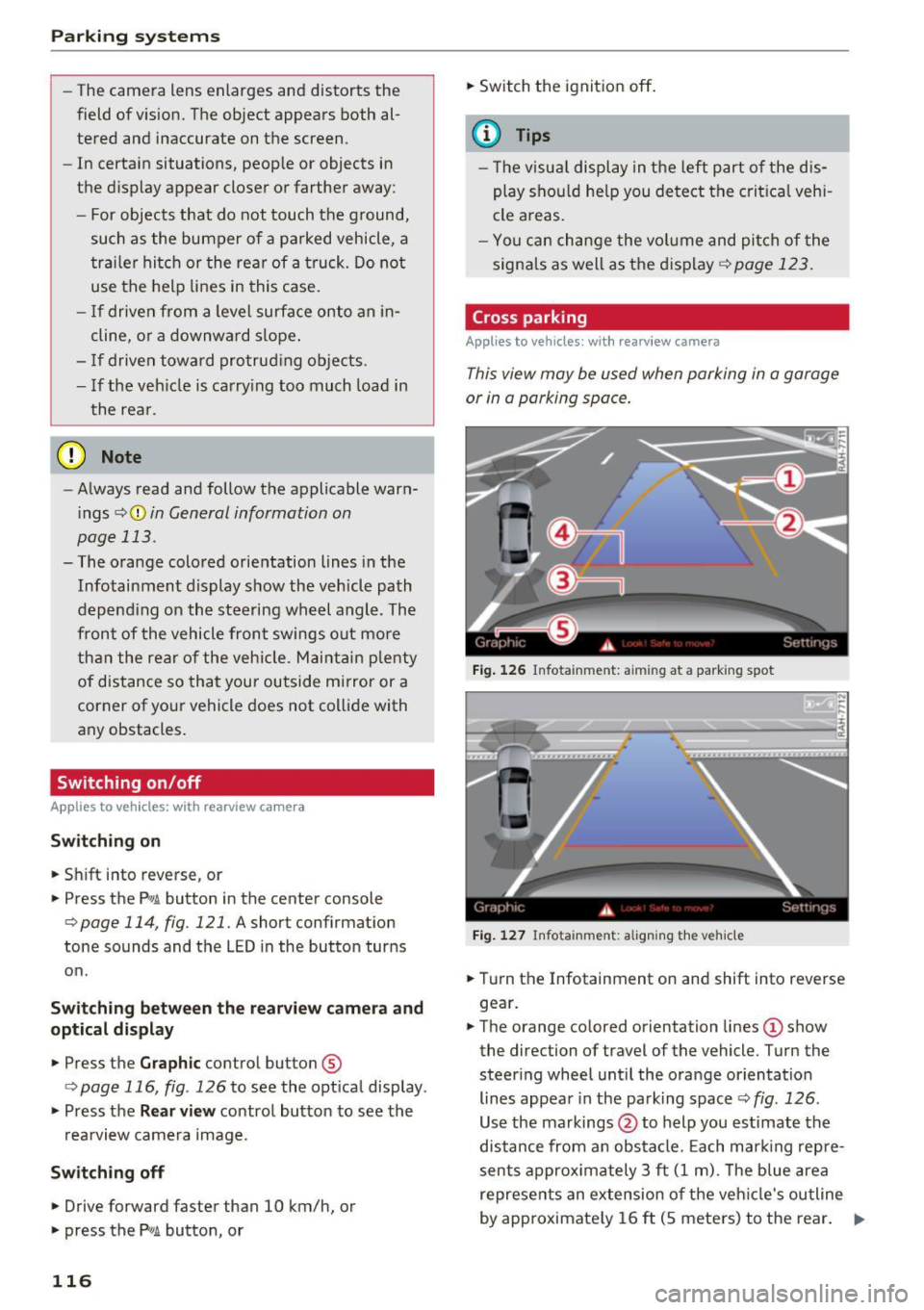
Fig. 126 Infotainment: aiming at a parking spot
Fig. 127 Infota inment: aligning the vehicle
.,. Turn the Infotainment on and shift into reverse
gear.
.,. The orange colored orientation lines
(D show
the direction of travel of the vehicle. Turn the
steer ing wheel until the orange orientation
lines appear in the parking space r::!>
fig. 126 .
Use the markings @to help you estimate the
distance from an obstacle. Each marking repre
sents approximately 3 ft
(1 m). The blue area
represents an extension of the vehicle's outline
by approximately
16 ft (5 meters) to the rear. .,._
Page 120 of 294
Parking system s
CD Note
Keep enough distance from the curb to avoid
damage to the rims .
@ Tips
The left or right orientation lines and surfaces
wi ll be displayed, depending on the turn sig
nal being used .
Peripheral cameras
Introduction
Applies to vehicles: with peripheral cameras
With this equipment, die parking system plus* is
supp lemented with var io us peripheral cameras
qpage 114. Depending on vehicle equipment,
you are provided with the following views: Around the vehicle, front corner and rear corner,
in front of the vehicle and behind the vehicle.
General information
Applies to veh icles: with peripheral cameras
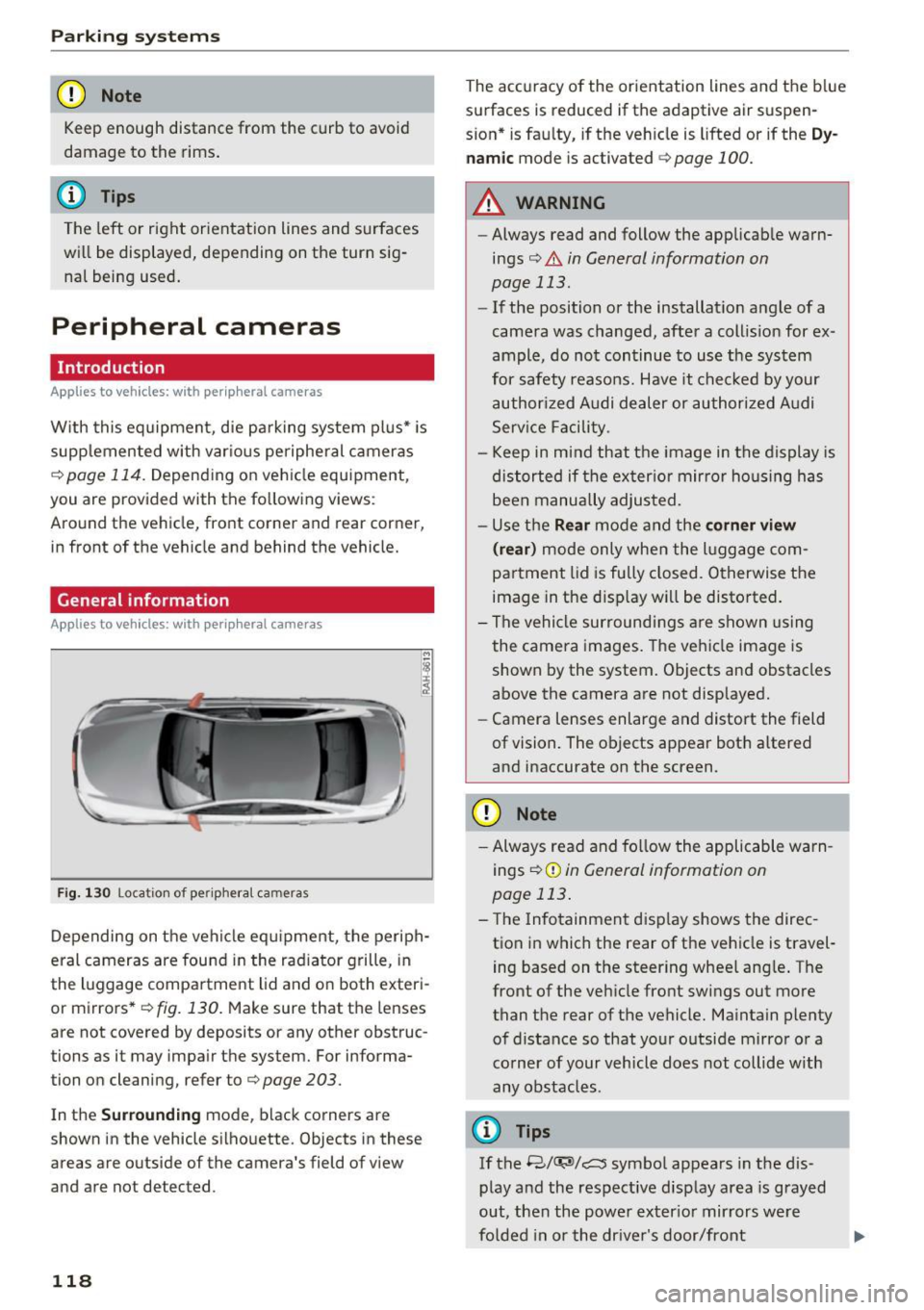
F ig . 1 30 Location of periphe ral cameras
Depending on the vehicle eq uipment, the periph
eral cameras are fou nd in the radiator grille, in
the luggage compa rtment lid and on both exteri
or mirrors *
q fig. 130. Make sure that the lenses
are not covered by deposits or any other obstruc
tions as it may impair the system. For informa
tion on cleaning, refer to¢
page 203.
In the Surrounding mode, black corners are
shown in the vehicle silhouette. Objects in these
areas are outside of the camera's field of v iew
and are not detected.
118
The accuracy of the orientation lines and the b lue
surfaces is reduced if the adaptive air suspen
s ion* is fau lty, if the veh icle is lifted or if the
D y
nam ic mode is activated qpage 100.
A WARNING
-Always read and follow the applicab le warn
ings¢ .&
in General information on
page 113.
- If the position or the installat ion angle of a
camera was changed, after a collis ion for ex
ample, do not continue to use the system
for safety reasons. Have it chec ked by your
authorized Audi dealer or authori zed A udi
Serv ice Facility.
- Keep in mind that the image in the display is
distorted if the exter ior mir ror ho using has
been manually adjusted.
- Use the
Rear mode and the corner view
( rear )
mode only when the l uggage com
partment lid is fu lly closed. Otherwise the
image in the disp lay will be disto rted.
- The vehicle surroundi ngs a re shown using
the camera images. The veh icle image is
shown by the system. Objects and obstacles
above the camera are not displayed.
- Camera lenses enlarge and distort the field
of vision. The objects appear both a ltered
and inaccurate on the screen.
CD Note
- Always read and fo llow the applicable warn
ings
¢ (Din General information on
page 113 .
-The Infotainment d isp lay shows the direc
tion in which the rear of the vehicle is travel
ing based on the steering wheel ang le . The
front of the vehicle front sw ings out more
than the rear of the vehicle. Maintain plenty of distance so that your o utside mirror or a
corner of your vehicle does not collide with
any obstacles.
(I} Tips
If the 8/(J;(SJ/c:, symbol appears in the dis
play and the respective display area is grayed
out, then the power exter io r mir rors we re
fo lded in or the dr ive r's door/front
Page 127 of 294
Driving safety
Basics
Safe driving habits
Please remember -safety first!
This chapter contains important information,
tips, instructions and warnings that you need to
read and observe for your own safety, the safety
of your passengers and others . We have summar
ized here what you need to know about safety
belts, airbags, child restraints as well as child
safety. Your safety is for us
priority number 1. Al
ways observe the information and warnings in
this section - for your own safety as well as that
of your passengers.
The information in this section applies to all
model versions of your vehicle. Some of the fea
tures descr ibed in this sections may be standard
equipment on some models, or may be optional
equipment on others. If you are not sure, ask
your authorized Audi dealer.
A WARNING
- Always make sure that you follow the in
structions and heed the WARNINGS in this
Manual. It is in your interest and in the in
terest of your passengers .
-
-Always keep the complete Owner's Litera
ture in your Audi when you lend or sell your
vehicle so that this important information
will always be available to the driver and
passengers.
- Always keep the Owner's literature handy so
that you can find it easily if you have ques
tions.
Safety equipment
The safety features are part of the occupant re
straint system and work together to help reduce the risk of injury in a wide variety of accident sit
uations.
Your safety and the safety of your passengers
should not be left to chance. Advances in tech
nology have made a var iety of features available
to help reduce the risk of injury in an accident.
Driving safety
The following is a list of just a few of the safety
features in your Audi:
- sophisticated safety belts for driver and all pas-
senger seat ing pos itions,
- safety belt pretensioners,
- safety belt force limiters for the front seats,
- safety belt height adjustment systems for the
front seats,
- front airbags,
- knee airbags for the front seats*
- side airbags in the front seats and outer rear
seats*,
- side curtain airbags with ejection mitigation
features,
- special LATCH anchorages for child restraints,
- head restraints for each seat ing position,
- adjustab le steering column.
These individual safety features, can work to gether as a system to help protect you and your
passengers in a wide range of accidents . These
features cannot work as a system if they are not
always correctly adjusted and correctly used.
Safety is everybody's responsibility!
Important things to do before driving
Safety is everybody 's job! Vehicle and occupant
safety always depends on the informed and care
ful driver .
For your safety and the safety of your passen
gers,
before driving always:
.,. Make sure that all lights and signals are operat
ing correctly .
.,. Make sure that the tire pressure is correct.
.,. Make sure that all windows are clean and afford
good visibility to the outside .
.,. Secure all luggage and other items carefully
¢ page 64, ¢ page 61 .
.,. Make sure that nothing can interfere with the
pedals.
.,. Adjust front seat, head restraint and mirrors
correctly for your height .
.,. Instruct passengers to adjust the head re
straints according to their height.
125
Page 201 of 294
Trailer mode Driving with a trailer
General information
Your Audi was designed primarily for passenger
transportation .
If you plan to tow a trailer, please remember that
the additional load will affect durability, econo
my and performance.
T railer tow ing not only p laces more stress on the
vehicle, it a lso calls for more concentration from
the dr iver.
F or this reason, always follow the operating and
driving instructions provided and use common
sense.
(D Note
If you are going to tow a trailer, you must ac
tivate the trai ler operation mode
¢ page 199, Operating instructions.
Technical requirements
Tr ailer hitch
Use a weight -carrying hitch conforming to the
gross tra iler weight. The h itch must be suitab le
for your vehicle and tra ile r and must be mo unted
securely on the vehicle's chassis at a
technically
sound
location . Use on ly a trailer hitch with a re
movable ba ll mou nt. Always che ck wit h the t rail
e r hitch manufac turer to make s ure that you a re
usi ng the co rrect hitch .
Do not use a bumper hitch .
The hitch must be installed in such a way that it
does not interfere with the impact -absorbing
bumper system . No mod ifica tions should be
made to the vehicle exhaust and brake systems .
Fr om time to time, chec k that all hitch mo un ting
bo lts rem ain securely fastened.
W hen you are not tow ing a trailer,
remove the
tra iler hitch ba ll mount . This prevents the hitch
from ca u sing damage s hou ld your veh icle be
struck from behind
¢ .&, .
Trailer mode
Trailer brakes
If your traile r i s equ ipped with a b raking sys tem,
c h ec k t o be sure that it con forms to a ll regu la
tions.
T he tra ile r h ydr aulic bra ke sy stem must not be
directly con nected to the vehicle's hydr aulic
brake sy stem.
Safety chains
Always use safety chains between your vehicle
and the tra iler .
Trailer lights
Trailer lights must meet all regulations. Be sure
to check w it h your Aud i dealer for correct wir ing,
swi tches and relays .
Mirrors
If you are unab le to see the traffic behind you us
ing the regular outside mirrors, then you
must in
stall extended mirrors . It is important that you
always have clear vision to the rear .
A WARNING
--
After remov ing the tra ile r hi tch, do not sto re
i t in yo ur vehicle. In case of sudde n brak ing,
t he hitch could fly fo rwa rd and injure you or
your passengers.
Operating instructions
Maximum trailer weight
A traile r for yo ur vehicle is lim ited to a typical
cla ss 1 or class 2 trailer.
Trailer load distribut ion
Be sure the load in the tra iler is held secure ly in
place to p reve nt it from shifting forward, back
ward o r sideways.
Ne ver allow a passenger to ride in a trailer¢.&.
in Driving instructions on page 201 .
Engine cooling system
Towing a tra ile r makes the engine wor k harder. It
is important that the cooling system's perform
ance is up to the additional load. Make sure that
the cool ing system has enoug h fluid . .,..
199
Page 206 of 294
Care and cleaning
-To reduce the risk of cuts, protect yourself
from sharp metal components when was h
ing the underbody or the inside of the wheel
housings .
- After washing the vehicle, the braking effect
may be delayed due to mo isture on the
brake rotors or ice in the winter . The brakes
must be d ried first w ith a few careful b rake
applications.
(D Note
- If you wash the vehicle in an automatic car
wash, you must fold the exte rior m irrors in
to reduce the risk of damage to the mirrors.
Power folding exte rior m irrors* must on ly
be fo lded in and out us ing the powe r folding
f u nct ion.
- To p revent paint damage , do not wash the
vehicle in di rect sunlight.
- To reduce the risk of damage to the surface,
do not use insec t remov ing sponges, kit chen
sponges or similar items. - Matte finish painted vehicle components:
-To reduce the r isk of damage to the sur-
face, do not use polis hing agents or hard
wax.
- Never use protective wax. It can destroy
the matte finish effect .
- Do not place any stickers or magnetic
signs on vehicle parts painted with matte
finish paint. The paint could be damaged
when the stickers or magnets are re
moved.
@ For the sake of the environment
Only wash t he ve hicle in facilities spec ially de
signed for that pu rpose . This will reduce the
r isk of dirty wate r contaminated with o il from
ente ring the sewe r system.
Cleaning and care information
When clean ing and c aring for ind ividua l vehicle
components, refer to the fo llow ing tables. The
information contained there is simply recom- mendat
ions. For questions or for components
t h at are not listed, refer to an author ized Audi
dealer. Also follow the informat ion found in¢&.
Ext erio r cl eaning
Component Situ ation Solution
Wind shield wip er
Deposits ¢ page 52, Cleaning windshield wiper blades
blade
s
Headligh ts/
Deposits Soft sponge with a mild soap solutiona >
tail light s
S en sors /
Deposits Sensors: soft cloth with solvent-free cleaning solution
cam era le nses Camera lenses: soft cloth with alcohol-free cleaning solu-
tion
Snow/ice H
and br ush/solvent-free de-icing spray
Wh eels Road salt Water
Brake dus t Acid-free special
cleaning solution
Ex haust tail p ipe s Road salt Water, clean ing solution su itable for stainless steel, if nee -
essary
Decorative parts / Deposits Mild
soap solution a), a cleaning solution suitable for stain-
trim less stee l, if necessary
204
Page 208 of 294
Care and cleaning
Component Situation Solution
Te xtil es
Deposits adhering to Vacuum cleaner
a rt ifici al le ather , the surface
Alcant ara Water-based deposits Absorben
t cloth and mild soap solutiona>
such as coffee, tea,
blood, etc.
O il-based deposits Apply am ild soap solutiona>, blot away the d issolved oil or
such as oil, make-up, dye, treat afterward with water, if necessary
etc.
Special deposits such Special stain remover, b lot with absorbent material, treat
as ink, na il polish, la- afterward with mild soap solution, if necessarya>
tex paint, shoe pol-
ish, etc.
Natural leather Fresh stains Wool cloth with a mild soap so
lutiona)
Water-based deposits fresh sta ins: absorbent cloth
such as coffee, tea, d ried stains: stain remover suitable for leather
blood, etc.
Oil-based deposits Fresh staiins: absorbent cloth and stain remover suitable
such as oil, make-up, for leather
etc. dried stains: Oil cleaning spray
Special deposits such Spot remover suitab le for leather
as ink, nai l polish, la -
tex paint, shoe pol-
ish, etc.
Ca re Regularly apply cond ition ing cream that protects from
light and penet rates into the materia l. Use specia lly-co l-
ored conditioning cream, if necessary.
Carbon parts Deposits clean the same way as plastic parts
a) Mild soap solution: maximum two tablesp oons of neutral soap in 1 quart (l liter) of water
_& WARNING
The windshie ld may not be trea ted with wa
ter-repelling windshield coating agents. Un
favorable conditions s uch as wetness, dark
ness, or low sun can result in increased glare .
Wiper blade chatter is also possible.
(D Note
- Headlights/tail light s
-Never clean headlights or tail lights with a
dry cloth or sponge.
- Do not use any cleaning product that con
tains alcohol, because they cou ld cause
cracks to form.
- Wheels
206
-
- Never use any paint polish or other abra
sive materials.
- Damage to the protect ive layer on the
rims such as stone chips or scratches must
be repaired immediately.
- Sensors /camera lenses
- Neve r use wa rm or ho t wa ter to remove
snow or ice from the camera lens . This
could cause the lens to crack .
- N eve r use ab rasive cleaning materials or
a lcohol to clea n the camera lens . This
could cause scratches and cracks .
-Doo r window s
-Remove snow and ice on windows and ex-
terior mirrors with a plast ic scraper. To
Page 209 of 294
avoid scratches, move the scraper only in
one direction and not back and forth.
- Never remove snow or ice from door win
dows and mirrors using warm or hot water
because this could cause cracks to form.
- To avoid damage to the rear window de
fogger , do not apply any stickers on the
heating wires on the inside of the window.
- Decorative parts/trim
- Never use chrome care or cleaning prod-
ucts .
- Paint
- To reduce the risk of scratches, the vehicle
must be free of dirt and dust before pol
ishing or waxing .
- To prevent paint damage, do not polish or
wax the vehicle in direct sunlight .
- To reduce the risk of paint damage, do not
polish away rust spots .
- Remove cosmetics and sunscreen immedi
ately- these could damage the paint.
- Displays
- To avoid scratches, do not use dry cleaning
methods on displays.
- Controls
- Make sure that no fluids enter the con-
trols, because this could cause damage.
- Safety belts
- Do not remove the safety belts to clean
them.
- Never clean safety belts or their compo
nents chemically or with corrosive fluids
or solvents and never allow sharp objects
to come into contact with the safety belts.
This could cause damage to the belt web
bing .
-If there is damage to the webbing, the
connections, the retractors or the buckles,
have them replaced by an authorized deal
er.
- Textiles/artificial leather/ Alcantara
- Never treat artificial leather/ Alcantara
with leather care products, solvents, floor polish, shoe polish, spot remove or similar
products .
- Have a specialist remove stubborn stains
to prevent damage.
Care and cleaning
- Never use steam cleaners, brushes, hard
sponges, etc. when cleaning.
- Do not turn on the seat heating* to dry the
seat.
- Objects with sharp edges such as zippers,
rivets on clothing or belts can cause dam
age to the surface.
- Open hook and loop fasteners , for exam
ple on clothing, can damage seat covers.
Make sure hook and loop fasteners are
closed .
- Natural leather
- Never treat leather with solvents, floor
polish, shoe polish, spot remover or simi
lar products.
- Objects with sharp edges such as zippers, rivets on clothing or belts can cause dam
age to the surface .
- Never use steam cleaners, brushes, hard
sponges, etc . when cleaning.
- Do not turn on the seat heating* to dry the
seat .
- To help prevent the leather from fading,
do not leave the vehicle in direct sunlight
for long periods of time. If leaving the ve
hicle parked for long periods of time, you
should cover the leather to protect it from
direct sunlight.
(D Tips
-Insects are easier to remove from paint that
has been freshly waxed.
- Regular waxing can prevent rust spots from
forming.
207
Page 282 of 294
Index
Date display . . . . . . . . . . . . . . . . . . . . . . . . . . 26
Daytime running lights . . . . . . . . . . . . . . . . . 44
Declaration of compliance Adaptive cruise control . . . . . . . . . . . . . . .
276
Audi side assist . . . . . . . . . . . . . . . . . . . . . 276
Cell phone package . . . . . . . . . . . . . . . . . . 276
Convenience key . . . . . . . . . . . . . . . . . . . . . 276
Electronic immob ilizer. . . . . . . . . . . . . . . . 276
Garage door opener (HomeLink) . . . . . . . . 276
Remote control key . . . . . . . . . . . . . . . . . . 276
Defective light bulb warning
Indicator light . . . . . . . . . . . . . . . . . . . . . . .
21
Defrosting (windows)
Four- zone automatic climate control . . . . .
71
Three-zone climate control . . . . . . . . . . . . . 68
DEF (instrument cluster) . . . . . . . . . . . . . . . . 26
Determining correct load limit . . . . . . . . . . 245
Diesel Indicator light . . . . . . . . . . . . . . . . . . . . . . .
20
Prewarming . . . . . . . . . . . . . . . . . . . . . . . . . 74
Diesel fuel . . . . . . . . . . . . . . . . . . . . . . . . . . .
209
Diesel particu late filter . . . . . . . . . . . . . . . . 196
Dimensions .. .. ............... .... ... 271
Dimming the rearview mirror . . . . . . . . . . . . 49
Distance . . . . . . . . . . . . . . . . . . . . . . . . . . . . . 24
Door/rear lid warning . . . . . . . . . . . . . . . . . . . 23
Doors Ch ild safety lock . . . . . . . . . . . . . . . . . . . . . . 39
Driver information system . . . . . . . . . . . . . . . 23
CD/radio display . . . . . . . . . . . . . . . . . . . . . . 23
Door/rear lid warn ing . . . . . . . . . . . . . . . . . 23
E ff iciency program . . . . . . . . . . . . . . . . . . . .
25
E xterior temperature display . . . . . . . . . . . 23
On-board computer . . . . . . . . . . . . . . . . . . . 24
Service interval display . . . . . . . . . . . . . . . .
26
Driver seating posit ion . . . . . . . . . . . . . . . . . 126
drive select
adaptive air suspension/sport . . . . . . . . . .
100
Adaptive dampers . . . . . . . . . . . . . . . . . . . 100
Curve light . . . . . . . . . . . . . . . . . . . . . . . . . 100
Engine sound . . . . . . . . . . . . . . . . . . . . . . . 100
Safety belt tensione r . . . . . . . . . . . . . . . . . 100
Sport differential . . . . . . . . . . . . . . . . . . . . 100
Drive select . . . . . . . . . . . . . . . . . . . . . . . . . . 100
Driving economically
Driving safely .. .. ... .......... .. .. .. .
Driving through water .......... .. .. .. .
280
196
125
194
Driving time
Duplicate key ...
... .. .. ................ 24
30
Dust filter
refer to Pollutant filter . . . . . . . . . . . . . . . . 67
Dynamic steering
Indicator light
E
190
Easy seat entry . . . . . . . . . . . . . . . . . . . . . . . . 7 4
Economy tips (efficiency program) . . . . . . . . 25
Eff · 1c1ency program . . . . . . . . . . . . . . . . . . . . . 25
Electromechanical parking brake
Operat ion . . . . . . . . . . . . . . . . . . . . . . . . . . . 77
Releasing and closing . . . . . . . . . . . . . . . . . 77
Warning/indicator lights . . . . . . . . . . . . . . .
15
Electromechanical steering . . . . . . . . . . . . . 190
Indicator light . . . . . . . . . . . . . . . . . . . . . . 190
Electronic differential lock
Indicator light . . . . . . . . . . . . . . . . . . . . . . .
18
Electronic Differential Lock . . . . . . . . . . . . . 187
Electronic differential lock (EDL)
Warning/indicator lights . . . . . . . . . . . . . . .
19
Electronic immobili zer . . . . . . . . . . . . . . . . . . 31
E lectronic power control (EPC)
warning/indicator light . . . . . . . . . . . . . . . .
20
Electronic speed limiter . . . . . . . . . . . . . . . . . 29
Electronic stabilization control
Indicator light . . . . . . . . . . . . . . . . . . . . . . .
18
E lectronic Stabilization Control . . . . . . . . . . 187
Sport mode . . . . . . . . . . . . . . . . . . . . . . . . 188
Emergency actuation
Doors . . . . . . . . . . . . . . . . . . . . . . . . . . . . . . 36
Emergency flasher . . . . . . . . . . . . . . . . . . . . . 47
Warning/indicator lights . . . . . . . . . . . . . . .
22
Emergency operation
Emergency braking function (parking brake) .7.8
Fuel filler door . . . . . . . . . . . . . . . . . . . . . .
212
Luggage compartment lid . . . . . . . . . . . . . . 39
Selector lever . . . . . . . . . . . . . . . . . . . . . . .
112
Sunroof . . . . . . . . . . . . . . . . . . . . . . . . . . . . . 42
Emergency starting . . . . . . . . . . . . . . . . . . .
264
Energy management . . . . . . . . . . . . . . . . . . 192
Engine
Compartment. ... .. .. ... ..... ..... ..
218
Coolant . . . . . . . . . . . . . . . . . . . . . . . . . . . . 222
Prewarming . . . . . . . . . . . . . . . . . . . . . . . . . 74
Page 283 of 294
Starting . . . . . . . . . . . . . . . . . . . . . . . . . . . . 7 4
Starting with jumper cables . . . . . . . . . . . 264
Stopping . . . . . . . . . . . . . . . . . . . . . . . . . . . . 7 5
E ng ine compartment ......... .. .. .... . 218
C losing the hood . . . . . . . . . . . . . . . . . . . . 217
Opening the hood ................... 216
Safety instructions .................. . 216
Working in the engine compartment .... 216
Index
Event Data Recorder (EDR) . . . . . . . . . . . . . 186
Expansion tank . . . . . . . . . . . . . . . . . . . . . . . 222
Exterior lighting . . . . . . . . . . . . . . . . . . . . . . . 44
Exterior mirrors
Adjusting . . . . . . . . . . . . . . . . . . . . . . . . . . . 48
Dimming ... ... .. .. ................ .. 49
Heating.... ... .. .. ................. . 48
Exterior temperature d isplay . . . . . . . . . . . . . 23
E ng ine coolant . . . . . . . . . . . . . . . . . . . . . . . 222
Adding coolant . . . . . . . . . . . . . . . . . . . . . . 223
F
Checking the engine coolant level. . . . . . . 222
Expansion tank . . . . . . . . . . . . . . . . . . . . . . 222
Malfunction symbol . . . . . . . . . . . . . . . . . . . 15
Radiator fan . . . . . . . . . . . . . . . . . . . . . . . . 224
Temperature gauge . . . . . . . . . . . . . . . . . . . 10
Engine oil ... .. ................ ..... . 218
Adding . . . . . . . . . . . . . . . . . . . . . . . . . . . . 220
Additives . . . . . . . . . . . . . . . . . . . . . . . . . . . 220
Changing . . . . . . . . . . . . . . . . . . . . . . . . . . 221
Checking oil level . . . . . . . . . . . . . . . . . . . . 220
Consumption . . . . . . . . . . . . . . . . . . . . . . . 220
Indicator light . . . . . . . . . . . . . . . . . . . . . . . 17
O il consumption . . . . . . . . . . . . . . . . . . . . . 219
Pressure malfunction . . . . . . . . . . . . . . . . . 17
Sensor defective . . . . . . . . . . . . . . . . . . . . . . 21
Specification and viscos ity.... .. .. .. .. . 218
Engine sound . . . . . . . . . . . . . . . . . . . . . . . . 100
Engine speed limitation (indicator light) 21
E ng ine Start-Stop mode
refer to Start-Stop-System . . . . . . . . . . . . . 81
Engine warm-up request Indicator light . . . . . . . . . . . . . . . . . . . . . . . 21
Environment Catalytic converter . . . . . . . . . . . . . . . . . . . 195
Diesel particulate filter . . . . . . . . . . . . . . . 196
Disposing of your vehicle battery . . . . . . . 229
Driving at high speeds . . . . . . . . . . . . . . . . 196
Fue l .. ... ... ...... ............. ... . 210
L eaks under your veh icle ....... .. .. .. . 216
L ett ing the veh icle stand and wa rm up . . . 197
Proper disposal of drained brake fluid . . . 225
Proper disposal of drained engine coolant 223
Proper disposal of drained engine oi l 220,221
Recycling used engine oil . . . . . . . . . . . . . 220
Unleaded fuel . . . . . . . . . . . . . . . . . . . . . . . 208
What should I do with an old battery? . . . 229
ESC Automatic post-collision braking system . 188 Fastening
Booster seats . . . . . . . . . . . . . . . . . . . . . . . 17 S
Convertible child safety seats . . . . . . . . . . 173
Infant seats . . . . . . . . . . . . . . . . . . . . . . . . 172
Floor mats . . . . . . . . . . . . . . . . . . . . . . . . . . . 130
Foot pedals . . . . . . . . . . . . . . . . . . . . . . . . . . 130
For the sake of the env ironment
Environmentally-friendly driving . . . . . . . 196
Gasoline fumes and the env ironment .. .. 210
Reducing engine noise by early upshifting . 10
Refueling . . . . . . . . . . . . . . . . . . . . . . . . . . 210
Saving fuel by early upshifting . . . . . . . . . . 10
Warming up the engine . . . . . . . . . . . . . . . . 74
Four-zone automatic climate control
Air vents . . . . . . . . . . . . . . . . . . . . . . . . . . . . 71
Auxiliary heater . . . . . . . . . . . . . . . . . . . . . . 72
Basic settings . . . . . . . . . . . . . . . . . . . . . . . . 72
Operating . . . . . . . . . . . . . . . . . . . . . . . . . . . 70
Recirculation mode . . . . . . . . . . . . . . . . . . . 72
Residual heat . . . . . . . . . . . . . . . . . . . . . . . . 71
Synchronizing .. .. .. .................. 71
Front airbags Description . . . . . . . . . . . . . . . . . . . . . . . . . 146
How they work . . . . . . . . . . . . . . . . . . . . . . 151
Frontal collisions and the laws of physics . . 135
Front seats . . . . . . . . . . . . . . . . . . . . . . . . . . . 54
Adjusting . . . . . . . . . . . . . . . . . . . . . . . . . . 127
Child restraints in the front seat . . . . . . . . 143
Fuel Additives . . . . . . . . . . . . . . . . . . . . . . . . . . . 208
Blended gasoline . . . . . . . . . . . . . . . . . . . . 208
Current consumption . . . . . . . . . . . . . . . . . . 24
Fuel filler neck . . . . . . . . . . . . . . . . . . . . . . 210
Fuel gauge .. .. .. ............... .. 10 , 11
Gasoline . . . . . . . . . . . . . . . . . . . . . . . . . . . 208
Gasoline additives . . . . . . . . . . . . . . . . . . . 209
Indicator light . . . . . . . . . . . . . . . . . . . . . . . 21
281