battery AUDI S6 2016 Owner's Manual
[x] Cancel search | Manufacturer: AUDI, Model Year: 2016, Model line: S6, Model: AUDI S6 2016Pages: 294, PDF Size: 73.88 MB
Page 230 of 294
Checking and Filling
will be d amage d and will then have to be re
placed.
Battery charging
Starting the engine requires a w ell charged bat
tery.
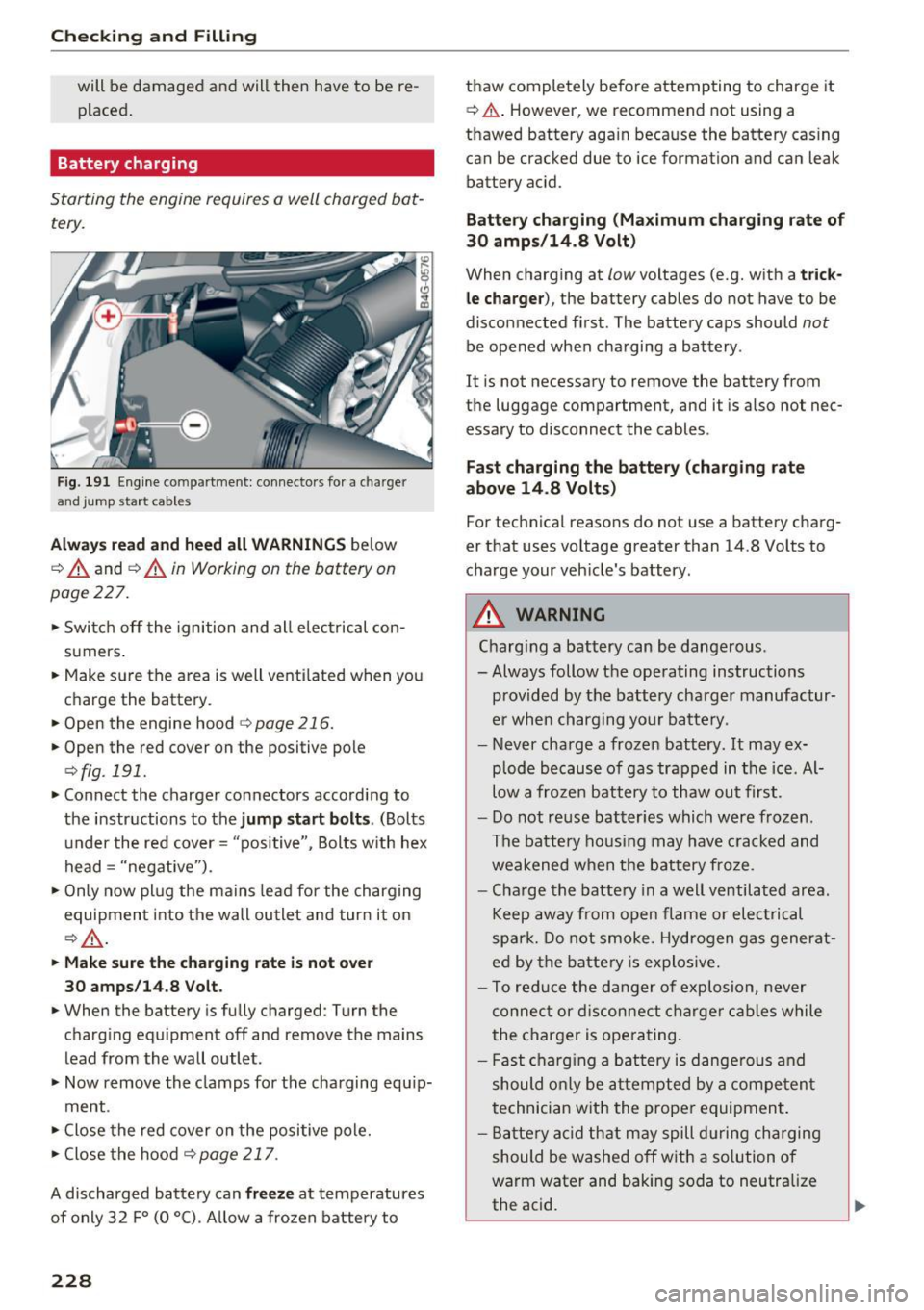
F ig. 191 Eng ine co mpartmen t: connecto rs for a cha rge r
and jump start cab les
Alwa ys re ad and h eed all WARNINGS below
¢ A and ¢ A in Working on the battery on
page 227.
• Switc h off the ignition and all elec trical con
sumers .
• Make sure the area is well venti lated when you
charge the battery .
• Open the engine hood
c> page 216.
• Open the red cover on the positive pole
¢ fig. 191.
• Connect the charger connectors according to
the instructions to the
j um p sta rt bo lt s . (Bolts
u nder the red cover= "positive" , Bolts w ith hex
head = "negative ") .
• Only now pl ug the mains lead for the charging
equipment into the wall outlet and tur n it on
¢£ .
• Make sure the charg ing rate is not o ver
30 a mps/14 .8 Volt .
• When the battery is fully charged: Turn the
charging equipment off and remove the mains
lead from the wall outlet .
• Now remove the clamps for the charging equ ip-
ment .
• Close the red cover on the positive pole.
• Close the hood
c> page 217 .
A discharged battery can free ze at temperatures
of only 32 F
0 (0 °C). A llow a frozen battery to
228
thaw completely before attempting to charge it
c> & . However, we recommend not using a
thawed battery aga in because the battery cas ing
can be cracked due to ice formation and can leak
battery ac id.
Batte ry cha rging (M ax imum charg ing rate of
30 amps /14 .8 V olt)
When charging at low voltages (e.g. with a tric k
le ch arger ),
the battery cables do not have to be
disconnected first . The battery caps should
not
be opened when charging a battery .
It is not necessary to remove the battery from
the luggage compartment, and it is also not nec
essary to disconnect the cables.
Fa st cha rging the batt ery (charg ing rat e
above 14 .8 Volt s)
For techn ical reasons do not use a battery charg
er that uses voltage greater than 14.8 Volts to
charge your veh icle's battery.
&_ WARNING
Charg ing a battery can be dangerous .
- Always follow the operating instructions
provided by the battery cha rger manufactur
er when charging your ba tte ry .
- Never charge a frozen battery . It may ex
plode because of gas trapped in the ice. Al
low a froze n battery to thaw out first.
- Do not reuse batter ies which were frozen.
The battery hous ing may have c racked and
weakened when the battery fro ze.
- Cha rge the batte ry in a well ventilated area .
Keep away from open flame or elect rical
sp ark. Do not smoke. Hydrogen gas generat
ed by the batte ry is e xplosive.
- To red uce the da nger of explosion, never
connect or d isconnect c harger c ables while
the charger is ope ra ting.
- Fa st c harg ing a bat tery is dange rous and
should o nly be atte mpted by a compe ten t
technician w ith the proper equipment .
- Ba tte ry a cid that may spill d uring charging
should be washed off w it h a so lution of
warm water and baking soda to neutralize
the acid.
Page 231 of 294
(D Note
Never use a fast charger as a booster to start
the engine . This will serious ly damage sensi
tive electronic components, such as control units, relays, radio, etc., as well as the battery
charger.
Battery replacement
The new battery must have the same specifica
tions and dimensions as the original equipment
battery .
Intelligent energy management in your vehicle is
responsible for distributing the electrical energy
throughout your vehicle
¢ page 192 . The intelli
gent energy management system w ill keep the
engine battery charged better than vehicles with
out this system . To make sure the addit ional
e lectrica l energy is available once again after you
have changed the battery, we recommend that
you install batteries of the same type and manu
facture only (the same as those installed at the
time your veh icle was delivered). Specifications
are listed on the battery housing. Your author
ized dealer must code the battery in the energy
management system to enable you to use the en
ergy management functions correctly after re
p lacing the battery .
The new battery must have the same capacity,
voltage (12-volts), amperage, construction and
plug sealing .
When installing the battery, make sure the igni
tion and all electrical consumers are sw itched
off.
(D Note
Make sure the ventilation hose on the side of
the battery is connected, otherw ise fumes or
battery acid can leak out.
- Vehicles with the Start-Stop-System* are
equipped with a special cycle-proof AGM
battery . Install ing a different type of bat
tery can cause prob lems in the vehicle elec
trical system. When replacing the vehicle
battery, always install one with the same
specifications as the original battery.
Checking and Filling
{® For the sake of the environment
Because of the problem of proper disposal of
a battery, we recommend your authorized
Audi dealer change the battery for you. Bat
teries contain sulfur ic acid and lead and must
always be disposed of properly in compliance
with all environmental regulations. Disposing
of veh icle batteries improperly is very danger
ous to the environment .
Windshield/head Light
washer container
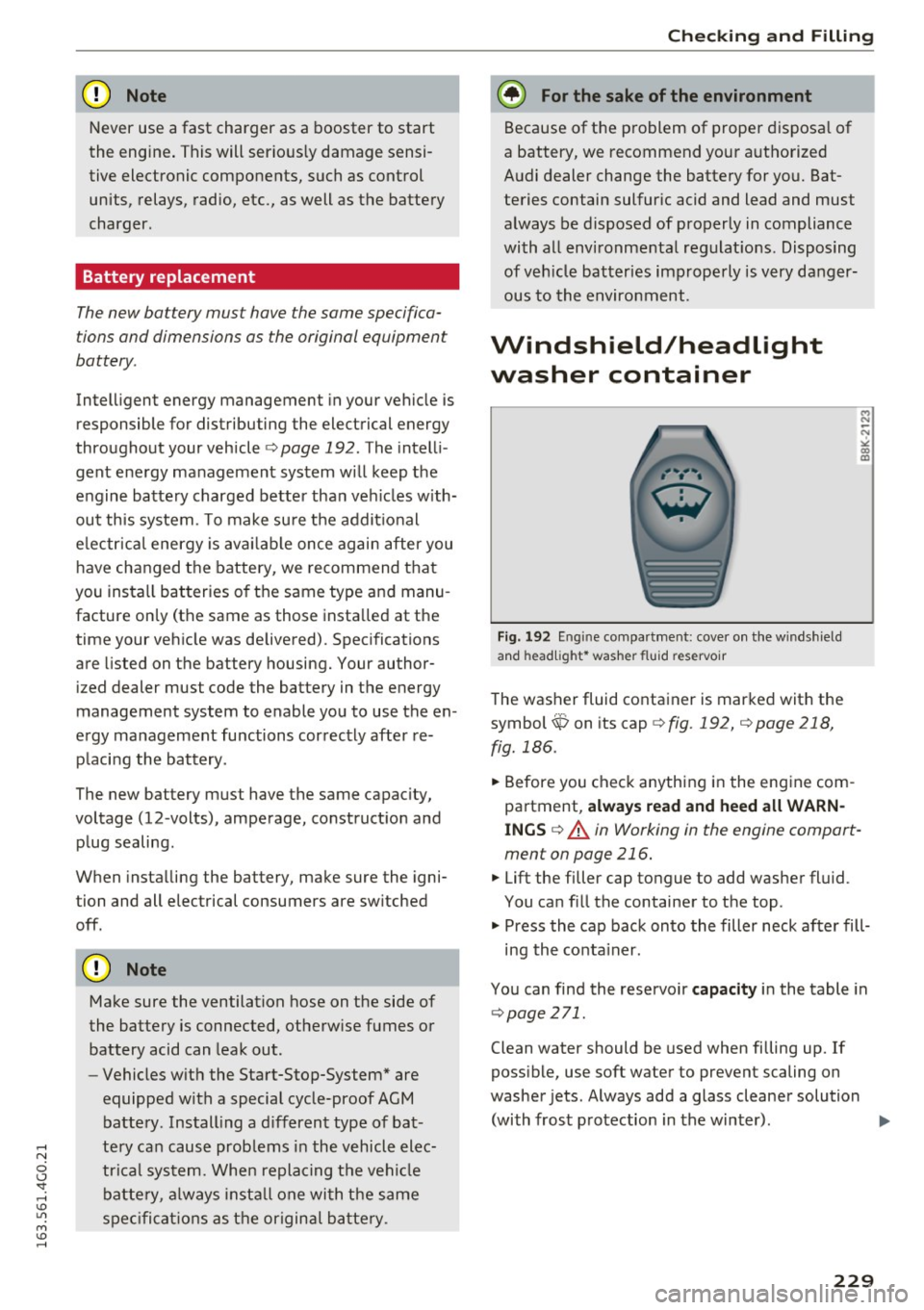
Fig. 192 Eng in e compar tment: cover on the windshie ld
and head light * washer fluid reservoir
The washer fluid container is marked with the
symbol~ on its cap
¢fig. 192, c:;,page 218,
fig. 186 .
.. Before you check anything in the engine com
partment,
always read and heed all WARN
INGS c::;, A in Working in the engine compart
ment on page 216.
.. Lift the filler cap tongue to add washer fluid .
You can fill the container to the top .
.. Press the cap back onto the filler neck after fill-
ing the container .
You can find the reservoir
capacity in the table in
¢page 271.
Clean water should be used when filling up. If
possible, use soft water to prevent scaling on
washer jets. Always add a glass cleaner solution
(with frost protection in the winter) . ..,.
229
Page 237 of 294
(a) Curb weight
(b) Accessory weight
(c) Vehicle capacity weight, and
(d) Production options we ight
Ma ximum (permissible)
inflation pressure
means the maximum cold infla
tion pressure to which a t ire may
be inflated. Also called "maxi
mum inflation pressure."
Normal occupant weight
means 150 lbs. (68 kilograms)
times the number of occupants
seated in the veh icle up to the to
tal seating capacity of your vehi c le.
Occupant distribution
means distribution of occupants
in a vehicle.
Outer diameter
means the overall diameter of an
inflated new tire.
Overall width
means the linear distance be
tween the exteriors of the side
walls of an inflated tire, including elevations due to labeling, deco
rations, or protective bands or
ribs .
Wheels
Ply
means a layer of rubber-coated
parallel cords .
Production options weight
means the combined weight of
those installed regular production
options weighing over 5 lbs. (2.3 kg) in excess of those standard
items which they replace, not pre
viously considered in curb weight
or accessory weight, including heavy duty brakes , ride levelers,
roof rack, heavy duty battery, and
special trim .
Radial ply tire
means a pneumatic tire in which
the ply cords that extend to the beads are laid at substantially 90
degrees to the centerline of the
tread.
Recommended inflation
pressure
see ~ page 234, Cold tire infla
tion pressure .
Reinforced tire
means a tire designed to operate
at higher loads and at higher in
flation pressures than the corre sponding standard tire. Rein
forced tires may be identified as
235
Page 266 of 294
Emergency situations
Emergency situations
General
This chapter is intended for trained emergency crews and working personnel who have the nec
essary tools and equipment to perform these
operations.
Starting by pushing or
towing
CD Note
Vehicles with an automatic transmission can
not be started by pushing or towing.
Starting with jumper
cables
If necessary, the engine con be started by con
necting it to the battery of another vehicle .
If the engine should fail to start because of a dis
charged or weak battery, the battery can be con
nected to the battery of
another vehicle, using a
pair of jumper cables to start the engine.
Jumper cables
Use only jumper cables of sufficiently large cross
section
to carry the starter current safely. Refer
to the manufacturer's specifications.
Use only jumper cables with
insulated terminal
clamps which are distinctly marked :
plus(+) cable in most cases colored red
minus(-) cable
in most cases colored black .
A WARNING
Batteries contain electricity, acid, and gas.
Any of these can cause very serious or fatal in
jury. Follow the instructions below for safe hand Ling of your vehicle's battery .
-Always shield your eyes and avoid leaning
over the battery whenever possible.
-A discharged battery can freeze at tempera
tures just below 32 °F (0 °C). Before con
necting a jumper cable, you must thaw the
264
frozen battery completely, otherwise it could explode .
- Do not allow battery acid to contact eyes or
skin. Flush any contacted area with water immediately.
- Improper use of a booster battery to start a
vehicle may cause an explosion.
- Vehicle batteries generate explosive gases.
Keep sparks, flame and lighted cigarettes
away from batteries.
- Do not try to jump start any vehicle with a
low acid level in the battery .
- The voltage of the booster battery must also
have a 12-volt rating. The capacity (Ah) of
the booster battery should not be lower
than that of the discharged battery. Use of
batteries of different voltage or substantial
ly different "Ah" rating may cause an explo
sion and personal injury .
- Never charge a frozen battery. Gas trapped in the ice may cause an explosion .
- Never charge or use a battery that has been
frozen . The battery case may have be weak
ened .
- Use of batteries of different voltage or sub stantially different capacity (Ah) rating may
cause an explosion and injury. The capacity
(Ah) of the booster battery should not be
lower than that of the discharged battery.
- Before you check anything in the engine
compartment, always read and heed all
WARNINGS
~page 216.
CD Note
-Applying a higher voltage booster battery
will cause expensive damage to sensitive
electronic components, such as control
units, relays, radio, etc.
- There must be no electrical contact between
the vehicles as otherwise current could al
ready start to flow as soon as the positive
(+) terminals are connected.
@ Tips
The discharged battery must be properly con-
nected to the vehicle's electrical system. .,.
Page 267 of 294
.... N
0 CJ '
When jump starting or charging the battery,
never connect the negative ground cable to
the battery negative post because the battery
manager system must be able to detect the
battery's state of charge . Always connect the
negative ground cable to the negat ive ground
post of the battery manager control unit .
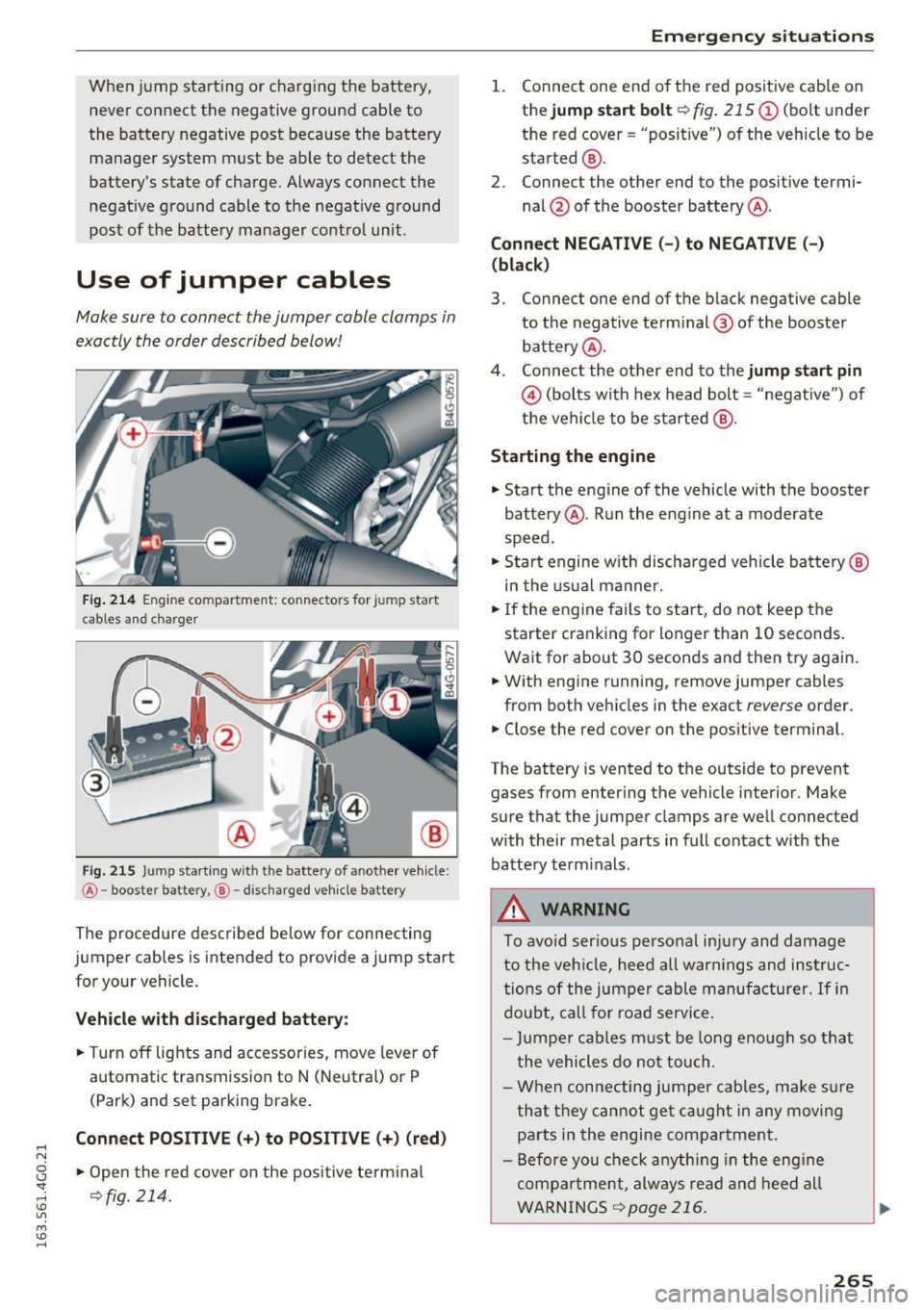
Use of jumper cables
Make sure to connect the jumper cable clamps in
exactly the order described below!
Fig. 214 Engine compa rtment: connec tor s for ju mp start
cables and cha rger
@
Fig. 215 Jump start ing with the battery of another vehicle:
@ -booste r battery ,@ -discharged vehicle battery
The procedure described below for connecting
jumper cables is intended to provide a jump start
for your vehicle.
Vehicle with discharged battery:
.. Turn off lights and accessories, move lever of
automatic transmission to N (Neutral) or P
(Park) and set parking brake .
Connect POSITIVE(+) to POSITIVE(+) (red)
.,. Open the red cover on the positive terminal
~fig. 214 .
Emergency situations
1. Connect one end of the red positive cab le on
the
jump start bolt~ fig. 215 (D (bolt under
the red cover = "posit ive") of the veh icle to be
started @.
2. Connect the other end to the posit ive termi-
nal @of the booster battery @.
Connect NEGATIVE (-) to NEGATIVE (- )
(black)
3. Connect one end of the black negative cable
to the negative terminal @ of the booster
battery @.
4 . Connect the other end to the
jump start pin
@ (bolts with hex head bolt= "negat ive") of
the vehicle to be started @.
Starting the engine
.. Start the engine of the vehicle with the booster
battery @. Run the eng ine at a moderate
speed .
.,. Start engine w ith discharged vehicle battery @
in the usual manner.
.,. If the engine fails to start, do not keep the
starter cranking for longer than 10 seconds.
Wait for about 30 seconds and then try again .
.. With engine running, remove jumper cables
from both vehicles in the exact
reverse order .
.. Close the red cover on the positive terminal.
The battery is vented to the outside to prevent gases from entering the vehicle interior . Make
sure that the jumper clamps are well connected
with their metal parts in full contact with the
battery term inals .
A WARNING
To avoid ser ious personal injury and damage
to the vehicle, heed all warnings and instruc
tions of the jumper cable manufacturer.
If in
doubt, call for road service.
- Jumpe r cables must be long enough so that
the vehicles do not touch .
- When connecting jumper cables, make su re
that they cannot get caug ht in any moving
parts in the engine compartment.
- Before you check anything in the engine
compa rtment, always read and heed all
WARNINGS
~page 216.
265
Page 268 of 294
Emergency situations
(D Note
Improper hook -up of ju mper cables can r uin
the generato r.
- Always con nect P OSITIVE( +) to POS ITI VE
( + ), and NEG ATI VE( -) to NEGATIVE( -)
ground post of t he battery manage r contro l
u nit .
- Check that a ll sc rew p lugs on the battery
cells are sc rewed in firmly . If not, t ighten
plugs p rior to connect ing clamp o n negat ive
b attery t erminal.
- Please note t hat the procedure fo r con nect
i ng a jumper cable as desc rib ed above ap
plies specifica lly to the case of yo ur vehicle
being jum p starte d. When you a re giv ing a
ju mp sta rt to anothe r vehicle, do
not con
n e ct t he neg ative( -) ca b le to the neg ative
(- ) termin al o n t he dis ch arged battery @
¢
fig . 215. Inste ad, securely connec t the
negative (-) cab le to either a so lid metal
compo nent that is f irm ly bolted to the e n
gine block o r to the engine bloc k itself. If
the battery that is bei ng cha rged does not
vent to the outside, escap ing battery gas
could ignite an d exp lode!
Towing with a tow truck
General hints
Your Audi requires special handling for towing.
The fo llow ing informa tion is to be used by com
mercial tow truck operators who know how to op
era te the ir equipmen t sa fe ly .
- Never tow your Audi. Towing will cause dam
age to the engine and transmi ssion.
- Never wrap the safety chains or winch cables
around the brake l ines .
- To prevent unnecessary damage, your Audi
must be transported with a flat bed truck.
- To load the vehicle on to the flat bed , use the
towing loop found in the vehicle tools and at
tach to the front or rear anchorage
¢ page 266 and ¢ page 267.
266
A WARNING
A veh icle being towed is not safe for passe n
ge rs . Neve r allow a nyone to ride in a vehicle
be ing towed, fo r any reason .
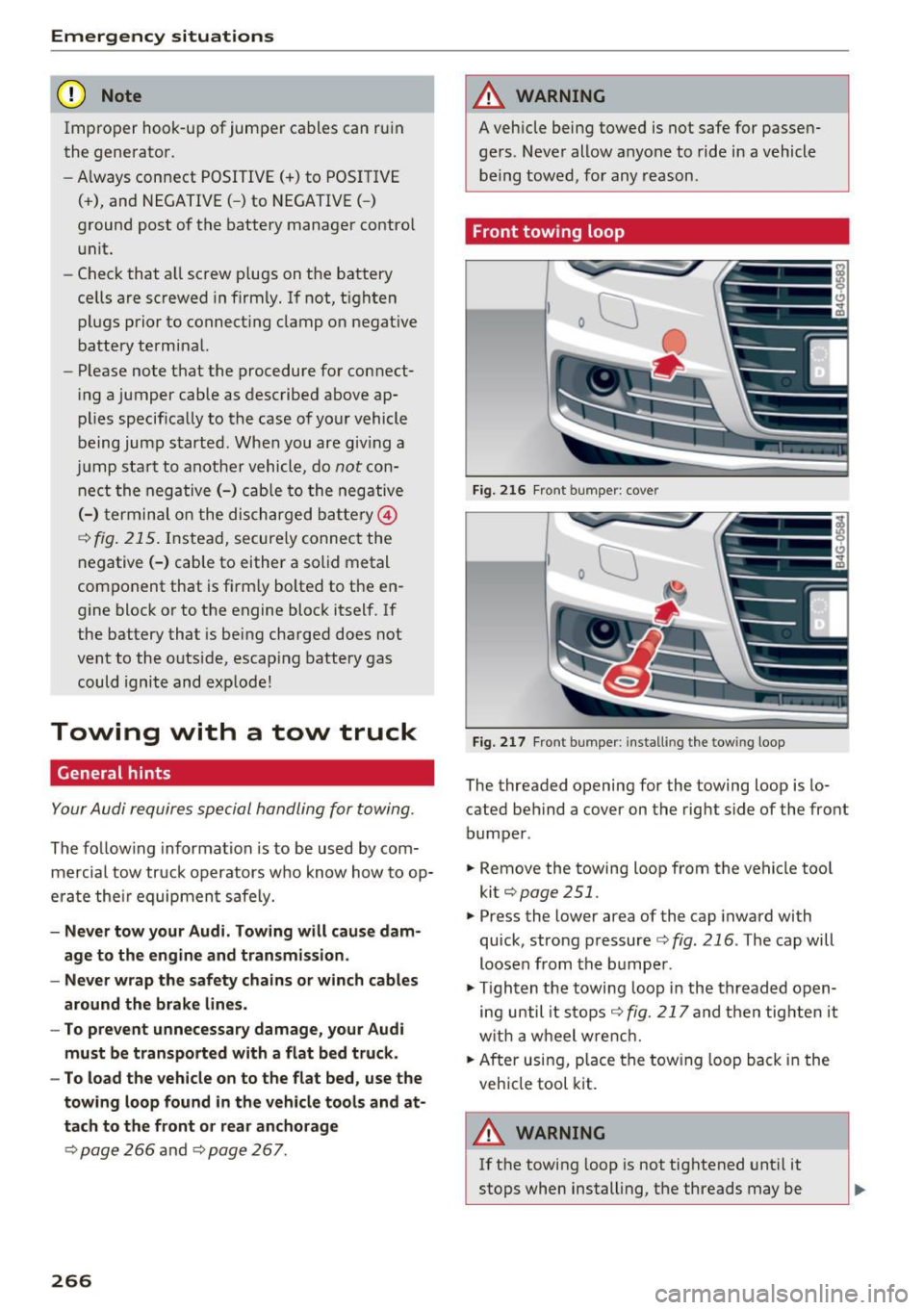
Front towing loop
Fig. 216 Fron t bumper : cover
Fi g. 21 7 Fron t bumper : install ing the tow ing loop
The threaded opening for the towing loop is lo
cated behind a cover on the rig ht side of the front
bumper .
.. Remove the towing loop f rom the vehicle too l
kit¢
page 251 .
.. Press the lower area of the cap inward with
quick, strong p ressure
¢ fig. 216 . The cap will
loosen from the b umpe r.
.. Tighten the towi ng loop in the threaded o pen
i n g until it stops ¢
fig. 21 7 and then tig hten it
w it h a wheel wre nc h .
.. After using, p lace the tow ing loop b ack in the
veh icle tool kit.
A WARNING
If t he t owi ng loop is not tightened unt il it
stops when installing, the threads may be
-
Page 280 of 294
Index
AUTO Automatic headlights . . . . . . . . . . . . . . . . . 44
Four-zone automatic cl imate control . . . . . 70
Three- zone climate control . . . . . . . . . . . . . 68
Auto Lock . . . . . . . . . . . . . . . . . . . . . . . . . . . . 32
Automatic belt retractor . . . . . . . . . . . . . . . 13 7
Automatic post-collision braking system . . 188
Automatic transm ission . . . . . . . . . . . . . . . . 106
Driving . . . . . . . . . . . . . . . . . . . . . . . . . . . . 108
Emergency mode . . . . . . . . . . . . . . . . . . . . 111
Hill descent contro l . . . . . . . . . . . . . . . . . . 109
Kick-down.......................... 110
Manual shift program . . . . . . . . . . . . . . . . 1 10
Selector lever . . . . . . . . . . . . . . . . . . . . . . . 106
Selector lever emergency release . . . . . . . 112
Automatic wipe/wash system . . . . . . . . . . . . 51
Auto Safety Hotline . . . . . . . . . . . . . . . . . . . 132
Auxiliary heater (four-zone automatic climate
control) . . . . . . . . . . . . . . . . . . . . . . . . . . . . . . 72
Auxiliary heater (three-zone climate control) 69
Average consumption . . . . . . . . . . . . . . . . . . . 24
Average speed . . . . . . . . . . . . . . . . . . . . . . . . 24
Avoid damaging the vehicle . . . . . . . . . . . . . 194
B
Battery ... .. .. ... .. .. .. ... .. ... .. .. .
Charge level .. .... ........... .... .. .
Charging . .. .. ............... .... .. .
Energy management ................ .
Important warnings .............. .. .
Jump starting ................... ... .
Location
. .. .. .. ............. .... .. .
Replacing the battery .. ... .... .. .. .. .
Win ter operation .... ............. .. .
Working on the battery .............. .
Before driving 226
192
228 192
226
264
226
229
226 226
12S
Belt tensioners . . . . . . . . . . . . . . . . . . . . . . . 140
Blended g asoline . . . . . . . . . . . . . . . . . . . . . 208
Blower (four-zone automatic climate control) .7.1
Blower (three-zone climate control) . . . . . . . 68
Booster seats . . . . . . . . . . . . . . . . . . . . . . . . 17 5
Brake fluid Changing the brake fluid . . . . . . . . . . . . . . 225
Checking the brake fluid level . . . . . . . . . . 225
Brakes Indicator light . . . . . . . . . . . . . . . . . . . . . . . 21
278
Brake system
Anti- lock braking syst em . . . . . . . . . . . . . . . 19
Brake booster . . . . . . . . . . . . . . . . . . . . . . . 190
Brake fluid . . . . . . . . . . . . . . . . . . . . . . . . . 22S
Brake fluid specific ations fo r refill and re
placement . . . . . . . . . . . . . . . . . . . . . . . . . 225
Brake power assist unit . . . . . . . . . . . . . . . 189
Brakes . . . . . . . . . . . . . . . . . . . . . . . . . . . . . 189
Electromechanical parking brake . . . . . . . . 77
Fluid reservoir . . . . . . . . . . . . . . . . . . . . . . 225
Warning/indicator lights . . . . . . . . . . . . . . . 14
Worn brake pads symbo l . . . . . . . . . . . . . . . 19
Braking Brake assist . . . . . . . . . . . . . . . . . . . . . . . . 187
Emergency braking function . . . . . . . . . . . . 78
Braking guard . . . . . . . . . . . . . . . . . . . . . . . . . 84
Messages . . . . . . . . . . . . . . . . . . . . . . . . . . . 91
Settings . . . . . . . . . . . . . . . . . . . . . . . . . . . . 91
Break-in period Brake pads . . . . . . . . . . . . . . . . . . . . . . . . . 189
Tires 194
Breaking in . . . . . . . . . . . . . . . . . . . . . . . . . . 194
New tires . . . . . . . . . . . . . . . . . . . . . . . . . . 238
Bulbs . . . . . . . . . . . . . . . . . . . . . . . . . . . . . . . 263
C
California Proposition 65 Warning ..... . .
Battery specific .. .. .. .. ........... . .
Capacities Ad Blue 217
227
271
212
E ngine oil ....... ... ............. .. . 218
Car carrier Tr ansporting your vehicle . . . . . . . . . . . . . 26 7
Care . . . . . . . . . . . . . . . . . . . . . . . . . . . . . . . . 203
Cargo area .. ... ... .. .. ... ..... ..... .. 131
Cargo net . . . . . . . . . . . . . . . . . . . . . . . . . . . . 65
Catalytic converter 195
Center armrest Cockpit . . . . . . . . . . . . . . . . . . . . . . . . . . . . . 56
Central locking . . . . . . . . . . . . . . . . . . . . . . . . 31
Emergency locking . . . . . . . . . . . . . . . . . . . . 36
Power windows . . . . . . . . . . . . . . . . . . . . . . 40
Setting . . . . . . . . . . . . . . . . . . . . . . . . . . . . . 33
Sunroof. . . . . . . . . . . . . . . . . . . . . . . . . . . . . 40
Certification . . . . . . . . . . . . . . . . . . . . . . . . . 276
Changing engine oil . . . . . . . . . . . . . . . . . . . 221
Page 283 of 294
Starting . . . . . . . . . . . . . . . . . . . . . . . . . . . . 7 4
Starting with jumper cables . . . . . . . . . . . 264
Stopping . . . . . . . . . . . . . . . . . . . . . . . . . . . . 7 5
E ng ine compartment ......... .. .. .... . 218
C losing the hood . . . . . . . . . . . . . . . . . . . . 217
Opening the hood ................... 216
Safety instructions .................. . 216
Working in the engine compartment .... 216
Index
Event Data Recorder (EDR) . . . . . . . . . . . . . 186
Expansion tank . . . . . . . . . . . . . . . . . . . . . . . 222
Exterior lighting . . . . . . . . . . . . . . . . . . . . . . . 44
Exterior mirrors
Adjusting . . . . . . . . . . . . . . . . . . . . . . . . . . . 48
Dimming ... ... .. .. ................ .. 49
Heating.... ... .. .. ................. . 48
Exterior temperature d isplay . . . . . . . . . . . . . 23
E ng ine coolant . . . . . . . . . . . . . . . . . . . . . . . 222
Adding coolant . . . . . . . . . . . . . . . . . . . . . . 223
F
Checking the engine coolant level. . . . . . . 222
Expansion tank . . . . . . . . . . . . . . . . . . . . . . 222
Malfunction symbol . . . . . . . . . . . . . . . . . . . 15
Radiator fan . . . . . . . . . . . . . . . . . . . . . . . . 224
Temperature gauge . . . . . . . . . . . . . . . . . . . 10
Engine oil ... .. ................ ..... . 218
Adding . . . . . . . . . . . . . . . . . . . . . . . . . . . . 220
Additives . . . . . . . . . . . . . . . . . . . . . . . . . . . 220
Changing . . . . . . . . . . . . . . . . . . . . . . . . . . 221
Checking oil level . . . . . . . . . . . . . . . . . . . . 220
Consumption . . . . . . . . . . . . . . . . . . . . . . . 220
Indicator light . . . . . . . . . . . . . . . . . . . . . . . 17
O il consumption . . . . . . . . . . . . . . . . . . . . . 219
Pressure malfunction . . . . . . . . . . . . . . . . . 17
Sensor defective . . . . . . . . . . . . . . . . . . . . . . 21
Specification and viscos ity.... .. .. .. .. . 218
Engine sound . . . . . . . . . . . . . . . . . . . . . . . . 100
Engine speed limitation (indicator light) 21
E ng ine Start-Stop mode
refer to Start-Stop-System . . . . . . . . . . . . . 81
Engine warm-up request Indicator light . . . . . . . . . . . . . . . . . . . . . . . 21
Environment Catalytic converter . . . . . . . . . . . . . . . . . . . 195
Diesel particulate filter . . . . . . . . . . . . . . . 196
Disposing of your vehicle battery . . . . . . . 229
Driving at high speeds . . . . . . . . . . . . . . . . 196
Fue l .. ... ... ...... ............. ... . 210
L eaks under your veh icle ....... .. .. .. . 216
L ett ing the veh icle stand and wa rm up . . . 197
Proper disposal of drained brake fluid . . . 225
Proper disposal of drained engine coolant 223
Proper disposal of drained engine oi l 220,221
Recycling used engine oil . . . . . . . . . . . . . 220
Unleaded fuel . . . . . . . . . . . . . . . . . . . . . . . 208
What should I do with an old battery? . . . 229
ESC Automatic post-collision braking system . 188 Fastening
Booster seats . . . . . . . . . . . . . . . . . . . . . . . 17 S
Convertible child safety seats . . . . . . . . . . 173
Infant seats . . . . . . . . . . . . . . . . . . . . . . . . 172
Floor mats . . . . . . . . . . . . . . . . . . . . . . . . . . . 130
Foot pedals . . . . . . . . . . . . . . . . . . . . . . . . . . 130
For the sake of the env ironment
Environmentally-friendly driving . . . . . . . 196
Gasoline fumes and the env ironment .. .. 210
Reducing engine noise by early upshifting . 10
Refueling . . . . . . . . . . . . . . . . . . . . . . . . . . 210
Saving fuel by early upshifting . . . . . . . . . . 10
Warming up the engine . . . . . . . . . . . . . . . . 74
Four-zone automatic climate control
Air vents . . . . . . . . . . . . . . . . . . . . . . . . . . . . 71
Auxiliary heater . . . . . . . . . . . . . . . . . . . . . . 72
Basic settings . . . . . . . . . . . . . . . . . . . . . . . . 72
Operating . . . . . . . . . . . . . . . . . . . . . . . . . . . 70
Recirculation mode . . . . . . . . . . . . . . . . . . . 72
Residual heat . . . . . . . . . . . . . . . . . . . . . . . . 71
Synchronizing .. .. .. .................. 71
Front airbags Description . . . . . . . . . . . . . . . . . . . . . . . . . 146
How they work . . . . . . . . . . . . . . . . . . . . . . 151
Frontal collisions and the laws of physics . . 135
Front seats . . . . . . . . . . . . . . . . . . . . . . . . . . . 54
Adjusting . . . . . . . . . . . . . . . . . . . . . . . . . . 127
Child restraints in the front seat . . . . . . . . 143
Fuel Additives . . . . . . . . . . . . . . . . . . . . . . . . . . . 208
Blended gasoline . . . . . . . . . . . . . . . . . . . . 208
Current consumption . . . . . . . . . . . . . . . . . . 24
Fuel filler neck . . . . . . . . . . . . . . . . . . . . . . 210
Fuel gauge .. .. .. ............... .. 10 , 11
Gasoline . . . . . . . . . . . . . . . . . . . . . . . . . . . 208
Gasoline additives . . . . . . . . . . . . . . . . . . . 209
Indicator light . . . . . . . . . . . . . . . . . . . . . . . 21
281
Page 285 of 294
J
Jac k 251
J ump-starting . . . . . . . . . . . . . . . . . . . . . . . . 264
Jumpe r cables . . . . . . . . . . . . . . . . . . . . . . . . 265
K
Key ... .. .. .. .. .. .. .. .... ... .. .. .... .. 30
Emergency key . . . . . . . . . . . . . . . . . . . . . . . 30
Indicator light . . . . . . . . . . . . . . . . . . . . . . . 76
K ey not recognized . . . . . . . . . . . . . . . . . . . 76
Key replacement . . . . . . . . . . . . . . . . . . . . . 30
Master key . . . . . . . . . . . . . . . . . . . . . . . . . . 30
Mechanical key . . . . . . . . . . . . . . . . . . . . . . . 30
R eplac ing the battery . . . . . . . . . . . . . . . . . 3 1
K ick-down (automatic transmission) . . . . . . 110
Knee ai rbags . . . . . . . . . . . . . . . . . . . . . . . . . 158
D escrip tion . . . . . . . . . . . . . . . . . . . . . . . . . 158
H ow they work . . . . . . . . . . . . . . . . . . . . . . 159
Important safety instructions . . . . . . . . . . 160
L
Lane assist
refer to Act ive lane assist . . . . . . . . . . . . . . 93
L ATCH . . . . . . . . . . . . . . . . . . . . . . . . . . . . . . 179
D escr ip ti on . . . . . . . . . . . . . . . . . . . . . . . . . 180
I ns tal ling a chi ld restraint . . . . . . . . . . . . . 18 1
L ocation . . . . . . . . . . . . . . . . . . . . . . . . . . . 180
M ounting and releasing the anchorage
hook . . . . . . . . . . . . . . . . . . . . . . . . . . . . . . 181
L aunch cont rol prog ram . . . . . . . . . . . . . . . . 110
Leather care/clean ing . . . . . . . . . . . . . . . . . 206
L eaving home . . . . . . . . . . . . . . . . . . . . . . . . . 46
Lifting jack . . . . . . . . . . . . . . . . . . . . . . . . . . 255
Light Ambie nt lighting . . . . . . . . . . . . . . . . . . . . . 47
Com ing/Leav ing home . . . . . . . . . . . . . . . . . 46
Daytime runn ing lights . . . . . . . . . . . . . . . . 44
E mergency flashe rs . . . . . . . . . . . . . . . . . . . 47
H igh beam . . . . . . . . . . . . . . . . . . . . . . . . . . 45
H igh be am ass ist . . . . . . . . . . . . . . . . . . . . . 45
I n ter io r/reading lig hts . . . . . . . . . . . . . . . . 47
L ow beams . . . . . . . . . . . . . . . . . . . . . . . . . . 4 4
Pa rking lights . . . . . . . . . . . . . . . . . . . . . . . . 4 4
Rear fog lights . . . . . . . . . . . . . . . . . . . . . . . 44
Turn signa ls . . . . . . . . . . . . . . . . . . . . . . . . . 45
Index
Li ght/rain senso r
Head lights . . . . . . . . . . . . . . . . . . . . . . . . . . 44
Indicator light . . . . . . . . . . . . . . . . . . . . . . . 22
Intermittent (windshie ld wipers) . . . . . . . . 51
Li ght ing
E xterior . . . . . . . . . . . . . . . . . . . . . . . . . . . . . 44
Interior . . . . . . . . . . . . . . . . . . . . . . . . . . . . . 47
Li ghts
He ad ligh t range cont ro l sys tem . . . . . . . . . 44
Load ing the roof rack . . . . . . . . . . . . . . . . . . . 63
Locking Power locking switch . . . . . . . . . . . . . . . . . . 35
Remote control . . . . . . . . . . . . . . . . . . . . . . 33
Using the key . . . . . . . . . . . . . . . . . . . . . . . . 35
L ow beam
Indicator light . . . . . . . . . . . . . . . . . . . . . . . 21
L ow beams . . . . . . . . . . . . . . . . . . . . . . . . . . . 44
Lower universal anchorages (Canada) 179
L uggage comp artmen t
12 Vo lt socket . . . . . . . . . . . . . . . . . . . . . . . 60
Cargo net . . . . . . . . . . . . . . . . . . . . . . . . . . . 65
En larging . . . . . . . . . . . . . . . . . . . . . . . . . . . 64
Load ing... .... .. .. ............... .. . 64
Ski sack . . . . . . . . . . . . . . . . . . . . . . . . . . . . . 66
Stor ing cargo correctly . . . . . . . . . . . . . . . 131
Stow ing luggage . . . . . . . . . . . . . . . . . . . . 131
Tie-downs . . . . . . . . . . . . . . . . . . . . . . . . . . . 6S
Luggage compartment lid
Closing button . . . . . . . . . . . . . . . . . . . . . . . 37
Emergency release . . . . . . . . . . . . . . . . . . . . 39
movement -activated opening . . . . . . . . . . . 38
Open ing/closing . . . . . . . . . . . . . . . . . . . . . . 37
Lumba r support
Front seats . . . . . . . . . . . . . . . . . . . . . . . . . . 5S
M
Maintenance . . . . . . . . . . . . . . . . . . . . . . . . . 273
Mainten ance i ntervals . . . . . . . . . . . . . . . . . . 26
Malfunc tion Indicator Lamp (MIL) . . . . . 20, 28
Manua l shift program . . . . . . . . . . . . . . . . . 110
Massage function Front seats . . . . . . . . . . . . . . . . . . . . . . . . . . 55
Mechan ica l key . . . . . . . . . . . . . . . . . . . . . . . . 30
Memo ry fun ct ion . . . . . . . . . . . . . . . . . . . . . . 5 7
Mirror Vanity mirror . . . . . . . . . . . . . . . . . . . . . . . . 50
283
Page 287 of 294
Pregnant women
Special considerations when wearing a safe-
ty belt . . . . . . . . . . . . . . . . . . . . . . . . . . . . . 139
Pre sense .. .. .. .. ........... .. .. .... .
Pressure (tires)
Pretensioners 184
249
Pre sense . . . . . . . . . . . . . . . . . . . . . . . . . . 184
Preventative passenger protection . . . . . . . 184
Prewarming . . . . . . . . . . . . . . . . . . . . . . . . . . 74
Proper occupant seating positions . . . . . . . 126
Proper safety belt position . . . . . . . . . . . . . . 138
Proper seating position Front passenger . . . . . . . . . . . . . . . . . . . . . 127
Occupants . . . . . . . . . . . . . . . . . . . . . . . . . . 126
Rear passengers . . . . . . . . . . . . . . . . . . . . . 128
Protecting . . . . . . . . . . . . . . . . . . . . . . . . . . . 205
Q
quattro (all wheel drive).......... ..... . 191
Quest ion
What happens to unbelted occupants? 135
R
Radiator fan 224
Rain/light sensor Headlights . . . . . . . . . . . . . . . . . . . . . . . . . . 44
Indicator light . . . . . . . . . . . . . . . . . . . . . . . 22
Intermittent (windshield wipers) . . . . . . . . 51
Raising the vehicle . . . . . . . . . . . . . . . . . . . . 268
Range (fuel level) . . . . . . . . . . . . . . . . . . . . . . 24
Reading lights . . . . . . . . . . . . . . . . . . . . . . . . . 47
Rear fog lights . . . . . . . . . . . . . . . . . . . . . . . . 44
Rear lid Escape hand le . . . . . . . . . . . . . . . . . . . . . . 251
Opening and clos ing . . . . . . . . . . . . . . . . . . 36
Rear light Indicator light . . . . . . . . . . . . . . . . . . . . . . . 21
Rearview camera
refer to Parking systems . . . . . . . . . . 114, 115
Rear view m irror . . . . . . . . . . . . . . . . . . . . . . . 49
Rear window defogger (four-zone automatic
climate control) . . . . . . . . . . . . . . . . . . . . . . . 71
Rear window defogger (three-zone climate
control) . . . . . . . . . . . . . . . . . . . . . . . . . . . . . . 69
Index
Recirculation mode (four-zone automatic cli
mate control) . . . . . . . . . . . . . . . . . . . . . . . . . 70
Recirculation mode (three-zone climate con-
trol) . . . . . . . . . . . . . . . . . . . . . . . . . . . . . . . . . 68
Recuperation . . . . . . . . . . . . . . . . . . . . . . . . . 24
Refilling AdBlue With bottle . . . . . . . . . . . . . . . . . . . . . . . . . 214
With canister . . . . . . . . . . . . . . . . . . . . . . . 214
Refuelling . . . . . . . . . . . . . . . . . . . . . . . . . . . 210
Remote control Garage door opener (Homelink) . . . . . . . . . 42
Unlocking and locking . . . . . . . . . . . . . . . . . 33
Remote control key LED . . . . . . . . . . . . . . . . . . . . . . . . . . . . . . . . 31
Replacing the battery . . . . . . . . . . . . . . . . . 31
Remote rear lid release . . . . . . . . . . . . . . . . . 36
Repair manuals . . . . . . . . . . . . . . . . . . . . . . . 273
Repairs Airbag system . . . . . . . . . . . . . . . . . . . . . . 157
Replacing Light bulbs . . . . . . . . . . . . . . . . . . . . . . . . . 263
Replacing windshield wiper blades . . . . . . . . 52
Reporting Safety Defects . . . . . . . . . . . 132, 133
Reset button (trip odometer) . . . . . . . . . . . . 26
Resetting the trip odometer . . . . . . . . . . . . . 26
Residual heat (four-zone automatic climate
control) . . . . . . . . . . . . . . . . . . . . . . . . . . . . . . 71
Retractor . . . . . . . . . . . . . . . . . . . . . . . . . . . . 13 7
Rims ..... ... .. .. .. ... ....... ... .. .. 246
Roof rack . . . . . . . . . . . . . . . . . . . . . . . . . . . . . 62
Loading . . . . . . . . . . . . . . . . . . . . . . . . . . . . . 63
Roof weight . . . . . . . . . . . . . . . . . . . . . . . . . 63
s
Safe driving habits
Safety 12S
Airbag system . . . . . . . . . . . . . . . . . . . . . . 142
Belts . . . . . . . . . . . . . . . . . . . . . . . . . . . . . . 134
Cargo . . . . . . . . . . . . . . . . . . . . . . . . . . . . . 131
Correct seating position . . . . . . . . . . . . . . 126
Pedal area . . . . . . . . . . . . . . . . . . . . . . . . . . 130
Safety belt pos ition . . . . . . . . . . . . . . . . . . . 138
Safety belt height adjustment . . . . . . . . . 139
Safety be lts worn by pregnant women . . . 139
Safety belt pretens ioner
Service and disposal . . . . . . . . . . . . . . . . . . 141
285