ECO mode AUDI S7 2012 Owner's Manual
[x] Cancel search | Manufacturer: AUDI, Model Year: 2012, Model line: S7, Model: AUDI S7 2012Pages: 294, PDF Size: 73.33 MB
Page 197 of 294
Avoid full throttle
Driving at moderate speeds saves fuel and
improves your mileage.
"" Try and keep well below your car's maxi-
mum speed.
Accelerating gently reduces fuel consump tion, engine wear, and does not disturb the
environment.
F ue l consumption, exhaust emissions and en
g ine noise increase disproportionately at high
speeds. If you drive at approximately three
quarters of top speed, fuel consumption will be reduced by one half. Never drive faster
than the posted speed limit and weather con
d itions permit .
Reducing unnecessary idling
Even when your car is just idling it burns up
fuel.
"" Shut the engine off when you are not driv
ing the vehicle.
"" Do not warm up the veh icle by letting the
engine run at idle .
It makes sense to shut
off the engine in traff ic
jams, when waiting for trains to pass at ra il
road crossings, or at traffic lights that have
l ong wa its on red. Turning the engine
off fo r
just
30-40 seconds saves more fue l than is
bu rned starting the eng ine again .
It takes a long time for the engine to warm up
fu lly when it is running at idle. However, wear
and nox ious em issions are especially high
when the engine is warming up. So you should
drive away as soon as you start the engine and
avoid running at high rpms while the engine is
still warming up .
(D Note
Do not leave engine idling unattended af
ter starting . If warning lights should come
on to indicate improper operation, they
would go unheeded. Extended idling also produces heat, which cou ld result in over-
Dri vin g and en vironm ent 195
'
heating o r othe r damage to the vehicle or
other property .
Regular maintenance
A badly tuned engine unnecessarily wastes a
lot of fuel.
"" Have your veh icle serviced at reg ular i nter-
vals.
By having your vehicle regu larly serviced by an
Audi dealer he lps to ensu re that it runs prop
erly and economically. The condition of your
vehicle not only affects its safety and ability to
hold its value, it a lso affects
fuel c onsump
tion .
Ch eck you r o il e ach time you fill your tank .
The amount of o il used is re lated to eng ine
load and speed .
It is normal for the oil consumption of a new
engine to reach its lowest value after a certa in
mileage has been driven .
You must drive your vehicle about 3,000 m iles
(5,000 kilometers) before you can properly
assess oil consumpt ion.
This also app lies to fue l consumption and en
gine output.
(U) Note
- Have your vehicle maintained properly
and in accordance with the service rec
ommendations in your Warranty
& Ma in
tenance booklet . Lack of proper mainte
nance as well as improper use of the ve
hicle will impair the function of the
em iss ion cont ro l system and could lead
to damage.
- Do not alter or remove any component of
the Emission Control System unless ap
proved by the manufacture r.
- Do not alter or remove any device, such
as heat shie lds, swit ches, ign ition w ires,
valves, which are designed to p rotect
your vehicle's Emission Control System
and other important vehicle compo
nents .
•
•
Page 221 of 294
Modern eng ine lubrication has taken a quan
tum leap in the last few years . Many synt hetic
oils ava ilable today provide better engine lu
brication that can outlast traditional pet role
um-based o ils, making them a smart choice
for use throughout the life o f your Audi .
W hether you use synthetic or petroleum
based engine oil, the oil that you use must
c o nform to Audi's oil quality standard
VW 502 00 to help keep your veh icle's engine
running smoothly and help prevent the for
mat ion of harmfu l deposits, sometimes called
"s ludge," that ove r time can lead to expensive
r epairs .
At the time of pri nting, engine o ils available in
the U .S . and Canada that meet the exacting
specifications of Audi oi l standard VW 502 00
are synthetic engine oils. This does not mean, h owever, that every synthetic engine oil w ill
meet Audi oil standard VW 502 00. So a lways
be sure that you use an approved oi l.
To help prevent the format ion of harmful de
posits use only oi l with the fo llowing spec ifi
cations printed on the oil container:
Audi oil standard VW 502 00
O il conta iner labels may carry the specif ica
tion s ingly or in comb inat ion w ith other des ig
nations and oil qua lity standards .
Viscosity
Engine oi ls are graded according to their vis
cosity. The proper v iscosity grade oi l for your
engine depends on cl imactic or seasonal con
d itions where you dr ive. You can use oil with a
viscosity grade of SAE 5W40 across all tem
pe rature ranges for normal d riving conditions .
However, if eng ine oi l viscosity grade SAE
5W40 is not avai lab le, you can also use viscos
ity grade SAE 5W -30 or SAE OW-40 as long as
it meets Audi o il quality standard VW 502 00
specifications.
Because engine oil that meets the Audi oil
standard may not be available everywhere
when you need it, we st rongly recomme nd
that you always carry with you a n ext ra quart
Checkin g and fillin g 219
(li ter) of oil that exp ress ly con forms to the
VW S02 00 specification , in case you have to
top
off the o il while on the road.
Only if the level of the o il is at or be low the
minimum mark -and no oi l that expressly
confo rms to Audi oil standard VW 502 00
spec ifications is available -may you top
off
with a h igh quality engine o il, preferab ly syn
thet ic-based, that meets ACEA A3 or API SM
specifications, but even then, only in v iscosity
grades SAE 5W-40, SA E 5W-30, o r SAE
OW-40 . However, dur ing the entire time be
tween o il cha nge inte rva ls, never top
off with
more than a tota l of 0. 5 q t/liter engine o il
that does not con form to A udi oil specification
VW S02 00.
Fo r more information about eng ine oi l tha t
has been approved for your veh icle, ple ase
contac t either yo ur a utho rized Aud i dea le r or
Audi C ustomer Re lations at 1 (800) 822 -2834
or visit our web site at www .audiusa.com or
www.aud icanada .ca. Here you w ill also find a
current list of oils (manufacturers, brand
names etc.) that conform to Audi oil standard
vw 502 00.
Changing the engine oil
T he eng ine oi l and o il f ilter m ust be changed
according to the mileage (kilometers) and
time intervals specified i n your vehicle's War
ranty
& Maintenance booklet. Do not exceed
these interva ls - harmful deposits from old
engine oil can reduce engine performance and
can lead to expensive engine repairs.
Changi ng the oil at the recommended inter
vals is so very important beca use the lubricat
ing propert ies of oil decrease gradually during
norma l veh icle use . If you a re not sure when
you have your o il cha nged, ask your author
ized Audi Se rv ice Adv isor.
Under some circumstances the engine oil
shou ld eve n be changed more frequent ly.
Change oil more often if you dr ive most ly
sho rt distances, operate the veh icle in dusty
areas o r most ly under stop-and-go traff ic con-
di tions, o r when you use your vehi cle where .,..
•
•
Page 225 of 294
Engine cooling system
Coolant
The engine coolant performs two functions: it
keeps the engine from overheating and it pro
tects the engine from freezing in the winter .
The cooling system is sealed and generally re
quires little attention .
The cooling system has been filled at the fac
tory with a permanent coolant which does not
need to be changed. The coolant consists of a
mixture of water and the manufacturer's gly
col-based coolant additive G12++ antifreeze
with anticorrosion additives (50% for USA
models; 60% for Canadian models). This mix
ture both assures the necessary frost protec
tion and protects metal components in the
engine's cooling system from corrosion and
scaling. It also raises the boiling point of the
coolant.
Do not reduce the concentration of the cool
ant in the summer by adding plain water.
The
proportion of coolant additive must be at
least 50% but not more than 60%
to main
tain antifree ze protection and cooling efficien
cy. If the coolant frost protection is too low,
the coolant could freeze and damage the vehi
cle heating and engine cooling system.
For year-round driving, antifreeze is added at
the factory for temperatures down to:
- -31 °F ( -3 5 °C) USA
- -40 °F ( - 40 °C) Canada.
You can mix the G12 ++ coolant additive with
other additives (G12+ or G12). Always check
with your authorized Audi dealer.
& WARNING
Before you check anything in the engine
compartment, always read and heed all
WARNINGS
~ .&. in Working in the engine
compartment on page 216.
(D Note
- Before winter sets in, have the coolant
checked to see if the coolant additive in
Checking and filling 223
your vehicle is sufficient to meet the cli
mate conditions. This is especially impor
tant if you live in a region where the win
ter is extremely cold. If necessary, in
crease the proportion of coolant additive
to 60% .
- When adding coolant additive to your
cooling system, remember :
- We recommend using only coolant ad
ditive G12++ (check the label) for your
vehicle. This coolant additive is availa
ble at authorized Audi dealers. Other
types of antifreeze can significantly re
duce corrosion protection. The result
ing corrosion can cause a loss of cool
ant and serious engine damage.
- Do not add any type of radiator leak seal
ant to your vehicle's engine coolant.
Adding radiator repair fluid may adverse
ly affect the function and performance of
your cooling system and could result in
damage not covered by your New Vehicle
Limited Warranty.
Checking the engine coolant level
The engine coolant level can be checked with
a quick glance.
M AX f
MINf
Fig. 172 Engine compar tment: markings on the coo l
an t expa nsion tank
Before you check anything in the engine com
partment,
always read and heed all WARN
INGS ¢.&, in Working in the engine compart
ment on page 216 .
"' Park your vehicle on a level surface .
"' Switch off the ignition.
"' Read the engine coolant level from the
coolant expansion tank~
fig. 172. With a
Page 228 of 294
226 Check ing and filling
Before you check anything in the engine com
partment,
always r ea d and heed all W ARN
INGS
¢ A in Working in the engine compart
ment on page 216.
• Read the brake fluid leve l from the brake
fluid reservoir
¢ fig. 173. The brake fluid
l evel must be between the
"MIN" and
"MAX" markings .
The location of the brake fluid reservoir can be
seen in the engine compartment illustration
co page 218.
The fl uid level may drop slightly after some
time due to the automatic adjustment of the brake pads . This is not cause for alarm .
I f the b rake fluid level falls
considerably be
l ow the "MIN" mark, the brake wa rning/indi
cator light- (U.S.
models) ;II (Canadian
models) will come on
¢ page 14. Do not con
tinue to operate the vehicle. The comp lete
brake system shou ld be thoroughly checked
by an authorized Audi dealer or other quali
fied fac il ity and the cause corrected. If the
brake fluid level is too low, the brake warn ing/
i ndicator light w ill illuminate. Contact an au
thor ized Audi dealer
imm ediatel y.
Changing brake fluid
Have the brake fluid changed by an experi
enced technician .
Brake fluid absorbs moistu re from the a ir . If
the water content in the brake fluid is too
h igh, corrosion in the brake system may result
after a per iod of t ime . The bo iling po int of the
b rake fluid w ill also decrease considerably and
dec rease braking per formance.
Therefore, the brake flu id must be changed
ev ery tw o y ear s. Always use new b rake fluid
which confo rms to Fede ral Motor Vehicle
Standard "FMVSS 1 16 DO T 4".
The brake flu id rese rvoi r can be difficult to
r each, therefo re , we re commend that yo u
have the brake fl uid changed by yo ur a utho r
ized
Audi dealer. Your dea ler has the correct tools, the
right brake flu id and t he know -how
to do this for you.
A WARNING
-- Brake flu id is poisonous. It must be stor-
ed only in the closed or igina l container
out of the reach of children!
- Brake failure can resu lt from o ld or inap
propriate brake f lu id. Observe these pre
cautions:
- Use only brake f luid that meets SA E
spe cifi cation
J 17 03 and conforms to
Federa l Motor Vehicle Standard 1 16 .
Always chec k with your authorized A udi
dealer to make sure yo u are using the
correct brake fluid. The cor rect type of
brake flu id is also ind icated on the
brake f lu id reservoir.
- The brake fluid must be new. Heavy use
of the brakes can cause a vapor lock if
the brake fluid is left i n the system too
long . This can se riously affect the effi
c iency of the brakes as well as your
safety . T h is i:ou ld result in an ai;i;ident.
(D Note
Brake fluid will damage the pai nt of you r
vehicle .
@ For the sake of the environment
Because of the prob lem of proper disposal
of brake fluid as well as the spec ial too ls
r equired and the necessary expertise, we
r ecommend that yo u have the brake flu id
changed by yo ur autho rized Aud i dea le r.
Battery
General information
Under normal operat ing cond itions, the bat
te ry in your Audi does not need any ma inte
nance. With
high outside temperatures or
long da ily drives we recommend that you have
the e lectrolyte leve l che cked by a se rv ice fa
c il ity. The electroly te leve l should also be
chec ked each time the battery is cha rged
¢ page 22 9.
Page 238 of 294
236 Tires and wheels
change. In the event of discrepancies, the tire
pressure labe l is located on the driver's side B
p ill ar a lways takes precedence.
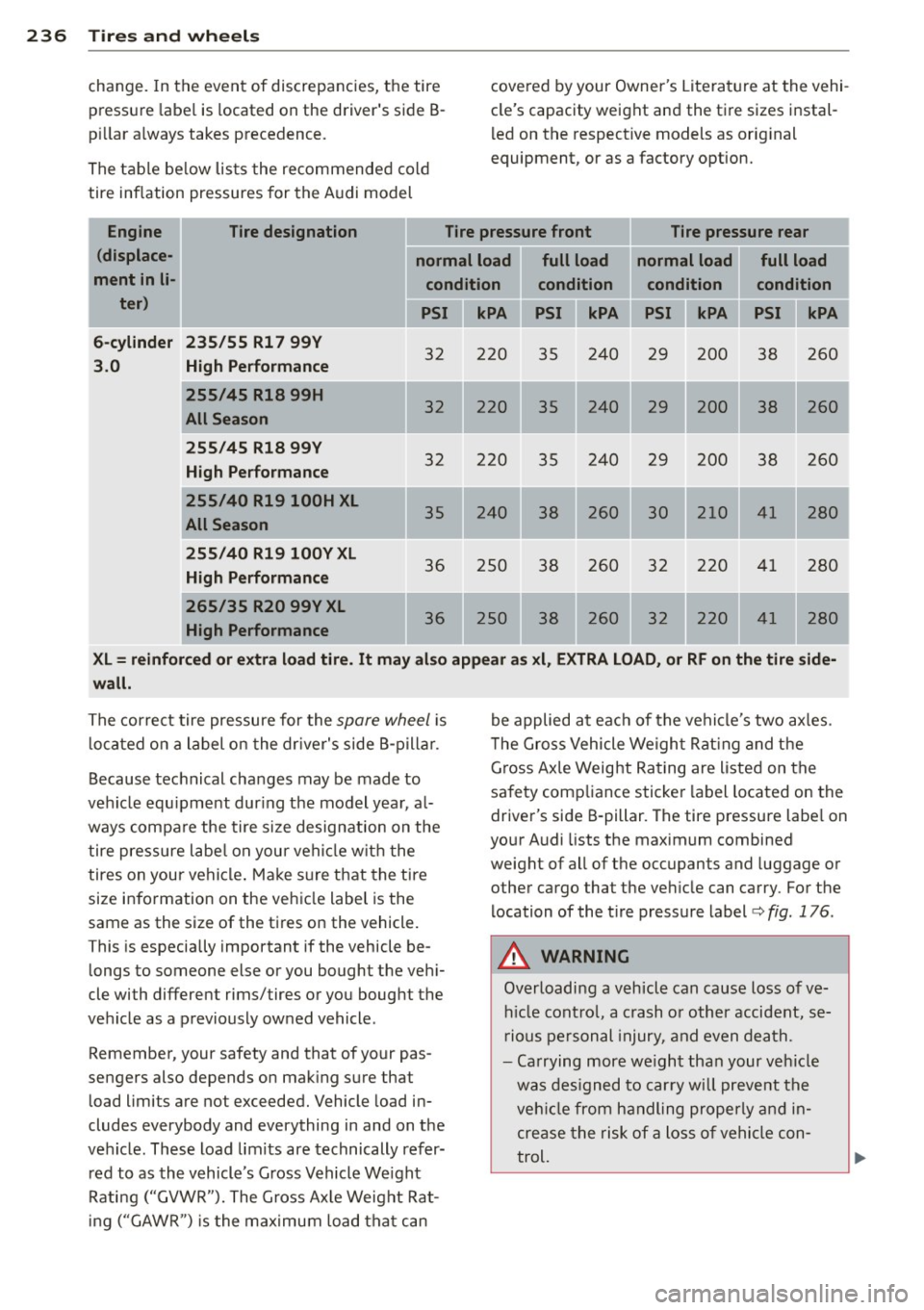
The table below lis ts the recommended cold
tire inflation pressures for the Audi model covered
by your Owner's Literature at the vehi
cle's capacity weight and the tire sizes instal
l ed on the respective models as orig inal
equipment, or as a factory option.
I Engine Tire designation
Tire pressure front Tire pressure rear I
(displace-
normal load full load normal load full load
ment in
li-condition condition condition condition
I
ter) PSI II kPA PSI JI kPA PSI II kPA PSI II kPA :
6-cylinder 235/55
Rl 7 99Y
3.0 High Performance 32
220
35 240 29 200
38 260
255/45 Rl8 99H '
32 220 35
240
29 200 38 260 All Season I
255/45 Rl8 99Y
32 220 35 240 29 200 38 260
High Performance
255/40 Rl9100H XL
35 240
38 260
30 2 10 41
280 All Season
255/40
Rl9100YXL
36 250 38 260 32 220 41 280
High Performance
265/35 R20 99Y XL '
36 250 38 260 32 220 41 280
High Performance .. • .. .. .. .. ..
XL= reinforced or extra load tire. It may also appear as xl, EXTRA LOAD, or RF on the tire side
wall.
The correct tire pressure for the spore wheel is
loc ated on a label on the driver's side B-pillar.
Because technical changes may be made to
vehicle equ ipment dur ing the model year, a l
ways compare the tire size designation on the
tire pressure labe l on your vehicle w ith the
tires on your vehicle . Make sure that the tire
size information on the vehicle label is the
same as the size of the ti res on the vehicle.
This is especially important if the vehicle be
longs to someone else or you bought the vehi
cle with different rims/tires or you bought the
vehicle as a previously owned vehicle.
Remember, your safety and that of your pas
sengers also depends on making sure that load limits are not exceeded. Vehicle load in
cludes everybody and everything in and on the
vehicle . These load limits are technically refer
red to as the vehicle's Gross Vehicle We ight
Rating ("GVWR"). The Gross Ax le Weight Rat
ing ("GAWR") is the maximum load that can be applied at each
of the vehicle's two ax les .
T he Gross Vehicle Weight Rat ing and the
Gross Axle Weight Rating are listed on the
safety compliance sticke r label located on the
driver's side B-pillar. The tire pressure labe l on
your Audi lists the maximum combined
weight of all of the occupants and luggage or
other cargo that the vehicle can carry . For the
location of the tire pressure label
¢fig. 176 .
A WARNING
-Overloading a vehicle can cause loss of ve-
hicle control, a crash or other accident, se
r ious personal injury, and even death.
- Carrying more weight than your veh icle
was designed to carry will prevent the
vehicle from handling properly and in
crease the risk of a loss of vehicle con
trol.
Page 250 of 294
248 Tire s and whee ls
Where snow chains are mandatory oncer
tain roads, this normally also applies to ve
hicles with a ll-wheel drive.
Wheel bolts
Wheel bolts must always be tightened to the
correct torque .
The design of whee l bolts is matched to the
factory insta lled rims . If different rims are fit
ted, the correct wheel bolts with the r ight
length and correctly shaped bolt heads must
be used. This ensures that wheels are fitted
securely and that the brake system functions
correctly .
In certain circumstances, you may not use
wheel bolts from a different vehicle -even if it
is the same model
r=> page 275.
A WARNING
Improperly tightened or maintained wheel
bolts can become loose caus ing loss of
cont ro l, a co llision and serious persona l in
Jury .
- Always keep the wheel bolts and the
threads in the wheel hubs clean so the
wheel bolts can turn easily and be prop
er ly t ightened .
- Never grease or oil the wheel bo lts and
the threads in the wheel hubs. They can
become loose while d riving if greased or
oiled, even if tightened to the specified
torque.
- Only use wheel bolts that belong to the
rim being installed.
- Never use different whee ls bolts on your
vehicle.
- Always maintain the co rrect tighten ing
torq ue fo r the wheel bo lts to reduce the
risk of a wheel loss . If the tightening tor
que of the wheel bo lts is too low, they
can loosen and come out w hen the veh i
cle is moving. If the tighteni ng torque is
too high, the whee l bolts and threads can be damaged and the whee
l can be
come loose.
@ Note
The specified torque for the whee l bolts is
90 ft lb (120 Nm) with a tolerance of± 7,4
ft lb(± 10 Nm) . Torque whee l bolts diago
nally. After changing a whee l, the torque
must be checked as soon as possible with a
torque wrench -preferably by an author
i zed Audi dealer or qualified workshop .
Low aspect ratio tires
Your Audi is factory-eq uipped w it h low aspect
ratio tires. These tires have been tho roughly
tested and been se lected specifically fo r your
model for their superb perfo rmance, road fee l
and handling under a variety of driving condi
t ions . Ask your author ized A udi dealer for
more details.
T he low aspect ratio of these tires is ind icated
by a numera l of
55 or less in the tire's s ize
designation. The numera l represents the ratio
of the tire's sidewa ll height in relation to its
tread width expressed in percentage. Conven
t iona l tires have a he ight/w idth ratio of 60 or
more .
The performance of low-aspect -ratio tires is
particularly sens iti ve to imp roper inflation
pre ssure. It is therefore important that low
a spect ratio tires ar e inflat ed to the specified
pre ssure and that the inflation pressure i s
r e gularly ch ecked and maintain ed. Tire pre s·
sure s should be checked at lea st once a
m onth and alw ays bef ore a long trip
r=> page 237, Checking tire pressure .
What you can do to avoid tire and rim
damage
Low aspect ratio tires can be d amaged more
easily by impact with potholes, curbs, gull ies
or ridges on t he road, particularly if the tire is
u nd eri nflated.
Page 267 of 294
@ Tips
The disc harged battery must be properly
connected to the vehicle's electrical sys
tem. When jump starting or charg ing the
battery, never connect the negative
ground cable to the batte ry negat ive post
because the ba tte ry manager system must
be ab le to detect the battery's state of
charge. Always connect the negative
g round cab le to the negative ground pos t
of t he battery manager cont ro l unit.
Use of jumper cables
Make sure to connect the jumper coble
clomps in exactly the order described b elow!
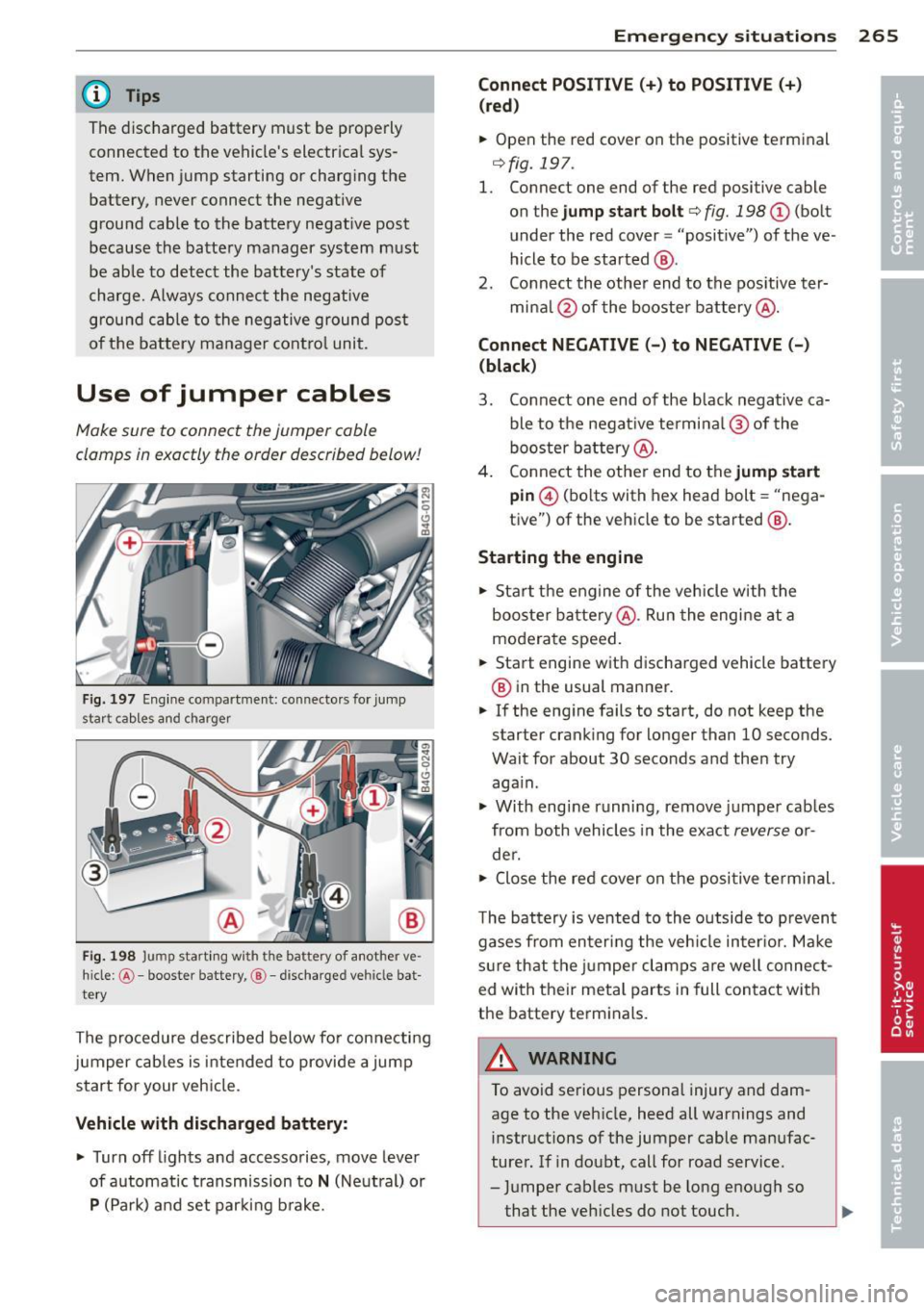
Fi g. 197 Eng ine co mpar tment: connecto rs for jum p
s tar t cab les and ch arg er
F ig. 1 98 Jump start in g w ith t he ba ttery of a not her ve ·
hi cle :
@-booster battery, ®-di sc harged ve hicle bat
te ry
The procedure des cribed below fo r connecti ng
jumper cables is intended to provide a jump
start for your veh icle.
Vehicle with discharged battery :
• Turn off ligh ts and accessories, move leve r
of automatic t ransmission to
N (Ne utral) or
P (Park) and set par king b rake.
Emergenc y situ ation s 265
Connect POSI TIVE(+) to POSITIVE(+ )
(red )
• Open the red cover on the positive terminal
¢fig. 19 7.
1. Connect one end of the red positive cable
on the jump sta rt bolt
¢ fig. 198 (D (bolt
under the red cover = "positive") of the ve
hicle to be started @.
2 . Connect th e othe r end to the pos itive ter-
mi na l@ of the booster battery @.
Connect NEGATIVE( -) to NEGATIVE(-)
(black )
3. Connect one end of the black negative ca ble to the negat ive termi na l@ of the
booster b attery @.
4. Connect the othe r end to the jump start
pin @ (bo lts w ith hex head bolt = "nega
tive") of the vehicle to be started @.
Starting the engine • Sta rt the engine of the veh icle w ith the
booste r ba tte ry @ . Ru n the engi ne at a
modera te speed.
• Start engine wit h discha rged vehicle battery
@ in the usual manner.
• If the eng ine fails to sta rt, do not keep the
starter c ranking for longer than 10 seconds.
Wait for about 30 seco nds a nd the n try
aga in .
• With eng ine runni ng , remove j umper cab les
from both vehicles in the exact
reverse o r
de r.
• Close the red cover on the posi tive term inal.
T he battery is v ented to th e outside to p rev ent
gases from en ter ing the veh icle in ter io r. Ma ke
s ur e th at the jumper clamps are well connec t
ed with their meta l parts in full con ta ct w ith
the battery term inals.
,8. WARNING
To avoid se rious personal injury and dam
age to the veh icle, heed all warnings and
instructions of the jumper cable man ufac
ture r. If in doubt, call for road service .
- Ju mpe r cables m ust be long enough so
that the veh icles d o not touch.
-
Page 275 of 294

Consumer Information
Warranty coverages
Your Audi is covered by the following war
ranties :
- New Vehicle Limited Warranty
- Limited Warranty Against Corrosion Perfo-
ration
- Emissions Control System Warranty
- Emissions Performance Warranty
- California Emissions Control Warranty (USA
vehicles only)
- California Emissions Performance Warranty
(USA vehicles only)
Detailed information regarding yo ur warran
ties can be found in your
Warranty & Mainte
nance booklet .
Operating your vehicle
outside the U.S.A. or
Canada
Government regulations in the United States
and Canada require that automobiles meet
specific emission regulations and safety
standards. Therefore, veh icles built for the
U.S.A. and Canada differ from vehicles sold in
other countries .
I f you p lan to take your vehicle outside the
continental limits of the United States or Can
ada, there is the possibility that
- unleaded fuels for vehicles with cata lytic
converter may not be available;
- fuel may have a considerably lower octane
rating . Improper fuel may cause engine
damage;
- service may be inadequate due to lack of
proper service facilities, tools or testing
equipment;
- replacement parts may not be readily availa
ble.
- Navigation systems for vehicles built for the
U.S.A. and Canada will not necessari ly work
in Europe, and may not work in other coun
tries outside North America .
Consumer Information 273
@ Note
Audi cannot be responsible for mechanical
damage that could result from inadequate
fuel, serv ice or parts availab ility.
Audi Service Repair
Manuals and Literature
Audi Offic ial Factory Service Manuals and Lit
erature are published as soon as possible after
model introduct ion. Service manuals and lit
erat ure are available to order from the Audi
T echnical Literature Ordering Center at:
www.audi.techliterature.com
Maintenance
' General
Your vehicle has been designed to help keep
maintenance requirements to a m inimum.
However, a certain amount of regular mainte
nance is still necessary to assure your vehicle's
safety, economy and reliability . For detailed
vehicle maintenance consult your Warranty &
Maintenance booklet.
Under difficult operating conditions , for ex
ample at extremely low outside temperatures,
in very dusty regions, when towing a trailer
very frequently, etc., some serv ice work
shou ld be pe rformed between the intervals
specified. This applies particularly to:
- oil changes, and
- cleaning or replacing the air filter.
® For the sake of the environment
By regularly maintaining your veh icle, you
help make sure that emission standards
are maintained, thus min imiz ing adverse
effects on the environment .
Important considerations for you and
your vehicle
The increasing use of electronics, sophistica t
ed fuel injection and emission contro l sys-
tems, and the genera lly increasing technica l ..,_
•
•
Page 282 of 294

280 Index
Child safety lock Rear doors .... .... ...... .. .. .... ..
37
C hild safety seats .......... .... .... . 169
Booster seats .......... .. .. .. .. .. . 172
Conve rtible child seats .... .. .. .... . 170
Conve rtible locking retractor . ..... .. .
How do I properly install a child safety
. h. l ? seat in my ve 1c e. . ............... .
Infant seats .. ........... .. .. .... .
Installing .. ............... .. .... .
Installing a child restraint using the
LATCH system .. .... ...... .. .. .. .. .
174
167
169
174
179
L ATC H system ............. ... .. ... 179
Lower anchorages ............ .... . 178
Mounting and releasing the anchorage
hook .. .. .. ... .... ......... ..... .
179
Safety instructions ......... ... .... . 167
Cigarette lighter . . . . . . . . . . . . . . . . . . . . . 54
Cleaning and protection ..... .. .. .... .
200
Alcantara (synthetic suede) . .. .. .. .. . 209
Eng ine compartment .... .. .. .. .... . 210
Exhaust tail pipes .......... ... .. .. . 206
Fabrics and fabr ic coverings .. .. .. .. . 206
Instrument panel ......... .. .. .... . 207
Inter ior .. .. ............. .. .. .. .. . 206
Lea ther .. .... ........... .... .... . 208
MMI display/controls ............... 206
Plastic and vinyl ................... 203
Plastic parts .. .......... ... .. .. .. . 207
Safety belts ............. .... .... . 209
trim strips 204
Trim str ips .... .. .. ... ... .. .. .. .. . 203
Climate control
Air vents ... .......... ..... .. .... .. 66
C limate controls . . . . . . . . . . . . . . . . . . . . .
64
Climate control (four-zone)
Operation .. ................ ... .. ..
67
Climate control (three-zone)
Operation . . . . . . . . . . . . . . . . . . . . . . . . . 65
C lock ... .. .. ............. .. .. .. .. .. 25
Closing Rear lid .. .. ................ ... ... . 35
Sliding/tilting sunroof ...... ..... .. ..
39
Cold tire inflation pressure ..... .. .... . 235
Com ing home ............. .. .. .... ..
43
Compact spare tire ...... .... ... .. .. . 253
Compartments .. ........ .. .. .. .... .. 55 Compliance
..... .. ... .. ........ .. ..
276
Consumer Information . . . . . . . . . . 126, 273
Consumption (fuel) ... .......... .. .. . 23
Contacting NHTSA
Convenience key ... ................ . . 126
33
Starting the engine ............. ... . 71
Stopping the engine (START ENG INE
STOP button) . . . . . . . . . . . . . . . . . . . . . .
73
Switching the ignition on ....... .. .. . 71
U nlocking and locking vehicle ...... .. . 33
Co nvertible child safety seats ... .. .. .. 170
Convertib le locking retractor
Activating . .... .. .. ........... ....
176
Deact ivat ing ... ... .............. .. 177
Using to secure a child safety seat 1.74, 176
Coolant
refer to Engine coolant ............. 223
Cooling mode (automat ic climate control) 67
Cooling mode (climate control) . . . . . . . . . 65
Cornering light .... ... .......... .. .. .
96
Cruise contro l
Changing speed .. ............. .... .
77
Presetting your speed .......... .. .. . 78
Switching off . . . . . . . . . . . . . . . . . . . . . . 78
Switching on . . . . . . . . . . . . . . . . . . . . . . . 77
Warning/ind icator lights .......... .. . 21
(upholder .... .. .. .. ........... .... . 55
D
Data ........ ... .. .. ... ........... . 272
Data recorder ... .. .. ........... .. .. 184
Date display .. .. .. ............. .... . 25
Daytime running lights ... ..... ... .. .. .
41
Declaration of compliance
Adaptive cruise control ........... ..
276
Audi s ide assist .. ............. .. .. 276
Cell phone package . ........... .. .. 276
Convenience key ... ................ 276
Electronic immob ilizer ....... ...... . 276
Homelink ® un iversal remote control .. 276
Remote control key
DEF What does this mean when it appears in 276
the tr ip odometer display? ....... ... . 25
Defective light bulb warning ...........
20