check oil AUDI S7 2013 User Guide
[x] Cancel search | Manufacturer: AUDI, Model Year: 2013, Model line: S7, Model: AUDI S7 2013Pages: 310, PDF Size: 77.45 MB
Page 234 of 310
232 Checking and filling
Engine compartment
Engine compartment overview
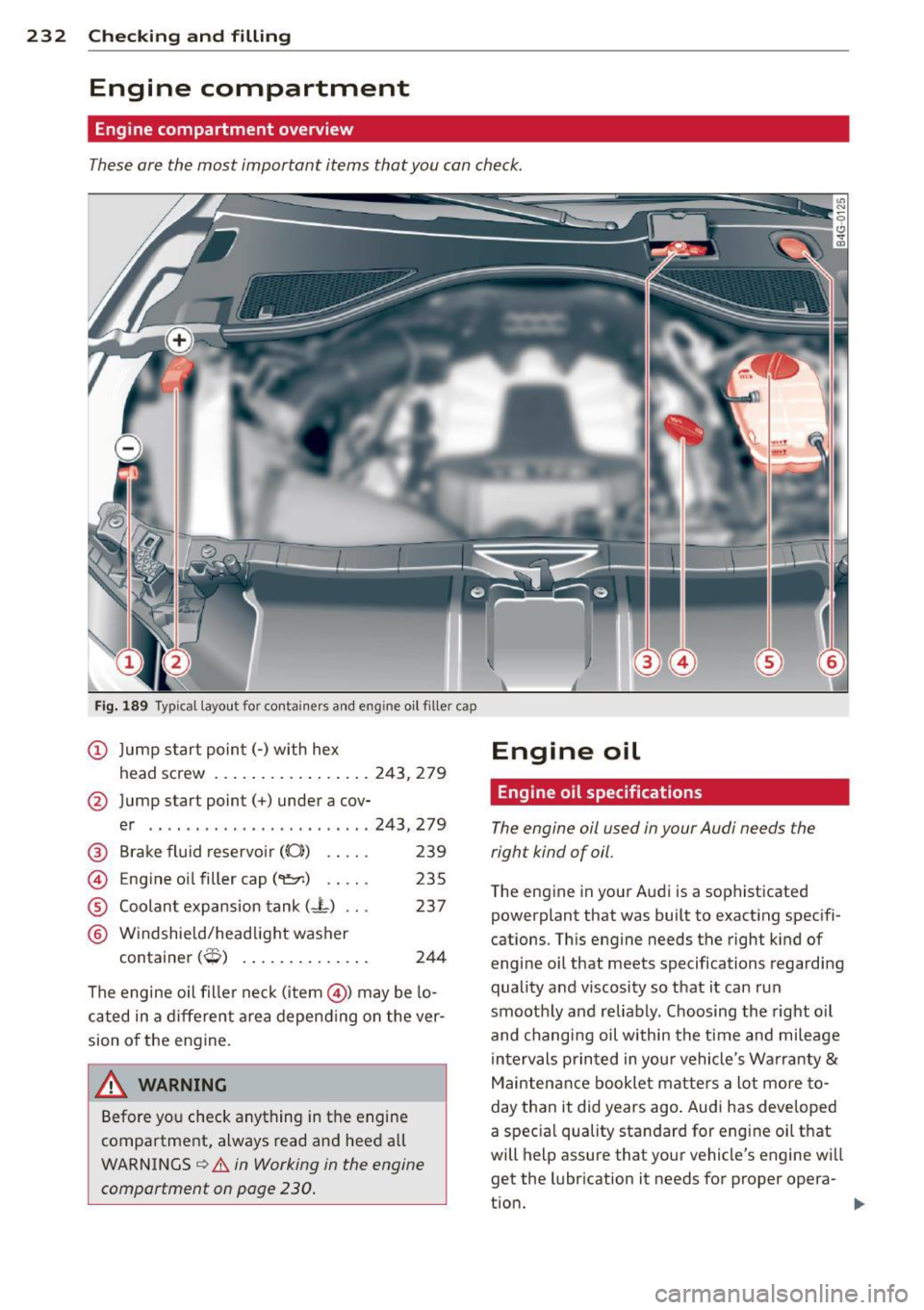
These are the most important items that you can check.
Fig. 189 Typ ical layout for contai ners and eng ine o il filler cap
(D Jump start point(-) with hex
head screw .... .............
243, 279
@ Jump start point(+) under a cov-
er .. .. ............... .... .
243,279
®
©
®
®
Brake fluid reservoir ((0)) . . . . . 239
Engine oil filler cap (
(-L) ...
Windshield/headlight washer
237
t . (.'R) con ainer ,,.., ............ . . 244
The engine oil filler neck (item @) may be lo
cated in a different area depending on the ver
sion of the engine.
~ WARNING
Before you check anything in the engine
compartment, always read and heed all
WARNINGS
¢ &. in Working in the engine
compartment on page 230.
-
Engine oil
Engine oil specifications
The engine oil used in your Audi needs the
right kind of oil.
The engine in your Audi is a sophisticated
powerplant that was built to exacting specifi
cations . This engine needs the right kind of
engine oil that meets specifications regarding
quality and viscosity so that it can run
smoothly and reliably . Choosing the right oil
and changing oil within the time and mileage
intervals printed in you r vehicle's Warranty
&
Maintenance booklet matters a lot more to
day than it did years ago . Audi has developed
a special quality standard for engine oil that
will help assure that your vehicle's engine wi ll
get the lubrication it needs for proper opera-
tion. ..,.
Page 235 of 310
Modern eng ine lubrication has taken a quan
tum leap in the last few years . Many synt hetic
oils ava ilable today provide better engine lu
brication that can outlast traditional petrole
um-based o ils, making them a smart choice
for use throughout the life of your Audi .
Whether you use synthetic or petroleum based engine oil, the oil that you use must
conform to Audi's oil quality standard
VW 502 00 to help keep your vehicle's engine running smoothly and help prevent the for
mat ion of harmfu l deposits, sometimes called
"s ludge," that ove r time can lead to expensive
r epairs .
At the t ime of pri nting, engine o ils available in
the U .S . and Canada that meet the exacting
specifications of Audi oi l standard VW 502 00
are synthetic engine oils. This does not mean, h owever, that every synthetic engine oil w ill
meet Audi oil standard VW 502 00. So always
be sure that you use an approved oi l.
To help preve nt the format ion of harmful de
posits use only oi l with the fo llowing spec ifi
cations printed on the oil container:
Audi oil standard VW 502 00
O il conta iner labels may carry the specif ica
tion s ingly or in comb inat ion w ith other des ig
nations and oil qua lity standards .
Viscosity
Engine oi ls are graded according to their vis
cosity. The proper v iscosity grade oi l for your
engine depends on cl imactic or seasonal con
d itions where you dr ive. You can use oil with a
viscosity grade of SAE SW40 across all tem
pe rature ranges for normal d riving conditions .
However, if eng ine oi l viscosity grade
SAE SW40 is not ava ilable, you can a lso use
viscosity grade SAE SW-30 or SAE OW-40 as
long as it meets Audi o il quality standard
VW 502 00 specifications.
Because engine oil that meets the Audi oil
standard may not be available everywhere
when you need it, we st rongly recomme nd
that you always carry with you a n ext ra quart
Checkin g and fillin g 233
(li ter) of oil that exp ress ly con forms to the
VW 502 00 specificatio n, in case you have to
top
off the o il while on the road.
Only if the level of the o il is at or be low the
minimum mark -and no oi l that expressly
confo rms to Audi oil standard VW 502 00
spec ifications is available -may you top
off
with a h igh quality engine o il, preferab ly syn
thet ic-based, that meets ACEA A3 or API SM
spec ifications, but even then, only in v iscosity
grades SAE SW-40, SA E SW-30, or
SA E OW-40 . However, during the ent ire time
betwee n oil change in tervals, never top
off
wi th more than a total of 0.5 q t/ li ter engine
o il t hat does no t conform to A udi o il specifica
tion VW 502 00.
Fo r more information abo ut eng ine oi l tha t
has been approved for your veh icle, ple ase
contac t eit h er yo ur autho rized Aud i dea le r or
Audi C ustomer Re lations at 1 (800) 822 -2834
or visit our web site at www .a u diusa.com or
www.aud icanada .ca. Here you w ill also find a
current list of oils (manufacturers, brand
names etc.) that conform to Audi oil standard
vw 502 00.
Changing the engine oil
T he eng ine oi l and o il f ilter m ust be changed
according to the mileage (kilometers) and
time intervals specified i n your ve hicle's War
ranty
& Maintenance booklet. Do not exceed
these interva ls - harmful deposits from old
engine oil can reduce engine performance and
can lead to expensive engine repairs.
Changi ng the oil at the recommended inter
vals is so very important beca use the lubricat
ing propert ies of oil decrease gradually during
norma l veh icle use . If you a re not sure when
yo u have your o il cha nged, ask your author
i zed Audi Se rv ice Adv isor.
Under some circumstances the engine oil
shou ld eve n be changed more frequent ly.
Change oil more often if you dr ive most ly
sho rt distances, operate the ve hicle in dusty
areas o r most ly under stop-and -go traff ic con-
di tions, o r when you use your vehi cle where .,..
•
•
Page 236 of 310
234 Checking and filling
temperatures stay below freezing point for long periods.
Detergent additives in the oil w il l make fresh
oil look dark after the eng ine has been run
ning for a short time . This is norma l and is not
a reason to change the oi l more often than
recommended.
Damage or malfun ctions due to lack of
maintenance
It is essential that you change your oil at the
recommended intervals using only engine o il
that complies with Audi oi l standard
VW 502 00. Your Limited New Vehicle War
ranty does not cover damage or malfunctions
due to fail ure to fo llow recommended mainte
nance and use requ irements as set forth in
the Audi Owner's Manual and Warranty &
Maintenance booklet . Your dealer will have to
deny warranty coverage unless you present to
the dea ler proof in the form of Service or Re
pa ir Orders that all scheduled ma intenance
was performed in a timely manner.
Eng ine oil consumption
The engine in your vehicle depends on an ade
quate amount of oil to lubricate and cool all
of its moving parts.
In order to provide effective lubrication and
cool ing of internal engine components, all in
ternal combustion eng ines consume a certain
amount of oil. Oil consumption varies from
engine to engine and may change significantly
over the life of the engine. Typically, engines
with a specif ied break-in period (see
¢ page 204) consume more oil during the
break-in period than they consume after oil
consumption has stabilized.
Under norma l conditions, the rate of oil con
sumption depends on the quality and viscosity
of the oil, the RPM (revolutions per minute) at
which the engine is operated, the ambient
temperature and road condit ions . Further fac
tors are the amount of oil d ilution from water
condensat ion or fuel residue and the oxida
tion level of the oil. As any engine is subject to wear as mi
leage builds up, the oil consump
tion may increase over time until replacement
of worn components may become necessary.
With all these variables coming into play, no
standard rate of oil consumption can be es
tablished or specified. There is no alternative
to regu lar and frequent checking of the o il lev
el, see Note.
If the yellow engine oil leve l warning symbo l
in the instrument cluster
II lights up, you
sho uld check the oil leve l as soon as possible
c:> page 235. Top off the oil at your earliest
convenience
c:> page 235.
A WARNING '"---
Before you check anythi ng in the engine
compartment, always read and heed all
WARNINGS
c:> A in Working in the engine
compartment on page 230.
(D Note
Driving with an insufficient o il level is like
ly to cause severe damage to the engine.
(D Tips
- The oil pressure warning display . is
not an indicator of the oil level. Do not
rely on it. Instead, check the oil level in
your engine at regular intervals, pref
erably each time you refuel, and always
before going on a long trip.
- If you have th e impression your engine
consumes excessive amounts of oil, we
recommend that you consult your Audi
dealer to have the cause of your concern
properly diagnosed. Keep in mind that
the accurate meas urement of oil con
sumption requ ires great care and may
take some t ime. Your Audi dealer has in
structions about how to measure oil con
sumption accurately.
-
Page 237 of 310
Checking the engine oil level
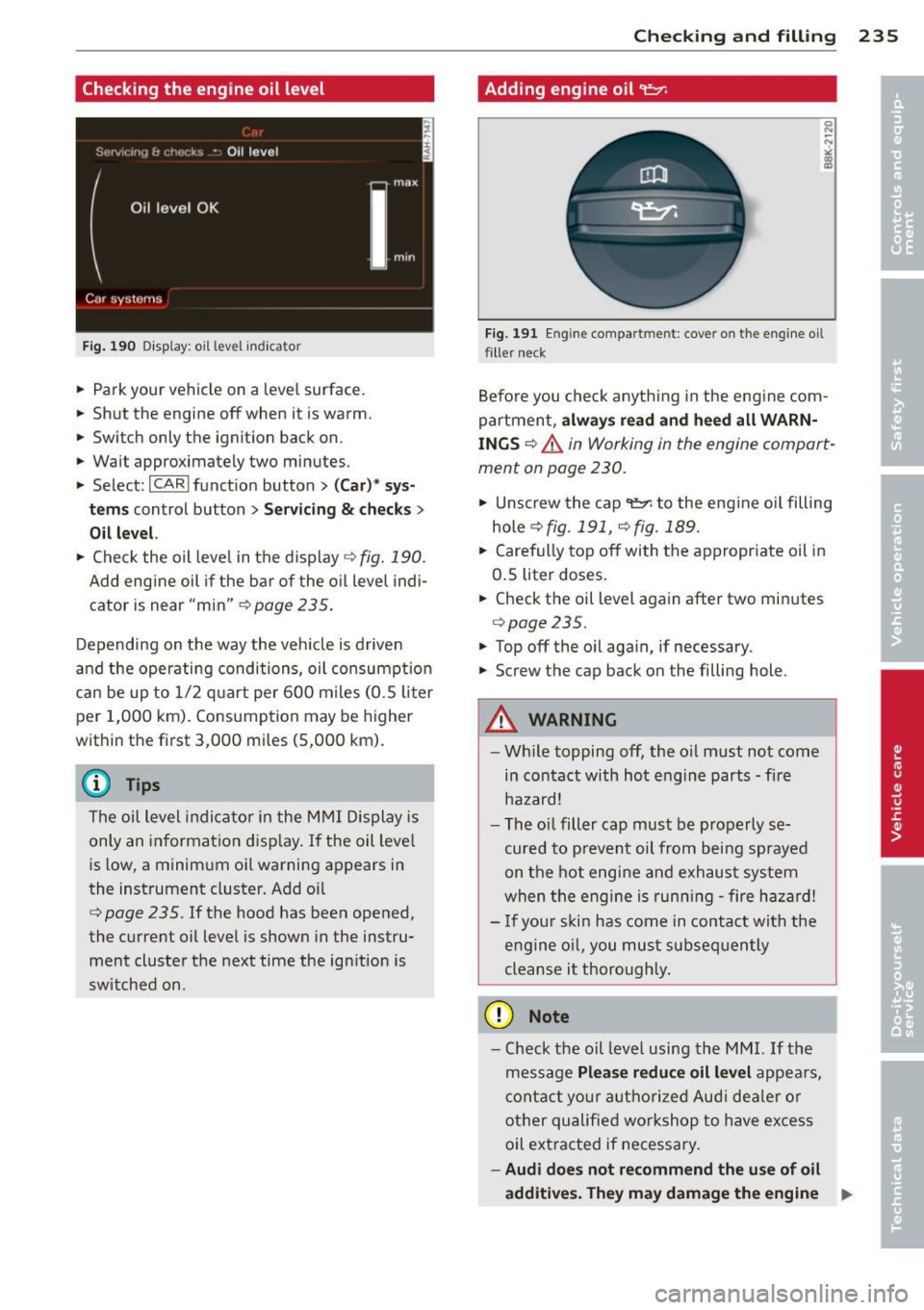
Fig . 190 D is p la y : o il level indi ca tor
• Park your vehicle on a lev el surfac e.
• Shut the engine off when it is warm.
• Switch only the ignition b ack on.
• W ait approxima tely two minutes .
• Se lect :
ICARI function button > ( C ar)* sys
t e m s
control button > Se rvicing & c h ecks >
Oil l ev el.
• Check the o il leve l in the display ¢ fig. 190.
Add engine oil if the bar of the oil level indi
cator is near "min "
¢page 235.
Depending on the way the veh icle is driven
and the operating conditions, oil consumpt ion
can be up to 1/2 q uart per 600 m iles (0.5 li ter
pe r 1,000 km) . Consumption may be higher
within the f irst 3 ,000 miles (5,000 km).
(D Tips
The oi l level indicator in the MMI Dis play is
only an in format ion disp lay . If the oil leve l
is low, a minim um oi l warni ng appears in
the instrument cluster. Add oi l
<=> page 235. If the hood has been opened,
the curre nt oil level is shown in the instru
ment cluste r the next time the ign ition is
sw itched on .
Checkin g and fillin g 235
Adding engine oil 'i=:1:
Fig. 191 Eng in e compa rtm en t: co ve r on the engine oi l
filler n eck
Before you check anything in the eng ine com
partment ,
alw ay s re ad and he ed all WARN
INGS ¢&.
in Working in the engine compart
ment on page 230.
• Uns crew the cap ce:r. to the eng ine oi l filling
hole
¢ fig . 191, ¢fig. 189.
• Caref ully top off with the appropr iate oil in
0.5 liter doses .
• Check t he oil level aga in after two minutes
¢ page 235 .
• Top off the o il aga in, if necessary .
• Screw the cap back on the filling hole .
A WARNING
-Wh ile topping off, the o il must not come
i n contact w ith hot engine parts -fi re
hazard!
- The oi l filler cap must be p roperly se
cured to prevent oil from bei ng sprayed
on the hot engine and exhaust system
when the engine is runn ing -fire ha zard!
- I f your ski n has come in contact with the
engine o il, you mus t subse quently
cleanse it thoroughly.
(D Note
- Check the oil level using the MMI. If the
message
Please reduce oil level appe ars,
c ontact yo ur a uth ori zed Aud i dea ler o r
ot her qualified workshop to have excess
oil ext racted if necessary.
- Audi d oes not re commend the u se of oil
additiv es. They m ay damage the engine
1111-
Page 238 of 310
236 Check ing and filling
and ad versely a ffect yo ur New Vehicl e
W arr ant y.
@) For the sake of the environment
- Under no circumstances can the oil come
in contact with the sewage network o r
the soil.
- Observe and follow lega l regu lations
when disposing of empty oil containers .
Changing the engine oil
We recommend that have your oil changed by
an authorized Audi dealer or a qualified serv
ice station.
Before you check anything in the engine com
partment,
a lw ays rea d an d h eed all WARN
INGS c::> .& in Working in the engine compart
ment on page 230.
The engine oil must be changed accord ing to
the intervals specified in your Warranty
&
Maintenance book let. This is very important
because the lubricating properties of oil di
minish gradua lly during normal vehicle use .
Under some ci rcumstances the engine oi l
should be changed more frequently. Change
oil more often if you drive most ly short dis
tances, operate the vehicle in dusty areas or under predominantly stop-and-go traffic con
ditions, or have your vehicle where tempera
tures remain below freezing for extended pe
riods .
Detergent addit ives in the oil w ill make fresh
oil look dark after the engine has been run n ing for a short time. This is normal and is not
a reason to change the oil more often than recommended.
Because of the problem of proper disposal,
along w ith the special tools and necessary ex
pertise required , we strongly recommend that
you have your o il changed by an authorized
Audi de ale r or a qual ified servi ce station.
If y ou choo se to c hang e y our oi l y our self,
please note the followi ng important informa
tion :
A WARNING
To reduce the risk of personal injury if you
must change the eng ine oil in your vehicle
yourself:
- Wear eye protect ion.
- To reduce the risk of burns from hot en- gine oil, let the engine cool down to the
touch.
- When removing the o il dra in plug with
your fingers, stay as far away as possible.
Always keep your forearm parallel to the
ground to help prevent hot oil from runn ing down you r arm.
- Dra in the oil into a container designed
for this purpose, one large enough to
hold at least the total amount of oil in
your engine.
- Engine oil is poisonous. Keep it we ll out
of the rea ch of childre n.
- Continuous contact with used eng ine o il
is harmfu l to your sk in. Always protect
your skin by washing oil off tho roughly
with soap and wate r.
@ Note
Never mix oil additives with your engine
oi l. These additives can damage your en
g ine and adversely affect you r A ud i Limit
ed New Veh icle War ranty.
@ For the sake of the environment
- Before changing your oil, first make su re
you know where you can prope rly dispose
o f the used oil.
- Always dispose of used eng ine oi l proper
ly. Do not dump it on garden soil, wood
ed areas, into open streams or down
sewage drains.
- Recycle used engi ne oil by taking it to a
used engine oil collection facility in you r
area, or contact a service station.
Page 239 of 310
Engine cooling system
Coolant
The engine coolant performs two functions: it
keeps the engine from overheating and it pro
te cts the engine from freezing in the winter .
The cooling system is sealed and generally re
qu ires little attention .
The cooling system has been filled at the fac
tory with a permanent coolant which does not need to be changed. The coolant consists of a
mixture of water and the manufacturer's gly
col-based coolant additive G13 ant ifreeze
w ith anticorrosion add itives (50% fo r USA
models; 60% for Canad ian models). This mix
ture bot h assu res the ne cessary frost protec
tion and protects metal components in the
engine's coo ling system from corrosion and
scaling. It also raises the boili ng po int of t he
coolant.
D o not red uce the concentration o f the coo l
ant in the summer by adding plain water .
The
proportion of coolant addit ive must be at
least 50% but not mo re than 60 %
to main
tain antifree ze protection and cooling efficien
cy. If the coolant frost protection is too low,
the coolant cou ld freeze and damage the veh i
cle heating and eng ine cooling system .
For year-round driving, antifree ze is added at
the factory for temperatures down to:
- -3 1°F (-35°C)USA
- -40 ° F ( - 4 0 °C) Canada.
A WARNING
Before yo u check anything in the engine
compartment , always read and heed a ll
WARNINGS
¢ & in Working in the engine
compartment on page 230.
(D Note
- Befo re winter sets i n, have the coolant
chec ked to see i f th e coo lant ad dit ive i n
you r vehicle is suffic ient to meet the cli
mate cond itions . T hi s is especially impor
ta nt if yo u live in a regi on whe re the w in-
-
Checkin g and fillin g 237
ter is ex treme ly co ld. If necessary, i n
crease t he p ro po rtion of coo lant additive
to 60%.
- W hen a dding coolant additive to yo ur
cooling system , remembe r:
- We recommend us ing on ly coo la nt ad
di tive G 12++ or G 13 (check the labe l)
fo r you r ve hicl e. This coolant additive is
a v ailabl e at author ized Aud i de alers.
Ot he r ty pes of antifree ze can signifi
cantly reduce corros ion p rotec tion. The
r es ulting co rrosion can cause a loss of
coolant and serio us engine damage .
- Do not add any ty pe of rad iator leak seal
ant to you r vehicle's engine coo lant .
Add ing radiator repair flu id may adverse
ly affect t he fu nction and performance of
your cooling system and cou ld result in
damage not covered by yo ur New Ve hicle
L imited Warranty .
Checking the engine coolant level
The engine coolant level can be checked with
a quick glance.
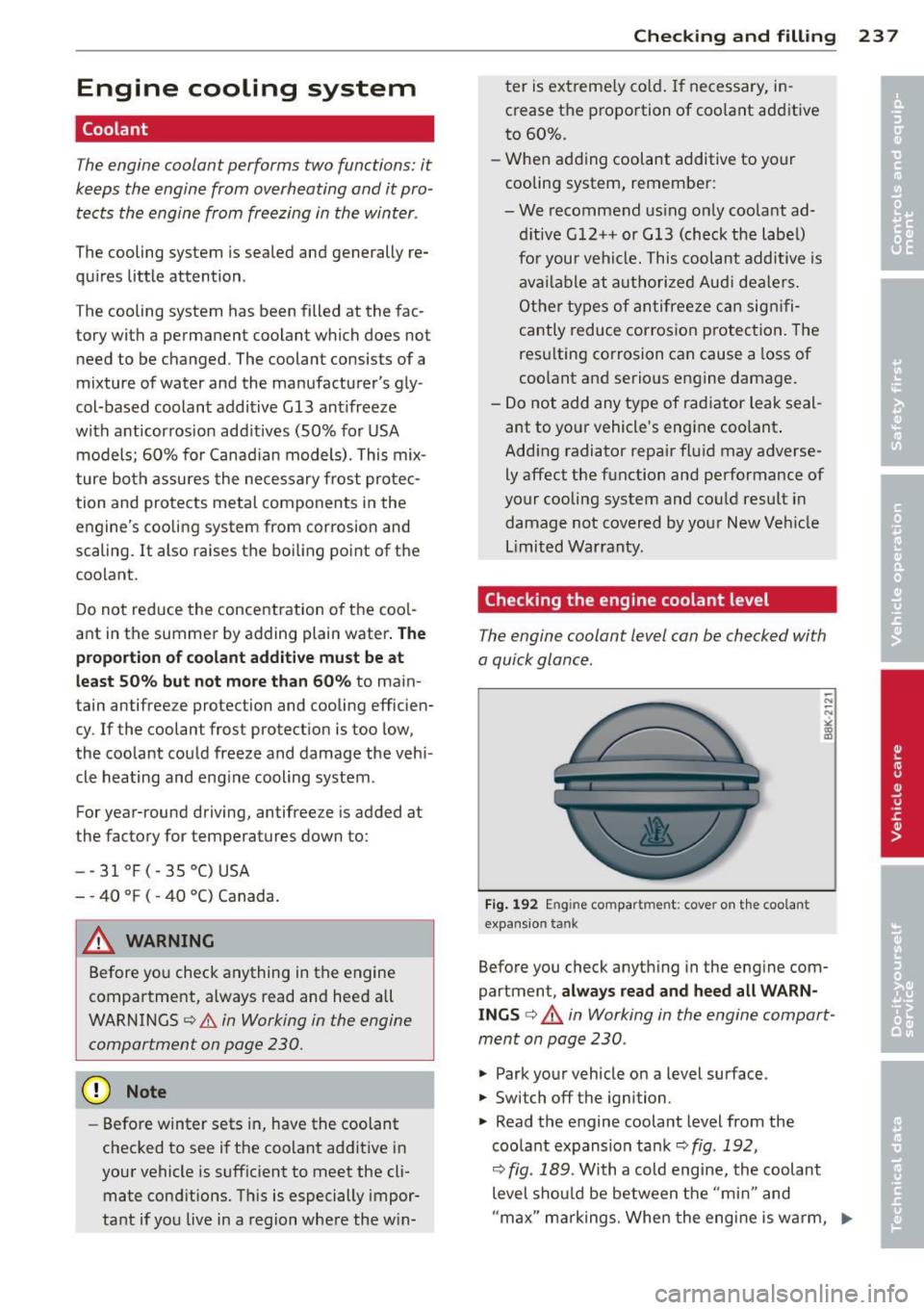
Fig. 19 2 Engine co mpart ment: cover on t he coo la nt
expansio n ta nk
Before you check a nyth ing in the eng ine com
partment,
always read and heed all WARN
INGS <=>&.
in Working in the engine compart
ment on page 230 .
.,. Park yo ur vehicle on a level surface .
.,. Switch off the ignition .
.,. Read the e ngine coolant level from the
coo la nt expansion tan k<=>
fig . 192,
¢ fig. 189 . With a cold engine, the coolant
level s hou ld be be tween the "m in" and
" max" mar kings. Whe n the engi ne is w arm,
Ill>-
Page 240 of 310
238 Checking and filling
the level may be slightly above the "max"
marking.
The location of the coolant expansion tank
can be seen in the engine compartment illus
tration
¢ page 232.
To obtain an accurate reading, the engine
must be switched off.
The expansion tank in your vehicle is equipped
with an electric coolant level sensor.
When the coolant level is too low, the warning light in the Auto-Check System¢
page 16 will
illuminate until you add coolant and the level
has been restored to normal. Even though
there is an electric coolant level sensor , we
still recommend you check the coolant level
from time to time.
Coolant loss
Coolant loss may indicate a leak in the cooling
system. In the event of coolant loss, the cool
ing system should be inspected immediately
by your authorized Audi dealer.
It is not
enough merely to add coolant.
In a
sealed system, losses can occur only if
the boiling point of the coolant is exceeded as
a result of overheating.
_& WARNING
The cooling system is under pressure and
can get very hot. Reduce the risk of scald
ing from hot coolant by following these
steps. -
- Turn off the engine and allow it to cool
down.
- Protect your face, hands and arms from
escaping fluid and steam by covering the
cap with a large, thick rag.
- Turn the cap slowly and very carefully in
a counter-clockwise direction while ap
plying light, downward pressure on the
top of the cap .
- To avoid being burned, do not spill anti freeze or coolant on the exhaust system
or hot engine parts. Under certain condi
tions, the ethylene glycol in engine cool
ant can catch fire .
(D Note
Do not add any type of radiator leak seal
ant to your vehicle's engine coolant. Add
ing radiator repair fluid may adversely af
fect the function and performance of your
cooling system and could result in damage not covered by your New Vehicle Limited
Warranty .
Adding coolant
Be very careful when adding engine coolant.
Before you check anything in the engine com
partment,
always read and heed all WARN
INGS ¢&. in Working in the engine compart
ment on page 230.
.. Turn off the engine .
.. Let the engine cool down.
.. Place a thick rag over the coolant expansion
tank ¢
fig. 192 and carefully twist the cap
counter-clockwise ¢,&. .
.,. Add coolant.
.. Twist the cap on again
tightly.
Replacement engine coolant must conform to
exact specifications ¢
page 23 7, Coolant. We
recommend using only coolant additive G12+
+, G13 or in an emergency G12+. Do
not use a
different additive. In an emergency use plain
water until you can get the correct additive
and can restore the correct ratio. This should
be done as soon as possible .
If you have lost a considerable amount of
coolant , then you should add cold antifreeze
and cold water only when the engine is cold.
Always use
new engine coolant when refilling.
Do not fill coolant above the "MAX" mark. Ex
cess coolant will be forced out through the
pressure relief valve in the cap when the en
gine becomes hot.
_& WARNING
-= -- The cooling system is under pressure and
can get very hot. Reduce the risk of ..,_
Page 248 of 310
24 6 T ire s and whee ls
Tires and wheels
Tires
General notes
Tires may be the least appreciated and most
abused parts of a motor vehicle .
Tires may be the least appreciated and most
abused parts of a motor vehicle . Tires are,
however, one of the most important parts of a
vehicle, particularly considering the compara
tive ly small patch of rubber on each tire that
assures that all -important contact between
you, your vehicle and the road.
Maintaining the correct tire pressure, making
sure that your vehicle and its tires do not have
to carry more weight than they can safe ly han
d le, avoiding damage from road hazards and
reg ularly inspecting t ires for damage includ
ing cuts, slashes irregu la r wear and overall
condition are the most important things that
you can do to he lp avoid sudden tire failure in
cluding tread separation and blowouts.
A vo idin g dama ge
I f you have to drive over a curb or similar ob
stacle, drive very slow ly and as close as possi
ble at a right angle to the curb.
A lways keep chem icals including grease, oil,
gasoline and b rake fluid off the tires.
Inspect the tires regularly for damage (cuts,
cracks or bl isters, etc.). Remove any foreign
bod ies embedded in the treads.
St orin g tire s
Mark tires when you remove them to indicate
the direction of rotation . Th is ensures you to
be ab le to mount them correctly when you re
install them.
When removed, the wheels or tires should be
stored in a cool, dry and preferably dark place .
Store tires in a vertical position if they are not mounted on rims, in a horizontal position if
they are mounted on rims. N
ew tir es
New t ires have to be broken in¢&,. .
The tread depth of new t ires may vary, accord
ing to the type and make of t ire and the tread
pattern .
Hidden damag e
Damage to tires and r ims is often not readily
vis ible . If you notice unusual vibrat ion or the
vehicle pulls to one s ide, th is may ind icate
that one of the t ires has been damaged . T he
t ir es must be checked immed iate ly by an au
tho rized Aud i dea le r or q ualified wor kshop.
Unidirecti onal t ires
A un idirectional tire can be identified by ar
rows on the sidewall, that po int in the direc
t ion the t ire is designed to rotate. You must
fol low the specified direction of rotation . This
is necessary so that these tires can develop
their optimum characteristics regarding grip, road noise, wear and hydrop laning resistance.
For more information
¢ page 274.
A WARNING
-New tires or tires that are old, worn or
damaged cannot provide maximum con
trol and braking ability .
-
-New tires tend to be slippery and must
be broken in . To reduce the risk of losing
control, a collision and ser ious personal
injuries, drive w ith special ca re for the
fi rst 350 m iles (560 km).
- Driving with worn or damaged tires can lead to loss of control, sudden tire fail
ure, including a blowou t and sudden de
flation, c rashes and serious personal in
juries . Have worn or damaged tires re
p laced immediate ly .
- Tires age even if they are not being used
and can fai l sudden ly, especially at high
speeds. Tires that are more than 6 years
old can only be used in an emergency
and then w ith special care and at low
speed.
Page 259 of 310
Unbalanced whee ls must be rebalanced to
avoid excessive wea r on steering, suspension
and tires. A wheel must a lso be rebalanced
when a new tire is installed .
Incorrect wheel alignment
Incorrect whee l alignment can cause exces
sive tire wear, impairing the safety o f the vehi
cle. If tires show excess ive wear, have the
wheel alignment checked by an authorized
Audi dealer or qualified workshop .
All-wheel d rive
Vehicles w ith quattro ® must always have tires
of the same size, construction and tread type .
F or detai ls see
r=!:> page 201 .
A WARNING
Sudden tire failure can lead to loss of con
trol, a crash and serious persona l injury!
- Never drive a veh icle when the tread on
any tire is worn down to the wear indica
tors.
- Worn tires are a safety hazard, they do not grip well on wet roads and increase
your risk of"hydrop lan ing" and loss of
co ntrol.
- Always keep chemicals that can cause
tire damage, such as grease, oil , gasoline
and brake fluid away from t ires.
- Tires age eve n if they are not be ing used
and can fail suddenly, especially at high
speeds. T ires that are more than 6 years
o ld can only be used in an emergency
and then with spe cial care a nd at lower
s peeds.
- Never mount used ti res on yo ur vehicle if
yo u a re not s ure of their "prev ious histo
ry." Old used ti res may have been dam
aged even though the damage cannot be
seen that can lead to s udden tire failure
and loss of vehicle control. Tires and wheels 25
7
New tires and replacing tires and wheels
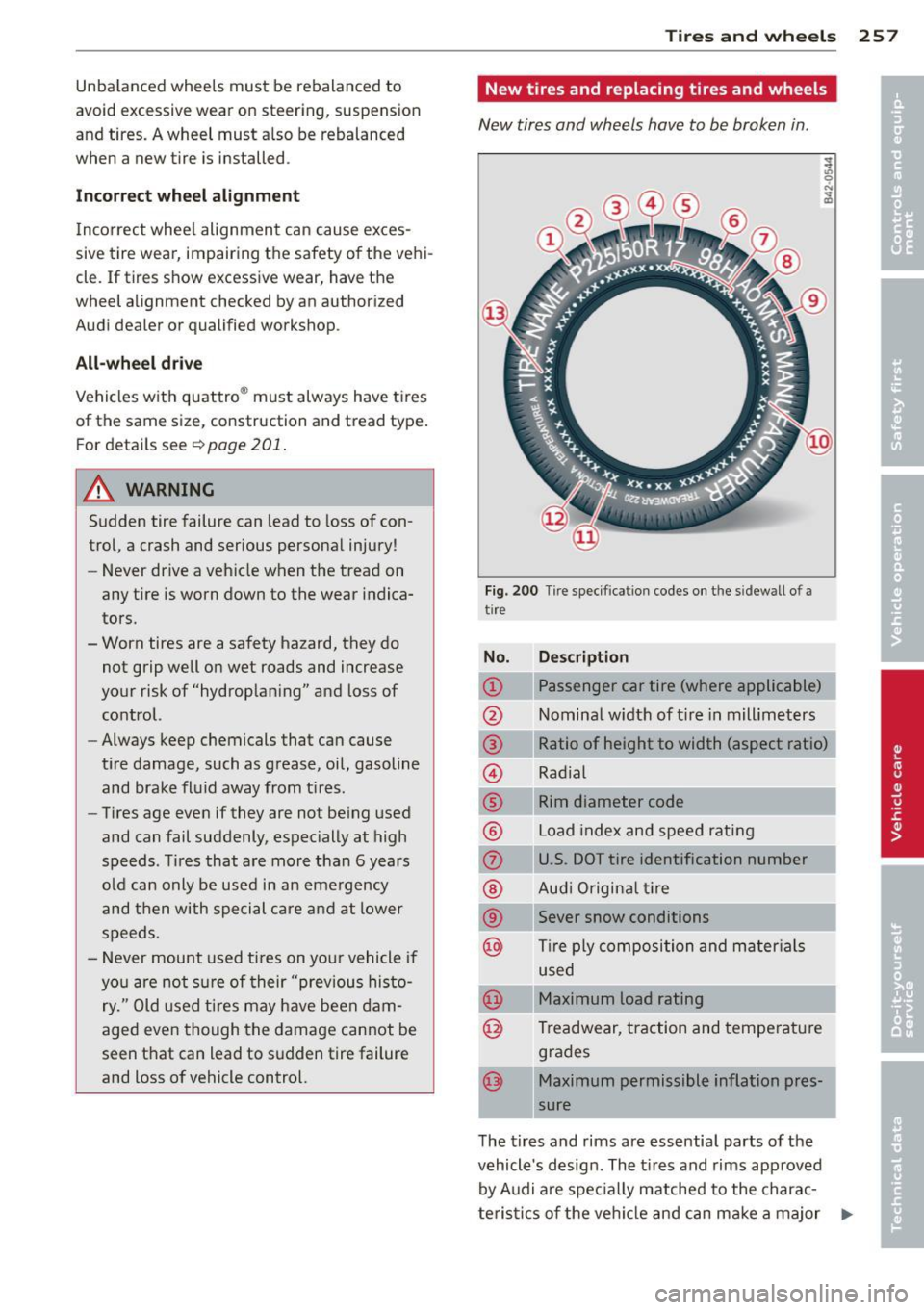
New tires and wheels have to be broken in .
Fig. 20 0 Tir e spec ificat io n codes on t he s idewall o f a
tire
No. De sc ription
CD Passenger car tire (where applicable)
@ Nomina l w idth of t ire in mill imeters
® Ratio of height to width (aspect ratio)
© Rad ial
® Rim diameter code
® Load index and speed rating
(f) U.S. DOT tire identification number
® Aud i Origina l tire
® Sever snow conditions
@ T ire ply composition and mater ials
used
@ Maximum load rating
@ Treadwear, traction and temperat ure
grades
@ Maximum permissible inflation pres-
sure
T he tires and rims are essential parts o f the
vehicle's design . The ti res and rims app roved
by Audi a re spec ia lly matched to the charac
teris tic s of the ve hicl e and can m ake a major .,.
•
Page 265 of 310
@ Tips
Where snow chains are mandatory oncer
tain roads, this normally also applies to
veh icles with all-wheel dr ive.
Wheel bolts
Wheel bolts must always be tightened to the
correct torque .
The design of whee l bolts is matched to the
factory insta lled rims . If different rims are fit
ted, the correct wheel bolts with the right
length and correctly shaped bolt heads must
be used. This ensures that wheels are f itted
securely and that the brake system functions
correctly .
In certain circumstances, you may not use
wheel bolts from a different vehicle -even if it
is the same model
<=> page 291.
.&_ WARNING
Improperly tightened or maintained wheel
bolts can becom e loose caus ing loss of
cont ro l, a co llision and serious persona l in
Jury .
- Always keep the wheel bolts and the
threads in the wheel hubs clea n so the
w heel bolts can t urn easily and be prop
erly t ightened .
- Never grease or oil the wheel bolts and
the threads in the wheel hubs. They can
become loose while d riving if greased or
oi led, even if tightened to the specif ied
torque.
- Only use whee l bolts that belong to the
rim being installed .
- Never use different whee ls bolts on your
vehicle.
- Always maintain the co rrect tighten ing
torq ue for the wheel bo lts to reduce the
risk of a wheel loss . If the tightening tor
que of the wheel bolts is too low, they
can loosen and come out when the vehi
cle is moving. If the tightening torque is
too high, the whee l bolts and threads
Tire s an d wheel s 263
can be damaged and the whee l can be
come loose.
(D Note
The specified torque for the whee l bolts is
90 ft lb (120 Nm) with a tolerance of± 7,4
ft lb(± 10 Nm) . Torq ue whee l bolts diago
nally. After changing a whee l, the torq ue
must be checked as soon as possible with a
torque wrench -preferably by an author
i zed Audi dealer or qualified workshop.
Low aspect ratio tires
You r Aud i is facto ry-equ ipped w it h low aspect
ra tio tires. These tires have been tho ro ughly
tested and been se lec ted spe cifically for you r
model for their superb perfo rmance, road fee l
and handling under a variety of driving condi
tions. Ask your authorized Audi dealer for
more details .
T he low aspect ratio of these t ires is ind icated
by a numera l of
55 or le ss in the tire's s ize
designation. The numera l represents the ratio
of the t ire's sidewa ll height in relation to its
tread width expressed in percentage. Conven
tiona l tires have a he ight/w idth rat io of 60 or
more .
The performance of low-aspect -ra tio tire s is
particularly sens it iv e to improper inflation
pressure. It is therefore important that low
aspect ratio t ires are inflated to the specified
pre ssure and that the inflation pressur e is
regularly che cked and maintain ed. Tire pre s
s ures should be checked at least on ce a
m onth and alwa ys before a long trip
¢ page 2 52, Checking tire pressure .
What you can do to avoid tire and rim
damage
Low aspect ratio tires can be damage d mo re
easily by impact w ith potholes, curbs, g ull ies
or ridges on t he road, partic ularly if the tire is
u nderinflated.
Ill>-
•
•