brake AUDI S7 2013 Repair Manual
[x] Cancel search | Manufacturer: AUDI, Model Year: 2013, Model line: S7, Model: AUDI S7 2013Pages: 310, PDF Size: 77.45 MB
Page 259 of 310
Unbalanced whee ls must be rebalanced to
avoid excessive wea r on steering, suspension
and tires. A wheel must a lso be rebalanced
when a new tire is installed .
Incorrect wheel alignment
Incorrect whee l alignment can cause exces
sive tire wear, impairing the safety o f the vehi
cle. If tires show excess ive wear, have the
wheel alignment checked by an authorized
Audi dealer or qualified workshop .
All-wheel d rive
Vehicles w ith quattro ® must always have tires
of the same size, construction and tread type .
F or detai ls see
r=!:> page 201 .
A WARNING
Sudden tire failure can lead to loss of con
trol, a crash and serious persona l injury!
- Never drive a veh icle when the tread on
any tire is worn down to the wear indica
tors.
- Worn tires are a safety hazard, they do not grip well on wet roads and increase
your risk of"hydrop lan ing" and loss of
co ntrol.
- Always keep chemicals that can cause
tire damage, such as grease, oil , gasoline
and brake fluid away from t ires.
- Tires age eve n if they are not be ing used
and can fail suddenly, especially at high
speeds. T ires that are more than 6 years
o ld can only be used in an emergency
and then with spe cial care a nd at lower
s peeds.
- Never mount used ti res on yo ur vehicle if
yo u a re not s ure of their "prev ious histo
ry." Old used ti res may have been dam
aged even though the damage cannot be
seen that can lead to s udden tire failure
and loss of vehicle control. Tires and wheels 25
7
New tires and replacing tires and wheels
New tires and wheels have to be broken in .
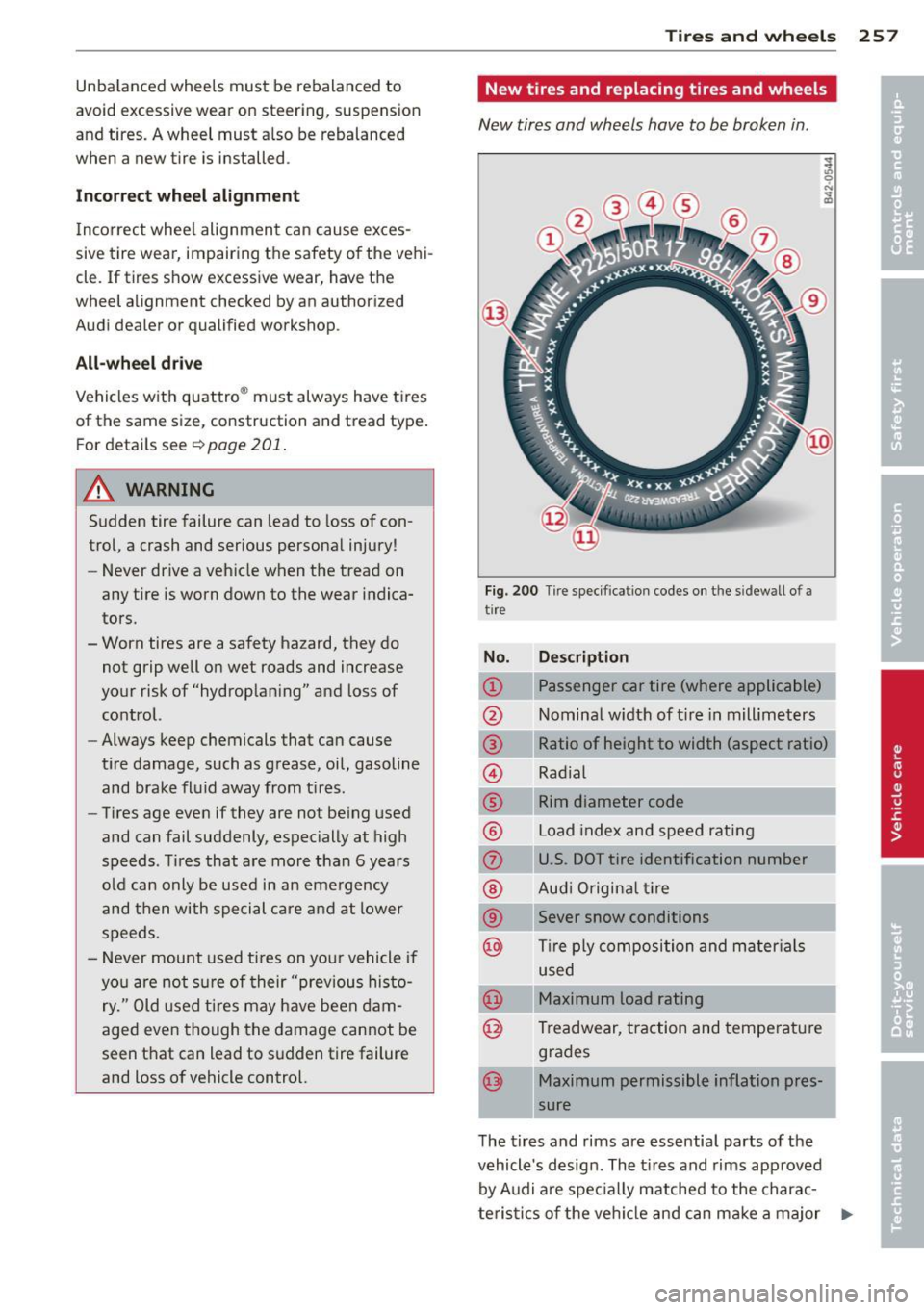
Fig. 20 0 Tir e spec ificat io n codes on t he s idewall o f a
tire
No. De sc ription
CD Passenger car tire (where applicable)
@ Nomina l w idth of t ire in mill imeters
® Ratio of height to width (aspect ratio)
© Rad ial
® Rim diameter code
® Load index and speed rating
(f) U.S. DOT tire identification number
® Aud i Origina l tire
® Sever snow conditions
@ T ire ply composition and mater ials
used
@ Maximum load rating
@ Treadwear, traction and temperat ure
grades
@ Maximum permissible inflation pres-
sure
T he tires and rims are essential parts o f the
vehicle's design . The ti res and rims app roved
by Audi a re spec ia lly matched to the charac
teris tic s of the ve hicl e and can m ake a major .,.
•
Page 262 of 310
260 Tires and wheels
-If the spare tire is not the same as the
tires that are mounted on the vehicle -
for example with winter tires - only use
the spare tire for a short period of time and drive with extra care. Refit the nor
mal road wheel as soon as safely possi
ble.
- Never drive faster than the maximum
speed for which the tires on your vehicle
are rated because tires that are driven
faster than their rated speed can fail
suddenly.
- Overloading tires cause heat build-up,
sudden tire failure, including a blowout
and sudden deflation and loss of control.
- Temperature grades apply to tires that
are properly inflated and not over or un
derinflated.
- For technical reasons it is not always
possible to use wheels from other
vehicles -in some cases not even wheels
from the same vehicle model.
- If you install wheel trim discs on the ve
hicle wheels, make sure that the air flow
to the brakes is not blocked. Reduced air
flow to the brakes can them to overheat,
increasing stopping distances and caus
ing a collision.
- Run flat tires may only be used on
vehicles that were equipped with them
at the factory. The vehicle must have a
chassis designed for run flat tires. Incor
rect use of run flat tires can lead to vehi
cle damage or accidents. Check with an
authorized Audi dealer or tire specialist
to see if your vehicle can be equipped
with run flat tires. If run flat tires are
used, they must be installed on all four
wheels. Mixing tire types is not permit
ted.
- For technical reasons, it is not generally
possible to use the wheel rims from oth
er vehicles. This can hold true for wheels
of the same vehicle type.
- If the spare tire is different from the
tires that you have mounted on your ve- hicle (for example winter tires or wide
profile tires), then use the spare tire for a
short period of time only and drive with
extra care. Replace
the flat tire with the
tire matching the others on your vehicle
as soon as possible.
- Never drive without the valve stem cap.
The valves could get damaged.
@ For the sake of the environment
Dispose of old tires in accordance with the
local requirements.
Uniform tire quality grading
-Tread wear
- Traction AA A B C
- Temperature ABC
Quality grades can be found where applicable
on the tire side wall between tread shoulder
and maximum section width
~ fig. 200.
For example: Tread wear 200, Traction AA,
Temperature A.
All passenger car tires must conform to Feder
al Safety Requirements in addition to these
grades .
Tread wear
The tread wear grade is a comparative rating
based on the wear rate of the tire when tested
under controlled conditions on a specified
government test course.
Fo r example, a tire graded 150 would wear
one and one half (1 1/2) times as well on the
government course as a tire graded 100.
The relative performance of tires depends
upon the actual conditions of their use, how
ever, and may depart significantly from the
norm due to variations in driving habits, serv
ice practices and differences in road character
istics and climate.
Traction
The traction grades, from highest to lowest,
are AA, A, Band
C. Those grades represent the
tire's ability to stop on wet pavement as ..,.
Page 265 of 310
@ Tips
Where snow chains are mandatory oncer
tain roads, this normally also applies to
veh icles with all-wheel dr ive.
Wheel bolts
Wheel bolts must always be tightened to the
correct torque .
The design of whee l bolts is matched to the
factory insta lled rims . If different rims are fit
ted, the correct wheel bolts with the right
length and correctly shaped bolt heads must
be used. This ensures that wheels are f itted
securely and that the brake system functions
correctly .
In certain circumstances, you may not use
wheel bolts from a different vehicle -even if it
is the same model
<=> page 291.
.&_ WARNING
Improperly tightened or maintained wheel
bolts can becom e loose caus ing loss of
cont ro l, a co llision and serious persona l in
Jury .
- Always keep the wheel bolts and the
threads in the wheel hubs clea n so the
w heel bolts can t urn easily and be prop
erly t ightened .
- Never grease or oil the wheel bolts and
the threads in the wheel hubs. They can
become loose while d riving if greased or
oi led, even if tightened to the specif ied
torque.
- Only use whee l bolts that belong to the
rim being installed .
- Never use different whee ls bolts on your
vehicle.
- Always maintain the co rrect tighten ing
torq ue for the wheel bo lts to reduce the
risk of a wheel loss . If the tightening tor
que of the wheel bolts is too low, they
can loosen and come out when the vehi
cle is moving. If the tightening torque is
too high, the whee l bolts and threads
Tire s an d wheel s 263
can be damaged and the whee l can be
come loose.
(D Note
The specified torque for the whee l bolts is
90 ft lb (120 Nm) with a tolerance of± 7,4
ft lb(± 10 Nm) . Torq ue whee l bolts diago
nally. After changing a whee l, the torq ue
must be checked as soon as possible with a
torque wrench -preferably by an author
i zed Audi dealer or qualified workshop.
Low aspect ratio tires
You r Aud i is facto ry-equ ipped w it h low aspect
ra tio tires. These tires have been tho ro ughly
tested and been se lec ted spe cifically for you r
model for their superb perfo rmance, road fee l
and handling under a variety of driving condi
tions. Ask your authorized Audi dealer for
more details .
T he low aspect ratio of these t ires is ind icated
by a numera l of
55 or le ss in the tire's s ize
designation. The numera l represents the ratio
of the t ire's sidewa ll height in relation to its
tread width expressed in percentage. Conven
tiona l tires have a he ight/w idth rat io of 60 or
more .
The performance of low-aspect -ra tio tire s is
particularly sens it iv e to improper inflation
pressure. It is therefore important that low
aspect ratio t ires are inflated to the specified
pre ssure and that the inflation pressur e is
regularly che cked and maintain ed. Tire pre s
s ures should be checked at least on ce a
m onth and alwa ys before a long trip
¢ page 2 52, Checking tire pressure .
What you can do to avoid tire and rim
damage
Low aspect ratio tires can be damage d mo re
easily by impact w ith potholes, curbs, g ull ies
or ridges on t he road, partic ularly if the tire is
u nderinflated.
Ill>-
•
•
Page 271 of 310
Changing a wheel
Before changing a wheel
Observe the following precautions for your
own and your passenger's safety when chang
ing a wheel .
.,. After you experience a tire fai lure, pull the
car well away from moving traffic and try to
reach
le vel gro und before you stop¢.&_ .
.. All passengers shou ld
leav e the car and
move to a safe location (fo r instan ce, be hind
the guardra il)¢ .&_.
.. Engage the
parking br ake to prevent your
vehicle from ro lling unintentionally¢ .&_.
.. Move
selecto r leve r to posi tion P ¢ .&_ .
.. If you are tow ing a trai ler, unh itch the trai l
er from your veh icle.
.,. Take the
jack and the spare tire out of the
luggage compartment ¢
page 267,
¢page 268.
.8, WARNING
You or your passengers cou ld be injured
w hile changing a whee l if yo u do not fol
low t hese safety precautions:
- If you have a flat t ire, move a safe dis
t a nce off the ro ad. Tur n off the eng ine,
turn the emergency f lashers on an d use
other warning dev ices to alert other mo
torists.
- Make sure that passengers wait in a safe
place away from the ve hicle and well
away from the road and traff ic.
- To help p revent the vehicle from moving
sudden ly and possibly slipping off the
jack, always fu lly set the parking brake
and block the wheel diagonally opposite
the wheel being changed. Whe n one
front wheel is lifted off the ground, plac ing the A utomat ic Transm iss ion in P
(Park) will
not p revent the vehicle from
moving.
- Before you change a wheel, be su re the
ground is level and fi rm. If necessa ry,
use a sturdy board under the jack.
-
What do I do now? 269
- Always store the vehicle tool kit, the jack
and the replaced tire in the luggage com partment
¢page 136.
(D Tips
Before changing the whee l, you must acti
vate the jacking mode, so that the auto matic controls for the Adaptive Air Sus
pension* do not make it more d iff icult to
lift the vehicle with the jack
¢ page 271 .
Changing a wheel
When you change a wheel , follow these
quence described below step-by-step and in
exactly that order .
l. Activate the vehicle jack mode*
¢page 271 .
2. Remove the decorativ e whee l cover* . For
more details see also¢
page 2 70, Deco
rative wheel covers
or ¢ page 2 70,
Wheels with wheel bolt caps .
3. Loosen the wh eel bolt s ¢page 271.
4. Loca te the p roper moun ting poin t for the
jack and align the jack be low that point
¢ page 271 .
5. Rais e the car with the jack ¢ page 271.
6. Remove the wheel with the flat tire and
then install
the spare ¢page 273.
7. Tighten all whee l bolts lightly .
8.
Lo wer the vehicle with the jack .
9 . Use the wheel bolt w rench and
firmly
t ighten al l wheel bolts¢ page 2 71.
10. Rep lace the deco ra ti ve whe el c ove r*.
11. Deactivate the vehicle jack mode* in the
MMI:
ICARI f u nction button > (Car )* sy s
tems
contro l button > S ervici ng & check s
> Air s usp.: jack mod e > Off.
The vehicle jack mode * switches off automati
ca lly at speeds above 6 mph (10 km/h) .
.8, WARNING
-Always read and fo llow all WARNINGS and
i nformat ion¢
A in Raising the vehicle on
page
272 and ¢ page 274.
•
•
Page 273 of 310
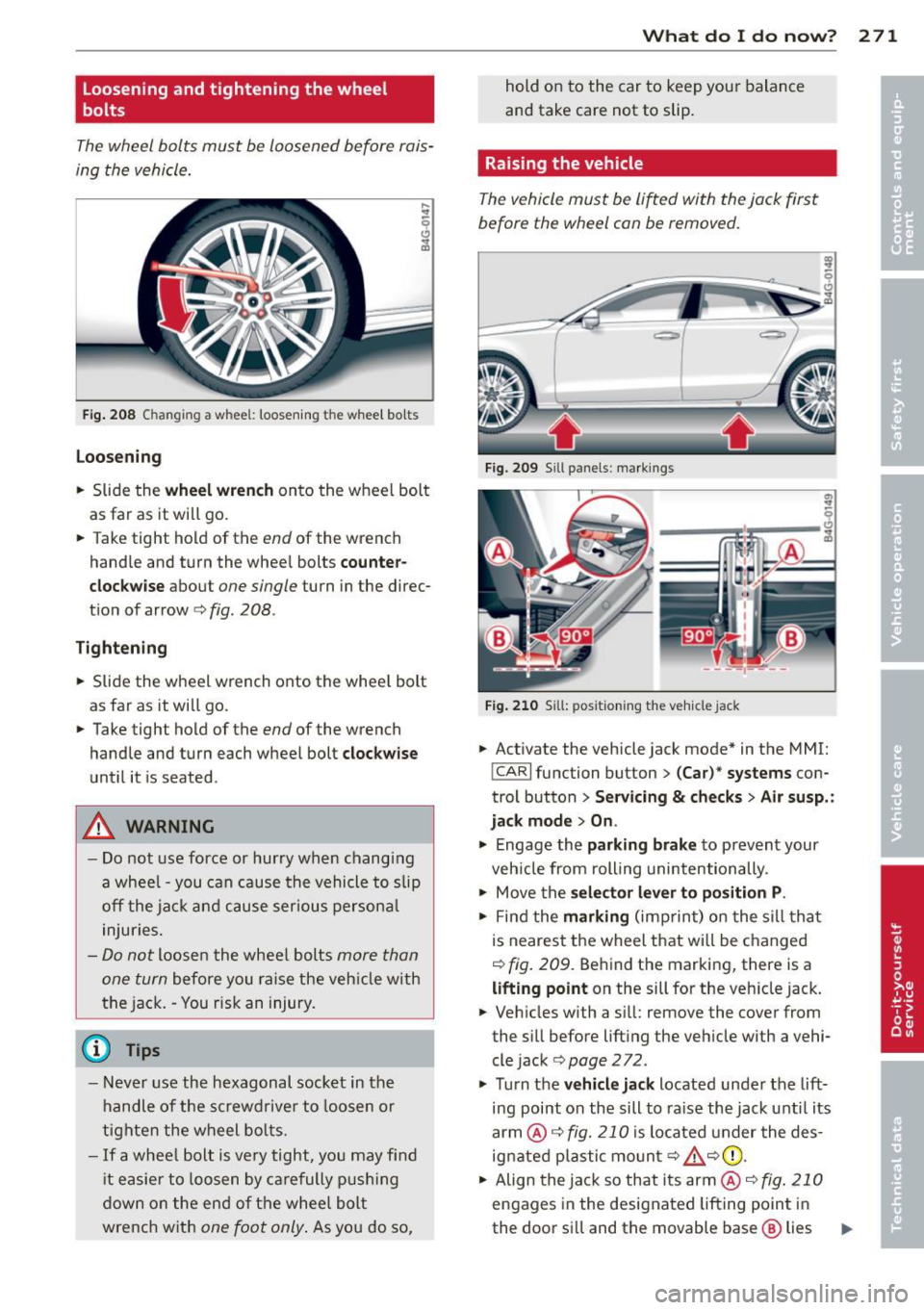
Loosening and tightening the wheel
bolt s
The wheel bolts must be loosened before rais
ing the vehicle.
F ig. 208 Changing a whee l: loos enin g the wh eel bo lt s
Loo sening
.. Slide the whe el w re nch onto the wheel bolt
as far as it wi ll go .
.. Take tight hold of th e
end of the wrench
hand le and turn the whee l bolts
counte r
clock wis e
abou t one single turn in the direc
tion of arrow c:>
fig. 208 .
Tightening
.. Slide the wheel wrench onto the whee l bolt
as far as it will go.
.. Take tigh t hold of the
end of the wrench
handle and turn each wheel bolt
cl ockw ise
unt il it is seated .
A WARNING
-Do not use force or hurry when changing
a whee l -you can cause the vehicle to s lip
off the jack and cause ser ious persona l
injuries.
- Do not loosen the wheel bolts more than
one turn
before you ra ise the veh icle w ith
the jack. -You risk an injury.
(D Tips
- Never use the hexagonal socket in the
handle of the screwd rive r to loosen or
tighten the wheel bo lts.
- If a whee l bolt is very tight, you may find
i t easier to loosen by c arefully p ushi ng
down on the end of the whee l bolt
wrench with
one foot only . As you do so,
What do I d o now ? 271
hold on to the car to keep your balance
and take care not to slip .
Raising the vehicle
The vehicle must be lifted with th e jack first
before the wheel can be removed.
F ig . 209 Sill panels : ma rki ngs
Fig . 210 Sill : p os it ion ing t he ve hicle jack
.. Act iv ate the vehicle jack mode* in the MMI:
!CAR I function button> (Car) * sy stems con
trol button>
S e rv icing & ch ecks > Air su sp .:
jack mode > On .
.,. Engage the park ing brake to prevent your
veh icle from rolling unintentionally .
.,. Move the
s elect or le ver to p osition P .
.,. Find the marking (imp rint) on the sill tha t
is nearest the wheel that wi ll be changed
r=> fig. 209 . Behind the marking, there is a
lifti ng p oint on the sill for the veh icle jack .
.. Veh icles wi th a s ill: remove the cover from
the sill before lift ing the veh icle wi th a vehi
cle jack
c:> page 272 .
.,. Turn the vehicl e ja ck located under the lift
ing point on the sill to ra ise the jack unti l its
arm @ c:>
fig. 210 is located under the des
ignated p lastic moun t c:> &, c:>(D .
.. Align the jack so that its arm@c:>
fig. 210
engages in the designated lifting point in
the door sill and the movable base @ lies
~
Page 275 of 310
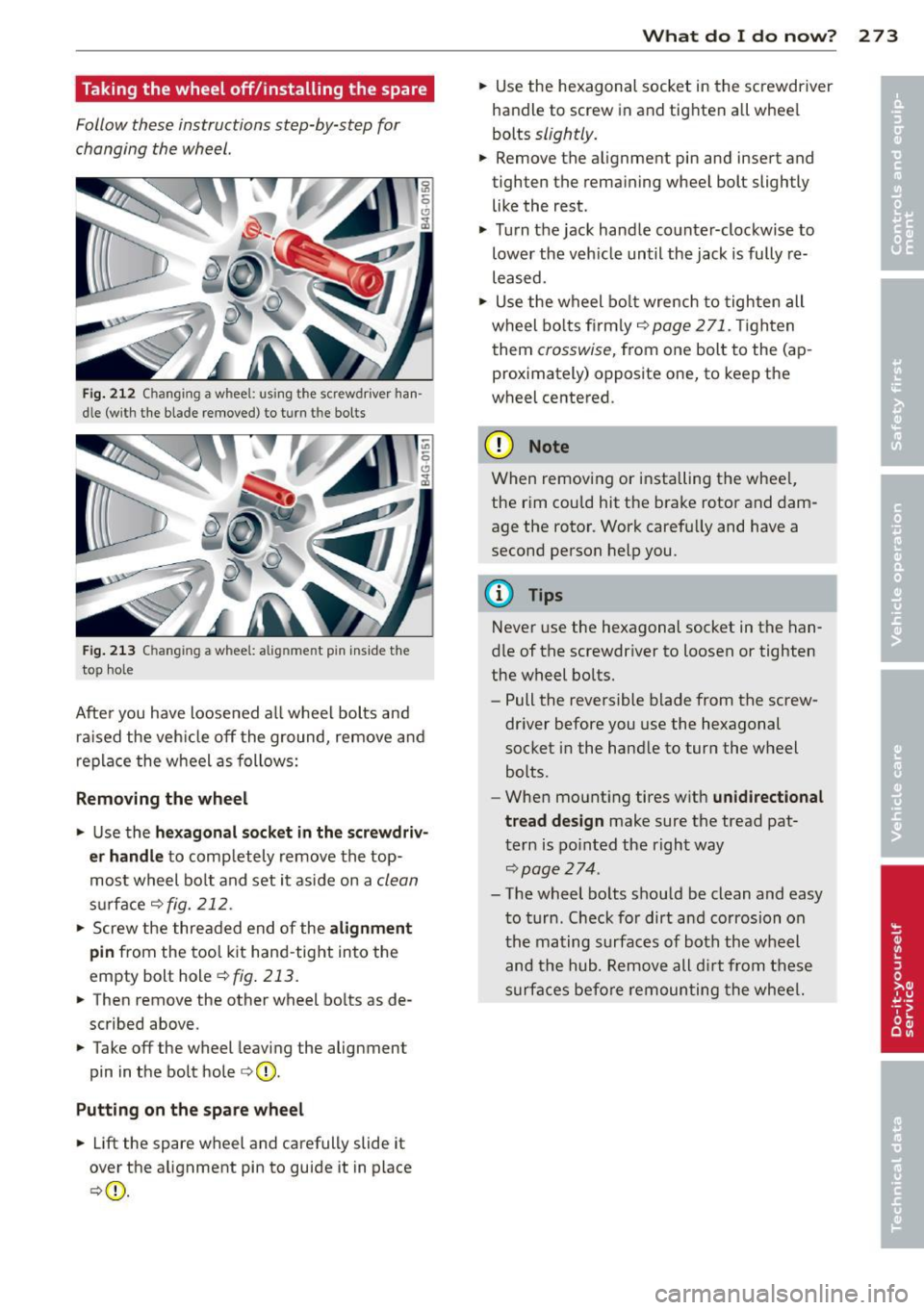
Taking the wheel off/installing the spare
Follow these instructions step-by-step for
changing the wheel.
Fig. 2 12 Changing a wheel: using the screwdriver han
dle (with the blade removed} to turn t he bo lts
F ig . 2 13 Changing a wheel: alignm en t pin ins ide the
top hole
After you have loosened a ll wheel bolts and
ra ised the veh icle off the ground, remove and
replace the wheel as follows:
R emoving the wheel
.. Use the hex agon al so ck et in th e scr ew dr iv
e r handle
to comp letely remove the top
most wheel bo lt and set it aside on a
clean
s u rface Q fig. 212 .
.. Screw the threaded end of the alignm ent
pin from the tool k it hand -tight into the
empty bolt hole
Qfig . 213.
.. Then remove the other wheel bo lts as de
scribed above .
.. Take off the wheel leaving the alignment
pin in the bolt hole
Q (D.
Putting on the spar e wheel
.. Lift the spare wheel and carefully slide it
over the alignment pin to guide it in place
Q (D.
What do I d o now ? 273
.. Use the hexagonal socket in the screwdriver
handle to screw in and tighten all wheel
bolts
slightly.
.. Remove the alignment pin and insert and
tighten the remaining wheel bolt slightly like the rest.
.. Turn the jack handle counter-clockwise to
lower the veh icle until the jack is fully re
leased .
.. Use the wheel bo lt wrench to tighten all
wheel bo lts firm ly
Q page 271. Tighten
them
crosswise, from one bolt to the (ap
proximately) opposite one, to keep the
wheel centered.
(D Note
When removing or installing the whee l,
the rim could hit the brake rotor and dam
age the rotor. Work carefully and have a
second person help you.
@ Tips
Never use the hexagonal socket in the han
dle of the screwdriver to loosen or tighten
the w heel bolts.
- Pull the reversible blade from the screw
dr iver before you use the hexagonal
socket in the hand le to turn the wheel
bolts.
- When mounting tires w ith
unidi rectional
tread design
make sure the tread pat
tern is po inted the right way
~page 274.
-The wheel bo lts shou ld be clean and easy
to turn . Check for dirt and corrosion on
the mating surfaces of both the wheel
and the hub. Remove all d irt from these
surfaces before remounting the whee l.
Page 278 of 310
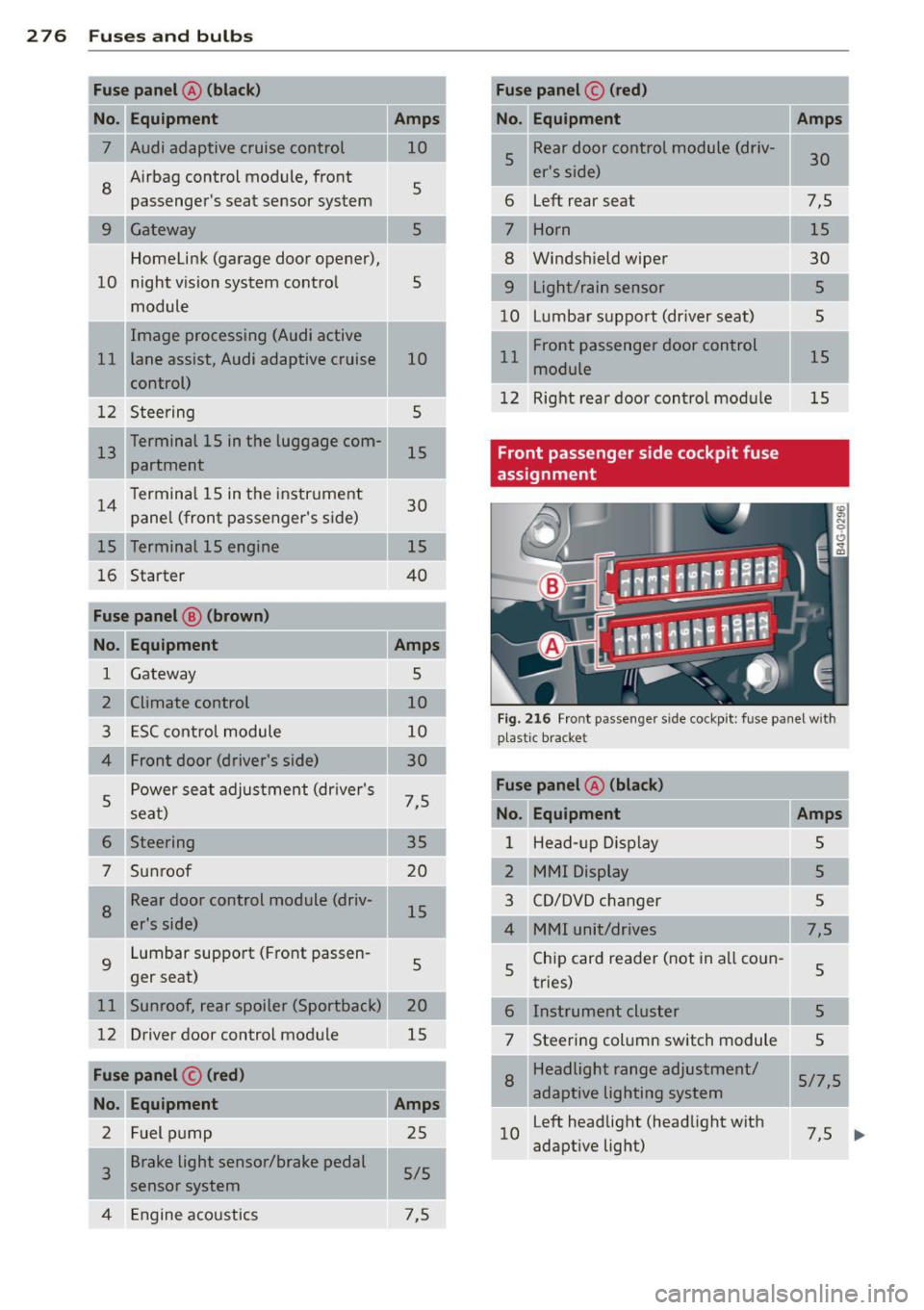
2 76 Fuses and bulbs
Fuse panel
@ (bl ack )
No. Equ ipment
= 7 Audi adaptive cruise control
8 Airbag control module, front
passenger's seat sensor system
9 Gateway
Homelink (garage door opener),
10 night vision system contro l
module
Image processing (Audi active
11 lane assist, Audi adaptive cruise
control)
12 Steering
I 13 Terminal 15 in the luggage com-
partment
14 T
ermina l 15 in the instr ument
pane l (front passenger's s ide)
15 Terminal 15 engine
16 Starter
Fuse panel B (brown)
No. Equipment
1 Gateway
2 Climate control
3 E SC con trol module
Front door (driver's side)
5 Power seat adjustment (dr
iver's
sea t)
6 Steering
7 Sun roof
8
R ear door control module (driv-
er's side)
9
Lumbar support ( Front passen-
ger seat)
11 Sunroof, rear spoiler ( Sportbac k)
12 Driver door control mod
ule
Fuse panel c (red)
No. Equipment
2 Fuel p ump
.
3
Brake light sensor/brake pedal
sensor s ystem
4 Engine aco ustics
Amp s
10
5
5
10
5
15
30 15
40
Amps
5
10
10
30
7,5
35
20 15
5
20
15
Amps
25
5/5
7 ,5
-Fuse panel © (red )
No. Equipment Amps
=· Rear door control module (driv-
5 30
er's side)
6 Left rear seat ______ , 7,5
Ho rn 15
Windshield wiper ____ 30
Light/rain sensor ___ 5
10 Lumba r support (dr iver seat) 5
11 Front passenger door control
module
1 2 Rig ht rear door control mod ule
Front passenger side cockpit fuse
assignment
15
15
Fig. 21 6 Fro nt passen ger sid e co ckp it : fu se pa nel w it h
p last ic brac ket
Fuse panel @ (black)
No. Equipment Amps
1 Head-up D is p la y 5
2
MMI Display 5
3 C D/DVD changer 5
4 MMI unit/drives 7,5
5 Chi
p card rea der (not in a ll co un-
5
tries)
6 Instrument cluster 5
7 Stee
ring column switch module
5
8 Headlight range adjustment/
5/7,5
adaptive lighting sys tem
1 0 Left headlight (head
light wit h
7,5
adaptive light)
I
...
Page 279 of 310

Fuse s and bulb s 2 77
Fuse panel @ (brown) Fuse panel@ (red )
No. Equipment Amps No.
Equipment Amps
Climate control 10 1 Left belt tensioner 25
Climate control system blower 40 2 Right belt tensioner 25
3
Diagnost ic connec tor 10 3 Socke t 20
4
Electrical ignition lock 5 4 Socket 20
5
Power s teering colum n adj ust-
5 ment
5 Ele ctromechanical parking brake 5
6 adaptive air suspension 15
6 Steering column switch module 10
7
Power steering column adjust -
25
ment
7
Rear door (front passenger 's
30 side)
8 Rear e xterior lighting 30
8 Light switch 5
9
L u ggage compa rtment lid con-
30
trol modu le
Luggage compartment fuse assignment Telephone 5
11
Sound amplif ier 30
12
Rear spoiler (Sportback) 20
Fuse panel © (b rown )
No . Amps
1
Radio receiver, Sound amplifier/ 30/20
MMI unit/drives
2 Tank leak detection system 5
Fig. 2 17 Luggage co mpar tment: fuse panel w ith plas-
t ic b racke t 4
AEM co ntrol module/battery 10/15
module
Fuse p anel A (black )
Battery fan 35
Radio receive r 7,5
No. Equipment Amps 8 Rear Seat Entertainment 7,5
Electromechanical parking brake 30
Electromechanical parking brake 30 9
Automatic d imm ing interior 5/15
rearview mirror/battery mod ule
6
Front door (front passenger's
30 side)
10 Parking system 5
7
Rear exterior lighting 30 Fuse panel @ (green )
Rear sun shade, clos ing aid, lug-No .
Equipment Amps
8
gage compartment lock, con-
20 venience key, START ENGINE
1 Aud i pre sense 5
2
Electromechanical parking brake 5
STOP, fuel fi ller door 3 ad aptive air suspens ion 5
9 Power seat adjustment 15
4 Automatic transmission 7,5
10
Parking system 5 5 Parking system 5
11
Rear seat heating 30 6 Rear Seat Entertainment 5
7
Sta rt -Stop-Sys tem 5
8 Audi side assist 5
Page 282 of 310
280 Emergency situations
@ Tips
The discharged battery must be properly
connected to the vehicle's electrical sys
tem. When jump starting or charging the
battery, never connect the negative
ground cable to the battery negative post
because the batte ry manager system must
be able to detect the battery 's state of
charge. Always connect the negative
ground cab le to the negative ground post
of the battery manager control unit.
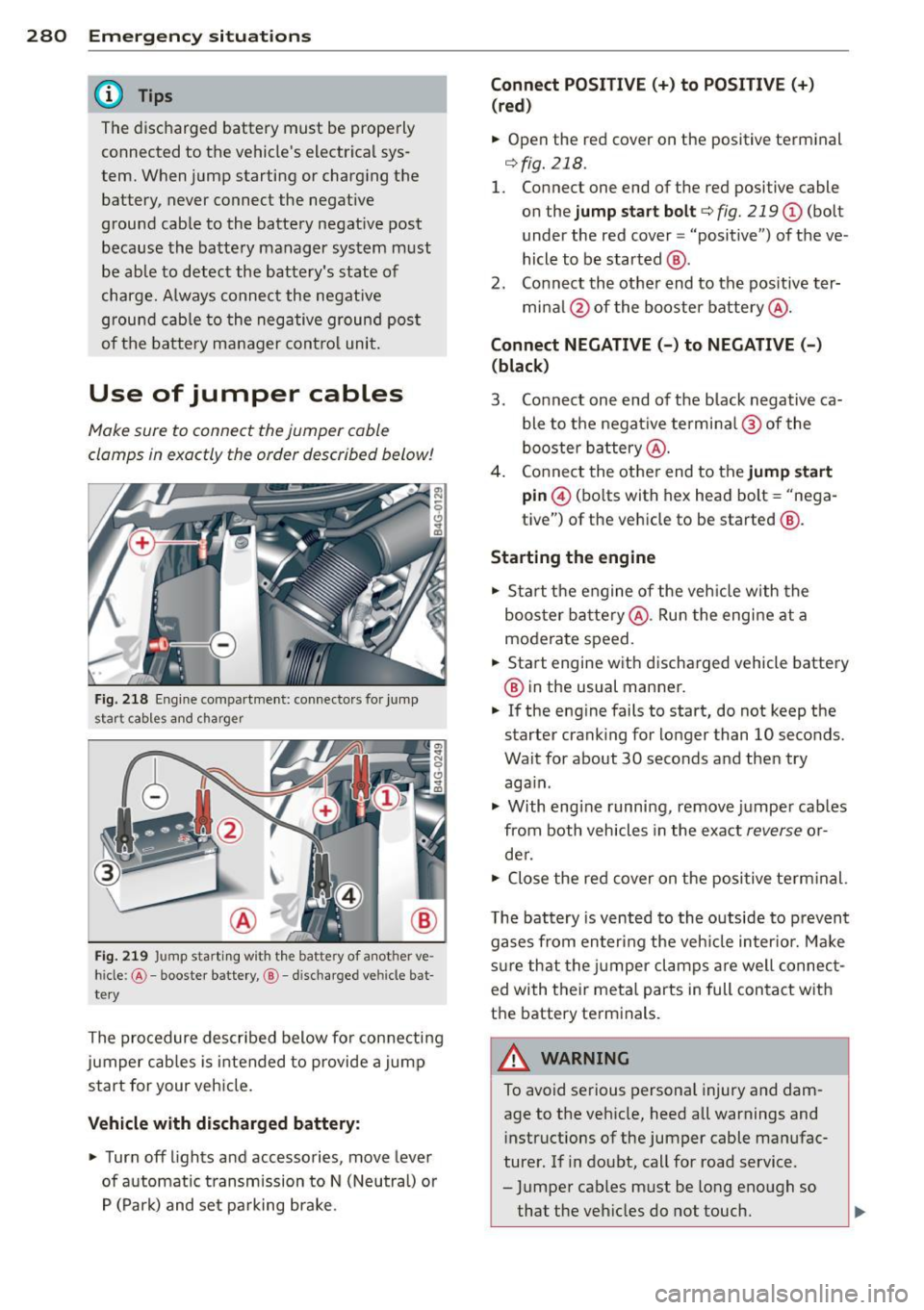
Use of jumper cables
Make sure to connect the jumper cable
clamps in exactly the order described below!
Fig. 218 Engine compartment: connecto rs for jump
start cables and charger
Fig. 219 Jump start ing with the battery of another ve·
hide: @-booster battery, @-discharged ve hicle bat
tery
The procedure described below fo r connecting
jumper cables is intended to provide a jump
start for your vehicle.
Vehicle with discharged battery:
.,. Turn off lights and accessories, move lever
of automatic transmission to N (Neutral) or
P (Park) and set parking brake.
Connect POSITIVE(+) to POSITIVE(+)
(red)
.,. Open the red cover on the positive terminal
¢fig. 218.
1. Connect one end of the red positive cable
on the
jump start bolt c::;, fig. 219 @ (bolt
under the red cover = "positive") of the ve
hicle to be started @.
2. Connect the other end to the positive ter-
mina l@ of the booster battery@.
Connect NEGATIVE (-) to NEGATIVE (-)
(black)
3. Connect one end of the black negative ca
ble to the negat ive terminal @ of the
booster battery @.
4. Connect the other end to the
jump start
pin © (bolts with hex head bolt= "nega
tive") of the vehicle to be started @.
Starting the engine
.,. Start the engine of the veh icle with the
booster battery@. Run the engine at a
moderate speed .
.,. Start engine with d ischarged vehicle battery
@ in the usual manner.
.,. If the engine fails to start, do not keep the
starter cranking for longer than 10 seconds.
Wait for about 30 seconds and then try aga in .
.,. With eng ine running,
remove jumper cables
from both vehicles in the exact
reverse o r
de r .
.,. Close the red cover on the positive term inal.
T he battery is vented to the outside to prevent
gases from entering the veh icle inter ior. Make
sure that the jumper clamps are well connect
ed with their metal parts in full contact with
the battery terminals.
_& WARNING
To avoid serious personal injury and dam
age to the vehicle, heed all warnings and
instructions of the jumper cable manufac
turer. If in doubt, call for road service .
- Jumper cables must be long enough so
that the veh icles do not touch.
-
Page 283 of 310
-When connecting jumper cables, make
sure that they cannot get caught in any
moving parts in the eng ine compart
ment .
- Before you check anything in the engine
compartment, always read and heed all
WARNINGS ¢
page 224, Engine com
partment.
(D Note
Improper hook-up of jumper cables can r u
in the generator.
- Always connect POSITIVE(+) to POSI
TIVE(+), and NEGA TIVE( -) to NEGATIVE
( - ) ground post of the battery manager
control u nit .
- Check that all sc rew plugs on the battery
cells are screwed in firmly. If not, tighten
pl ugs p rior to connecting clamp on nega
tive batt ery terminal.
- P lease note that the procedure for con
nect ing a jump er cable as describe d
above applies spec ifically to the case of
your vehi cle be ing j ump s tarted. When
you are giving a jump star t to anothe r ve
hicle, do
not connec t the negative( -) ca
b le to the negat ive (-) term inal on the
discharged battery@¢
fig. 219. In
stead, securely connect the negative(-)
cable to e ither a solid metal component
that is firmly bolted to the engine block
or to the engine block itself.
If the bat
te ry tha t is being charged does not vent
to the ou tside, es ca ping b attery gas
could ignite and ex plode!
Emergency towing
with commercial tow
truck
General hints
Your Audi requires special handling for tow
ing .
The fo llow ing informa tion is to be used by
commercia l tow tr uck operators who know
how to ope rate thei r equipmen t sa fe ly.
Emergenc y situ ation s 281
-Ne ver tow your Audi. Towing will cau se
damage to the engine and tran smission.
- Never wrap the safety chain s or w inch ca
ble s around the brake lines.
- To prevent unnece ssary damage , your Audi
must be transported with a flat bed tru ck.
- To load the vehicle on to the fl at bed , use
the towing loop found in the vehicle tools
a nd attach to the front or rear anchora ge
¢page 281 and ¢page 282 .
_& WARNING
A vehicle being towed is not safe for pas
sengers. Never allow anyo ne to ride in a
vehicle be ing towed, for any reason.
Front towing loop
Only install the front towing loop when it is
needed.
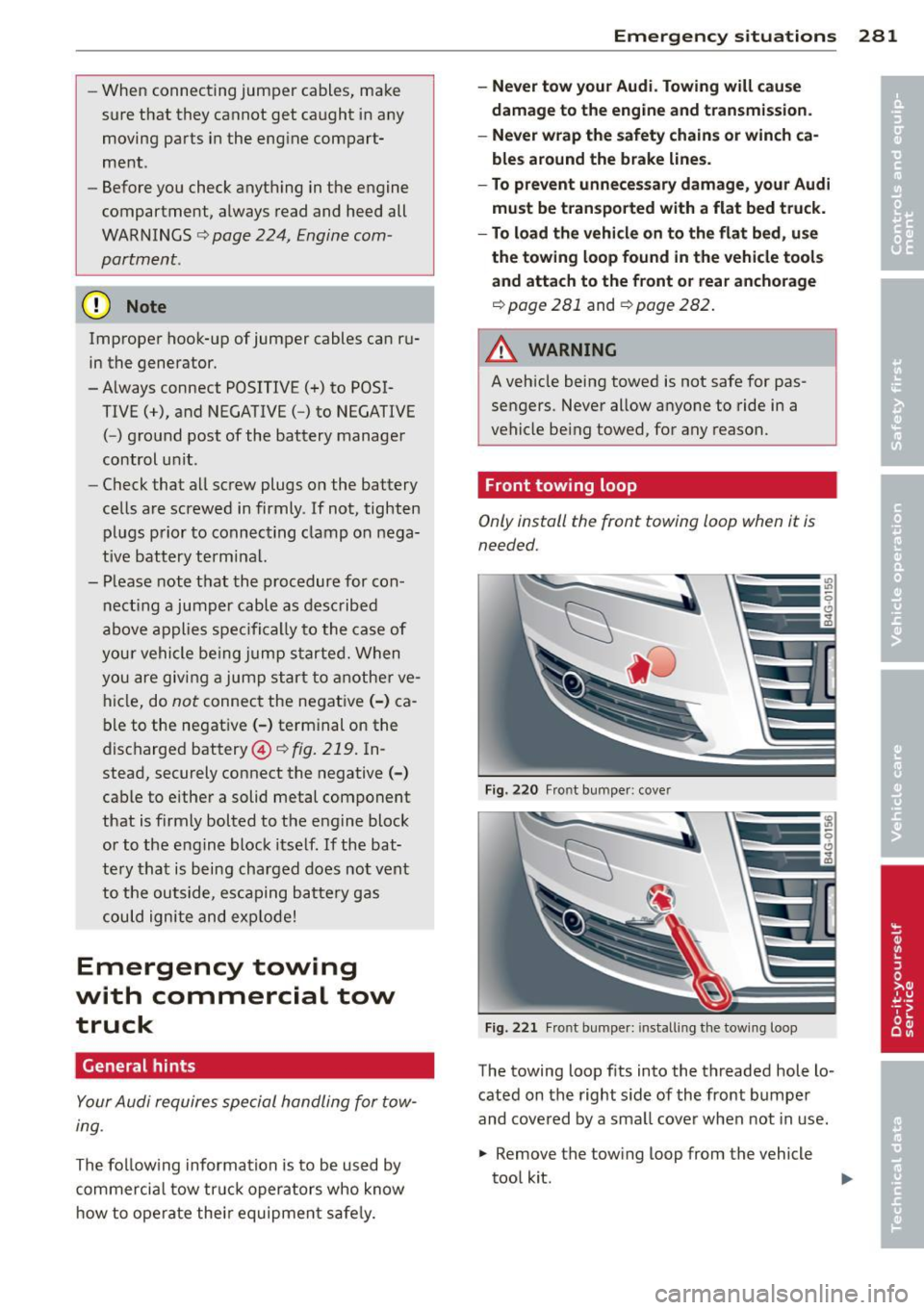
Fig. 22 0 Front bumpe r: cove r
Fig. 22 1 Front bu mpe r: in stall ing t he tow ing loop
-
The towing loop fits into the threaded hole lo
cated on the right s ide of the front bumpe r
and cove red by a sma ll cover when not in use.
.. Remove the tow ing loop from the vehicle
too l kit .