ignition AUDI S7 2013 Repair Manual
[x] Cancel search | Manufacturer: AUDI, Model Year: 2013, Model line: S7, Model: AUDI S7 2013Pages: 310, PDF Size: 77.45 MB
Page 233 of 310

-Always disconnect the battery.
- Never smoke or work near heaters or open flames. Fluids in the engine com
partment could start a fire.
- Keep an approved fire extinguisher im
mediately available.
- To avoid electrical shock and personal in
jury while the engine is running or being
started, never touch :
- Ignition cables
- Other components of the high voltage
electronic ignition system.
- If you must perform a check or repair
with the engine running:
- First, fully apply the parking brake,
move selector lever to P (Park).
- Always use extreme caution to prevent
clothing, jewelry, or long hair from get
ting caught in the radiator fan, V-belts
or other moving parts, or from contact ing hot parts. Tie back hair before
starting, and do not wear clothing that
will hang or droop into the engine.
- Minimize exposure to emission and
chemical ha zards c:::> & .
A WARNING
California Proposition 65 Warning:
- Engine exhaust, some of its constituents,
and certain vehicle components contain
or emit chemicals known to the State of
California to cause cancer and birth de
fects and reproductive harm. In addition ,
certain fluids contained in vehicles and
certain products of component wear con
tain or emit chemicals known to the
State of California to cause cancer and
birth defects or other reproductive harm .
Checking and filling 231
-Battery posts, terminals and related ac
cessories contain lead and lead com
pounds, chemicals known to the State of
California to cause cancer and reproduc
tive harms. Wash hands after handling.
(D Note
When adding fluids, always make sure that
they are poured into the proper container
or filler opening, otherwise serious dam
age to vehicle systems will occur.
(® For the sake of the environment
To detect leaks in time, inspect the vehicle
floor pan from underneath regularly . If
you see spots from oil or other vehicle flu ids, have your vehicle inspected by an au
thorized Audi dealer.
Closing the engine hood
.,. Pull the hood down until the pressure from
the struts is reduced.
.,. Let the hood
drop down and latch in place.
Do not try to push it shut; it may fail to en
gage
c:::> ,A .
A WARNING
-
A hood that is not completely latched
could fly up and block your view while driv
ing .
- When you close the engine hood, check it
to make sure the safety catch has proper ly engaged. The hood should be flush
with the surrounding vehicle body parts.
- If you notice while driving that the hood
is not secured properly , stop at once and
close it. •
•
Page 237 of 310
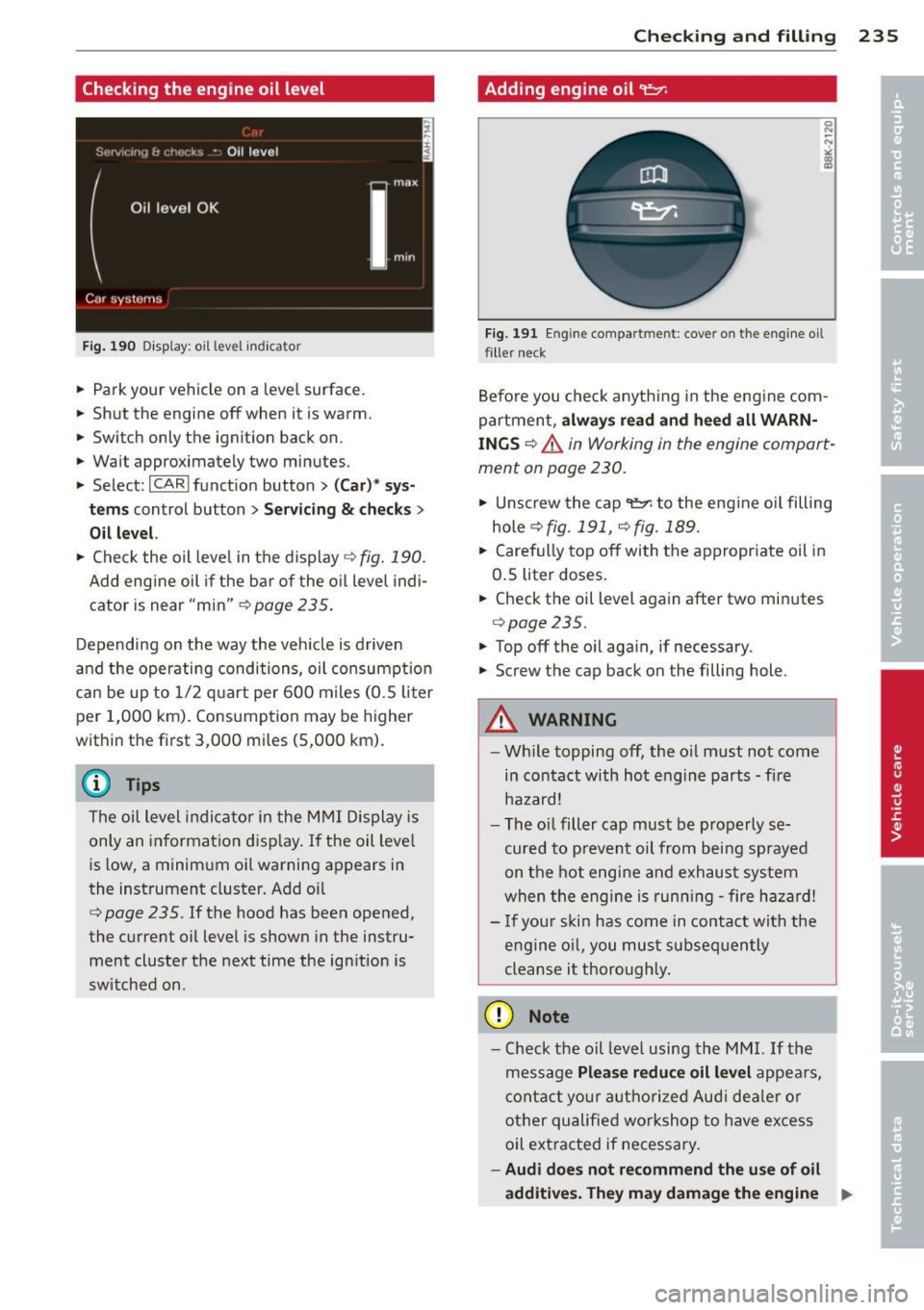
Checking the engine oil level
Fig . 190 D is p la y : o il level indi ca tor
• Park your vehicle on a lev el surfac e.
• Shut the engine off when it is warm.
• Switch only the ignition b ack on.
• W ait approxima tely two minutes .
• Se lect :
ICARI function button > ( C ar)* sys
t e m s
control button > Se rvicing & c h ecks >
Oil l ev el.
• Check the o il leve l in the display ¢ fig. 190.
Add engine oil if the bar of the oil level indi
cator is near "min "
¢page 235.
Depending on the way the veh icle is driven
and the operating conditions, oil consumpt ion
can be up to 1/2 q uart per 600 m iles (0.5 li ter
pe r 1,000 km) . Consumption may be higher
within the f irst 3 ,000 miles (5,000 km).
(D Tips
The oi l level indicator in the MMI Dis play is
only an in format ion disp lay . If the oil leve l
is low, a minim um oi l warni ng appears in
the instrument cluster. Add oi l
<=> page 235. If the hood has been opened,
the curre nt oil level is shown in the instru
ment cluste r the next time the ign ition is
sw itched on .
Checkin g and fillin g 235
Adding engine oil 'i=:1:
Fig. 191 Eng in e compa rtm en t: co ve r on the engine oi l
filler n eck
Before you check anything in the eng ine com
partment ,
alw ay s re ad and he ed all WARN
INGS ¢&.
in Working in the engine compart
ment on page 230.
• Uns crew the cap ce:r. to the eng ine oi l filling
hole
¢ fig . 191, ¢fig. 189.
• Caref ully top off with the appropr iate oil in
0.5 liter doses .
• Check t he oil level aga in after two minutes
¢ page 235 .
• Top off the o il aga in, if necessary .
• Screw the cap back on the filling hole .
A WARNING
-Wh ile topping off, the o il must not come
i n contact w ith hot engine parts -fi re
hazard!
- The oi l filler cap must be p roperly se
cured to prevent oil from bei ng sprayed
on the hot engine and exhaust system
when the engine is runn ing -fire ha zard!
- I f your ski n has come in contact with the
engine o il, you mus t subse quently
cleanse it thoroughly.
(D Note
- Check the oil level using the MMI. If the
message
Please reduce oil level appe ars,
c ontact yo ur a uth ori zed Aud i dea ler o r
ot her qualified workshop to have excess
oil ext racted if necessary.
- Audi d oes not re commend the u se of oil
additiv es. They m ay damage the engine
1111-
Page 239 of 310
Engine cooling system
Coolant
The engine coolant performs two functions: it
keeps the engine from overheating and it pro
te cts the engine from freezing in the winter .
The cooling system is sealed and generally re
qu ires little attention .
The cooling system has been filled at the fac
tory with a permanent coolant which does not need to be changed. The coolant consists of a
mixture of water and the manufacturer's gly
col-based coolant additive G13 ant ifreeze
w ith anticorrosion add itives (50% fo r USA
models; 60% for Canad ian models). This mix
ture bot h assu res the ne cessary frost protec
tion and protects metal components in the
engine's coo ling system from corrosion and
scaling. It also raises the boili ng po int of t he
coolant.
D o not red uce the concentration o f the coo l
ant in the summer by adding plain water .
The
proportion of coolant addit ive must be at
least 50% but not mo re than 60 %
to main
tain antifree ze protection and cooling efficien
cy. If the coolant frost protection is too low,
the coolant cou ld freeze and damage the veh i
cle heating and eng ine cooling system .
For year-round driving, antifree ze is added at
the factory for temperatures down to:
- -3 1°F (-35°C)USA
- -40 ° F ( - 4 0 °C) Canada.
A WARNING
Before yo u check anything in the engine
compartment , always read and heed a ll
WARNINGS
¢ & in Working in the engine
compartment on page 230.
(D Note
- Befo re winter sets i n, have the coolant
chec ked to see i f th e coo lant ad dit ive i n
you r vehicle is suffic ient to meet the cli
mate cond itions . T hi s is especially impor
ta nt if yo u live in a regi on whe re the w in-
-
Checkin g and fillin g 237
ter is ex treme ly co ld. If necessary, i n
crease t he p ro po rtion of coo lant additive
to 60%.
- W hen a dding coolant additive to yo ur
cooling system , remembe r:
- We recommend us ing on ly coo la nt ad
di tive G 12++ or G 13 (check the labe l)
fo r you r ve hicl e. This coolant additive is
a v ailabl e at author ized Aud i de alers.
Ot he r ty pes of antifree ze can signifi
cantly reduce corros ion p rotec tion. The
r es ulting co rrosion can cause a loss of
coolant and serio us engine damage .
- Do not add any ty pe of rad iator leak seal
ant to you r vehicle's engine coo lant .
Add ing radiator repair flu id may adverse
ly affect t he fu nction and performance of
your cooling system and cou ld result in
damage not covered by yo ur New Ve hicle
L imited Warranty .
Checking the engine coolant level
The engine coolant level can be checked with
a quick glance.
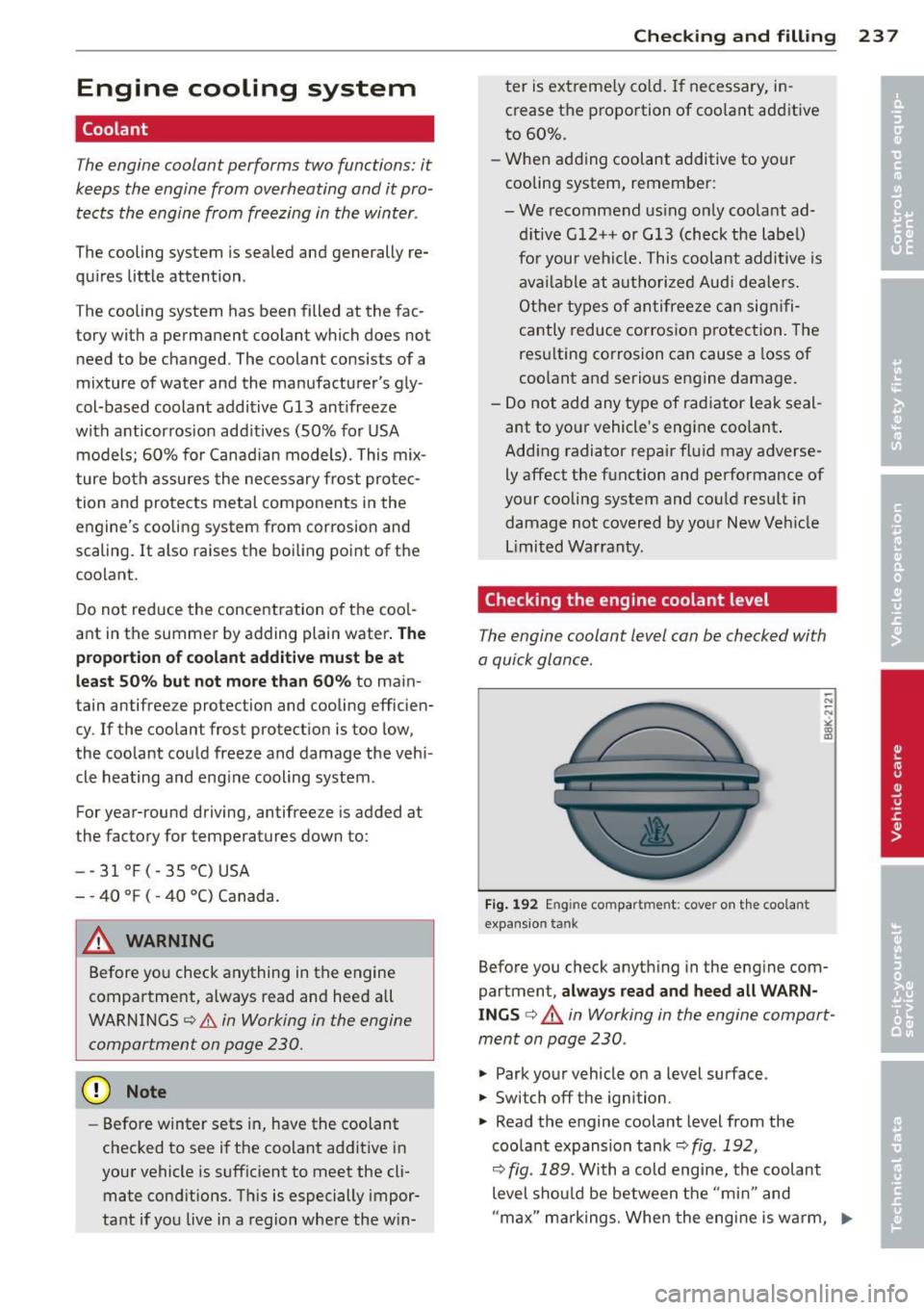
Fig. 19 2 Engine co mpart ment: cover on t he coo la nt
expansio n ta nk
Before you check a nyth ing in the eng ine com
partment,
always read and heed all WARN
INGS <=>&.
in Working in the engine compart
ment on page 230 .
.,. Park yo ur vehicle on a level surface .
.,. Switch off the ignition .
.,. Read the e ngine coolant level from the
coo la nt expansion tan k<=>
fig . 192,
¢ fig. 189 . With a cold engine, the coolant
level s hou ld be be tween the "m in" and
" max" mar kings. Whe n the engi ne is w arm,
Ill>-
Page 243 of 310
Disconne cting the batt ery t erminals
Some vehicle functions (power w indow regu
l ators, for example) are lost if the battery ter
minals are disconnected . These functions have
to be re learned after the battery terminals are
connected again. To prevent this, the battery
should only be disconnected from the vehicle
electrical system when absolutely necessary
for repairs .
Vehicles not driven fo r lo ng period s
If you do not drive your vehicle over a period
of several days or weeks, electrical compo
nents are gradually cut back or switched off .
This reduces energy consumption and main
tains starting capab ility over a longer per iod
c> page 202 . Some of the convenience func
tions may not operate, such as the inte rior
lights or power seat adjustment. The conven
ience functions will be ava ilable again when
you switch on the ignition and start the en
g ine.
Winter operation
D uring the winter months, batte ry capacity
tends to decrease as tempe ratu res d rop . This
is because more power is also consumed while
starting , and the headlights, rear window de
fogger, etc., are used more often.
Avoid unnecessary power consumption, par
ticularly in city t raffic or when traveling on ly
short distances. Let your a uthorized Audi
dealer check the capacity of the vehicle bat
tery before winter sets inc>
page 243. A well
charged battery w ill not only prevent starting
prob lems when the weather is cold, but will
also last longer .
@ Tips
If your vehicle is left standing for severa l
weeks at extremely low temperatu res, the
veh icle battery should be removed and
sto red where it will not freeze. This will
prevent it from being damaged and hav ing
t o be rep la ced.
Checkin g and fillin g 241
Working on the battery
Be especially careful when working on or near
the battery.
The battery is located in the luggage compart ment under the floor. Before you check any
th ing in the luggage compartment,
read and
he ed all WARNINGS
<=> ..&_ .
Always heed the safet y warnings , when work
i ng on the vehicle batte ry or the vehicle e lec
trical system to prevent inju ry.
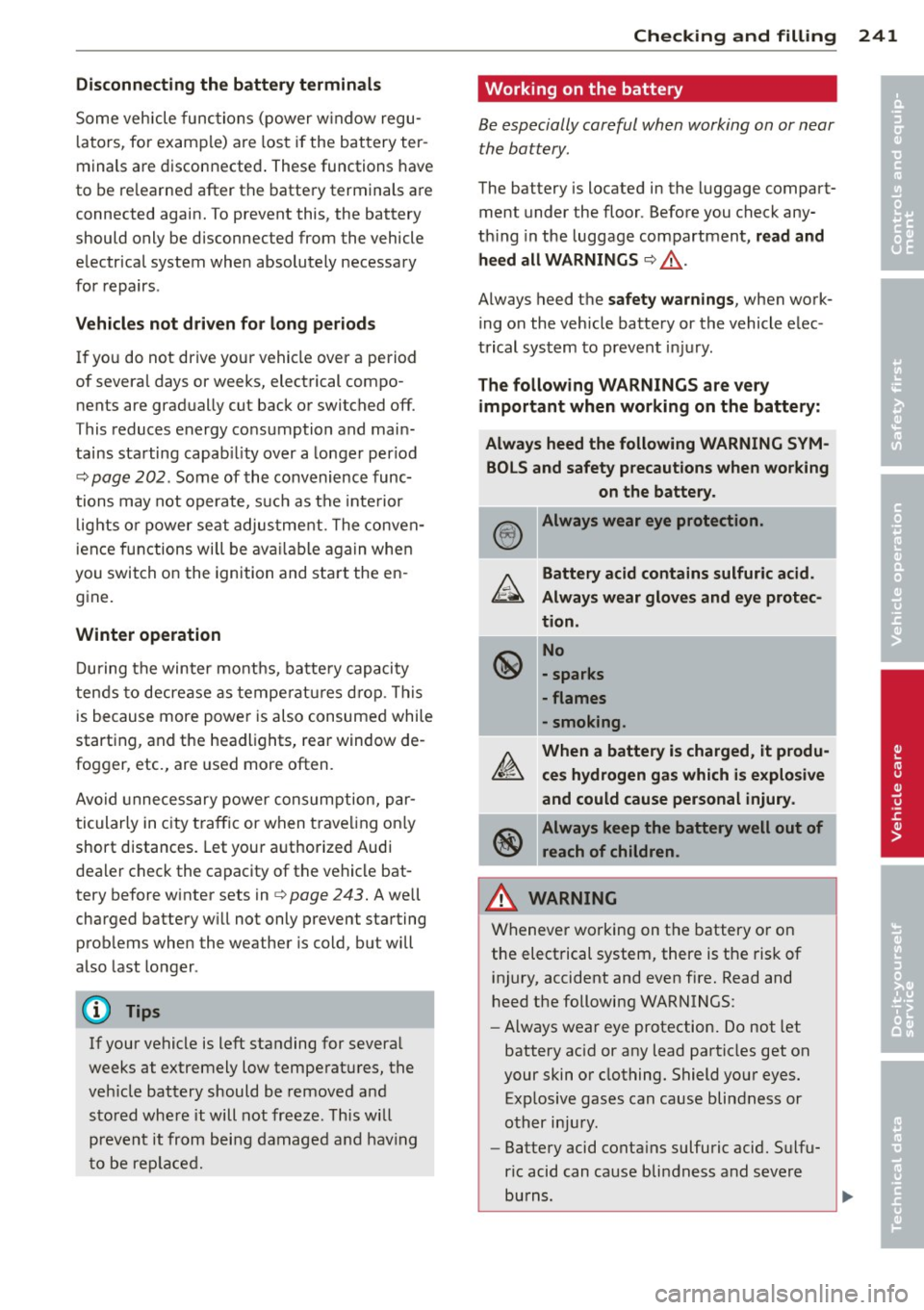
The following WARNINGS ar e very
important when wor king on the battery:
Always heed the following WARNING SYM BOLS and safety pre cautions when working
on the battery.
Always wear eye protection.
Battery acid contains sulfuri c acid .
Always w ear glove s and eye protec
tion.
No
- sparks
- flames
- smoking .
1
When a batter y is charged, it produ
ce s hydrogen g as which is e xplo sive
and could cause per sonal injury .
---·-
®
Always keep the battery well out of
reach of children .
A WARNING
Whenever working on the battery o r on
the electrical system, there is the risk of injury, accident and even fire. Read and
heed the following WARNINGS :
- Always wear eye protection. Do not let
-
battery ac id or any lead particles get on
your skin or clothing. Shield your eyes. Exp losive gases can cause blindness or
other inju ry.
- Battery acid conta ins sulfuric acid. Sulfu
ric acid can cause blindness and severe
bu rns.
•
•
Page 244 of 310
242 Checking and filling
-Always wear gloves and eye protection.
Do not tilt the battery because acid
could leak out of the ventilation open ings.
- If you get battery acid in your eyes or
on your skin, immediately rinse with
cold water for several minutes and get
medical attention .
- If you should ingest any battery acid,
seek medical attention immediately.
- Do not expose the battery to an open
flame, electric sparks or an open light .
- Do not smoke.
- Do not interchange the positive and neg-
ative cables .
- When working on the battery , be sure
not to short-circuit the terminals with
tools or other metal objects. This would
cause the battery to heat up very quickly,
which could lead to damage or explosion
and personal injury .
- When a battery is charged, it produces
hydrogen gas which is explosive and
could cause personal injury .
- Always keep the battery well out of the reach of children .
- Before work is done on the electrical sys
tem, disconnect the negative ground ca ble.
- Before performing any work on the elec
trical system, switch off the engine and
ignition as well as any electrical equip
ment. The negative cable on the battery
must be disconnected. If you are just go
ing to replace a light bulb, then it is
enough to switch off the lights.
- Before disconnecting the battery, switch
off the anti-theft alarm system! Other
wise you will set off the alarm.
- When disconnecting the battery, first
disconnect the negative cable and then
the positive cable.
- Before reconnecting the battery, make sure all electrical consumers are switch
ed off. Reconnect the positive cable first
and then the negative cable. Never inter
change the cables - this could start a fire! -
Never charge a frozen or a thawed-out
battery . It could explode! If a battery has
frozen, then it must be replaced. A dis charged battery can freeze over at 32 °F
(0 °C) .
-Make sure the vent hose is always attach
ed to the opening on the side of the bat
tery .
- Never use batteries which are damaged .
There is the danger of an explosion! Al
ways replace a damaged battery.
A WARNING ....__
California Proposition 65 Warning:
- Battery posts, terminals and related ac
cessories contain lead and lead com
pounds, chemicals known to the State of
California to cause cancer and reproduc
tive problems . Wash hands after han
dling.
(D Note
- Do not disconnect the vehicle battery
when the ignition is on or when the en
gine is running, otherwise , you will dam
age electronic components in the electri
cal system.
- If your vehicle is going to stand for a
long period of time without being driven,
protect the battery from "freezing", oth
erwise it will be damaged and will then
have to be replaced.
- When opening the doors, the windows
lower approximately 10 mm automati
cally. This function is not available when
the battery is disconnected, which
means there is a risk that the door seal
or the window could be damaged .
Page 267 of 310

When the malfunction indicator is illuminat
ed, the system may not be able to detect or
signal low tire pressure as intended. TPMS
malfunctions may occur for a variety of rea
sons, including the installation of replace ment or alternate tires or wheels on the vehi
cle that prevent the TPMS from function ing
properly . Always check the TPMS malfunction
tellta le after replacing one or more tires or
wheels on your vehicle to ensure that the re
placement or alternate tires and wheels allow
the TPMS to continue to function properly.
Tire pressure indicator appears
Applies to vehicles: with tire pressure monitoring system
The tire pressure indicator in the instrument
cluster informs you if the tire pressure is too
low or if there is a system malfunction.
Fig. 201 Display : underinflatio n warning
Fig. 202 Display : Syste m malfun ctio n
Using the ABS sensors, the tire pressure moni
toring system compares the tire tread circum
ference and vibration characteristics of the in
dividual tires . If the pressure decreases in one
or more tires , th is is indicated in the instru
ment cluster with a warning symbol
RE and a
message¢
fig . 201.
The tire pressure monitoring system must be
reset via MMI each time the pressures are ad-
Tires and wheels 265
justed (e.g. when switching between partial
and full load pressure) or after changing or re
plac ing a tire on your vehicle¢
page 266. The
TPMS indicator only monitors the tire pres
sure that you have previously stored. You can
find the recommended tire pressures for your
vehicle on the label on dr iver's side B-pillar
<=:>page 250 .
Tire tread circumference and vibration charac
teristics can change and cause a tire pressure
warning if :
- the tire pressure in one or more tires is too
low,
- the tire has structural damage,
- the tire pressure was changed, wheels rotat-
ed or replaced but the TPMS was not reset
¢page 266 .
Warning symbols
RE Loss of pressure in at least one tire¢.&. .
Check the tire or tires and replace or repair if
necessary. The indicator light
RE in the instru
ment cluster also illuminates
¢ page 12.
Check/correct the pressures of all four tires
and reset TPMS via MMI.
11;;~, ( T ire Pressure Monitoring System) Tire
pressure! System malfunction.
If11NIS, appears after switching the ignition
on or while driving¢
fig. 202 and the indica
tor light
RE in the instrument cluster blinks
for approximately one minute and then stays
on, there is a system malfunction.
Attempt to store the correct tire pressure
¢
page 266 . If the indicator light does not
turn off or if it turns on shortly thereafter, im
mediately drive your vehicle to an authorized
Audi dealer or authorized repair facility to have the malfunction corrected .
A WARNING
-If the tire pressure ind icator appears in
the instrument cluster display, one or
more of your tires is significantly under
inflated. Reduce your speed immediately
and avoid any hard steering or braking
maneuvers. Stop as soon as possib le and .,.
Page 268 of 310

26 6 T ire s and whee ls
check the tires and their pressures. In
flate the tire pressure to the proper pres
sure as indicated on the vehicle's tire
pressure label
c> page 250. Driving on a
significantly under-inflated tire causes
the tire to overheat and can lead to tire
failure. Under-inflation also is likely to impair the vehicle's handling and stop
ping ability.
- T he driver is responsible for ma inta ining
the correct tire pressures. You must check the t ire pressures regular ly .
- Under certain cond itions (such as a spor
ty driving style, winter condit ions or un
paved roads), the pressure monitor indi
cator may be de layed .
- Ask your author ized Audi dealer if r un
flat tires may be used on your vehicle .
Your vehicle regist ration becomes invalid
if yo u use these tires when not permit
ted. Damage to your veh icle or accidents
cou ld also result.
- The tire pressure monitoring system
stops working when there is an ESC/ABS
malfunction .
- Using snow chains may result in a system
malfunction.
- The tire pressure monitoring system on
your Audi was developed using tires with
the "AO" or "RO" identif ication on the
tire sidewall
c> page 257. We recom
mend using these t ires.
Reset tire pressure monitoring system
App lies to vehicles: with tire pressure monito ring system
If the tire pressure is adjusted, wheels are ro
tated or changed, the TPMS must be reset via
MMI.
., Switch on the ignition .
., Se lect in the MMI: !CAR !function button>
(C ar)* s ystems contro l butto n > Se rvicing &
checks > Tire pre ssure mon itoring > Store
tire pr essures> Ye s, store n ow .
(D Tips
Do not store the tire pressure if there are
snow cha ins on the tire .
Page 277 of 310
Fuses and bulbs
Fuses
Replacing fuses
Fuses that have blown will have metal strips
that have burned through.
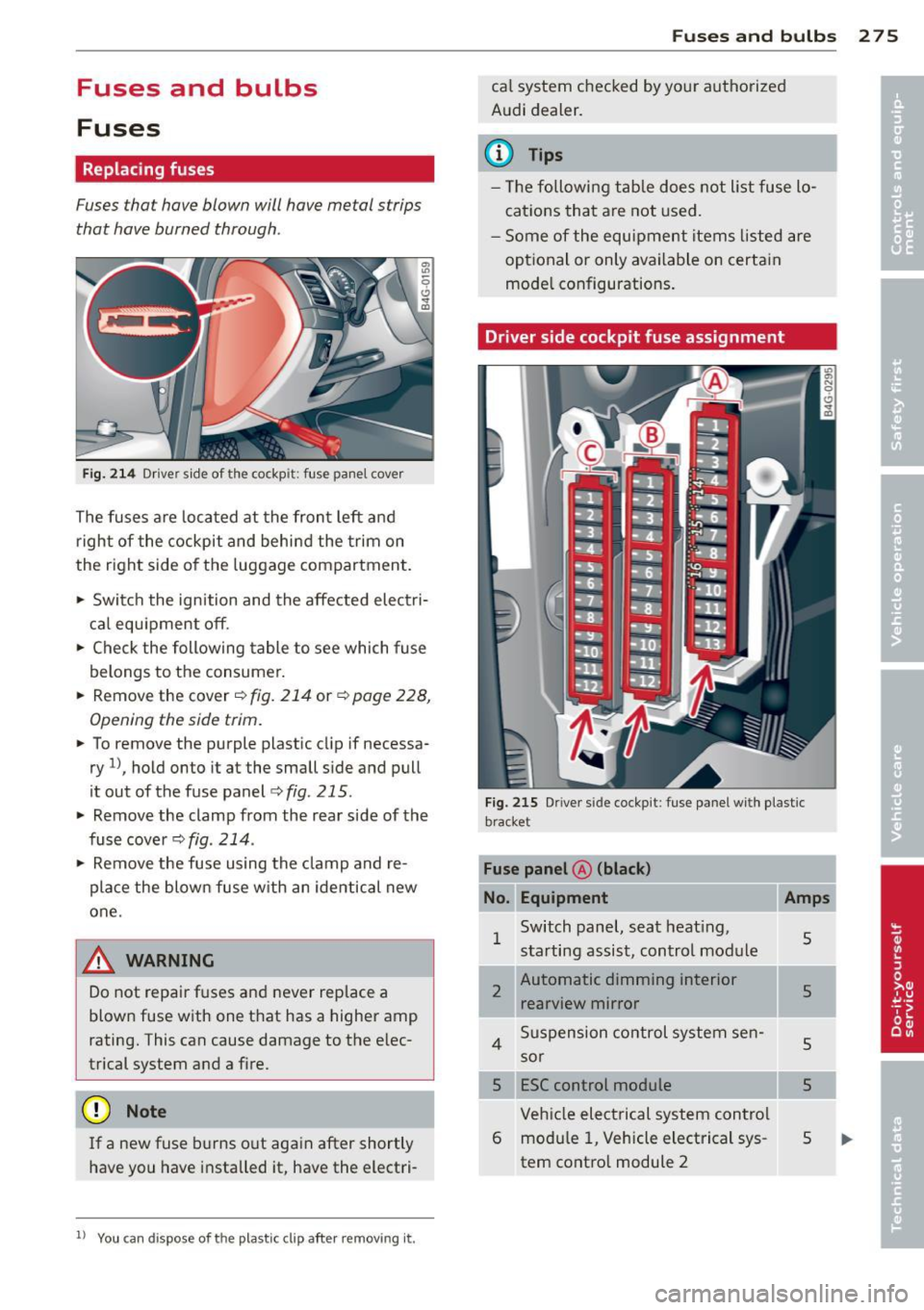
Fig. 2 14 Driver s ide of the cockp it: fuse panel cover
The fuses are located at the front left and
r igh t of the cockpit and behi nd the trim on
the right side of the luggage compartment .
.. Switc h the ignition and the affected electri
ca l equipment off .
.. Check the following table to see which fuse
belongs to the consumer .
.. Remove the cover ~
fig. 214 or~ page 228,
Opening the side trim .
.. To remove the purple plastic clip if necessa
ry
ll, hold onto it at the small s ide and pull
it out of the fuse panel ¢
fig. 215 .
.. Remove the clamp from the rear s ide of the
fuse cover ¢
fig. 214 .
.. Remove the fuse using the clamp and re
place the blown fuse w ith an identical new
one.
A WARNING
-
Do not repair f uses and never replace a
blown fuse w ith one t hat has a higher amp
rating. This can cause damage to the e lec
trical system and a fire.
(D Note
If a new fuse b urns o ut again after shortly
have you have installed it, have the electri-
11
You can dispose of the pla stic cl ip after removing it.
Fu se s and bulb s 2 7 5
ca l system checked by your authorized
Audi dealer.
a) Tips
- T he followi ng table does not list fuse lo
cations that are not used.
- Some of the equipment items listed are
optional or only available on certain
mode l configurations.
Driver side cockpit fuse assignment
F ig. 215 Dr iver side cockp it : fuse pa nel with plastic
brac ket
No. Equipm ent
1
2
Switch panel, seat heating,
starting assist, control module
Automatic dimming interior rearview mirror
4 Suspension control system sen-
sor
5 ESC control module Veh icle electrical system contro l
6 modu le 1, Vehicle electrical sys
tem contro l module 2
Amp s
s
5
5
5
s
Page 279 of 310

Fuse s and bulb s 2 77
Fuse panel @ (brown) Fuse panel@ (red )
No. Equipment Amps No.
Equipment Amps
Climate control 10 1 Left belt tensioner 25
Climate control system blower 40 2 Right belt tensioner 25
3
Diagnost ic connec tor 10 3 Socke t 20
4
Electrical ignition lock 5 4 Socket 20
5
Power s teering colum n adj ust-
5 ment
5 Ele ctromechanical parking brake 5
6 adaptive air suspension 15
6 Steering column switch module 10
7
Power steering column adjust -
25
ment
7
Rear door (front passenger 's
30 side)
8 Rear e xterior lighting 30
8 Light switch 5
9
L u ggage compa rtment lid con-
30
trol modu le
Luggage compartment fuse assignment Telephone 5
11
Sound amplif ier 30
12
Rear spoiler (Sportback) 20
Fuse panel © (b rown )
No . Amps
1
Radio receiver, Sound amplifier/ 30/20
MMI unit/drives
2 Tank leak detection system 5
Fig. 2 17 Luggage co mpar tment: fuse panel w ith plas-
t ic b racke t 4
AEM co ntrol module/battery 10/15
module
Fuse p anel A (black )
Battery fan 35
Radio receive r 7,5
No. Equipment Amps 8 Rear Seat Entertainment 7,5
Electromechanical parking brake 30
Electromechanical parking brake 30 9
Automatic d imm ing interior 5/15
rearview mirror/battery mod ule
6
Front door (front passenger's
30 side)
10 Parking system 5
7
Rear exterior lighting 30 Fuse panel @ (green )
Rear sun shade, clos ing aid, lug-No .
Equipment Amps
8
gage compartment lock, con-
20 venience key, START ENGINE
1 Aud i pre sense 5
2
Electromechanical parking brake 5
STOP, fuel fi ller door 3 ad aptive air suspens ion 5
9 Power seat adjustment 15
4 Automatic transmission 7,5
10
Parking system 5 5 Parking system 5
11
Rear seat heating 30 6 Rear Seat Entertainment 5
7
Sta rt -Stop-Sys tem 5
8 Audi side assist 5
Page 287 of 310
General information Explanation of
technical data
Som e of t he technical data listed in this man
ual requires further explanation .
The technical data for your vehicle is listed in
the charts starting on
Q page 287 . This sec
tion provides general information, notes and r estr ictions wh ich app ly to this data.
Vehicle identification
The key data is given on the vehicle identifi ca
tion number ( VIN) plate and the vehicle data
sti cker .
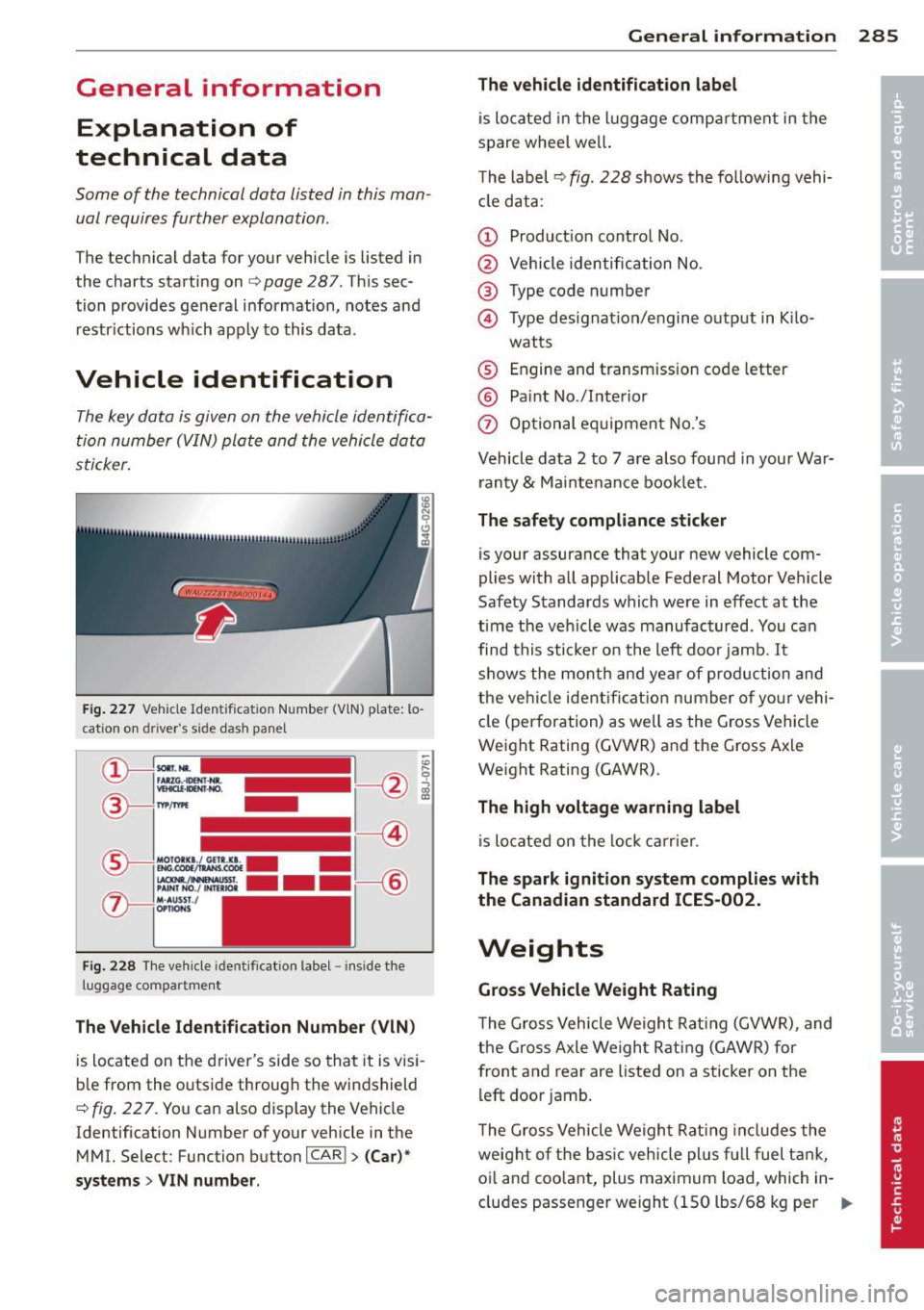
Fig. 22 7 Vehicle Ident ific atio n Num ber (V lN) p la te: lo
cation o n dri ve r"s s ide das h pa nel
Fi g. 2 28 The ve hicle iden tifi cat ion label -inside the
l u ggage co mpartme nt
The Vehicle Identification Number (VlN)
is located on the d river's side so tha t it is v is i
b le from the outside throug h the windshield
Q fig . 22 7. You can also d isplay the Vehicle
Identification N umber of your vehicle in the
MMI. Select: Function button
!CAR I> (Car )*
systems
> VIN number .
General inform ation 285
The vehicle identification label
is lo cated in the l uggage comp artment in the
spare whee l we ll.
T he label
r:::> fig. 228 shows th e fo llow ing vehi
cl e data :
(D Product ion cont ro l No.
@ Vehicle identific ation No.
@ Type code number
© Type designat ion/e ngine o utput in K ilo-
wat ts
® Engine and transm ission code letter
® Pa int No ./lnterior
0 Op tio nal eq uipment No.'s
Vehicle data 2 to 7 are a lso found in your War
ranty
& Mai nte nance bookle t.
The safety compliance sticker
is your assurance that your new vehicle com
plies with a ll applicab le Fede ral Motor Vehicle
Safety Standards which were in effect at the
time the ve hicle was manufactur ed . You can
find this sticke r o n the left doo r jamb.
It
sh ows the month an d ye ar of pro duction and
t he ve hicl e ident ificat io n number of yo ur vehi
cle (perforation) as well as the G ross Vehicle
Weight Rating (GVW R) and the Gross Axle
Weight Rating (GAWR) .
The high voltage warning label
is lo cate d on the lock ca rrie r.
The spark ignition system complies with
the Canadian standard ICES-002.
Weights
Gross Vehicle Weight Rating
T he Gro ss Vehicle Weigh t Rat ing (GVWR), and
t he Gross Axle We igh t Rati ng (GAWR) for
fron t and rear are listed on a sticker on the
l eft door jamb .
T he Gro ss Vehicle Weigh t Rat ing incl udes the
weight of the bas ic vehicle plus f ull fuel t ank,
oi l and coo lant, plus maximum load, which in
cludes passen ger we ight (150 lbs/68 kg per ..,.