transmission AUDI S7 2014 User Guide
[x] Cancel search | Manufacturer: AUDI, Model Year: 2014, Model line: S7, Model: AUDI S7 2014Pages: 306, PDF Size: 76.83 MB
Page 117 of 306
![AUDI S7 2014 User Guide cannot engage the reverse gear. Drive to your
authorized Audi dealer or qualified repair fa
cility immediately to have the malfunction
corrected.
[O] Transmission malfunction: St](/img/6/57602/w960_57602-116.png "AUDI S7 2014 User Guide cannot engage the reverse gear. Drive to your
authorized Audi dealer or qualified repair fa
cility immediately to have the malfunction
corrected.
[O] Transmission malfunction: St")
cannot engage the reverse gear. Drive to your
authorized Audi dealer or qualified repair fa
cility immediately to have the malfunction
corrected.
[O] Transmission malfunction: Stop vehicle
and shift to P
Do not continue driving. Select the P selector
l eve r position and see your autho rized Aud i
dealer or qualified repair facility for assis
tance.
(D Note
If the transmission switches to emergency
mode, you should take the vehicle to an
authorized Audi dealership as soon as pos
sible to have the cond ition corrected.
Selector lever emergency release
Applies to vehicles: with S tro nic/t iptronic
If the vehicle's power supply fails, the selec
tor lever can be released in an emergency.
Fig. 121 F ront center co nsole: selecto r lever emergen
c y r elease
~ To r each the emergency release mechanism,
remove the asht ray insert* .
~ Loosen and remove the small cap in the ash
tray mount
~ fig. 121.
~ You now have access to a bolt. Using a
screwdriver or simi lar, press the bolt down
and hold it down.
~ Now press the interlock and move the selec-
tor lever to the N pos ition.
The selector lever can only be moved from the P posit ion if the ignition is turned on . If the
vehicle has to be pushed or towed if the power
supp ly fai ls (e .g . battery is discha rged), the
Automatic Transmission 115
selector lever must first be moved to the N
position using the emergency locking device.
Page 202 of 306

200 Intelligent technology
Braking
General information
What affects braking efficiency?
Operating conditions and driving habits
The brakes on today's automobi les are sti ll
subject to wear, depending largely on operat
ing conditions and driving habits
c:> ,&. On
vehicles that are either driven mostly in stop
and-go city traffic or are driven hard, the brake pads should be checked by your author
ized Audi dealer more often than specified in
the
Warranty & Maintenan ce booklet . Failure
to have your b rake pads inspected can result
in red uced brake performance.
On steep slopes, you shou ld use the brak ing
effect of the engine. This way, you prevent un
necessary wear on the brake system. If you
must use yo ur brakes, do not hold the brakes
down continuously. Pump the brakes at inter
va ls.
Moisture or road salt
Unde r certain conditions, for example, when
driving through water or very heavy rain, or
even after washing your vehicle, the braking
effect can be red uced due to moisture (or in
freezing conditions ice) on the brake pads. A
few careful brake applications should dry off the brake pads or remove any ice coatings.
When you are driving at higher speeds with
the windshield wipers on, the brake pads will
briefly touch the brake discs in regular inter
vals so as to improve reaction t ime when brak
ing on wet surfaces. You the driver will not no
tice anything .
The effectiveness of the brakes can be reduced
when the vehicle is dr iven on a salt-covered
road and the brakes are not used . Here too,
you should clean off accumulated salt coat ing
from brake discs and pads with a few careful
applications of the brake
c:> ,& .
Corrosion
There may be a tendency for dirt to build up
on the brake pads and corrosion to form on the
discs if the car is not driven regu larly or
o n Ly for short trips with litt le use of the
brakes.
If the brakes are not used frequently, or if cor
r osion has formed on the discs, it is advisable
to clean off the pads and discs by braking
firmly a few times from a moderately h igh
speed
c:> .&. .
Faults in the brake system
If you shou ld notice a sudden increase in
brake pedal travel, then one of the two brake
circuits may have fai led
c::> .&. .
Low brake fluid level
Malfunctions can occu r in the brake system if
the brake fluid level is too low. The brake fluid
l evel is monitored electronically.
Brake booster
The brake booster works with vacuum pres
su re which is created only when the eng ine is
running
c::> ,& .
Brake lining wear status
Brake lining wear may be checked by visual in
spect ion of the condition of the brake pads
t hr ough the open ings in the wheel. If neces
sary, the wheel may be removed for this in
spect ion
c:> page 266, Changing a wheel.
.8_ WARNING
-You shou ld perform braking maneuvers
for the purpose of cleaning the brake
system only if road conditions permit.
Other road users must not be put at risk -
you may cause an accident!
- Before descending a steep grade, reduce
speed and sh ift transmission into a lower
gear or lower driving range. Do not ride
the brakes or hold the pedal down too
long or too often . This could cause the
brakes to get hot and diminish braking
efficiency.
- Do not "ride the brakes" by resting your
foot on the pedal when you do not intend
to brake. This may cause the brakes to
Page 208 of 306

206 Driving and en vir onm ent
8_ WARNING
- Do not park your vehicle over flammable
materials such as grass or leaves because
the high temperature of the diesel par
t icu late filter could start a fire .
- Do not apply an underbody protectant in
the exhaust system area or a fire could start.
Avoid damaging the vehicle
When you are driving on poor roads, or over
curbs, steep ramps, etc., make certain that
low-lying parts such as spoilers and exhaust
system parts do not bottom out and get dam
aged.
This is especia lly true for vehicles with low
slung chassis (sports chassis)* and fully load
ed vehicles.
Driving through water
on roads
Note the following to avoid vehicle damage
when dr iving through water, for example on
flooded roads:
- The water must not be any higher than the bottom of the vehicle body.
- Do not drive faster than wa lking speed.
8_ WARNING
After driving through water, mud, slush,
etc., the brakes may be slow to take effect
because of wet brake rotors and pads. Dry
the brakes f irst by brak ing carefully to re
sto re the full braking effect.
(D Note
- Vehicle components such as the engine,
transmission, suspension or electrical
system can be severely damaged by driv
ing through water.
- Always switch off the Start-Stop-System
when driving through water~
page 81.
-
(D Tips
-Check the depth of the water before d riv
ing through it .
- Do not stop the vehicle, drive in reverse
or switch the engine off when driving
through water.
- Keep in mind that oncoming vehicles
may create waves that raise the water
level and make it too deep for your vehi
cle to drive through safely.
- Avoid driving through salt water because
it can cause corrosion.
Shutting down vehicle
If you would like your vehicle to remain inop
erative for a longer period of time, contact an
Audi or other specialized dealer. They can ad
vise you on necessary precautions e .g. corro
sion prevention, maintenance and storage .
Pay attention to additional information con
cern ing the battery. Refer to
~ page 238.
Operate your vehicle
economically and
minimize pollution
General
Your personal style of driving will determine
the economy of your vehicle, as well as ex
haust and noise levels.
Fuel economy, env ironmental impact, and
wear on your eng ine , brakes and tires largely
depend on three factors:
- your personal driving style
- operating conditions
- technical limitations
If you anticipate what you need to do next and
drive economically, you can easily cut your
fuel consumption by 10-15 percent . This sec
tion will give you some tips on how you can
help the environment and your pocketbook.
Page 268 of 306
266 What do I do now?
Changing a wheel
Before changing a wheel
Observe the following precautions for your
own and your passenger's safety when chang
ing a wheel .
... After you experience a tire failure, pull the
car well away from moving traffic and try to
reach
level ground before you stop o ,&.
... All passengers should leave the car and
move to a safe location (for instance, behind
the guardrail)
o A-
.. Engage the parking brake to prevent your
vehicle from rolling unintentionally
o ,&.
... Move selector lever to position Po ,& .
• If you are towing a trailer, unhitch the trailer
from your vehicle .
... Take the
jack and the spare tire out of the
luggage compartment
o page 264,
o page265.
A WARNING
You or your passengers could be injured
while changing a wheel if you do not fol
low these safety precautions:
- If you have a flat tire,
move a safe dis
tance off the road. Turn off the engine,
turn the emergency flashers on and use
other warning devices to alert other mo
torists.
- Make sure that passengers wait in a safe
place away from the vehicle and well
away from the road and traffic.
- To help prevent the vehicle from moving
sudden ly and possibly slipping off the
jack, always fully set the parking brake
and block the wheel diagonally opposite
the wheel being changed . When one
front wheel is lifted off the ground, plac
ing the Automatic Transmission in P
(Park) will
not prevent the vehicle from
moving.
- Before you change a wheel, be sure the
ground is level and firm.
If necessary,
use a sturdy board under the jack.
-
-Always store the vehicle tool kit, the jack
and the replaced tire in the luggage com
partment
opage 136.
@ Tips
Before changing the whee l, you must acti
vate the jacking mode, so that the auto
matic controls for the Adaptive Air Sus
pension* do not make it more difficult to
lift the vehicle with the jack
o page 268 .
Changing a wheel
When you change a wheel, follow these
quence described below step-by-step and in
exactly that order.
l. Activate the vehicle jack mode*
opage 268 .
2. Remove the decorative wheel cover* . For
more details see also
o page 267, Deco
rative wheel covers
or o page 267,
Wheels with wheel bolt caps.
3. Loosen the wheel bolts o page 268.
4. Locate the proper mounting point for the
jack and align the jack below that point
opage 268.
5. Raise the car with the jack o page 268.
6. Remove the wheel with the flat tire and
then install
the spare opage 270.
7. Tighten all wheel bolts lightly .
8.
Lower the vehicle with the jack .
9 . Use the wheel bolt w rench and
firmly
tighten all wheel bolts o page 268.
10. Replace the decorative wheel cover*.
11. Deactivate the vehicle jack mode * in the
MMI:
I CARI function button > (Ca r)* sys
tems
control button > Servicing & checks
> Air susp.: jack mode > Off.
The vehicle jack mode* switches off automati
ca lly at speeds above 6 mph (10 km/h) .
A WARNING ,-
Always read and follow all WARNINGS and
in format ion
o .&. in Raising the vehicle on
page 269
and opage 271.
Page 276 of 306

274 Fu ses and bulb s
No. Equ ipment Amps
8
Headlight range adjustment/
5/7,S
adaptive lighting system
10 Left headlight
(headlight with
7,5
adaptive light)
11 Supplementary heater
s
F
u se p ane l@ (b ro wn)
No . Equipmen t Amps
1 Climate control
10
2 Climate control system blower 40
3 Diagnostic interface
10
4 E lectrical ignition lock
s
s
Power steering column adjust-
s ment
6 Steering column switch module
10
7 Power
steering column adjust-
ment 25
8 Light switch
s
Luggage compartment fuse assignment
Fig
. 22 1 Luggage compartment: fuse panel with plas
tic bracket
Fuse p anel @ (b la ck )
No. Equipment Amps
4 E lectromechanical parking brake 30
s Electromechanical parking brake
30
6 Front door
(front passenger's
30
s ide)
7 Rear exter ior lighting
30
Rear sun shade, closing aid, lug-
8 gage compartment
lock, con-
20
venience key, START ENGINE
STOP, fuel filler door
No. Equipment Amps
9 Power seat adjustment
15
10 Parking system
s
11 Rear seat
heating
30
Fuse pan el@ (r e d )
No . Equipment Amps
l Left belt tensioner
25
2 Right belt tensioner 25
3 Socket/cigarette
lighter
20
4 Socket 20
5 Electromechanical
parking brake
5
6 adaptive ai r suspension 15
7 Rear door
(front passenger's
30
side)
8 Rear exterior lighting 30
9 Luggage compartment
lid con-
30
t rol module
10 Telephone 5
11 Sound amplifier 30
12 Rear
spoiler (Sportback)
20
Fuse p anel© (brown)
No . Equipment Amps
1 Radio receiver,
Sound amplifier/
30/20
MMI unit/drives
2 Tank leak detection system
s
4 AEM
control module/battery
10/15
module
6 Battery fan 35
7 Rad
io receiver 7,5
8 Rear Seat Entertainment 7,5
9 Automatic dimming interior
5/15
rearview mirror/battery module
10 Parking system 5
Fuse pan el@ (gre en)
No . Equipment Amps
1 pre sense 5
2 Electromechanical parking brake
s
3 adaptive
air suspension
5
4 Automatic transmission 7,5
Page 278 of 306
2 76 Emergency situations
Emergency situations
General
This chapter is intended for trained emer
gency crews and working personnel who
have the necessary tools and equipment to
perform these ope rations.
Starting by pushing or
towing
Q;) Note
Vehicles w ith an automatic transmission
cannot be started by pus hing o r tow ing.
Starting with jumper
cables
If necessary, the engine can be started by
connecting it to the battery of another vehi
cle.
If the engine should fail to start because of a
discharged or weak battery, the battery can be
connected to the battery of
another vehicle,
using a
pair of jumpe r cables to start the en
g ine .
Jumper cables
Use only jumper cables of sufficiently large
cross section to carry the starter current safe
ly. Refer to the manufacturer's specif ications.
Use only jumper cables with
insulated termi
na l clamps which are distinctly marked:
plus(+) cable in most cases colored red
minu s(-) cable
in most cases colored black .
A WARNING
Batteries contain electricity, acid, and gas.
Any of these can cause very serious or fatal
inju ry. Follow the instructions below for
safe handling of your veh icle's battery.
- Always shield you r eyes and avoid lean
ing over the battery whenever possible.
- A discharged battery can freeze at tem
peratures just be low 32 °F (0 °C). Before connecting a
jumper cable, you must
thaw the frozen battery complete ly, oth
erwise it could explode.
- Do not allow battery acid to contact eyes
or skin . Flush any contacted area with
water immediately .
- Improper use of a booster battery to start a vehicle may cause an explosion.
- Vehicle batteries generate explosive gas
es. Keep sparks, flame and lighted ciga
rettes away from batteries.
- Do not try to jump start any vehicle with a low acid level in the battery.
- The vo ltage of the booster battery must
also have a 12-volt rating. The capacity
(Ah) of the booster battery should not be
lower than that of the discharged bat
tery . Use of batteries of d ifferent voltage
or substantially different "Ah" rating
may cause an exp losion and personal in
jury.
- Never charge a frozen batte ry. Gas trap
ped in the ice may cause an explosion.
- Never charge or use a battery that has
been frozen. The battery case may have
be weakened.
- Use of batter ies of different voltage or
substantially different capacity (Ah) rat
ing may cause an exp losion and injury.
The capacity (Ah) of the booster battery
should not be lower than that of the dis
charged battery.
- Before you check anything in the engine
compartment, always read and heed a ll
WARNINGS¢
page 22 7.
(D Note
- App lying a higher voltage booster bat
tery will cause expensive damage to sen
sitive electronic components, such as
contro l units, relays, radio, etc .
- Th ere must be no electrical contact be
tween the vehicles as otherwise current cou ld already start to f low as soon as the
positive(+) terminals are connected. .,.
Page 280 of 306
2 78 Emergency situations
-When connecting jumper cables, make
sure that they cannot get caught in any
moving parts in the engine compart
ment.
- Before you check anything in the engine
compartment, always read and heed all
WARNINGS
<=) page 227.
(D Note
Improper hook-up of jumper cables can ru
in the generator.
- Always connect POSITIVE( +) to POSI
TIVE(+), and NEGATIVE(-) to NEGATIVE
( - ) ground post of the battery manager
control unit.
- Check that all screw plugs on the battery
cells are screwed in firmly . If not, tighten
plugs prior to connecting clamp on nega
tive battery terminal.
- Please note that the procedure for con
necting a jumper cable as described
above applies specifically to the case of
your vehicle being jump started. When
you are giving a jump start to another ve
hicle , do
not connect the negat ive( -) ca
ble to the negative( -) terminal on the
discharged battery@<=)
fig. 223. In
stead, securely connect the negative( -)
cable to either a solid metal component
that is firmly bolted to the engine block
or to the engine block itself. If the bat
tery that is being charged does not vent
to the outside, escaping battery gas
could ignite and explode!
Emergency towing
with commercial tow
truck
General hints
Your Audi requires special handling for tow
tng.
The following information is to be used by
commercia l tow truck operators who know
how to operate their equipment safely.
-Never tow your Audi. Towing will cause
damage to the engine and transmission .
- Never wrap the safety chains or winch ca
bles around the brake lines.
- To prevent unne cessary damage , your Audi
must be transported with a flat bed truck.
- To load the vehicle on to the flat bed, use
the towing loop found in the vehicle tools
and attach to the front or rear anchorage
<=)page 278 and ¢page 279.
.&_ WARNING
=
A vehicle being towed is not safe for pas-
sengers. Never allow anyone to ride in a
vehicle be ing towed, for any reason.
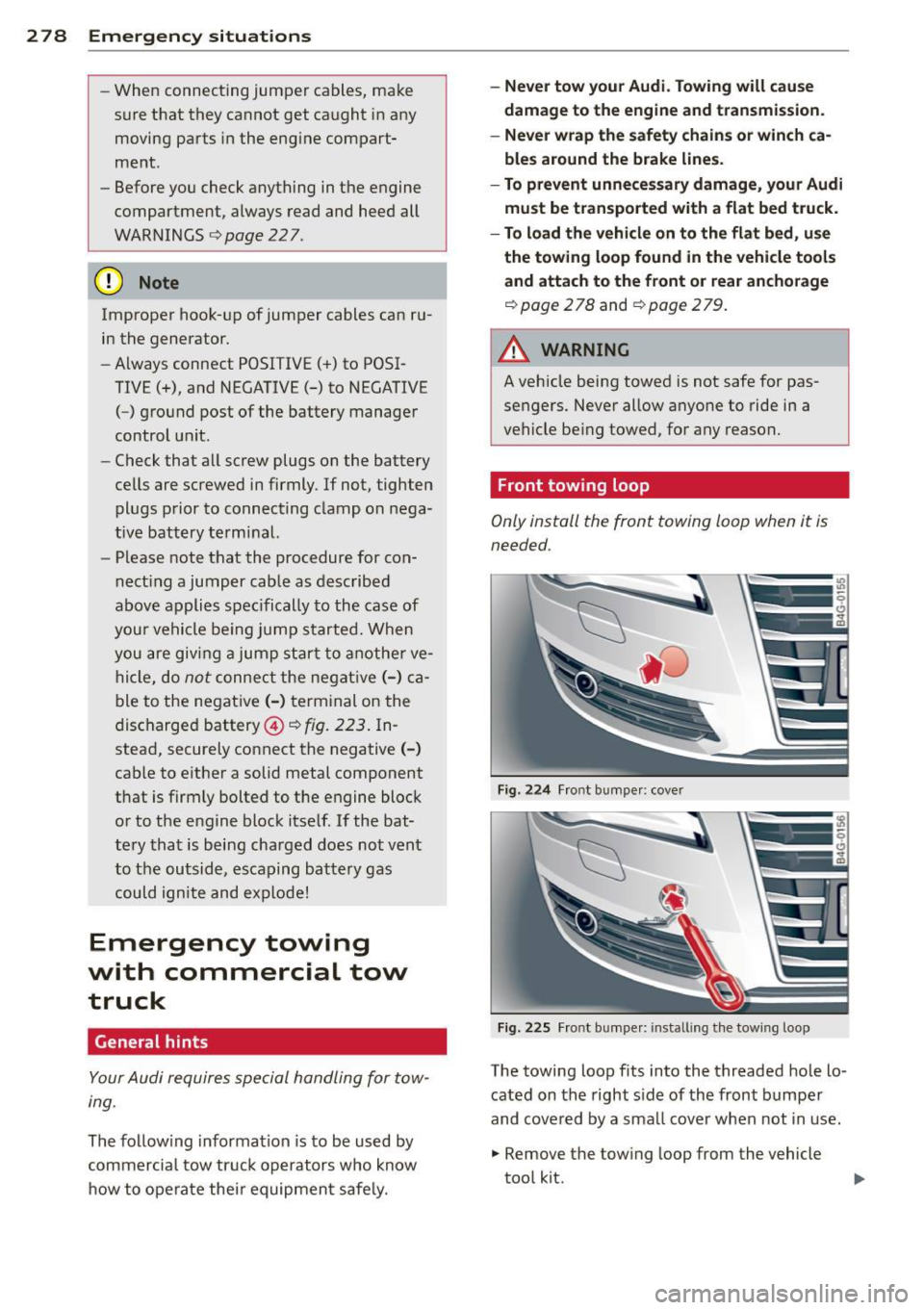
Front towing loop
Only install the front towing loop when it is
needed.
Fig. 224 Front bumper: cover
Fig. 225 Front bumper : in stalling the towing loop
-
The towing loop fits into the threaded hole lo
cated on the right side of the front bumper
and covered by a smal l cover when not in use.
.,. Remove the towing loop from the vehicle
tool kit.
Page 283 of 306

heavy components such as the engi ne
b lock or transmiss ion are removed.
- W hen removing heavy components like
these, ancho r vehicle to hoist o r add cor
respond ing weig hts to ma inta in the cen
ter of g ravity . Otherwise, the vehicle
m ight tilt o r sli p off the hoist, causi ng
ser ious p erso na l in ju ry.
([) Note
-Be awa re of the fo llowing points befo re
li fting t he vehicle:
- The vehicle should never be lifted or
jacked up from underneath the engine oil pan, the transmission housing, the
front or rear axle or the body side
members. This could lead to serious
damage.
- To avoid damage to the underbody or
chassis frame , a rubber pad must be
i nserted between the floor jack and
the lift points.
- Before driving over a workshop hoist,
check that the veh icle weight does not
exceed the permissible lifting capacity
of the hoist.
- Before driving over a workshop hoist,
ensure that there is sufficient clear
ance between the hoist and low parts
of the vehicle.
Emergency situations 281
•
•
Page 284 of 306

282 Technical data
Technical data
Vehicle identification
F ig. 23 1 Vehicle I dent ifica tion Num ber (VlN) pla te: lo·
cat ion on driver 's side dash pane l
XXXXX XX · X -XXXX XXX xx
r,"\__l f~ -11!111 · NII. ~ V!Hlll -llllll . NO.
IYP IT'fl'E
XXXXXXXX XX X XXXXXXXX
XXX XXX
XX XXXXXXX XX X X XX
XXX
KW XXX
®i ~~:f :l~~ XXXX XXX XXX
@+ ~~r= XXXX I XXXX XXX I XX M ,. AIIISl./ lflllllS
EOA 7D5 4 UB 6XM SSG 5RW
2E H JDZ llB l AS lBA
3FC 5MU 7Xl
FO A
9G3 OG7 O
YH OJF
TL6 3
KA BEH
UlA X9B QZ 7
l XW
8Q3 9Q8 82 4 020
7T6 CV 7 7KO 4X3 2K2
3L4 4 KC 3YO 4I3 502
lS A 7GB Q1A 4GQ
XX X
XX X XX X XXXX
Fig. 23 2 The ve hicle identi ficat ion label -inside the
luggage co mpa rtmen t
Vehicle Identification Number (VlN )
The Ve hicle Identific ation Number is located
in different p laces:
- under the w indshield on the driver's s ide
~fig . 231.
- in the MMI : Select: Function button ICAR I >
(Car) * syst ems > VIN number .
-on the veh icle identification label.
Vehicle identification label
The vehicle identification labe l is located in
the luggage compartment in the spare wheel
well. T
he label ~
fig. 232 shows the fo llowing vehi
cle data:
(D Vehicle Iden tificat io n Num ber (V IN)
@ . Vehicle type, engine o utput, transmission
® Engine and transm iss ion code
@ Pain t number and inte rior
® Optional equipment numbers
T he information of the vehicle identification
label can also be found i n your Warranty
&
Maintenance booklet.
Safety compliance sticker
The safety compliance sticker is your assur
ance that yo ur new veh icle complies with all
applicable Federa l Motor Vehicle Safety
Standards which we re in effect at the time the
vehicle was manufactured. You can find this
sticker on the door jamb on the driver's side.
It shows the mo nth and year of production
and the vehicle ident ificat io n number of your
vehicle (perfo rat io n) as well as the Gross Ve hi
cl e Weig ht Rating (GVWR) a nd the Gross Ax le
Weig ht Rating (GAWR) .
High voltage warning label
The high voltage warning label is located in
the engine compartment next to the engine
hood re lease . The spar k ign it ion sys tem com·
plies wi th the Ca nadian standard IC ES-002.
Weights
Gross Vehicle Weight Rating
The Gross Vehicle We ight Rat ing (GVWR), and
t h e Gross Axle Weight Rat ing (GAWR) for
fron t and rear are liste d on a sticker on the
doo r jamb on the d river's side .
T he Gross Vehicle We ight Rat ing includes the
weight of the bas ic vehicle plus f ull fuel tank,
o il and coo la nt, plus max imum load, which in
cl udes passe nger we igh t (150 l bs/68 kg per
designate d sea ting posi tion) an d lugg age
weight ~&. - .,.
Page 293 of 306

_______________________________ I~ n~ d:::: e~x 291
AUTO
automatic climate control ... ... .. .. ..
73
Automatic headlights ............... 44
climate control . . . . . . . . . . . . . . . . . . . . . 70
Auto Lock . . . . . . . . . . . . . . . . . . . . . . . . . . 34
Automatic belt retractor . . . . . . . . . . . . . 143
Automatic climate control
Air vents ... ............. .... .. ....
73
Automatic recirculation ...... .. .. .. .. 74
Operation . . . . . . . . . . . . . . . . . . . . . . . . . 72
Setup . .. ... ...... ............. ... 74
synchron izing ......... ...... .... ... 73
Automatic Shift Lock (ASL) .. .. .. .. .. . 110
Automatic transmission ....... .. .. .. . 109
Automatic Shift Lock (ASL) .......... 110
Driving .... ................ ... ... 111
Emergency mode . . . . . . . . . . . . . . . . . . 114
Emergency release ........ .. .. .. .. . 115
Kick-down .. ............. .... .. ... 113
Manual shift program ....... .. .. .. . 113
Selector lever ............... ... ... 109
Automatic wipers .................... 48
Auto Safety Hotline .......... .. .. .. . 138
Average consumption ....... .. .. .. .. .. 25
Average speed . . . . . . . . . . . . . . . . . . . . . . .
25
Avoid damaging the vehicle .. .. .. .. .. . 206
B
Bag hooks . . . . . . . . . . . . . . . . . . . . . . . . . . 67
Battery ..... .. ................ .... 238
Charging ... ................ ... ... 240
Important warnings ...... .. .. .. .. . 238
Jump starting ............ .... .. ... 276
Location . .. ............. .... .. ... 238
low ..... ... ...... ............. .. 202
Replacing the battery ....... .. .. .. . 241
State of charge ........... .... .. .. . 202
w· t · 1n er operation ......... .. .. .. .. .
Working on the battery .... .. .. .. .. .
Before driving .............. ... ... . .
Blended gasoline 238
238
130
218
Blower (automatic climate control) . . . . . . 73
Blower (climate control) . . . . . . . . . . . . . . . 70
Booster seats ................ ... ... 184
Brake fluid
Changing the brake fluid ............
237
Checking the brake fluid level ........ 237
What is the correct brake fluid level? .. 237
What should I do if the brake fluid warn-
ing light comes on? . .............. .
237
Brake system
Anti- lock braking system .............
20
Brake assist system .............. .. 196
Brake booster .. .. ................. 200
Brake fluid ...... .. ..... .......... 237
Brake fluid specifications for refill and re-
placement ...... .. ...............
237
Brake light defective . . . . . . . . . . . . . . . . 23
Brake pads .. .. .. .... ........... .. 204
Electromechanical parking brake ..... . 79
Fluid reservoir ..... ............... 237
How does moisture or road salt affect the
brakes? . .. .. .. .. .. ...............
200
Warning/indicator lights ........ .. .. . 15
Worn brake pads symbol ............ . 21
braking guard
Settings ... ..... .. ................
93
Braking guard ... .. .... ........... .. . 86
Messages . .. .. .. .. ............... . 93
Break-in period .. .. ... ... ...... ..... 204
Brake pads ...... .. ............... 204
Tires
Bu lbs
C
...... .. .. .. .................
204
275
California Proposition 65 Warning ..... 228
Battery specific .. .. .............. . 239
Capacities .... .. .. .... ............. 283
Engine oil ... .. .. ................. 229
Carbon parts
Cleaning . . . . . . . . . . . . . . . . . . . .
215,216
Car carrier
Transporting your vehicle ......... ..
280
Care ....... .. .. .. ... ............ .. 213
Cargo area ........ .. ............... 136
Cargo net . . . . . . . . . . . . . . . . . . . . . . . . . . . 66
Catalytic converter . ............. .. .. 205
Center armrest
Cockpit ... .. .. .. .. . .. .... ........ .
56
Central locking . ..... ................ 34
Emergency locking .... ......... .. .. . 38
•
•