flat tire AUDI S7 2014 Owner's Manual
[x] Cancel search | Manufacturer: AUDI, Model Year: 2014, Model line: S7, Model: AUDI S7 2014Pages: 306, PDF Size: 76.83 MB
Page 264 of 306
262 Tires and wheels
remain continuously illuminated. This se
quence will continue upon subsequent vehicle
start-ups as long as the malfunction exists.
When the malfunction indicator is ill uminat
ed, the system may not be able to detect or
signal low tire pressure as intended . TPMS
malfunctions may occur for a variety of rea
sons , including the installat ion of replace
ment or alternate tires or wheels on the vehi
cle that prevent the TPMS from funct ioning
properly . Always check the TPMS malfunction
tellta le after replacing one or more t ires or
wheels on your veh icle to ensure that the re
placement or alternate tires and wheels allow
the TPMS to continue to function properly.
Tire pressure indicator appears
Applies to vehicles: with tire pressure monitoring system
The tire pressure indi cator in the instrument
cluster informs you if the tire pressure is too
low or if there is a system malfunction.
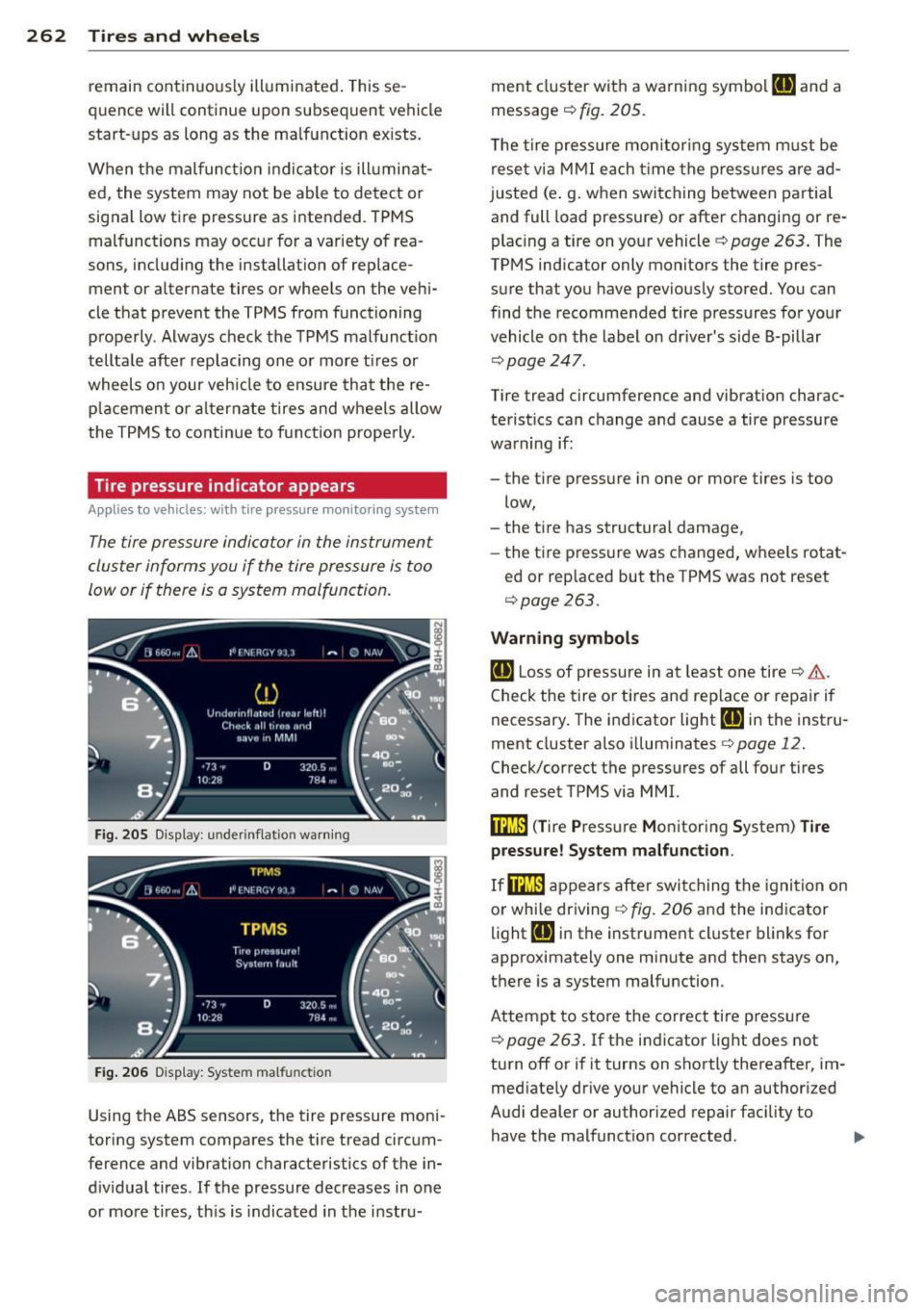
Fig. 205 Display: underi nflatio n warn ing
Fig. 206 Display: System mal functio n
Using the ABS sensors, the tire pressure moni
toring system compares the t ire tread circum
ference and vibration characteris tics of the in
dividual tires. If the pressure decreases in one
or more tires, this is indicated in the i nstru- ment
cluster with a warning symbol
RE and a
message
c:> fig. 205 .
The tire pressure monitoring system must be
reset via MMI each time the p ress ures are ad
justed (e.g . when switching between partial
and full load pressure) or after changing or re
plac ing a tire on your vehicle
c:> page 263 . The
TPMS indicator only monitors the tire pres
sure that you have previously stored. You can
find the recommended tire pressures for your
vehicle on the Label on dr iver's side 8-pillar
<=:>page 247 .
Tire tread circumference and vibrat ion charac
teristics can change and cause a tire pressure
wa rning if:
- the t ire pressure in one or more tires is too
low,
- the tire has structural damage,
- the tire pressure was changed, wheels rotat -
ed or replaced but the TPMS was not reset
<=:> page 263.
Warning symbols
RE Lo ss of pressure in at least one tire c:> .&..
Check the tire or tires and replace or repair if
necessary. The indicator light
RE in the instru
ment cluster also illuminates
c:> page 12 .
Check/correct the pressures of all four tires
and reset TPMS via MMI.
film (T ire Pressure Monitor ing System) Tire
pressure! System malfunction .
If film appears after switching the ignition on
or while dr iving
c:> fig. 206 and the indicator
light
[ti] in the instrument cluster blinks for
approximately one minute and then stays on,
there is a system malfunction .
Attempt to store the correct tire pressu re
<=:> page 263 . If the indicator light does not
turn off or if it turns on shortly thereafter, im
mediately drive your vehicle to an author ized
Audi dealer or authorized repair facility to
have the malfunct ion corrected .
Page 265 of 306
A WARNING 1= •
-If the tire pressure indicator appears in
the instrument cluster d isplay, one or
more of your tires is s ignificantly under
inflated. Reduce your speed immediately
and avoid any hard steering or braking
maneuvers. Stop as soon as possible and
check the tires and their pressures . In
flate the tire pressure to the proper pres
sure as indicated on the vehicle's tire
pressure label¢
page 247. Driving on a
signif icantly under-inflated tire causes
the tire to overheat and can lead to tire
failure. Under-inflation also is likely to impair the vehicle's handling and stop
ping abi lity .
- The driver is responsible for ma inta ining
the cor rect t ire pressures. You must
check the t ire pressures regularly.
- Under certain cond itions (such as a spor
ty driving style, w inter condit ions or un
paved roads), the pressure monitor ind i
c ator may be de layed.
- Ask your author ized Audi dealer if run
flat tires may be used on your veh icle.
You r vehicle registrat ion becomes inva lid
i f you use these tires when not permit
ted. Damage to your vehicle o r acc idents
cou ld also resu lt.
@ Tips
- The t ire pressure monitoring system
stops working when there is an ES C/A BS
malfunction.
- Using snow chains may resul t in a system
malfunction.
- The t ire pressure moni toring sys tem on
you r A udi was developed using t ires with
the "AO" or "RO" identification on the
tire sidewall ¢
page 254. We recom
mend using these t ires.
Tire s an d wheel s 263
Reset tire pressure monitoring system
Applies to veh icles : w ith tire p ress ure mo nito rin g syste m
If the tire pressure is adjusted, wheels are ro
tated or changed, the TPMS must be reset via
MMI .
.,. Switch o n the ignition.
.,. Select in the MMI:
ICA RI function button >
(Car )* syste m s control button > Servicing &
ch eck s > Tire pr essure monitoring > Store
tire pre ssur es> Yes, stor e now .
(D Tips
Do not s to re the tire pressure if there are
snow cha ins on t he tire.
•
•
Page 267 of 306
-Never use the jack s upplied with your
Audi on another vehicle, particularly on a
heavier one. The jack is only suitable for
use on the vehicle it came w ith.
@ Tips
- Some of the on board items listed above
are provided on certain mode ls only or
are optional extras.
- Before you can raise your vehicle using
the jack, you must activate the jack ing
mode
c:> page 268.
Space-saving spare tire (compact spare
tire)
The spare tire/wheel is located in the luggage
compartment under the cargo floor cover . It
is intended for short-term use only.
Taking out the sp are tire
... Fold the floor to the seatback with the help
of the handle.
... Turn the large screw~
page 264, fig . 208
counter-clockw ise .
.,. Take out the spare tire .
.,. Always store the vehicle too l kit, the jack*
and the replaced tire in the l uggage com
partment
c::> page 136 .
Using the spare tire (compact spare tir e)
The compact spare tire is only intended for
emergenc ies until you can reach a repair shop.
Replace it as quick ly as poss ible with a stand
ard wheel and t ire.
There are some restrict ions on the use of the
compact spare t ire. The compact spare t ire
h as been des igned specifically for you r type of
veh icle. It must not be swapped wi th a com
pact spare tire from another type of vehicle .
Snow chains
For technica l reasons, the use of snow chains
on the compact spare tire is
not p ermitt ed .
If you do have to dr ive with snow chains and a
front tire fails, mount the spare wheel w ith
tire instead of a rear t ire . Install the snow
What do I do now? 265
chains on the rear tire and use it to rep lace
the defective front tire .
A WARNING
-Never use the spare t ire if it is damaged
or if it is worn down to the tread wear in
dicators.
- If the spare tire is more than 6 years old,
use it only in an emergency and with ex
treme caution and careful driv ing.
- The spare tire is intended only for tem
porary and short-term use . It should be
replaced as soon as poss ible with the
normal wheel and tire .
- After mounting the compact spare t ire,
the t ire pressure must be checked as
soon as possible . The tire pressure of the
compact spare t ire must be 4. 2 bar; oth
erwise, you risk having an a ccident.
- Do not dr ive faster than SO mph (80 km/
h). You ris k having an accident .
- Avoid full-throttle acceleration, heavy
brak ing, and fast cornering. You risk hav
ing an accident .
- Never drive using more than one spare
wheel and ti re. You r is k having an acci
dent.
- Normal summer or winter t ires must not
be mounted on the compact spare wheel
rim.
- For technical reasons, the use of tire
chains on the spa re tire is not permitted .
If i t is necessary to d rive with t ire chains,
the spare wheel must be mounted on the
front ax le in the event of a flat in a rear
tire. The newly available front whee l
must then be insta lled in place of the
rear wheel w ith the flat tire. Installing
the t ire cha in before mounting the whee l
and tire is recommended .
- Loose items in the passenger compart
ment can cause serious personal injury
during hard brak ing or in an accident.
Never store the inflatable spare tire or
jack and tools in the passenger compart ment. •
•
Page 268 of 306
266 What do I do now?
Changing a wheel
Before changing a wheel
Observe the following precautions for your
own and your passenger's safety when chang
ing a wheel .
... After you experience a tire failure, pull the
car well away from moving traffic and try to
reach
level ground before you stop o ,&.
... All passengers should leave the car and
move to a safe location (for instance, behind
the guardrail)
o A-
.. Engage the parking brake to prevent your
vehicle from rolling unintentionally
o ,&.
... Move selector lever to position Po ,& .
• If you are towing a trailer, unhitch the trailer
from your vehicle .
... Take the
jack and the spare tire out of the
luggage compartment
o page 264,
o page265.
A WARNING
You or your passengers could be injured
while changing a wheel if you do not fol
low these safety precautions:
- If you have a flat tire,
move a safe dis
tance off the road. Turn off the engine,
turn the emergency flashers on and use
other warning devices to alert other mo
torists.
- Make sure that passengers wait in a safe
place away from the vehicle and well
away from the road and traffic.
- To help prevent the vehicle from moving
sudden ly and possibly slipping off the
jack, always fully set the parking brake
and block the wheel diagonally opposite
the wheel being changed . When one
front wheel is lifted off the ground, plac
ing the Automatic Transmission in P
(Park) will
not prevent the vehicle from
moving.
- Before you change a wheel, be sure the
ground is level and firm.
If necessary,
use a sturdy board under the jack.
-
-Always store the vehicle tool kit, the jack
and the replaced tire in the luggage com
partment
opage 136.
@ Tips
Before changing the whee l, you must acti
vate the jacking mode, so that the auto
matic controls for the Adaptive Air Sus
pension* do not make it more difficult to
lift the vehicle with the jack
o page 268 .
Changing a wheel
When you change a wheel, follow these
quence described below step-by-step and in
exactly that order.
l. Activate the vehicle jack mode*
opage 268 .
2. Remove the decorative wheel cover* . For
more details see also
o page 267, Deco
rative wheel covers
or o page 267,
Wheels with wheel bolt caps.
3. Loosen the wheel bolts o page 268.
4. Locate the proper mounting point for the
jack and align the jack below that point
opage 268.
5. Raise the car with the jack o page 268.
6. Remove the wheel with the flat tire and
then install
the spare opage 270.
7. Tighten all wheel bolts lightly .
8.
Lower the vehicle with the jack .
9 . Use the wheel bolt w rench and
firmly
tighten all wheel bolts o page 268.
10. Replace the decorative wheel cover*.
11. Deactivate the vehicle jack mode * in the
MMI:
I CARI function button > (Ca r)* sys
tems
control button > Servicing & checks
> Air susp.: jack mode > Off.
The vehicle jack mode* switches off automati
ca lly at speeds above 6 mph (10 km/h) .
A WARNING ,-
Always read and follow all WARNINGS and
in format ion
o .&. in Raising the vehicle on
page 269
and opage 271.
Page 269 of 306
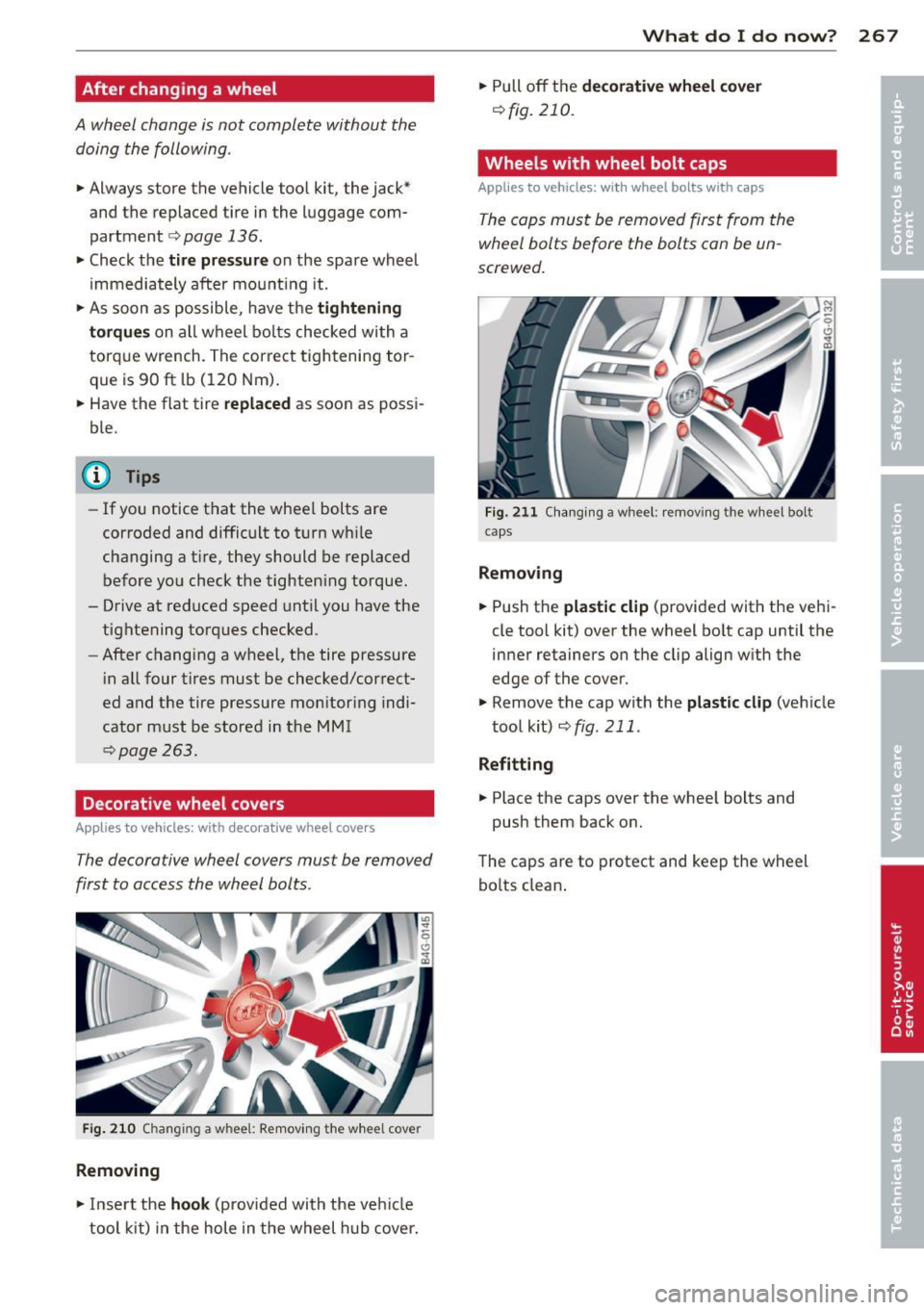
After changing a wheel
A wheel change is not complete without the doing the following .
• Always store the vehicle tool kit, the jack*
and the replaced tire in the luggage com
partment
Q page 136.
• Check the tire pressure on the spare wheel
immediately after mou nting it.
• As soon as possible, have the
tightening
torques
on al l wheel bolts checked with a
torque wrench. The correct tightening tor
que is 90 ft lb (120 Nm).
• Have the flat tire
replaced as soon as possi
ble.
(D Tips
- If you notice that the wheel bolts are
corroded and difficult to turn wh ile
changing a tire, they should be replaced
before you check the tightening torque.
- Drive at reduced speed until you have the
tightening torques checked .
- After changing a wheel, the tire pressure
i n all four tires must be checked/correct
ed and the tire pressure mon itor ing indi
cator must be stored in the MMI
Qpage263 .
Decorative wheel covers
Applies to vehicles: with decorative wheel covers
The decorative wheel covers must be removed
first to access the wheel bolts .
Fig. 210 Ch ang ing a whee l: Removing the wheel cove r
Removing
.. Insert the hook (provided with the veh icle
tool kit) in the hole in the wheel hub cover.
What do I do now? 267
• Pull off th e decorative wheel cover
Qfig. 210.
Wheels with wheel bolt caps
Applies to vehicles: with wheel bolts with caps
The caps must be removed first from the
wheel bolts before the bolts can be un
screwed.
Fig. 211 C hanging a whee l: removing the wheel bolt
caps
Removing
• Push the plastic clip (provided with the vehi
cle too l kit) over the wheel bo lt cap until the
inner retainers on the clip align w ith the
edge of the cover.
.. Remove the cap with the
plastic clip (veh icle
tool kit)
Qfig . 211 .
Refitting
• Place the caps over the whee l bolts and
push them back on.
The caps are to protect and keep the wheel
bo lts clean .
Page 271 of 306
flat on the ground. The base @ must be ver
tical under the lifting point @.
.. Wind the jack up further until the flat tire
comes off the ground
c:> ,&. .
Position the vehicle jack onl y under the desig
nated lifting points on the sill
c:> fig . 213.
The re is exactly one location for each wheel.
The jack must not be positioned at any other location
c:> & c:>(D.
An unstable surf ace under the jack can cause
the vehicle to slip off the jack . Always provide
a firm base for the jack on the ground. If nec
essary place a sturdy board o r similar support
u nder the jack . On
hard, slippery surface s
(such as tiles) use a rubber mat or sim ilar to
p revent the jack from s lipping
c:> & -
& WARNING
-You or your passengers could be injured
wh ile chang ing a whee l if you do not fol
low these safety precautions:
- Position the vehicle jack only at the
designated lifting points and align the
jack. Otherwise, the vehicle jack could slip and cause an injury if it does not
have sufficient ho ld on t he vehicle.
-A soft or unstab le surface under the
jack may ca use the vehicle to slip off
the jack. Always provide a fi rm base for
the jack on the gro und.
If necessary,
use a sturdy board under the jack.
- On hard, slippery surface (such a s tiles)
use a rubber mat or similar to prevent
the jack from slipping.
- T o help p revent injury to you rself and
yo ur passengers:
- Do not raise the vehicle until you are
sure the jack is securely engaged.
- Passengers must not remain i n the ve
h icle when it is jacked up.
- Make sure that passengers wait in a
safe place away from the vehicle and
well away from the road and traffic.
- Make sure jack position is correct, ad
just as necessary and then continue to ra ise the jack.
What do I d o now ? 269
-Changes in temperature or load can af
fect the he ight of the vehicle .
(D Note
Do not lift the vehicle by the sill . Position
the vehicle jack only at the designated lift ing points on the sill. Otherwise, your vehi
cle will be damaged.
(I} Tips
The vehicle jack mode * switches off auto
matically at speeds above 6 mph (10 km/
h).
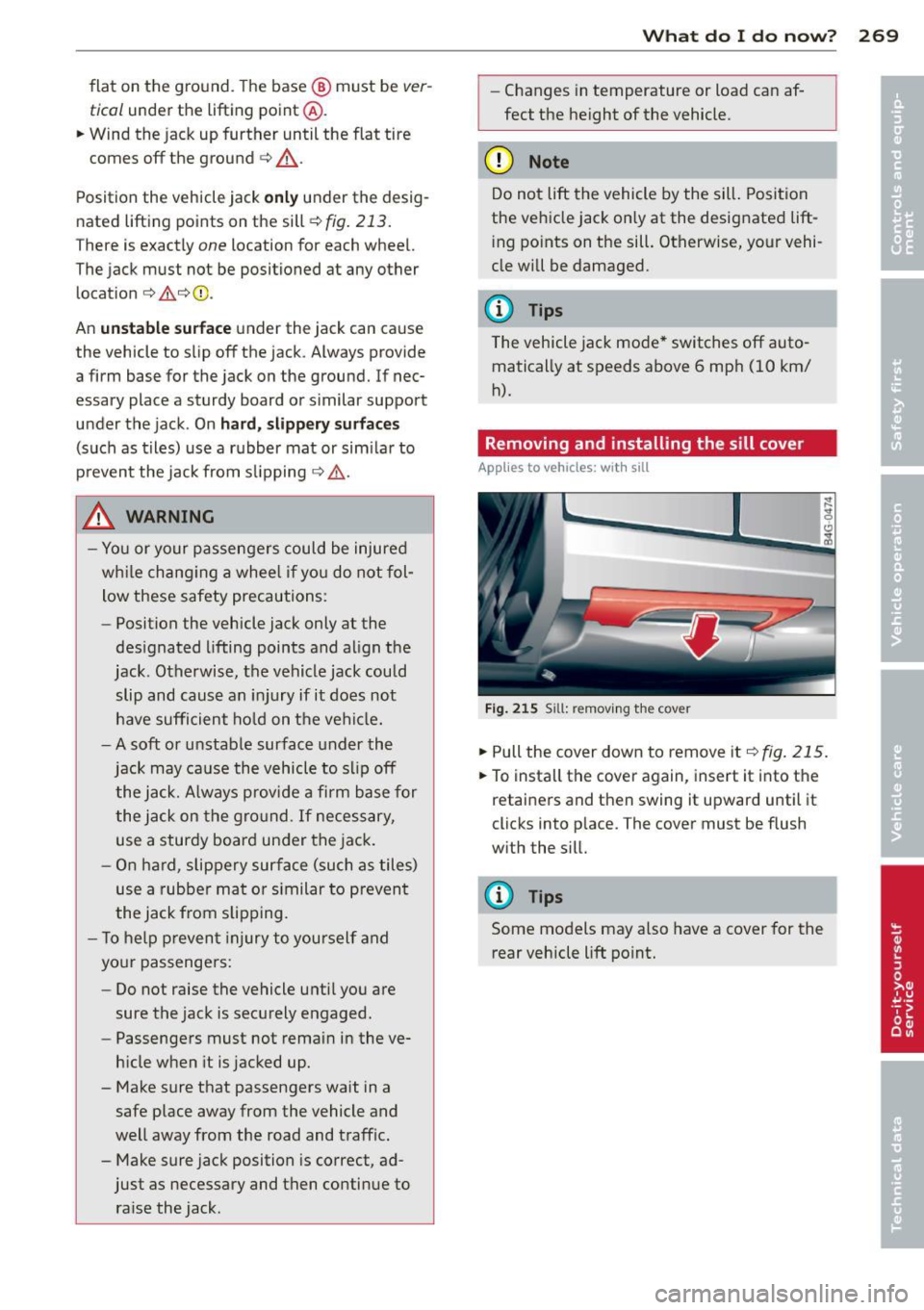
Removing and installing the sill cover
App lies to vehicles: wit h sill
Fig . 215 Sill : re moving th e co ver
.. Pull the cover down to remove it c:> fig. 215.
.. To insta ll the cover again, insert it into the
retainers and then swing it upward until it
clicks into p lace . The cover must be flush
with the sill.
(D Tips
Some models may also have a cover for the rear vehicle lift po int.
Page 273 of 306

Tires with unidirectional tread design
Tires with unidirectional tread design must be
mounted with their tread pattern pointed in
the right direction.
Using a spare tire with a tread pattern
intended for use in a specific direction
When using a spare tire w ith a tread pattern
in tended for use in a specific direction, please
note the following:
- The direction of rotation is marked by an ar
row on the side of the tire.
- If the spare t ire has to be installed in the in
correct direction, use the spare tire only
temporarily since the tire will not be able to
achieve its optimum performance character
istic s with rega rd to aquaplaning, noise and
wear.
- We recommend that you pay particular at
tention to this fact during wet weather and
that you adjust your speed to match road
conditions.
- Replace the flat tire with a new one and
have it installed on your veh icle as soon as
possib le to restore the handling advantages
of a unid irectiona l tire .
Notes on wheel changing
Please read the information c:> page 254, New
tires and replacing tires and wheels
if you are
going to use a spare t ire which is different
from the tires on your veh icle.
After you change a tire :
-Check the tire pressure on the spare imme
diately after installation .
- Have the wheel bolt tightening torque
checked with a torque wrench as soon as
possible by your authorized Audi dealer or
a qualified service station.
- With steel and alloy wheel rims, the wheel
bolts are correctly tightened at a torque of
90 ft lb (120 Nm).
- If you notice that the wheel bolts are cor
roded and difficult to turn while changing
a tire, they should be replaced before you
check the tightening torque. What do I do now? 271
- Replace the flat tire with a new one and
have it installed on your vehicle as soon as
possible. Remount the wheel cover.
Until then , drive with extra care and at re
duced speeds.
A WARNING
-
- If you are going to equ ip your vehicle
with tires or rims which differ from those
which were factory installed, then be
sure to read the information<=>
page 254,
New tires and replacing tires and
wheels.
- Always make sure the damaged wheel or
even a flat tire and the jack and tool kit
are properly secured in the luggage com
pa rtment and are not loose in the pas
senger compartment .
- In an accident or sudden maneuver they
could fly forward, in juring anyone in the
veh icle.
- Always store damaged wheel, jack and
too ls securely in the luggage compa rt
ment. Otherwise , in an accident or su d
den maneuver they could fly forward,
causing injury to passengers in the vehi
cle.
•
•
Page 282 of 306

280 Emergency situations
@ Tips
Check carefully to make sure the hook-up
is secure before moving the car up the flat
bed truck ramp.
Vehicle transport
Whenever you have your vehicle transported,
be sure to note the following:
(D Note
Mount the tie-down chains/cables over the
running surface (circumference) of the
tires. Never secure the vehicle by the axle,
the suspension struts or the front or rear
towline eye. For technical reasons, the
pressure in the suspension struts may
change during the transport and this will
adversely affect vehicle handling.
Lifting vehicle
Lifting with workshop hoist and with
floor jack
The vehicle may only be lifted at the lifting
points illustrated.
Fig. 229 Front lift in g po int
Fig. 230 Rear lifti ng point
., Read and heed WARNING c> &, .
~ N 0 6 .., (0
., Activate the vehicle jack mode* in the MMI:
!CARI function button > (Car)* systems con
trol button>
Servicing & checks> Air susp.:
jack mode > On.
., Locate lifting points ¢ fig . 229 and
¢fig . 230 .
., Adjust lifting arms of workshop hoist or
floor jack to match veh icle lifting points .
., Insert a rubber pad between the floor jack/
workshop hoist and the lifting points .
The vehicle jack mode* must be activated so
that the automat ic adjustment of the Adap
tive Ai r Suspens ion* does not make it more
difficult to raise the vehicle with the floor
jack .
If you must lift your vehicle with a floor jack
to work underneath, be sure the vehicle is
safely supported on stands intended for this
purpose.
Front lifting point
The lifting point is located on the floor pan re
inforcement about at the same level as the
jack mounting point
¢fig. 229. Do not lift
the vehicle at the vertical sill reinforcement .
Rear lifting point
The lifting point is located on the vert ical rein
forcement of the lower sill for the on-board
jack
c!;> fig. 230.
Lifting with vehicle jack
Refer to¢ page 268 .
A WARNING
-To reduce the risk of serious injury and
veh icle damage.
- Always lift the vehicle only at the spe
cial workshop hoist and floor jack lift
points illustrated¢
fig. 229 and
¢ fig. 230.
-Failure to lift the veh icle at these
points could cause the vehicle to tilt or
fall from a lift if there is a change in ve
hicle weight distribution and balance.
This might happen, for example, when
-
Page 294 of 306
29 2 Index
Certification ...... ..... ... .. .. .... . 288
Changing a wheel .............. .. ... 266
Changing engine oi l ........ .. .. .. .. . 233
Chec king
Engine coolant leve l .... ... .. .. .... . 235
Tire pressure ... .. ..... ... .. .. .... . 249
Ch ild restra ints
Da nger of us ing ch ild restra ints in the
front seat . . . . . . . . . . . . . . . . . . . . . . . . 151
Where can I get additional information
about child restraints and their use? .. 193
Ch ild restra int system anchors ... ..... 189
Ch ild safety .. ..... ........ .. .. .... . 175
Convertible locking retractor . . . . . . . . . 186
Important safety instructions for using
ch ild safety seats ........... .. .. .. . 179
I mportant th ings to know when dr iving
with ch ildren . ............. .. .... . 175
Tether anchors .................... 192
Tether straps .. ... ...... ... .. .... . 192
Ch ild safety lock
Rear doors . .............. ... .. .... 40
Child safety seats .............. .... . 181
Boo ster se ats . . . . . . . . . . . . . . . . . . . . . 184
Convertible child seats ............. 182
Conve rtible locking retractor ......... 186
H ow do I properly install a child safety
seat in my vehicle? ...... .. .. .. .. .. . 179
I nfant sea ts ............. .. .. .. .. . 181
I nstall ing .... ............. ...... . 186
I nstalling a child restraint using the
L ATCH system .. .. ..... ... .. .. .... . 191
LATCH system ... .. .... ... .. .. .. .. . 19 1
Lower anchorages ............ .... . 190
Mount ing and releasing the anchorage
hook .. .. .. ... .... ...... ... ... .. . 191
Safety instructions . . . . . . . . . . . . . . . . . 179
Unused safety belts on the rear seat .. 181
C igarette lighter . . . . . . . . . . . . . . . . . . . . . 59
C le a ning .. .. .. . .......... .. .. .. .. . 213
Climate control Air vents ... ... .... ...... ... ... .. .. 71
Climate controls . . . . . . . . . . . . . . . . . . . . . 69
C limate con trol system
Supp lementary hea ter ... .. .. .. .... . . 74
Climate control (four-zone)
Operation . . . . . . . . . . . . . . . . . . . . . . . . . 72 Climate control (three
-zone)
Operation . . . . . . . . . . . . . . . . . . . . . . . . . 70
Clock .............................. 28
Closing Rear lid ........................... 38
Sl id ing/tilting sunroof ............. .. 42
Co ld tire inflation pressure ..... ... .. .. 247
Coming home ... .. ............. .... . 46
Compact spare tire .............. .... 265
Compartments . . . . . . . . . . . . . . . . . . . . . . 60
Compliance . . . . . . . . . . . . . . . . . . . . . . . . 288
Consumer Information . . . . . . . . . . 138, 285
Consumption (fuel) ... .......... .. .. . 25
Co ntacting NHTSA . ................ . 138
Controls Cleaning . ..... .. .. ... ..... ... .. .. 215
Co nvenience key . . . . . . . . . . . . . . . . . . . . . 36
Star ting the engine ............ .. .. . 76
Stopping the eng ine (START ENG IN E
STOP button) . . . . . . . . . . . . . . . . . . . . . . 77
Switching the ignition on .... ... .. .. . 76
Un locking and locking vehicle ......... 36
Converti ble child sa fe ty seats ..... .... 182
Co nvertib le locking retractor
Activati ng .... .... ............... . 188
Deact ivat ing . .. .. .......... ...... . 188
U si ng to secu re a child safety seat 1.86, 188
Coolant
refer to Engine coolant ............ . 234
Cooling mode (automatic climate control) 72
Cooling mode (climate control) ......... 70
Cruise contro l
Changi ng speed .. .. ... ....... ... .. . 85
Presett ing your speed ............... 85
Switching off .. .................... 85
Switch ing on . .. .. ... .......... .. .. . 84
Warning/ind icator lights ........ .. .. . 24
(upholder .. .. ... . .. .... .... ... .. .. . 60
C u rve light . ..... .. ... .. ..... .... . .. 102
Cylinder on demand System ........... 27
D
Data recorder ... ................... 196
Date disp lay . ..... .. .... .... ... .. .. . 28
Daytime run ning lights ........... .. .. . 44
Page 302 of 306
300 Index
Starting from rest . . . . . . . . . . . . . . . . . . . . 80
Starting off with a tra iler ... ... .. .. .. . . 80
Starting the engine .......... .. .. .. .. 76
Steer ing
Electrically adjustable steering whee l .. 75
Manually adjustable steering whee l .. .. 75
also refer to Electro -mechanical power
assist . ...... ................... . 201
Steer ing whee l
Easy entry feature ......... ... .... .. 76
Indicator light . . . . . . . . . . . . . . . . . . . . . 18
Steering whee l heating ..... ... .. ... . 74
Steering wheel column
Adj usting e lectr ically ...... .. .. .. .. . . 75
Adjusting manually ........ ... .. .. .. 75
Steer ing wheel w ith tiptronic ... .. .. .. . 113
Steps for determining correct load limit . 252
Stopping the engine . . . . . . . . . . . . . . . . . . 77
Storage . . . . . . . . . . . . . . . . . . . . . . . . 60, 64
S tronic transmission Launch Control Program ............ 114
S tron ic (automatic transmission) . .... . 109
Sunroof . .. ................... .... .. 42
Sun shade ... ................ ..... .. 48
Sun visors . . . . . . . . . . . . . . . . . . . . . . . . . . 48
Symbols
refer to Warning/indicator lights ...... 12
T
Tachometer . . . . . . . . . . . . . . . . . . . . . 12, 24
Tail lights
C leaning ................ .... ..... 214
TOI clean diesel
refer to Ad Blue .. ...... .... ... .. .. . 223
Technical data .............. ... .. .. . 282
Technical modifications ..... .. .. .... . 288
Temperature d isplay ...... .. .... .. .. .. 24
Tether anchors ..................... 192
Tether strap . ... ......... ... .. .. ... 192
Textiles Cleaning . .. ............. .. .. .. ... 216
The first 1,000 miles (1,500 km) and after-
wards ..... .. ................ ..... . 204
Three-zone climate control .. .. .. .. .. . . 70
Tie-downs . . . . . . . . . . . . . . . . . . . . . 66, 137 T
ips for the environment
Saving fuel . ..... ................ .. 63
t iptron ic (automatic transmission) 109, 113
Tire pressure .... ................... 249
T ire pressure monitoring system ....... 261
Loss of air pressure ................ 262
Malfunction ..... ................ . 262
Resetting tire pressures ......... .... 263
T ires ....... .. .. .. ............... .. 243
Service life .... .. ............. .... 253
Speed rating letter code ............ 255
Tire manufacturing date ............ 255
Tire specifications ............... .. 255
Tread depth ...................... 253
Uniform tire quality grading ..... .... 257
Winter tires ..... ... ........... ... 258
Tires and vehicle load limits ........ ... 251
T ires and wheels
Checking tire press ure ........ .. .. .. 249
Cold tire inflation pressure ....... ... 247
Dimensions . ..... ................ . 254
General notes .... ................ . 243
G lossary of tire and loading terminolo-
gy ....... .. .. .. .. ............... 244
Low aspect ratio tires ............. .. 260
New tires and wheels ........ ... .. .. 254
Replac ing ... .. .. ....... ...... .. .. 255
Snow chains ..... ... ........... ... 259
T ires and veh icle load limits ..... .... 251
Wheel bolts .................. .... 260
Winter tires ...... ................ 258
Tire service life .. .. ..... ..... ... .. .. 253
Too ls ..... ... .. .. ................ . 264
T orn or frayed safety belts ............ 143
Towing Tow truck procedures ........ ... .. .. 278
TPMS Tire pressure monitoring system . .. .. 262
T rai le r towing . .. .. ............... .. 209
Operating instructions .............. 209
Parking system ... ................ . 127
Technical requirements . . . . . . . . 209,210
Trai ler towing tips ................. 211
T rain (transport ing you r vehicle) . .. .. .. 280
Transmission .. .. .. ....... ...... .... 109
Transmission malfunction (indicator
light) . . . . . . . . . . . . . . . . . . . . . . . . . . . . . 114