lock AUDI S7 2014 Repair Manual
[x] Cancel search | Manufacturer: AUDI, Model Year: 2014, Model line: S7, Model: AUDI S7 2014Pages: 306, PDF Size: 76.83 MB
Page 224 of 306
222 Fuel su ppl y and fillin g yo ur fu el t an k
- For your safety , we strongly recommend
that you do not travel with a portable
fuel container in your vehicle. The con
tainer, full or empty may leak and could cause a fire, especially in a crash.
- If, under exceptional circumstances, you
must transport a portable fuel container,
please observe the following:
- Never fill a portab le fuel container
while it is anywhere in or on the vehicle
(for example, in the luggage compart
ment, or on the trunk). Static electrici
ty can build up while filling and can ig n ite fuel vapors causing a fire .
- Always place a portable fuel container
on the ground before filling.
- Always keep the fi ller nozzle complete
ly inside the portable container before
and during filling.
- If filling a portable container made of
metal, the filler nozzle must always be
in contact with the container . This will
help prevent static electricity from dis
charging and cause a fire .
- Never sp ill fuel inside the vehicle or
luggage compartment. Fuel vapors are
h ighly flammable.
- Always observe local and state/provin
cial laws regarding the use, storage
and transpo rtation of fuel conta iners.
- Make certa in the fuel container meets
industry standards (ANSI/ ASTM
F8S2-86).
@ Note
If any fuel has spilled onto the car, it
should be removed immed iately to prevent
damage to the paint .
@) For the sake of the environment
As soon as the correctly operated nozzle
sw itches off automatically for the first
time, the tank is full . Do not try to add
mo re fuel because fuel may spill out. In
add it ion, the expans ion space in the fuel
tank will be f illed -causing the fue l to overflow when it becomes warm and pol
lute the environment .
(D Tips
-Running your engine whi le refue lling
may cause vapors to escape or even
cause fuel to spi ll out of the tank. This
would then shut off the fue l nozzle be
fore the tank is full.
- Do not refuel your vehicle with the igni
tion switched on. The fuel gauge may
otherwise not ind icate the correct fuel
level after refuelling .
- Diesel vehicles* are equipped with a die sel misfueling protector. It allows the
vehicle to be fueled only with a diesel
fuel pump nozzle. A worn or damaged nozzle or a nozzle that is too small may
not be ab le to open the diesel misfueling
protector. If this is the case, try turning
the nozzle before insert ing it in the f uel
filler neck, use a different fuel pump or
see your authorized Audi dea ler or au
thorized repair facility for assistance.
- The fuel fi ller f lap of your vehicle is not
locked when you lock the vehicle from
the inside.
Page 225 of 306
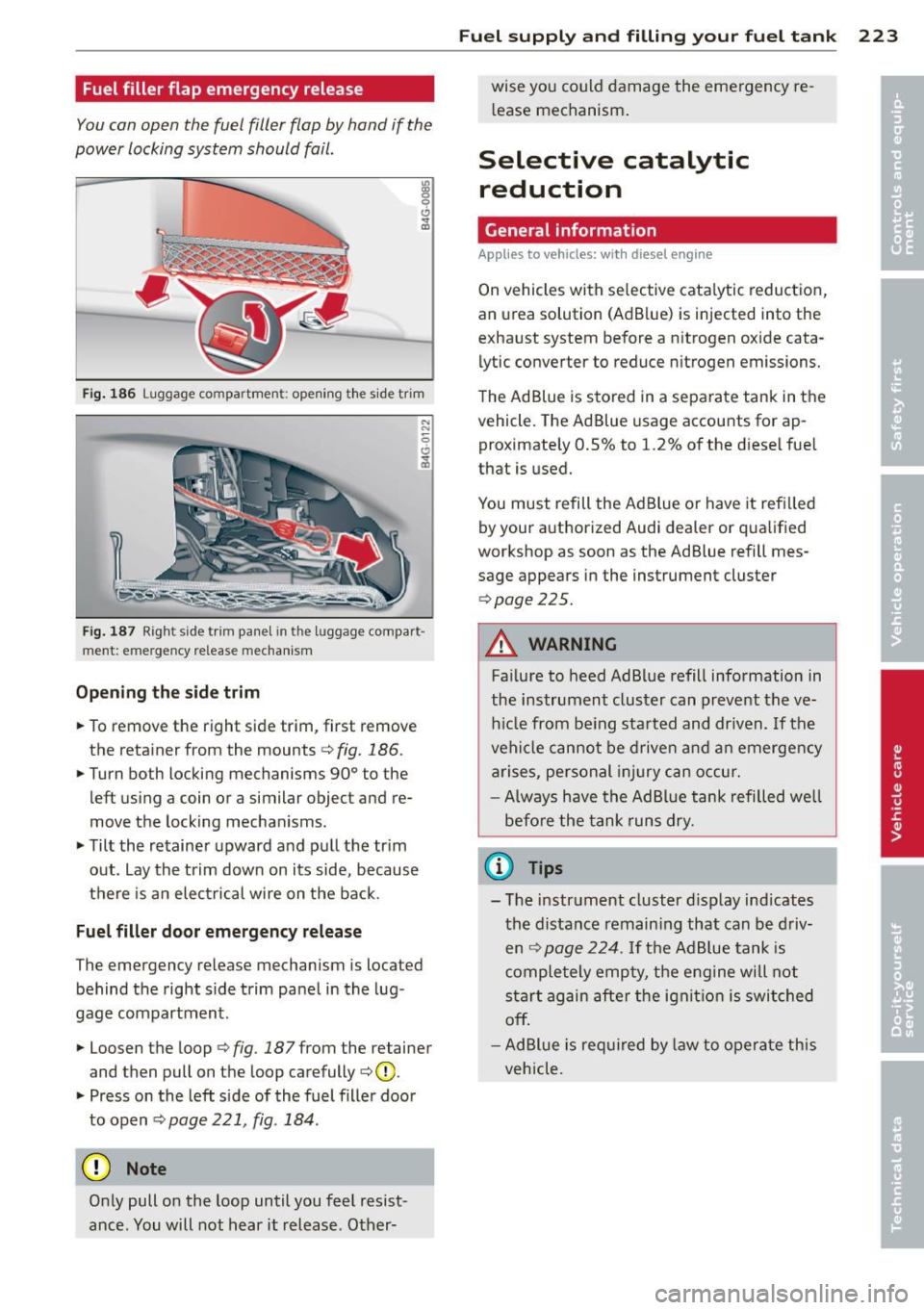
Fuel filler flap emergency release
You can open the fuel filler flap by hand if the
power locking system should fail.
Fig . 186 Luggage co mpa rt m ent: opening t he s ide tr im
N
N
0
Fi g. 187 Righ t side trim pane l in the lu ggage compar t
ment: e mergency re lease mec han ism
Opening the side trim
.. To remove t he right side trim, first remove
the retainer from the mounts
c> fig. 186.
.. Turn both locking mechanisms 90° to the
left us ing a coin or a similar object and re
move the locking mecha nisms .
.. Tilt the retainer upward and pull the tr im
out . Lay the trim down on i ts side, because
there is a n electrical wire on the back.
Fuel filler door emergency relea se
The emergency release mechanism is located
behind the right side trim pane l in the lug
gage compartment.
.. Loosen the loop
c> fig. 187 from the retainer
and then pull on the loop carefully
c> (D.
.. Press on the left s ide of the fuel filler door
to open
c> page 221, fig. 184 .
(D Note
Onl y pull on the loop until you feel resist
ance. You will not hear it releas e. Other-
Fu el suppl y and filli ng your fuel t ank 223
wise you could damage the eme rgency re
l ease mechanism .
Selective catalytic
reduction
General information
App lies to vehicles: wi th diesel eng ine
On vehicles with se lective cata lytic reduc tion,
an urea solution (Ad Blue) is injected into the
exha ust system before a nitrogen oxide cata
lytic converter to reduce n itrogen emissions.
The Ad Blue is s tored in a separate tank in the
vehicle. The Ad Blue usage accounts for ap
proximately 0.5% to 1.2% of the diesel fue l
that is used.
You must refill the Ad Blue or have it refi lled
by your authorized Audi dea ler or q ua lified
workshop as soon as the Ad Blue refill mes
sage appears in the instrument cluster
c> page225.
A WARNING
Fa ilure to heed AdB lue refil l information in
the inst rument cluster can preve nt t he ve
h icl e from be ing star ted and dr iven.
If the
vehi cle canno t be drive n and a n emerge ncy
ar ises, personal inju ry c an o ccu r .
- Always have the Ad Blue tank refilled we ll
befo re the tank runs dry.
(D Tips
- Th e instr ument cluster d isp lay ind icates
the distance remain ing that can be d riv
en ¢
page 22 4. If th e A d Bl ue tank is
c omple tely empty, the eng ine will not
s tart a gain afte r the igni tion is swi tched
off .
-Ad Bl ue is req uired by law to ope ra te th is
vehicle .
Page 227 of 306

Filling AdBlue
Applies to vehicles: wit h diesel engine
A special refill bottle must be used to fill the
AdBlue .
Fig. 1 89 Right rear ve hicle s ide: remov ing the Ad B lu e
cap
Fi g. 190 AdBl ue filler t ube: inse rt in g the ref ill bott le
The Ad B lue fi ller tube is located near the die
sel filler tube . Always add 1.5 gallons (5. 7 lit
ers) of AdBlue (three bottles). This
is the m ini
mum amount requi red to ens ure the system
detects the refilling and to start the eng ine .
The Ad B lue tank capac ity is approximately
4 .5 gallons ( 17 lite rs).
Opening the filler tube and adding
AdBlue
Requirement: The request to add Ad B lue m ust
appear in the instrument cluste r d is play.
.. Switch the ignition off .
.. Open the tank cover
r=v page 221 .
.. Turn the cap counte rclockw ise with the l ug
wrenc h from the veh icle tool k it to remove it
¢fig . 189.
.. Remove the cap from the refill bottle.
.. Position the refill bottle on the filler tu be
and tu rn the bottle clockwise unt il it stops
turning
(D r=v fig . 190.
Fu el suppl y and filli ng your fuel t ank 225
.. Press ligh tly against the bottom of the bot
tle @ to empty it. Continue pressing the
bottom of the bottle unt il it is empty or un
til f luid stops flowing into the tank.
.. Turn the bottle to the left w ithout pressing
on the bottom .
Closing the filler tube
.. Tu rn the cap clockwise on the filler tu be
w ith the l ug wrench until you hear it t ighten
completely .
.. Close the tank cover.
After filling
The vehicle must be driven . The system may
take up to two minutes to detect t hat the
AdB lue has been f illed .
.. If the re was no Ad Blue left in the tank and a
range of
O mi (0 km ) was displayed in the
instrument cluster, switch the ignition on
for about 15 seconds before start ing the en
gine.
A WARNING
Ad B lue can irritate the sk in , eyes and res
p ira to ry system .
If there is contact wit h
the fluid, flush immedia tely with plenty of
wa ter . Co nsu lt a phys ician if ne cessary.
(D Note
- On ly use AdB lue that conforms to the
s tandar d ISO 22241-1. Do not mix any
add itives w ith the AdBlue and do not d i
lute it wi th water.
- Ad Blu e is not a diesel add itive . Do not
add it to the diese l tank. If AdBl ue is
m ixed wi th d iesel f uel, it can lead to
d amage to the engine an d the A dBl ue
t ank system . The Limited New Vehicle
W arranty does not cove r such damage .
- Ad B lue attacks su rfaces s uch as painted
vehicle components, p las tic a nd carpet .
Remove t he fluid as quickly as possible
w ith a damp cloth and p lenty o f cold wa
ter. If the Ad Bl ue has already crystal-
lized, use warm water and a sponge. ..,_
Page 230 of 306

228 Check ing and filling
- Always disconnect the battery.
- Never smoke or wor k near heaters or
open flames . Fluids in the engine com
partment could start a fire.
- Keep an approved fire extinguisher im
mediately available.
- To avoid electrical shock and persona l in
jury while the engine is running or being started, never touch:
- Ignition cables
- Other components of the high voltage
electronic ignition system.
- If you must perform a check or repa ir
with the engine running:
- Fi rst, fully apply the parking brake,
move se lec tor lever to P (Pa rk) .
- Always use extreme caution to prevent
clot hing, jewe lry, or long ha ir from ge t
ting caught in the radiator fan, V -belts
or other moving parts, or from contact ing hot parts . Tie back hair before
start ing, and do not wear cloth ing that
will hang or droop into the eng ine .
- Minimize exposure to emission and chemica l ha zards¢ ,&..
A WARNING
California Propos ition 65 Warning:
- Engine exhaust, some of its constituents,
and certa in veh icle components conta in
or emit chemicals known to the State of
Califor nia to cause cancer and b irth de
fects a nd reproduct ive ha rm. In addition ,
certain fluids conta ined in vehicles and
certa in prod ucts of co mponent wear co n
ta in or emi t chemicals known to the
State o f Ca lifornia to cause can cer and
birth defects or other reproductive harm . -
Battery posts, terminals and re lated ac
cessories conta in lead and lead com
pounds, chemicals known to the State of
California to cause cancer and reproduc
tive harms. Wash hands after handling .
(D Note
When adding flu ids, always make sure that
they are poured into the proper conta iner
or f iller opening, otherwise serious dam
age to vehicle systems w ill occur.
® For the sake of the environment
To detect leaks in time, inspect the vehicle
floor pan from underneath regularly. If
you see spots from oil or other ve hicle flu
i ds, have yo ur vehicle inspected by a n au
thori zed Audi dea le r.
Closing the engine hood
.,. Pull the hood down un til the pressure from
the struts is reduced.
.,. Let the hood
drop down and latch in p lace .
Do not try to push it shut; it may fail to en
gage ¢&_ .
A WARNING
-
A hood that is not completely latched
could fly up and b lock your view while dr iv
ing .
-When you close the engine hood, check it
to make sure the safety catch has p roper
ly engaged. The hood sho uld be flush
with the surrou nding vehicle body pa rts.
- If you notice while driv ing that the hood
is not s ecured prope rly, stop at onc e and
close it.
Page 237 of 306

Checking the engine coolant level
The engine coolant level can be checked with
a quick glance .
Fig. 196 Eng ine compartment: cover on the coolant
expansion tank
Before you check anything in the engine com
partment,
alwa ys read and hee d all W ARN
ING S ¢.&. in Working in the engine compart
ment on page 22
7 .
.,. Park your vehicle on a level surface.
.,. Switch off the ignit ion.
.,. Read the engine coolant level from the cool
ant expansion tank¢
fig. 196, ¢ page 229 ,
fig. 193 .
With a cold engine, the coolant
level should be between the "min" and
"max" mar kings. When the engine is warm,
the leve l may be slightly above the "max"
marking.
The location of the coolant expansion tank
can be seen in the engine compartment illus
tration¢
page 229 .
To obtain an accurate read ing, the eng ine
must be switched off.
The expans ion tank in you r vehicle is equipped
with an electric coolant level sensor .
When the coolant level is too low, the warning
light in the Auto -Check System ¢
page 17 will
illum inate u ntil you add coolant a nd the level
has been restored to normal. Even though
there is an electric coolant level sensor, we
still recommend you check the coolan t leve l
from time to time.
Coolant loss
Coolant loss may indicate a leak in the cool ing
system. In the event of coolant loss, the cool-
Checkin g and fillin g 235
ing system should be inspected immediately
by your authorized Audi dealer . It is not
enough merely to add coolant.
In a
s ea led system, losses can occur on ly if
the boiling point of the coo lant is exceeded as
a result of overheating.
A WARNING
The cooling system is under pressure and
can get very hot. Reduce the risk of scald
ing from hot coolant by follow ing these
steps.
- Turn off the engine and allow it to cool
down.
- Protect your face, hands and arms from
escap ing f lu id and steam by cover ing the
cap with a la rge, th ick rag.
- Turn the cap slowly and very carefully in
a counter-clockwise d irect ion while ap
plyi ng light, downward pressure on the
top of the cap .
- To avo id being burned, do not sp ill anti
freeze or coolant on the exhaust system
or hot engine parts. Under certa in cond i
tions, the ethylene gly col in engine coo l
a nt can catch fire.
(D Note
Do not add any type of radiator leak sea L
ant to your veh icle's engine coo lant . Add
i ng radiato r repa ir flui d may adverse ly af
fect the funct io n and performa nce o f your
cooling system and could result in damage
not covered by your New Vehicle Limited
War ranty.
Adding coolant
Be very careful when adding engine coolant .
Before you che ck anyth ing in the eng ine com
partmen t,
alway s read and heed all WARN
INGS ¢.&_ in Working in the engine compart
ment on page
227 .
.,. Tur n off the engi ne.
.,. Let the engine cool down.
Page 238 of 306

236 Check ing and filling
• Place a thick rag ov er the coolant expansion
tank ¢
page 235, fig . 196 and care fully
twist the cap counter-clockwise ¢ &_.
• Add coolant mixed in the correct ratio
¢ page 234, Coolant.
• Twist the cap on again tightly .
Replacement engine coolant must conform to
exact specifications ¢
page 234, Coolant .
We recommend using on ly coo lant addi-
tive
Gl2++, Gl3 or in an emergency Gl2 +. Do
not use a different additive. In an emergency
use plain water unt il you can get the correct
addit ive and can restore the correct ratio . This
should be done as soon as possible .
If you have lost a considerable amount of
coolant, then you should add cold antifree ze
and cold water only when the eng ine is co ld.
A lways use
new engine coolant when refi lling.
Do not fill coolant above the "MAX" mark. Ex
cess coolant will be forced out t hrough the
press ure relief valve in the cap when the en
gin e becom es hot.
A WARNING
- The coo ling system is under p ress ure and
can get very hot. Reduce the risk of
scalding from hot coolant by following
these steps .
- Tu rn o ff the eng ine a nd a llow i t to cool
down.
- Pr otect your f ace, hands and arms from
escaping f luid and steam by cover ing
the cap with a large, thick rag.
- Tu rn the cap slowly and very ca re fully
in a counte r-clockwise direct ion while
applying light, downwa rd p ress ure on
the top of the cap.
- To avoid being burned, do not spi ll an
tifreeze or coolant on the exhaust sys
tem or hot engine parts. Under certa in
conditions, the ethylene glyco l in en
g ine coolant can catch f ire.
- Antifreeze is poisonous. Always store an
t ifreeze in its original container and well
out of the reach of children. -
If you drain the coo lant, it m ust be
caught and safely stored in a proper con
tainer clearly marked "poison".
(D Note
- Coo lant poll utes the environment and
cou ld cause an engine fire . Excess cool
ant will be forced out through the pres
sure relief valve in the cap when the en
gine becomes hot .
- If, in an emergency, only water can be
added, the correct ratio between water
and antifreeze ¢
page 234 must be re
stored as soon as possible .
® For the sake of the environment
Drained coolant should not be reused. Al
ways d ispose of used coolant while observ
i ng all environmental regulations .
Radiator fan
The radiator fan switches on automatically by
itself .
An auxiliary electric radiator fan switches on
and off depending on coolan t temperature
and othe r vehicle operat ing condit ions.
After you switch the engine off, the aux iliary
fan can continue running for up to 10 m inutes
- even w it h the ignition off. It can even switc h
o n aga in later by itself¢
A, if
- the temper ature of the engine coo lant rises
due to the heat build-up from the engine in
the engine compartment, or
- the engine compartment heats up because
the vehicle is parked in intense sunlig ht.
A WARNING
- To reduce the risk of personal injury nev
er touch t he rad iator fan .
- The auxiliary electric fan is temperat ure
controlled and can sw itch on suddenly
even when the engine is not ru nning .
- The auxiliary radiator fan sw itches on a u
tomatically when the engine coo la nt
reaches a certai n temperature and wi ll ..,.
Page 239 of 306
continue to run until the coolant temper
ature drops.
Brake fluid
Checking brake fluid level
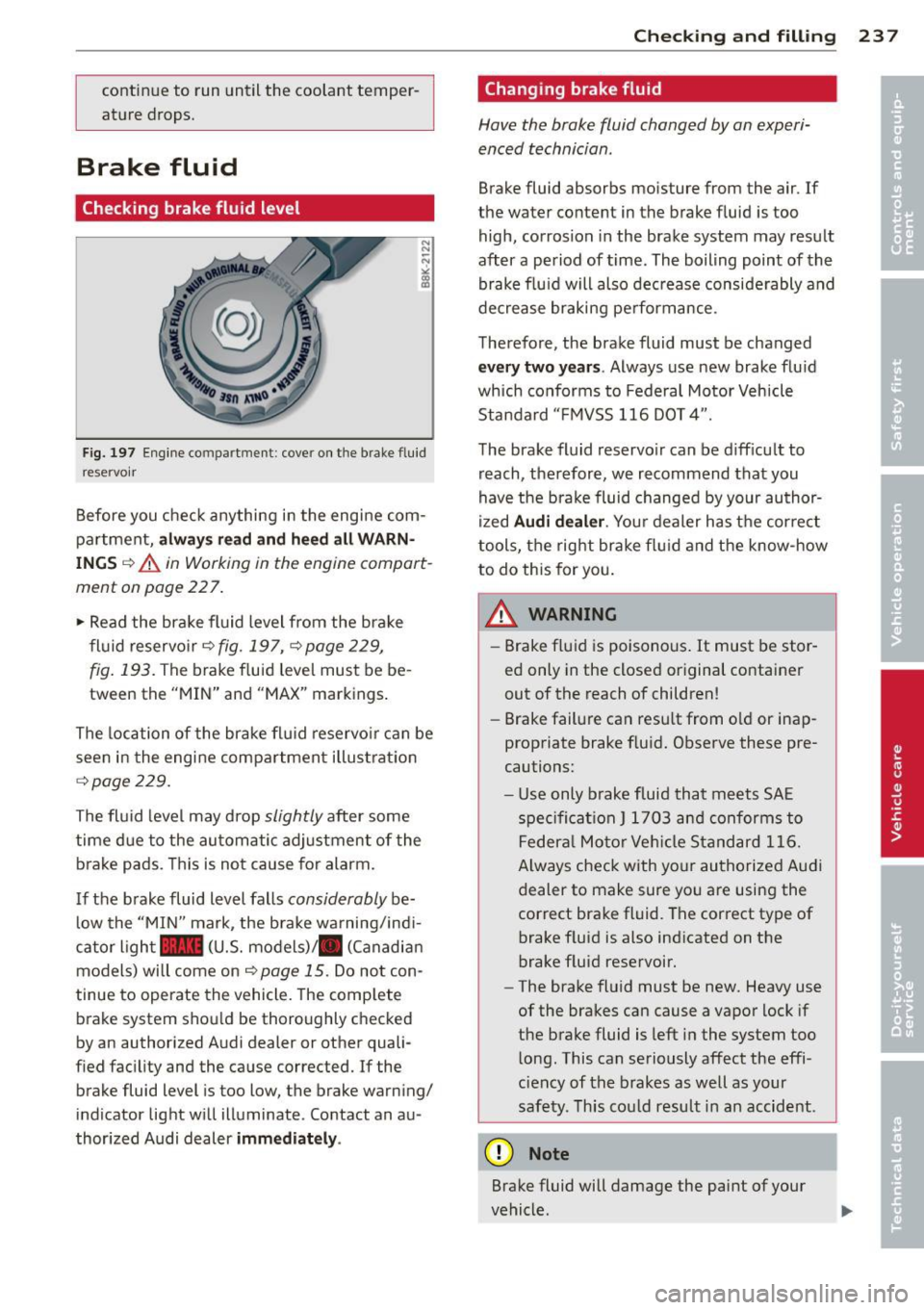
Fig. 197 E ngine co mpartment : cove r on the b rake fluid
r ese rvoir
Before you check anything i n the engine com
partment,
a lw ays read and heed all W ARN
ING S 9 A in Working in the engine compart
ment on page
22 7.
~ Read the brake fluid level from the brake
fluid reservoir
9 fig . 197, 9 page 229,
fig. 193.
The brake fluid level must be be
tween the "MIN" and "MAX" markings .
The location of the brake fl uid reservo ir can be
seen in the engine compartment illustrat ion
9 page229.
The fluid level may drop slightly after some
time due to the automatic adj ustment of the
b rake pads. This is not cause for alarm.
I f the brake fluid level falls
considerably be
l ow the "MIN " mark, the brake wa rning/indi
cator ligh t
1111 (U.S. models)/ . (Canadia n
models) will come on~
page 15 . Do not con
tinue to operate the vehicle. The comp lete
brake system shou ld be thoroughly checked
by an authorized Audi dealer or other quali
f ied fac ility and the cau se corrected.
If the
brake fluid level is too low, the brake warning/
indicator light will illuminate . Contact an au
thor ized Audi dealer
imm ediat ely .
Checkin g and fillin g 237
Changing brake fluid
Have the brake fluid changed by an experi
enced technician .
Brake fluid absorbs mois ture from the air. If
the wa ter content in the brake fluid is too
high , corrosion in the brake system may result
after a period of time . The boiling point of the
brake flu id will also dec rease considerably and
decrease braking pe rformance.
Therefore, the brake fluid must be changed
ev ery two years. Always use new brake flu id
which conforms to Federal Motor Vehicle
Standard "F MVSS 116 DOT 4 ".
The brake fluid reservo ir can be d iff icult to
reach, the refore, we recommend that you
have the brake fluid changed by your author
i zed
Audi dealer . Your dealer has t he correct
tools, the right brake fl uid and the know-how
to do this for you.
A WARNING
-
- Brake fluid is poisonous . It must be stor
ed only in the closed original container
out of the reach of children!
- Brake failure can resu lt from o ld or inap
propriate brake f luid. Observe these pre
cautions:
- Use only brake fluid that meets SAE
spec ificat ion
J 1 7 03 and conforms to
Federa l Moto r Ve hicl e Standard 116.
Always check with yo ur authorized Audi
dealer to make sure yo u are using the
correct bra ke fluid. The correct type of
brake f luid is also indicated on the
brake fluid reservoir.
- The brake fluid must be new. Heavy use
of the brakes can cause a vapor lock if
the brake fluid is left in the system too
l ong . This can seriously affect the effi
c iency of the brakes as well as your
safety. Th is cou ld resu lt in an accident .
(D Note
Brake fluid will damage the paint of your
vehicle .
.
Page 252 of 306

250 Tire s and wheel s
used today are underinflated just by looking
at them.
Therefore, be sure to check tire pressures at least once a month and always before going
on a long tr ip. Make sure to take the number
of people and the amount of luggage into ac
count when adjusting tire pressure for a trip -
even one that you would not consider to be
"long." See
c> page 251, Tires and vehicle
load limits
for more important information .
Always use an accurate tire pressure gauge
when checking and adjusting inflation pres
sures . Check all of the t ires and be sure not to
forget the spare tire . If the pressure in any tire
i s too high when the tire is "cold," let air out
of the tire slowly with the edge of the tire
gauge and keep checking the pressure unt il
you reach the pressu re that is correct for the
l oad (passengers and luggage) and kind of
driving you plan to do.
I f the p ress ure in any tire is too low, note the
d ifference between the pressure in the cold
tire and the pressure you need and add the a ir
that you need to reach the correct pressure for
the vehicle load (passengers and luggage) for
the tires on your veh icle as listed on the on
you r veh icle and in this manual and the k ind
of dr iving you plan to do.
Ne ver e xceed the m aximum inflation pre s
su re li sted on the ti re sidewall for an y rea
son.
Remember that the vehicle manufacturer, not
the tire manufacturer, determines the correct
tire p ressure fo r the t ires on your vehicle .
It is important to check the tire pressu re when
the tires are cold.
- Read the requ ired t ire p ress ure from the tire
pressure label. The ti re pressu re labe l is lo
cated on the drive r's side 8-pi llar.
- T urn the valve stem cap counter- clockwise
to remove i t from the tire valve.
- Place the air pressu re gauge on the valve .
- The tire pressures should only be checked
and adjusted when the tires a re cold . The slightly raised pressures of warm tires must
not be reduced.
- Adjust the tire pressure to the load you are
carrying.
- Reins tall the valve stem cap on the va lve.
When sh ould I check the tire pressure?
The correct tire pressure is especially impor
tant at h igh speeds. The pressure should
the refore be checked at least once a mo nth
and always before starting a jo urney. Do not
f orget to c heck the ti re p ress ure fo r the spare
whee l
i=;,poge 265.
When should I adjust the tire pressures?
Adjust the tire pressure to the load you are
ca rrying. After changing a whee l
or replaci ng
whee ls yo u have to adj ust the ti re press ures
on all whee ls. In addition, you m ust then
store the new tire pressures in the tire pres
s u re monito ring system*
c> page 261.
A WARNING ~
Incorrect tire pressures and/or underinfla-
tion can lead sudden tire fa ilure, loss of
control, collision, serious personal injury
or even death.
- When the warn ing symbol
RI] appears in
the instrument cluster, stop and inspect
the t ires.
- Incorrect tire pressure and/or underinfla
tion can cause increased tire wear and can affect the handling of the vehicle and
stopping ability .
- Inco rrect tire pressures and/or underin
flation can a lso lead to sudden t ire fail
ure, including a blowou t and sudden de
flation, ca us ing loss of veh icle cont ro l.
- The drive r is responsible for the co rrect
tire pressures for all tires on the veh icle.
T he applicable pressure values are loca t
ed on a sticke r on the dr iver's s ide 8-pil
lar .
- On ly when all tires on the vehicle are fil
led to the correct pressu re, the t ire pres
sure monitoring* system can work cor rectly.
Page 259 of 306

Driving with different tires reduces vehi
cle handling and can lead to a loss of
control.
- If the spare tire is not the same as the
tires that are mounted on the vehicle -
for example with winter tires -only use
the spare tire for a short period of time and drive with extra care. Refit the nor
mal road wheel as soon as safely possi
ble.
- Never drive faster than the maximum
speed for which the tires on your vehicle
are rated because tires that are driven
faster than their rated speed can fail
suddenly.
- Overloading tires cause heat build-up,
sudden tire failure, including a blowout
and sudden deflation and loss of control.
- Temperature grades apply to tires that
are properly inflated and not over or un
deri nflated.
- For technical reasons it is not always
possible to use wheels from other
vehicles -in some cases not even wheels
from the same vehicle model.
- If you install wheel trim discs on the ve
hicle wheels, make sure that the air flow
to the brakes is not blocked. Reduced air
flow to the brakes can them to overheat, increasing stopping distances and caus
ing a collision.
- Run flat tires may only be used on
vehicles that were equipped with them at the factory . The vehicle must have a
chassis designed for run flat tires. Incor
rect use of run flat tires can lead to vehi
cle damage or accidents. Check with an
authorized Audi dealer or tire specialist
to see if your vehicle can be equipped
with run flat tires. If run flat tires are used, they must be installed on all four
wheels. Mixing tire types is not permit
ted.
(D Note
- For technical reasons, it is not generally
possible to use the wheel rims from oth-
Tires and wheels 257
er vehicles. This can hold true for wheels
of the same vehicle type.
- If the spare tire is different from the
tires that you have mounted on your ve
hicle (for example winter tires or wide
profile tires), then use the spare tire for a
short period of time only and drive with
extra care. Replace the flat tire with the
tire matching the others on your vehicle
as soon as possible.
- Never drive without the valve stem cap .
The valves could get damaged .
(® For the sake of the environment
Dispose of old tires in accordance with the
local requirements.
Uniform tire quality grading
-Tread wear
- Tract ion AA A B C
- Temperature AB C
Quality grades can be found where applicable
on the tire side wall between tread shoulder
and maximum section width
c;, page 254,
fig. 204.
For example: Tread wear 200, Traction AA,
Temperature A.
All passenger car tires must conform to Feder
al Safety Requirements in addition to these
grades.
Tread wear
The tread wear grade is a comparative rating
based on the wear rate of the tire when tested
under controlled conditions on a specified
government test course.
For example, a tire graded ISO would wear
one and one half (11/2) times as well on the
government course as a tire graded 100.
The relative performance of tires depends upon the actual conditions of their use, how
ever, and may depart significantly from the
norm due to variations in driving habits, serv
ice practices and differences in road character-
istics and climate.
ll-
•
•
Page 261 of 306
The speed rating letter code (c::> page 246) is
on the side wall of the tire
c::> page 254.
A WARNING
Winter tires have maximum speed limits
that may be lower than your vehicle's max
imum speed . Always know the maximum
speed before driving off. Never drive faster
than the speed permitted for your specific
winter tires . This will cause damage to the
tires leading to an accident and serious
personal injury to you and your passen
gers.
A WARNING
Driving faster than the maximum speed
for which the winter tires on your vehicle
were designed can cause tire failure in cluding a blowout and sudden deflation,
loss of control, crashes and serious per
sonal injuries . Have worn or damaged tires
replaced immediately.
- Winter tires have maximum speed rating
that may be lower than your vehicle's
maximum speed .
- Never drive faster than the speed for
which the winter or other tires installed
on your vehicle are rated .
A WARNING
Always adjust your driving to the road and
traffic conditions. Never let the good ac
celeration of the winter tires and all-wheel
drive tempt you into taking extra risks . Al
ways remember :
- When braking, an all-wheel drive vehicle
handles in the same way as a front drive
vehicle.
- Drive carefully and reduce your speed on
icy and slippery roads, even winter tires
cannot help under black ice conditions.
@l For the sake of the environment
Use summer tires when weather condi
tions permit. They are quieter, do not wear
as quickly and reduce fuel consumption.
-
Tires and wheels
Snow chains
Snow chains may be fitted only to the front
wheels , and only to certain tire sizes. Ask your
authorized Audi dealer on which tire sizes
snow chains can be used.
If you are going to use snow chains, then you
must install them on the front wheels at
least.
The snow chains must have low-profile links
and must not be thicker than 0.4 inch
(10,S mm) , including the lock.
Remove wheel center covers and trim discs
before putting snow chains on your vehicle
c::> (]) . For safety reasons cover caps must then
be fitted over the wheel bolts. These are avail
able from authorized Audi dealers.
A WARNING ,..__
Using the wrong snow chains for your vehi
cle or installing them incorrectly can in
crease the risk of loss of control leading to
serious personal injury.
- Snow chains are available in different
sizes . Always make sure to follow the in
structions provided by the snow chain manufacturer .
- When driving with snow chains never
drive faster than the speed permitted for
your specific snow chains .
- Always observe local regulations.
(D Note
- Remove snow chains before driving on
roads not covered with snow to avoid
damaging tires and wearing the snow
chains down unnecessarily.
- Snow chains, which come into direct con
tact with the wheel rim, can scratch or
damage it. Therefore, make sure that the
snow chains are suitably covered . Check
the position of the snow chains after
driving a few yards and correct if neces
sary. Follow the instructions from the
snow chain manufacturer when doing so.
- If the Adaptive Air Suspension* should
malfunction, do not mount or use snow ..,.
259
•
•