engine oil AUDI S7 2015 Owner's Manual
[x] Cancel search | Manufacturer: AUDI, Model Year: 2015, Model line: S7, Model: AUDI S7 2015Pages: 316, PDF Size: 78.09 MB
Page 233 of 316
M N
"' rl
-Always dispose of used engine oil proper
ly. Do not dump it on garden soil, wood
ed areas, into open streams or down
sewage drains.
- Recycle used engine oil by taking it to a
used engine oil collection facility in your
area, or contact a service station.
Engine cooling system
Coolant
The engine coolant performs two functions: it
keeps the engine from overheating and it pro
tects the engine from freezing in the winter.
The cooling system is sealed and generally re
quires little attention .
The cooling system has been filled at the fac
tory with a permanent coolant which does not
need to be changed . The coolant consists of a
mixture of specially conditioned water and the
manufacturer 's glycol-based coolant addi-
tive G13 antifreeze with anticorrosion addi
tives (50% for USA models; 60% for Canadian
models) . This mixture both assures the neces
sary frost protection and protects metal com
ponents in the engine's cooling system from
corrosion and scaling.
It also raises the boil
ing point of the coolant.
Do not reduce the concentration of the cool
ant in the summer by adding plain water.
The
proportion of coolant additive must be at
least 50% but not more than 60%
to main
tain antifreeze protection and cooling efficien
cy .
If the coolant frost protection is too low,
the coolant could freeze and damage the vehi
cle heating and engine cooling system.
For year -round driving, antifreeze is added at
the factory for temperatures down to:
- -31°F(-35°C)USA
- -40 °F ( - 40 °C) Canada.
If you must add coolant, use a mixture of wa
ter and coolant additive. Mixing the coolant
additive with distill ed water is recommended .
Checking and filling 231
A WARNING
Before you check anything in the engine
compartment, always read and heed all
WARNINGS ~&.
in Working in the engine
compartment on page 225.
(D Note
- Before winter sets in, have the coolant
checked to see if the coolant additive in
your vehicle is sufficient to meet the cli
mate conditions. This is especially impor
tant if you live in a region where the win
ter is extremely cold. If necessary, in
crease the proportion of coolant additive
to 60%.
- When adding coolant additive to your
cooling system, remember:
- We recommend using only coolant ad
ditive G12++ or G13 (check the label)
for your vehicle. This coolant additive is
available at authorized Audi dealers.
Other types of antifreeze can signifi
cantly reduce corrosion protection. The
resulting corrosion can cause a loss of
coolant and serious engine damage.
- Do not add any type of radiator leak seal
ant to your vehicle's engine coolant.
Adding radiator repair fluid may adverse
ly affect the function and performance of
your cooling system and could result in
damage not covered by your New Vehicle Limited Warranty.
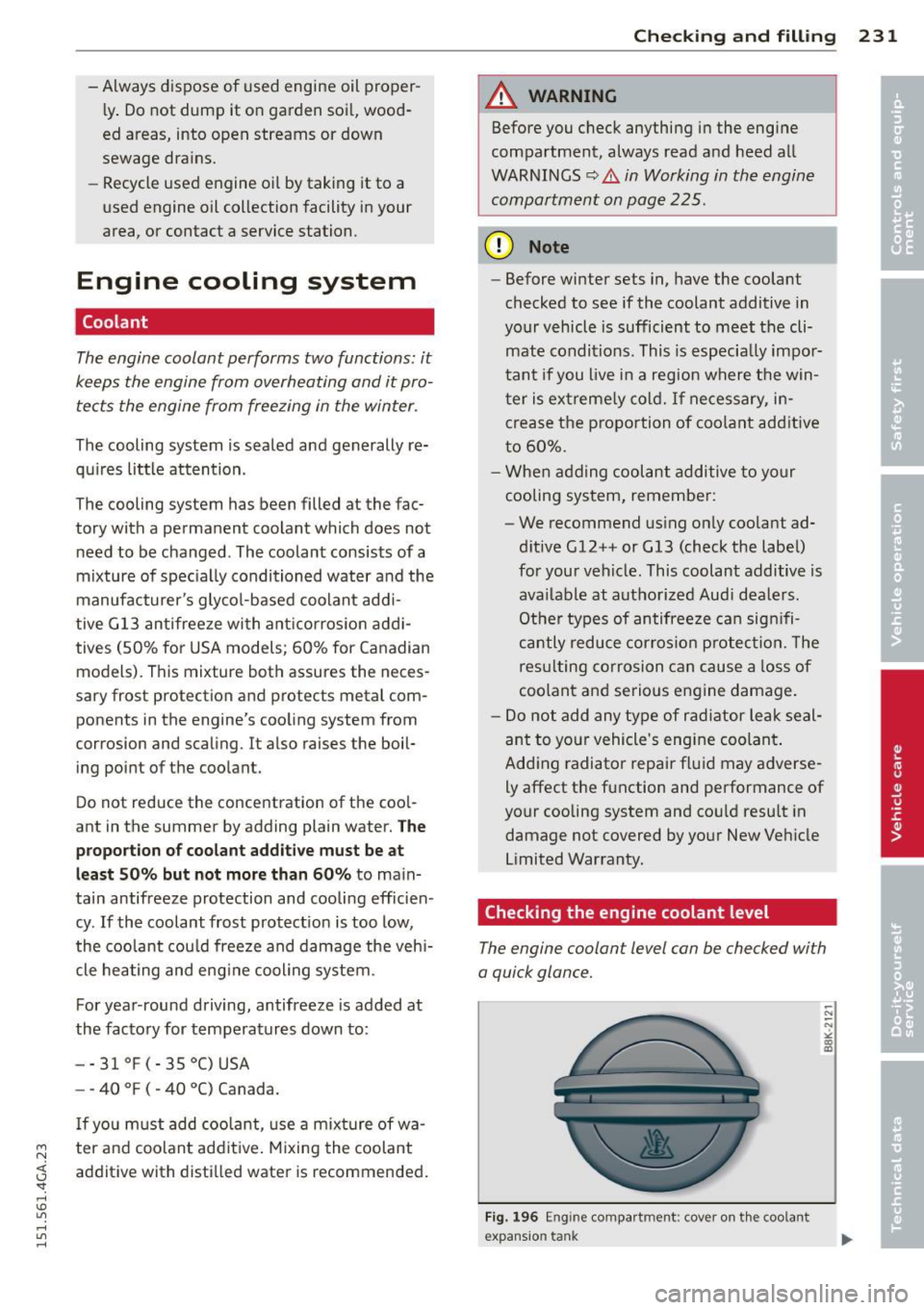
Checking the engine coolant level
The engine coolant level can be checked with
a quick glance.
Fig. 196 Engine compa rtment: cove r on t he coola nt
expansion tank
Page 234 of 316
232 Check ing and filling
Before you check anything in the engine com
partment,
a lways r ea d and heed all WARN
INGS ¢ A in Working in the engine compart
ment on page 225.
• Park your vehicle on a level surface.
• Switch
off the ignition .
• Read the eng ine coolant leve l from the cool
ant expansion tank
c> fig. 196, c> page 22 7,
fig. 193. With a cold eng ine, the coolant
level should be between the "min" and
"max" markings. When the engine is warm,
the leve l may be slightly above the "max"
ma rk ing.
The location of the coolant expans ion tank
can be seen in the engine compartment illus
tration ¢
page 22 7.
To obtain an accurate reading, the engine
must be sw itched
off.
The expans ion tank in your vehicle is equipped
with an electric coolant level sensor.
When the coo lant level is too low, the warning
light in the Auto-Check System ¢ page l 6 will
i l luminate unti l yo u add coolant and the level
has been restored to normal. Even though
there is an electric coolant level senso r, we
still recommend you check the coolant leve l
from time to time .
Coolant loss
Coolant loss may indicate a lea k in the cooling
system. In the event of coolant loss, the cool
ing system should be inspected immediately
by your author ized Audi dealer. It is not
enough merely to add coolant.
In a
sealed system, losses can occur only if
the boiling point of the coolant is exceeded as
a result of overheat ing.
A WARNING
T he cooling system is unde r pr essure and
c an get ve ry hot. Reduce t he risk of s cald
ing from hot coolant by followi ng these
steps .
- T urn
off the engine and allow it to cool
dow n. -
Protect your face, han ds and arms from
escaping flu id and steam by cover ing the
cap with a large, thick rag.
- Tu rn the cap slowly and very care fully in
a counte r-clockwise direct ion while ap
plying lig ht, downward pressure on the
top of the cap.
- To avo id being burned, do not sp ill anti
freeze or coolant on the exhaust system
or hot engine par ts. Under certa in cond i
tions, th e ethylen e glyco l in engine coo l
a nt can catch fire.
(D Note
Do not add a ny type o f radiator leak sea l
ant to your veh icle's engine coolant. Add
i ng radiator r epa ir fluid may adv erse ly af
fe ct the funct io n and perfo rma nce of you r
co oling syste m and could result in damage
not covered by your New Veh icle Limi ted
War ran ty.
Adding coolant
Be very careful when adding engine coolant.
Befo re you check anyth ing in the eng ine com
partment,
alway s read and heed all WARN·
INGS ¢ A in Working in the engine compart
ment on page 225.
• Requirement: The re must be a r esidua l
amount of coolant in the e xpansion ta nk
¢(D.
•Tur no ff the engine.
• Le t the engine cool down.
• Place a thick rag ove r th e coo lant expansion
tank
¢ page 231, fig. 196 and carefully
twist the cap co unte r-clockwise c> &_ .
• Add coo lant m ixed in the correct rat io
¢ page 231, Coolant up to the MAX mark
ing.
• Make s ure that the fl uid leve l remains sta-
b le. Add more coo la nt if necessary.
• Twis t the cap o n again
tightly.
Replacement engine coo la nt must confo rm to
exact spec ificat ions
¢ page 2 31, Coolant. .,.
Page 236 of 316
234 Checking and filling
Brake fluid
Checking brake fluid level
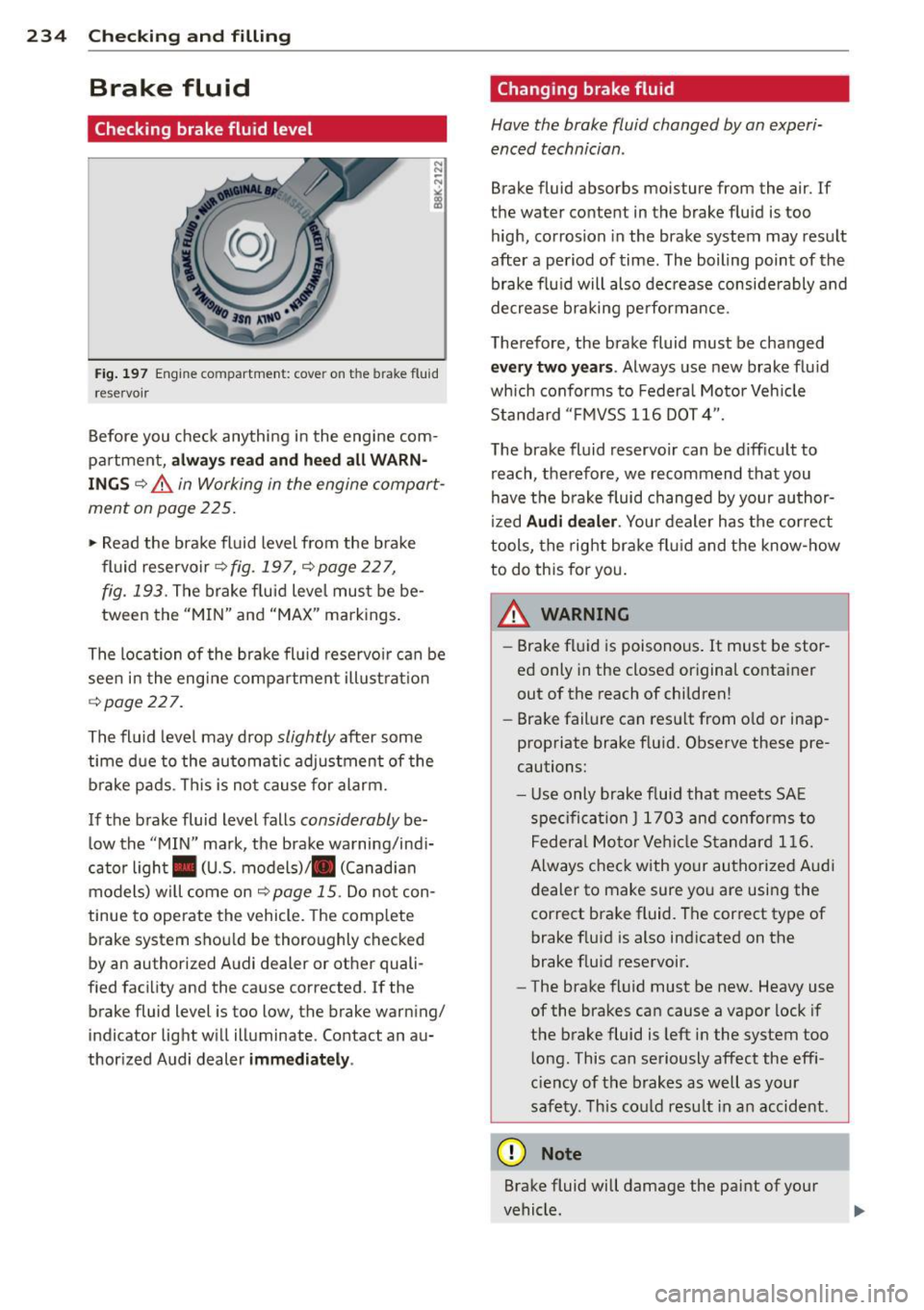
Fig . 197 Engine compartment: cove r on the brake fluid
reservo ir
Before you check anything in the engine com
partment,
always read and heed all WARN
INGS ¢&. in Working in the engine compart
ment on page 225.
,.. Read the brake fluid level from the brake
fluid reservoir¢
fig . 197, ¢ page 22 7,
fig. 193.
The brake flu id level must be be
tween the "MIN" and "MAX" markings.
The location of the brake flu id reservoir can be
seen in the engine compartment illust rat ion
¢ page 227.
The fluid level may drop
slightly after some
time due to the automatic adjustment of the
brake pads. This is not cause for alarm.
If the brake fluid level falls
considerably be
low the "MIN" mark, the brake warning/indi
cator light . (U.S. models)/ . (Canadian
models) will come on¢
page 15. Do not con
tinue to operate the vehicle. The comp lete
brake system shou ld be thoroughly checked
by an authorized A udi dealer or other quali
fied facility and the cause corrected.
If the
brake fluid level is too low, the brake warning/
indicator light will illuminate. Contact an au
thorized Audi dealer
immediately .
Changing brake fluid
Have the brake fluid changed by an experi
enced technician .
Brake fluid absorbs moisture from the air. If
the water content in the brake fluid is too high, corrosion in the brake system may result
after a period of time . The boiling point of the
brake flu id will also decrease conside rably and
decrease braking pe rformance.
Therefore, the brake fluid must be changed
every two years . Always use new brake flu id
which conforms to Federal Motor Vehicle
Standard "FMVSS 116 DOT 4".
The brake fluid reservoir can be difficult to reach, therefore, we recommend that you
have the brake fluid changed by your author
ized
Audi dealer. Your dealer has the correct
tools, the right brake fluid and the know-how
to do this for you.
A WARNING
- Brake fluid is poisonous . It must be stor
ed only in the closed original container
out of the reach of children!
- Brake failure can resu lt from o ld or inap
propriate brake fluid. Observe these pre
cautions:
- Use only brake fluid that meets SA E
specification
J 1703 and conforms to
Federal Motor Vehicle Standard 116.
Always check with your authorized Audi
dealer to make sure you are using the
correct brake fluid. The correct type of
brake f luid is also indicated on the
brake fluid reservoir.
- The brake fluid must be new. Heavy use
of the brakes can cause a vapor lock if
the brake fluid is left in the system too
long. This can seriously affect the effi
c ie ncy of the brakes as well as your
safety. This could resu lt in an accident.
(D Note
Brake fluid will damage the paint of your
vehicle .
Page 284 of 316
282 Fuses and bulbs
No . Equipment Amps
4 Suspension control system sen-
5
sor
5 Electron
ic Stabilization Control
5
(ESC) mod ule
6 Climate
control
5
7 Adaptive cruise control 10
8
Airbag control module, front
5
passenger's seat sensor system
9 Gateway 5
Garage door opener (Homelink),
10 night vision system contro l 5
module
11 Image processing (active
lane
10
ass ist, adaptive cruise control)
12 Dynamic steering 5
13 Terminal 15
in the instrument
15
panel
14 T
ermina l 15 in the luggage com-
partment 30
15 T
erminal 15 (engine)
15
16 Starter 40
Fuse panel @ (brown)
No . Equipment Amps
1 Gateway
5
2 Climate control 10
E lec tronic Stabilization Contro l
10
3
(ESC) module
4 Front door (driver's
side)
30
5 Power seat adjustment (driver's
7,5
seat)
6 Dynamic steering
35
7 Su nroof 20
Rear door control module (driv- 15
8
er's side)
9 Lumbar support (Front passen-
5
ger seat)
10 Tire pressure monitoring system
5
11 Su
nroof, rear spoiler (Sportbac k)
20
12 Driver door
control module
15
Fuse panel© (red)
No . Equipment
2 Fuel pump
3 Brake light sensor/brake pedal
sensor system
4 AdBlue control module (Diesel)/
Engine acoustics
5 Left rear door contro l modu le
6 Power
seat adjustment (pas-
senger's seat)
7 Horn
8 Windshield wiper motor
9
Light/rain sensor, heater for vid-
eo camera in windscreen
10 Lumbar support (dr iver seat)
11 Front
passenger door control
module
12 Right rear door control mod ule
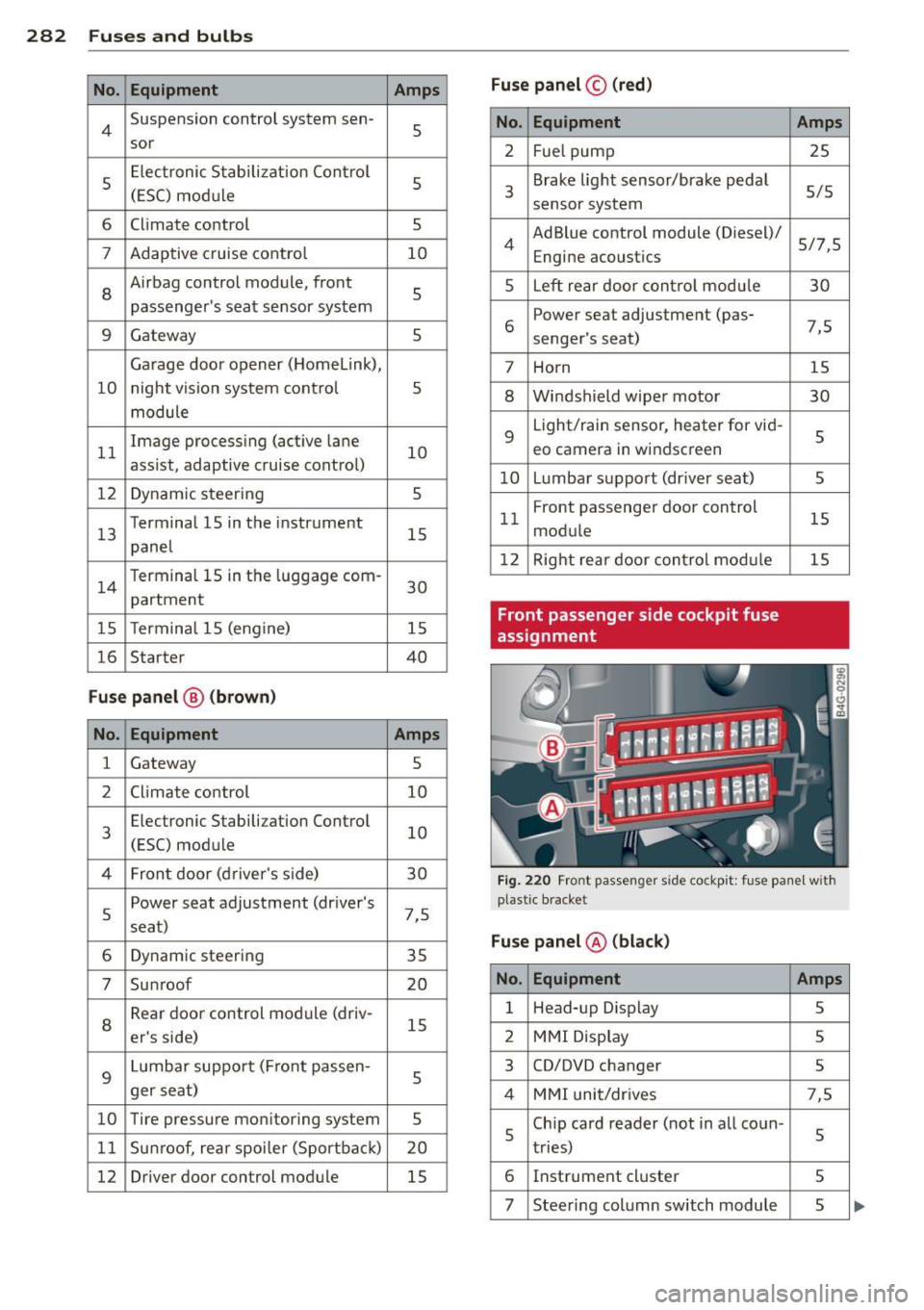
Front passenger side cockpit fuse
assignment Amps
25
5/5
5/7,5 30
7,5 15
30
5
5
15
15
Fig. 220 Front passenger side cockpit: fu se pane l w ith
plastic bracket
Fuse panel @ (black)
No. Equipment Amps
1 Head-up Display
5
2 MMI Display 5
3 CD/DVD changer
5
4 MMI unit/dr ives 7,5
5 Chip card reader (not
in all coun-
5
tries)
6 Instrument cluster
5
7 Steering column switch module 5
Page 285 of 316
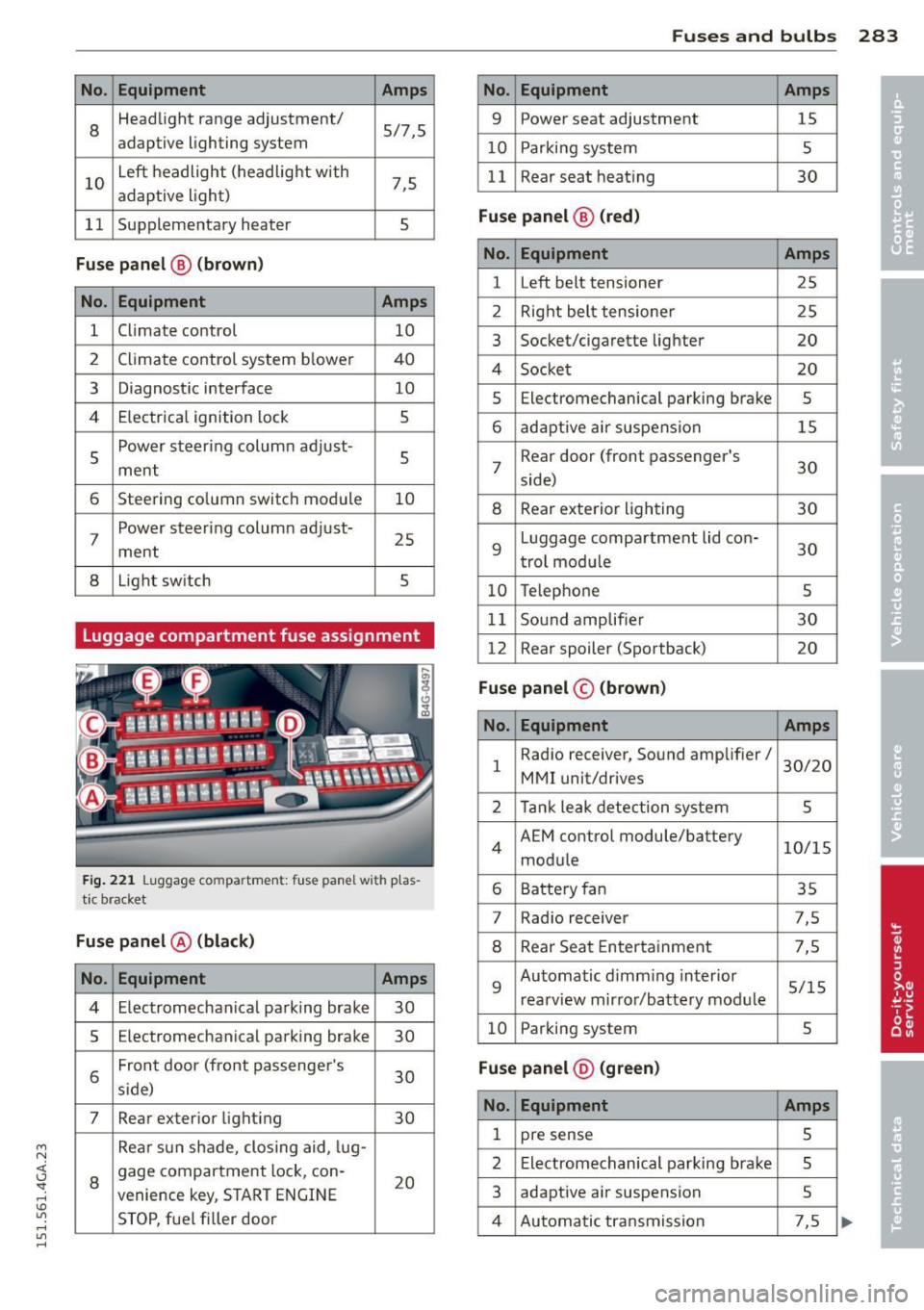
M N <( I.J "". rl I.O
"' rl
"' rl
No. Equ ipment Amps
8
Headlight range adjustment/ 5/7,5
adaptive lighting system
10
Left headlight (headlight with 7,5 adaptive light)
11 Supplementary heater s
Fuse p anel @ (b ro w n)
No . Equipment Amps
1 Climate control 10
2
Climate control system blower 40
3
Diagnostic interface 10
4
E lectrical ignition lock s
5
Power steering column adjust-
ment
s
6 Steering column switch module 10
7
Power steering column adjust-
ment
25
8 Light switch 5
Luggage compartment fuse assignment
Fig . 221 Luggage compa rtmen t: fuse panel wit h p las
tic bracket
Fuse p anel @ (black )
No. Equipment Amps
4 Electromechan ical parking brake 30
5
Electromechanical parking brake 30
6
Front door (front passenge r's
30 s ide)
7 Rear exterior light ing 30
Rea r sun shade, closing aid, lug-
8
gage compartment lock, con-
20 venience key, START ENGINE
STOP, fuel filler door
Fu se s and bulb s 283
No. Equipment Amps
9 Power seat adjustment 15
10
Parking system 5
11
Rear seat heating 30
Fu se p an el@ (r e d )
No . Equipment Amps
1 Left belt tensioner 25
2
Right belt tensioner 25
3
Socket/cigarette lighter 20
4
Socket 20
5
Electromechanical parking brake 5
6 adaptive air suspension 15
7
Rear door (front passenger's
30 side)
8 Rear exterior lighting 30
9
Luggage compartment lid con-
30 trol modu le
10 Telephone 5
11
Sound amplifier 30
12
Rear spoiler (Sportback) 20
Fuse panel© (brown)
No . Equ ipment Amps
1
Radio receiver, Sound amplifier/
30/20
MMI unit/drives
2 Tank leak detection system 5
4
AEM control module/battery 10/15
module
6 Battery fan 35
7
Rad io receiver 7,5
8 Rear Seat Entertainment 7,5
9
Automatic d imm ing interior 5/15
rearview mirror/battery module
10 Parking system 5
Fu se pan el@ (gr ee n)
No . Equipment Amps
1 pre sense 5
2
Electromechanical parking brake 5
3
adaptive air suspension 5
4 Automatic transmission 7,5
Page 292 of 316

2 90 Emergency situations
heavy components such as the engine
b lock or transmiss io n are removed.
- W he n removing heavy components like
these, ancho r vehicle to ho ist o r add cor
responding weig hts to ma inta in the cen
ter of g ravity . Othe rwise, the vehicle
might tilt or s lip off t he hoist, causing
ser ious p erson al injury.
(D Note
-Be awa re of the follow ing points befo re
li fting the vehicle:
- The vehicle should never be lifted or
jacked up from underneath the engine oil pan, the transmission housing, the
front or rear axle or the body side
membe rs. This could lead to ser ious
damage.
- To avoid damage to the underbody or
chassis frame , a rubber pad must be
i nserted between the floor jack and
the l ift points.
- Before driving over a workshop hoist,
check that the veh icle weight does not
exceed the permissible lifting capacity
of the hoist .
- Before driving over a workshop hoist,
ensure that there is sufficient clear
ance between the hoist and low parts
of the vehicle.
Page 293 of 316

M N <( I.J ""'. rl I.O
"' rl
"' rl
Technical data
Vehicle identification
F ig. 231 Veh ide Identificat ion Number (VlN) plate: lo ·
c ation on d river 's s ide das h pane l
XXXXX XX · X -XXXX XXX
~ fAllftlli. -llllll · NR. ~ W!ru -llllll -NO.
xx
XXXX XXXX XX X XXXXXXXX
XXX XXX
IYP /TYPE
XX XXXXXXX XX X X XX
XXX KW XXX
®i ~W.::·f :l~~ XXXX XXX XXX
©+ ::rw= xxxx I xxxx XXX I xx
M. · AUSSt I IJ'IIDIIS
~--
EOA 7D 5 4UB 6XM SSG SRW
2E H JOZ 1LB lA S 1BA
3FC SMU 7X l
FD A 9G3 OG7 OYH OJF
TL6 3 KA 8EH UlA X98 027
lXW 803 908 824 D2D
7T6 CV7 7KO 4X3 2K2
3L4 4KC 3YO 413 502
1S A 7GB 01A 4GO
XX. X XX X XX X XXXX
Fig. 232
The vehicle identification label - inside the
luggage co mpartment
Vehicle Identification Number (VlN)
The Veh icle Identification Number is located
in different p laces :
- under the w indshield on the driver's side
¢fig. 231.
- in the MMI: Select: Function button ICAR ! >
(Car)* systems> Servicing & checks > VIN
number.
-on the vehicle identification label.
Techni cal data 291
Vehicle identification label
The vehicle identification label is located in
the luggage compartment in the spare wheel
well.
T he label¢
fig. 232 shows the following vehi
cle data :
(D Vehicle Identificat ion Number (VIN)
@ Vehicle type, engine output, transmission
® Engine and transmission code
© Paint number and interior
® Optional equipment numbers
The information of the veh icle identification
label can also be found in your Warranty
&
Maintenance booklet .
Safety compliance sticker
The safety compliance sticker is your assur
ance that your new veh icle complies with all
applicable Federal Motor Vehicle Safety
Standards which were in effect at the time the
vehicle was manufactured . You can find this
sticker on the door jamb on the driver's side. It shows the month and year of production
and the vehicle ident ification number of your
vehicle (perforation) as well as the Gross Vehi
cle Weight Rating (GVWR) and the Gross Axle
Weight Rating (GAWR) .
High voltage warning label
The high voltage warning label is located in
the engine compartment next to the engine hood release. The spark ignition system com
plies with the Canadian standard ICES-002 .
Weights
Gross Vehicle Weight Rating
The Gross Vehicle Weight Rating (GVWR), and
the Gross Axle Weight Rating (GAWR) for
front and rear are listed on a sticker on the
door jamb on the driver's s ide.
The Gross Vehicle Weight Rating includes the
weight of the basic vehicle plus full fuel tank,
oil and coolant, plus maximum load, which in
cludes passenger we ight (150 lbs/68 kg per
II>--
Page 294 of 316
29 2 Techni cal data
designated seating position) and luggage
weight¢ .&,.
Gross Axle W eight Rating
The Gross Axle Weight Rating is the maximum
l oad that can be applied at each axle of the
vehicle ¢Lr!, .
Vehicle cap acit y weight
The vehicle capac ity we ight (max. load) is list
ed either on the dr iver's side B-pilla r or inside
the fuel filler flap.
_& WARNING
- T he actual Gross Axle Weight Rat ing at
the front and rear axles shou ld not ex
ceed the permissible weights, and their
combination must not exceed the Gross
Vehicle Weight Rating.
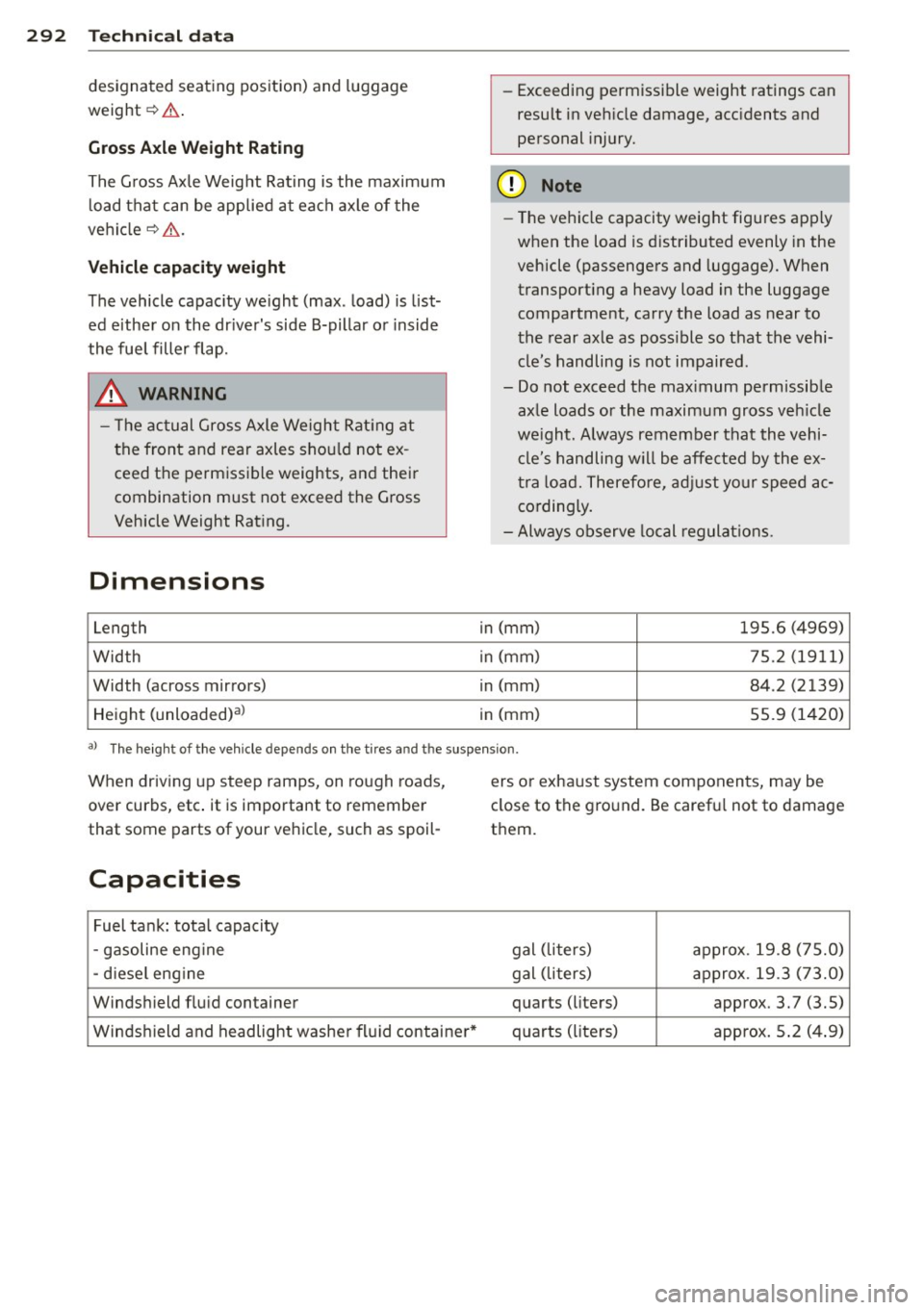
Dimensions
Length
Width
Width (across mirrors) Height (unloaded)al
-
-Exceeding permissible weight ratings can
result in vehicle damage, accidents and
personal injury.
(D Note
- The vehicle capacity weight figures apply
when the load is distributed evenly in the
vehicle (passengers and luggage). When
transport ing a heavy load in the luggage
compartment, carry the load as near to
the rear axle as poss ible so that the vehi
cle's handling is not impaired.
- Do not exceed the maximum permissible axle loads or the maximum gross veh icle
we ight. Always remember that the vehi
cle's handling w il l be affected by the ex
tra load. Therefo re, adj ust your speed ac
cordingly.
- Always observe local regulat ions.
in (mm)
195.6 (4969)
i n (mm) 75.2 (1911)
in (mm)
84.2 (2139)
in (mm) 55.9 (1420)
al The he ight of the veh icle depen ds on the t ires and the suspension.
When driving up steep ramps, on rough roads,
over curbs, etc . it is important to remember
that some parts of your vehicle, such as spoil-
Capacities
Fuel tank: total capacity
-gasoline engine
- d iesel engine
Windsh ield fluid container
Windsh ield and headlight washer fluid containeir* ers
or exhaust system components, may be
close to the ground . Be carefu l not to damage
them.
gal ( liters)
approx. 19.8 (75.0)
gal ( liters) approx. 19.3 (73.0)
quarts (liters) approx. 3.7 (3.5)
quarts (liters) approx. 5.2 (4 .9)
Page 295 of 316

M N <( (.J
'SI: ,...., \!) ..,.,
,...., ..,., ,....,
Gasoline engines
A7 3.0, 6 cylinder
Maximum output SAE net
Maximum torque SAE net
Displacement
Engine oil with filter change
Fuel
57 4.0, 8 cylinder
Maximum output SAE net
Maximum torque SAE net
Displacement
Engine oil with filter change
Fuel
Diesel engine
A7 3.0 TOI, 6 cylinder
Maximum output SAE net
Maximum torque SAE net
Displacement
Engine oil with filter change
Fuel
Techn ical data 293
•
•
hp@rpm 310@ 5500 -6500
l b-ft@ rpm 325@ 2900 - 4500
CID (cm
3 ) 182 (2995)
quarts (liters) 7.2 (6.8)
Premium unleaded (91 AKI), c> page 217, Gasoline
hp@rpm 420 @ 5500 - 6400
l b-ft@ rpm 406 @ 1400 -5200
CID (cm
3 ) 243.7 (3993)
quarts (liters) 8.8 (8.3)
Premium unleaded (91 AKI), i=>page 217, Gasoline
hp@ rpm 240@ 3500 - 3750
lb-ft@ rpm 428@ 1750 -2250
CID (cm
3
) 181 (2967)
quarts (liters) 6.8 (6.4)
ULSD No. 2, c> page 218, Diesel fuel
Page 296 of 316

294 Consumer Information
Consumer Information
Warranty coverages
You r Audi is covered by the following war
ranties:
- New Vehicle Limited Warranty
- Limited Warranty Against Corrosion Perfo-
ration
- Emissions Control System Warranty
- Emissions Performance Warranty
- California Emissions Control Warranty (USA
vehicles only)
- California Emissions Performance Warranty
(USA vehicles only)
Detailed information regarding your warran
ties can be found in your
Warranty & Mainte
nance booklet .
Operating your vehicle
outside the U.S.A. or
Canada
Government regu lations in the United States
and Canada require that automobiles meet
specific emission regulations and safety
standards. Therefore, veh icles built for the
U.S.A . and Canada differ from vehicles sold in
other countries .
If you p lan to take your vehicle outside the
continental limits of the United States or Can
ada, there is the possibility that:
- unleaded fuels for vehicles with cata lytic
converter may not be available;
- fuel may have a considerably lowe r octane
rating. Improper fuel may cause engine
damage ;
- service may be inadequate due to lack of
proper service facilities, tools or testing
equipment ;
- replacement pa rts may not be readily availa
ble.
- Navigation systems for vehicles built for the
U.S.A. and Canada will not necessar ily work
in Europe, and may not work in other coun
tries outside North America .
(D Note
Audi cannot be responsible for mechanical
damage that could result from inadequate
fuel, service or parts availability.
Audi Service Repair Manuals and Literature
Audi Official Factory Service Manuals and Lit
erature are published as soon as possible after
model introduction. Service manuals and lit
erature are available to order from the Audi
T echnical Literature Ordering Center at:
www.audi.techliterature.com
Maintenance
General
Your vehicle has been designed to help keep
maintenance requirements to a minimum.
However, a certain amount of regular mainte
nance is still necessary to assure your vehicle's
s afety, economy and rel iability. For detailed
vehicle maintenance consult your Warranty &
Maintenance booklet.
Under difficult operating conditions, for ex
ample at extremely low outside temperatures,
i n very dusty regions , when towing a trailer
very frequently, etc., some service work
should be performed between the intervals
specified. This applies particularly to:
- oil changes, and
- cleaning or replacing the air filter .
(® For the sake of the environment
By regularly maintaining your vehicle, you
help make sure that emission standards
are maintained, thus minimizing adverse
effects on the environment.
Important considerations for you and
your vehicle
The increasing use of electronics, sophisticat
ed fuel injection and emission contro l sys-
tems, and the genera lly increasing technical
liJJ,