service AUDI S7 2015 Owner's Manual
[x] Cancel search | Manufacturer: AUDI, Model Year: 2015, Model line: S7, Model: AUDI S7 2015Pages: 316, PDF Size: 78.09 MB
Page 209 of 316
You must drive your vehicle about 3,000 miles (5,000 ki lometers) before you can properly
assess o il consumption.
This also applies to fuel consumption and en
gine output.
(D Note
- Have yo ur vehicle maintained properly
and in accordance with the service rec
ommendations in your Warranty
& Main
tenance booklet. Lack of proper mainte
nance as well as improper use of the ve
hicle will impair the funct ion of the
emission control system and could lead
to damage .
- Do not alter or remove any component of
the Em ission Control System unless ap
proved by the manufacturer.
- Do not alter or remove any dev ice, such
as heat shields, switches, ignition wires,
valves, wh ich are designed to protect
your vehicle's Emission Control System
and other important veh icle compo
nents.
Fewer short trips
Fuel consumption will always be relatively
high on short trips .
.,. Try to avo id driving short distances with a
cold engine .
The engine and catalyt ic converter have to
reach their optimal
operating temperature to
reduce fuel consumption and noxious emis
sions effect ively.
Just after starting, a cold engine in a mid-size
car only achieves a fuel economy of 6 -8 miles
per gallon (30-40 l/100 km). After about a
half a mile, fuel economy climbs to 12 mpg
(20 l/100 km). Afte r abo ut
2.5 m iles (4 km),
the eng ine is at its proper operating tempera
ture and fue l economy has reached a normal
M leve l. So you can see that you should avoid N
j short trips whenever possible.
'SI: ,...., \!) 1.1'1 ,...., 1.1'1 ,....,
Driving and environment 207
The outside temperature is also critical in this
regard . Your car consumes more fue l in the
winter than in the summer.
•
•
Page 220 of 316
218 Fuel supply and filling your fuel tank
-Blend must contain not more than 15%
MTBE.
Seasonally adjusted gasoline
Many gasoline grades are blended to perform
espec ially we ll for winter or summer driv ing.
During seasonal change-over, we suggest that
you fill up at busy gas stat ions where the sea
sonal adjustment is more likely to be made in
time.
(CT) Note
- Methanol fuels which do not meet these
requirements may cause corrosion and
damage to plastic and rubber compo
nents in the fuel system .
- Do not use fuels that fai l to meet the
specified criteria in this chapter.
- If yo u are unable to determine whether
or not a particular fuel blend meets the
specifications, ask your service station or
its fuel sup plier.
- Do not use fuel for which the contents cannot be identified.
- Fuel system damage and performance
problems resulting from the use of fuels
different from those specified are not
the respons ibility of Audi and are not
covered under the New Vehicle or the Emission Control System Warranties.
- If you experience a loss of fuel economy
or driveability and performance prob l ems due to the use of one of these fuel
blends, we recommend that you switch
to unblended fuel.
Gasoline additives
A major concern among many auto manufac
turers is carbon deposit build- up caused by
the type of gasoline you use.
A lthough gasoline grades differ from one
manufacturer to another, they have certain
things in common. All gasoline g rades contain
substances that can cause deposits to co llect
on vital engine parts, such as fuel injectors
and intake valves. Although most gasoline
brands include additives to keep engine and fuel
systems clean, they a re not equally effec
tive .
A udi recommends using TOP TIER Detergent
Gasoline. For more information on TOP TIER
Detergent Gasoline, please go to the official
website (www.toptiergas.com).
After an extended period of using inadequate
f uels, carbon deposit build-ups can rob yo ur
engine of peak performance.
CD Note
Damage or malf u nct ion due to poor fuel
quality is not covered by the Aud i New Ve
hicle Limited Warranty.
Diesel fuel
Applies to veh icles: w ith diesel engine
Always use ULSD (Ultra Low Su lfu r Diesel)
No. 2. The U LSD No. 2 meets the ASTM D975.
Diesel fuel with concentrations of biodiese l
higher than 5 % s uch as Bl 1, B2O or BlOO are
strictly prohib ited.
Serv ice stat ion fuel pumps are labeled with
the correct fuel information for easy recogn i
t io n by the user. If the diesel fuel pump is not
labeled ask the station operator what fue l is
being dispensed before filling up your vehicle.
ULSD No. 2 may not be available outside the
USA and Canada. Be sure to check before trav
eling to other countries.
ULSD No. 2 can become thicker in very cold
temperatu res, and this can impair the en
gine's start ing and running. Depending on the
season, gas stat ions provide ULSD No. 2 that
flows better in cold temperatures so that you
can continue operating your vehicle as usua l.
CD Note
-Yo ur vehicle's diesel engine was de
signed soley for use with ULSD No. 2.
Therefore, never use gasoline, heating
oil, other fuels or flow improvers. These
conta in substances that will severely
damage the fuel system and the engine.
II>
Page 221 of 316
M N <( I.J "". rl I.O
"' rl
"' rl
Such damage will not be covered by your
New Vehicle Limited Warranty .
- If you p ut any amount of incorrect fue l in
t h e fue l tank, do not start the engine un
der any circumstances. Immediately con
tact the nearest author ized Audi dealer
or authorized Audi Service Facility for as
s istance. These fuels contain substances
that can severely damage the fuel sys
tem and the engin e if the engine is start
ed.
Fuel tank
Fuel filler neck
The fuel filler neck is located on the r ight rear
side panel behind the fuel f iller flap.
If the power loc king system should fail, you
can st ill open the flap manually -for detai led
instructions see ¢
page 221.
You can find the fue l tank capacity o f you r ve
hicle in
¢ page 292.
The label on the inside of the fuel filler flap
tells you the cor rec t f uel for yo ur vehicle . For
more in formation about fuel specificat ions,
see
¢ page 217 .
Your veh icle fuel tank has an on board refue l
ling vapor recove ry system . T his feature he lps
to p revent fuel vapo rs from escaping from the
tank and polluting the environment whi le you
refuel your ve hicle. In order to fill the tank
properly whi le protect ing the e nv ironment,
p lease follow t his refueling procedure careful
ly .
& WARNING
Under no rma l operating condi tions, neve r
car ry add itiona l fuel containe rs in your car.
G as can iste rs a nd other c ontaine rs used to
t ran sport fue l can be dange rous. Such con
t ainers, full or empty, may lea k and co uld
cause a fi re in a co llision . If you must
transport fue l to use for yo ur lawn mower,
snow blower, etc., be very ca refu l and al
ways observe local and state laws regard
ing the use, transportat io n and storage of
Fu el suppl y and filli ng your fuel t ank 219
such fuel containe rs . M ake certa in the con
tainer meets industry standa rds (ANSI/
ASTM F852 -86).
(D Note
Neve r drive your vehicle until the fuel tank
i s completely empty. T he irreg ular s upply
of fue l can ca use m isfir ing. Gasoline cou ld
enter t he exhaust system and damage the
catalytic converter .
Refuelling
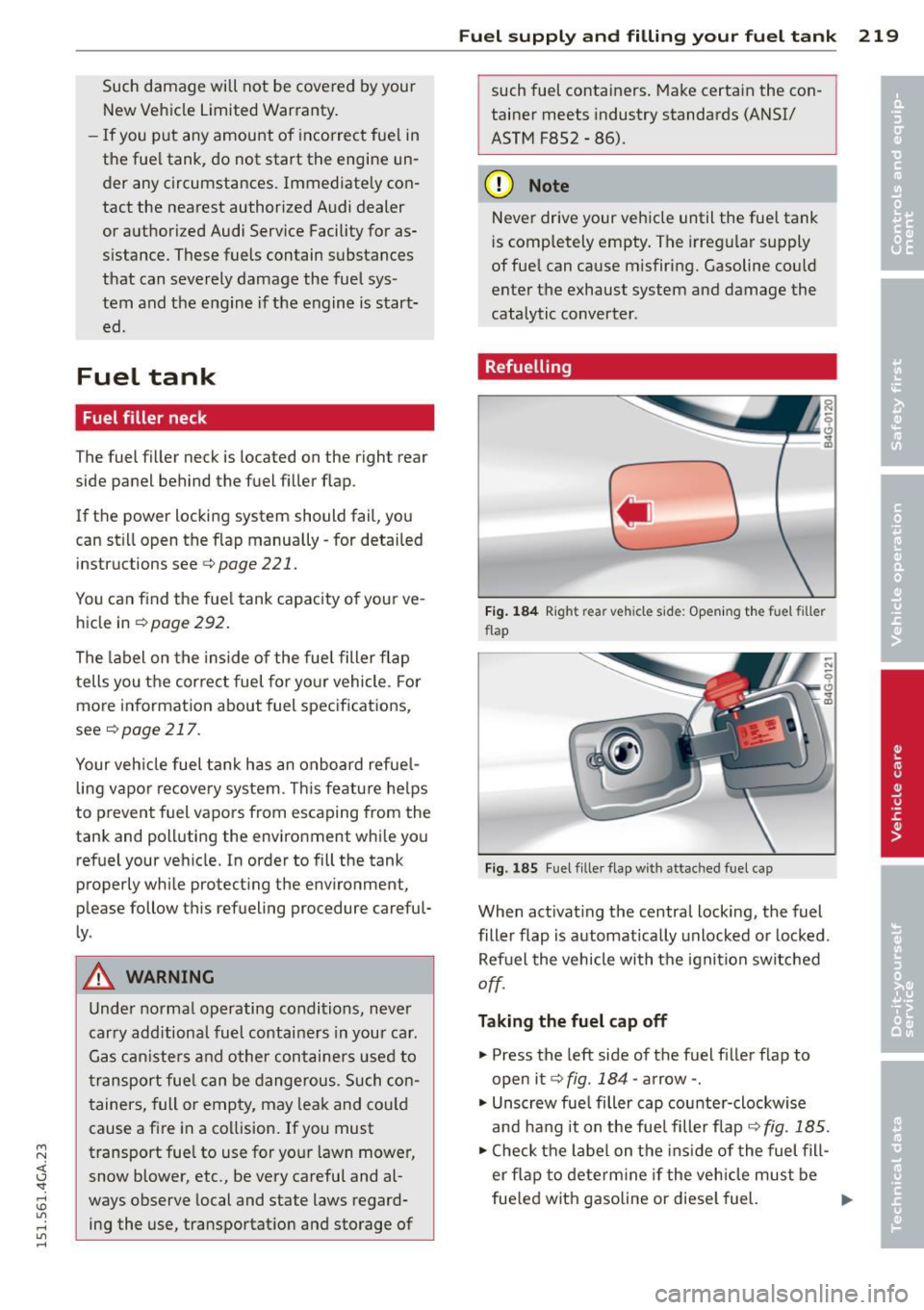
Fig. 1 84 R ig ht rea r ve hicle s ide : Open ing t he fuel filler
flap
F ig . 185 Fu el f ille r fla p with attac hed fuel cap
When act ivat ing the centra l locking, the fuel
filler flap is a utomatically unlocked o r locked .
Ref uel the vehicle wi th t he ignition switched
off.
Taking the fuel cap off
.,. Press the left side of the fuel f iller flap to
open it ¢
fig. 184 -arrow -.
.,. Unsc rew fue l filler cap counte r-clockw ise
and ha ng it on the fue l filler flap ¢
fig. 185.
.,. Check t he label on t he ins ide of the f uel fill
er f lap t o dete rm ine if the veh icle mus t be
fue led with gasoline or diese l fuel. ..,.
Page 229 of 316
M N <( I.J "". rl I.O
"' rl
"' rl
Checking and fillin g 22 7
Engine compartment
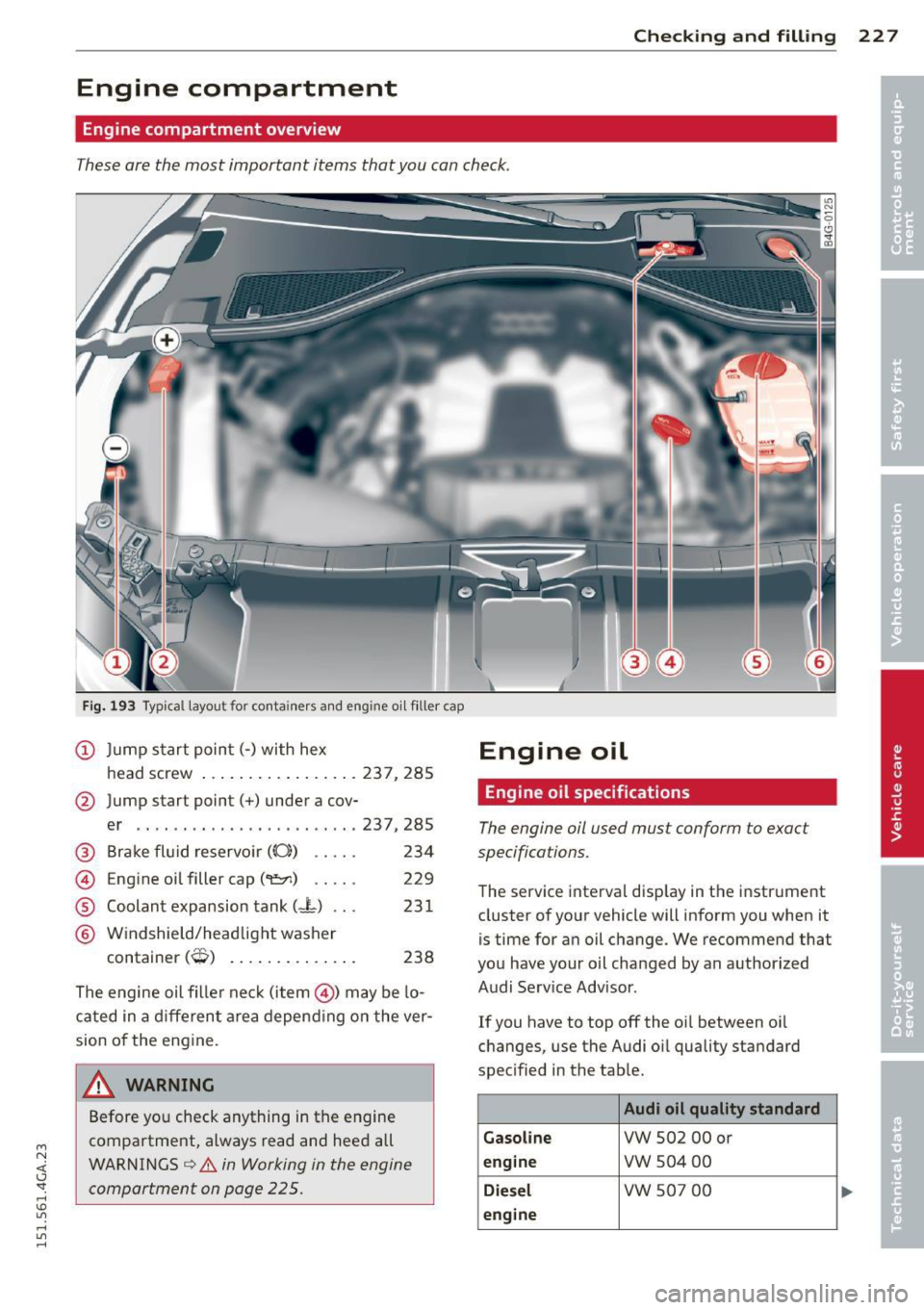
Engine compartment overview
These are the most important items that you can check.
Fig. 193 Typical l ayout for conta iners and engine o il filler cap
@ Jump start poin t(-) with hex
head screw .. .. ..... ... .. .. . 237, 285
@ Jump start point(+) under a cov-
er .. .. ... ..... ...... ...... 237,285
@ Brake fl uid reservo ir ((0)) .... .
© Engine oil filler cap ("1:::r.) .... .
® Coolant expansion tank (-L) .. .
© Windshield/headlight washer
t .
(;;:;) con ainer ,..,, .. .... .. .. . .. . 234
229
23 1
238
The engine oil fille r neck (item @) may be lo
cated in a d ifferent a rea depend ing o n the
ver
sion of the eng ine.
WARNING
Before you check anything in the engine
compartment, always read and heed all
WARNINGS
c::> &. in Working in the engine
compartment on page 225.
Engine oil
Engine oil specifications
The engine oil used must conform to exact
specifications.
T he service interva l d isp lay in the instrument
cluster of yo ur vehicle will inform you when it
is time for an oil change. We recommend that
you have your oil changed by an authorized
Audi Serv ice Advisor .
If you have to top off the oi l between oi l
changes, use the Audi o il quality standard
spec ified in the table.
Audi oil quality standard
Gasoline
VW 502 00 or
engine vw 504 00
Diesel vw 507 00
eng ine
Page 230 of 316
228 Check ing and filling
Using the proper engine o il is important for
the functionality and service life of the en
g ine. Your engine was factory-filled with a
h igh-quality oil which can usua lly be used
throughout the entire year.
0 Note
Your L imited New Vehicle Warranty does
not cover damage or ma lfunctions due to
fai lure to follow recommended mainte
nance and use requ irements as set forth in
the Audi Owner's Manual and Warranty
&
Ma intenance booklet.
- Use only a high quality eng ine oil that ex
pressly complies w ith the Audi o il quality
standard spec ified for your veh icle's en
gine. Using any other oil can cause seri
ous eng ine damage.
- Do not mix any lubricants o r othe r addi
tives into the eng ine o il. Doing so can
ca use engine damage.
If you need to add oi l and there is no ne
availab le tha t mee ts the Audi oil qua lity
s tandard your engine requires, yo u may
add a tota l of no more than 0 .5 quart/liter
of a high-quality "synthetic"oil that meets
the following specifications.
- Vehicles with gaso line engine: ACEA A3
or API SM with a viscosity grade of
SAE 0W-30, SAE SW-30 or SAE SW-40.
- Vehicles with diesel engine: ACEA C3 or
API CF with a v iscosity grade of
SAE 0W-30 or SAE SW-30.
- For more information abo ut eng ine oil
that has been approved for your vehicle, please contact either your a uthorized
Audi dealer or Audi Customer Relations
at 1 (800) 822-2834 or visit our web site
at www.audiusa .com or
www.aud icanada.ca.
Engine oil consumption
The engine in your vehicle depends on on ade
quate amount of oil to lubricate and cool all
of its moving ports .
In order to provide effective lubricat ion and
cooling of interna l eng ine components, all in
ternal combust ion e ngines consume a certain
amount of oil. Oil consumpt ion va ries from
engi ne to engine and may change sig nifican tly
over the life of the engine. Typically, engines
with a spec ified break -in period (see
c> page 203) consume more oil during the
break-in period than they cons ume after oi l
consumption has stabilized.
U nder normal cond itions, the rate o f oi l con
s u mption depends on the q uality and viscos ity
of the oil, the RPM (revolutions per minute) at
which the engine is operated, the ambient
temperature and road conditions. Further fac
tors are the amount of oil dilut ion from water
condensation or fue l residue a nd the oxida
t ion level of the oil. As any eng ine is subject to
wea r as m ileage builds up, t he oil co nsump
t ion may increase over time until replacemen t
of worn components may be come necessary.
With a ll these variab les coming into play, no
standard rate of oil consumpt io n can be es
tabl ished o r spe cified . There i s no alte rnative
to regu lar and frequent che ck ing of the o il lev
el , see
Note.
If the yellow engine oil leve l wa rning symbo l
i n t he i nstr ument cluster
Ill lights up, you
sho uld check the oil leve l as soon as possib le
i=> page 229 . Top off the oil at your earliest
convenience
i=> page 229.
A WARNING
--
Before you check anything in the engine
compartment, always read and heed a ll
WARNINGS
c> & in Working in the engine
comportment on page 225.
(D Note
Driving with an insufficient o il level is like-
l y to cause severe damage to the engine. .,.
Page 232 of 316
230 Check ing and filling
- If your skin has come in contact with the
engine oil, you must subsequently
cleanse it thoroughly.
- Check the oil leve l using the MMI. If the
message
Ple ase red uce oil le vel appears,
contact your author ized Audi dealer or
other qualified workshop to have excess
oil extracted if necessary .
-Audi does not recommend t he use o f oil
add it ive s. They ma y damage the e ngine
and adve rsely aff ect your New Vehicl e
Warranty.
@ For the sake of the environment
- Under no circumstances can the oil come
in contact with the sewage network or
the soil.
- Observe and follow lega l regu lations
when disposing of empty oil containers.
Changing the engine oil
We recommend tha t have your oil changed by
an authorized Audi dealer or a qualified serv
ice station .
Before you check anything in the engine com
partment,
alway s read and heed all WARN
INGS
~ .& in Working in the engine compart
ment on page 225 .
The engine oil must be changed according to
the intervals specified in your Warranty
&
Maintenance booklet . This is very important
because the lubricating properties of oil di
minish gradua lly dur ing no rmal veh icle use .
Under some circumstances the engine o il
should be changed more frequently . Change
oil more often if you drive most ly short dis
tances , ope rate the vehicle in dusty areas or
under predominantly stop-and-go traffic con
d itions, or have your veh icle where tempera
tures remain below freezing fo r ex tended pe
riods .
Detergent addit ives in the o il w ill ma ke fresh
oil look dark after the eng ine has been run- ning for a sho
rt time. This is normal and is not
a reason to change the oil more often than
recommended.
Because of the problem of proper disposal,
along with the specia l tools and necessary ex
pertise req uired, we strongly recommend that
you have your oil changed by an a uthorized
Aud i deale r or a qualified service station.
If yo u choo se to chan ge your oil yours elf ,
please note the fo llowing important informa
t ion:
A WARNING
=
To reduce the risk of personal injury if you
must change the eng ine oil in your vehicle
yourself:
- Wear eye protect ion.
- To reduce the risk of burns from hot en-
g ine oil, let the engine cool down to the
touch.
- When removing the oil dra in p lug with
your fingers, stay as far away as possible.
Always keep your forearm parallel to the
ground to help prevent hot oil from runn ing down you r arm.
- Dra in the oil into a container designed
for this purpose, one large enough to hold at least the tota l amount of o il in
your engine .
- Engine oil is poisonous . Keep it wel l out
of the reach of children.
- Continuous contact with used eng ine o il
is harmful to your sk in . Always protect
your skin by washing oil off tho roughly
wit h soap and wate r.
(D Note
Neve r mix oil additives with you r engine
oi l. These additives can damage your en
gine and adversely affect your Audi Limit
e d New Veh icle War ranty.
@ For the sake of the environment
- Before changi ng your oil, first make su re
you know where you can prope rly dispose
o f the used oil. ..,.
Page 233 of 316
M N
"' rl
-Always dispose of used engine oil proper
ly. Do not dump it on garden soil, wood
ed areas, into open streams or down
sewage drains.
- Recycle used engine oil by taking it to a
used engine oil collection facility in your
area, or contact a service station.
Engine cooling system
Coolant
The engine coolant performs two functions: it
keeps the engine from overheating and it pro
tects the engine from freezing in the winter.
The cooling system is sealed and generally re
quires little attention .
The cooling system has been filled at the fac
tory with a permanent coolant which does not
need to be changed . The coolant consists of a
mixture of specially conditioned water and the
manufacturer 's glycol-based coolant addi-
tive G13 antifreeze with anticorrosion addi
tives (50% for USA models; 60% for Canadian
models) . This mixture both assures the neces
sary frost protection and protects metal com
ponents in the engine's cooling system from
corrosion and scaling.
It also raises the boil
ing point of the coolant.
Do not reduce the concentration of the cool
ant in the summer by adding plain water.
The
proportion of coolant additive must be at
least 50% but not more than 60%
to main
tain antifreeze protection and cooling efficien
cy .
If the coolant frost protection is too low,
the coolant could freeze and damage the vehi
cle heating and engine cooling system.
For year -round driving, antifreeze is added at
the factory for temperatures down to:
- -31°F(-35°C)USA
- -40 °F ( - 40 °C) Canada.
If you must add coolant, use a mixture of wa
ter and coolant additive. Mixing the coolant
additive with distill ed water is recommended .
Checking and filling 231
A WARNING
Before you check anything in the engine
compartment, always read and heed all
WARNINGS ~&.
in Working in the engine
compartment on page 225.
(D Note
- Before winter sets in, have the coolant
checked to see if the coolant additive in
your vehicle is sufficient to meet the cli
mate conditions. This is especially impor
tant if you live in a region where the win
ter is extremely cold. If necessary, in
crease the proportion of coolant additive
to 60%.
- When adding coolant additive to your
cooling system, remember:
- We recommend using only coolant ad
ditive G12++ or G13 (check the label)
for your vehicle. This coolant additive is
available at authorized Audi dealers.
Other types of antifreeze can signifi
cantly reduce corrosion protection. The
resulting corrosion can cause a loss of
coolant and serious engine damage.
- Do not add any type of radiator leak seal
ant to your vehicle's engine coolant.
Adding radiator repair fluid may adverse
ly affect the function and performance of
your cooling system and could result in
damage not covered by your New Vehicle Limited Warranty.
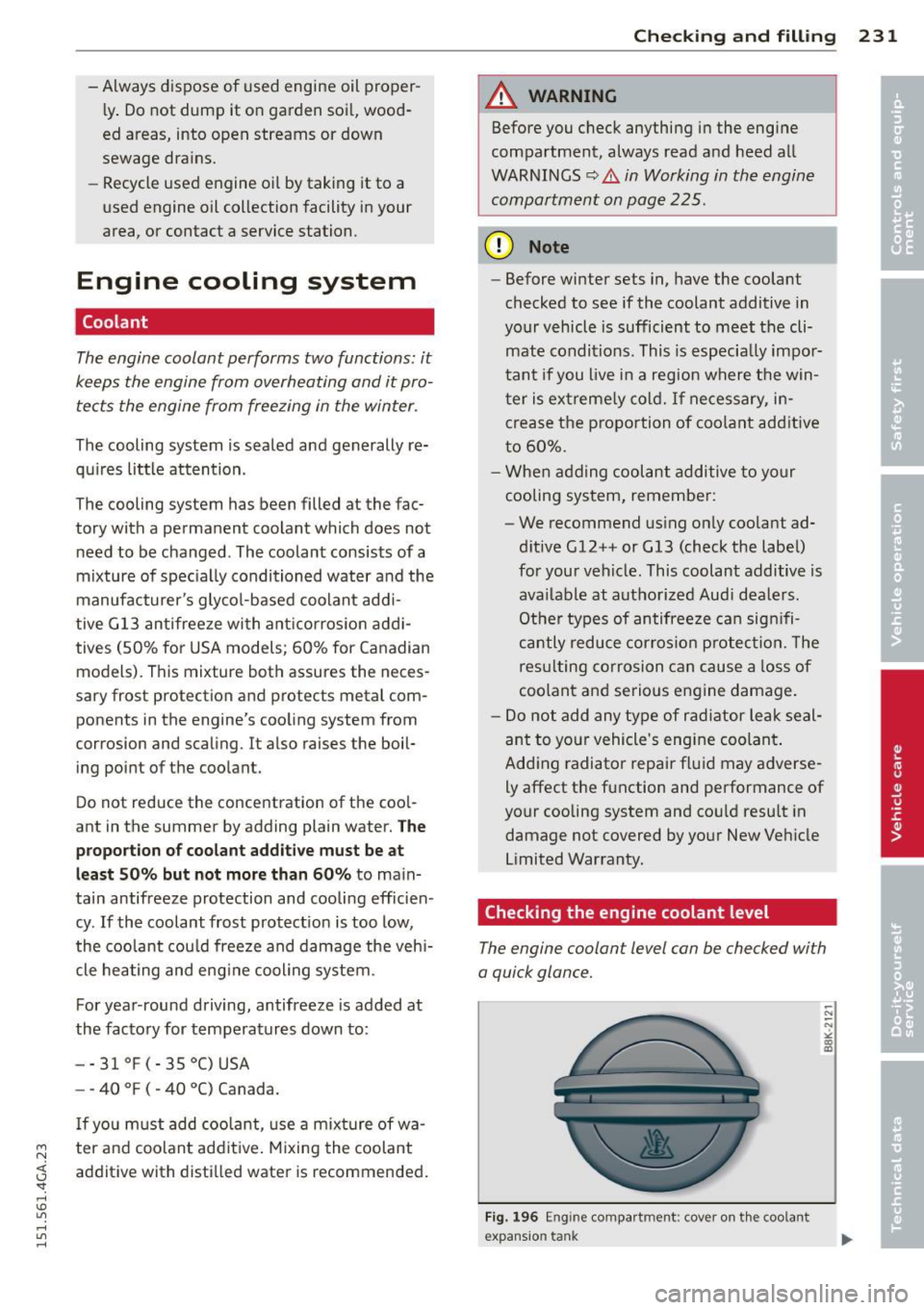
Checking the engine coolant level
The engine coolant level can be checked with
a quick glance.
Fig. 196 Engine compa rtment: cove r on t he coola nt
expansion tank
Page 237 of 316
M N <( (.J
'SI: ,...., \!) 1.1'1 ,...., 1.1'1 ,....,
@ For the sake of the environment
Because of the pr oblem of proper d isposa l
of brake flu id as we ll as the special tools
requ ired and the necessary expert ise, we
recommend that you have the brake fluid
changed by your author ized Audi dealer .
Battery
General information
Under normal operating conditions, the bat
tery in your Audi does not need any mainte
nance. With
high outside temperatures or
long daily dr ives we recommend that you have
the electro lyte level checked by a service fa
cility . The electrolyte level shou ld also be
checked each time the battery is charged
¢ page 237.
Have the battery checked when you take your
ve hicle in for service . You are well adv ised to
replace a battery that is older than 5 yea rs .
W ith certa in types of a irbag deployment, t he
b attery is d isconnected from the vehicle elec
tr ica l system for safety reasons¢.&.
in Re
pair, core and disposal of the airbags on
page 163.
Disconnecting the battery terminals
Some vehicle functions (power w indow regu
lators , for example) are lost if the battery ter
m inals a re d isconnected. These func tions have
to be re lea rned after the batte ry term inals a re
connected agai n. T o prevent this , the bat tery
should only be d isconnec ted from the vehicle
e lec tric al system when absolu tely necessa ry
for repairs .
Vehicles not driven for long periods
If you do not drive you r vehicle over a period
of severa l days or weeks, elec trical compo
nen ts are gr adually cut b ack o r swi tched off .
This redu ces energy cons umption and main
tains starting capab ility over a longer per io d
¢ page 201. Some of the co nvenience func
tions may not operate, s uch as the inte rior
lights or power seat adjustme nt. The conven-
Checkin g and fillin g 235
ience funct ions w ill be available again when
yo u sw itch on the ign ition and start the en
gine.
Winter operation
D ur ing the w inte r mon ths, bat tery ca pa city
tends to decrease as tempera tures drop . This
is beca use more power is a lso consumed wh ile
starting, and the headlights, rear window de
fogger, etc., are used mo re often.
Avoid unnecess ary powe r consumpt ion, pa r
ticu lar ly in city traffic o r when traveling only
sho rt distances. Let yo ur authorized A udi
dealer check the capacity of the vehicle bat
tery before w inter sets in¢
page 23 7. A well
charged battery will no t on ly prevent star tin g
problems w hen the weather is cold, but w ill
also last longer .
@ Tips
If your vehicle is left standing for seve ral
weeks at extremely low temperatures, the
vehicle battery s hou ld be removed and
stored where it will not freez e. This will
p reve nt it from be ing dam aged and having
to be repl aced .
Working on the battery
Be especially careful when working on or near
the bat tery.
The battery is located in the luggage compar t
ment under the floor . B efo re you che ck any
thi ng in the luggage compartment,
read and
heed all WARNINGS
¢ .&, .
Always heed the safety warnings , when work
i ng on the veh icle batte ry or t he vehicle e lec
t rical sys tem to p reven t inju ry.
The following WARNINGS are very
important when working on the battery:
Always heed the following WARNING SYM· BO LS and safety precautions when working
on the battery .
®
Always wear eye protection.
•
•
Page 257 of 316
M N <( (.J
'SI: ,...., \!) 1.1'1 ,...., 1.1'1 ,....,
tire failure and loss of
control.
-Excessive speed and/over loading can cause heat
build -up, sudden tire failure
and loss of control.
-If the tire pressure is too low or too high, the tires
will wear prematurely and
the vehicle will not handle
well.
-If the tire is not flat and you do not have to change a
wheel immediately, drive at
reduced speed to the near
est service station to check
the tire pressure and add air as required.
(D Note
Driving without valve stem
caps can cause damage to
the tire valves. To prevent
this, always make sure that
factory installed valve stem caps on all wheels are secure
ly mounted on the valve.
@ For the sake of the environment
Underinflated tires will also
increase the fuel consump
tion.
Tires and wheels 255
Tires and vehicle load limits
'
There are limits to the amount of load or weight that any vehi
cle and any tire can carry. Ave
hicle that is overloaded will not
handle well and is more diffi
cult to stop. Overloading can
not only lead to loss of vehicle
control, but can also damage important parts of the vehicle
and can lead to sudden tire fail
ure, including a blowout and
sudden deflation that can cause
the vehicle to crash.
Your safety and that of your passengers also depends on
making sure that load limits are
not exceeded. Vehicle load in
cludes everybody and every
thing in and on the vehicle .
These load limits are technical ly referred to as the vehicle's
Gross Vehicle Weight Rating
("GVWR").
The "GVWR" includes the
weight of the basic vehicle, all
factory installed accessories, a
full tank of fuel, oil, coolant and other fluids plus maximum ""
•
•
'
Page 260 of 316

258 Tires and wheels
being loaded on the vehicle.
That weight may not safely
exceed the available cargo
and luggage load capacity
calculated in Step 4.
6. If your vehicle will be towing
a trailer, load from your trail
er will be transferred to your
vehicle. Consult this manual
to determine how this re duces the available cargo
and luggage load capacity of
your vehicle.
.,.Check the tire sidewall
(¢ page 260, fig. 204) to de
termine the designated load
rating for a specific tire.
Tire service life
The service life of tires depends
on a lot of different things in
cluding proper installation and
balancing, correct tire pressure
and driving style.
Fig. 202 Tire tread: tread wear indi
cators (TWI)
Fig. 203 Rotating tires for more even
wear
Tread Wear Indicator (TWI)
The original tires on your vehi
cle have
1/16 inch (1.6 mm)
high "wear indicators"
¢ fig. 202 running across the
tread. Depending on the make,
there will be six to eight of
them evenly placed around the
tire. Marks on the tire sidewall (for example "TWI" or other
symbols) indicate the positions
of the tread wear indicators.
Worn tires must be replaced. Different figures may apply in
other countries
¢ .&. .
Tire pressure
Incorrect tire pressure causes
premature wear and can cause
sudden tire blow-out. For this
reason, tire press ure must be
checked at least once a month
¢page 252.