wheel AUDI S7 2015 Repair Manual
[x] Cancel search | Manufacturer: AUDI, Model Year: 2015, Model line: S7, Model: AUDI S7 2015Pages: 316, PDF Size: 78.09 MB
Page 243 of 316

Tires and wheels 241
and make of tire and the tread -New tires tend to be slip-•
pattern.
pery and must be broken in. • '
Hidden damage To reduce the risk of losing
Damage to tires and rims is of -control, a collision and seri-
ous personal injuries, drive
ten not readily visible. If you with special care for the
notice unusual vibration or the first 350 miles (560 km).
vehicle pulls to one side, this
-Driving with worn or dam-
may indicate that one of the
aged tires can lead to loss of
tires has been damaged . The
control, sudden tire failure,
tires must be checked immedi-
ately by an authorized Audi including a blowout and
sudden deflation, crashes
dealer or qualified workshop.
and serious personal inju-
Unidirectional tires ries. Have worn or damaged
A unidirectional tire can be tires replaced immediately.
identified by arrows on the -Tires age even if they are
sidewall, that point in the di rec- not being used and can fail
tion the tire is designed to ro- suddenly, especially at high
tate. You must follow the speci- speeds. Tires that are more
fied direction of rotation. This is than 6 years old can only be
necessary so that these tires used in an emergency and
can develop their optimum then with special care and
characteristics regarding grip, at low speed.
road noise, wear and hydro- -Never mount used tires on
planing resistance. For more in- your vehicle if you are not
formation
¢ page 280. sure of their "previous histo-
ry." Old used tires may have
A WARNING
been damaged even though -
New tires or tires that are the damage cannot be seen
old, worn or damaged cannot that can lead to sudden tire
provide maximum control failure and loss of vehicle
M N and braking ability. <(
control. (.J
'SI: ,...., \!) 1.1'1 ,...., 1.1'1 ,....,
Page 244 of 316

242 Tires and wheels
-If you notice unusual vibra
tion or if the vehicle pulls to
one side when driving, al
ways stop as soon as it is
safe to do so and check the
wheels and tires for dam
age.
0 Note
-Please note that summer and winter tires are de
signed for the conditions
that are typical in those sea
sons. Audi recommends us
ing winter tires during the
winter months. Low tem peratures significantly de
crease the elasticity of
summer tires, which affects
traction and braking ability. If summer tires are used
in
very cold temperatures, cracks can form on the tread
bars, resulting in perma
nent tire damage that can
cause loud driving noise and
unbalanced tires. Audi is not
responsible for this type of
damage.
-Burnished, polished or chromed rims must not be used in winter road condi
tions. The surface of the
rims does not have suffi
cient corrosion protection
for this and could be perma
nently damaged by road salt
or similar substances.
Glossary of tire and loading terminology
Accessory weight
means the combined weight (in
excess of those standard items
which may be replaced) of auto matic transmission, power
steering, power brakes, power
windows, power seats, radio, and heater, to the extent that
these items are available as fac
tory-installed equipment (whether installed or not).
Aspect ratio
means the ratio of the height to
the width of the tire in percent.
Numbers of 55 or lower indi
cate a low sidewall for im
proved steering response and
better overall handling on dry
pavement.
...
Page 245 of 316
M N <( (.J
'SI: ,...., \!) 1.1'1 ,...., 1.1'1 ,....,
Bead
means the part of the tire that
is made of steel wires, wrapped
or reinforced by ply cords and
that is shaped to fit the rim .
Bead separation
means a breakdown of the bond
between components in the
bead.
Cord
means the strands forming the
plies in the tire.
Cold tire inflation pressure
means the tire pressure recom
mended by the vehicle manu
facturer for a tire of a designat
ed size that has not been driven
for more than a couple of miles (kilometers) at low speeds in
the three hour period before
the tire pressure is measured or
adjusted.
Curb weight
means the weight of a motor
vehicle with standard equip
ment including the maximum
capacity of fuel, oil, and cool
ant, air conditioning and addi
tional weight of optional equip
ment.
Tires and wheels 243
Extra load tire
means a tire design to operate
at higher loads and at higher inflation pressures than the
corresponding standard tire .
Extra load tires may be identi
fied as "XL", "xl", "EXTRA
LOAD", or "RF" on the sidewall.
Gross Axle Weight Rating ("GAWR")
means the load-carrying capaci
ty of a single axle system,
measured at the tire-ground in
terfaces.
Gross Vehicle Weight Rating ("GVWR")
means the maximum total
loaded weight of the vehicle .
Groove
means the space between two
adjacent tread ribs.
Load rating (code)
means the maximum load that
a tire is rated to carry for a giv
en inflation pressure. You may
not find this information on all
tires because it is not required by law.
•
•
'
Page 247 of 316
Recommended inflation
pressure
see¢ page 243J Cold tire infla
tion pressure.
Reinforced tire
means a tire design to operate
at higher loads and at higher
inflation pressures than the
corresponding standard tire. Reinforced tires may be identi
fied as "XL", "xl", "EXTRA
LOAD", or "RF" on the sidewall.
Rim
means a metal support for a
tire or a tire and tube assembly
upon which the tire beads are
seated.
Rim diameter
means nominal diameter of the
bead seat. If you change your
wheel size, you will have to pur chase new tires to match the
new rim diameter.
Rim size designation
means rim diameter and width.
Rim width
means nominal distance be
~ tween rim flanges.
<( (.J
'SI: ,...., \!) 1.1'1 ,...., 1.1'1 ,....,
Tires and wheels 245
Sidewall
means that portion of a tire be
tween the tread and bead.
Speed rating (letter code)
means the speed at which a tire
is designed to be driven for ex
tended periods of time. The rat ings range from 93 mph (150
km/h) to 186 mph (298 km/h)
¢ page 263. You may not find
this information on all tires be cause it is not required by law.
The speed rating letter code,
where applicable, is molded on
the tire sidewall and indicates
the maximum permissible road speeds ¢
A in Winter tires on
page
267.
Tire pressure monitoring system
means a system that detects
when one or more of a vehicle's tires are underinflated and illu
minates a low tire pressure
warning telltale.
Tread
means that portion of a tire
that comes into contact with
the road.
•
•
'
Page 249 of 316
M N <( I.J "".
Vehicle maximum load on the tire
means that load on an individu
al tire that is determined by
distributing to each axle its
share of the maximum loaded
vehicle weight and dividing by two.
Vehicle normal load on the tire
mean s that load on an individu
al tire that is determined by
Tires and wheels 247
distributing to each axle its
share of the curb weight, acces
sory weight, and normal occu
pant weight (distributed in ac
cordance with table below
¢ page 247) and dividing by
two.
Occupant loading and distribution for vehicle normal load for
various designated seating capacities
Designated seating Vehicle normal load, Occupant distribu-
capacity, number of number of occupants tion in a normally
occupants loaded vehicle
4 2 2 in front
5 3 2 in front, 1 in back
seat
Cold tire inflation pressure
Tire pressure affects the overall handling, performance and safety
of a vehicle.
- Kl'A. . PSI
- KPA. .
PSI
- KPA. . PSI
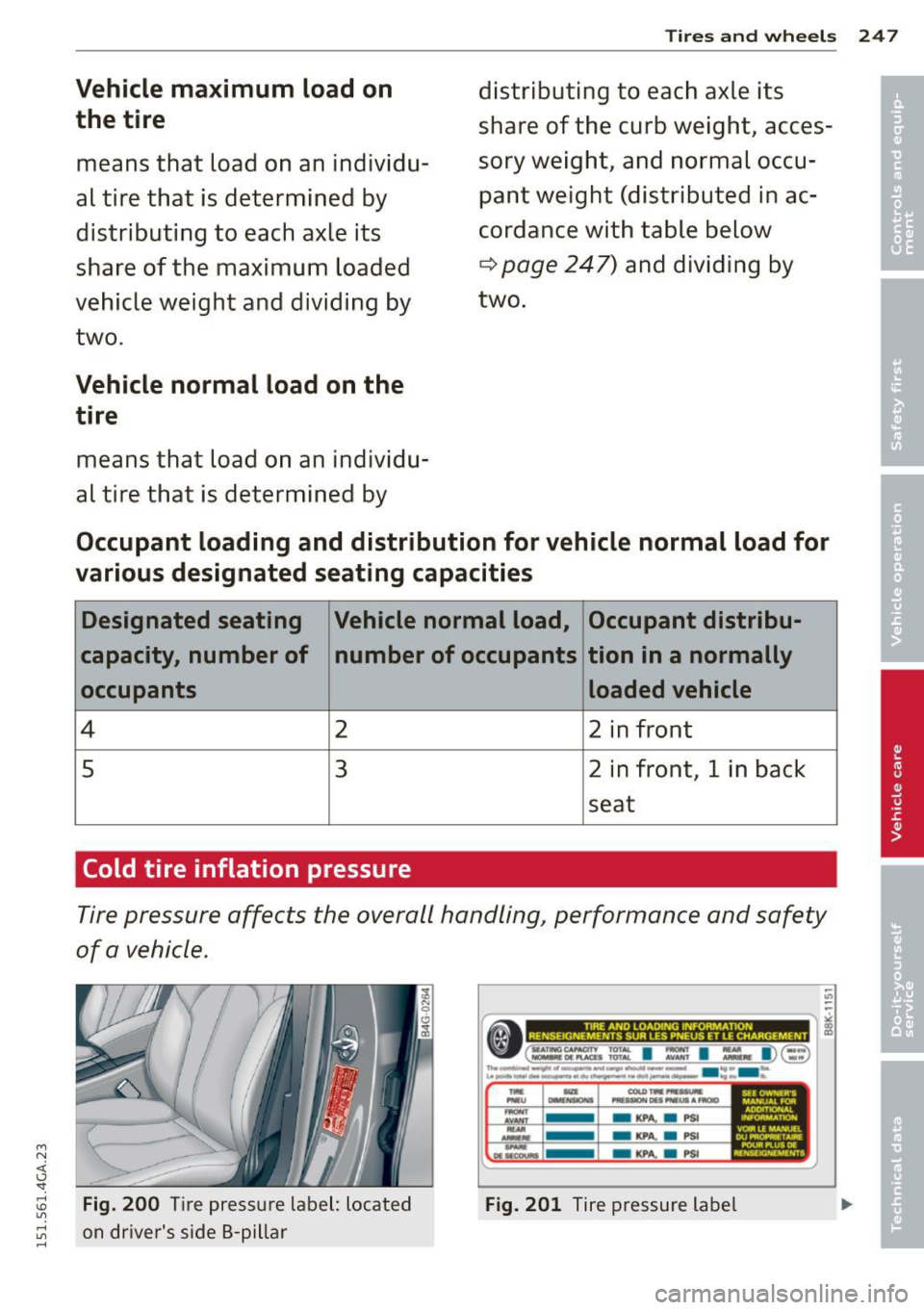
; Fig. 200 Tire pressure label: located Fig. 201 Tire pressure label
.... l/1 .... on driver's side B-pillar
Page 251 of 316
M N <( (.J
'SI: ,...., \!) 1.1'1 ,...., 1.1'1 ,....,
If you wish to improve comfort
when operating the vehicle at normal load (up to 2/3* occu
pants), you can adjust tire
pressures to those specified
for normal vehicle load. Before
operating the vehicle at maxi mum load, you must increase
the tire pressures to those
specified for maximum vehicle load
c> .&. .
Bear in mind that the tire pres
sure monitoring system can on
ly monitor the tire pressures
you have stored. The system does not recognize the load
condition of your vehicle.
The effectiveness of the tire pressure monitoring system
will be impaired if you store normal load pressures but then
operate the vehicle at its maxi
mum load
c> .&. .
Tires and wheels 249
See the illustration c> fig. 200
for the location of the label on
driver's side B-pillar (color of
the actual label and exact loca
tion on the vehicle will vary slightly).
Note that the following table is
accurate at the time of going to
press and is subject to change.
In the event of discrepancies,
the tire pressure label is locat ed on the driver's side B-pillar
always takes precedence.
The table below lists the rec ommended cold tire inflation pressures for the Audi model
covered by your Owner's Litera
ture at the vehicle's capacity
weight and the tire sizes instal
led on the respective models as
original equipment , or as a fac-
tory option. ..,.
•
•
'
Page 252 of 316

250 Tires and wheels
Model/ Tire designation Tire pressure
Engine normal load condition
full load condition
fronta> reara>
front rear
PSI kPA PSI kPA PSI kPA PSI kPA
A7: 235/55 Rl 7 99Y
32 220 29 200 35 240
38 260 3.0 liter High Performance
6-cylinder
255/45 R18 99H
All Season
32 220 29 200 35 240 38 260
255/45 Rl8 99Y 32 220 29 200
35 240
38 260
High Performance
255/40 R19 lOOH XL
35 240 32 220 38 260 280 All Season 41
255/40 Rl9 lOOY
XL
36 250 32 220 38 260 41 280 High Performance
265/35 R20 99H XL
35 240
32 220 38 260 41
280 All Season
265/35 R20 99Y XL
36 250 32 220 38 260 41
280 High Performance
57: 255/40 R19 lOOY XL
39 270
33 230
42 290 42 290 4.0 liter High Performance
a-cylinder 265/35 R20 99Y XL
High Performance
41 280 35 240 44 300 44 300
XL= reinforced or extra load tire. It may also appear as xl, EXTRA LOAD, or RF on the tire side-
wall.
a) normal load
condition¢ page 247.
The correct tire pressure for the
spare wheel is located on a la
bel on the driver's side B-pillar.
Because technical changes may
be made to vehicle equipment
during the model year, always
compare the tire size designa
tion on the tire pressure label
on your vehicle with the tires on
your vehicle. Make sure that the
tire size information on the ve
hicle label is the same as the
size of the tires on the vehicle. This is especially important if
the vehicle belongs to someone
else or you bought the vehicle
with different rims/tires or you bought the vehicle as a previ
ously owned vehicle.
Remember, your safety and
that of your passengers also de
pends on making sure that load
limits are not exceeded. Vehicle
load includes everybody and ev
erything in and on the vehicle.
These load limits are
Page 253 of 316
technically referred to as the
vehicle's Gross Vehicle Weight Rating ("GVWR"). The Gross
Axle Weight Rating ("GAWR") is
the maximum load that can be applied at each of the vehicle's
two axles. The Gross Vehicle
Weight Rating and the Gross
Axle Weight Rating are listed on the safety compliance stick
er label located on the driver's
side B-pillar. The tire pressure
label on your Audi lists the
maximum combined weight of
all of the occupants and lug
gage or other cargo that the ve
hicle can carry. For the location
of the tire pressure label
c> fig . 200.
A WARNING
-
Overloading a vehicle can
cause loss of vehicle control,
a crash or other accident, se rious personal injury, and
even death.
-Carrying more weight than your vehicle was designed to carry will prevent the vehicle from handling properly
and increase the risk of a
~ loss of vehicle control. <(
~ -The brakes on a vehicle that has been overloaded may
Tires and wheels 251
not be able to stop the vehi
cle within a safe distance.
- Tires on a vehicle that has
been overloaded can fail
suddenly causing loss of control and a crash.
-Always make sure that the total load being transported
- including the weight of a
trailer hitch and the tongue
weight of a loaded trailer -
does not make the vehicle
heavier than the vehicle's
Gross Vehicle Weight Rat
ing.
A WARNING
-Incorrect tire pressures
and/or underinflation can
lead to a serious or fatal ac
cident.
-Incorrect tire pressures and/or underinflation cause
increased tire wear and can
affect the handling of the
vehicle.
-Incorrect tire pressures and/or underinflation can
also lead to sudden tire fail
ure, including a blowout
and sudden deflation, caus
ing loss of vehicle control.
•
•
'
Page 254 of 316
252 Tires and wheels
Checking tire pressure
The correct tire pressure for the
tires originally installed on
your vehicle is listed on the tire pressure label located on driv
er's side 8-pillar.
The recommended tire pres
sures are on the tire pressure
label and in the table
c::> page 247, Cold tire inflation
pressure. This means that the
pressure must be checked and
adjusted when the tire has not
been driven for more than a
couple of miles (kilometers) at
low speeds during the previous
three hours. Air in the tires ex
pands when the tire heats up as
a result of internal friction as it
flexes in use . The tire pressure
is higher when the tire has
warmed up than when it is "cold."
It is the inflation pressure in a
"cold" tire that counts. There
fore, you should never let air
out of a warm tire to match
"Cold tire inflation pressure"
recommendations
c:::> page 247 .
The tires would then be under
inflated and could fail sudden
ly. The tire
pressure label on your
Audi lists the recommended
cold tire inflation pressures at maximum capacity for the new,
original equipment tires that
were on your vehicle at the time
it was manufactured. For the
location of the label
c::> page 247, fig. 200.
Most tires lose air naturally
over time. They can also lose
some air if you drive over a pot hole or hit a curb while parking.
It is usually not possible to see
whether the radial tires used
today are underinflated just by
looking at them.
Therefore, be sure to check tire
pressures at least once a month
and always before going on a long trip . Make sure to take the
number of people and the
amount of luggage into ac count when adjusting tire pres
sure for a trip -even one that
you would not consider to be
"long." See
c:::> page 255, Tires
and vehicle load limits for more
important information .
Always use an accurate tire pressure gauge when checking
and adjusting inflation .,.
Page 255 of 316

Tires and wheels 253
pressures. Check all of the tires It is important to check the tire •
and be sure not to forget the pressure when the tires are • '
spare tire. If the pressure in any cold.
tire is too high when the tire is -Read the required tire pres-
"cold," let air out of the tire sure from the tire pressure la-
slowly with the edge of the tire bel. The tire pressure label is
gauge and keep checking the located on the driver's side B-
pressure until you reach the pillar.
pressure that is correct for the -Turn the valve stem cap coun-
load (passengers and luggage) ter-clockwise to remove it
and kind of driving you plan to from the tire valve.
do. -Place the air pressure gauge
If the pressure in any tire is too on the valve.
low, note the difference be- -The tire pressures should only
tween the pressure in the cold be checked and adjusted when
tire and the pressure you need the tires are cold. The slightly
and add the air that you need to
raised pressures of warm tires
reach the correct pressure for must not be reduced.
the vehicle load (passengers -Adjust the tire pressure to the
and luggage) for the tires on load you are carrying.
your vehicle as listed on the on -Reinstall the valve stem cap
your vehicle and in this manual on the valve.
and the kind of driving you plan
When should I check the tire
to do.
pressure?
Never exceed the maximum in-
The correct tire pressure is es-
flation pressure listed on the
pecially important at high
tire sidewall for any reason.
speeds. The pressure should
Remember that the vehicle therefore be checked at least
manufacturer, not the tire man- once a month and always be-
ufacturer, determines the cor- fore starting a journey. Do not
....
M N
rect tire pressure for the tires <( (.J
'SI:
on your vehicle . .... \!) 1.1'1
.... 1.1'1 ....