Hood AUDI S7 2016 User Guide
[x] Cancel search | Manufacturer: AUDI, Model Year: 2016, Model line: S7, Model: AUDI S7 2016Pages: 294, PDF Size: 73.82 MB
Page 35 of 294
M N <( I.J "". rl I.O
"' N I.O rl
unlocked to give access to the vehicle
occupants from the outside.
- If the power locking system should ma l
funct ion, you can lock the driver's door us
i ng the mechanical key¢
page 36.
- If the power loc king system should fail, yo u
ca n still open the fuel tank flap in an emer
gency
¢ page 214.
- You are we ll advised not to keep valuables
i nside an unattended vehicle, v is ible or not.
Even a properly locked ve hicle cannot pro
v ide the secur ity of a safe.
- If the LED in the upper edge of the driver's
door panel comes on for about 30 seconds
after the vehicle is locked, there is a mal
funct io n in the power locking or the anti
theft warning system. Have the malfunction
cor re cted by a n authorized A udi deal ersh ip
or q ualified repa ir facility.
Setting central locking
In the Infotainment system, you can set which
doors the central locking system will unlock .
.. Se lect : the ICAR I function button > (Car )* Sys
tems
control button > Vehicle settings > Cen
tral locking *.
Door unlocking -
You can decide if All doors or
only t he
Dri ver should unlock . The luggage com
partment lid also unlocks when
All is selected. If
you select Dr iver in a veh icle w ith a convenience
k ey*, only the door w hose handle you pull w ill un
l oc k.
If you s elect
Driver , all the doo rs and l uggage
compartment lid wi ll u nlock if you press the~
b utton on the remote co ntrol mas ter key tw ice.
Disable tailgat e handle -If you se lect On , the
luggage compartment lid handle is locked . In
this case the luggage compa rtment lid can be
ope ned wi th the
l""'I b ut ton on the maste r key or
with the
! ""' I button* in the driver's door . In
ve hicl es w ith a convenience key *, you can still
open the l uggage compartment lid using the
h andle if an authorized master key is nea r the
prox imity sensor *.
Open ing and clo sing
Fold mirror s when lo cking * -
If you se lect On ,
th e exterior rearview mirrors fold i n automatical
ly when yo u press the
[ml button on the remote
control master key or touc h the sensor* in the
handle.
Lock when driving -If you select On, the vehicle
locks a utomatically when d riving . All of the doo rs
and the luggage compartment lid lock.
Tone when locking -if you select On, a tone will
sound when you lock the vehicle.
Locking and unlocking the vehicle with the
remote control
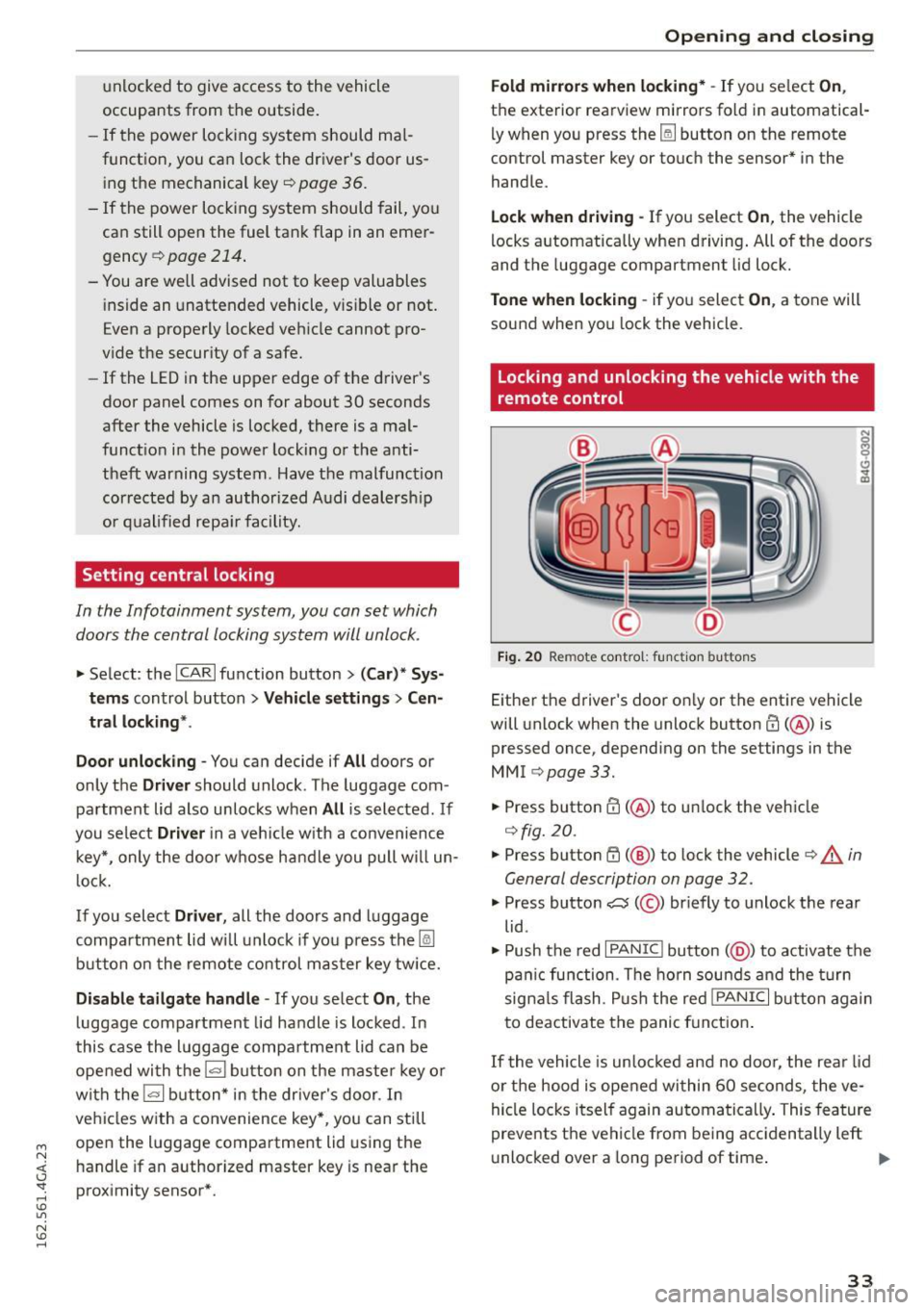
Fi g. 20 Re mote control: funct io n buttons
Eithe r the driver's door on ly or the ent ire vehicle
will unlock when the unloc k button
m (@ ) is
pressed once, depending on the settings in the
MMI ¢page33.
"'Press button m (@ ) to u nlock the vehicle
¢ fig. 20.
.. Press button~( @) to lock the vehicle ¢ A in
General description on page 32.
.,. Press button C;j (@ ) briefly to unlock t he rea r
lid .
• Push the red
I PANIC i button (@ ) to activate the
pa nic function . T he horn sounds and the turn
signa ls flash . P ush the red
!PANIC I b utton again
to deactivate the panic f unction .
If the vehicle is un loc ked and no doo r, the rea r lid
o r th e hood is opened wi thin 60 seconds, the ve
hicle lo cks i tsel f ag ain au toma tica lly. This feature
prevents the vehicle from being acc identally left
u nlocked over a long period of time . ..,.
33
Page 53 of 294
M N <( (.J
'SI: ,...., \!) ..,.,
N \!) ,....,
~ Switch the windshield wipers off (position@
c:>poge49, fig. 46).
~ Select: the ICARI function button > (Car)* Sys
tems
control button > Servi ce & cont rol > W ip
er cha nge posit ion
> On /O ff.
R emoving the wip er blade
~ Fold the windshield wiper arm away from the
windshield.
~ Press the locking knob@c:> fig. 47 on the wiper
blade. Hold the wiper blade firm ly.
~ Remove the wiper blade in the direction of the
arrow.
In sta ll in g t he w ip er bl ade
~ Insert the new wiper blade into the mount on
the wiper arm@ unti l you hear it latch into
place.
~ Place the wiper arm back on the windshield.
~ Turn the service pos ition off.
A WARNING
For safety reasons, the windshield wiper
blades should be replaced once or twice each
yea r.
0 Note
- Only fold the windshield wipe rs away when
i t is in the service pos ition. Otherw ise, you
r isk damag ing the pa int on the hood or the
windsh ield wiper motor.
- You should not move you r vehicle or ope rate
the windshie ld w iper lever when the wiper
arms are folded away from the windshield.
The windshield wipers would move back in
to t heir original position and could damage
the hood and windshield.
(D Tips
- You can also use the service pos ition, for ex
ample, if you want to protect the windshield
from icing by using a cover.
- You cannot activate the service position when the hood is open.
Light s and Vis ion
5 1
Page 82 of 294
Driving
made a full brake application . ESC and the as·
soc iated components (ABS, ASR, EDL) cannot
overcome the laws of physics. In corners and
when road or weather conditions a re bad, a
full b rake app lication can cause the vehicle to
skid or the rea r end to break away, wh ich in·
c reases the risk of an acc ident.
Start-Stop-System
Description
Applies to vehicles: with Sta rt-Stop-System
The Start-Stop-System can he lp increase fue l
economy and red uce CO2 emissions.
I n Start -Stop mode, the eng ine shuts
off auto
matica lly w hen the vehicle is stopped, such as at
a traffic light. The ign ition remains sw itched on
during this stop phase . The engine w ill restart
automatically when needed .
The Start-Stop-System is automatically activated
each time you switch on the ignition.
Basic requirements for Start -Stop mode
- T he driver's door is closed.
- T he driver' seat be lt is lat ched .
- The hood is closed .
- The vehicle must have been dr iven faster than
2.5 mph (4 km/h) s ince the last stop.
- A trai ler is not hitched to the vehicle .
(D Note
Always switch the Start-Stop-System off when
driving through water <=>
page 80.
@ Tips
The engine stops shortly before the vehicle
comes to a stop
1>. The fu ll function of the
brake booster and the power steering is sti ll
available.
l l de pend ing on eng in e
80
Stopping/starting the engine
Applies to vehicles: with Start-Stop-System
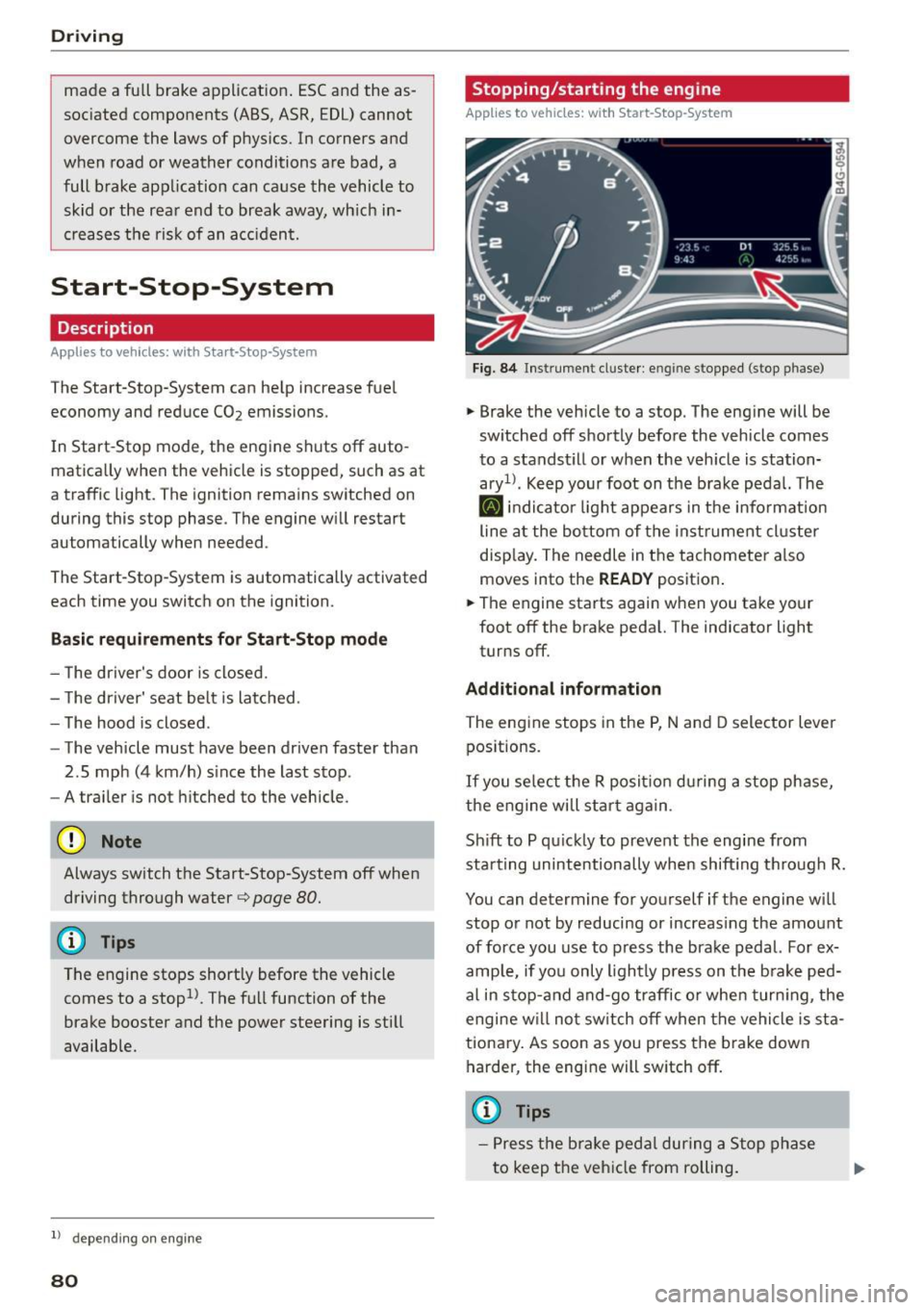
Fi g. 8 4 Instrument cl uste r: en gin e stopped (stop phase)
.,. Brake the vehicle to a stop. The eng ine will be
sw itched
off shortly before the vehicle comes
to a standst ill or when the veh icle is station
ary 1>. Keep your foot on the b rake peda l. The
[I] indi cato r light appears in the info rmat ion
line a t the bottom of the inst rument cl uster
disp lay. The needle in the tachometer a lso
moves into the READY positio n.
.,. The engine starts again when you take your
foot
off the brake peda l. The indicator light
turns
off.
Additional information
The engine stops in the P, N and D selector lever
pos itions.
If you se lect the R posit io n du ring a stop phase,
the e ngine will star t aga in .
Sh ift to P qu ickly to prevent the engine from
starting unintentionally when shift ing th rough R.
You can determine for yourself if the engine will
stop or not by reducing or increas ing the amount
of force you use to p ress the brake pedal. For ex
ample, if yo u only lightly press on t he b rake ped
al in s top-and and-go traffic o r when tur ning, the
engine w ill no t sw itch
off when the vehi cle is sta
tiona ry . As soon as you press the b rake down
harder, the eng ine will sw itch
off.
(D Tips
- Press the bra ke peda l during a S top phase
to keep the vehi cle from rolling.
Page 112 of 294
Automatic transmission
-Do not ride the brakes or press the brake
pedal too often or too long when driving
down a hill. Constant braking causes the
brakes to overheat and substantially re
duces braking performance, increases brak
ing distance or causes complete failure of
the brake system .
- To prevent the vehicle from rolling back
when stopping on inclines, always hold it in
place with the brake pedal or parking brake.
- Never hold the vehicle on an incline with a
slipping clutch. The clutch opens automati
cally when it becomes too hot from the
overload . An indicator lamp
mJ illuminates
and a driver message appears¢
page 112
when the clutch is overloaded.
-If the engine must remain running, never
have any driving position engaged when
checking under the hood. Make sure these
lector lever has securely engaged and is
locked in P with the parking brake set
¢page 218. Otherwise, any increase in en
gine speed may set the vehicle in motion,
even with the parking brake applied.
@ Note
- When stopping on an incline, do not try to
hold the vehicle in place by pressing the ac
celerator pedal while a driving gear is se lected . This can cause the transmission to
overheat and can damage it . Activate the
parking brake or press the brake pedal to
prevent the vehicle from rolling.
- Allowing the vehicle to roll when the engine
is stopped and the selector lever is in N will
damage the transmission because it is not
lubricated under those circumstances.
@ Tips
For safety reasons, the parking brake is re
leased automatically only when the driver's
safety belt is engaged in the buckle.
110
· Hill descent control
Hill descent control assists the driver when driv
ing down hills .
Hill descent control is activated when the selec
tor lever is in the D or S posi tion and you press
the brake pedal. The transmission automatically selects a gear that is suitable for the incline . Hill
descent control tries to maintain the speed ach
ieved at the time of braking, within physical and
technical limitations. If may still be necessary to
adjust the speed with the brake pedal.
Hill descent control switches off once the hill lev
els out or you press the accelerator pedal.
On vehicles with a cruise control system*
¢
page 83, hill descent control is also activated
when the speed is set.
A WARNING
Hill descent control cannot overcome physical
limitations, so it may not be able to maintain
a constant speed under all conditions. Always be ready to apply the brakes.
Page 155 of 294
Safety belts are important to help keep front seat
occupants in the proper seated position so that
airbags can unfold proper ly and provide supple
mental protection in a frontal collision.
The front airbags are designed to provide addi
tional protection for the chest and face of the
driver and the front seat passenger when:
- sa fety belts are worn properly,
- the seats have been posit ioned so that the oc-
c u pant is properly seated as far as poss ib le
from the airbag,
- and for adjustable head restraints: the head re -
stra ints have been properly adjusted.
Because airbags inflate in the blink of an eye w ith
g reat force, things you have on your lap or h ave
p laced on the seat cou ld become dangerous p ro
jectiles, and be pus hed into yo u if the airbag in
flates.
W hen an a irbag deploys, fine dust is released.
This is normal and is not caused by a fire in the
ve hicl e. This dust is made up mos tly of a powde r
used to lubricate the airbags as they deploy. It
could irritate skin.
I t is impor tan t to remember that while the sup
p lemental air bag sys tem is designed to reduce
the likelihood o f se rious injuries, othe r injuries,
for example swe lling, bruising and minor abra
sions, can also happen when airbags inflate . Air
bags do not protect the arms or the lower parts
of the body. Front airbags supplement the three
point safety belts only in some frontal collisions
in which the veh icle deceleration is h igh enough
to deploy the airbags .
Front airbags will not deploy:
- if the ignit ion is switched off when a crash oc-
curs,
- in side collisions,
- in rear-end collisions,
- in ro llovers,
- when the crash deceleration measured by the
airbag system is less than the minimum thresh -
~ old needed for airbag deployment as registered <( o by the electronic control unit. 'SI: ,...., \!) 1.1"1
N \!) ,....,
Airbag syste m
The front passenge r airbag also will not
deploy :
-when t he front passenger seat is not occupied,
- when the electr ica l capacitance measured by
the capacitive passenger detection system for
the front passenger seat indicates that the pas
senger s ide frontal airbag must be switched off
by the electronic control unit (the
PASSENGER
AIR BAG OFF
light¢ page 155 and how they
work comes on and stays on).
A WARNING ,..__ -Sitting in the wrong pos ition can increase the
r isk of ser ious injury in crashes.
- To reduce the risk of injury when the airbags
inflate, the driver and passenge rs must al
ways sit in an up right pos ition, must no t
lean ag ains t or place any part of the ir body
too close to the area where the a irb ags are
located .
- Occupants who are unbel ted, out of position
or too close to the airbag can be serio usly
inj ured by an ai rbag as it unfo lds with great
force in the blink of an eye ¢ page 1 44 .
A WARNING
A child in a rearward-facing ch ild seat insta l
l ed on the front passenger seat will be ser i
ously injured and can be k illed if the front air
bag inflates -even with an Advanced Airbag
System.
- The inflating airbag will hit the ch ild seat o r
infant carrier with great force and will
smash the child seat and child against the
backrest, cente r armrest, door or roof.
- Always install rear-fac ing ch ild seats on the
rea r seat .
- If you must install a rearward fac ing child
seat on the front passenger seat because of
exceptiona l circumstances and the
PASSEN
GER AIR BAG OFF
l ight does not come on
an d stay on , immedi ately ins tall the rear
facing chi ld seat in a rear seat ing pos ition
and have the airbag system inspected by
your Audi dea ler.
153
Page 162 of 294
Airbag system
Remember too, airbags will deploy only once and
only in certain kinds of accidents -your safety
be lts are always there to offer protection in those
accidents in which airbags are not supposed to
deploy or when they have already deployed, for
examp le when your vehicle strikes or is struck by
another after the first collision .
This is just one of the reasons why an airbag is
not a substitute for the safety belt. The airbag
system works most effectively when used with
the safety belts. Therefore, always wear your
safety belts correctly .
It is important to remember that while the sup
plemental knee airbag system is des igned to re
duce the likelihood of serious injuries, other inju
ries, for example, swelling, bruising and minor
abrasions and friction burns can also occur when
an airbag inflates.
The knee airbag system basically consists of:
-The electronic control modu le
- Two inflatable airbags (airbag and gas genera-
tor), one for the driver and one for the front
passenger
- The airbag indicator light in the instrument
panel
The knee airbag system will not deploy:
-when the ignition is switched off
- in frontal collisions when the deceleration
measured by the control unit is too low
- in s ide collisions
- in rear-end collisions
- in rollovers
- in the event of a system malfunct ion (warning/
indicator light is on) ¢
page 18.
.&, WARNING
-Safety belts and the airbag system can only
provide protection when occupants are in
the proper seating position
¢page 152.
-If the airbag indica tor lig ht ¢page 18
comes when the vehicle is being used, have
the system inspected immediate ly by your
authorized Audi dealer. It is possible that
the airbag will inf late when it is not sup
posed to, or w ill not inflate when it should.
160
How knee airbags work
App lies to vehicles: wi th kne e airbags
The risk of injury to the leg area can be reduced
by fully inflated knee airbags .
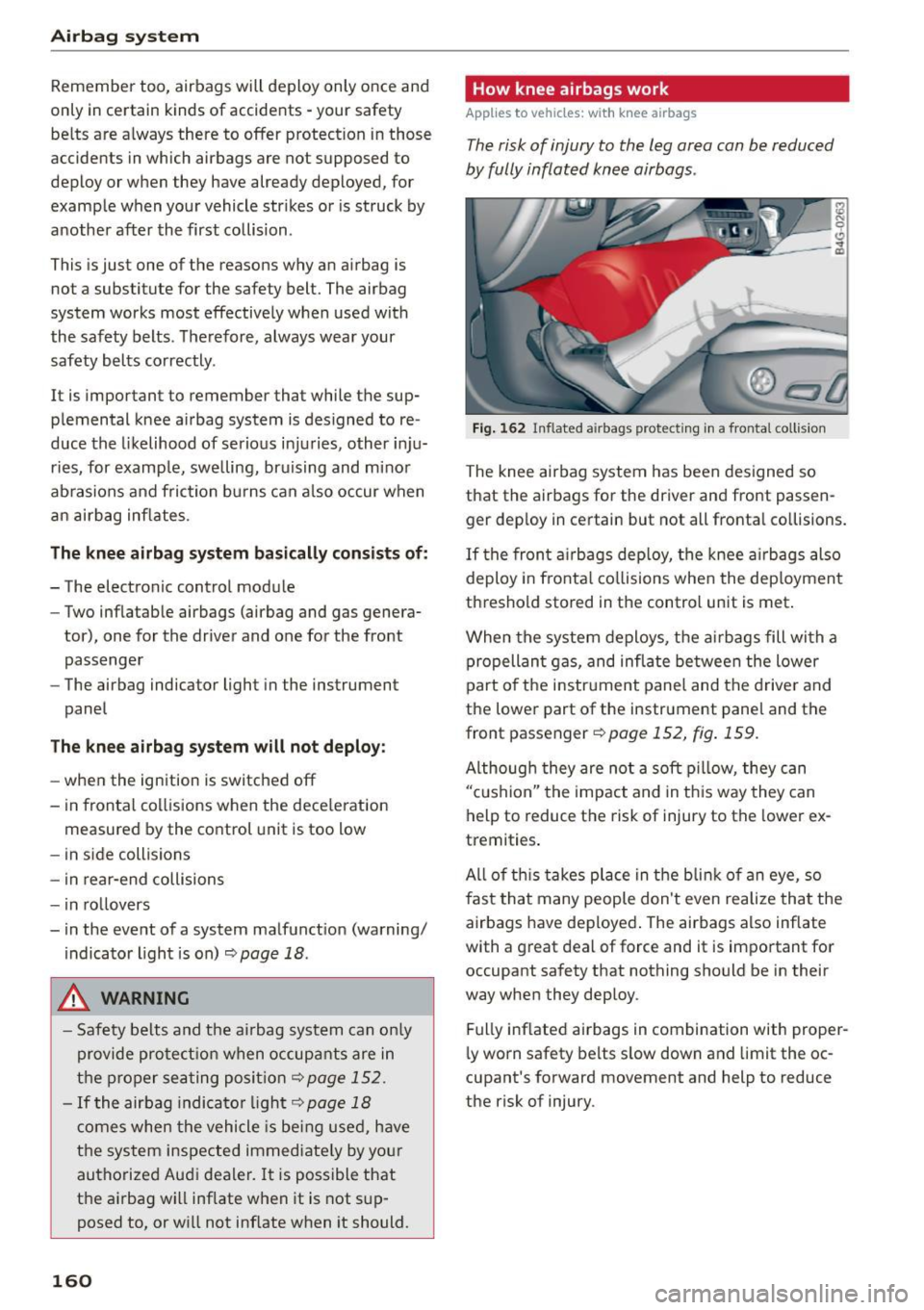
Fig. 162 Inflated airbags protect ing in a frontal collis ion
The knee airbag system has been designed so
that the airbags for the driver and front passen
ger dep loy in certain but not all fronta l co llisions .
If the front airbags deploy, the knee airbags also
deploy in frontal collisions when the deployment
threshold stored in the control unit is met.
When the system deploys, the airbags fill with a
propellant gas, and inflate between the lower
part of the instrument panel and the driver and
the lowe r part of the instrument panel and the
front passenger ¢
page 152, fig. 159.
Although they are not a soft pillow, they can
"c ushion" the impact and in this way they can
help to reduce the risk of injury to the lower ex
tremities .
A ll of this takes place in the blink of an eye, so
fast that many people don't even realize that the
airbags have deployed . The airbags also inflate
with a great deal of force and it is important for
occupant safety that nothing should be in their
way when they dep loy .
F ull y inflated airbags in combination with proper
l y worn safety belts s low down and limit the oc
cupant's forward movement and help to reduce
the risk of injury .
Page 164 of 294
Airbag syste m
-the e lectronic control module and external side
impact sensors
- the two airbags located in the sides of the front
backrests and the two airbags* located in the
rear backrest
- the ai rbag warning light in the inst rument cl us-
ter .
The a irbag system is monitored electron ica lly to
make certa in that it is function ing properly at a ll
times. Each time you switch on the ignition, the
airbag system indicator light will come on for a
few seconds (self diagnostics).
The s ide a irbag system supplements the safety
be lts and can he lp to reduce the risk of injury to
the driver 's, front and rear passenger 's upper tor
so on the side of the vehicle that is struck in a
side collision. The airbag deploys only in side im
pacts and on ly when the vehicle accelera tion reg
istered by the control unit is high enough . If this
rate is below the reference value programmed in
to the contro l unit , the side airbags will not be
tr iggered, even though the car may be badly
damaged as a result of the co llision.
It is not pos
sible to def ine an a irbag tr igger ing range that
will cover every possible angle of impact, since
the circumstances wi ll vary considerably between
one co llision and another. Important factors in
clude, for example, the nature (hard or soft) of
t he impacting object, the angle of impact, vehicle
speed, etc. ¢
page 163, Important safety in
structions on the side airbag system.
Aside from the ir norma l safety function, safety
be lt s work to help keep the dr iver or front pas
senger in pos it ion in the event of a s ide collision
so that the side a irbags can provide protect ion.
The airbag system is
not a subst itute for your
safety belt. Ra ther, it is part o f the overall occu
pant restraint system in your vehicle . Always re
member that the s ide a irbag system can only
he lp to protect you if you are wear ing your safety
be lt and wearing it p roperly. This is another rea
son why you shou ld always wea r you r safety
be lts, not just because the law requ ires you to do
so ¢
page 135, General information.
It is important to remember that while the sup
p lemental side airbag system is des igned to re-
162
duce the like lihood of serious injur ies, other inju
ries , for example, swelling, bruising, friction
burns and m inor abrasions can a lso be associated
with deployed side airbags. Remember too, s ide
airbags will dep loy only once and only in certain
k inds of accidents -your safety belts are always
the re to offer protection .
Vehicle damage, repair costs or even the lack of
vehicle damage are no t necessarily an indication
of over-sensitive or failed airbag activation . In
some collis ions, both front and side ai rbags may
i nflate . Remember too, that a irbags w ill deploy
o nl y once and on ly in certa in kinds of collisions -
you r safety be lts a re a lways there to offer p rotec
tion in those accidents in which airbags are not s u pposed to deploy or when they have a lready
deployed.
The side airbag system will not deploy:
- when the ignit io n is swit ched off
- in side co llisions when the accele rat ion meas-
ured by the senso r is too low
- in front-end collisions
-in rear-end collisions
- in rollovers.
In some types of accidents the front airbags, side
curtain airbags and side airbags may be triggered
together.
A WARNING
- Safety belts and the airbag system will only
provide protection when occupants are in
the proper seating position
¢ page 163.
-If the airbag ind icator light¢ page 18
comes when the veh icle is being used, have
the system inspected immediately by your
author ized Audi dealer .
It is possible that
the airbag will in flate when i t is not sup
posed to, or will not infla te when it should.
Page 167 of 294
M N <( I.J "". rl I.O
"' N I.O rl
below the refe rence value p rogrammed into the
control unit, the side curtain airbag will not be
tr iggered, even though the car may be badly
damaged as a result of the co llision. It is not pos
sible to define an airbag triggering range that
will cover every poss ible angle of impact, since
the circumstances will vary considerably between one co llision and another. Important factors in
clude, for example, the nature (hard or soft) of
the impacting object, the angle of impact, vehicle speed, etc.¢
page 165, How side curtain air
bags work.
Aside from the ir normal safety function , safety
be lts work to help keep the dr iver or front pas
senger in posit ion in the event of a co llision so
that the side curtain a irbags can provide protec
tion.
The airbag system is not a s ubst itute for yo ur
safety belt. Rather, it is part of the overall occu
pant restraint system in your vehicle . Always re
member that the airbag system can only help to
protect you if you are wear ing your safety be lt
and wearing it properly. Th is is another reason
why you should always wear your sa fety bel ts,
not just because the law requires you to do so
¢ page 135, General information.
It is important to remember that while the side
curta in airbag system is designed to help reduce
the likelihood of serious injuries, other injur ies,
for example , swelling , b ruising, fr iction burns
and minor abras ions can also be associated with
these airbags upon deployment . Remember too,
these airbags will deploy only once and only in
certain k inds of accidents -your safety belts are
always there to offer protectio n.
The side curtain airbag system basically
consis ts of :
- The elec tronic contro l mod ule and externa l side
impact sensors
- The side c urtain a irbags above the front and
rear side windows with ejection mitigation fea
tures
- T he airbag indicator light in the instrument
panel
The airbag system is monitored elect ron ically to
make certa in it is function ing properly a t all
Ai rb ag sy stem
times . Each time you switch on the ign ition, the
airbag system indicator light will come on for a
few seconds (self diagnostics).
Th e s ide curtain airbag is not activated:
- if the ignition is sw itched off,
- in side co llisions when the accele ration meas-
ured by the sensor is too low,
- in rear-end col lisions .
A WARNING
-Safety belts and the airbag system will only
p rovide p rotection when oc cupan ts are in
the proper seating position ¢
page 52, Gen
eral information.
- If the airbag ind ic a tor light~ page 18
comes when the veh icle is being used, have
the system inspected immediately by your
authorized Audi dealer . It is possib le that
the airbag will inflate when it is not sup
posed to, or will not inflate when it should.
How side curtain airbags work
Side curtain airbags con work together with side
airbags to help reduce the risk of head and upper
torso injuries for occupants who ore properly re
strained .
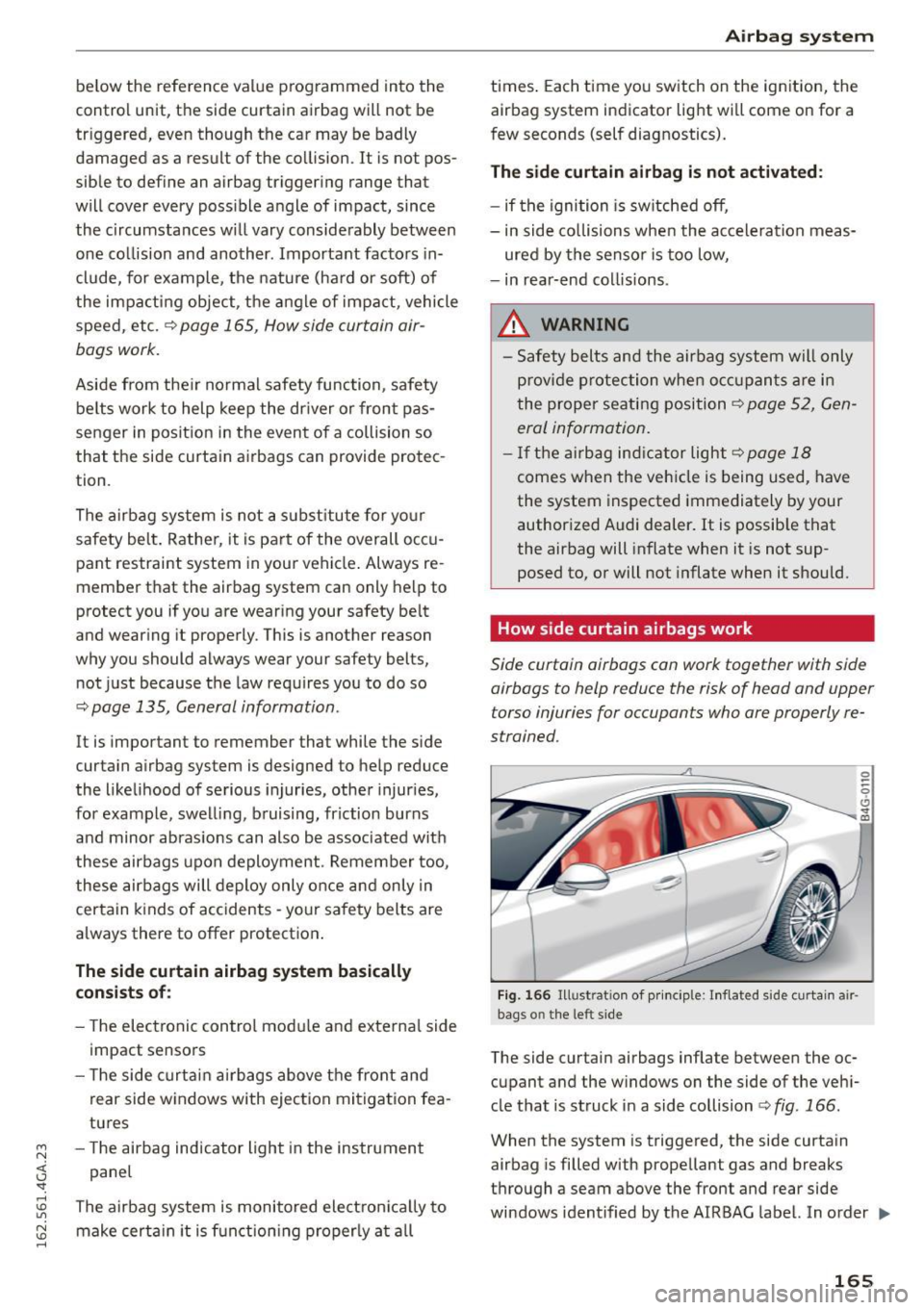
Fig. 166 Illust rat ion of pr incip le : I n flated si de curtai n air
bags o n th e le ft side
The side curtain airbags inflate betwee n the oc
cupant and the w indows on the side of the veh i-
cle that is struck in a side collision ¢
fig. 166 .
When the system is triggered, the side curtain
airbag is filled wi th propellant gas and breaks
t h rough a seam above the front and rear side
windows identified by the A IRBAG label. In order
ll>-
165
Page 187 of 294
M N <( (.J
'SI: ,...., \!) 1.1'1
N \!) ,....,
Audi pre sense Preventative passenger
protection
App lies to veh icles: with Audi p re se nse
Pre sense can initiate steps to protect veh icle oc
cupa nts in certain dangerous situations. The
functions descr ibed a re ava ilable depending on
ve hicle equ ipme nt:
Pre sense ba sic*
The fo llow ing funct ions can be triggered in cer
tain driving situations:
- Tensioning of the safety be lts (for example,
during heavy b raking) : The front safety belts
have revers ib le be lt pretensioners. If a collision
does not occur, the safety belts loosen sli ght ly
and are ready to trigger aga in.
- Clos ing the windows and the sunroof* (for ex
amp le, when over- or understeering): The door
windows and the sunroof* are closed almost
completely until o nly a sma ll gap is open .
Audi pre sense basic functions can be triggered at
speeds above 20 mph (30 km/h).
Drive se lect: The deployment time is adapted in
Dynamic mode .
Pre sense front (vehicles with adaptive cruise
control* }
Pre sense front contains the functions of pre
sense basic . In add ition, the likelihood of a rear
end collis ion with the vehicle ahead is also calcu
lated, within the limits of the system. If the risk
of a collision is detected, the following functions
can trigger:
- Brak ing guard
¢ page 91
-Tensioning of the safety be lts
- Closing the w indows and the sun roof*
Pre sense rear (v ehicles with side assist* }
Pre sense rea r contains the funct ions of pre sense
bas ic. I n addit io n, the li kelihood of a rea r-end
coll is ion from the veh icle behi nd is also calc ulat
ed, w it hi n the lim its of the system. If the risk of a
collision is de tected, the following functions can
trigger :
Audi pre sense
-Tens ion ing of the sa fe ty belts
- Clos ing the windows an d the s unroo f*
Pre sense plus*
P re sense p lus conta ins the functions of pre
sense front and p re se nse rea r.
Error mes sage
Aud i pre sense: Unavailable
Preventative passenge r protection is not availa
ble. Drive to yo ur autho rized Audi deale r immedi
ately to have the ma lfunction corrected.
A WARNING
-
Pre sense cannot overcome natural physical
l aws. It is a system designed to assist and it
ca nnot prevent a collision. Do not let the in
creased safety prov ided temp t you into taking
risks . This could incr eas e yo ur risk of a co lli
s ion.
- The system can deploy incorrectly .
- Please note that t he sensors do not always
detect a ll objects . This inc reases the r isk of a
coll is io n.
- Pre sense does not react to people or a ni
mals or objec ts that are crossi ng the vehi
cle 's path o r are difficult to det ect
¢ page 85.
-Reflec tive ob jects s uch as guard rai ls o r the
entrance to a tunne l, heavy rai n and ice can
a ffec t the fu nction of the rada r senso rs and
t he system's ability to de te ct a co llision risk.
(D Note
The sensors can be d isplaced by impacts or
d amage to the bumper, w heel housing a nd
u nder body. Pre se nse can be impa ired by th is .
H ave an a utho riz e d Aud i de aler o r au th orized
A udi Service Facility check the ir func tion .
(D Tips
-Certa in p re sense fro nt functions swi tch off
w he n sp o rt mode is sw itche d off or w hen
dr iving in reverse .
- T he p re sense fun ctions m ay not be av aila
b le i f th ere is a m alfu nction in t he ES C sys
tem or t he a irbag con tro l mod ule.
185
Page 207 of 294
M N <( (.J
'SI: ,...., \!) 1.1"1
N \!) ,....,
Care and cleaning
General information
Regular, proper care helps to maintain your vehi
cle's value.
It can a lso be a req uirement when
submitting warranty claims for corrosion damage
and paint defects on the body.
The necessary care products can be obtained
from your a uthorized Audi dea ler . Read and fol
l ow the instructions for use on the packaging .
A WARNING
- Using clean ing and care products incorrectly
can be dangerous to your health.
- Always store cleaning and care products out of reach of children to reduce the r isk of po i
soning .
@) For the sake of the environment
- Preferably use environmentally-friendly
products when b uying cleaning agents.
- Do not dispose of leftover cleaning and care
products with h ousehold tras h.
Car washes
The longer that deposits remain on the vehicle ,
the more the s urface may be damaged . H igh
temperatures s uch as those caused by s unlight
increase the damaging effect.
Before washing, rinse off heavy deposits with
p lenty of water.
S tu bbor n depos its s uch a s bird dropp ings o r tree
sap are best removed w ith plenty of wa ter and a
microfiber cloth .
A lso, was h the unde rs ide of your vehi cle once
ro ad salt s tops be ing use d fo r t he season .
Pressure washers
When washing your ve hicles w ith a pressure
washer, always follow the operating instructions
p rov ided with t he p ress ure washer. This is espe
ci ally importan t in reg ard to the p ress ure and
sp ray ing dist ance. Do not aim the spray direc tly
at seals on side windows, doors, the hood, the
rear lid or the sunroof * or at tires, rubber hoses,
Care and cleaning
insulat ing mater ia l, sensors * or camera lenses *.
Keep a distance of at least 16 inches (40 cm) .
D o no t remove snow and ice with a pressu re
washe r.
Never use rotary nozzles or high pressure noz
z les.
The water temperature must not be above 140 °F
(60 °() .
Automat ic car washes
Sp ray off the ve hicle before washing .
Make sure tha t the w indows and roo f* are close d
and the windshield wipers are off . Follow inst ruc
tions from the car wash operator, especially if
there are accessor ies attached to your vehicle.
If possible, use car washes th at do not h ave
brushes.
Washing
by hand
Clean the ve hicle starting from the top and work
i ng down using a soft sponge or cleani ng b rush .
U se solven t-free cle ani ng p rod ucts.
Washing vehicles with matte finish paint
by
hand
T o avoid damaging the pain t whe n washing, first
remove dus t and large particles from yo ur vehi
cle . Inse cts , grease s pots and fingerprin ts a re
best removed with a specia l cleaner for matte
finish pai nt.
Apply t he p rod uct using a mi crofiber cloth. To
avo id damaging the paint surfa ce, do not use too
much pressure.
Rinse the ve hicle thoroughly with water. Then
cl ea n usi ng a neutr al sham poo and a so ft mi cro
fiber clo th .
Rinse the ve hicle thoroughly again and let it air
dry. Remove a ny wate r residue using a s ham my.
A WARNING
- Onl y wa sh the vehicle w hen the ign ition is
off and fo llow the ins truc tions from the car
wash ope rator to reduce the risk of a cci
dents.
-
205