transmission AUDI S7 2016 User Guide
[x] Cancel search | Manufacturer: AUDI, Model Year: 2016, Model line: S7, Model: AUDI S7 2016Pages: 294, PDF Size: 73.82 MB
Page 115 of 294
M N <( I.J "". rl I.O
"' N I.O rl
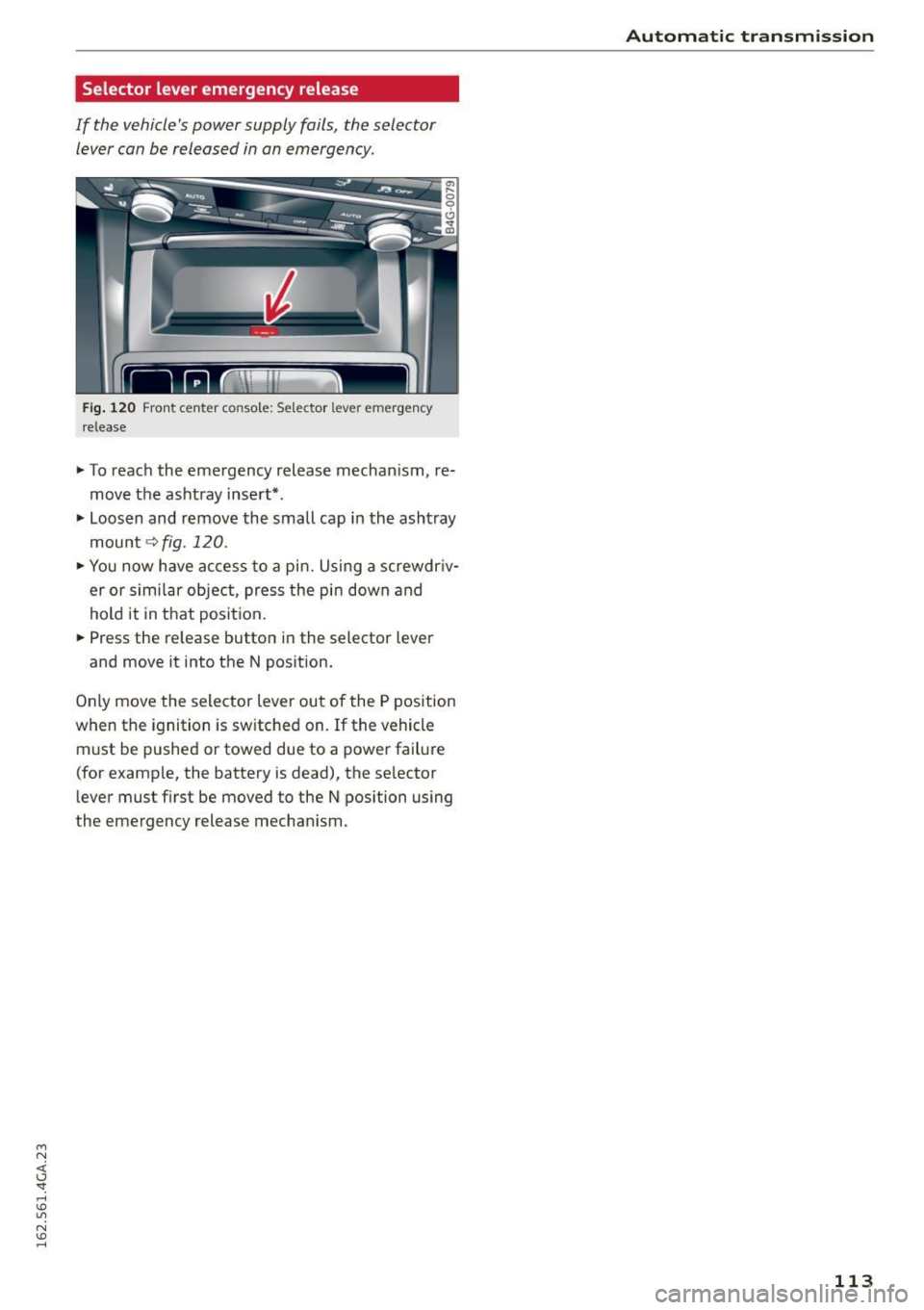
Selector lever emergency release
If the vehicle's power supply fails, the selector lever can be released in an emergency.
Fig . 120 Front center co nsole: Selector leve r em ergency
re lease
• To reach the emergency release mechanism, re
move the ashtray insert*.
• Loosen and remove the small cap in the ashtray
mount ¢ffg.120.
• You now have access to a pin. Using a screwdriv
er or similar object, press the pin down and
hold it in that position.
• Press the release button in the selector lever
and move it into the N position.
Only move the selector lever out of the P position
when the ignition is switched on. If the vehicle
must be pushed or towed due to a power failure
(for example, the battery is dead), the selector
lever must first be moved to the N position using
the emergency release mechanism .
Automatic transmission
113
Page 198 of 294
Driving and the environment
Driving and the
environment
Breaking in
New engine
The engine needs to be run-in during the first
1,000 miles (1,500 km).
For the first 600 miles (1,000 kilometers ):
.,. Do not use full throttle .
.,. Do not drive at engine speeds that are more
than 2/3 of the maximum permitted RPM .
.,. Avoid high engine speeds.
From 600 to 1,000 miles (1,000 to 1,500
kilometers ):
.,. Speeds can gradually be increased to the maxi
mum perm issible road or eng ine speed.
During and after break-in period
.,. Do not rev the engine up to high speeds when it
is cold . This applies whether the transmission is
i n N (Neutral) or in gear .
After the break-in period
.,. Do not exceed maximum engine speed under
any circumstances.
.,. Upshift into the next higher gear
before reach
i ng the red area at the end of the tachometer
scale~
page 10 .
During the first few hours of driving, the engine's
internal friction is higher than later when all the
mov ing parts have been broken in. How well th is
break-in process is done depends to a cons idera
b le extent on the way the vehicle is driven during
the first 1,000 miles (1,500 kilometers).
(D Note
Extremely high engine speeds are automati
cally reduced. However, these rpm limits are
programmed for an engine wel l run-in, not a
new engine.
196
® For the sake of the environment
Do not drive with unnecessarily high engine
speeds -upshifting early saves fuel, reduces
noise and protects the environment.
New tires
If your vehicle is running on new tires, drive par
ticularly careful for the first 350 miles (500 kilo
meters) after f itting .
.8, WARNING
New tires tend to be slippery and must also
be "broken- in". Be sure to remember this dur
ing the first 350 mi les (500 kilometers).
Brake gently. Avoid following closely behind
other ve hicles or other situations that might
require sudden, hard braking.
Avoid damaging the
vehicle
When you are driving on poor roads, or over
curbs, steep ramps, etc ., make certain that low
lying parts such as spoilers and exhaust system
parts do not bottom out and get damaged .
This is especially true for vehicles with low-slung chass is (sports chassis)* and fully loaded
vehicles .
-
Driving through water on
roads
Note the following to avoid vehicle damage whe n
driving through water, for example on flooded
roads:
- The water must not be any highe r than the bot
tom of the vehicle body.
- Do not dr ive faster than walk ing speed .
.8, WARNING
After driv ing through water or mud, the brak
ing effect can be reduced due to moisture on
the brake discs and brake pads. A few careful
brake applications shou ld dry off the brakes.
Page 199 of 294

M N <( (.J
'SI: ,...., \!) 1.1"1
N \!) ,....,
CD Note
-Vehicle components such as the engine ,
transmission, suspension or e lectr ical sys
tem can be severe ly damaged by driving
through water .
- Always switch the Start-Stop -System* off
when driving through water
c> page 80.
@ T ips
- Determine the depth before driving through
water.
- Do not stop the vehicle, drive in reverse or
switch the eng ine off when driving through
water.
- Keep in mind that oncoming vehicles may
create waves that raise the water level and
make it too deep for your vehicle to drive
through safely.
- Avoid driving through sa lt water (corrosion).
Catalytic converter
Applies to vehicles: with gasoline engine
It is very impor tan t tha t your emission control
system (catalyti c converter) is functioning prop
erly to ensure that your vehicle is running in an
environmentally sound manner .
... Always use lead-free gasoline c> page 210,
F uel supply .
... Never run the tank down all the way to empty .
.,. Never put too much motor oil in your engine
c> page 222, Adding engine oil~-
.,. Never try to push- or tow-start your veh icle.
The catalytic converter is an eff icient "clean-up"
dev ice bu ilt into the exhaust system of the vehi
cle . T he catalytic converter burns many of the
pollutants in the exhaust gas before they are re
l eased into the atmosphere.
The exclusive use of unleaded fuel is cr itically im
portant for the life of the catalyt ic converte r and
proper functioning o f the eng ine .
A WARNING
The temperature o f the exhaust system is
high, both when driving and after stopping
the engine .
Driving and th e en vir onm ent
- Never touch the exhaust tail pipes once they
have become hot. Th is could resu lt in burns.
- Do not park or operate the vehicle in areas
where the hot exhaust system may come in contact w ith dry grass, brush, fuel spill or
other material which can cause a fire.
- Do not app ly additional undercoating or
rustproofing on or near the exhaust mani
fold, exhaust pipes, catalytic converter or heat shields . During dr iving, the substance
used for undercoat ing could overheat and
cause a fire .
CD Note
-Be aware that just one tank filling with lead
ed
fuel w ill already ser iously degrade the
performance of the catalyt ic converter .
- Do not exceed the correct engine oil level
¢ page 222.
-Do not drive until the fuel tank becomes
completely empty . The engine cou ld misfire .
Unburned fuel could also get into the ex
haust system and this cou ld cause the cata
lyt ic converter to overheat.
- Do not switch off the ignit io n while the veh i
cle is movi ng.
- Do not continue to ope rate your veh icle un
der these conditions, as othe rwise f uel can
reach the catalytic converter . This could re
sult in overheating of the co nve rter , requ ir
ing its replacement .
- T o assu re eff icient operation of the Emission
Contro l System:
- Have your vehicle maintained properly and
in accordance w ith the serv ice recommen
dat ions in your Warranty
& Maintena nce
booklet .
- Lack of proper maintenance as we ll as im
p roper use of the vehicle will impair the
function of the emission control system
and could lead to damage.
@ For the sake of the environment
Even when the Emiss ion Control System is op
erating properly, the exhaust gas can have a
su lfu r-like exhaus t gas sme ll unde r some op
erating states. Th is depends on the s ulf ur
197
Page 206 of 294
Trailer mode
(D Tips
If you move the selector lever of the a utomat
ic transmission to P be fore applying the par k
ing brake and before block ing the wheels, you
may have to use more force later to move the
lever out of the P position .
204
Page 237 of 294

® Mud and snow capability
"M/S" or "M+S" indicates the tire
has characte ris tics that make it
suitable for driving on mud and snow .
& indica tes a winter tire.
@ Composition of the tire cord
and materials
T he number of plies indicates the
number of rubber ized fabric lay
ers in the tire . In general: the
more layers, the more weight a
tire can carry. Tire manufacturers
must also specify the mater ials
used in the ti re. These include
stee l, nylon, polyester and other
materials.
@ Maximum permitted load
This number indicates the maxi
mum load in kilograms and
pounds that the tire can carry .
@ Uniform tire quality grade
standards for treadwear,
traction and temperature resistance
Treadwear , traction and tempera
ture ranges
c::::> page 250 .
@Running direction
The arrows ind icate the running
direction of unidirect ional tires.
You must always follow the speci- fied running direction
c::::> page 259.
€3) Ma
ximum permitted
inflation pressure
Whe els
This number indicates the maxi
mum pressure to which a tire can
be inflated unde r normal operat
ing conditions .
Glossary of tire and loading
terminology
Accessory weight
means the combined weight (in
excess of those standard items
which may be replaced) of auto matic transmission, power steer
ing, power brakes, power win
dows, power seats, radio, and
heater, to the extent that these
items are available as factory-in
stalled equipment (whether in
stalled or not).
Aspect ratio
means the ratio of the height to
the width of the tire in percent. Numbers of 55 or lower indicate a
low s idewall for improved steer
ing response and better overall
handling on dry pavement . .,.
235
Page 266 of 294
Fuses
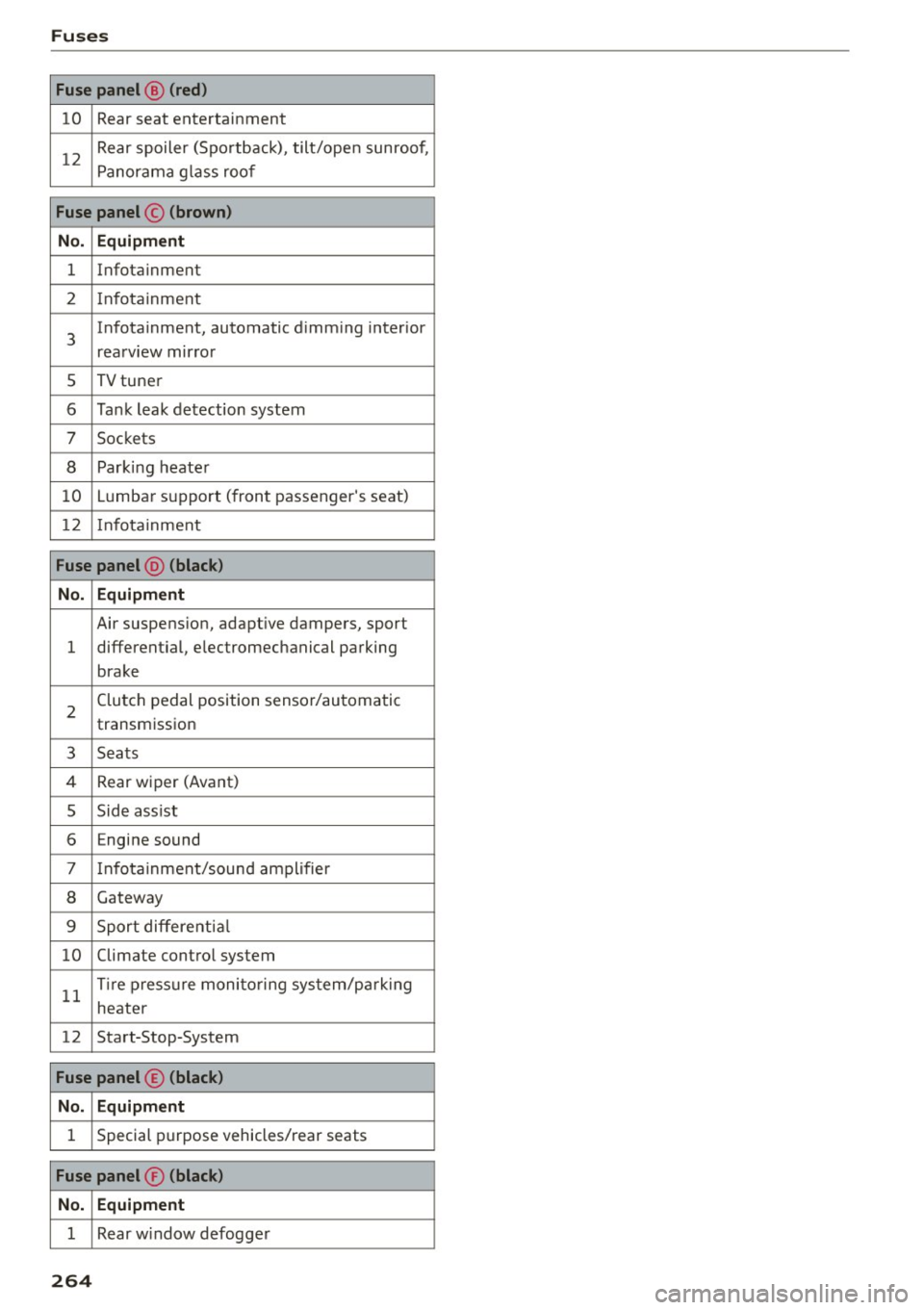
Fuse panel® (red)
10 Rear seat entertainment
12
Rear spoiler (Sportback), tilt/open sunroof,
Panorama g lass roof
Fuse panel © (brown)
No. Equipment
1 Infotainment
2 I n fota inment
3
Infotainment , automatic d imm ing interior
rea rview mirro r
s TV tuner
6 Tank leak detection system
7 Sockets
8 Park ing heate r
10 Lu mba r su pport (front passenger's seat)
12 Infota inment
Fuse panel @ (black )
No. Equipm ent
Air suspens io n, adapt ive dampers, sport
l differentia l, e lectr om echanical parking
brake
2
Clu tch pedal position senso r/au tomatic
transmission
3 Seats
4 Rear w iper (Avant)
s Side assist
6 Engine sound
7 Infota inment/sound amplifier
8 Gateway
9 Sport differentia l
10 Climate control system
11
T ire press ure moni to ring sys tem/p ark ing
heater
12 Start-Stop-System
Fuse panel © (black )
No. Equipment
1 Special p urpose vehicles/rear seats
Fuse panel ® (black)
No. Equipment
1 Rear w indow defogge r
264
Page 267 of 294

M N <( (.J
'SI: ,...., \!) 1.1'1
N \!) ,....,
Emergency situations
General
This chapter is intended for trained emergency
crews and working personnel who have the nec
essary tools and equipment to perform the se
operations.
Starting by pushing or
towing
(D Note
Vehicles w ith an automatic transmission can
not be started by push ing o r tow ing.
Starting with jumper
cables
If necessary, the engine can be started by con
necting it to the battery of another vehicle .
If the engine should fail to start because o f a dis
charged or weak battery, the battery can be con
nected to the battery of
another vehicle, us ing a
pair of jumper cables to start the engine .
Jumper cables
Use only jumper cables of sufficiently large cros s
section
to carry the starter current safe ly. Refer
to the manufacturer's specifications.
Use only jumper cables with
insulated term inal
clamps which are distinctly marked:
plus(+) cable in most cases co lored red
minus (-) cable
in most cases colored black .
A WARNING
Batteries contain electricity, acid, and gas .
Any of these can cause very ser ious or fatal in
jury . Fo llow the instructions be low for safe
handling of your vehicle's battery.
- Always shield your eyes and avoid leaning
over the battery whenever possible.
- A discharged battery can freeze at tempera
tures just below 32 °F (0 °C) . Before con
necting a jumper cable, you must thaw the
Emergency situations
frozen battery completely, otherwise it
could explode .
- Do not allow battery acid to contact eyes or
skin. Flush any contacted area with water immediately.
- Improper use of a booster battery to start a
veh icle may cause an explosion.
- Vehicle batteries generate explosive gases .
Keep sparks, flame and lighted cigarettes
away from batteries.
- Do not try to jump start any vehicle with a
low acid level in the battery.
- The voltage of the booster battery must al
so have a 12-volt rating. The capacity (Ah) of
the booster battery should not be lower
than that of the discharged battery. Use of batteries of different voltage or substantial
ly different" Ah" rating may cause an explo
sion and personal injury.
- Never charge a frozen battery . Gas trapped
in the ice may cause an explosion .
- Never charge or use a battery that has been
frozen . The battery case may have be weak
ened ,
- Use of batter ies of different voltage or sub
stantially different capacity (Ah) rating may
cause an exp losion and injury. Th e capacity
(Ah) of the booste r battery should not be
lower than that of the discharged battery.
- Before you check anything in the engine
compartment, always read and heed a ll
WARNINGS
q page 218 .
(D Note
-Applying a h igher voltage booster battery
w ill cause expensive damage to sensitive
electronic components, such as control
units, relays, radio, etc.
- Th ere must be no ele ct rical contact between
the vehicles as otherwise current could al
ready start to flow as soon as the positive
(+) termina ls are connected.
(D Tips
The discharged battery must be properly con-
nected to the vehicle's e lectrical system. .,..
265
Page 271 of 294
M N <( I.J "". rl I.O
"' N I.O rl
Raising the vehicle
lifting with workshop hoist and with floor
jack
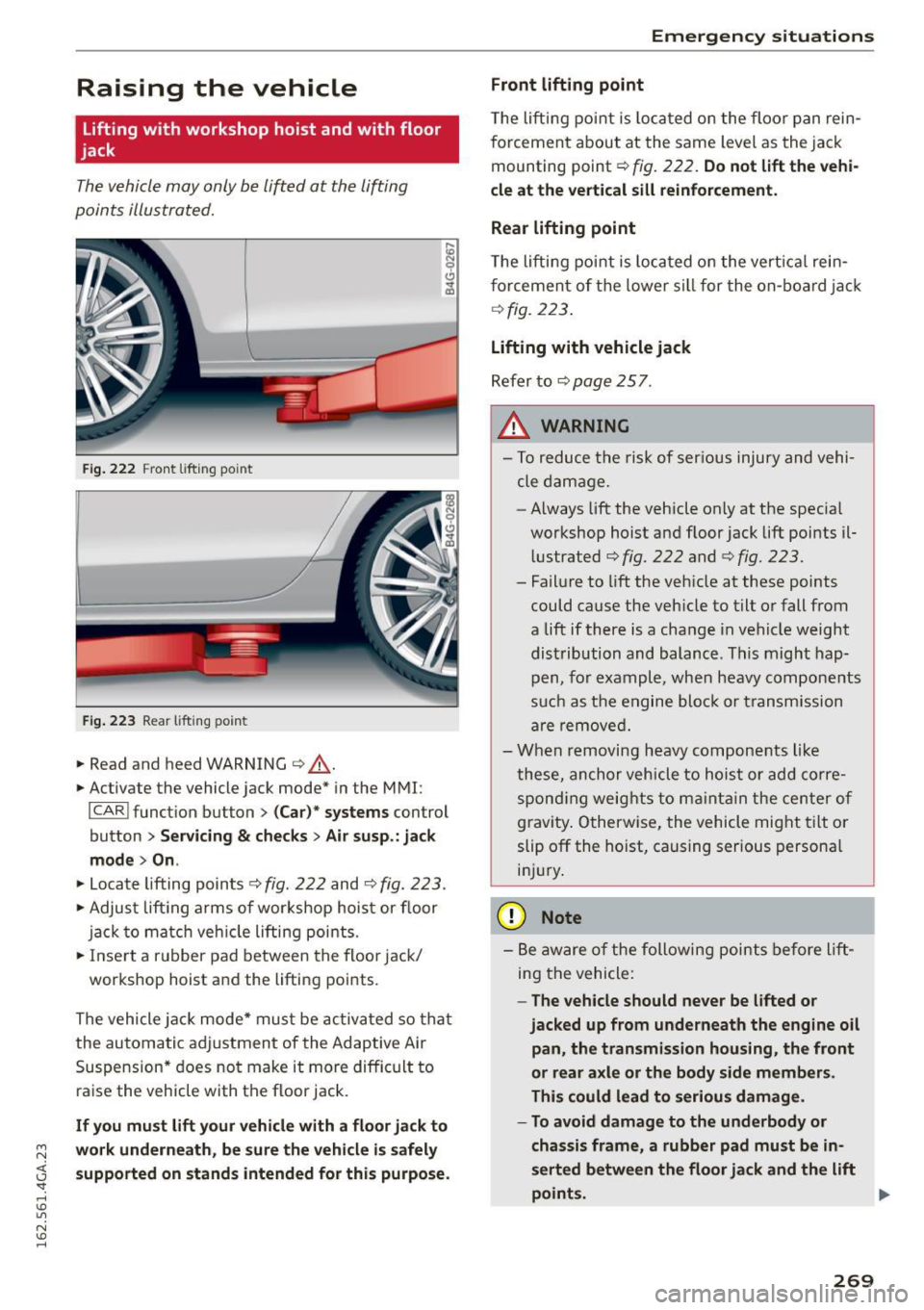
The vehicle may only be lift ed at the lifting
poin ts illustra ted.
F ig. 222 Front lift in g po int
F ig. 223 Rear lift in g point
.,. Read and heed WARNING ¢ .&_.
.,. Activate the vehicle jack mode* in the M MI:
I CAR I funct ion button> (Car )* systems control
button >
Servicing & checks > Air susp.: jack
mode > On .
.. Locate lifting points¢ fig. 222 and¢ fig. 223 .
.. Adju st lift ing a rm s of wor ksh op hoist or floor
jack t o match ve hicle lifting poi nts.
.. Inse rt a r ubber pa d between the floor jac k/
workshop hoist and the lifting poi nts.
T he vehicle jac k mode* mus t be activa ted so that
the au tomatic a djust ment of the Adaptive Air
Suspension * does not make it more diffi cult to
ra ise the veh icle with the floor jack.
If you must lift your vehicle with a floor jack to
work underneath , be sure the vehicle is safely
supported on stands intended for this purpose.
Emergency situations
Front lifting point
T he li ftin g po in t is loca ted o n the floo r pan rein
f o rcement about at the same level as the ja ck
mounting point¢
fig. 222 . Do not lift the vehi
cle at the vertical sill reinforcement.
Rear lifting point
T he lifti ng po int is loc ated o n the vert ica l rei n
f o rcement o f the lower s ill for the on- bo ar d ja ck
¢ fig. 223.
lifting with vehicle jack
Refer to¢ page 257 .
A WARNING
- To reduce t he ris k o f ser ious injury and vehi
cle damag e.
- Always lift the vehicle only at the specia l
workshop h oist a nd f loor jack lift poi nts il
lu strat ed¢
fig. 222 and ¢ fig. 223.
- Fail ure to lift the ve hicle at these points
could cause the veh icle to tilt o r fall from
a lift if there is a cha nge in veh icle weight
dis tributi on and balance . T his might hap
p en, fo r example, wh en h eavy compone nts
s uch as th e engine blo ck or trans missi on
are re m ove d.
- Wh en removing heavy comp onents li ke
t he se, an ch or veh icle to h ois t o r ad d corre
spon ding we ights to m aintai n the c enter of
g ravity . Otherwise, the vehicle might tilt or
slip off the hoist , causing ser ious persona l
i nju ry .
(D Note
- B e aw are o f the following poi nts befo re li ft
ing the vehicle:
- The vehicle should never be lifted or
jacked up from underneath the engine oil
pan, the transmission housing, the front
or rear axle or the body side members.
Thi s could lead to serious damage .
- To avoid damage to the underbody or
chassis frame, a rubber pad must be in
serted between the floor ja ck and the lift
point s. .,,.
269
Page 273 of 294
Technical data
Vehicle identification
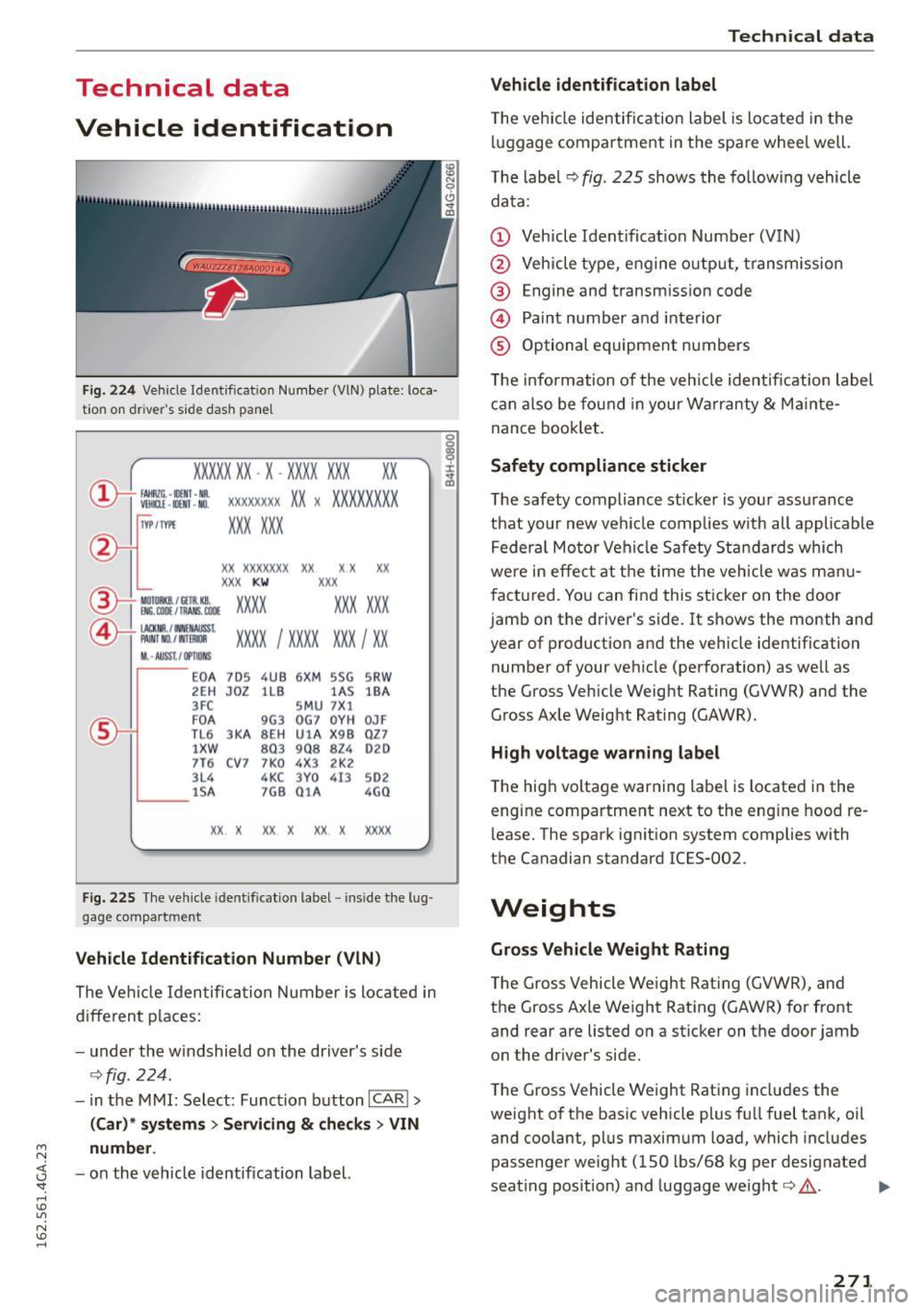
F ig. 22 4 Vehicl e Ide ntificat io n Number (VlN) plate: loca ·
t io n on drive r's s id e das h pane l
XXXXX XX -X -XXXX XXX XX
CD+ ~t :1:: xxxxxxxx xx x xxxxxxxx
T VP /fffl XXX XXX
XX XXXXXXX XX X X XX
XXX
KW XXX
®i ~:J ·f lfils~~ XXXX XXX XXX
®-+ ~N:a=i~ l xxxx ; xxxx xxx ; xx
II.· AUSS, I OPTIONS
E0 A
7D5 4UB 6XM 5SG 5RW
2EH J0Z lLB l
A S lB A
3FC SMU 7Xl
F0A 9G3 0G7
0YH 0JF
T L6 3KA 8EH Ul A X98 QZ7
l X W 803 908 824 020
7T6 CV7 7K0 4X3 2K2
3L4 4KC 3Y0 413
502
lSA 7GB 01A 4G0
XX. X XX X XX X xxxx
Fig. 225 T he veh icle iden ti fica tion label -inside the lug ·
g age compart ment
Vehicle Identification Number (VlN )
The Veh icle Iden tifica tion Number is located in
d iffe rent p laces:
- u nder the w indshield on the dr iver's side
¢ fig . 224.
-in the MMI: Select: Funct ion button ICAR I >
(Car )* syste ms> Servi cing & checks > VIN
~ numb er.
i3 -on the vehicle identification label.
"". rl I.O
"' N I.O rl
Technical d ata
Vehicle identification label
The vehicle identification label is lo cate d in the
lu ggage compartment in the spare whee l we ll.
T he labe l¢
fig. 225 shows the fo llowing vehicle
da ta:
(D Vehicle Ident ificat ion Number (VIN)
@ Vehicle type , engine o utp ut, transmission
® Engine and transm iss ion code
@ Paint number and interior
® Optional equipment numbers
T he information of the veh icle identification label
c a n a lso be fo und in your W arranty
& Mai nte·
nance booklet.
Safety compliance sticker
The safety compliance sticker is you r assurance
that your new vehi cle complies w ith all applicable
Fede ra l Mo tor Vehi cle Safety Sta ndards which
were in effec t at the time the vehicle was m anu
fac tured. Yo u can find this sticker on the door
jamb on the driver 's side. It shows the month and
year of production and the vehicle identification number of your vehicle (perforation) as we ll as
the Gross Veh icle Weight Rating (GVWR) and the
Gross Axle Weight Rating (GAWR).
H igh vo ltage warn ing lab el
T he high voltage wa rning label is located in the
engine compartment next to the eng ine hood re
lease. The spark ign it ion system complies with
t h e Canadian standard ICES-002 .
Weights
Gross Vehicle Weight Rating
The Gross Vehicle Weight Rat ing (GVWR), and
the Gross Axle Weight Rating (GAWR) for front
and rear are listed on a st icker on the door jamb
on the dr iver 's side.
The Gross Vehicle Weight Rat ing includes the
weight of the basic vehicle plus f ull fuel tank, oil
and coolant, pl us maxim um load, which includes
passenger weigh t (150 lbs/68 kg per design ated
seat ing pos ition) and luggage weight ¢.&, . ..,,.
271
Page 277 of 294
M N <( (.J
'SI: ,...., \!) 1.1'1
N \!) ,....,
today's automobiles, have steadily reduced the
scope of maintenance and repairs which can be
carried out by vehicle owners .
Also , s afety a nd
en viro nm enta l
concerns place very strict limits
on the nature of repa irs and adjustments to en
g ine and transmission parts which an owner can
perform.
Maintenance, adjustments and repa irs usua lly re
qu ire spec ial tools, testing devices and other
equ ipment available to specially trained work
shop perso nnel in order to assure proper per
formance, reliab ility and safety of the vehicle and
its many systems.
Improper ma intenance, adjustments and repairs
can impair the operation and reliability of your
vehicle and even void your vehicle warranty .
Therefore, proof of se rv icing in accordance with
the m aintenance schedule may be a condi tion for
upho ld ing a possib le warranty cla im made w ith in
the warranty period .
Above all, operational safety can be adversely af
fected, creating unnecessary r isks fo r you and
your passengers.
I f in doubt about any servicing, have it done by
your author ized Audi dealer or any other prope rly
equ ipped and qua lified workshop. We st rongly
urge you to give your authorized Audi dealer the
opport unity to perform all sched uled mainte
nance and necessary repairs . Your dealer has the
fac ilities, origina l parts and trained specia lists to
keep yo ur vehicle runn ing properly.
P e rforming lim it e d ma inten anc e y ours elf
The fo llowing pages describe a limited number of
proced ures which can be performed on yo ur vehi
cle with ordinary tools, should the need arise and
trained personne l be unavailable. Before per
forming any of these procedures, always thor
oughly read all of the applicable text and careful
ly follow the instructions g iven . Always rigorously
observe the
W ARNINGS prov ided .
Befo re you check an ything in the engine com
partm ent, always r ead and h eed all WARNING S
c:> .&. and c:> .&. in Working in the engine comport
ment on page 218.
C o nsum er information
A WARNING
- Ser ious personal injury may occur as a result
of improperly performed maintenance, ad
justments or repairs.
- Always be extremely careful when work ing
on the vehicle. Always follow commonly ac
cepted safety practices and general com mon sense. Never ris k personal injury.
- Do not attempt any of the maintenance,
checks or repairs descr ibed on the following
pages if you are not fully familia r wi th these
or other procedures w ith respect to the vehi
cle, or a re unce rtain how to proceed .
- Do not do any work without the proper tools
a nd eq uipment. Have the necessary work
done by your authorized Audi dealer or an
other properly equipped and qualified work
shop .
- The engine compar tment o f any motor vehi
cle is a potentially hazardous area. Never reach into the area around or touch the radi
ator fan. It is temperature contro lled and
can switch on suddenly - even when the en
g ine is off. The radiator fan sw itches on au
tomatically when the coolant reaches a cer
tain tempe ratu re and will continue to run
until the coolant temperature drops.
- Always sw itch off the ignition before anyone
gets under the vehicle.
- Always support your veh icle with safety
stands if it is necessary to work underneath
the vehicle. The jack supplied w ith the vehi
cle is not adequate for this purpose and
could collapse caus ing serious personal in
jury.
- If you m ust wor k underneath t he vehicle
with the wheels on the ground, a lways make
sure the vehicle is on level ground, that the
wheels are a lways secure ly blocked and that
the engine cannot be started.
- Always make sure the transmission se lector
lever (automatic transmiss ion) is in P (Park
position) and the park brake is applied.
Ill>
275