ignition AUDI S7 2016 Workshop Manual
[x] Cancel search | Manufacturer: AUDI, Model Year: 2016, Model line: S7, Model: AUDI S7 2016Pages: 294, PDF Size: 73.82 MB
Page 178 of 294
Child safety
airbag system inspected by your authorized
Audi dealer.
- Take the child restraint off the front passen
ger seat and install it properly at one of the
rear seat positions if the
PASSENGER AIR
BAG OFF
light does not stay on whenever
the ignition is switched on .
Booster seats and safety belts
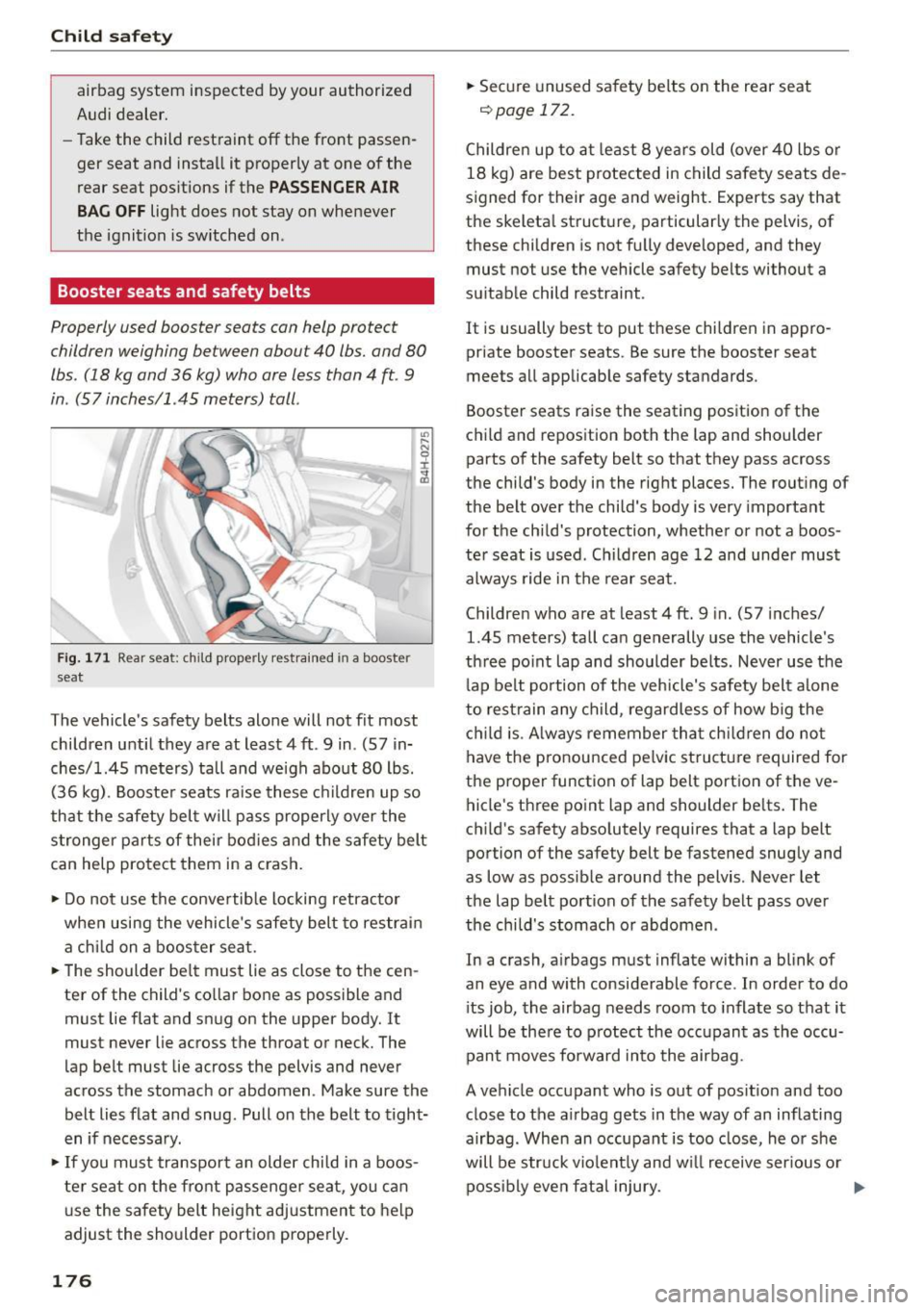
Properly used booster seats con help protect
children weighing between about 40 lbs. and 80
lbs. (18 kg and 36 kg) who ore less than 4
ft. 9
in . (57 inches/1 .45 meters) tall .
Fig. 171 Rear seat: ch ild prope rly restrained in a booster
seat
"' ,-.
i i
The vehicle's safety belts alone will not fit most
children until they are at least 4
ft. 9 in . (57 in
ches/1.45 meters) tall and weigh about 80 lbs.
(36 kg). Booster seats raise these children up so
that the safety belt will pass properly over the
stronger parts of their bodies and the safety belt
can help protect them in a crash.
• Do not use the convertible locking retractor
when using the vehicle's safety belt to restrain
a child on a booster seat.
• The shoulder be lt must lie as close to the cen
ter of the child's collar bone as possible and
must lie flat and snug on the upper body. It
must never lie across the throat or neck. The
lap belt must lie across the pelvis and never
across the stomach or abdomen . Make sure the
belt lies flat and snug . Pull on the belt to tight
en if necessary.
• If you must transport an older child in a boos
ter seat on the front passenger seat, you can
use the safety belt height adjustment to help
adjust the shoulder portion properly .
176
• Secure unused safety belts on the rear seat
r=;, page 172 .
Children up to at least 8 years old (over 40 lbs or
18 kg) are best protected in child safety seats de
signed for their age and weight . Experts say that
the skeletal structure, particularly the pelvis, of
these children is not fully developed, and they
must not use the vehicle safety belts without a
suitable child restraint .
It is usually best to put these children in appro
priate booster seats . Be sure the booster seat
meets all applicable safety standards.
Booster seats raise the seating position of the
child and reposition both the lap and shoulder parts of the safety belt so that they pass across
the child 's body in the right places. The routing of
the belt over the child 's body is very important
for the child's protection, whether or not a boos
ter seat is used. Children age 12 and under must
always ride in the rear seat.
Children who are at least 4
ft. 9 in. (57 inches/
1.45 meters) tall can generally use the vehicle's
three point lap and shoulder belts . Never use the
lap belt portion of the vehicle's safety belt alone
to restrain any child, regardless of how big the
child is. Always remember that childr en do not
have the pronounced pelvic structure required for
the proper function of lap belt portion of the ve
hicle 's three point lap and shoulder belts. The
child's safety absolutely requires that a lap belt
portion of the safety belt be fastened snugly and
as low as possible around the pelvis . Never let
the lap belt portion of the safety belt pass over
the child's stomach or abdomen .
In a crash, airbags must inflate within a blink of
an eye and with considerable force . In order to do
its job, the airbag needs room to inflate so that it
will be there to protect the occupant as the occu
pant moves forward into the airbag .
A vehicle occupant who is out of position and too
close to the airbag gets in the way of an inflating
airbag . When an occupant is too close, he or she
will be struck violently and will receive serious or
possibly even fatal injury. .,..
Page 179 of 294
M N <( (.J
'SI: ,...., \!) 1.1'1
N \!) ,....,
In order for the airbag to offer protection, it is
important that all vehicle occupants, especially
any children, who must be in the front seat be
cause of exceptional circumstances, be properly
restrained and as far away from the airbag as
possible . By keeping room between the child's
body and the front of the passenger compart
ment, the airbag can inflate completely and pro
vide supplemental protection in certain frontal
collisions .
A WARNING
Not using a booster seat, using the booster
seat improperly, incorrectly installing a boos
ter seat or using the vehicle safety belt im
properly increases the risk of serious personal
injury and death in a collision or other emer
gency situation. To help reduce the risk of se
rious personal injury and/or death:
- The shoulder belt must lie as close to the
center of the child's collar bone as possible
and must lie flat and snug on the upper
body . It must never lie across the throat or
neck. The lap belt must lie across the pelvis
and never across the stomach or abdomen.
Make sure that the belt lies flat and snug.
Pull on the belt to tighten if necessary.
- Failure to properly route safety belts over a
child's body will cause severe injuries in an
accident or other emergency situation
¢ page 135.
-The rear side of the child safety seat should
be positioned as close as possible to the
backrest on the vehicle seat.
- For adjustable head restraints : adjust or re
move the rear seat head restraint if it is dif
ficult to install the child seat with the head restraint in place¢
page 56. Install the
head restraint again immediately once the
child seat is removed. Driving without head
restraints or with head restraints that are
not properly adjusted increases the risk of
serious or fatal neck injury dramatically .
- Children on the front seat of any car, even
with Advanced Airbags, can be seriously in
jured or even killed when an airbag inflates.
- Never let a child stand or kneel on any seat,
for example the front seat.
-
Child safety
-Never let a child ride in the cargo area of
your vehicle.
- Always remember that a child leaning for
ward, sitting sideways or out of position in any way during an accident can be struck by
a deploying airbag. This will result in serious
personal injury or death.
- If you must install a booster seat on the
front passenger seat because of exceptional
circumstances the
PASSENGER AIR BAG
OFF
light must come on and stay on, when
ever the ignition is switched on.
- If the
PASSENGER AIR BAG OFF light does
not come on and stay on, perform the
checks described ¢
page 154, Monitoring
the Advanced Airbag System.
- Take the child restraint off the front passen
ger seat and install it properly at one of the
rear seat positions if the
PASSENGER AIR
BAG OFF
light does not stay on whenever
the ignition is switched on.
- Always read and heed all WARNINGS when
ever using a child restrained in a vehicle is
being used
¢ page 135, Safety belts,
¢ page 143, Airbag system and
¢ page 167, Important information.
Securing child seats
Securing a child safety seat using a safety
belt
Safety belts for the rear seats and the front pas
senger can be locked with the convertible locking
retractor to properly secure child safety seats.
The safety belts emergency locking retractors for
the rear seats safety belts and for the front pas
senger's seat safety belt have a convertible lock
ing retractor for child restraints. The safety belt
must be locked so that belt webbing cannot un
reel. The retractor can be activated to lock the
safety belt and prevent the safety belt webbing
from loosening up during normal driving. A child
safety seat can only be properly installed when
the safety belt is locked so that the child and
child safety seat will stay in place .
Always remember: Even though your vehicle is equipped with an Advanced Airbag system, all
177
Page 180 of 294
Child safety
children, especially those 12 years and younger,
should always ride in the back seat properly re
strained for their age and size.
A WARNING
Improperly installed child safety seats in
crease the risk of serious personal injury and
death in a collision.
-
-Always make sure that the safety belt re
tractor is locked when installing a child safe
ty seat . An unlocked safety belt retractor
cannot hold the child safety seat in place
during normal driving or in a crash.
- Always buckle the child safety seat firmly in
place even if a child is not sitting in it . A
loose child safety seat can fly around during
a sudden stop or in a collision.
- Always make sure that the rear seat back
rest to which the center rear safety belt* is
attached is securely latched whenever the
rear center safety belt is being used to se
cure a child restraint.
- If the backrest is not securely latched, the
child and the child restraint will be thrown
forward together with the backrest and will
strike parts of the vehicle interior. The child can be seriously injured or killed.
- Never install rear-facing child safety seats or
infant carriers on the front passenger seat.
A child will be seriously injured and can be killed when the passenger airbag inflates.
- The inflating airbag will hit the child safety seat or infant carrier with great force and
will smash the child safety seat and child against the backrest, center armrest, door
or roof.
- Always install rear-facing child safety seats
or infant carriers on the rear seat .
- Forward-facing child safety seats or infant
carriers installed on the front passenger's
seat may interfere with the deployment of
the airbag and cause serious injury to the child.
- It is safer to install a forward-facing child
safety seat on the rear seat.
- Always read and heed all WARNINGS when
ever using a child restrained in a vehicle is
being used
Qpage 167. Special precautions
178
apply when installing a child safety seat on
the front passenger seat
Q page 144, Child
restraints on the front seat -some impor
tant things to know.
A WARNING
Always take special precautions if you must
install a forward or rearward-facing child re
straint on the front passenger's seat in excep
tional situations:
- Whenever a forward or rearward-facing
child restraint is installed on the front pas
senger seat, the
PASSENGER AIR BAG OFF
light must come on and stay on whenever
the ignition is switched on.
- If the PASSENGER AIR BAG OFF light does
not come on and stay on, perform the
checks described
Q page 154, Monitoring
the Advanced Airbag System.
- Take the child restraint off the front passen
ger seat and install it properly at one of the
rear seat positions if the
PASSENGER AIR
BAG OFF
light does not stay on whenever
the ignition is switched on.
- Improper installation of child restraints can
reduce their effectiveness or even prevent
them from providing any protection.
- An improperly installed child restraint can interfere with the airbag as it deploys and
seriously injure or even kill the child .
-Always carefully follow the manufacturer's
instructions provided with the child safety
seat or carrier.
- After checking to make sure that the child
restraint is properly installed, make certain
that the child restraint is correctly recog
nized by the capacitive passenger detection
system in the front passenger seat and that
the
PASSENGER AIR BAG OFF light signals
the correct front passenger frontal airbag
status.
A WARNING
Forward-facing child restraints:
-
Page 181 of 294
M N <( (.J
'SI: ,...., \!) ..,.,
N \!) ,....,
-Always mak e sure the forward-facing seat
has been designed and certified by its man
ufacturer for use on a front seat with a
passenger front and side airbag .
- Never pu t the forward-facing child restraint
up, aga inst or very near the ins trument pan
el.
- Always move the passenger seat into its
rearmost position in the seat's fore and aft
adjustment range, as far away from the air
bag as possib le befo re installing the for
wa rd-fac ing child restra int. The backres t
must be ad justed to an up right posit io n.
- Make sure that the
PASSENGER AIR BAG
OFF
light comes on and s tays on all the t ime
whe never the ignition is switched on.
_& WARNING
Rearw ard-fac ing ch ild restra ints:
- A ch ild in a rearwa rd-facing child safety seat
installed on the fron t passenger seat will be
seriously injured and can be k ille d if the
front airbag inflates - even with an Ad
vanced Airbag System .
- The inflati ng a irbag w ill hit the child safety
seat or infant carrier with great fo rce and
will smash the ch ild safety seat and chi ld
against the backrest, center armrest, door
o r roof.
- Always be especially caref ul if you must in
stall a rearward facing ch ild safety seat on
the front passenger seat in exceptional cir
cumstances .
- Make sure that the
PASSENGER AIR BAG
OFF
light comes on and stays on all the t ime
whenever the ignition is switched on .
- If the
PASSENGER AIR BAG OFF light does
not come on and stay on, immed iately in
stall the rear-fac ing c hild safety seat in a
rear seating position and have the airbag
system inspected by your Au di deale r.
Child sa fety
Act ivating the convertible locking retractor
Use the convertible locking retractor to secure a
child restraint .
Always heed the ch ild safety seat manufac ture r's
ins truc tions when ins talling a child res train t in
your vehicle . T o activate the convertible locking
re tractor:
.. Place the child restraint on a sea t, preferably on
the rear sea t.
.. Slowly p ull the belt
all the way out .
.. Route it a round or through the child rest ra int
be lt pat h
~ .& .
.. Push the c hild safety sea t down with you r full
we igh t to ge t the sa fe ty belt re ally t igh t.
.. Insert the belt tongue into the buc kle for tha t
seating posit ion .
.. Guide the saf ety belt back into the retractor un
til the belt lies flat and sn ug on the ch ild safety
seat .
.. You should hear a "clicking" noise as the belt
w inds bac k into the ine rtia reel. Test the con
vert ible locking retracto r by pu lli ng on the belt .
Yo u shou ld no lo nger be able to pull the belt
ou t of the re tr actor. The conve rtible locking re
t racto r is now ac tiva ted .
.. Ma ke s ure that the red release button is fac ing
away from the child rest raint so that it can be
unbuckled quickly .
.. Pull on the belt to make sure the safety be lt is
properly tight and fastened so t hat the se at
cannot move forward or sideways more than
one inch (2 .5 cm) .
_& WARNING
Using the wrong child re straint o r an i mprop
e rly insta lled child rest raint can cau se serious
p erson al injury or deat h in a cra sh .
- Always ma ke sure that the safe ty belt re
tr act o r i s lo cked when in sta lling a child safe
ty seat . An unloc ked sa fety belt retrac tor
cannot hold the child safety seat in place
du ring normal d riving or in a c rash.
- Always buckle the child sa fe ty seat firmly in
p lace even if a ch ild is not sitting in it. A
loose child safety seat can fly aro und durin g
a sudden stop or in a c rash. ..,.
179
Page 197 of 294
M N <( (.J
'SI: ,...., \!) ..,.,
N \!) ,....,
back or switched off. This reduces energy use and
ensures the vehicle will be able to start after long
periods of time . Some convenience functions,
such as interior lighting or power seat adjust ment, may not be available under certa in circum
stances . These convenience functions will be
available aga in once you switch the ignition on
and start the engine.
With the engine switched off
The battery will drain if you use functions such as
listening to the rad io while the engine is switched
off.
The vehicle's ability to start may be impaired by
the energy use, a message w ill appear in the In
fotainment system d isp lay.
The message indicates that the system will
switch off automatically soon. If you would like
to continue using the funct ions, you must start
the eng ine.
With the engine running
Although electrical energy is generated whi le
driving, the battery can drain. This can happen
when little energy is generated, and much is used
and the charge level of the battery is not optimal.
To restore the balance of energy, components
that require large amounts of energy are tempo
rarily sca led back or switched off . Heating sys
tems in particu lar require a great deal of energy .
If you notice, for example, that the seat heating*
or rear window defroster is not working, then it
has been tempo rar ily reduced or sw itched off .
These systems are available again as soon as the
ene rgy balance has been restored.
In addition, you may notice that the idle speed
h as slightly increased . That is normal and no
cause for concern. Due to the increased idling
speed , the additional required energy w ill be gen
e rat ed and the battery will be charged.
Intelligent Technology
195
Page 201 of 294
M N <( (.J
'SI: ,...., \!) 1.1'1
N \!) ,....,
Reducing unnecessary idling
Even when your car is just idling it burns up fuel.
~ Shut the engine off when you are not driving
the vehicle.
~ Do not warm up the vehicle by letting the en-
gine run at idle .
The idling phase is automatically reduced for
veh icles with the Start-Stop-System . It is effi
cient to switch off the engine in vehicles without
the Start-Stop-System when stopped at railroad
crossings and long red lights. Turning the engine
off for just 30-40 seconds saves more fuel than is
burned by starting the engine again.
It takes a long time for the engine to warm up
fully when it is running at idle . However, wear
and noxious emissions are especially high when
the engine is warm ing up. So you shou ld drive
away as soon as you start the engine and avoid
running at high rpms while the engine is still
warming up .
(D Note
Do not leave engine idling unattended after
starting. If warning lights should come on to
indicate improper operation, they would go
unheeded. Extended idling a lso produces
heat, wh ich could resu lt in overheating or oth
er damage to the vehicle or other property.
Regular maintenance
A badly tuned engine unnecessarily wastes a lot of fuel.
~ Have your vehicle serviced at regular intervals.
By having your vehicle regularly serviced by an
Aud i dea ler helps to ensure that it runs properly
and economica lly. The condition of your vehicle
not only affects its safety and ability to hold its
value, it a lso affects fuel consumption .
Check your oil each time you fill your tank.
The amount of oil used is related to engine load
and speed.
Driving and the environment
It is normal for the oil consumption of a new en
gine to reach its lowest value after a certain mile
age has been driven.
You must drive your veh icle about 3,000 miles
(5,000 kilometers) before you can properly as
sess oil consumption .
T h is also applies to fuel consumption and engine
o ut put .
CD Note
- Have your vehicle maintained properly and
in accordance with the service recommenda
tions in your Warranty
& Maintenance book
let . Lack of proper maintenance as well as
improper use of the vehicle will impair the
function of the em ission contro l system and
cou ld lead to damage.
- Do not alter or remove any component of
the Emission Control System unless ap
proved by the manufacturer.
- Do not alter or remove any device, such as
heat shields, sw itches, ignition wires,
valves, which are designed to protect your
vehicle's Emission Control System and other important vehicle components .
Fewer short trips
Fuel consumption will always be relatively high
on short trips .
~ Try to avoid dr iv ing short distances w ith a co ld
eng ine .
The engine and cata lytic converter have to reach
their optimal operating temperature to reduce
fuel consumpt ion and nox ious em issions effec
t ively.
Just after starting, a co ld engine in a mid-size car
only achieves a fuel economy of 6-8 mi les per
gallon (30-40 l/100 km) . After about a half a
mile, fuel economy climbs to 12 mpg (20 l/100
km). After about
2.5 miles (4 km), the eng ine is
at its proper operating temperature and fuel
economy has reached a norma l level. So you can
see that you should avoid short trips whenever
poss ible. .,.
199
Page 212 of 294
Fuel and Refueling
Fuel and Refueling
Gasoline
Fuel supply
A pp lies to veh icles: w ith gaso line engine
Using the right fuel helps keep the environment
clean and prevents engine damage.
Fuel r eco mmendation
The f uel recommended for your vehicle is unlead
ed premium
grade gaso line. A udi recommends
using TOP TIER Detergent Gasoline with a min i
mum octane rating of 91 AKI (95 RON). For more
info rmation on TOP TIER Detergent Gasoli ne,
p lease go to the official website
(www.toptiergas.com).
The recommended gasoline octane rating for
your engine can a lso be found on a label located
on the ins ide of the fue l filler flap. This ra ting
may be specified as AKI or RON.
Your vehicle may also be operated using unlead
ed regula r gasol ine with a minimum octane rat
ing of 87 AKl/91 RON. However, using 87 AKl/91
RON octane fue l will slight ly reduce eng ine per
for mance.
Use unleaded ga soline only. Unleaded gasoline
is available th roughout the USA, Canada, and in
most European cou ntries. We recommend t hat
you do not ta ke yo ur vehicle to a reas or coun tries
where unlea ded gaso line may no t be ava ilab le.
For mo re info rmat ion on refueli ng your ve hicle,
see
¢page 212.
Octane rat ing
Octane rating ind icates a gaso line's ability to re
sist engine damaging "knock" caused by prema
ture ignition and detonation. The refore, buying
the co rrect g rade of gasoline is very importa nt to
he lp p revent possible eng ine damage a nd a loss
of eng ine pe rforma nce.
Gasoline most commonly used in the Un ited
States and Canada has the following octane rat
i n gs that ca n usually be found on the filler pump:
- Prem ium G rade: 91 - 96 AKI
210
- Regular Grade: 8 7 -90 AKI
E xplanation of the abb revia tions:
AKI = Anti Knock Index= (R+M)/2 = (RON+MON)/
2
RON= Research Octane Number
M ON= M otor Octane Number.
{[) Note
-Do not use a ny fue l w ith o ctane rat ings low
er th an 8 7 AKI or 91 R ON othe rwi se e xpe n
sive engine damage w ill occur .
- Do
not use le ade d gas oline . The u se of le ad
e d gasoline will severely damage your veh i
cle's cataly tic conver ter and i ts ab ility to
cont rol exha ust em issions.
Blended gasoline
App lies to vehicles: wit h gaso line e ngi ne
U se of g asoline cont aining alcohol or MTBE
(methyl tert iary butyl ether)
You may use unleaded gasoline blended with a l
cohol or MTBE (commonly referred to as oxygen
ates) if th e b le nded mixture mee ts the following
c riteria :
Blend of gasoline methanol (wood alcohol or
methyl alcohol)
- Anti -knoc k index must be 8 7 AKI or higher.
- Blend must contain no more t han 3% metha-
nol.
- Blend must contain more than 2% co -solven ts.
Blend of gasoline and ethanol (grain alcohol or
ethyl alcohol)
- Anti-knoc k index mus t be 87 AKI or higher.
- Blend must not conta in more than 15% etha-
nol.
Blend of gasoline and MTBE
- Anti-knoc k index mus t be 87 A KI or high er.
- Blend mus t contain no t mo re tha n 1S % M TBE.
Seasonally adjusted gasoline
Many gasoline grades are blended to perfo rm es
pecially well for winter or s ummer dr iv ing . Dur-
i ng seasonal change-over, we suggest that you .,..
Page 214 of 294
Fuel and Refueling
These fuels contain substances that can se
verely damage the fuel system and the en
gine if the engine is started.
Refueling
Fuel filler neck
The fuel filler neck is located on the right rear
side pane l beh ind the fuel filler flap .
If the power locking system should fail, you can
still open the flap manually - for detailed instruc
tions see
¢page 214.
You can find the fuel tank capacity of your vehicle
in
¢ page 272 .
The label on the inside of the fuel filler flap tells
you the correct fuel for your vehicle. For more in
formation about fuel specifications, see
¢ page 210 .
Your vehicle fuel tank has an on board refuelling
vapor recovery system. This feature helps to pre
vent fuel vapors from escaping from the tank and polluting the environment while you refue l your
vehicle. In order to fill the tank properly whi le
protec ting the environment, please follow this
refueling procedure carefully.
8_ WARNING
Under normal operating conditions, neve r ca r
ry additional fuel containers in your car. Gas
canisters and other containers used to trans
port fuel can be dangerous. Such containers,
full or empty, may leak and could cause a fire
in a collision. If you must transport fuel to
use for your lawn mowe r, snow blower, etc.,
be very careful and always observe loca l and
state laws rega rding the use, transportation
and storage of such fuel containers. Make cer
tain the con tainer meets industry standards
(ANSI/ASTM F852 -86).
(D Note
Never drive you r vehicle until the fuel tank is
completely empty. The irregu lar supply of
fue l can cause misfiring. Gasoline could enter
the exhaust system and damage the catalytic
converter.
212
Refuelling
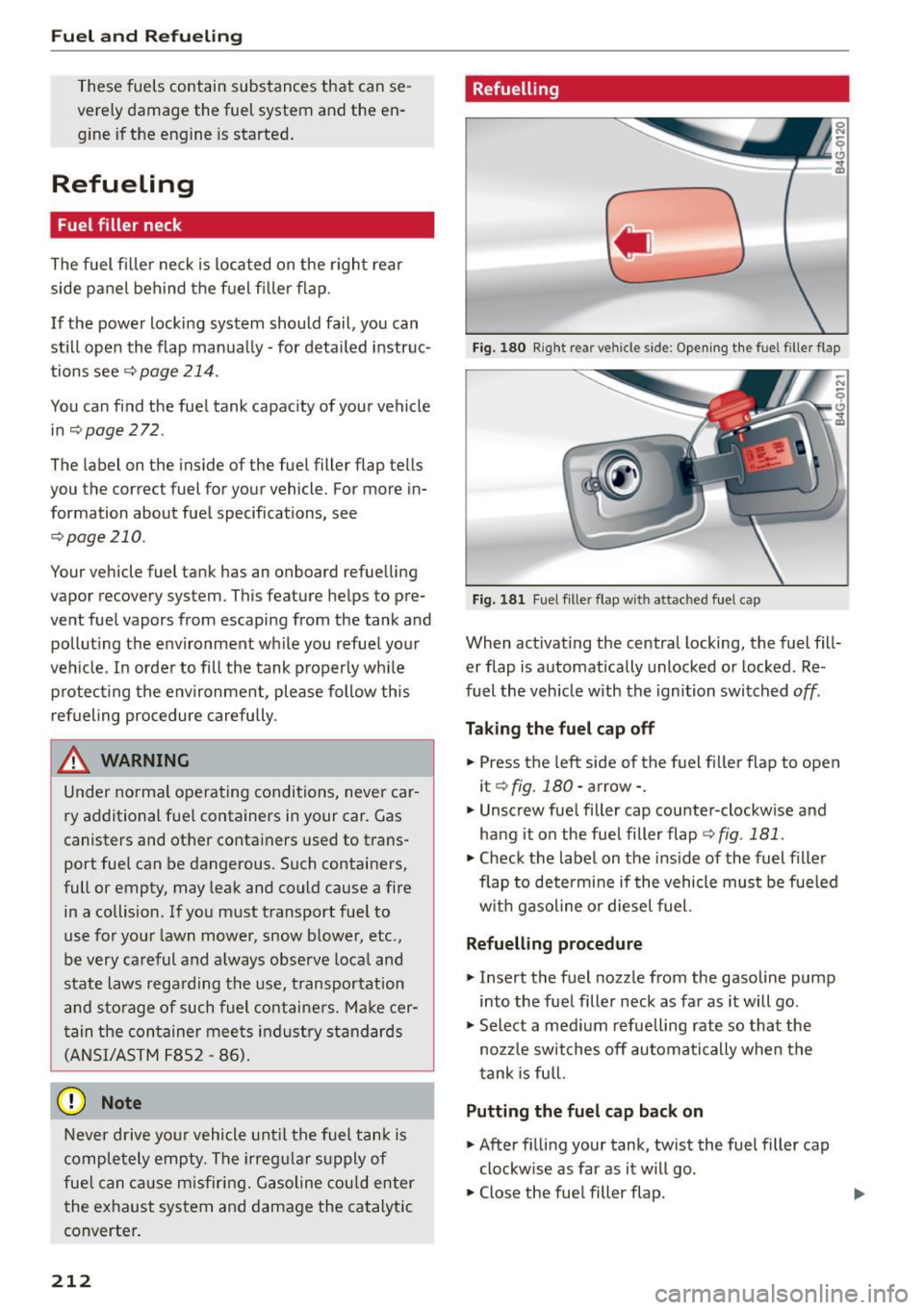
Fig. 180 R ig ht rea r ve hicle side : Opening the fuel fill er flap
Fig. 181 Fuel fille r flap w ith attac hed fuel cap
When act ivating the central locking, the fuel fill
er flap is automatically unlocked or locked . Re
fuel the veh icle with the ignition switched
off.
Taking the fuel cap off
.. Press the left side of the fuel f iller flap to open
it ¢
fig. 180-arrow-.
.. Unscrew fuel filler cap counter-clockwise and
hang it on the fuel filler flap
~ fig . 181 .
.. Check the label on the ins ide of the fuel filler
flap to determine if the vehicle must be fue led
w ith gasoline or diesel fuel.
Refuelling procedure
.. Insert the fuel nozzle from the gasoline pump
into the fuel filler neck as far as it will go .
.. Select a medium refuelling rate so that the
nozzle switches off automatically when the
tank is full.
Putting the fuel cap back on
.. After filling your tank, twist the fuel filler cap
clockw ise as far as it will go .
.. Close the fuel filler flap . ..,_
Page 215 of 294
M N <( (.J
'SI: ,...., \!) 1.1'1
N \!) ,....,
To avoid fuel spilling or evaporating from the fuel
tank always close fuel filler cap properly and
completely. An improperly closed fuel filler cap
may also cau se the MIL lamp¢
page 28 to come
on.
A WARNING
Improper refueling or handling of fuel can
cause fire, explosion and severe burns .
- Fuel is highly flammable and can cause se
vere burns and other injuries .
- Failure to shut the engine off while refuel
ing and/or to insert the pump nozzle fully
into the fuel filler neck could cause fuel to
spray out of filler neck or to overflow . Fuel
spray and overflowing fuel can cause a fire .
- Never use a cellular telephone while refuel
ing. The electromagnetic radiation can
cause sparks that can ignite fuel vapors and
cause a fire.
-
-Never get back into your vehicle while refu
eling.
If in exceptional circumstances you
must get back in your vehicle while refuel
ing, make certain that you close the door
and touch metal to discharge static electric
ity before touching the filler nozzle again.
Static electricity can cause sparks that can ignite fuel vapors released during refueling.
- Never smoke or have an open flame any where in or near your vehicle when refueling
or filling a portable fuel container.
- For your safety, we strongly recommend that you do not travel with a portable fuel container in your vehicle . The container, full
or empty may leak and could cause a fire,
especially in a crash .
- If, under exceptional circumstances, you
must transport a portable fuel container,
please observe the following:
- Never fill a portable fuel container while it
is anywhere in or on the vehicle (for exam
ple, in the luggage compartment, or on
the trunk). Static electricity can build up while filling and can ignite fuel vapors
causing a fire.
- Always place a portable fuel container on
the ground before filling.
Fuel and Refueling
- Always keep the filler nozzle completely
inside the portable container before and
during filling.
- If filling a portable container made of
metal, the filler noz zle must always be in
contact with the container. This will help prevent static electricity from discharging
and cause a fire.
- Never spill fuel inside the vehicle or lug
gage compartment . Fuel vapors are highly
flammable.
- Always observe local and state/provincial laws regarding the use, storage and trans
portation of fuel containers.
- Make certain the fuel container meets in
dustry standards (ANSI/ ASTM F852 -86) .
(D Note
If any fuel has spilled onto the car, it should
be removed immediately to prevent damage
to the paint.
@) For the sake of the environment
As soon as the correctly operated nozzle
switches off automatically for the first time,
the tank is full. Do not try to add more fuel
because fuel may spill out . In addition, the
expansion space in the fuel tank will be filled -
causing the fuel to overflow when it becomes
warm and pollute the environment.
(D Tips
- Running your engine while refuelling may
cause vapors to escape or even cause fuel to
spill out of the tank. This would then shut
off the fuel nozzle before the tank is full.
- Do not refuel your vehicle with the ignition
switched on. The fuel gauge may otherwise
not indicate the correct fuel level after refu
elling.
- Diesel vehicles* are equipped with a diesel
misfueling protector. It allows the vehicle to
be fueled only with a diesel fuel pump noz
zle . A worn or damaged nozzle or a nozzle
that is too small may not be able to open
the diesel misfueling protector. If this is the .,..
213
Page 216 of 294
Fuel and Refueling
case, try turning the nozzle before inserting
it in the fuel fi ller neck, use a different fuel
pump or see your authorized Audi dea ler or
authorized repair facility for assistance.
- The fuel filler flap of your vehicle is not
l ocked when you lock the vehicle from the
inside .
Fuel filler door emergency release
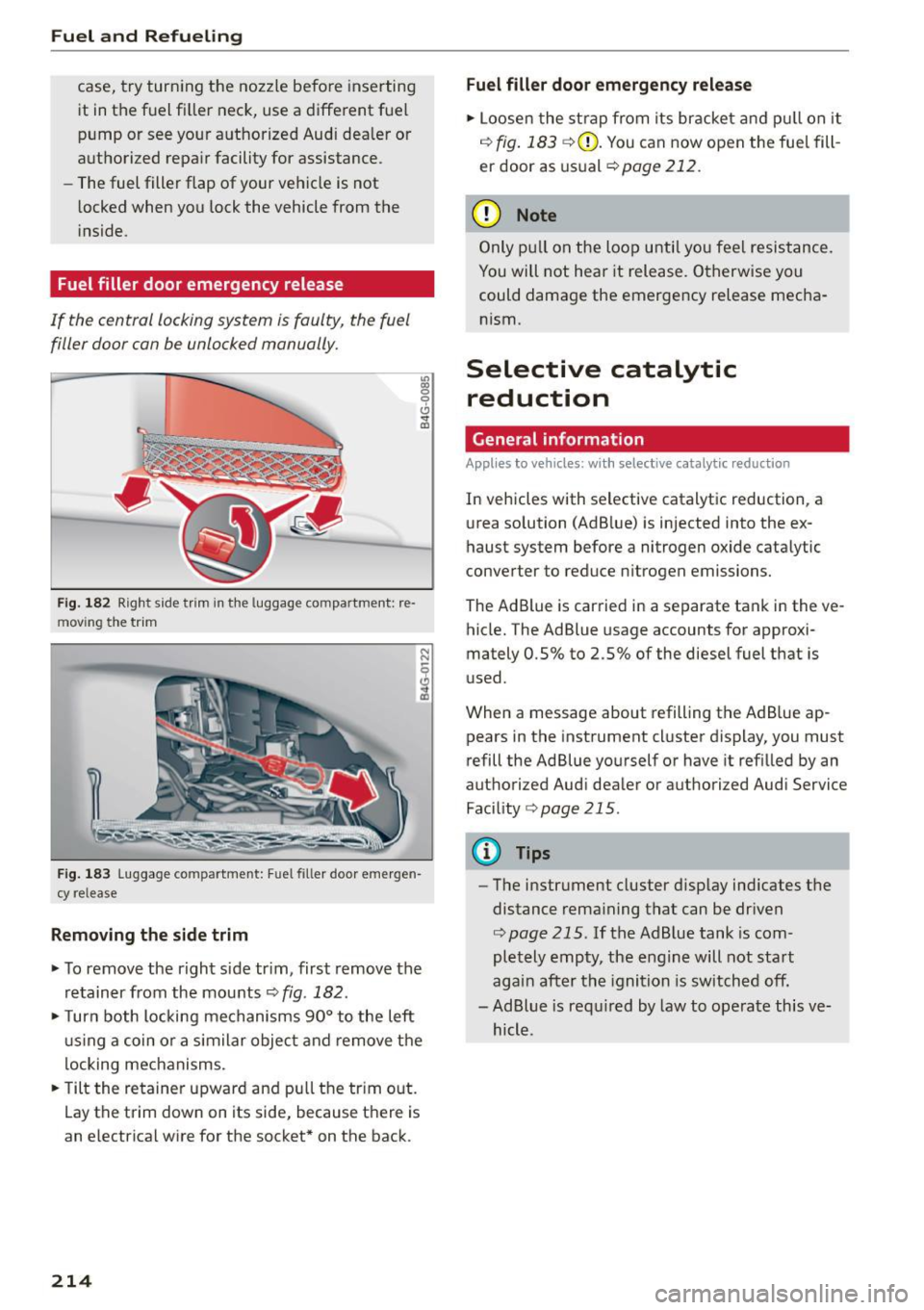
If the central locking system is faulty, the fuel
filler door can be unlocked manually.
Fig. 182 Right side tri m in the luggag e compartme nt: re·
mov ing the trim
"' ~ 0
<.:l
Fig. 183 Luggage compartment: Fuel filler door emergen
cy release
Removing the side trim
• To remove the right side tr im, first remove the
retainer from the mounts
r:!.> fig. 182.
• Turn both locking mechanisms 90° to the Left
using a coin or a similar object and remove the
locking mechanisms.
• Tilt the retainer upward and pu ll the tr im out.
Lay the trim down on its side, because there is
an electrical wire for the socket* on the back.
214
Fuel filler door emergency release
• Loosen the strap from its bracket and pull on it
r:!.> fig. 183 r:!.>{2) . You can now open the fuel fill
er door as usu al
r:!.> page 212.
(D Note
Only pull on the Loop until you feel resistance.
You will not hear it release. Otherwise you
could damage the emergency release mecha nism.
Selective catalytic reduction
General information
Applies to vehicles: with selective catalyt ic red uction
In vehicles with selective catalytic reduction, a
urea solution (AdB lue) is injected into the ex
haust system before a nitrogen oxide catalytic
converter to reduce nitrogen emissions.
The Ad Blue is carried in a separate tank in the ve
hicle. The Ad Blue usage accounts for approxi
mately O. 5 % to 2. 5% of the diesel fuel that is
used.
When a message about refilling the AdBlue ap
pears in the instrument cluster display, you must
refill the Ad Blue yourself or have it refilled by an
authorized Audi dealer or authorized Audi Service
Facility
r:!.> page 215.
{!) Tips
-The instrument cluster d isp lay indicates the
distance remaining that can be driven
r:!.>page 215. If the AdBlue tank is com
pletely empty, the engine will not start
again after the ignition is switched off.
- Ad Blue is requ ired by law to operate this ve
hicle.