check oil AUDI S8 2008 User Guide
[x] Cancel search | Manufacturer: AUDI, Model Year: 2008, Model line: S8, Model: AUDI S8 2008Pages: 404, PDF Size: 52.7 MB
Page 314 of 404
-
Checking and filling
..._--=--=--------------
Fig. 264 Illustration of
principle 2: Markers on
oil dipstick
Before you check anything in the engine compartment,
always read and heed all
WARNINGS ~ & in "Working in
the engine compartment" on
page 307 .
Determining oil level
-Park your vehicle so that it is horizontally level.
-While at operating state temperature, briefly let the
engine run at idle and then shut it off.
-Wait approx. two minutes.
Pull out the oil dipstick. Wipe off the oil dipstick with a
clean cloth, and slide it back in as far as it will go.
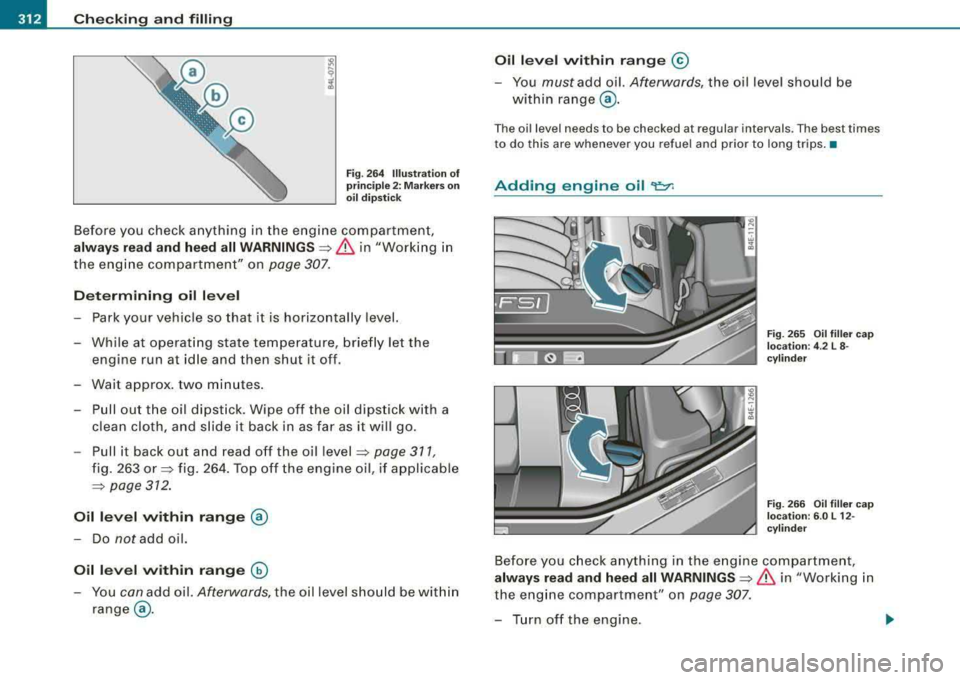
-Pull it back out and read off the oil level ~ page 311,
fig. 263 or~ fig. 264. Top off the engine oil, if applicable
~ page 312.
Oil level within range @
-Do not add oil.
Oil level within range
@
-You can add oil. Afterwards, the oil level should be within
range @. Oil level within range
©
You must add oil. Afterwards, the oil level should be
within range @.
The oil level needs to be checked at regular intervals. The best times
to do this are whenever you refuel and prior to long trips. •
Adding engin e oil 'l:::7:
Fig. 265 Oil filler cap
location: 4.2 L
8-
cylinder
Fig . 266 Oil filler cap
location : 6.0 L
12 -
cylinder
Before you check anything in the engine compartment,
always read and heed all
WARNINGS ~ & in "Working in
the engine compartment" on
page 307.
-Turn off the engine . .._
Page 315 of 404
Checkin g and fillin g -
-----------------=-----------"'---
•
-Unsc rew the oil filler cap f rom the cylinde r head cover
=>
page 312, f ig . 265 or=> page 312, fi g. 266 .
-Carefully top off with the appropriate o il in 0.5 liter doses.
-Check the oi l level again after two minutes => page 311 .
-Top off the oil again, if necessary .
-Screw the cap bac k on the filling hole and slide the oil
dipstick in as fa r as i t will go .
& WARNING
• Whil e topping off , the oil mu st not com e in c ontact with hot
e ng ine p art s
-fire h azard!
• The oil filler cap mu st be prop erly se cur ed to pr even t oil from
be ing spr aye d on the hot en gi ne a nd exha ust sys te m when the
engin e is running
-fir e haza rd!
• If your skin h as c ome in cont act wi th the engine oil , you mu st
s ubs equen tly c leanse it thoroughl y.
0 Not e
• The o il level must not be above range @- da nger of converter or
engine damage! Contact an authorized dealership to draw off oi l, if
necessary.
• Audi d oes no t re commend the u se of o il a ddit ives. The y m ay
damage th e engine and adv erse ly a ffect y our New Vehicle Warr ant y.
<£> For the sake of the environment
• Under no circumstances can the o il come i n contact w ith the
sewage network or the soil.
• Observe and fol low legal regulat ions when d ispos ing of empty
oi l containers. •
Changing the engine oil
We recommend that have your oil changed by an auth o
rized Audi dealer or a qualified service station.
Before you check anything in the engine compartment, always rea d
and heed all
WARNING S=> & in "Working in the engine co mpart
ment" on
page 307.
The engine oi l must be changed according to the interva ls specified
in your Warranty
& Maintenance booklet . This is very important
because the lubricating properties of oi l diminish gradua lly during
normal vehicle use.
Under some circumstances the engine oil shou ld be changed more
frequently . Change oil mo re often if you drive most ly short
distances, operate the vehicle in dusty areas or under predomi
nantly stop -and -go traffic conditions, or have your ve hicle where
temperatures remain below freezing for extended periods.
Detergent additives in the oil will make fresh oi l look dark after the
eng ine has been runn ing for a short t ime . Th is is normal and is not
a reason to change the oil more often than recommended .
Because of the problem of proper disposal, along with the spec ial
tools and necessary expertise required, we strong ly recommend
that you have your oi l ch anged by an authorized Audi dealer or a
qualified service station .
If you choo se to ch ang e y our oil your self, please note the following
important information:
& WARNING
To r edu ce the ri sk of per son al inju ry if you mu st change th e engine
oil in your v ehicl e your self :
• Wear eye prote ction .
• To r educ e the ri sk of burn s from hot en gine oil , le t the engine
c ool do wn t o th e tou ch . .,_
Vehicle care
Page 316 of 404
___ C_ h_e _c _ k_ i_ n ~g~ a_ n_ d_ f_ i_ll _in _g~--------------------------------------------
&, WARNING (continued)
• When removing the oil drain plug with your fingers, stay as far
away as possible. Always keep your forearm parallel to the ground
to help prevent hot oil from running down your arm.
• Drain the oil into a container designed for this purpose, one
large enough to hold at least the total amount of oil in your engine.
• Engine oil is poisonous. Keep it well out of the reach of children.
• Continuous contact with used engine oil is harmful to your
skin. Always protect your skin by washing oil off thoroughly with
soap and water.
0 Note
Never mix oil additives with your engine oil. These additives can
damage your engine and adversely affect your Audi Lim ited New
Vehicle Warranty.
<£> For the sake of the environment
• Before changing your oil, first make sure you know where you
can properly dispose of the used oil.
• Always dispose of used engine oil properly. Do not dump it on
garden soil , wooded areas , into open streams or down sewage
drains.
• Recycle used engine oil by taking it to a used engine oil collec
tion facility in your area, or contact a service station. •
Engine cooling system
Coolant
The engine coolant performs two functions: it keeps the
engine from overheating and it protects the engine from
freezing in the winter.
The cooling system is sealed and generally requires little attention.
The cooling system has been filled at the factory with a permanent
coolant which does not need to be changed . The coolant consists of
a mixture of water and the manufacturer's glycol -basedcoolant
additive G12 ++ antifreeze with anti corrosion addi tives (50% for USA
models; 60% for Canadian models). This mixture both assures the
necessary frost protection and protects metal components in the
engine's cooling system from corrosion and scaling. It also raises
the boiling point of the coolant.
Do not reduce the concentration of the coolant in the summer by
adding plain water.
The proportion of coolant additive must be at
least 50% but not more than 60%
to maintain antifree ze protection
and cooling efficiency. If the coolant frost protection is too low, the
coolant could freeze and damage the vehicle heating and engine
cooling system.
For year-round driving, antifreeze is added at the factory for temper
atures down to :
• -31 °F ( -35 °C) USA
•
-40 °F ( -40 °C) Canada .
You can mix the G12 ++ coolant additive with other additives (G12 +
or G12). Always check with your authori zed Audi dealer .
& WARNING
Before you check anything in the engine compartment, always
read and heed all WARNINGS
~ & in "Working in the engine
compartment" on
page 307.
Page 317 of 404
___________________________________________ C;:_:_: h..:e ..:c :..;.k..: i_n ..::g :.._ a_n _d_ f_il _li _n ..::g :.._--JIIIII
0 Note
• Before winter sets in, have the coolant checked to see if the
coolant additive in your vehicle is sufficient to meet the climate
conditions. This is especially important if you live in a region where
the winter is extremely cold. If necessary , increase the proportion of
coolant additive to 60%.
• When adding coolant additive to your cooling system,
remember:
-We recommend using only coolant additive G12+ + (check the
label) for your vehicle. This coolant additive is available at autho
rized Audi dealers. Other types of antifreeze can significantly
reduce corrosion protection . The resulting corrosion can cause a
loss of coolant and serious engine damage .
• Do not add any type of radiator leak sealant to your vehicle's
engine coolant. Adding radiator repair fluid may adversely affect the
function and performance of your cooling system and could result
in damage not covered by your New Vehicle Limited Warranty .•
Checking the engine coolant level
The engine coolant level can be checked with a quick
glance.
Fig . 267 Engine
compartment : Coolant
expansion tank
Before you check anything in the engine compartment,
always read and heed all WARNINGS => & in "Working in
the engine compartment" on
page 307.
Turn off the ignition.
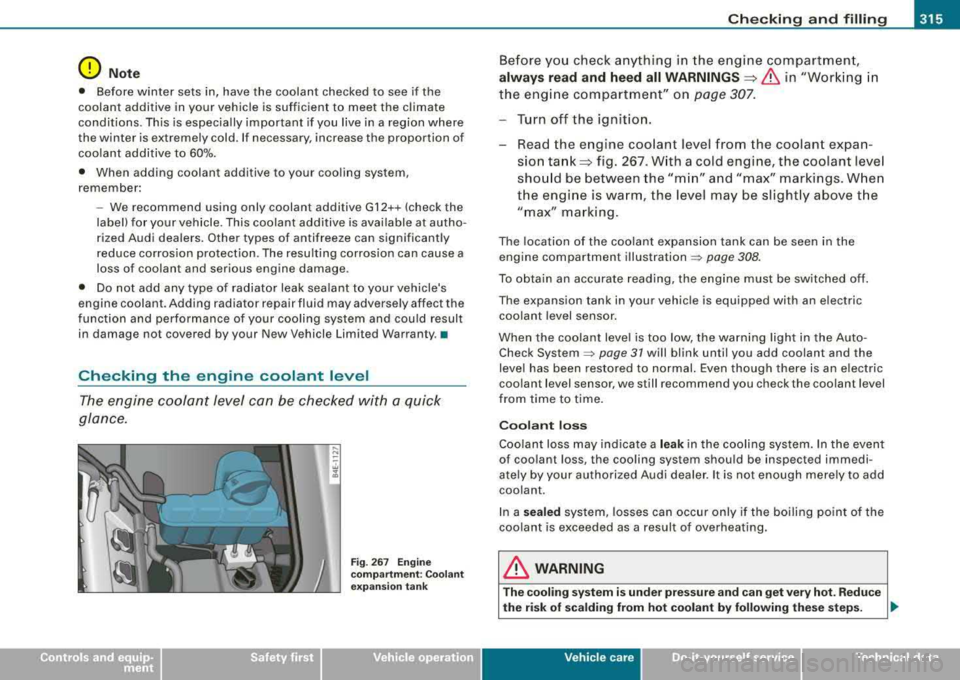
Read the engine coolant level from the coolant expan
sion
tank => fig. 267 . With a cold engine, the coolant level
should be between the "min" and "max" markings. When
the engine is warm, the level may be slightly above the
"max" marking.
The location of the coolant expansion tank can be seen in the
engine compartment illustration =>
page 308.
To obtain an accurate reading, the engine must be switched off.
The expansion tank in your vehicle is equipped with an electric
coolant level sensor.
When the coolant level is too low, the warning light in the Auto
Check
System => page 31 will blink until you add coolant and the
level has been restored to normal. Even though there is an electric
coolant level sensor, we still recommend you check the coolant level
from time to time.
Coolant loss
Coolant loss may indicate a leak in the cooling system. In the event
of coolant loss, the cooling system should be inspected immedi
ately by your authorized Audi dealer . It is not enough merely to add
coolant .
In a
sealed system, losses can occur only if the boiling point of the
coolant is exceeded as a result of overheating.
& WARNING
The cooling system is under pressure and can get very hot. Reduce
the risk of scalding from hot coolant by following these steps.
.,_
Vehic le care I I Technical data
Page 320 of 404
___ C_ h_e _c _ k_ i_ n ~g~ a_ n_ d_ f_ i_ll _in _g~--------------------------------------------
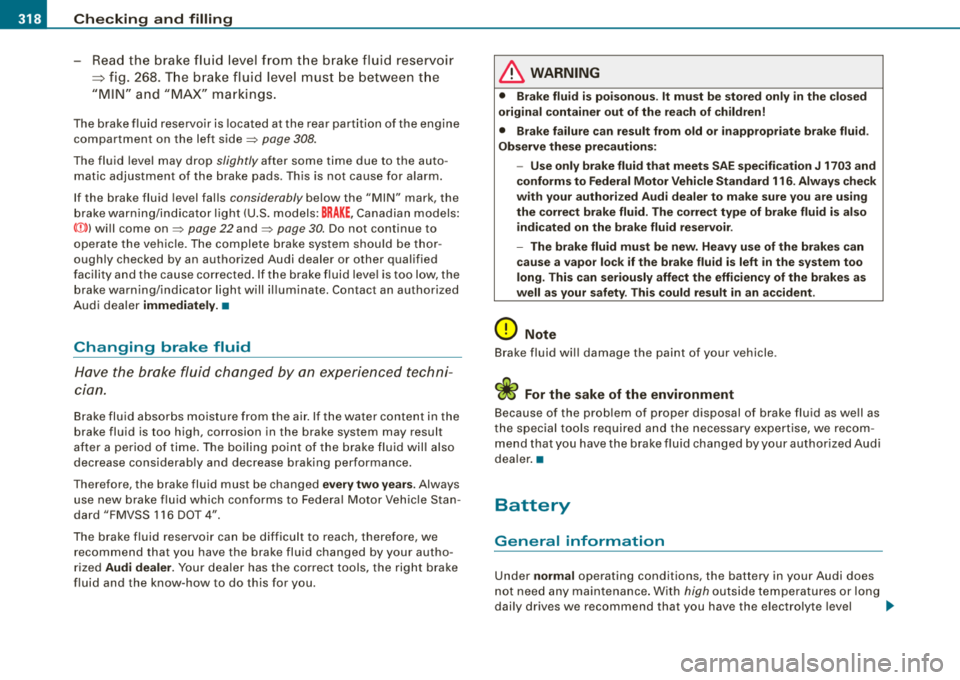
-Read the brake fluid level from the brake fluid reservoir
=> fig. 268. The brake fluid level must be between the
"MIN" and "MAX" markings.
The brake fluid reservoir is located at the rear partition of the engine
compartment on the left
side~ page 308.
The fluid level may drop slightly after some time due to the auto
matic adjustment of the brake pads. This is not cause for alarm.
If the brake fluid level falls considerably below the "MIN" mark, the
brake warning/indicator light (U.S. models:
BRAKE , Canadian models:
«D>l will come on~ page 22 and~ page 30. Do not continue to
operate the vehicle. The complete brake system should be thor
oughly checked by an authorized Audi dealer or other qualified
facility and the cause corrected. If the brake fluid level is too low, the
brake warning/indicator light will illuminate. Contact an authorized
Audi dealer
immediately. •
Changing brake fluid
Have the brake fluid changed by an experienced techni
cian.
Brake fluid absorbs moisture from the air. If the water content in the
brake fluid is too high, corrosion in the brake system may result
after a period of time. The boiling point of the brake fluid will also
decrease considerably and decrease braking performance.
Therefore, the brake fluid must be changed
every two years. Always
use new brake fluid which conforms to Federal Motor Vehicle Stan
dard "FMVSS 116 DOT 4".
The brake fluid reservoir can be difficult to reach, therefore, we
recommend that you have the brake fluid changed by your autho
rized
Audi dealer. Your dealer has the correct tools, the right brake
fluid and the know-how to do this for you.
& WARNING
• Brake fluid is poisonous . It must be stored only in the closed
original container out of the reach of children!
• Brake failure can result from old or inappropriate brake fluid .
Observe these precautions:
-Use only brake fluid that meets SAE specification J 1703 and
conforms to Federal Motor Vehicle Standard 116. Always check
with your authorized Audi dealer to make sure you are using
the correct brake fluid. The correct type of brake fluid is also indicated on the brake fluid reservoir .
- The brake fluid must be new. Heavy use of the brakes can
cause a vapor lock if the brake fluid is left in the system too
long. This can seriously affect the efficiency of the brakes as
well as your safety . This could result in an accident .
0 Note
Brake fluid will damage the paint of your vehicle .
<£> For the sake of the environment
Because of the problem of proper disposal of brake fluid as well as
the special tools required and the necessary expertise, we recom
mend that you have the brake fluid changed by your authorized Audi
dealer. •
Battery
General information
Under normal operating conditions, the battery in your Audi does
not need any maintenance. With high outside temperatures or long
daily drives we recommend that you have the electrolyte level .,,_
Page 327 of 404
Tires and wheels -
----------------
•
& WARNING (continued)
crashes and serious personal injuries . Have worn or damaged tires
replaced immediately.
• Tires age even if they are not being used and can fail suddenly,
especially at high speeds. Tires that are more than 6 years old can
only be used in an emergency and then with special care and at
low speed.
Glossary of tire and loading terminology
Accessory weight
means the combined weight (in excess of those standard items
which may be replaced) of automatic transmission, power steering,
power brakes, power windows, power seats, radio, and heater, to
the extent that these items are available as factory-installed equip
ment (whether installed or not).
Aspect ratio means the ratio of the height to the width of the tire in percent.
Numb ers of 55 or lower indicate a low sidewall for improved
steering response and better overall handling on dry pavement.
Bead
means the part of the tire that is made of steel wires, wrapped or
reinforced by ply cords and that is shaped to fit the rim.
Bead separation
means a breakdown of the bond between components in the bead.
Cord
means the strands forming the plies in the tire.
& WARNING (continued)
• Never mount used tires on your vehicle if you are not sure of
their
"previous history." Old used tires may have been damaged
even though the damage cannot be seen that can lead to sudden
tire failure and loss of vehicle control.
• If you notice unusual vibration or if the vehicle pulls to one side
when driving, always stop as soon as it is safe to do so and check
the wheels and tires for damage.
•
Cold tire inflation pressure
means the tire pressure recommended by the vehicle manufacturer
for a tire of a designated size that has not been driven for more than
a couple of miles (kilometers) at low speeds in the three hour period
before the tire pressure is measured or adjusted.
Curb weight
means the weight of a motor vehicle with standard equipment
including the maximum capacity of fuel, oil, and coolant, air condi
tioning and additional weight of optional equipment.
Extra load tire
means a tire design to operate at higher loads and at higher infla
tion pressures than the corresponding standard tire. Extra load tires
may be identified as
"XL", "xi", "EXTRA LOAD", or "RF" on the side
wall.
Gross Axle Weight Rating
("GAWR")
means the load-carrying capacity of a single axle system, measured
at the tire -ground interfaces.
Gross Vehicle Weight Rating
( " GVWR")
means the maximum total loaded weight of the vehicle.
Vehicle care
Page 345 of 404
Tires and wheels 11111 --------------------------------------------
•
Wheel bolts
Wheel bolts must al wa ys be tightened to the correc t
tor que .
The design of wheel bo lts is matched to the factory installed rims. If
di fferent r ims a re fitted, t he co rrect w heel bo lts wi th the rig ht len gth
and correct ly shaped bolt heads m ust be used. This ensures that
w he els a re fitt ed se cu rel y and that t he bra ke syste m functi on s
correctly.
In certa in ci rc ums ta nces, yo u may no t use wheel bo lts fr om a
differ ent vehicle - eve n if it is the sa me
model=:> page 382.
& WARNING
Improperly tightened or maintained wheel bolts can become loose
causing loss of control, a collision and serious personal injury.
• Always keep the wheel bolts and the threads in the wheel hubs
clean so the wheel bolts can turn easily and be properly tightened .
• Never grease or oil the wheel bolts and the threads in the wheel
hubs. They can become loose while driving if greased or oiled,
even if tightened to the specified torque .
• Only use wheel bolts that belong to the rim being installed .
• Never use different wheels bolts on your vehicle.
• Always maintain the correct tightening torque for the wheel
bolts to reduce the risk of a wheel loss .
If the tightening torque of
the wheel bolts is too low, they can loosen and come out when the
vehicle is moving . If the tightening torque is too high, the wheel
bolts and threads can be damaged and the wheel can become
loose .
0 Note
The specified torque for the wheel bo lts is 9 0 ft lb (12 0 N m) with a
t olerance o f± 7,4 ft lb(± 10 Nm). T orque whee l bolts diago nally.
After changing a whee l, the torque must be checked as soon as possible with a torque wrench
-preferably by an authorized Audi
dea ler o r qua lif ied wo rksho p.•
Low aspect ratio tires
You r Aud i is fact ory- eq uip pe d w it h lo w aspect rati o tire s. T hese tir es
hav e been thorough ly t ested and been se lect ed specifical ly for your
mod el for thei r supe rb pe rf or manc e, r oad f eel an d ha nd ling under
a variety of driving conditions. As k your authorized Audi d ealer for
m or e de tails.
The low aspect rat io o f th ese t ires is indicat ed by a nume ra l of 55 or
less in the tire's size designatio n. The numeral represents the ratio
o f t he tir e's s idewa ll he ig ht in r ela ti on to it s tread w idt h ex pressed
in percentage . Conventiona l tires have a height/width ratio of 60 or
more.
The performan ce of low -aspe ct-ratio tires is particularly sensitive to
improper inflation pressure . It is therefore important that low
aspect ratio tires are inflated to the specified pressure and that the
inflation pressure is regularly checked and maintained . Tire pres
sures should be checked at least once a month and alway s before a
long
trip :::::, page 331, "Checking tire pressure" .
What you can do to avoid tire and rim damage L ow a spect ratio tires can be damaged mo re easily by impact with
pot ho les, cu rbs, gull ies o r ridge s o n th e road, part icular ly if th e tire
is underinf lated .
I n or der to mini mize th e occurren ce of i mpac t da mag e to the tires
of your vehicle, we recommend that you observe the fol lowing
pr ecaut ions :
• Alwa ys m aint ain recom mended inflatio n pressu res . C he ck you r
t ire p res su re eve ry 2,000 mi les (3, 000 k m) and add ai r if neces sary .
• D rive carefully on roads with potho les, deep gullies or ridges .
The impac t from d riving th rough or ove r such o bstacles can
da mage you r tir es . Imp act with a curb may a lso caus e damage to
your tire s. .,_
Vehicle care
Page 372 of 404
lffll....__E_ m_ e_r -=g :....e_ n
_ c-=y _ s_ i_t _u _a _t_ i_o _n_ s _______________________________________________ _
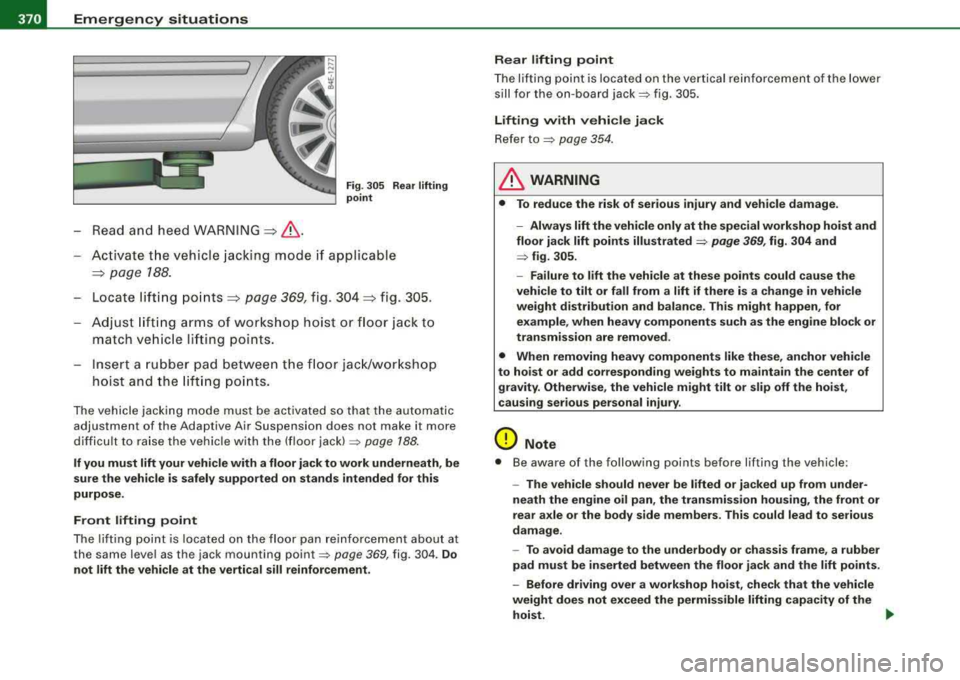
-Read and hee d WARNI NG =:> & .
Fig. 305 Re ar lifting
point
Ac tivate t he vehicle jackin g mode if a pp licable
=:> p age 188 .
-Loc ate lift ing po in ts=:> page 369 , fig. 3 04 =:> fig. 3 05.
Ad just lift in g a rms of works hop hoi st or floor jack t o
match ve hicle li ftin g points.
Ins ert a ru b be r pad betwe en the floor jack/work shop
h o ist and t he li ftin g poin ts.
The vehicle jacki ng m ode mus t be ac tiva ted so that the au tomatic
adjustment of the Adaptive Air Suspension does not make it more
d ifficu lt to ra ise the vehic le w ith the (floor
jac k) => page 188 .
If you must lift your vehicle with a floor jack to work underneath , be
sure the vehicle is safely supported on stands intended for this
purpo se.
Front lifting point
T he lif ti ng po int is locat ed o n th e floor pan re inforc ement abou t at
the same level as the jack mounting
point => page 3 69, fig. 304. Do
not lift the vehicle at the vertical sill reinforcement. Rear lifting point
Th
e lif tin g po int is loca ted o n the vertical re info rce ment of the l ower
s ill for t he o n-board
jack=> fig . 305.
Lifting with vehicle jack
Refer to => page 354.
& WARNING
• To reduce the risk of serious injury and vehicle damage.
-Always lift the vehicle only at the special workshop hoist and
floor ja ck lift points illustrated
=> page 369 , fig. 304 and
=> fig . 305.
- Failure to lift the vehicle at these points could cause the
vehicle to tilt or fall from a lift if there is a change in vehicle
weight distribution and balance. This might happen , for
example , when heavy components such as the engine block or
transmission are removed .
• When removing heavy components like these, anchor vehicle
to hoist or add corresponding weights to maintain the center of gravity. Otherwise , the vehicle might tilt or slip off the hoist,
c ausing serious personal injury .
0 Note
• Be awar e of the following points before lifting the vehicle :
-The vehicle should never be lifted or jacked up from under
neath the engine oil pan , the transmission housing , the front or
rear axle or the body side members . This could lead to serious
damage .
-To avoid damage to the underbody or chassis frame , a rubber
pad must be inserted between the floor jack and the lift point s.
- Before driving over a workshop hoist, check that the vehicle
weight does not exceed the permissible lifting capacity of the
hoid . ~
Page 383 of 404
_______________________________________________ C
_ o_ n
_ s_u _ m_ e_ r_l_ n _f_o _ r_ m_ a_ t
_ i
_ o _ n
__ l'III
re liabi lity . For detailed vehicle maintenance consult your Warranty &
Maintenance book le t.
Und er diff icult oper ating conditi ons, for example at extreme ly low
outside temperatures, in very dusty regions, when towing a trailer
very frequently, etc ., some serv ice work shou ld be performed
between the intervals specified. This applies particu lar ly to :
• oil changes, and
• cleaning or replacing the air filter.
c£> For the sake of the environment
By regularly maintaining your vehicle, you help make sure that emis
sion s tandards are maintained, thus minimizing adverse e ffec ts on
the environment. •
Important considerations for you and your
vehicle
The increasing use of electronics, sophisticated fue l injection and
emission contro l systems, and the genera lly increasing techn ica l
complexity of today's automobiles, have steadily reduced the scope
of maintenance and repairs which can be carr ied out by veh ic le
owners.
Also , safet y and env ironmental concerns p lace very strict
l im its on the nature of repairs a nd adjustmen ts t o engine and trans
mission parts which an owner can perform.
Maintenance, adjustments and repairs usually require special tools,
testing devices and other equipment availab le to spec ia lly trained
workshop personne l in order to assure proper performance, reli
abil ity and sa fety of the vehicle a nd its many systems.
I mproper maintenance, adjustments and repairs can impair the
operat ion a nd rel iabil ity of your vehicle and even vo id your vehicle
warranty. Therefore , proof of servicing in accordance with the main
t enance sched ule may be a cond ition fo r uphold ing a p ossi ble
warranty claim made within the warranty period.
Controls and equip ment Safety first Vehicle operation
Above all, operational safety can be adverse
ly affected, creating
unnecessary risks for you a nd yo ur passengers .
If in doubt about any servicing, have it done by your authorized Audi
dea ler or any other properly equipped and qualified workshop. We
strongly urge you to give your authorized Audi dea ler the opportu
nity to perform all scheduled maintenance and necessary repairs.
Your dealer has the fac ilities, origina l parts and trained spec ialists
to keep your vehic le running proper ly.
P e rforming limited maintenan ce yourself
The following pages describe a limited number of procedures which
ca n be performed on your vehicle with ord inary tools, should the
need arise and trained personne l be unavailab le. Before performing
any of these procedures, a lways t hor oughly read all o f the app li
cable text and carefu lly fo llow the instruct ions given. Always rigor
ously observe t he
WARNINGS provided .
Before you che ck anything in the engine comp artment , alwa ys re ad
and heed all
WARNING S=> & and => & in "Working in the engine
compartment" on
page 307.
& WARNING
• Serious personal injury may occur a s a result of imprope rly
performed maintenance , adju stments or repair s.
• Always be e xtremely careful when working on the vehi cle .
Always follow commonly accepted safety practice s and general
c ommon sen se . Ne ver risk per sonal injur y.
• Do not attempt any of the maintenance , checks or repairs
de scribed on the following pages if you are not fully familiar with
these or other pro cedures with re spe ct to the vehicle , or are uncer
tain how to pro ceed .
• Do not do any work without the proper tools and equipment.
Have the ne ce ssary work done by your authorized Audi dealer or
another properly equipped and qualified workshop .
~
Vehicle care Do-it-yourself service Technical data
Page 392 of 404
lll'ffll_....:..A..:.;l~ p :..;h..:.; a= b..:e :..;t:.:..i c::..:: a.:..l .,;. in :..:..:. d:..;e :..;x..:..,_ ___________________________________________ _
Driver's seat memory . . . . . . . . . . . . . . . . . 94
Activating remote contro l key .. ... .. 95
Recalling a seat position ...... .... . 94
Storing a seat position ............. 94
Driving messages .................... 29
Dr ivingsafely .... .... .... ...... .... 198
Driving time .... ... .. .... .... ...... .. 38
Dup licate key ......... ............... 47
DVD p layer for navigation system . . . . . 112
E
Easy entry feature 129
Electromechanica l parking brake
Emergency braking ............... 136
Malfunction ........ .... .... .... . 136
Operation . . . . . . . . . . . . . . . . . . . . . . . 134
Parking . . . . . . . . . . . . . . . . . . . . . . . . . 135
Re leasing and app lying .... .... ... 134
Starting
off with a trailer . ...... ... 136
Warning/indicator lights ........... 22
Electronic differential lock (EDU
How the system works . . . . . . . . . . . . 269
Warning/indicator lights ........... 21
Electronic immobilizer .. ...... ..... 14, 49
Electron ic power contro l
(EPC) warning/indicator light .. .... .. 18
Electronic speed limiter .. .. .. .... ..... 28
Electronic stabi lization program (ESP)
How the system works . . . . . . . . . . . . 268
Warning/indicator lights ........... 18
Emergency braking .. ....... .. ...... 136 Emergency
closing
Power sunroof ................. 67, 68
Emergency flasher . . . . . . . . . . . . . . . . . . . 73
Warning/indicator lights ..... ...... 19
Emergency locking ....... .... .... .... 54
Emergency locking of doors ........... 54
Emergency starting ........ .... ... .. 364
Emergency towing ..... .. .... .... ... 366
Emergency warning triangle ... ....... 348
Energy management .... .... ... .. ... 274
Battery power . . . . . . . . . . . . . . . . . . . 275
Driver notification ................ 275
Engine 4.2 I, 8-cylinder (350 hp) .... .... ... 308
6 .0 I, 12-cylinder (450 hp) .......... 309
Compartment . .... .... .... .. 308, 309
Coolant ......................... 314
Hood ... .. .... .... .... .... .... .. 306
Starting ...... .............. 129, 130
Starting with jumper cables .. ... .. 364
Stopping ........................ 131
Engine compartment ... .. .... .... ... 308
Safety instructions .......... ..... 307
Working the engine compartment .. 307
Engine coolant ..................... 314
Adding coolant ............. ..... 316
Checking the engine coo lant level .. 315
Expansion tank .................. 315
Malfunction symbo l ...... .... .... . 31
Radiator fan ...... .... .... .... ... 317
Temperature gauge . . . . . . . . . . . . . . . 12
Engine data ........................ 378 Engine hood
Closing ..... .. .... .... ...... ... . 307
How to release the hood . . . . . . . . . . 306
Engine oi l ..... ... .... .... .... ...... 309
Adding ......................... 312
Additives ........................ 312
Changing .. .... .... ..... .. .... .. 313
Checking the engine oil level ....... 311
Indica tions and conditions requiring extra
checking .. ...... .... ...... .... 311
Oil consumption ................. 311
Oil grades .. .... .... ... .... .... .. 309
Oil level symbol .... .... ...... ... .. 35
Pressure ma lfunction ... ... .... .... 32
Recommended oil check intervals .. 311
Sensor defective . . . . . . . . . . . . . . . . . . 35
Specification and viscosity ......... 309
Environment Break -in period .................. 277
Catalytic converter .... .... .... ... 278
Disposing of your vehicle battery ... 322
Driving at high speeds ....... ... .. 279
Driving to minimize pollution and noise .
279
Fuel ...... .... ........... .... ... 303
Fuel economy .......... .... .... .. 279
L eaks under your vehicle .......... 307
Le tting the vehicle stand and warm up ..
280
Proper disposal of drained brake fluid
318
Proper disposal of drained engine coolant . .... .... .... .... ....... 316