climate control AUDI S8 2008 User Guide
[x] Cancel search | Manufacturer: AUDI, Model Year: 2008, Model line: S8, Model: AUDI S8 2008Pages: 404, PDF Size: 52.7 MB
Page 125 of 404
Warm and cold -
------------------------------..J
[ i J Tip s
If the climate control system is operating in cool ing mode, air flows
primarily from the outlets in the center console and in the door
pillars . To achieve adequate cooling, you should never close the
out lets completely. •
Using climate controls economically
Using the climate controls prudently can help save fuel.
When you use t he a ir conditioner, engine power is reduced
and fuel consumption increases. To save fuel, you should
use the a ir co nditioner only when necessary. Also please
note the follow ing po ints:
- If you want to save fuel, activate ECON.
If you are going to drive with the windows open, use ECON.
W For the s ake of the environm ent
By reducing the amount of fuel you use, you also reduce the amount
of pollutants emitted into the air. •
Applies to v ehicl es: with so lar slidi ng /tilt ing sunr oof
Solar blower fan /solar roof
With sufficient sunlight, the blower fan continues to
operate with solar energy to bring in fresh air after the
ignition has been switched off.
T he fan motor is operated by solar energy through the solar roof
after the igni tion is turned off. P lease make certa in that
vents ©
and© are open to achieve optimal ventilation ~ page 122, fig. 137 .
Controls a nd eq uip
ment
The ventilation operates only with the sunroof c losed or in the tilted
position.
If the vehicle was switched off in the recirculation mode, the air
conditioning automatica lly switches to fresh air operation .
Solar operation is not activated at low outside temperatures .•
Windshield defogging/defrosting
Ap plie s to v ehic le s : with windsh ield defogg er/defr oste r
Windshield defogger /defroster ®
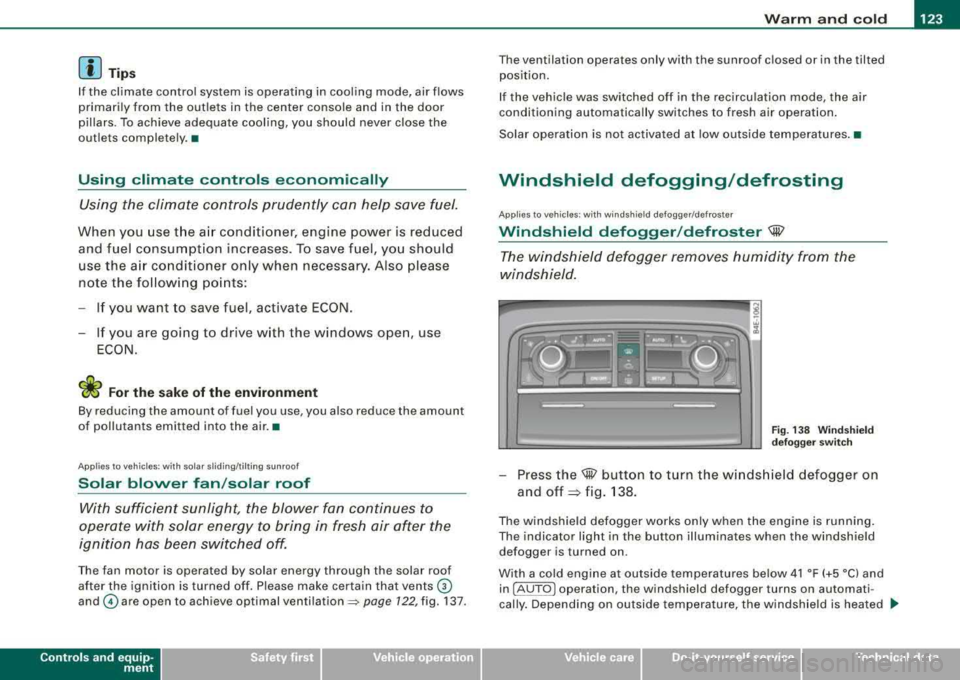
The win dshield defogger rem oves humidity from the
windshield.
F ig. 138 Win dsh ield
d efogger sw itc h
- Press the@ button to turn the w indshield defogger on
and
off ~ fig. 138 .
The w indshield defogger works only when the engine is running .
The indicator light in the button illuminates when the windshield defogger is turned on .
With a cold engine at outside temperatures below 41 °F (+5 °C) and in !AU TO
l operation , the windshield defogger turns on automati
cally . Depending on outside temperature, the windshie ld is heated .._
Vehicle care I I irechnical data
Page 126 of 404
___ w_ a_ rm __ a_ n_ d_ c_ o_ ld __________________________________________________ _
for a maximum of 4 minutes. The temperature for the climate
control must be selected so that it is operating in the heating mode.
When selecting the program setting
®, the windshield
defogger/defroster is switched on automatically at outside temper
atures below 41 °F (+5
°Cl. Depend ing on outside temperature, the
windshield is heated from 2 up to a maximum of 4 minutes.
The windshield defogger is deactivated in ECON mode .
[ i J Tips
• If a crack forms in the windshield due to a foreign object (e .g . a
stone chip), the defogger/defroster is not turned on . This prevents
the crack from spreading.
• We recommend that you locate an Audi dealership immediately
to have the windshield replaced.
•
Rear window defogger QW
Fi g. 13 9 Sw itch for
r ea r wi ndow defo gger
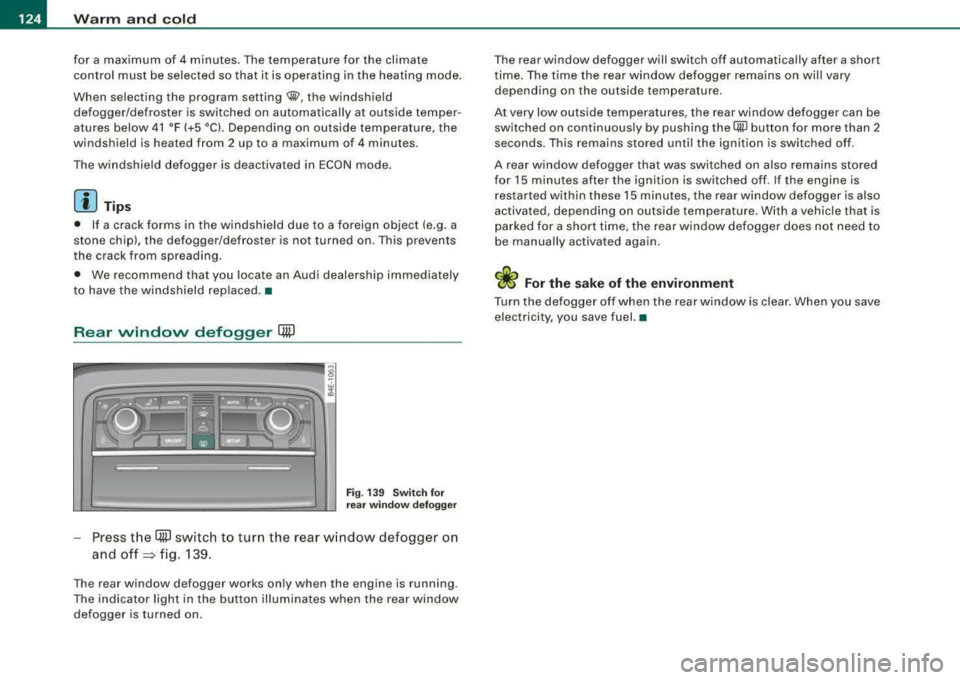
Press t he (ffiJ switch to turn the rear w indow defogger on
and
off => fig. 139.
The rear window defogger works only when the engine is running .
The indicator light in the button illuminates when the rear window
defogger is turned on . T
he rear window defogger will switch off automatically after a short
t ime . The time the rear window defogger remains on wi ll vary
depending on the outside temperature.
At very low outside temperatures, the rear window defogger can be switched on continuously by push ing the
QiP button for more than 2
seconds. This remains stored until the ignition is switched off .
A rear window defogger that was switched on also remains stored
for 15 minutes after the ignition is switched off . If the engine is
r estarted within these 15 minutes, t he rear w indow defogger is also
activated, depending on outside temperature. With a vehic le that is
parked for a short time, the rear window defogger does not need to
be manua lly activated aga in.
W For the sake of the environment
Turn the defogger off when the rear w indow is clea r. When you save
electricity, you save fuel. •
Page 127 of 404
Warm and cold -
-----------------'
Rear climate controls
Ap plies to vehic les: with rear a ir co ndition ing
Controls
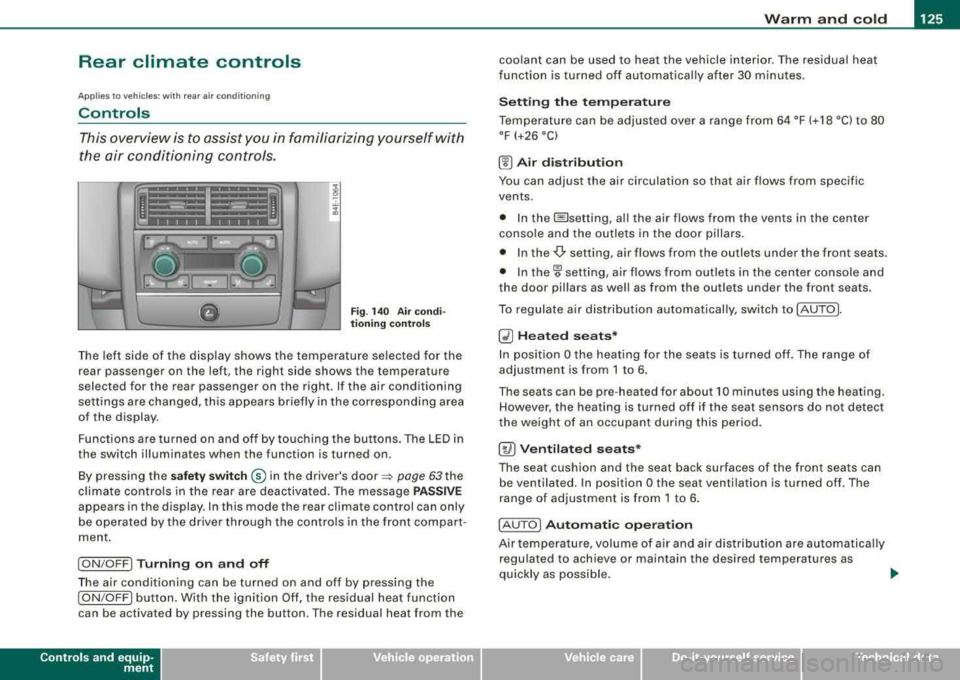
This overview is to assist you in familiarizing yourself with
the air conditioning controls .
Fig . 140 Air co ndi
t io ning contr ols
The left side of the display shows the temperature selected for the
rear passenger on the left, the right side shows the temperature
selected for the rear passenger on the right . If the air conditioning
settings are changed, this appears briefly in the corresponding area
of the display.
Functions are turned on and off by to uching the buttons . The LED in
the switch illuminates when the function is turned on .
By pressing the
sa fet y swi tc h ® in the driver's door ~ page 63 the
climate controls in the rear are deactiva ted. The message
P AS SIV E
appears in the display. In this mode the rear climate control can only
be operated by the driver through the contro ls in the front compar t
ment.
I ON /OFF] Tu rni ng o n and off
The air conditioning can be turned on and off by pressing the
I ON /OFF] button. With the ignit ion Off, the residual heat function
can be activated by pressing the button . The residual heat from the
Contro ls a nd eq uip
ment
coolant can be used to heat the vehicle interior. The residual heat
f unction is turned off au tomatica lly after 30 minu tes .
Se tting th e te mp era tu re
Temperature can be adjus ted over a range from 64 °F (+ 18 °C) to 80
°F (+26 °C)
(!) A ir di st ribu tion
You can adjust the air circulation so that air flows from specific
vents.
• In the @setting, al l the air flows from the v ents in the center
conso le and the outlets in the door pillars.
• In the
-Or setting, air flows from the outlets under the front seats.
• In
the~ setting, air flows from ou tlets in the center console and
the door pil lars as we ll as from the outlets under the front seats .
To regulate air distribution automatical ly, swi tch to !AUTO].
~ H ea ted se ats*
In posit ion O the heating for the seats is turned off. The range of
adjustment is from 1 to 6 .
The seats can be pre -heated for about 10 minutes us ing the heating.
However , the heating is turned off if the seat sensors do not detect
the weight of an occupant during this period .
[ty) Ventil ate d seats*
The seat cushion and the seat back surfaces of the fron t seats can
be ventilated. In position
O the seat ventilation is turned off. The
range of adjustment is from 1 to 6 .
! AU TO
I Autom ati c o pera tion
Air tempe rature, volume of air and air dis tribu tion are automatically
regulated to achieve or maintain the desired temperatures as
quickly as possible .
.,
Vehicle care I I irechnical data
Page 128 of 404
___ w_ a_ r_ m __ a_n_ d_ c_ o_ld ________________________________________________ _
0 Note
To avoid damage to the heating elements in the seats, do not kneel
on the seats or place heavy loads on a small area of the seat. •
Basic settings [SETUP]
General
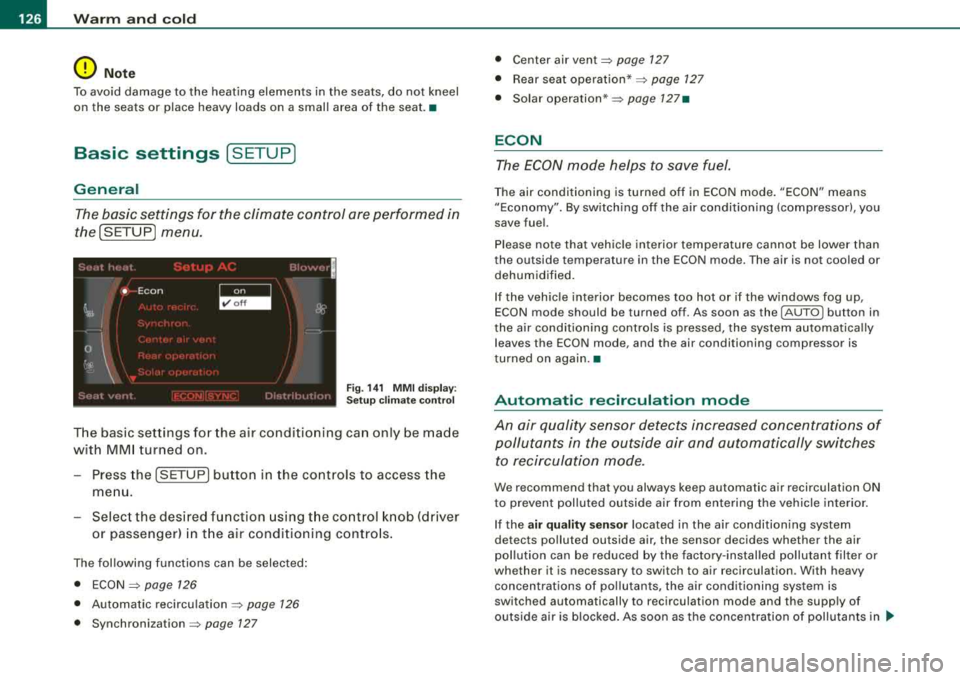
The basic settings for the climate control are performed in
the[SETUP] menu.
Fig . 141 MMI display:
Setup climate control
The basic settings for the air conditioning can only be made
with MMI turned on.
- Press the !SETUP] button in the controls to access the
menu.
- Select the desired function using the control knob (driver
or passenger) in the air conditioning controls.
The following functions can be selected:
• ECON
=> page 126
• Automatic recirculation => page 126
• Synchronization => page 127
• Center air vent=> page 127
• Rear seat operation* => page 127
• Solar operation* => page 127•
ECON
The ECON mode helps to save fuel.
The air conditioning is turned off in ECON mode. "ECON" means
"Economy". By switching off the air conditioning (compressor), you
save fuel.
Please note that vehicle interior temperature cannot be lower than
the outside temperature in the ECON mode. The air is not cooled or
dehumidified.
If the vehicle interior becomes too hot or if the windows fog up,
ECON mode should be turned off. As soon as the
(AUTO ] button in
the air conditioning controls is pressed, the system automatically leaves the ECON mode, and the air conditioning compressor is
tu rned on again. •
Automatic recirculation mode
An air quality sensor detects increased concentrations of pollutants in the outside air and automatically switches
to recirculation mode.
We recommend that you always keep automatic air recirculation ON
to prevent polluted outside air from entering the vehicle interior.
If the
air quality sensor located in the air conditioning system
detects polluted outside air, the sensor decides whether the air
pollution can be reduced by the factory-installed pollutant filter or
whether it is necessary to switch to air recirculation . W ith heavy
concentrations of pollutants, the air conditioning system is
switched automatically to recirculation mode and the supply of
outside air is blocked. As soon as the concentration of pollutants in
~
Page 129 of 404
Warm and cold -
----------------
the outside air drops, fresh air is supplied to the vehicle interior
again .
In the event that the windows fog up during automatic air recircula
tion, you must press
the® button immediately.
Under certa in operat ing cond it ions, automatic a ir rec ircu lation is
switched off automatically . With outside temperatures below about
-8 °C and in the ECON mode, automatic air rec ircula tion is limited to
15 seconds. •
Synchronization
One climate control setting for all seats.
With synchronization active, the driver's or the passenger's settings
are adopted for the other seats . Al l the other set tings that were
made are transferred to the other seats. This includes all the c limate
control settings right down to the heated seats .
If
a d ifferent setting is selected at a "synchron ized seat", synchroni
zation is cancelled.
•
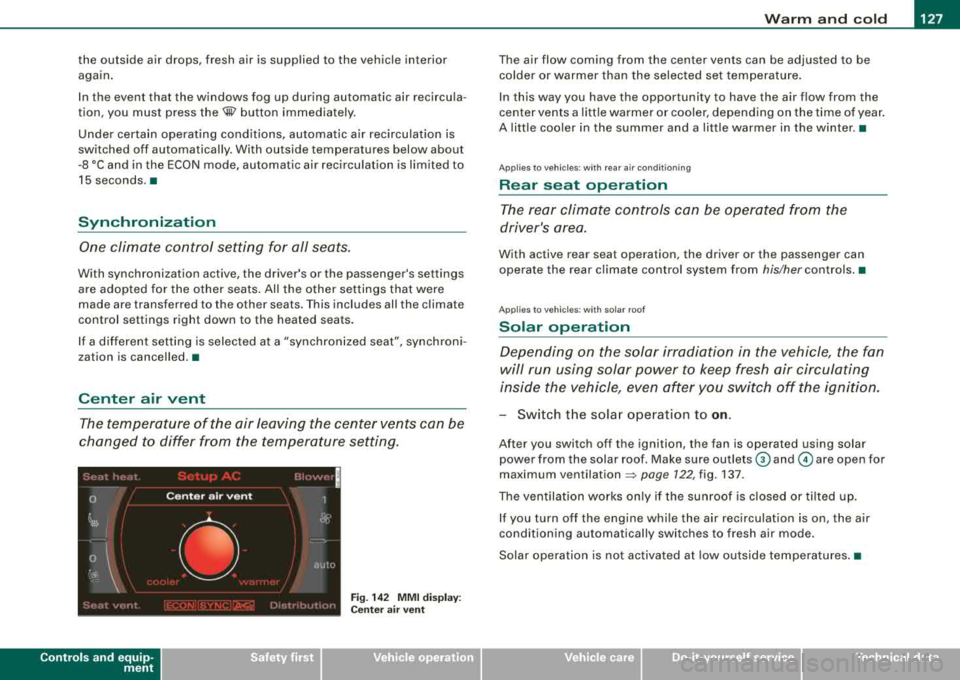
Center air vent
The temperature of the air leaving the center vents can be
changed to differ from the temperature setting.
Controls and equip ment
Fig. 14 2 MMI di spla y:
Ce nter a ir ve nt
The air flow coming from the center vents can be adjusted to be
colder or warmer t han the selected set temperatu re.
In this way you have the opportunity to have the a ir flow from the
center vents a litt le warmer or coo ler, depending on the time of year .
A litt le cooler in the summer and a little warmer in the winter. •
Applies to vehic les : with rear air condition in g
Rear seat operation
The rear climate con trols can be o perated fr om the
driver's area.
With active rear seat operation, the driver or the passenger can
operate the rear climate control system from
his/her contro ls. •
Ap plies to vehicles : w ith so lar roof
Solar operation
Depending on the solar irradiation in the vehicle, the fan
will run using solar power to keep fresh air circulating
inside the vehicle, even af ter you switch off the ignition.
- Switch the solar operation to on .
After you switch off the ignition, the fan is operated using solar
power from the solar roof. Make sure outlets
G) and © are open for
maximum
ventilation => page 722, fig. 137.
The vent ilation works on ly if t he sunroof is closed or t ilted up.
If you turn off the engine whi le the air rec irculation is on, the air
conditioning automatically switches to fresh air mode.
Solar operation is not activated at low outside temperatures .•
Page 342 of 404
___ T_ ir_e _s_ a_n_ d_ w_ h
_ e_e_ l_ s _______________________________________________ _
• If the spare tire is different from the tires that you have mounted
on your vehicle (for example winter tires or wide profile tires), then
use the spare tire for a short period of time only and drive with extra
care . Replace the flat tire with the tire matching the others on your
vehicle as soon as possible.
• If you should put different wheels and tires on your vehicle (e.g.
winter wheels and tires), you must be certain that the wheels and
tires are compatib le with the tire pressure monitoring system.
Otherwise the system will register a malfunction and a fault message will be displayed. For more information, contact your Audi
dea ler.
0 Note
• When installing new tires, be careful not to damage the valves or
tire pressure monitoring system sensors.
• Never drive without the va lve stem cap. The valves could get
damaged.
• If the sensors must be replaced, then the valve must also be
replaced at the same time.
For the sake of the environment
Dispose of o ld tires in accordance with the loca l requirements. •
Uniform tire quality grading
• Tread wear
• Traction AA A B C
• Temperature A B C
Qua lity grades can be found where applicable on the tire side wal l
between tread shoulder and maximum section width
=> page 336,
fig. 276.
For example: Tread wear 200, Traction AA, Temperature A.
All passenger car tires must conform to Federal Safety Require
ments in addit ion to these grades.
Tread wear
The tread wear grade is a comparative rating based on the wea r rate
of the tire when tested under contro lled conditions on a specified
government test course.
For example, a tire graded 150 wou ld wear one and one half (1 1/2)
times as well on the government course as a tire graded 100.
The relative performance of tires depends upon the actua l condi
tions of their use, however, and may depart significantly from the
n orm due to variations in driving habits, service practices and differ
ences in road characteristics and climate .
Traction
The traction grades, from highest to lowest, are AA, A, Band C.
T hose grades represent the tire's ability to stop on wet pavement as
measured under contro lled conditions on specified government
t est surfaces o f asphalt and concrete. A tire marked C may have
poor traction performance
=:> & .
Temperature
The temperature grades are A (the highest), B, and C, representing
t he tire's resistance to the genera tion of heat and its abi lity to dissi
pate heat when tested under control led conditions on a specified
indoor laboratory test wheel.
Sustained high temperature can cause the mater ial of the tire to
degenerate and reduce tire life, and excessive temperature can lead
to sudden tire
failure=> &.
The grade C corresponds to a leve l of performance which a ll
passenger car tires must meet under the Federal Motor Vehicle
Safety Standard No. 109. Grades Band A represent higher levels of
performance on the laboratory test whee l than the minimum
required by law.
~
Page 363 of 404
_________________________________________________ F_ u_ s_ e_s _ a_n _d_ b_ u
_ lb_ s _ __,_
-
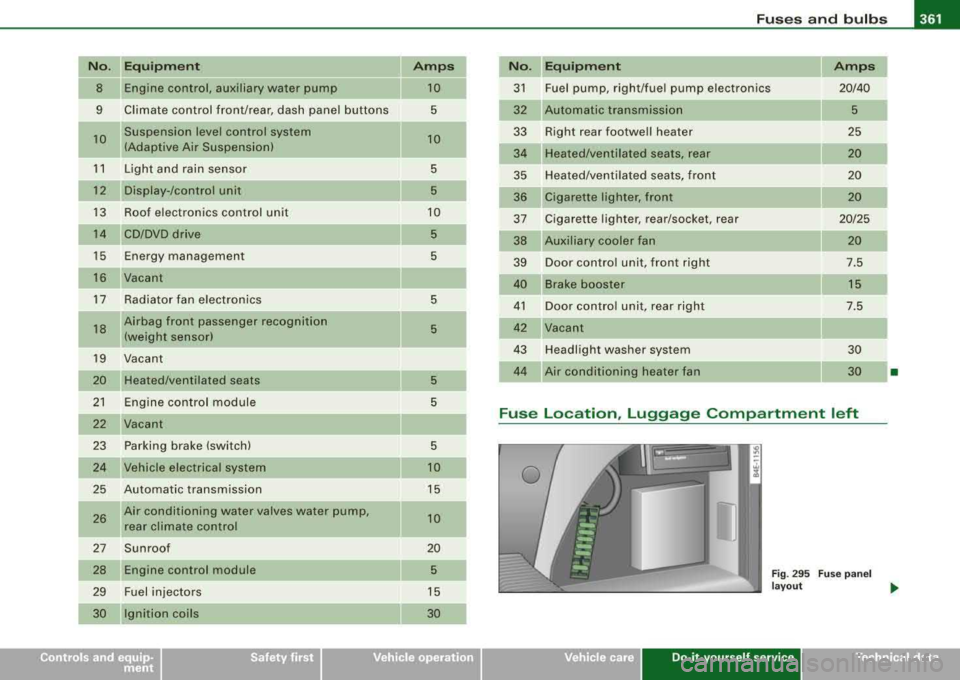
No . II Equipm ent
8 Engine control, auxiliary water pump
9
10 C
limate control front /rear, dash panel buttons
Suspension level control system
(Adaptive Air Suspension)
11 Light and rain sensor
1 2 Display -/control unit
13 Roof electronics control unit
CD/DVD d rive
15 Energy managemen t
16 Vacant
17 Radiator fan e lectronics
18 Airbag front passenger recognition
(weight sensor)
19 Vacant
20 Heated/ventilated seats
21 Engine control module
22 Vacant
23 Parking brake (switch)
24 Vehicle electrical syste m
25
26
27
Automatic transmission Air condi tioning water valves wate r pump,
rea r climate control
Sunroof
28 Engine control module
29 Fuel injectors
30 Ignition coils
Amps
10
5
1 0
5
5
10
5
5
5
5
5
5
5
1 0
15
10
20
5
1 5
30
-
No . Equipm ent
31 Fuel pump , right/fue l pump e lectronics
32 Automatic transmission
33
34
Right rear footwe ll heater
Heated/ventila ted seats, rear
35 Heated/ventilated seats, front
36 Cigarette lighter, front
37 Cigarette lighter, rear/socket, rear
38 Auxil iary cooler fan
39 Door contro l unit, front right
40 Brake booster
41 Door contro l unit, rear right
42 Vacant
43 Headlight washer system
44 A ir co nditioning heater fan
Amps
20/40
5
25
20
20
20
20/25 20
7.5
1 5
7.5
30
30 •
Fuse Location , Luggage Compartment left
0
Fig . 2 95 Fuse pan el
l a you t _.
Vehicle care Do-it-yourself service irechnical data
Page 389 of 404
______________________________________________ A_ l.!. p _h_ a_ b_e _ t_i c_ a..:..l ...:.. in :..:..:. d:..:e :..: x_;__ _,n
Kne e airbags ...... ... .. .... ..... 234 ASR
Moni to ring .. ... .... .... ....... .. 229 How the Anti-S lip Regu la tion Sys tem
PASSENGER AIR BAG OFF ligh t .... . 230 works ...... ... .... .... .... .... 270
Repairs ........ .... .... ......... 232
Safety instructions ... .... ... .... . 231
Side airbags ... .. .... .... ... .... . 237
Side curtain air bags (SIDEGUARD) .. 240
Warning/indicator lights ...... .... .. 19
Weight -sens ing mat ...... ... .... . 2 44
When mu st the syst em be insp ected?
229
Aircra ft
T ransporting your v ehicle .. ........ 369
All W hee l Dr ive ...... .... ... .... .... 273
Alloy whee ls ... .... .... .... ... .... .. 293
A ll-whee l drive
W int er tir es . ..... .... ... ... . .... . 34 1
A lternator
See Ge ne ra tor . ....... ... .... .... . 18
An ti-free ze
See Engine coolan t ..... .... .... .. 314
An ti- lock brak e system
How th e ABS syst em works ....... . 272
Wa rning /indi cato r ligh ts .. .. .. .... .. 21
Anti -Sl ip Reg ulat io n System (ASR)
H ow the system works .... .... .... 270
Anti -theft systems
Anti -theft alarm system .. ... .... ... 61
E lectron ic immob ilizer . .... .... .... 49
Ashtray Fron t .. .... ... .. .... ...... .... .. 106 Aud
i Service Repa ir Manua ls and Literatu re
380
A UTO mode
AC climate con tro l .. .. .... .... .... 117
Auto Safety Hotline .... .... .... ... .. . 207
A ut o-C heck Con trol ...... .... ... .... .. 28
Automatic belt retracto r ... .. .... .... . 213
Automati c car wash
See Washing . .............. .... .. 289
A ut om atic Sh ift Loc k (ASU . ...... .... . 165
Automat ic transmission
6 -speed automat ic t rans missio n .... 163
Auto matic S hift Lock (ASU .... .... . 165
Dr iving . ...... .... .... .... .... ... 163
Dynamic sh ift p rogram .. ...... .... 166
Em ergency release fo r selecto r leve r 168
F a il- safe mode . ...... .... .... .... 168
I gnition key s afety lock . ...... .... . 130
K ick -down .... .... .... .... ... .... 166
Manual sh ift program ....... .... .. 167
S ele ctor le ve r ... ........... .... .. 164
Shift buttons ... .... .... .... .... . 168
S teering wheel w ith tiptronic . ...... 168
Average speed . ...... .... .... .... ... . 38
Avo id damaging the ve hicle .. ...... ... 279
B
Rear . ...... .. ...... .... ......... 107 Background lighting . ...... .... ... .. .. 76 Ba
ttery .... ... .. .... .... ...... .... . 318
Ba ttery location ins ide the luggage
compa rtmen t ... .... ... .... .... . 319
Chargi ng .. .... .... ... .... .... ... 321
Impo rtant wa rnings when working on the
battery .. .... .... ... .... ...... . 319
low ...... .... .... .... ... .... .... 274
Replaci ng t he battery .. ... .... ... . 3 22
State of cha rge . ...... .... .... ... . 27 4
Winter operat ion ..... .... .... .. . . 318
Wo rking on the batte ry . ....... ... . 319
Battery vo ltage .. .. .. .... .... .... ..... 35
B efo re driving ... .... .... ...... .... . 199
Blended gasoline ... .. .... .... .... ... 30 1
Body cavity sealing ........ .... .... .. 294
Boos ter seat ... .. .... .... ... .... .... 251
How do I properly install a booster seat in my veh ic le? . .... .... ... .... .... 251
Safety instructions .. ...... .... ... . 251
Brake flu id
Changing the brake fluid ...... .... . 318
Check ing the brake fluid leve l .... .. 317
What is the co rrect brake fluid leve l? 317
What s hould I do i f th e brake fluid warning
l ight com es on? . .... .... .... .... 317
Brake system Ant i- lock brake sys tem .... .... .... . 21
B rake assis ta nt .... .... ... .... .... 272
Brake booster .. ... .... ... .... .... 271
Brake flu id . ... .... .... ... .... .... 317
Brake f luid specifications for ref ill and
replace men t . .... .... .... ...... . 318
Bra ke light de fective . .... . .... .. .. . 26
Brake pads . ...... .... ... .... .... 278
Controls and equip
ment Safety first Vehicle operation
Vehicle care Do-it-yourself service Technical data
Page 391 of 404
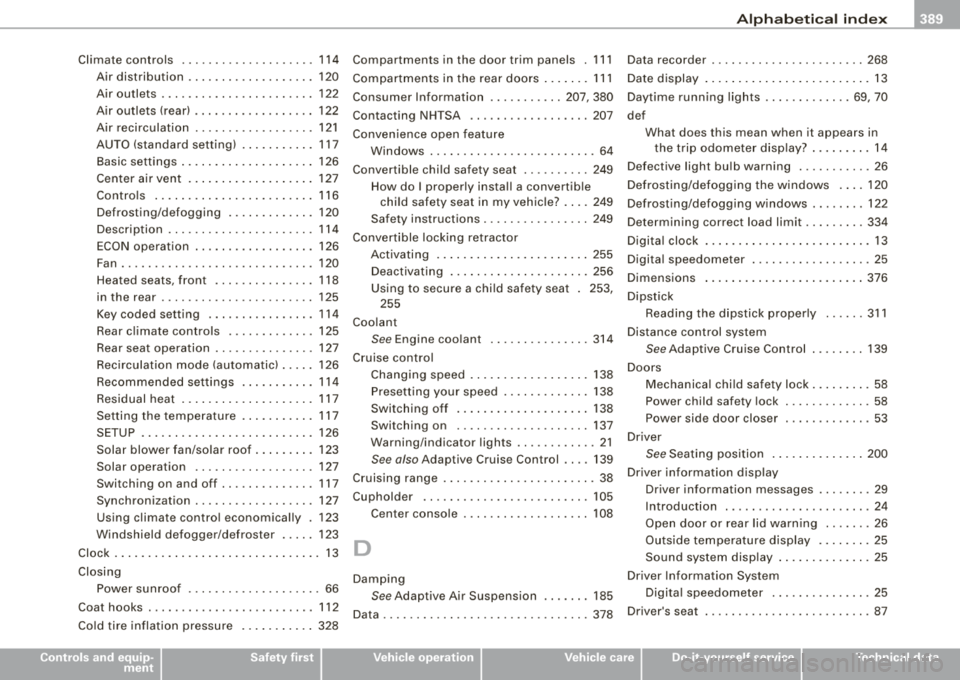
Alphab eti ca l ind ex I'll
----------------------------------------- -'---------
Climate controls ............. .... ... 114
Air distribution ... .... .... .... .... 120
Air outlets ..... .. .... .... .... .... 122
Air outlets (rear) .... ... .... .... ... 122
Air recirculation .. .... .... ... .... . 121
AUTO (standard setting) ...... .... . 117
Basic se ttings ... .. .... ... .... .... 1 26
Cen ter ai r vent . ....... ... .... .... 127
Contro ls ... .. .... .... ... .... .... 116
Defrosting/defogging ..... ... .... . 120
Description ... .... ....... .... .... 114
ECON operation .. .... .... ... .... . 126
Fan . .... .... .... .... .... ... .... . 120
Heated seats , front ... .... .... .... 118
in the rear ...... .... .... .... .... . 125
Key coded setting ... .... .... .... . 114
Rear c limate controls .... .... .... . 125
Rear seat operation .. .... .... .... . 127
Rec ircu lation mode (automatic) ... .. 126
Rec ommended set tin gs ...... .... . 11 4
Residual heat .. ...... .... .. . .... . 117
Set ting t he tempe rature ..... . .... . 117
SETUP . ......... .... .... ... .... . 126
Solar blower fan/solar roof .. ...... . 123
Solar operation ... ....... .... .... 127
Switching on and off .. .... ...... .. 117
Synchroni zation .. .... .... ... .... . 127
Using climate contro l economical ly . 123
Windshield defogger/defroster . .... 123
Clock . ...... .... .... .... ... .... .... . 13
Closing Power sunroo f .... .... ... .... .... . 66
Coat hooks . ... .... .... .... .... .... . 112
Co ld ti re inflati on pressure .. ...... ... 328
Controls and equip
ment Safety first
Compartments in the door trim panels
. 111
Co mpar tmen ts in the rea r do ors ... .. .. 111
Consumer Information ... .... .... 207 , 380
Contacting N HTSA .. .. .. .... .... .... 207
Conven ie nce open featu re
Win dows ..... ... .... .... .... .... . 64
Convertib le chi ld safe ty seat .... .... .. 249
How do I properly ins ta ll a convertib le
child safety seat in my vehic le? . ... 249
Safety instructions . .... .... ....... 249
Convertible lock ing retractor
Act ivating .. ...... .... .... .... ... 255
Dea ctivati ng .. ... ... .... .... .... . 256
Using to secure a chi ld safety seat . 253,
255
Coo lant
See Engine coo lant
Cr uise control
3 14
Cha nging speed ...... .... .... .... 138
Presett ing your speed ... .. .... .... 138
Switching off .... .... .... .... .... 138
Switching on . .... .... .... ....... 137
Warning/indicator lights .. .... .... .. 21
See also Adaptive Cruis e Con trol .. .. 139
Cr uis ing ra nge . ...... .... .... .... ... . 38
Cupholder .. .. .. ...... ....... .... .. 105
Center conso le .. .. .... ..... .. .... 108
D
Damping
See Adaptive Air Suspension .. ..... 185
Data .... .... .... ... .... .... .... .... 378 Data recorder
....... .... ....... .... . 268
Date d isplay ...... .... ... .... .... .... 1 3
Daytime running lights ... .... .... .. 69, 70
def What does this mean when it appears in the trip odomete r disp lay? ... .. .... 14
Defective light bu lb warning .... .... ... 26
Defrosting/defogg ing the windows . ... 120
Defrosting/defogging windows .. ..... . 122
Determining correct load limit .... .... . 33 4
Digita l clock .. ...... .... .... .... .. . .. 13
Digita l speedometer . .... .... .... ... .. 25
Dimensions ...... .... ... .... .... ... 376
Dipstick Readi ng the dipstick proper ly .. ... . 311
Distance control system
See Adaptive Cruise Contro l ... .. ... 139
Doors Mechanica l chi ld safety lock .. ...... . 58
Power child safety lock . .... .... .... 58
P ower side door closer . ... .... .... . 53
Dr iver
See Seating posi tion ...... .... .... 200
Driver information display Driver information messages ... ... .. 29
Introduct ion .. ... .... .... .... .... . 24
Open door o r rear lid wa rn ing .. .... . 26
Outs ide temperature display .. ...... 25
Sound system disp lay ........ ... .. . 25
Driver Information System Digita l speedometer ... ... .... .... . 25
Driver 's seat .. .... .... ... .... .... .... 87
Vehicle operation Vehicle care Do-it-yourself service Technical data
Page 394 of 404
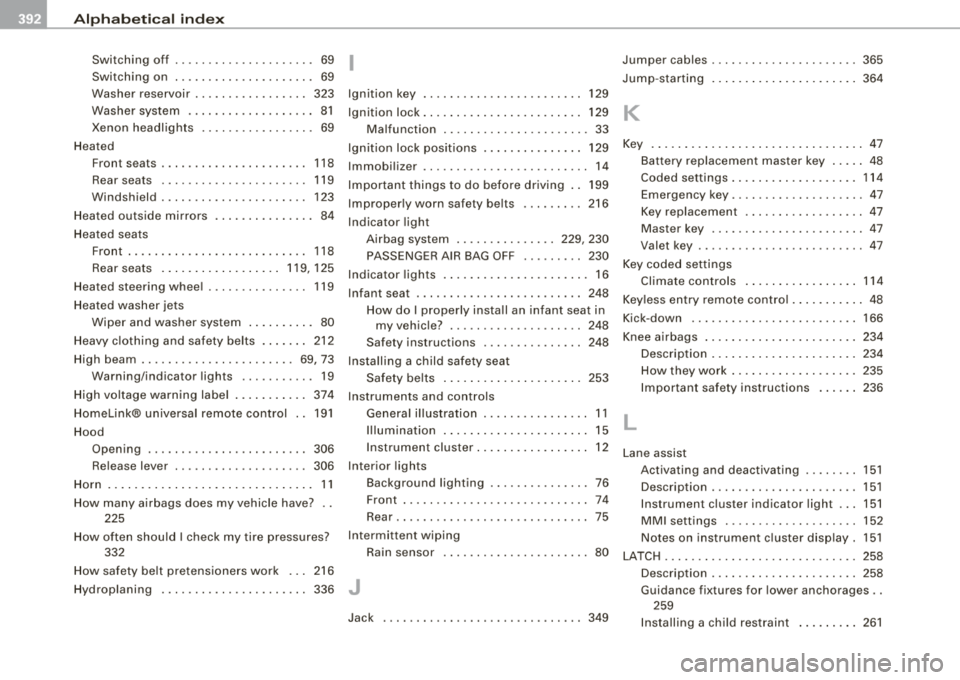
111'1_....:..A..:.;l~ p :..;h..:.; a= b..:e :..;t:.:..i c::..:: a.:..l .,;. in :..:..:. d:..;e :..;x..:..,_ ___________________________________________ _
Switching off ....... .... .... .... .. 69 I
Switching on . .... .... .... ...... .. 69
Washer reservoir . . . . . . . . . . . . . . . . . 323
Washer system . . . . . . . . . . . . . . . . . . . 81
Xenon headl ights . ..... .. .... .... . 69
Heated Fron t seats . . . . . . . . . . . . . . . . . . . . . . 118
Rear seats . . . . . . . . . . . . . . . . . . . . . . 119
Windshield .... ...... .... .... .... 123
Heated outside mirrors . . . . . . . . . . . . . . . 84
Heated seats Front . . . . . . . . . . . . . . . . . . . . . . . . . . . 1 18
Rear seats . . . . . . . . . . . . . . . . . . 11 9, 125
Heated stee ring whee l . . . . . . . . . . . . . . . 119
H eated washer jets
Wiper and washer system . . . . . . . . . . 80
Heavy c lothing and sa fety belts . ...... 212
High beam .. ...... .... .... .... ... 69, 73
Warning/indicator ligh ts .. ... .... .. 19
H igh vo ltage warn ing label .... .. .. ... 374
Ho melink® universal remote control
Hood 191
Opening ........ ... .. .... ...... . 306
Re lease lever .... .... .... .... .... 306
H orn . . . . . . . . . . . . . . . . . . . . . . . . . . . . . . . 11
How many airbags does my vehicle have? ..
225
H ow of ten shoul d I check my tire pressures?
332
H ow safety be lt pre tens io ners work . . . 216 Ignition key
129
Ignition lock ...... .... .... .... .... .. 129
Malfunction .. .... ... .... .... .... . 33
Ig nition lock pos it ions .. ...... .... ... 12 9
Immobi lizer .. ... ....... .... .... .... . 14
Important things to do before dr iving .. 199
Improper ly worn safety be lts ..... .. .. 216
Indicator light
Airbag system . .......... .... 229, 230
PASSENGER AIR BAG OFF ........ . 230
Ind ica tor lights ...... .... .... .... ... . 16
Infant seat ...... ....... .... .... ... . 248
How do I properly insta ll an infant seat in
my vehic le? .. .... .... .... ...... 248
Safety instruct ions .......... .... . 248
Installing a child safe ty seat
Safety be lts ...... ... .... .... .... 253
Instruments and controls General illustration . .... .... .... ... 1 1
Illu mination ...... .... .... .... .... 15
Instrument cluster . . . . . . . . . . . . . . . . . 12
Inte rior lights
Background lighting .. ... .... .... .. 76
F ront . ...... .. ...... .... ... .. .... 74
Rear .. ... .... ....... .... .... .... . 75
Intermitt ent w iping
Rain sensor ... ...... ....... .... .. 80
Hydroplaning ..... .. ...... .... ... .. 336
J
Jack ...... .... .... ........... .... . 349 Jumper cables
.... .... .... ...... .... 365
Jump -star ting 36
4
K
Key ...... .... .... .... ... .... ..... .. 4 7
Battery replacement master key ... .. 4 8
Coded settings ...... ... .... .... .. 114
Emergency key . .... ....... .... .... 47
Key replacement ... .... ...... .... . 47
Mast er key ...... .... .... ... .. .... 47
Valet key .... .... .... .... .... ..... 47
Key c oded setti ngs
Climate controls ...... .... .... ... 114
Key less entry remote co ntro l ... .... .... 48
Kick-down ......... .... .... .... ... . 166
Knee a irbags ...... .... ... ....... .. . 234
Descrip tion ..... ... .... .... .... .. 23 4
H ow they work . . . . . . . . . . . . . . . . . . . 235
I mportant safety instructions
236
L
Lane assist
Activating and deactivating 151
Description ....... ... .. ...... .... 151
I nstrumen t clus ter indicator ligh t .. . 151
MM I settings ... .. .... .... .... ... 152
Notes on instrument c luster disp lay. 15 1
LA TCH .... .... .... ....... .... .... .. 258
Description .... .... .... ...... .... 258
Guidance fix tur es for low er anchorages ..
2 59
I nstalling a ch ild restraint ...... ... 261