engine oil AUDI S8 2008 User Guide
[x] Cancel search | Manufacturer: AUDI, Model Year: 2008, Model line: S8, Model: AUDI S8 2008Pages: 404, PDF Size: 52.7 MB
Page 273 of 404
_________________________________________ ___..!l~ n ~t ~e :..!.ll ~ig ~ e:.!::n ~t ~ t~ e~ c~ h~ n~o ~l~o ~g !Jy ~ --
•
On steep slo pes, you shou ld use th e braking effect of the engine .
This way, yo u preve nt u nn ecessary wear on the bra ke sys te m. If you
must use your brakes, do not hold the brakes down cont inuous ly .
Pu mp the brakes at in terval s.
Moisture or road salt
U nder ce rtain cond itions, for e xa m ple, w hen drivi ng thro ug h w ate r
or v ery h eavy rain, or even after washing your vehicle, the braking
e ff ect can be red uce d du e to mo is tu re ( or in fr eezin g c ond it ions ice)
on t he b rake pads . A few carefu l brake applicatio ns should dry off
t h e br ake pads o r rem ove a ny ice coatings .
The e ffective ness of t he b ra kes ca n b e red uced wh en th e ve hicle is
driven o n a salt -covered road and t he brakes are not used. Here too,
yo u should cle an off acc umulate d sa lt co atin g from b rake di scs a nd
pads w ith a few careful app lications of th e
brake=>&.
Corrosion
T here may be a tendency for dirt to build up on t he bra ke pads and
c o rr os ion t o form on th e dis cs if t he car is not driven reg ular ly or
only for short trips with little use of the bra kes .
If th e bra ke s are not us ed fr equ ent ly , or if corro sion h as form ed on
th e discs, it is adv isab le to cl ean off the pa ds and discs by braking
firm ly a few times from a moderate ly h igh
speed =>& .
Faults in the brake system
If y ou s ho uld n oti ce a
sud d en inc rea se in b rake pe dal trave l, then
one of the two b rake c ircuits may h ave
fai led =>& .
Low brake fluid level
M alfunctions can occur in the brake system if the b ra ke fluid leve l is
t oo low. Th e br ake fluid level is monitor ed ele ctr onic a lly .
& WARNING
• You should perform braking maneuvers for the purpose of
cleaning the brake system only if road conditions permit. Other
road users must not be put at risk -you may cause an accident!
& WARNING (continued )
• Before descending a steep grade , reduce speed and shift trans
mission into a lower gear or lower driving range . Do not ride the
brakes or hold the pedal down too long or too often . This could
cause the brakes to get hot and diminish braking efficiency .
• Do not "ride the brakes" by resting your foot on the pedal when
you do not intend to brake . This may cause the brakes to overheat ,
premature wear and increased stopping distance .
• Under certain climatic and operating conditions such as
passing through water, driving in heavy rain or after washing the
vehicle , the effectiveness of the brakes can be reduced . In winter,
ice can accumulate on the brake pads , linings , discs and drums .
Carefully apply brakes for a test. Brakes will dry and ice coatings
will be cleaned off after a few careful brake applications .
• Driving for an extended period of time on salt-covered roads
without using your brakes can also affect braking efficiency. Clean
off accumulated salt coating from brake discs and pads with a few
careful brake applications .
• If you damage the front spoiler , or if you install a different
spoiler, be sure the air flow to the front brakes is not obstructed.
Otherwise the brake system could overheat reducing the effective
ness of the entire brake system.
• Failure of one brake circuit will impair the braking capability
resulting in an increased stopping distance. Avoid driv ing the
vehicle and have it towed to the nearest Audi dealer or qualified
workshop. •
Brake booster
Th e brake boo ster adds ex tra braking po wer.
The b ra ke booster works wit h vacuu m press ure which is created
on ly wh en th e e ngi ne is
r un ning => & .
Page 280 of 404
llffll,.__ __ D_r_ iv _ in_.... g,_ a_n_ d __ e_n _v_ ir_o_ n_ m_ e_n_ t _____________________________________________ _
New brake pads
Remember that new brake pads do not have a full braking
effec t during the first 250 miles (400 kilometers) after they
are installed .
New brake pads have to be "burnished in" before they have optimal
grab =>& .
During the break -in period, you s hou ld avoid putting severe loads
on the brakes . Severe loads include, for examp le, sudden hard
braking, in particular at very high speeds or, for example, on moun
t ain passes.
& WARNING
N ew brake p ad s don 't h ave the be st stopping po wer and mu st be
"broken -in " during the initial 100 to 150 mile s (150 to 200 kil ome
t e rs) of norm al c ity dri ving . You can comp en sa te for thi s by
pr ess ing the brake ped al more firmly . Thi s al so appli es later when
ne w pad s a re in sta lled. •
Catalytic converter
It is very important tha t your emission control sys tem
(catalytic converter) is functioning properly to e nsure that
y o ur vehicle is running in an environmentally sound
manner.
-Always use lead-f ree gasoli ne :=> page 301, "Fuel supply".
-Never run the tank down a ll the way to empty.
-Never put too much motor o il in your engine :=> page 312,
"Adding eng ine oil 'l=;r111
•
-Never try to push -or tow -s ta rt yo ur vehic le.
T he catalytic converter is an efficient "clean -up" device built into the
exhaust system of the vehicle. The catalytic converter burns ma ny
of the po llutants in the exhaust gas before they are released into the
atmosphere.
The exclusive use o f un leaded fue l is critica lly important for the l ife
of the cata lytic converter and proper functioning of the engine.
& WARNING
• Do not park or operate th e veh icle in ar ea s where the hot
e x hau st sys tem m ay come in cont act w ith dr y grass, brush , fuel
s pill or other material which can cau se a fire .
• Do not appl y additi ona l u ndercoating or ru stpr oofing on or
near the exhau st manifol d, exhau st pipe s, ca tal ytic converter or
h ea t shield s. Du ring dri ving , the sub sta nce u sed f or under coating
c ould overhe at and cau se a fir e.
0 Note
• Be aware that just one tank filling with leaded fue l wi ll already
seriously degrade the performance of the catalyt ic converter.
• Do not exceed the correct engine oil
level => page 312 .
• Do not drive until the fuel tank becomes comp letely empty . The
engine cou ld misfire. Unburned fuel could also get into the exhaust
system and this could cause the catalytic converter to overheat .
• Do not turn off t he ignition wh ile the vehicle is moving.
• Do not continue to operate your vehicle under these conditions,
as otherwise fuel can reach the cata lyt ic converter . This cou ld result
in overheating of the converter, requiring its rep lacement .
• To assure eff ic ient operat ion of the Emiss ion Contro l System:
- Have your vehicle maintained properly and in accordance with
the service recommendations in your Warranty
& Maintenance
booklet. _,.
Page 282 of 404
ffl.,__ __ D_r_ i_v _i_n _.g..,_ a_ n_d_ e_ n_v _ i
_ r_o _ n_ m_ e_ n_ t _______________________________________________ _
one half. Never drive faster than the posted speed limit and weather
co nditions permit. •
Reducing unnecessary idling
Even when your car is just idling it burns up fuel.
- Shut the eng ine off when you are not driving the vehicle .
- Do not warm up the vehicle by letting the engine run at
id le .
It makes sense to shut off the engine in traff ic jams, when waiting
for trains to pass at rai lroad crossings, or at traffic lights that have
long waits on red. Turning the engine off for just 30 -40 seconds
saves more fue l than is burned starting the engine again .
It takes a long time for the engine to warm up fu lly when it is
running at idle. However, wear and noxious em issions are espec ially
high when the engine is warming up . So you should drive away as
soon as you start the engine and avoid running at high rpms while
the engine is sti ll warming up.
0 Note
Do not leave engine idling unattended after starting . If warning
lights should come on to indicate improper operation, they would
go unheeded. Extended idling also produces heat, which could
result in overheating or other damage to the vehicle or other
property .•
Regular maintenance
A badly tuned engine unnecessarily wastes a lot of fuel.
- H ave your vehicle serviced at regular intervals .
By having your vehicle regularly serviced by an Audi dealer helps to
ensure t hat it runs properly and economical ly . The condit ion of your
vehic le not only affects its safety and abi lity to hold its va lue, it also
affects
fuel con sumpt ion .
C hec k your oil each time you fill your tan k.
The amount of oil used is related to engine load and speed.
I t is norma l for the oi l consumption of a new engine to reach its
lowest va lue after a certain mileage has been driven.
You must drive your vehicle about 3,000 miles (5,000 kilometers) before you can properly assess oil consumption .
T his also applies to fuel consump tion and engine output .
0 Note
• Have your vehicle maintained properly and in accordance with
t he service recommendat ions in your Warranty
& Maintenance
booklet. Lack of proper ma intenance as well as improper use of the
vehic le wi ll impair the function of the emission control system and
cou ld lead to damage.
• Do not alter or remove any component of the Emission Contro l
System unless approved by the manufacturer.
• Do not alte r or remove any device, such as heat sh ields,
switches, ignition wires, valves, which are designed to protect your
vehic le's Emission Control System and other important vehic le
components .•
Fewer short trips
Fuel consumption will always be relatively high on short
trips.
- Try to avoid driving short dista nces with a cold engine. ~
Page 301 of 404
_____________________________________________ C_ l_ e _a_ n_ in~ g_a
_ n_d_ p_ r_ o_ t
_ e_ c_t _io _ n __ fflll
•
from fading . Slight color variations will develop in normal use and
are not an indication of material deterioration.
0 Note
• Never use chemical solvents (e.g. lighter fluid, turpentine),
waxes, shoe polish or similar products on Alcantara® surfaces.
• To avoid damage, have stubborn stains removed by a commer
cial cleaning specialist.
• Do not use brushes, stiff sponges or similarly abrasive cleaning
aids. •
Safety belts
Only well-maintained safety belts work reliably when
needed.
- Keep belts clean.
- For cleaning, use a mild soap and water solution. Let
belts dry thoroughly and away from direct sunlight.
- Do not allow inertia reel safety belts to retract before
they are completely dry.
- Check the condition of your safety belts
regularly.
Heavily soiled safety belts may not retract properly.
& WARNING
Damaged safety belts can break in a crash.
• Anything that might damage your safety belts could mean that
you and your passengers would not be adequately protected in an
accident.
• Safety belt performance depends on correct installation. Never
remove belts from the vehicle to clean them.
&, WARNING (continued)
• Do not use chemical cleaning agents, bleach or dyes. They have
corrosive properties which weaken the webbing.
• When cleaning your safety belts, inspect them for damage. If
you discover damage, see your Audi dealer.
• Always read and heed all WARNINGS and other information
=> page 288. •
Engine compartment
Be especially careful when cleaning the engine compart
ment.
Always switch off the ignition before cleaning the engine => &,.
Plenum panel
Remove leaves from the plenum panel in front of the windshield
under the engine hood. This prevents the water drain holes from
becoming blocked, and it prevents debris from entering the vehicle
interior through the heating and ventilation ducts.
Corrosion protection
The engine compartment and transmission have been corrosion
protected at the factory.
Good anti-corrosion treatment is very important, particularly in the
winter. If the vehicle is frequently driven on salt treated roads, the
entire engine compartment and plenum panel should be thor
oughly cleaned at the end of winter and retreated to prevent salt
damage. At the same time, the underside of the vehicle should be
washed as well.
If the engine compartment is cleaned at any time with grease
removing solutions
11 , or if you have the engine washed, the anti
corrosion treatment is almost always removed as well. It is therefore .,_
11 Use only the correct cleaning solut ions. Never use gasoline or diesel fuel.
Vehicle care
Page 310 of 404
111'1...__C_ h_ e_c _k _ i_n ..::g ,_ a_n_ d_ f_il _li _n....: g=-- --------------------------------------------
& WAR N ING (continued )
-Always use extreme caution to prevent clothing , jewelry, or
long ha ir from getting caught in the radiator fan , V -belts o r
other moving parts , or from contacting hot parts . Tie back hair
before starting , and do not wear clothing that will hang or
droop into the engine .
• Minimize exposure to emis sion and chemi cal hazards
=> & .
& WARNING
Californ ia Proposition 65 W arning :
• Engine exhaust , some of its constituents , and certain vehicle
c omponents conta in or emit chemicals known to the State of Cali
fornia to cause cancer and birth defects and reproductive harm. In addition , ce rtain fluids contained in vehi cles and certa in products
of component wear contain or emit chemicals known to the State
of California to cause cancer and birth defects or other reprodu c
tive harm.
• Battery posts , terminals and related accessories contain lead
and lead compounds , chemicals known to the State of California
to cause cancer and reproductive harms. Wash hands after
handling.
0 Note
When adding f luids, always make sure that they are poured into the
proper container or filler opening, othe rwise serious damage to
vehicle systems wi ll occur.
For the sake of the environment
To detect leaks in time, inspect the vehicle floor pan from under
n eath regu larly. If you see spots from oil o r o ther ve hicle flu ids, have
your vehicle ins pected
by an autho rized Audi dea ler. •
Engine compartment
Ap plies to vehi cles : wi th 8 -cy lind er e ngi ne
Engine compartment overview : 8-cylinder
engine
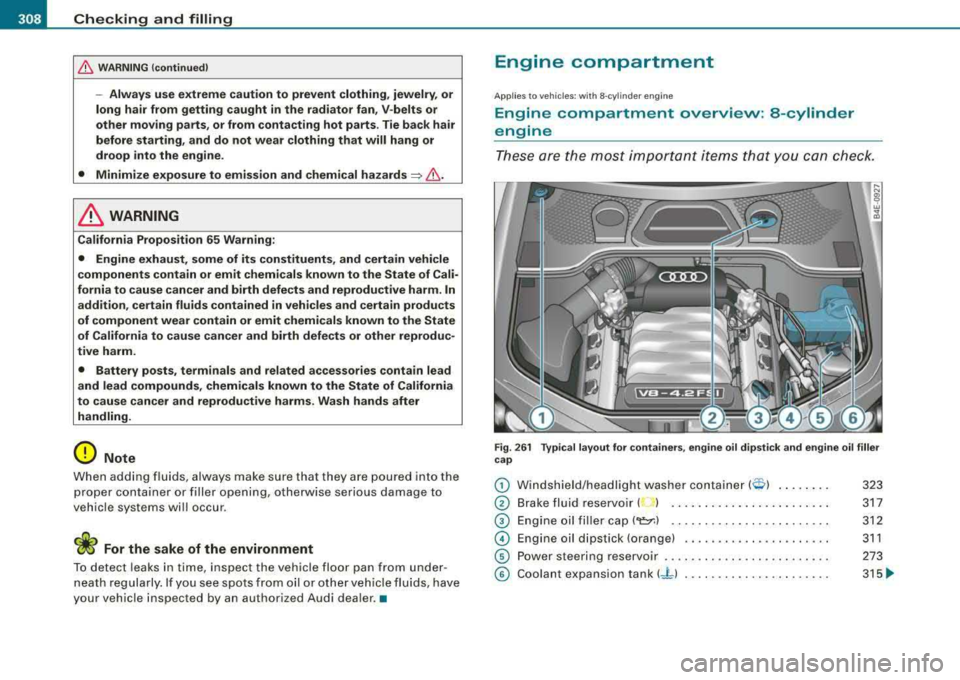
T hese are the m ost i mpor tant i tems th at yo u c an ch eck .
Fig. 261 Typical l ayout for containe rs, engine o il d ip stic k a nd engine oil fille r
c a p
G) Winds hield/headlight washer containe r(~ ) ...... . .
© Brake fluid reservo ir ( ) ) . . .. .. .. ...... .... ... .. .
© En gine oi l filler cap ("t::r.) .. .. .... ...... ....... . _.
© Eng ine oil d ipstick (orange) .... ..... ....... ... .. .
© Power steering reservoir ...... ....... .... .. ... .. .
© Coolant expansion tank (_ L J ... ...... .... ... .... . .
323
317
312
3 11
2 7 3
315
..
Page 311 of 404
_____________________________________________ C_h_ e_ c
_ k_in --= g'-a
_ n_d _ f_il _li _n ..::g ::.-__.ffllll
& WARNING
B efor e you che ck an ything in the eng ine comp artm ent, a lw ays
read and heed all WARN ING S
~ & in "W orkin g in the engin e
c omp artment " on
page 30 7. •
Appl ies to vehicles: with 12- cy linder engine
Engine compartment overview : 1 2-cyl inder
engine
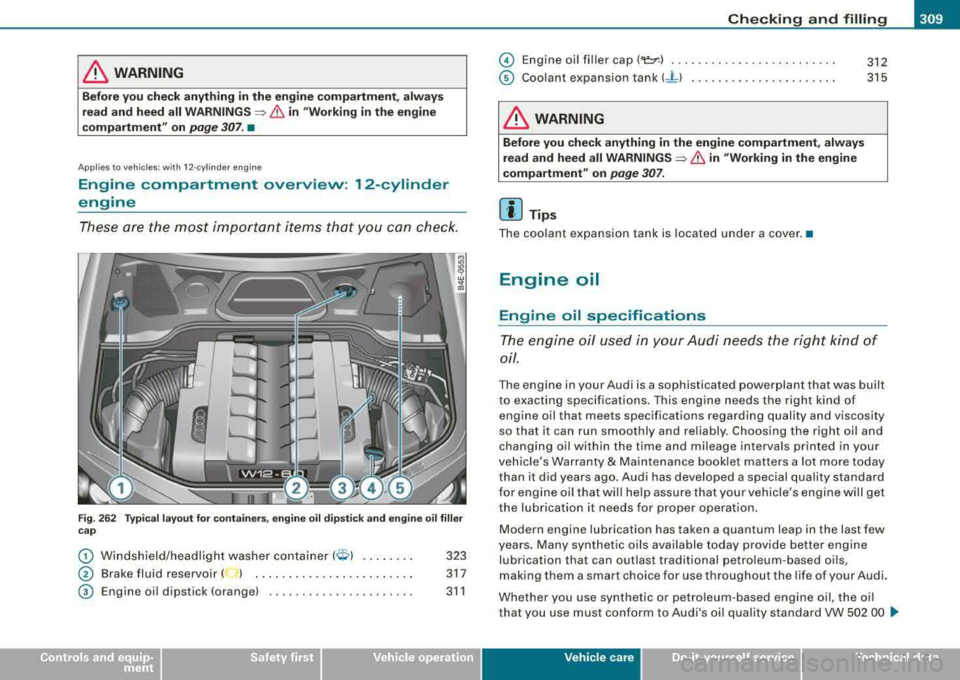
These are the most important items that you can check.
F ig . 262 Ty pi cal layout for c ontain ers, en gine oil dip st ic k a nd e ngine o il filler
ca p
G) Windshield/head light washer container ( Q ) . . . . . . . . 323
@ Brake fluid reservoir ( ) . . . . . . . . . . . . . . . . . . . . . . . . 317
© Engine oi l dipstick (orange) . . . . . . . . . . . . . . . . . . . . . . 311
© Engine oil filler cap ('t=:11) .. ...... .... ... ... ... .. . .
© Coolant expansion tank (- L l ..................... .
& WARNING
Before you check anything in th e engine co mpartment , alway s
read and he ed all W ARNI NGS
~ & in "Wo rking in t he engin e
c ompartm ent " on
page 307.
[ i ] Tip s
The coolant expansion tank is located under a cover .•
Engine oil
Engine oil specifications
312
315
The engine oil us ed in your Audi needs the right kind of
oil.
The engine in your Audi is a sophisticated powerplant that was built
to exacting specifications. This engine needs the right kind of engine oil that meets specifications regarding quality and viscosity
so that it can run smoothly and re liably. Choosing the righ t oil and
changing oil within the time and mileage interva ls printed in your
vehicle's Warranty
& Ma intenance book let matters a lo t more today
than it did years ago. Audi has developed a special quality standard
for engine oil that wil l help assure that your vehicle's engine wi ll get
the lubrication it needs for proper operation .
Mode rn engine lubrication has taken a quantum leap in the last few
years . Many syn thetic oils available today provide better engine
lubrication that can outlast traditional petroleum-based oils,
making them a smart choice for use throughout the life of your Audi.
Whether you use synthetic or petroleum -based engine oil, the oi l
that you use must conform to Audi's oi l qua lity standard VW 502 00
..,
Vehic le care I I irechnical data
Page 312 of 404
___ C_ h_e _c _ k_ i_ n ~g~ a_ n_ d_ f_ i_ll _in _g~--------------------------------------------
to help keep your vehicle's engine running smoothly and help
prevent the formation of harmfu l deposits, sometimes called
"sludge, " that over time can lead to expensive repairs .
At the time of printing, engine oils available in the U.S. and Canada
that meet the exacting specificat ions of Audi oil standard VW 502 00
are synthetic engine oils. This does not mean, however, that every
synthetic engine oil will meet Audi oi l standard VW 502 00. So
a lways b e sur e that you use an approved oil.
To help prevent the formation of harmful deposits use only oi l with
the following specifications printed on the oil container :
Audi oil sta nda rd VW 502 00
Oil container labels may carry the specification singly or in combi
nation with other designations and oil quality standards.
V iscosi ty
Engine oi ls are graded according to their viscosity . The proper
viscosi ty grade oi l for your engin e depends on climactic or seasonal
conditions where you drive . You can use o il with a v iscosity grade of
SAE 5W40 across all temperature ranges for normal driving condi
tions.
However , if eng ine oil viscosity grade SAE 5W40 is not available, you
can a lso use viscosity grade SAE 5W -30 or SAE 0W -40 as long as it
meets Audi oil quality standard VW 502 00 specifications.
B ecause engin e oil that meets the Audi oi l standard may not be
avai lable everywhere when you need it, we strongly recommend
that you a lways carry with you an extra quart !liter) of oil that
express ly conforms to t he VW 502 00 specification, in case you have
to top off the oil while on the road.
Only if th e level of the oil is at or be low the minimum mark on the
oi l dipstick -and no oil that express ly conforms to Audi oi l standard
VW 502 00 specifications is avai lable -may you top off with a high
quality engine oi l, preferably synthetic -based, that meets ACEA A3,
ACEA A5 or ACEA B5, API SL or ILSAC GF -3 specifications , but even
t hen, only in viscosity grades SAE 5W -40, SAE 5W -30, or SAE 0W -40.
However, during the entire time betwe en oil change int erva ls, nev er top off with more than a total of 0
.5 qt/ liter engine oil that does not
conform to Audi oil specifica tion VW 502 00.
For more information about engine oil that has been approved for
your vehic le, please contact either your authorized Audi dealer or
Aud i Customer Relat ions at 1 (800) 822-2834 or v isit our web s ite at
www.audiusa.com or www.audicanada.ca. Here you will also find a
current list of o ils (manufacturers, brand names
etc.I that conform
to Audi oi l standard VW 502 00.
Ch an g in g t he en gin e oil
The engine oil and o il filter must be changed according to the
mileage (ki lometers) and time intervals specified in your vehic le 's
Warranty & Maintenance booklet . Do not exceed these intervals -
harmful deposits from old engin e oil can reduce engin e perfor
mance and can lead to expensive eng ine repa irs.
Changing the oil at the recommended intervals is so very impor tant
because the lubricating properties of oi l decrease gradua lly during
normal vehicle use. If you are not sure when you have your o il
changed, ask your authorized Audi Service Advisor.
Under some circumstances the eng ine oil should even be changed
mor e frequen tly . Change oil more oft en if you drive most ly short
distances, operate the vehicle in dusty areas or mostly under stop
and -go traffic conditions, or when you use your vehicle where
t emperatures stay be low freezing po int for long per iods .
Detergent add it ives in the oi l wi ll make fresh oil look dark after the
engine has be en running for a short time. This is normal and is not
a reason to change the oi l more often than recommended .
Dam age or malfun ction s du e to lack of m aint enan ce
It is essential that you change your oil at the recommended interva ls
using on ly engine oil that complies with Audi oil standard
VW 502 00. Your Limited New Vehicle Warranty does not cover
damage or malfunctions due to fai lure to follow recommended
maintenance and use requirements as set forth in the Audi Owner's
Manual and Warranty
& Maintenance booklet. Your dea ler wi ll have
to deny warranty coverage un less you pr esent to the dea ler proof in
.,_
Page 313 of 404
Checkin g and fillin g 1111
-------------~~~
•
the form of Service or Repair Ord ers that all scheduled maintenance
was perfo rmed in a t imely man ner. •
Engine oil consumption
The engin e in your vehicle d ep ends on an adequate
amount of oil to lubricate and cool all of its moving parts.
In order to provide effect ive lubrication and cool ing of internal
engine components, all internal combustion engines consume a
certain amount of o il. Oil consumption varies from engine to eng ine
and may change significantly over the life of the engine . Typically,
eng ines wi th a specif ied break -in period
(see => page 2771 consume
more oil during the break -in period than they consume after oi l
consumption has stabi lized .
Under normal conditions, the rate of oil consumption depends on
the quality and viscosity of the oil, the RPM (revolutions per minute)
at which the engine is operated, the ambient temperature and road
conditions. Further factors are the amount of oil dilution from water
co ndensation or fue l residue and the oxidation level of the o il. As
any engine is subject to wear as mileage builds up, the oil consump
t io n may increase over time until rep lacement of worn components
may become necessary .
With all these variables coming into play, no standard rate of oil consu mption can be estab lished or specified. T here is no a lternative
to regular and frequent checking of the oil level, see
Note .
If the yellow eng ine o il level warni ng symbol in the instrume nt
cluster ~ lights up, you should check the oil level as soon as
poss ible
with the oil dipstick => page 311 . Top off the oil at your
earliest
convenience=> page 312.
& WARNING
Bef ore you che ck anything in the eng ine comp artment , alw ay s
read and heed all WARNINGS
=> & in "Working in the engine
c ompartment " on
page 307 .
0 Note
Driving with an insuff ic ie n t o il level is l ikely to cause severe damage
to the engine.
[ i ] Tip s
• The oil pr es sure warning displ ay
regular inter vals, preferably ea ch time you refuel , and al ways before
going on a long trip.
• I f you have the impression your engine consumes excessive
amounts of oi l, we reco mmend that you consult your Audi dealer to
have the cause of your concern properly diagnosed . Keep in mind
t hat t he acc urate measureme nt of oil consump tion requ ires g reat
care and may take some time. Your Audi dealer has instructions
about how t o measure oil consumpt ion accurately. •
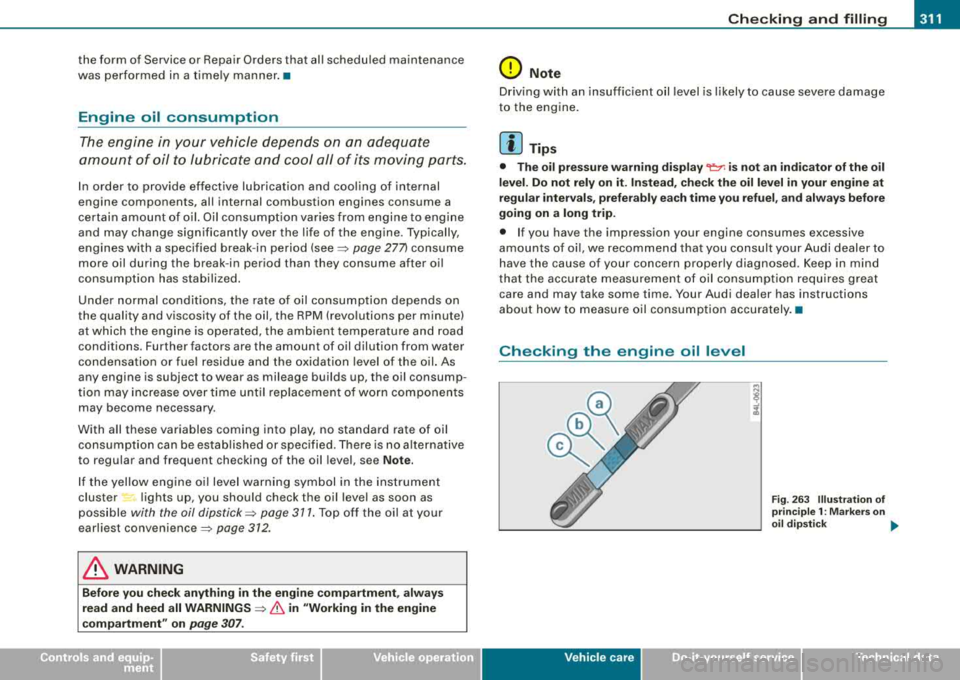
Checking the engine oil level
Vehicle care
Fig. 26 3 Illu stration of
prin cipl e 1: Mar ker s on
o il dip sti ck ...
Page 314 of 404
-
Checking and filling
..._--=--=--------------
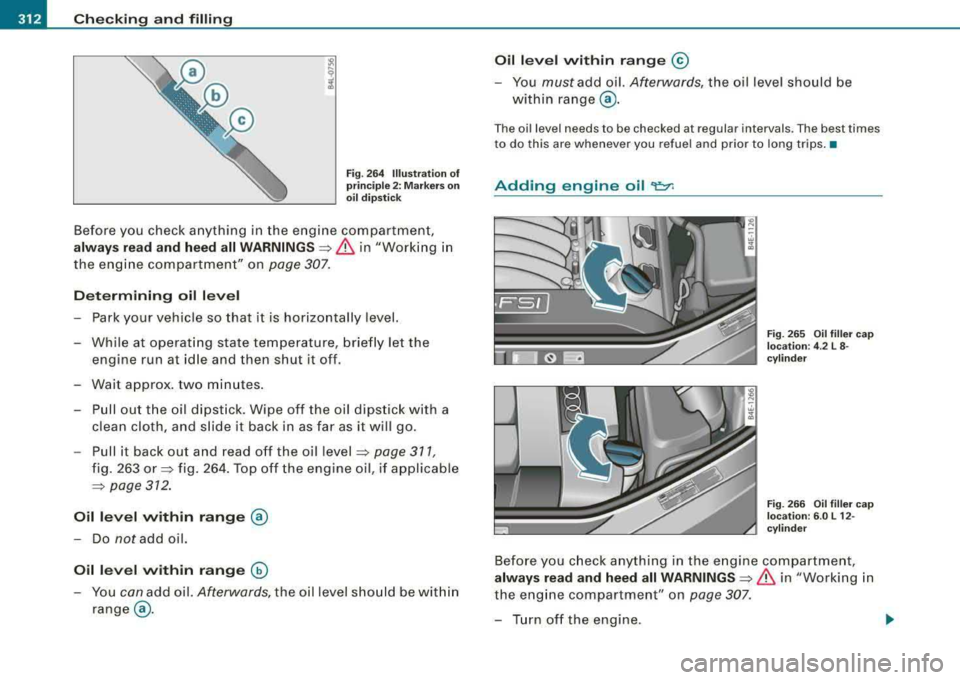
Fig. 264 Illustration of
principle 2: Markers on
oil dipstick
Before you check anything in the engine compartment,
always read and heed all
WARNINGS ~ & in "Working in
the engine compartment" on
page 307 .
Determining oil level
-Park your vehicle so that it is horizontally level.
-While at operating state temperature, briefly let the
engine run at idle and then shut it off.
-Wait approx. two minutes.
Pull out the oil dipstick. Wipe off the oil dipstick with a
clean cloth, and slide it back in as far as it will go.
-Pull it back out and read off the oil level ~ page 311,
fig. 263 or~ fig. 264. Top off the engine oil, if applicable
~ page 312.
Oil level within range @
-Do not add oil.
Oil level within range
@
-You can add oil. Afterwards, the oil level should be within
range @. Oil level within range
©
You must add oil. Afterwards, the oil level should be
within range @.
The oil level needs to be checked at regular intervals. The best times
to do this are whenever you refuel and prior to long trips. •
Adding engin e oil 'l:::7:
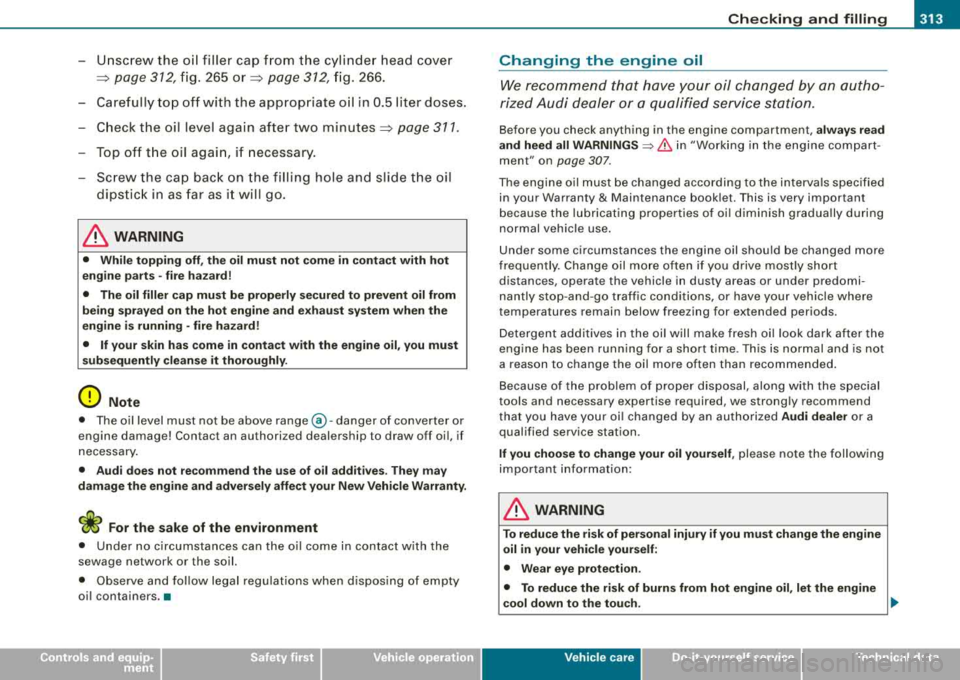
Fig. 265 Oil filler cap
location: 4.2 L
8-
cylinder
Fig . 266 Oil filler cap
location : 6.0 L
12 -
cylinder
Before you check anything in the engine compartment,
always read and heed all
WARNINGS ~ & in "Working in
the engine compartment" on
page 307.
-Turn off the engine . .._
Page 315 of 404
Checkin g and fillin g -
-----------------=-----------"'---
•
-Unsc rew the oil filler cap f rom the cylinde r head cover
=>
page 312, f ig . 265 or=> page 312, fi g. 266 .
-Carefully top off with the appropriate o il in 0.5 liter doses.
-Check the oi l level again after two minutes => page 311 .
-Top off the oil again, if necessary .
-Screw the cap bac k on the filling hole and slide the oil
dipstick in as fa r as i t will go .
& WARNING
• Whil e topping off , the oil mu st not com e in c ontact with hot
e ng ine p art s
-fire h azard!
• The oil filler cap mu st be prop erly se cur ed to pr even t oil from
be ing spr aye d on the hot en gi ne a nd exha ust sys te m when the
engin e is running
-fir e haza rd!
• If your skin h as c ome in cont act wi th the engine oil , you mu st
s ubs equen tly c leanse it thoroughl y.
0 Not e
• The o il level must not be above range @- da nger of converter or
engine damage! Contact an authorized dealership to draw off oi l, if
necessary.
• Audi d oes no t re commend the u se of o il a ddit ives. The y m ay
damage th e engine and adv erse ly a ffect y our New Vehicle Warr ant y.
<£> For the sake of the environment
• Under no circumstances can the o il come i n contact w ith the
sewage network or the soil.
• Observe and fol low legal regulat ions when d ispos ing of empty
oi l containers. •
Changing the engine oil
We recommend that have your oil changed by an auth o
rized Audi dealer or a qualified service station.
Before you check anything in the engine compartment, always rea d
and heed all
WARNING S=> & in "Working in the engine co mpart
ment" on
page 307.
The engine oi l must be changed according to the interva ls specified
in your Warranty
& Maintenance booklet . This is very important
because the lubricating properties of oi l diminish gradua lly during
normal vehicle use.
Under some circumstances the engine oil shou ld be changed more
frequently . Change oil mo re often if you drive most ly short
distances, operate the vehicle in dusty areas or under predomi
nantly stop -and -go traffic conditions, or have your ve hicle where
temperatures remain below freezing for extended periods.
Detergent additives in the oil will make fresh oi l look dark after the
eng ine has been runn ing for a short t ime . Th is is normal and is not
a reason to change the oil more often than recommended .
Because of the problem of proper disposal, along with the spec ial
tools and necessary expertise required, we strong ly recommend
that you have your oi l ch anged by an authorized Audi dealer or a
qualified service station .
If you choo se to ch ang e y our oil your self, please note the following
important information:
& WARNING
To r edu ce the ri sk of per son al inju ry if you mu st change th e engine
oil in your v ehicl e your self :
• Wear eye prote ction .
• To r educ e the ri sk of burn s from hot en gine oil , le t the engine
c ool do wn t o th e tou ch . .,_
Vehicle care