oil level AUDI S8 2008 User Guide
[x] Cancel search | Manufacturer: AUDI, Model Year: 2008, Model line: S8, Model: AUDI S8 2008Pages: 404, PDF Size: 52.7 MB
Page 313 of 404
Checkin g and fillin g 1111
-------------~~~
•
the form of Service or Repair Ord ers that all scheduled maintenance
was perfo rmed in a t imely man ner. •
Engine oil consumption
The engin e in your vehicle d ep ends on an adequate
amount of oil to lubricate and cool all of its moving parts.
In order to provide effect ive lubrication and cool ing of internal
engine components, all internal combustion engines consume a
certain amount of o il. Oil consumption varies from engine to eng ine
and may change significantly over the life of the engine . Typically,
eng ines wi th a specif ied break -in period
(see => page 2771 consume
more oil during the break -in period than they consume after oi l
consumption has stabi lized .
Under normal conditions, the rate of oil consumption depends on
the quality and viscosity of the oil, the RPM (revolutions per minute)
at which the engine is operated, the ambient temperature and road
conditions. Further factors are the amount of oil dilution from water
co ndensation or fue l residue and the oxidation level of the o il. As
any engine is subject to wear as mileage builds up, the oil consump
t io n may increase over time until rep lacement of worn components
may become necessary .
With all these variables coming into play, no standard rate of oil consu mption can be estab lished or specified. T here is no a lternative
to regular and frequent checking of the oil level, see
Note .
If the yellow eng ine o il level warni ng symbol in the instrume nt
cluster ~ lights up, you should check the oil level as soon as
poss ible
with the oil dipstick => page 311 . Top off the oil at your
earliest
convenience=> page 312.
& WARNING
Bef ore you che ck anything in the eng ine comp artment , alw ay s
read and heed all WARNINGS
=> & in "Working in the engine
c ompartment " on
page 307 .
0 Note
Driving with an insuff ic ie n t o il level is l ikely to cause severe damage
to the engine.
[ i ] Tip s
• The oil pr es sure warning displ ay
regular inter vals, preferably ea ch time you refuel , and al ways before
going on a long trip.
• I f you have the impression your engine consumes excessive
amounts of oi l, we reco mmend that you consult your Audi dealer to
have the cause of your concern properly diagnosed . Keep in mind
t hat t he acc urate measureme nt of oil consump tion requ ires g reat
care and may take some time. Your Audi dealer has instructions
about how t o measure oil consumpt ion accurately. •
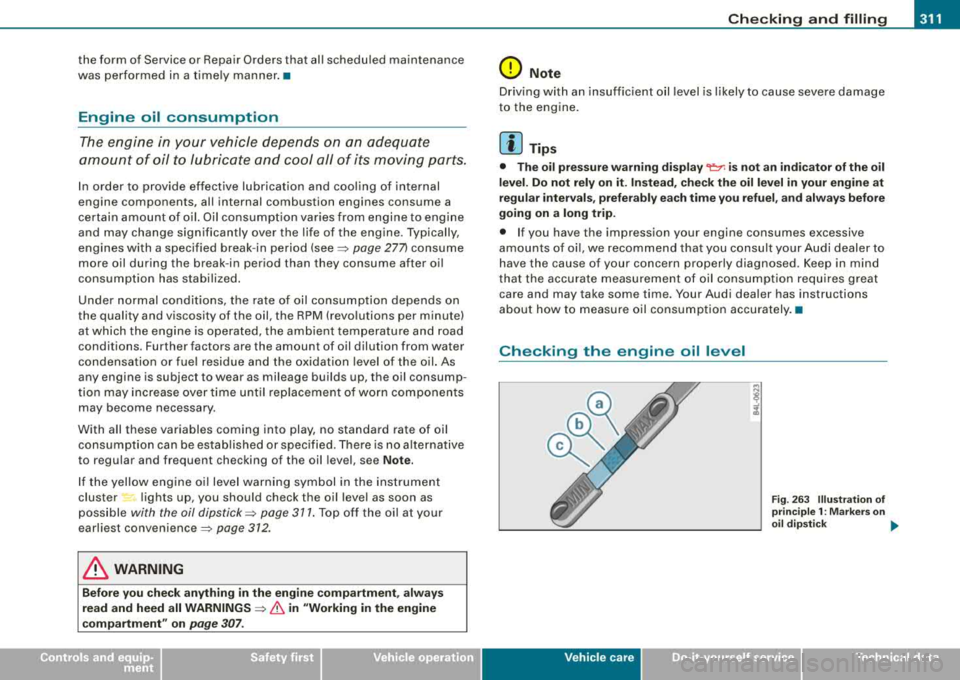
Checking the engine oil level
Vehicle care
Fig. 26 3 Illu stration of
prin cipl e 1: Mar ker s on
o il dip sti ck ...
Page 314 of 404
-
Checking and filling
..._--=--=--------------
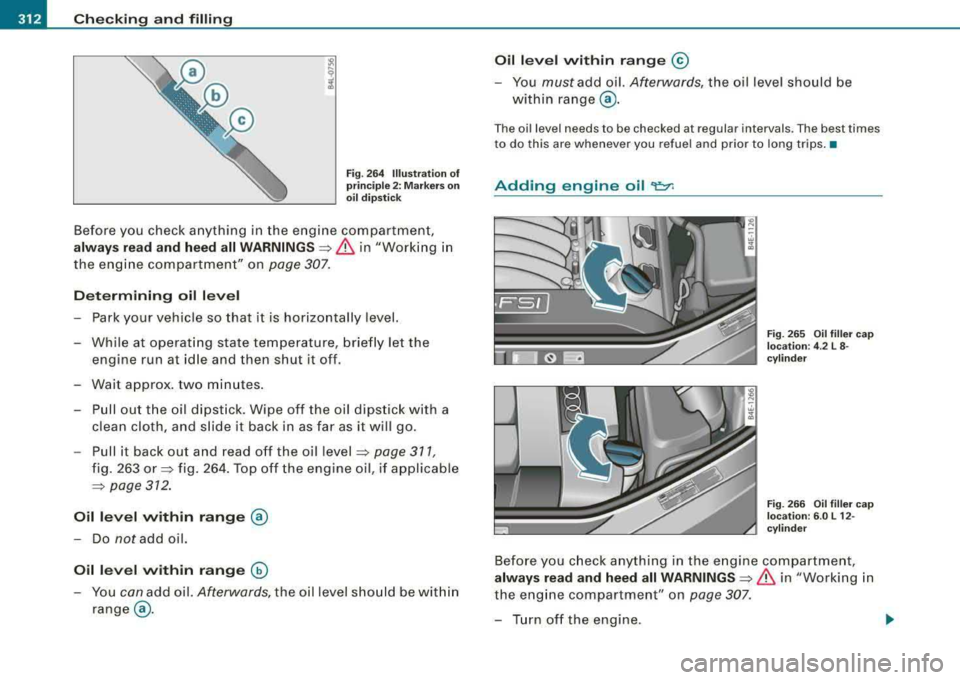
Fig. 264 Illustration of
principle 2: Markers on
oil dipstick
Before you check anything in the engine compartment,
always read and heed all
WARNINGS ~ & in "Working in
the engine compartment" on
page 307 .
Determining oil level
-Park your vehicle so that it is horizontally level.
-While at operating state temperature, briefly let the
engine run at idle and then shut it off.
-Wait approx. two minutes.
Pull out the oil dipstick. Wipe off the oil dipstick with a
clean cloth, and slide it back in as far as it will go.
-Pull it back out and read off the oil level ~ page 311,
fig. 263 or~ fig. 264. Top off the engine oil, if applicable
~ page 312.
Oil level within range @
-Do not add oil.
Oil level within range
@
-You can add oil. Afterwards, the oil level should be within
range @. Oil level within range
©
You must add oil. Afterwards, the oil level should be
within range @.
The oil level needs to be checked at regular intervals. The best times
to do this are whenever you refuel and prior to long trips. •
Adding engin e oil 'l:::7:
Fig. 265 Oil filler cap
location: 4.2 L
8-
cylinder
Fig . 266 Oil filler cap
location : 6.0 L
12 -
cylinder
Before you check anything in the engine compartment,
always read and heed all
WARNINGS ~ & in "Working in
the engine compartment" on
page 307.
-Turn off the engine . .._
Page 315 of 404
Checkin g and fillin g -
-----------------=-----------"'---
•
-Unsc rew the oil filler cap f rom the cylinde r head cover
=>
page 312, f ig . 265 or=> page 312, fi g. 266 .
-Carefully top off with the appropriate o il in 0.5 liter doses.
-Check the oi l level again after two minutes => page 311 .
-Top off the oil again, if necessary .
-Screw the cap bac k on the filling hole and slide the oil
dipstick in as fa r as i t will go .
& WARNING
• Whil e topping off , the oil mu st not com e in c ontact with hot
e ng ine p art s
-fire h azard!
• The oil filler cap mu st be prop erly se cur ed to pr even t oil from
be ing spr aye d on the hot en gi ne a nd exha ust sys te m when the
engin e is running
-fir e haza rd!
• If your skin h as c ome in cont act wi th the engine oil , you mu st
s ubs equen tly c leanse it thoroughl y.
0 Not e
• The o il level must not be above range @- da nger of converter or
engine damage! Contact an authorized dealership to draw off oi l, if
necessary.
• Audi d oes no t re commend the u se of o il a ddit ives. The y m ay
damage th e engine and adv erse ly a ffect y our New Vehicle Warr ant y.
<£> For the sake of the environment
• Under no circumstances can the o il come i n contact w ith the
sewage network or the soil.
• Observe and fol low legal regulat ions when d ispos ing of empty
oi l containers. •
Changing the engine oil
We recommend that have your oil changed by an auth o
rized Audi dealer or a qualified service station.
Before you check anything in the engine compartment, always rea d
and heed all
WARNING S=> & in "Working in the engine co mpart
ment" on
page 307.
The engine oi l must be changed according to the interva ls specified
in your Warranty
& Maintenance booklet . This is very important
because the lubricating properties of oi l diminish gradua lly during
normal vehicle use.
Under some circumstances the engine oil shou ld be changed more
frequently . Change oil mo re often if you drive most ly short
distances, operate the vehicle in dusty areas or under predomi
nantly stop -and -go traffic conditions, or have your ve hicle where
temperatures remain below freezing for extended periods.
Detergent additives in the oil will make fresh oi l look dark after the
eng ine has been runn ing for a short t ime . Th is is normal and is not
a reason to change the oil more often than recommended .
Because of the problem of proper disposal, along with the spec ial
tools and necessary expertise required, we strong ly recommend
that you have your oi l ch anged by an authorized Audi dealer or a
qualified service station .
If you choo se to ch ang e y our oil your self, please note the following
important information:
& WARNING
To r edu ce the ri sk of per son al inju ry if you mu st change th e engine
oil in your v ehicl e your self :
• Wear eye prote ction .
• To r educ e the ri sk of burn s from hot en gine oil , le t the engine
c ool do wn t o th e tou ch . .,_
Vehicle care
Page 317 of 404
___________________________________________ C;:_:_: h..:e ..:c :..;.k..: i_n ..::g :.._ a_n _d_ f_il _li _n ..::g :.._--JIIIII
0 Note
• Before winter sets in, have the coolant checked to see if the
coolant additive in your vehicle is sufficient to meet the climate
conditions. This is especially important if you live in a region where
the winter is extremely cold. If necessary , increase the proportion of
coolant additive to 60%.
• When adding coolant additive to your cooling system,
remember:
-We recommend using only coolant additive G12+ + (check the
label) for your vehicle. This coolant additive is available at autho
rized Audi dealers. Other types of antifreeze can significantly
reduce corrosion protection . The resulting corrosion can cause a
loss of coolant and serious engine damage .
• Do not add any type of radiator leak sealant to your vehicle's
engine coolant. Adding radiator repair fluid may adversely affect the
function and performance of your cooling system and could result
in damage not covered by your New Vehicle Limited Warranty .•
Checking the engine coolant level
The engine coolant level can be checked with a quick
glance.
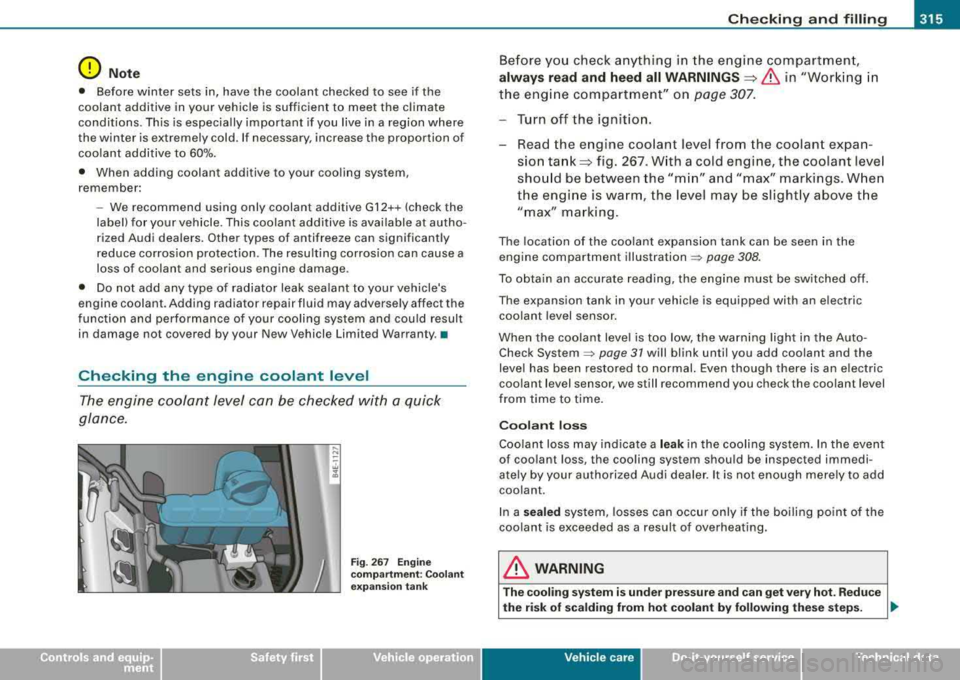
Fig . 267 Engine
compartment : Coolant
expansion tank
Before you check anything in the engine compartment,
always read and heed all WARNINGS => & in "Working in
the engine compartment" on
page 307.
Turn off the ignition.
Read the engine coolant level from the coolant expan
sion
tank => fig. 267 . With a cold engine, the coolant level
should be between the "min" and "max" markings. When
the engine is warm, the level may be slightly above the
"max" marking.
The location of the coolant expansion tank can be seen in the
engine compartment illustration =>
page 308.
To obtain an accurate reading, the engine must be switched off.
The expansion tank in your vehicle is equipped with an electric
coolant level sensor.
When the coolant level is too low, the warning light in the Auto
Check
System => page 31 will blink until you add coolant and the
level has been restored to normal. Even though there is an electric
coolant level sensor, we still recommend you check the coolant level
from time to time.
Coolant loss
Coolant loss may indicate a leak in the cooling system. In the event
of coolant loss, the cooling system should be inspected immedi
ately by your authorized Audi dealer . It is not enough merely to add
coolant .
In a
sealed system, losses can occur only if the boiling point of the
coolant is exceeded as a result of overheating.
& WARNING
The cooling system is under pressure and can get very hot. Reduce
the risk of scalding from hot coolant by following these steps.
.,_
Vehic le care I I Technical data
Page 320 of 404
___ C_ h_e _c _ k_ i_ n ~g~ a_ n_ d_ f_ i_ll _in _g~--------------------------------------------
-Read the brake fluid level from the brake fluid reservoir
=> fig. 268. The brake fluid level must be between the
"MIN" and "MAX" markings.
The brake fluid reservoir is located at the rear partition of the engine
compartment on the left
side~ page 308.
The fluid level may drop slightly after some time due to the auto
matic adjustment of the brake pads. This is not cause for alarm.
If the brake fluid level falls considerably below the "MIN" mark, the
brake warning/indicator light (U.S. models:
BRAKE , Canadian models:
«D>l will come on~ page 22 and~ page 30. Do not continue to
operate the vehicle. The complete brake system should be thor
oughly checked by an authorized Audi dealer or other qualified
facility and the cause corrected. If the brake fluid level is too low, the
brake warning/indicator light will illuminate. Contact an authorized
Audi dealer
immediately. •
Changing brake fluid
Have the brake fluid changed by an experienced techni
cian.
Brake fluid absorbs moisture from the air. If the water content in the
brake fluid is too high, corrosion in the brake system may result
after a period of time. The boiling point of the brake fluid will also
decrease considerably and decrease braking performance.
Therefore, the brake fluid must be changed
every two years. Always
use new brake fluid which conforms to Federal Motor Vehicle Stan
dard "FMVSS 116 DOT 4".
The brake fluid reservoir can be difficult to reach, therefore, we
recommend that you have the brake fluid changed by your autho
rized
Audi dealer. Your dealer has the correct tools, the right brake
fluid and the know-how to do this for you.
& WARNING
• Brake fluid is poisonous . It must be stored only in the closed
original container out of the reach of children!
• Brake failure can result from old or inappropriate brake fluid .
Observe these precautions:
-Use only brake fluid that meets SAE specification J 1703 and
conforms to Federal Motor Vehicle Standard 116. Always check
with your authorized Audi dealer to make sure you are using
the correct brake fluid. The correct type of brake fluid is also indicated on the brake fluid reservoir .
- The brake fluid must be new. Heavy use of the brakes can
cause a vapor lock if the brake fluid is left in the system too
long. This can seriously affect the efficiency of the brakes as
well as your safety . This could result in an accident .
0 Note
Brake fluid will damage the paint of your vehicle .
<£> For the sake of the environment
Because of the problem of proper disposal of brake fluid as well as
the special tools required and the necessary expertise, we recom
mend that you have the brake fluid changed by your authorized Audi
dealer. •
Battery
General information
Under normal operating conditions, the battery in your Audi does
not need any maintenance. With high outside temperatures or long
daily drives we recommend that you have the electrolyte level .,,_
Page 361 of 404
_________________________________________________ F_ u_ s_ e_s _ a_n _d_ b_ u
_ lb_ s _ __.11111
[ i J Tips
You are well advised to keep a supply of spare fuses in your vehicle.
Fuses with the proper ampere ratings are available at your Audi
dealer. •
Fuse Location , Instrument Panel left
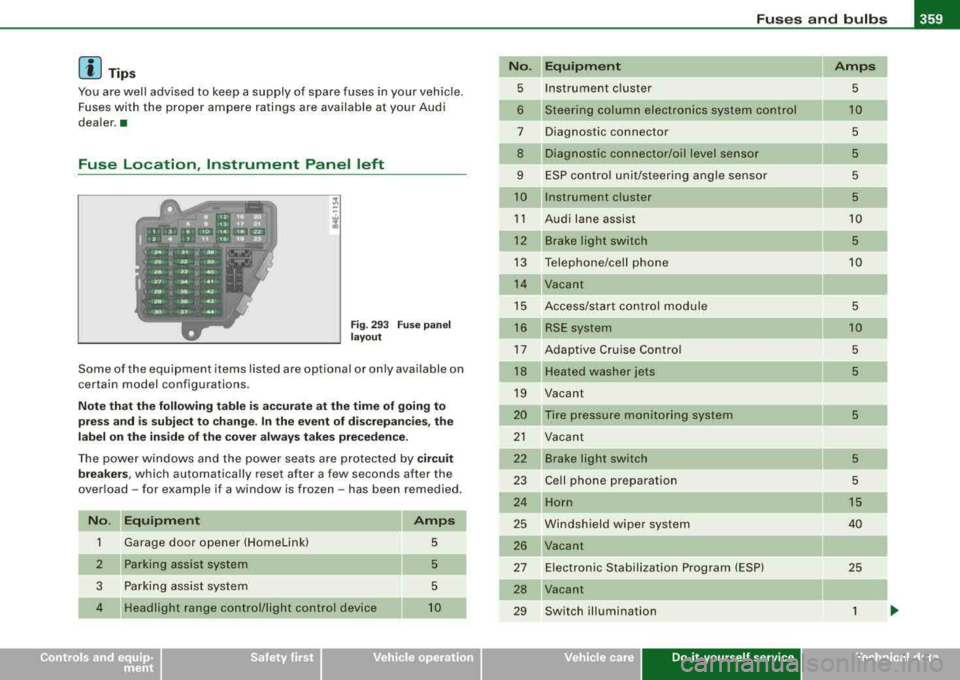
Fig . 293 Fuse panel
layout
Some of the equipment items listed are optional or only available on
certain model configurations.
Note that the following table is accurate at the time of going to
press and is subject to change. In the event of discrepancies, the
label on the inside of the cover always takes precedence.
The power windows and the power seats are protected by circuit
breakers, which automatically reset after a few seconds after the
overload -for example if a window is frozen -has been remedied.
No. Equipment
1 Garage door opener (Homelinkl 5
2
Parking assist system 5
3
Parking assist system 5
4
Headlight range control/light control device 10
No.
5
6
7
8
9
10
11
12
13
14
15
16
17
18
19
20
21
22
23
24
25
26
27
28
29
Equipment Amps
Instrument cluster 5
Steering column electronics system control 10
Diagnostic connector 5
Diagnostic connector/oil level sensor 5
ESP control unit/steering angle sensor 5
Instrument cluster 5
Audi lane assist 10
Brake light switch 5
Telephone/cell phone 10
Vacant
Access/start control module
5
RSE system 10
Adaptive Cruise Control 5
Heated washer jets 5
Vacant
Tire pressure mon itoring system
5
Vacant
Brake light switch
5
Cell phone preparation 5
Horn 15
Windshield wiper system 40
Vacant Electronic Stabilization Program (ESP)
25
Vacant
Switch illumination
1
Vehicle care Do-it-yourself service irechnical data
Page 363 of 404
_________________________________________________ F_ u_ s_ e_s _ a_n _d_ b_ u
_ lb_ s _ __,_
-
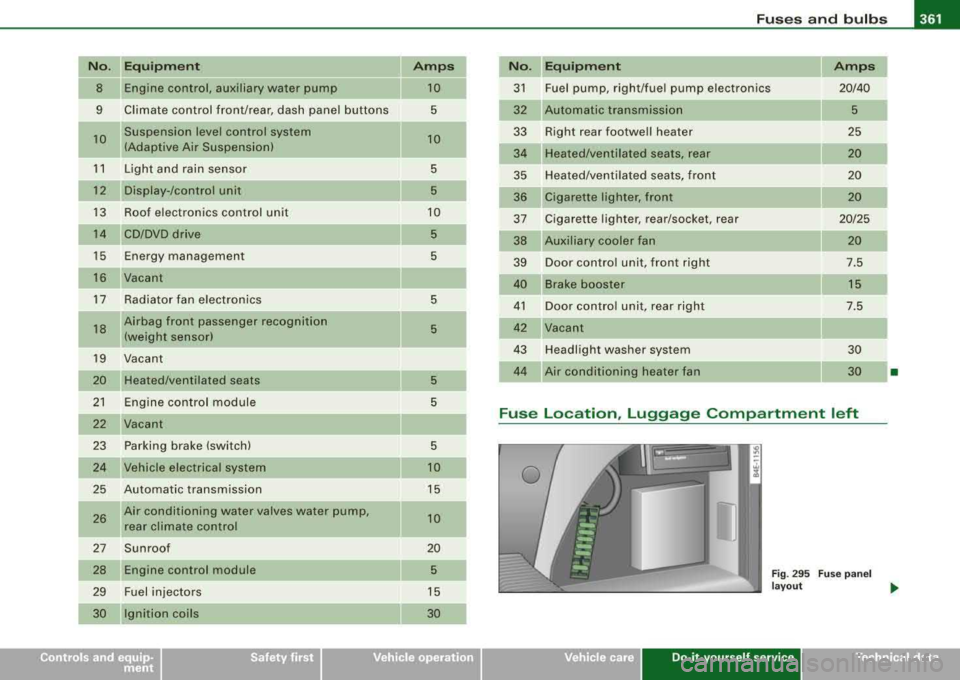
No . II Equipm ent
8 Engine control, auxiliary water pump
9
10 C
limate control front /rear, dash panel buttons
Suspension level control system
(Adaptive Air Suspension)
11 Light and rain sensor
1 2 Display -/control unit
13 Roof electronics control unit
CD/DVD d rive
15 Energy managemen t
16 Vacant
17 Radiator fan e lectronics
18 Airbag front passenger recognition
(weight sensor)
19 Vacant
20 Heated/ventilated seats
21 Engine control module
22 Vacant
23 Parking brake (switch)
24 Vehicle electrical syste m
25
26
27
Automatic transmission Air condi tioning water valves wate r pump,
rea r climate control
Sunroof
28 Engine control module
29 Fuel injectors
30 Ignition coils
Amps
10
5
1 0
5
5
10
5
5
5
5
5
5
5
1 0
15
10
20
5
1 5
30
-
No . Equipm ent
31 Fuel pump , right/fue l pump e lectronics
32 Automatic transmission
33
34
Right rear footwe ll heater
Heated/ventila ted seats, rear
35 Heated/ventilated seats, front
36 Cigarette lighter, front
37 Cigarette lighter, rear/socket, rear
38 Auxil iary cooler fan
39 Door contro l unit, front right
40 Brake booster
41 Door contro l unit, rear right
42 Vacant
43 Headlight washer system
44 A ir co nditioning heater fan
Amps
20/40
5
25
20
20
20
20/25 20
7.5
1 5
7.5
30
30 •
Fuse Location , Luggage Compartment left
0
Fig . 2 95 Fuse pan el
l a you t _.
Vehicle care Do-it-yourself service irechnical data
Page 372 of 404
lffll....__E_ m_ e_r -=g :....e_ n
_ c-=y _ s_ i_t _u _a _t_ i_o _n_ s _______________________________________________ _
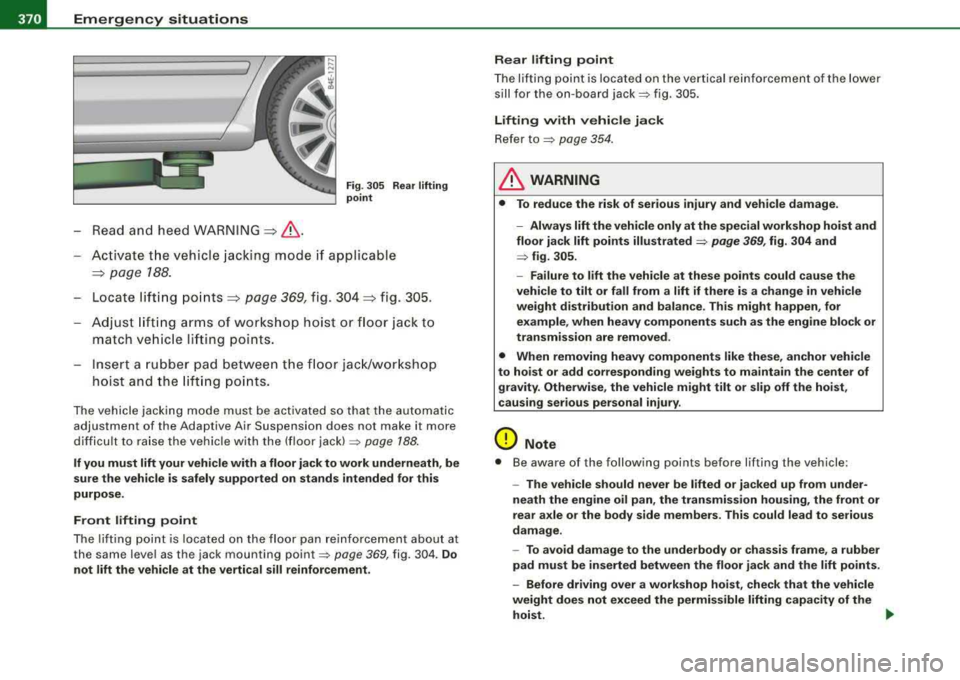
-Read and hee d WARNI NG =:> & .
Fig. 305 Re ar lifting
point
Ac tivate t he vehicle jackin g mode if a pp licable
=:> p age 188 .
-Loc ate lift ing po in ts=:> page 369 , fig. 3 04 =:> fig. 3 05.
Ad just lift in g a rms of works hop hoi st or floor jack t o
match ve hicle li ftin g points.
Ins ert a ru b be r pad betwe en the floor jack/work shop
h o ist and t he li ftin g poin ts.
The vehicle jacki ng m ode mus t be ac tiva ted so that the au tomatic
adjustment of the Adaptive Air Suspension does not make it more
d ifficu lt to ra ise the vehic le w ith the (floor
jac k) => page 188 .
If you must lift your vehicle with a floor jack to work underneath , be
sure the vehicle is safely supported on stands intended for this
purpo se.
Front lifting point
T he lif ti ng po int is locat ed o n th e floor pan re inforc ement abou t at
the same level as the jack mounting
point => page 3 69, fig. 304. Do
not lift the vehicle at the vertical sill reinforcement. Rear lifting point
Th
e lif tin g po int is loca ted o n the vertical re info rce ment of the l ower
s ill for t he o n-board
jack=> fig . 305.
Lifting with vehicle jack
Refer to => page 354.
& WARNING
• To reduce the risk of serious injury and vehicle damage.
-Always lift the vehicle only at the special workshop hoist and
floor ja ck lift points illustrated
=> page 369 , fig. 304 and
=> fig . 305.
- Failure to lift the vehicle at these points could cause the
vehicle to tilt or fall from a lift if there is a change in vehicle
weight distribution and balance. This might happen , for
example , when heavy components such as the engine block or
transmission are removed .
• When removing heavy components like these, anchor vehicle
to hoist or add corresponding weights to maintain the center of gravity. Otherwise , the vehicle might tilt or slip off the hoist,
c ausing serious personal injury .
0 Note
• Be awar e of the following points before lifting the vehicle :
-The vehicle should never be lifted or jacked up from under
neath the engine oil pan , the transmission housing , the front or
rear axle or the body side members . This could lead to serious
damage .
-To avoid damage to the underbody or chassis frame , a rubber
pad must be inserted between the floor jack and the lift point s.
- Before driving over a workshop hoist, check that the vehicle
weight does not exceed the permissible lifting capacity of the
hoid . ~
Page 384 of 404
___ C_ o_n_ s_ u_m _ e_ r_ ln_ f_o _r_m _ a_ t_ i_o _n ______________________________________________ _
&, WARNING (continued )
• The engine compartment of any motor vehicle is a potentially
hazardous area . Never reach into the area around or touch the
radiator fan . It is temperature controlled and can switch on
suddenly -even when the engine is off and the ignition key has
been removed . The radiator fan switches on automatically when
the coolant reaches a certain temperature and will continue to run until the coolant temperature drops .
• Always remove the ignition key before anyone gets under the
vehi cle .
• Always support your vehicle with safety stands if it is neces
sary to work underneath the vehicle . The jack suppl ied with the
vehicle is not adequate for this purpose and could collapse causing serious personal injury .
• If you must work underneath the vehicle with the wheels on
the ground , always make sure the vehicle is on level ground , that
the wheels are always securely blocked and that the engine
cannot be started .
• Always make sure the transmission selector lever (automatic
transmission) is in
"P " (Park position ) and the park brake is firmly
applied.
W For the sake of the environment
• Cha ng ing the eng in e sett ings will adverse ly aff ect em iss ion
levels . This is detrimenta l to the environment and increases fuel
c o nsu mp tion .
• Always observe environmenta l regu lations when disposing of
o ld eng ine oil, u sed b ra ke flu id, d irty e ng in e coo la nt, spe nt batter ies
or worn out tires.
• Undeployed airba g modul es and pret ensioners might be classi
fied as Perchlorate Material -special handling may apply, see
www .dtsc.ca .gov/ haza rdouswast e/p erc hlor ate . W hen the vehicle or
parts of the restraint s ystem including airbag modules safety be lts
w it h p ret en sio ner s are scra p pe d, a ll ap pl icable l aw s and reg ula- tions must be observed
. Your authorized Audi dea ler is familiar with
th ese re q ui re me nts a nd we reco mmend th at you h ave your dea le r
perform this serv ice for you .•
Additional accessories,
modifications and parts replacement
Additional accessories and parts
replacement
Always consult an author ized Audi dealer before
pu rcha sing a ccess ories .
Your vehicle incorporates the latest safety design featu res ensuring
a high sta nd ard of ac tive a nd pass iv e sa fet y.
T his sa fety could be compromised by non -approved chang es to th e
veh ic le . Fo r th is reason, if pa rts have to be replaced, please o bse rve
the followi ng po ints wh en insta lling addi tio na l acc essor ies:
A pprove d Audi accesso ries and genuine A udi parts are avai lable
fr om autho rized Aud i d eale rs.
T hese deale rs also have the necessary fac ilities, tools and tra ined
spec ial is ts to ins tal l the part s and accesso rie s prope rly.
L1}. WARNING
Using the wrong spare parts or using non -approved accessories
can cause serious personal injury.
• Use only accessories expressly approved by Audi and genuine
Audi spare parts
• These parts and accessories have been specially designed to
be used on your vehicle .
• Never install accessories such as telephone cradles or
beverage holders on airbag covers or within the airbag deploy-
Page 392 of 404
lll'ffll_....:..A..:.;l~ p :..;h..:.; a= b..:e :..;t:.:..i c::..:: a.:..l .,;. in :..:..:. d:..;e :..;x..:..,_ ___________________________________________ _
Driver's seat memory . . . . . . . . . . . . . . . . . 94
Activating remote contro l key .. ... .. 95
Recalling a seat position ...... .... . 94
Storing a seat position ............. 94
Driving messages .................... 29
Dr ivingsafely .... .... .... ...... .... 198
Driving time .... ... .. .... .... ...... .. 38
Dup licate key ......... ............... 47
DVD p layer for navigation system . . . . . 112
E
Easy entry feature 129
Electromechanica l parking brake
Emergency braking ............... 136
Malfunction ........ .... .... .... . 136
Operation . . . . . . . . . . . . . . . . . . . . . . . 134
Parking . . . . . . . . . . . . . . . . . . . . . . . . . 135
Re leasing and app lying .... .... ... 134
Starting
off with a trailer . ...... ... 136
Warning/indicator lights ........... 22
Electronic differential lock (EDU
How the system works . . . . . . . . . . . . 269
Warning/indicator lights ........... 21
Electronic immobilizer .. ...... ..... 14, 49
Electron ic power contro l
(EPC) warning/indicator light .. .... .. 18
Electronic speed limiter .. .. .. .... ..... 28
Electronic stabi lization program (ESP)
How the system works . . . . . . . . . . . . 268
Warning/indicator lights ........... 18
Emergency braking .. ....... .. ...... 136 Emergency
closing
Power sunroof ................. 67, 68
Emergency flasher . . . . . . . . . . . . . . . . . . . 73
Warning/indicator lights ..... ...... 19
Emergency locking ....... .... .... .... 54
Emergency locking of doors ........... 54
Emergency starting ........ .... ... .. 364
Emergency towing ..... .. .... .... ... 366
Emergency warning triangle ... ....... 348
Energy management .... .... ... .. ... 274
Battery power . . . . . . . . . . . . . . . . . . . 275
Driver notification ................ 275
Engine 4.2 I, 8-cylinder (350 hp) .... .... ... 308
6 .0 I, 12-cylinder (450 hp) .......... 309
Compartment . .... .... .... .. 308, 309
Coolant ......................... 314
Hood ... .. .... .... .... .... .... .. 306
Starting ...... .............. 129, 130
Starting with jumper cables .. ... .. 364
Stopping ........................ 131
Engine compartment ... .. .... .... ... 308
Safety instructions .......... ..... 307
Working the engine compartment .. 307
Engine coolant ..................... 314
Adding coolant ............. ..... 316
Checking the engine coo lant level .. 315
Expansion tank .................. 315
Malfunction symbo l ...... .... .... . 31
Radiator fan ...... .... .... .... ... 317
Temperature gauge . . . . . . . . . . . . . . . 12
Engine data ........................ 378 Engine hood
Closing ..... .. .... .... ...... ... . 307
How to release the hood . . . . . . . . . . 306
Engine oi l ..... ... .... .... .... ...... 309
Adding ......................... 312
Additives ........................ 312
Changing .. .... .... ..... .. .... .. 313
Checking the engine oil level ....... 311
Indica tions and conditions requiring extra
checking .. ...... .... ...... .... 311
Oil consumption ................. 311
Oil grades .. .... .... ... .... .... .. 309
Oil level symbol .... .... ...... ... .. 35
Pressure ma lfunction ... ... .... .... 32
Recommended oil check intervals .. 311
Sensor defective . . . . . . . . . . . . . . . . . . 35
Specification and viscosity ......... 309
Environment Break -in period .................. 277
Catalytic converter .... .... .... ... 278
Disposing of your vehicle battery ... 322
Driving at high speeds ....... ... .. 279
Driving to minimize pollution and noise .
279
Fuel ...... .... ........... .... ... 303
Fuel economy .......... .... .... .. 279
L eaks under your vehicle .......... 307
Le tting the vehicle stand and warm up ..
280
Proper disposal of drained brake fluid
318
Proper disposal of drained engine coolant . .... .... .... .... ....... 316