roof AUDI S8 2008 User Guide
[x] Cancel search | Manufacturer: AUDI, Model Year: 2008, Model line: S8, Model: AUDI S8 2008Pages: 404, PDF Size: 52.7 MB
Page 81 of 404
the shade shuts off when the temperature in the vehicle falls below
23 °F (- 5 °C). The shade cannot be operated until the passenger
compartment warms up above this temperature. •
Applies to vehic les: with e lectr ic sunshade for the rear side windows
Electric sunshade for the rear side windows
Each rear s;de w;ndow ;s equ;pped w;th an electr;c
sunshade.
oou
t;;:::=:;1
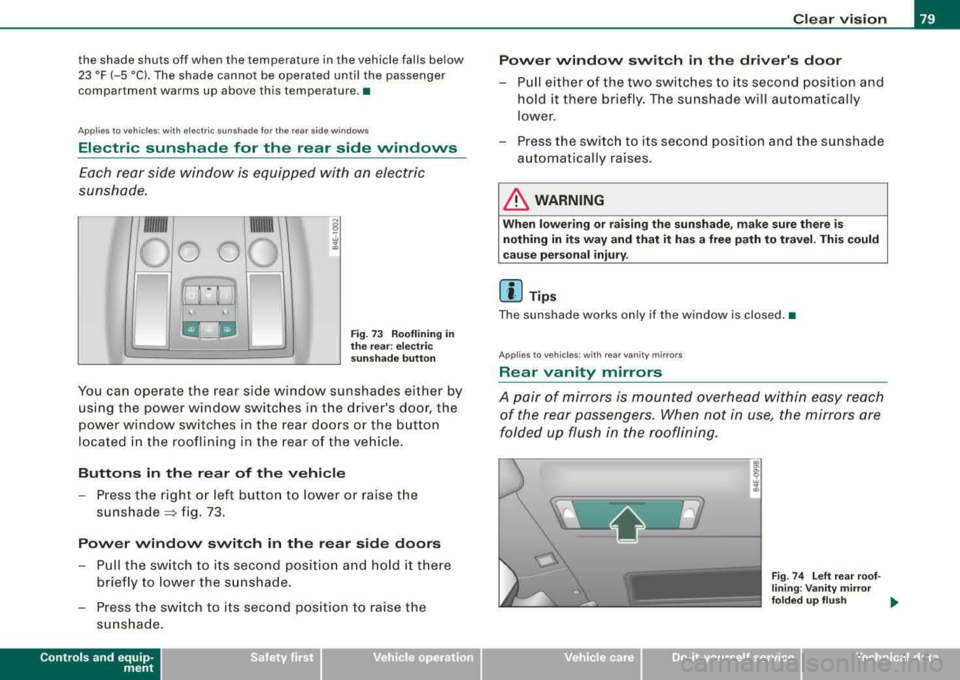
~ Fig . 73 Rooflining in
the rear: electric
sunshade button
You can operate the rear side window sunshades either by
using the power window switches in the driver's door, the
power window switches in the rear doors or the button
located in the rooflining in the rear of the vehicle.
Buttons in the rear of the vehicle
-Press the right or left button to lower or raise the
sunshade => fig. 73.
Power window switch in the rear side doors
-Pull the switch to its second position and hold it there
briefly to lower the sunshade.
-Press the switch to its second position to raise the
sunshade.
Contro ls a nd eq uip
ment
Clear vision
Power window switch in the driver's door
-Pull either of the two switches to its second position and
hold it there briefly. The sunshade will automatically
lower.
-Press the switch to its second position and the sunshade
automatically raises .
& WARNING
When lowering or raising the sunshade, make sure there is
nothing in its way and that it has a free path to travel. This could
cause personal injury.
[ i] Tips
The sunshade works only if the window is closed. •
Applies to vehicles: with rear vanity mirrors
Rear vanity mirrors
A pa;r of m;rrors ;s mounted overhead w;th;n easy reach
of the rear passengers. When not
;n use, the mirrors are
folded up flush
;n the rooft;ning.
Vehicle care I I
Fig . 74 Left rear roof
lining: Vanity mirror
folded up flush
~
irechnical data
Page 82 of 404
Clear vision
Fig. 75 Left rear roof
lining: Vanity mirror
folded down
-To fold down, tap the rear edge of the mirror as indicated
by
arrow~ page 79, fig. 74.
As the mirror folds down, it automatically il lumina tes.•
Wiper and washer system
Windshield wiper ~
The windshield wiper lever controls both the windshield
wipers and the washer system.
Fig. 76 Windshield
wiper lever
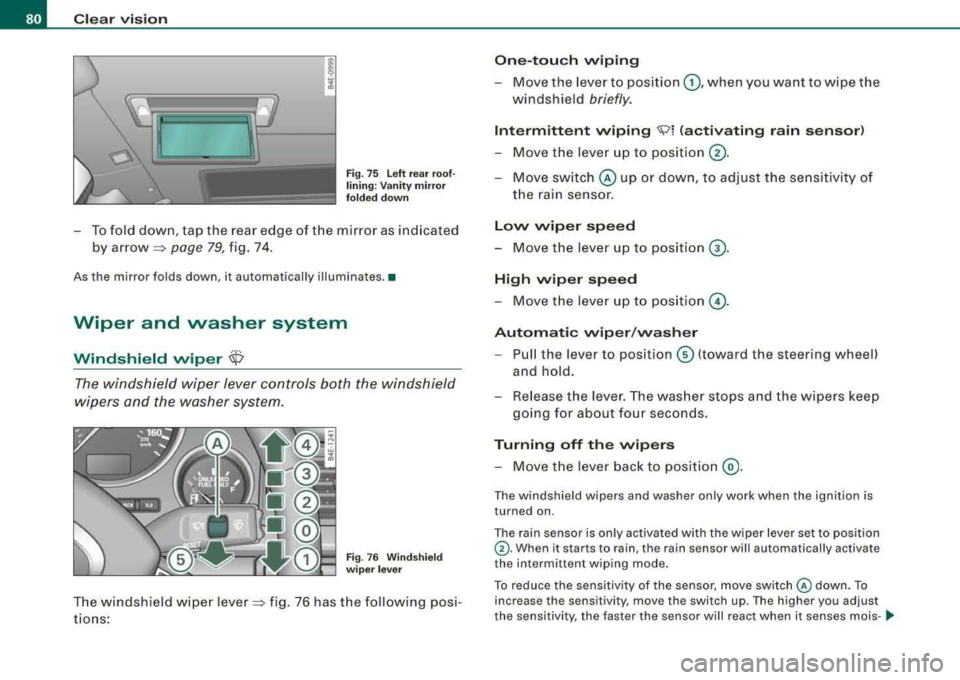
The windshield wiper lever~ fig. 76 has the following posi
tions:
One-touch wiping
-Move the lever to position G) , when you want to wipe the
windshield
briefly.
Intermittent wiping <:S;)l (activating rain sensor)
-Move the lever up to position ®·
-Move switch © up or down, to adjust the sensitivity of
the rain sensor.
Low wiper speed
-Move the lever up to position G).
High wiper speed
-Move the lever up to position @.
Automatic wiper/washer
-Pull the lever to position© (toward the steering wheel)
and hold.
-Release the lever. The washer stops and the wipers keep
going for about four seconds.
Turning off the wipers
-Move the lever back to position @.
The windshield wipers and washer only work when the ignition is
turned on.
The rain sensor is only activated with the wiper leve r set to position
G) . When it starts to rain, the rain sensor will automatically activate
the intermittent wiping mode.
To reduce the sensitivity of the sensor, move switch
@ down. To
increase the sensitivity, move the switch up. The higher you adjust
the sensitivity, the faster the sensor will react when it senses mois-
.,_
Page 94 of 404
Seats a nd sto ra g e
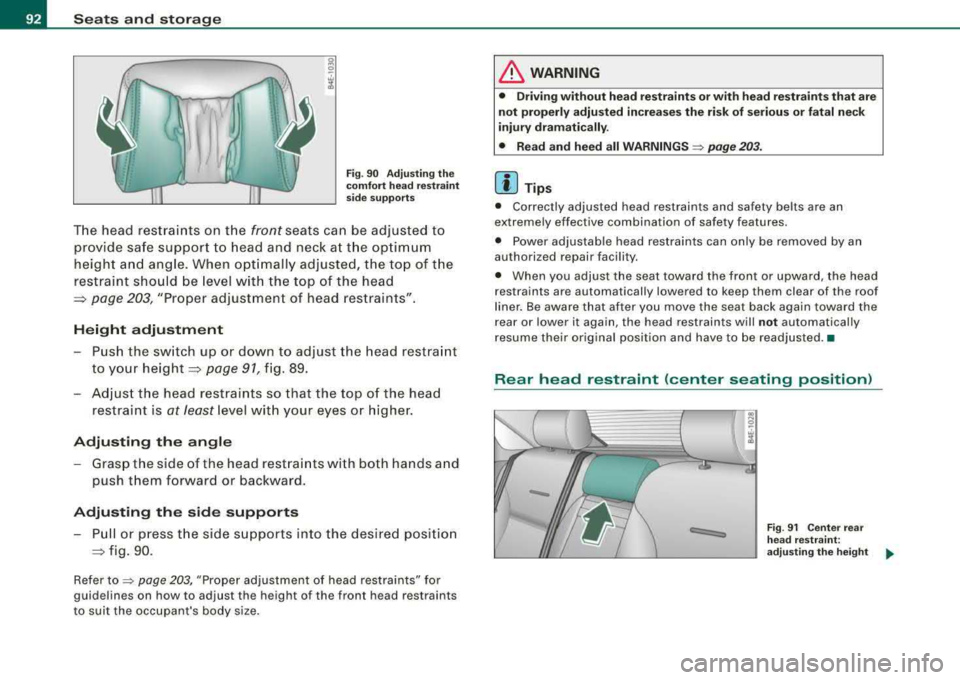
Fig . 90 A djust ing t he
co mfort h ead re str ain t
s id e su pports
The head restrai nts on the front seats ca n be adjusted to
provide safe support to head and neck a t th e op timum
height and angle. When opt imally adjusted, the top of t he
restraint shou ld be level w ith the top of the head
~ page 203, "Proper adjustment of head restraints" .
Height adju stm ent
-Pus h the sw itch up or down to adjust the head restra int
to your
height ~ page 91, fig. 89 .
-Adjust the head restraints so that the top of the head
restraint is
at least level with your eyes or higher.
Adjust ing the angl e
-Grasp the side of the head restra ints with both hands a nd
push them forward or backward.
Adjusting the side supports
-Pull or press t he side supports into the desired positio n
~ fig. 90.
Refer to => page 203, "Proper adjustment of head restraints" for
guidelines on how to ad just the height of the front head restraints
t o suit the occupant's body s ize .
& WARNING
• Drivin g w ithout he ad r estraint s or with head re straint s th at are
not properly adju ste d incr eases the ri sk of serio us or f atal ne ck
i nj ury dram atically .
• Read and heed all WARNING S
:::> page 203.
[ i] Tips
• Correctly adjusted head restraints and safety belts are an
extremely effective combination of safety features .
• Power adjustable head restraints can only be removed by an
authorized repair faci lity.
• When you adjust the seat toward the front or upward, the head
restraints are automatically lowered to keep them clear of the roof
l iner. Be aware that after you move the seat back again toward the
rear or lower it again, the head restraints will
not automatical ly
resume their orig inal position and have to be readjusted. •
Rear head restraint (center seating position)
Fig . 9 1 Cente r rear
hea d re str aint:
a dju st ing t he h eight
Page 105 of 404
________________________________________________ S_ e_ a_t _
s _a_ n_d _ s_t _o _ r_ a_ g~ e __ _
& WARNING
• The ski sack is intended only for the transportation of skis and
other light objects. To reduce the risk of serious personal injury,
never transport heavy or pointed objects in the ski sack.
• When braking rapidly or during an accident, the load could be
displaced and cause injury to occupants.
• Sharp edges on the load must be covered for protection.
Always fasten the belt tightly around the sack and its contents
=:> page 102, fig. 108.
[ i] Tips
Never stow the ski sack away when it is still wet or damp (for
example, snow melting from skis). Allow i t to dry completely before
stowing it away. •
Roof rack
First things first
A roof rack can be fitted to carry additional luggage on
the roof.
- Always read and follow the instructions provided by the
roof rack manufacturer when the roof rack system must
be installed.
If a roof rack or similar luggage carrying equipment is to be
installed, please note the following:
• To enhance the vehicle's streamlined design, rain gutters have
been molded into the roof. It is not possible to use normal roof
racks. Only install a roof rack specifically designed for your model
A8. Contact the nearest Audi dealer for information on approved modular roof racks for your vehicle.
Controls and equip
ment
• These approved roof racks are the basis for a complete roof rack
system. Additional attachments for the basic roof rack are neces
sary to safely transport luggage, bicycles, surf boards, skis or small
boats. All necessary hardware for these systems is available at your
authorized Audi dealer.
• We recommend that you keep the installation instructions for
your roof rack system together with your Owner's l iterature in the
vehicle.
When should the roof rack be removed?
• Before going through an automatic car wash (it is best to ask the
car wash operator for advice)
• When not in use, to reduce fuel consumption, wind noise and to
guard against theft.
& WARNING
• Use of an unapproved roof rack or incorrect mounting of an
approved roof rack can cause the roof rack or the items attached
to it to fall off the roof onto the road.
• Objects falling from the roof of a vehicle can cause a crash and
personal injury.
• Only mount the system between the markings shown in
~ page 104, fig. 109.
• The roof rack system must be installed exactly according to the
instructions provided.
(D Note
• Your vehicle warranty does not cover any damages to the vehicle
caused by using roof racks or mounting struc tures not approved by
Audi for your vehicle. The same applies to damage resulting from
incorrect roof rack installation.
• Always check the roof rack mountings and hardware before each
trip and during a trip to make sure everything is securely tightened.
~
Page 106 of 404
--~S~e~ a~t ~s ~a~n~d~ s~t~ o~r~ a:!Jg~ e:._ _____________________________________________ _
If necessary, retighten the mountings and check the entire system
from time to time.
• After mounting a roof rack system, or when you transport
objects on the roof of your vehicle, the height of the vehicle is natu
ra lly increased . Be careful when driving under low bridges or in
parking garages for examp le. This cou ld cause damage to the load
and even the vehicle itself. •
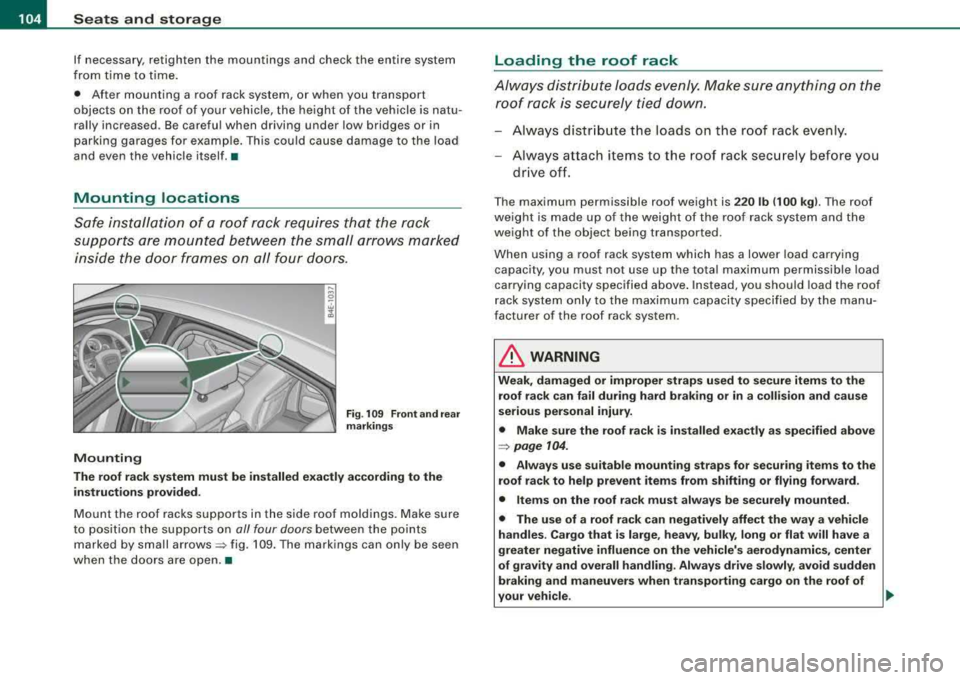
Mounting locations
Safe installation of a roof rack requires that the rack
sup ports are m ounted between the small arrows marked
inside the door frames on all four doors .
Mounting
Fig. 1 09 Front and r ear
ma rkings
Th e roof r ack sy stem mu st be in stalled exactly according to th e
i n stru ction s prov ided .
Mount the roof racks suppo rts in the side roof moldings. Make sure
to position the supports on
all four doors between the points
marked by small
arrows => fig. 109. The markings can only be seen
when the doors are open . •
Loading the roof rack
Always distribute loads evenly. Make sure anything on the
r o of rack is securely tied down .
-Always distribute the loads on the roof rack evenly.
Always attach items to the roof rack securely before you
drive off.
T he maximum permissible roof weight is 220 lb (100 kg ). The roof
we ight is made up o f the weight of the roo f rack system and the
weight of the object being transported .
When using a roof rack system which has a lower load carrying
capacity, you must not use up the total maximum permissible load
carrying capacity specified above . Instead, you should load the roof
r ack system only to the maximum capacity specified by the manu
facturer of the roof rack system .
& WARNING
Weak, damag ed or improper str ap s used to secur e item s to the
r o of rack can fail du ring hard b raking o r in a colli sion and c ause
s eriou s per sonal injur y.
• Make sure the roof rack i s in stalled exactly as s pecifi ed abo ve
=> page 104 .
• Alway s use suitable m ounting strap s for securing it e ms t o the
r o of rack to help prevent item s from shiftin g or fly ing forward.
• Items on the r oof rack mus t al w ay s be se curel y mo unted .
• The u se of a roof r ack can n egatively affect the way a v ehicle
hand les . C arg o that i s la rge , he avy, bulky , long or fl at will h ave a
greater ne gative influence on the vehicle' s aerodyn amics, center
of grav it y and o verall handli ng. Alw ays dri ve slowl y, avoid sudden
braking and maneuver s when tr ansp orting carg o on the roof of
yo ur vehicle . ...,
Page 107 of 404
__________________________________________________ S_ e_ a_t _s _ a_n _ d_ s_ t
_ o_ r_a ""'g :c.. e _ ___.ffllll
fl::. W ARNING (continued )
• Never exceed the maximum permi ssible load carrying capa city
of the roof of you r vehi cle , the p ermi ssible axle weight s and the
permissible tot al w eig ht of your
vehicle ~ page 375, "Weight s".
• Alwa ys drive slo wly, av oid sudden brak ing and maneuver s
when transporting cargo on th e roof of your vehicle.
<£> For the sake of the environment
Sometimes it may be easier to leave a roof rack insta lled even
though you are not using it. Due to the increased a ir resistance your
veh icle wi ll unnecessarily use more fuel. Remove the roof rack if you
a re no t going to use it .•
Cupholder
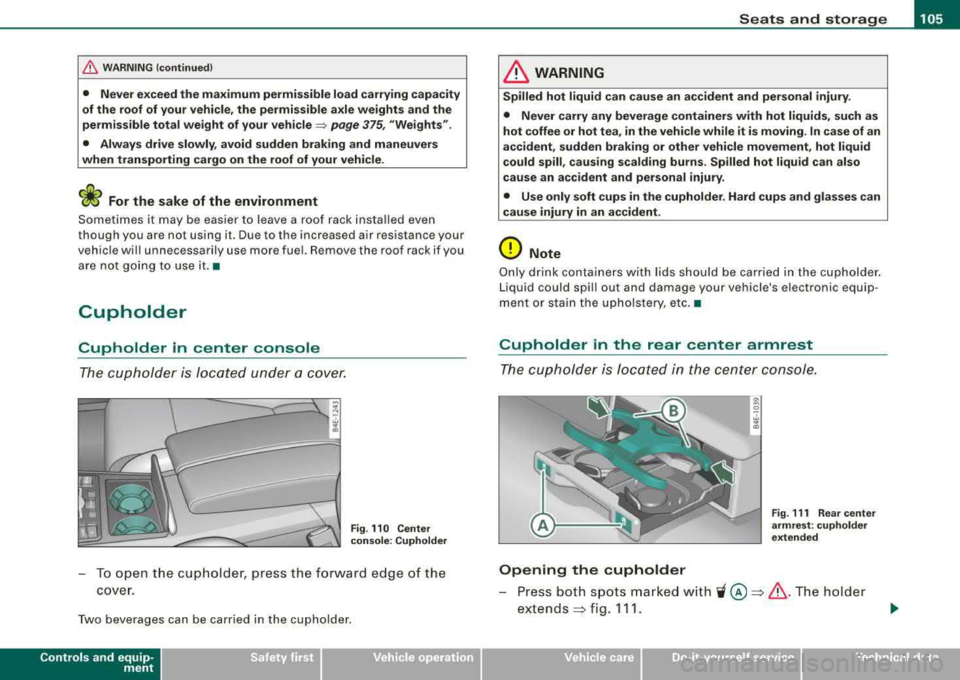
Cupholder in center console
The cupholder is located under a cover.
Fi g. 110 Cente r
c on sole : Cuphold er
To o pen t he cup holder, press the forward edge of the
cover.
Two beverages can be carried in the cupholder.
Contro ls a nd eq uip
ment
& WARNING
Spilled hot l iqui d can c ause a n accident and pe rsona l injur y.
• Never car ry any b everage con tainer s with hot liquid s, such as
hot coffee or hot tea , in the veh icle w hile it i s mov ing . In c ase of an
accident, sudden brakin g or other vehicle movement, h ot liquid
c ould spill , cau sing scald ing bu rn s. Spilled hot liquid can also
cause an ac cident and per sonal injury .
• Use only s oft cups in the cuph older. Hard cups and glasses c an
cause injury in an accid ent.
0 Note
Only drink containers wi th lids should be carried in the cupholder .
Liquid could spi ll out and damage your vehicle's electronic equip
ment or stain the upho lstery, etc. •
Cupholder in the rear center armrest
The cupholder is located in the center console .
Opening the cupholder
8 . w 1li
Fig. 111 Rea r cen te r
a rm re st : c uph olde r
e xt end ed
Press both spots marked with 'i @ ~ & .The holder
extends
~ fig . 111.
Vehicle care I I Technical data
Page 117 of 404
Warm and cold -
----------------
energy are temporarily cut back or switched off~ page 274 .
Heating sys tems in par ticular require a great dea l of energy. If yo u
not ice, for example, that the seat *, w indshield * or rear w indow
hea ting is no t heat ing, they have bee n t em por arily c ut b ack or
switched off by
energy management . These systems are availabl e
aga in as soon as the ene rgy ba lance has bee n restor ed.
& WARNING
Reduced visibility is dangerous and can cause accidents .
• For safe driving it is very important that all windows be free of
ice , snow and condensation.
• Completely familiarize yourself with the proper use and func
tion of the heating and ventilation system and especially how to defog and defrost the windows .
• Never use the windshield wiper /washer system in freezing
weather until you have warmed the windshield first , using the
heating and ventilation system. The washer solution may freeze
on the windshield and reduce visibility .
0 Note
• If you suspect that the air conditioner has been damaged, turn
on ECO N and con tac t an autho riz e d Aud i dea le r t o hav e th e sys te m
inspected .
• Re pairs t o the A udi air co nd it io ner req uire s pecia l tec hni cal
know ledge and special tools . Contact an authorized Audi dealer for
assista nce.
[ i ] Tips
• Kee p th e air in ta ke s lots (in fron t of the w inds hield) free from i ce,
snow and debris in order to maintain the proper function of the
cl im ate c ontro l sy ste m.
Controls and equip
ment
• Air escapes through vents under the rear window . When p lacing
ite ms of c lothing on the luggage c ompartme nt cover, e nsu re th at
the openings are not covered .
• Climate c ont ro l wor ks mo st effectively if the windows and t he
power roof are c losed . However, if the interior of a parked vehicle is
e xt re mely ho t fro m the sun's rays , briefly open ing the windows ca n
speed up the cooling process .•
Page 125 of 404
Warm and cold -
------------------------------..J
[ i J Tip s
If the climate control system is operating in cool ing mode, air flows
primarily from the outlets in the center console and in the door
pillars . To achieve adequate cooling, you should never close the
out lets completely. •
Using climate controls economically
Using the climate controls prudently can help save fuel.
When you use t he a ir conditioner, engine power is reduced
and fuel consumption increases. To save fuel, you should
use the a ir co nditioner only when necessary. Also please
note the follow ing po ints:
- If you want to save fuel, activate ECON.
If you are going to drive with the windows open, use ECON.
W For the s ake of the environm ent
By reducing the amount of fuel you use, you also reduce the amount
of pollutants emitted into the air. •
Applies to v ehicl es: with so lar slidi ng /tilt ing sunr oof
Solar blower fan /solar roof
With sufficient sunlight, the blower fan continues to
operate with solar energy to bring in fresh air after the
ignition has been switched off.
T he fan motor is operated by solar energy through the solar roof
after the igni tion is turned off. P lease make certa in that
vents ©
and© are open to achieve optimal ventilation ~ page 122, fig. 137 .
Controls a nd eq uip
ment
The ventilation operates only with the sunroof c losed or in the tilted
position.
If the vehicle was switched off in the recirculation mode, the air
conditioning automatica lly switches to fresh air operation .
Solar operation is not activated at low outside temperatures .•
Windshield defogging/defrosting
Ap plie s to v ehic le s : with windsh ield defogg er/defr oste r
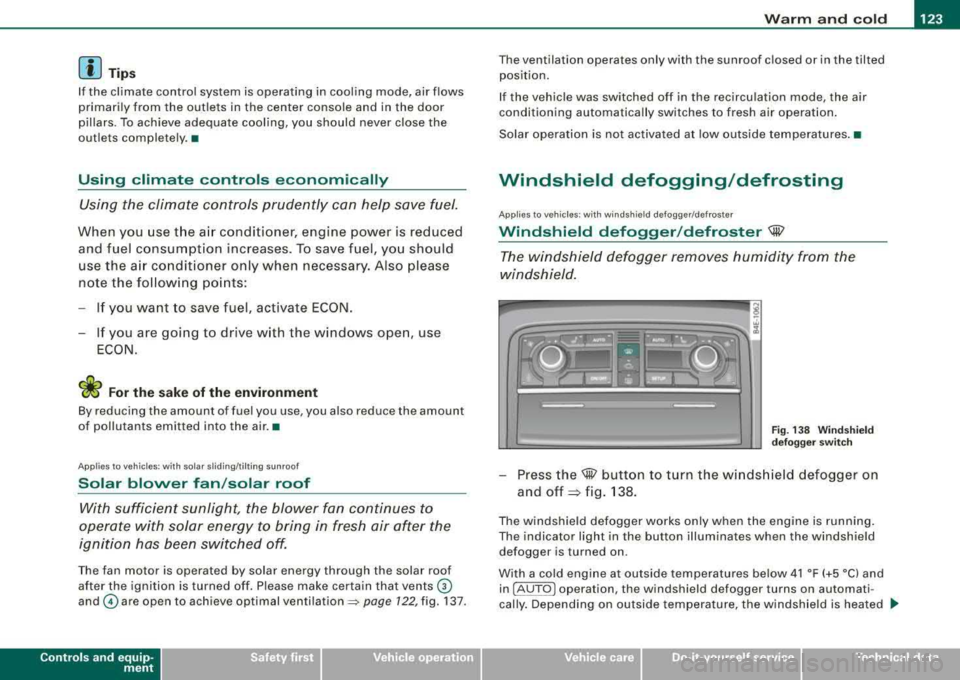
Windshield defogger /defroster ®
The win dshield defogger rem oves humidity from the
windshield.
F ig. 138 Win dsh ield
d efogger sw itc h
- Press the@ button to turn the w indshield defogger on
and
off ~ fig. 138 .
The w indshield defogger works only when the engine is running .
The indicator light in the button illuminates when the windshield defogger is turned on .
With a cold engine at outside temperatures below 41 °F (+5 °C) and in !AU TO
l operation , the windshield defogger turns on automati
cally . Depending on outside temperature, the windshie ld is heated .._
Vehicle care I I irechnical data
Page 129 of 404
Warm and cold -
----------------
the outside air drops, fresh air is supplied to the vehicle interior
again .
In the event that the windows fog up during automatic air recircula
tion, you must press
the® button immediately.
Under certa in operat ing cond it ions, automatic a ir rec ircu lation is
switched off automatically . With outside temperatures below about
-8 °C and in the ECON mode, automatic air rec ircula tion is limited to
15 seconds. •
Synchronization
One climate control setting for all seats.
With synchronization active, the driver's or the passenger's settings
are adopted for the other seats . Al l the other set tings that were
made are transferred to the other seats. This includes all the c limate
control settings right down to the heated seats .
If
a d ifferent setting is selected at a "synchron ized seat", synchroni
zation is cancelled.
•
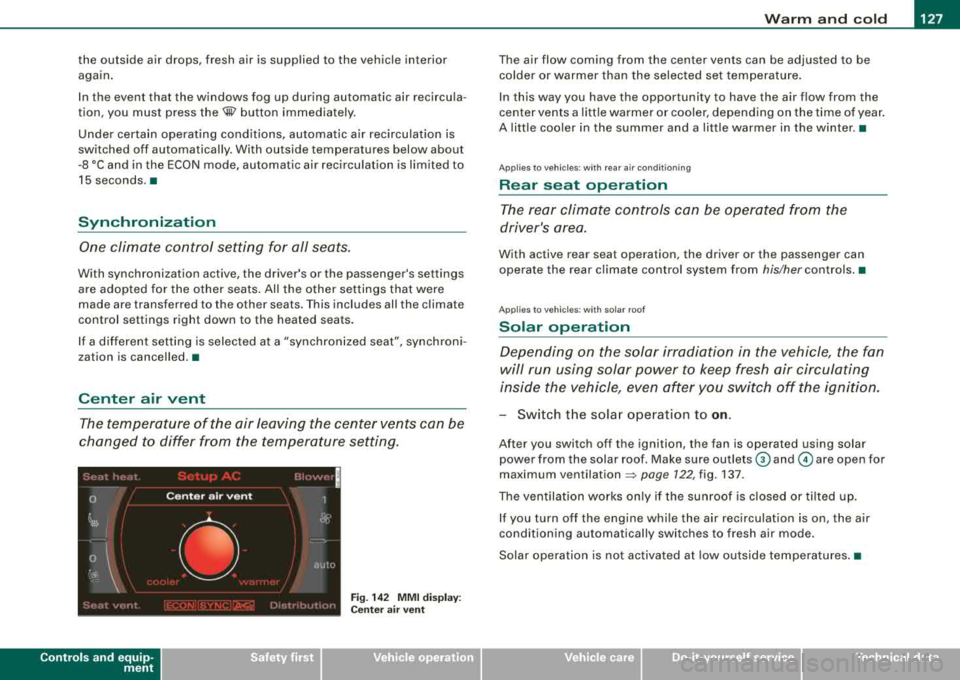
Center air vent
The temperature of the air leaving the center vents can be
changed to differ from the temperature setting.
Controls and equip ment
Fig. 14 2 MMI di spla y:
Ce nter a ir ve nt
The air flow coming from the center vents can be adjusted to be
colder or warmer t han the selected set temperatu re.
In this way you have the opportunity to have the a ir flow from the
center vents a litt le warmer or coo ler, depending on the time of year .
A litt le cooler in the summer and a little warmer in the winter. •
Applies to vehic les : with rear air condition in g
Rear seat operation
The rear climate con trols can be o perated fr om the
driver's area.
With active rear seat operation, the driver or the passenger can
operate the rear climate control system from
his/her contro ls. •
Ap plies to vehicles : w ith so lar roof
Solar operation
Depending on the solar irradiation in the vehicle, the fan
will run using solar power to keep fresh air circulating
inside the vehicle, even af ter you switch off the ignition.
- Switch the solar operation to on .
After you switch off the ignition, the fan is operated using solar
power from the solar roof. Make sure outlets
G) and © are open for
maximum
ventilation => page 722, fig. 137.
The vent ilation works on ly if t he sunroof is closed or t ilted up.
If you turn off the engine whi le the air rec irculation is on, the air
conditioning automatically switches to fresh air mode.
Solar operation is not activated at low outside temperatures .•
Page 208 of 404
___ D_ r
_ i_v _i_n ..;::g :;_ S_ a_ f_ e_, ly'----------------------------------------------------
& WARNING
Improperly stored luggage or other items can fly through the
vehicle causing serious personal injury in the event of hard braking
or an accident. To help reduce the risk of serious personal injury:
• Always put objects, for example, luggage or other heavy items
in the luggage compartment.
• Always secure objects in the luggage compartment using the
tie-down hooks and suitable straps.
& WARNING
Heavy loads will influence the way your vehicle handles. To help
reduce the risk of a loss of control leading to serious personal
injury :
• Always keep in mind when transporting heavy objects, that a
change in the center of gravity can also cause changes in vehicle
handling:
-Always distribute the load as evenly as possible.
- Place heavy objects as far forward in the luggage compart-
ment as possible.
• Never exceed the Gross Axle Weight Rating or the Gross
Vehicle Weight Rating specified on the safety compliance sticker on the left door jamb. Exceeding permissible weight standards
can cause the vehicle to slide and handle differently.
• Please observe information on safe
driving => page 198.
& WARNING
To help prevent poisonous exhaust gas from being drawn into the
vehicle, always keep the rear lid closed while driving.
• Never transport objects larger than those fitting completely
into the luggage area because the rear lid cannot be fully closed.
& WARNING (continued)
• If you absolutely must drive with the rear lid open, observe the
following notes to reduce the risk of poisoning :
- Close all windows,
- Close the power roof,
- Open all air outlets in the instrument panel,
- Switch off the air recirculation,
- Set the fresh air fan to the highest speed.
& WARNING
Always make sure that the doors, all windows, the power roof and
the rear lid are securely closed and locked to reduce the risk of injury when the vehicle is not being used.
• After closing the rear lid, always make sure that it is properly
closed and locked.
• Never leave your vehicle unattended especially with the rear lid
left open. A child could crawl into the vehicle through the luggage
compartment and close the rear lid becoming trapped and unable
to get out . Being trapped in a vehicle can lead to serious personal
injury.
• Never let children play in or around the vehicle.
• Never let passengers ride in the luggage compartment. Vehicle
occupants must always be properly restrained in one of the
vehicle's seating positions.
[ i] Tips
Air circulation helps to reduce windowfogging. Stale air escapes to
the outside through vents in the trim panel, on the left side of the
luggage compartment. Be sure to keep these slots free and open. •