roof AUDI S8 2008 Owner's Manual
[x] Cancel search | Manufacturer: AUDI, Model Year: 2008, Model line: S8, Model: AUDI S8 2008Pages: 404, PDF Size: 52.7 MB
Page 223 of 404
as defined in the elec tronic control unit~ page 230 , "PA SSENGER
AI R BAG OFF ligh t".
A lways r em ember, a ch ild seat or infant carrier install ed on th e front
seat may be st ruck and knocked out of position by the rap idly
i n fl ating pass enger's airbag in a fr ontal co llisio n. T he airb ag co uld
greatly reduce the effectivenes s of the chi ld restraint and even seri
ously inju re t he c hild duri ng i nflatio n .
F or this reason, and because the bac k seat is the safest place for
chi ldr en -w hen pro perly res traine d acc ording to th eir age an d size
- w e stron gly recomm end that c hildren a lways sit in th e bac k seat
~ page 243, "C hil d Safe ty" .
& WARNING
A child in a rearward -facing child seat installed on the front
passenger seat will be seriously injured and can be killed if the
front airbag inflates - even with an Advanced Airbag System.
• The inflating airbag will hit the child seat or infant car rier with
great force and will smash the child seat and child against the
backrest , center arm rest, door or roof .
• Always install rear-facing child seats on the rear seat.
• If you must install a rearward facing child seat on the front
passenger seat because of exceptional circumstances and the
PASSENGER AIR BAG OFF light does not come on and stay on,
immediately install the rear-facing child seat in a rear seating posi
tion and have the airbag system inspected by your Audi dealer.
• Forward -facing child seats installed on the front passenger's
seat may interfere with the deployment of the airbag and cause
serious personal injury to the child .
& WARNING
If, in exceptional circumstances, you must install a forward-facing
child restraint on the front passenger's seat:
Controls and equip ment Safety first
Vehicle operation
Airbag system
&, WARNING (continued )
• Always make sure the forward-facing seat has been designed
and certified by its manufacturer for use on a front seat with a
passenger front and side airbag .
• Never put the forward-facing child restraint up against or very
near the instrument panel .
• Always move the passenger seat into its rearmost position in
the seat's fore and aft adjustment range, as far away from the
airbag as possible before installing the forward-facing child
restraint. The backrest must be adjusted to an upright position .
• Make sure that the PASSENGER AIR BAG OFF light comes on
and stays on all the time whenever the ignition is switched on.
& WARNING
To reduce the risk of serious injury, make sure that the PASSENGER
AIR BAG OFF light will be displayed whenever a child restraint is
installed on the front passenger seat and the ignition is switched
on.
• If the PASSENGER AIR BAG OFF light does not stay on , perform
the checks described
~ page 229 , "Monitoring the Advanced
Airbag System" .
• Take the child restraint off the front passenger seat and install
it properly at one of the rear seat positions if the PASSENGER AIR
BAG OFF light does not stay on .
• Have the airbag system inspected by your Audi dealer immedi
ately .
• Always carefully follow instructions from child restraint manu
facturers when installing child restraints .
& WARNING
If, in exceptional circumstances, you must install a forward or
rearward -facing child restraint on the front passenger's seat:
Vehicle care Do-it-yourself service Technical data
Page 226 of 404
___ A_ ir_b _ a_ g=- s-a. y_s _t _e _m _________________________________________________ _
When a person is detected on the front passenger seat, weighing
mor e tha n the to ta l w eigh t of a c hild th at is a bout 1 year old
restrain ed in one of th e rear -facing or forward -fac ing infant
r es trai nts (l isted in Fede ra l M oto r Veh icle Safe ty Sta ndard
208 wi th
which the Advanc ed Airba g Syst em in your ve hic le was certified),
the fro nt airbag on the pas se nge r si de may o r may not de ploy .
The
PASSENGER AIR BAG OFF li g ht com es on when the elec troni c
contro l unit detects a total weight on the front passenger seat that
r e qui res th e front airb ag to b e turned off. If th e
PASSENGER AIR BAG
OFF
li g ht does not com e on, the front airbag on the pass enger side
h as not b een t urn ed off by the c ont rol unit and can d eploy if th e
control unit senses an impact that meets t he conditions stor ed in its
mem ory.
If the t otal weig ht on the fro nt passe nger seat is m ore than that of
a typical
1 y ear -old, but less than the we ight of a small adult, the
fr ont air ba g on th e passen ger side m ay depl oy (the
PASSENGER AIR
BAG OFF
li ght does not come on).
For example, the airbag may deploy if:
• a sma ll chil d th at is heav ie r th a n a ty pica l 1 yea r-old chi ld is o n
the front passenge r seat (regardless of w hether the child is in one
o f the chi ld seats lis ted
=> p ag e 24 5),
• a child who h as out grown child r estr ain ts is on th e fron t
passen ger seat.
I f the front passenge r airba g is turned off, the
PASSENGER AIR BAG
OFF
li g ht in the ce nter of t he ins trum ent p anel will com e on and stay
o n.
The fro nt airb ag o n the pa ssenge r sid e may
not de plo y (t he
PASSENGER AIR BAG OFF lig ht does not illumi nate a nd sta y li t) if:
• a small adu lt or teenager is on the front passenger seat
• a pass enge r w ho i s no t si tti ng upright wi th their back aga inst a
non -reclined bac krest with their feet on the vehicle f loor in front of
the sea t is o n the front pass enger se at.
I f the front passenger ai rbag deploys, the Fed era l S tanda rd requ ires
th e a irbag to m eet th e "low risk " de ploy ment c rit eri a to he lp reduc e th
e risk of injury throu gh interaction with th e airbag . "Low risk"
dep loyment oc cur s in th ose cras hes tha t take p lace at l ow er decel
e rations as defined in t he elect ron ic co ntro l
unit=> page 22 9.
Always remember : Even th ough yo ur veh icle is eq uipped w ith
A dv anced Airbags, the safest plac e for chil dren i s properly
r estra ined on the back seat. Please be su re t o read t he important
i n form atio n in th e sec tions th at f oll ow and be su re to heed all of the
W ARNING S.
& WARNING
To reduce the risk of injury when an airbag inflates, always wear
safety belts properly.
• If you are unrestrained, leaning forward, sitting sideways or out
of position in any way, your risk of injury is much higher .
• You will also receive serious injuries and could even be killed if
you are up against the airbag or too close to it when it inflates
-
even with an Advanced Airbag => page 218.
& WARNING
A child in a rearward -facing child seat installed on the front
passenger seat will be seriously injured and can be killed if the
front airbag inflates
-even with an Advanced Airbag System .
• Although the Advanced Airbag System in your vehicle is
designed to turn off the front airbag when a rearward -facing child
restraint has been installed on the front passenger seat , nobody
can absolutely guarantee that deployment is impossible in all
conceivable situations that may happen during the useful life of
your vehicle.
• The inflating airbag will hit the child seat or infant carrier with
great force and will smash the child seat and child against the
backrest , center arm rest , door , or roof .
• Always install rearward -facing child restraints in the back seat .
~
Page 230 of 404
__ ....!:,A~i'.!. r !::b :!a ~g:L.: s~ y~ s:!: t::.:: e~ m'..!.!.. ______________________________________________ _
or the low er parts of the body . Front airbags only supplement th e
th re e po int safe ty b elts in som e front al c ollis ions in which the
vehic le dece lerat ion is h igh enou gh to deploy the a irba gs.
Front airbags will not deploy:
• if the ignition is switched off when a crash occurs,
• i n sid e coll is io ns,
• in r ear- e nd collisi ons ,
• in ro llovers,
• when th e cras h de cele ration meas ured b y th e a irba g sys tem is
less than the mini mum threshold needed for a irbag deployme nt as
r egi stere d by th e ele ctr on ic con trol uni t.
The front passenger airbag will also not deploy :
• when th e front p asseng er seat is not occ upi ed ,
• when the weight on the front pas senge r seat a s sensed by the
A dvance d Airb ag Syste m indicates t hat th e fr on t airb ag on the
passenger side has to be t urned off b y the e lectronic control unit
(the PASSENGER AIR BAG OFF li g ht come s on and s tays o nl.
& WARNING
Sitting in the wrong position can increase the risk of serious injury
in crashes .
• To reduce the risk of injury when the airbags inflate , the driver
and passengers must always sit in an upright position , must not
lean against or place any part of their body too close to the area
where the airbags are located.
• Oc cupants who are unbelted , out of position or too close to the
airbag can be seriously injured by an airbag as it unfolds with
great force in the blink of an eye
=> page 220.
& WARNING
A child in a rearward -facing child seat installed on the front
passenger seat will be seriously injured and can be killed if the
front airbag inflates - even with an Advanced Airbag System .
• The inflating airbag will hit the child seat or infant carrier with
great force and will smash the child seat and child against the
backrest , center arm rest , door or roof .
• Always install rear-facing child seats on the rear seat.
• If you must install a rearward facing child seat on the front
passenger seat because of exceptional circumstances and the
PASSENGER AIR BAG OFF light does not come on and stay on ,
immediately install the rear-facing child seat in a rear seating posi
tion and have the airbag system inspected by your Audi dealer.
& WARNING
Objects between you and the a irbag will increase the risk of injury
in a crash by interfering with the way the airbag unfolds or by
being pushed into you as the airbag inflates.
• Never hold things in your hands or on your lap when the vehicle
is in use.
• Never transport items on or in the area of the front passenger
seat. Objects could move into the area of the front airbags during
braking or other sudden maneuver and become dangerous projec
tiles that can cause serious personal injury if the airbags inflate.
• Never place or attach accessories or other objects (such as cup
holders, telephone brackets, large , heavy or bulky objects) on the
doors , over or near the area marked
"AIRBAG " on the steering
wheel , instrument panel , seat backrests or between those areas
and yourself . These objects could cause injury in a crash, espe
cially when the airbags inflate .
• Never recline the front passenger's seat to transport objects .
Items can also move into the area of the side airbag or the front
airbag during braking or in a sudden maneuver. Objects near the .,_
Page 242 of 404
___ A_ ir_b _a_ g;::;_ s-=-- y_s _t _e _m _________________________________________________ _
& WARN ING (c ontinued)
- Alwa ys hav e w ork on the do ors done by an auth ori zed Audi
de ale r or qualified work shop . •
Side curtain airbags (SIDEGUARD™)
Description of SIDEGUARD™ airbags
The SIDEGUARD™ airbag system can provide supple
mental protection t o properly restrained occupants.
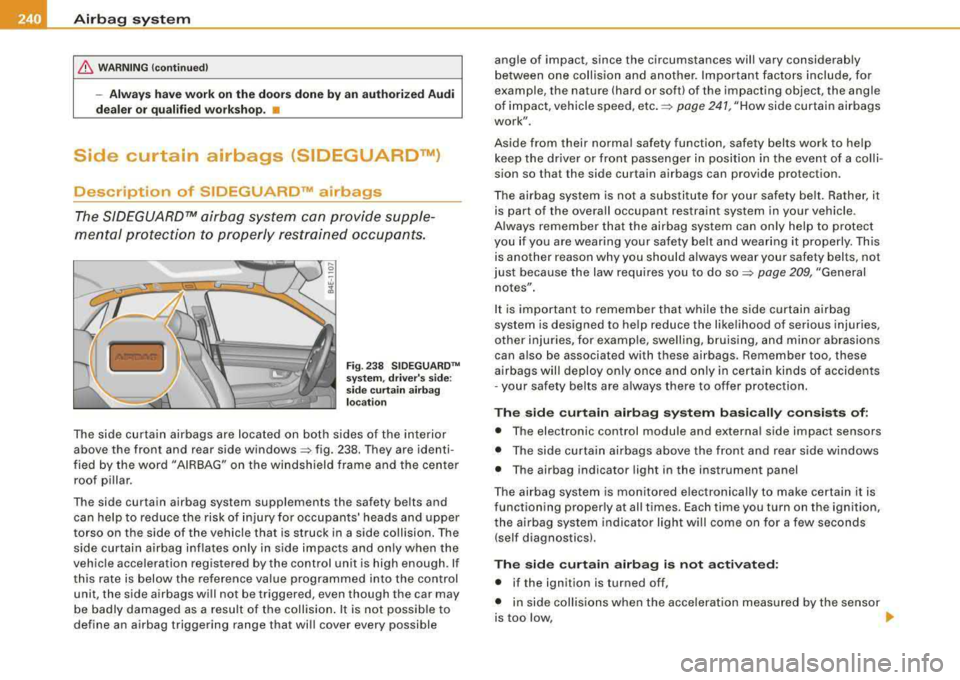
Fig . 23 8 SIDEG UARD ™
s y st em , dri ve r's si de:
s id e c urt a in airb ag
l oca tio n
The side curtain airbags are located on both sides of the interior
above the front and rear side
windows=> fig. 238 . They are identi
fied by the word "AIRBAG" on the windshield frame and the center
roof pillar .
The side curtain airbag system supplements the safety belts and can help to reduce the risk of injury for occupan ts' heads and upper
torso on the side of the vehicle that is struck in a s ide collision. The
side curtain airbag inflates only in side impacts and on ly when the
vehic le acceleration registered by the control unit is high enough . If
this rate is below the reference value programmed into the con trol
unit, the side airbags wi ll not be triggered , even though the car may
be badly damaged as a result of the collision . It is not possib le to
define an airbag triggering range that will cover every possible angle of impact, since the circumstances will vary considerab
ly
be tween one collision and another . Important factors include, for
example, the nature (hard or soft) of the impacting object, the ang le
of impact, vehicle speed,
etc .=> page 241 , "How side curtain airbags
work" .
Aside from their normal safety function, safety belts work to help keep the dr iver or front passenger in position in the event of a colli
sion so tha t the side curtain airbags can provide protection .
The airbag system is not a substitute for you r safety belt. Rathe r, it
is part of the overa ll occupant restrain t system in your vehicle .
A lways remember that the airbag system can only help to protect
you if you are wearing your safety belt and wearing it properly. This
is another reason why you should always wear your safety belts, not
just because the law requires you to do
so => page 209, "General
notes".
I t is important to remember that while the side curtain airbag
system is designed to he lp reduce the like lihood of serious injuries,
other injuries, for examp le, swelling, bruising, and minor abrasions
can a lso be associated with these airbags. Remember too, these
airbags will deploy only once and only in certain kinds of accidents
-your safety belts are a lways there to offer protection.
The side curta in airbag system ba sically con sist s of:
• The electronic control module and externa l side impact sensors
• The side curtain airbags above the front and rear side windows
• T he airbag indicator light in the instrument panel
The airbag system is mo nitored elec tronica lly to make certain it is
functioning proper ly at all times . Each time you turn on the ignition,
the airbag system indicator light wi ll come on for a few seconds
(self diagnostics).
T he sid e curtain airbag i s not act ivated:
• if the ignition is turned off,
• in side collisions when the acce leration measured by the sensor
is too low ,
.,_
Page 249 of 404
_____________________________________________ C_ h
_ il_d _S_ a
_ fe_t--' y'---_ffllll
& WARNING
Not using a child safety seat , using the wrong child safety seat or
improperly installing a child restraint increases the risk of serious
personal injury and death .
• All vehicle occupants and especially children must always be
restrained properly whenever riding in a vehicle .
- An unrestrained or improperly restrained child can be injured or killed by being thrown against the inside of the vehicle or by
being ejected from it during a sudden maneuver or impact.
- An unrestrained or improperly restrained child is at much
greater risk of injury or death by being struck by an inflating
airbag.
• Commercially available child safety seats are required to
comply with U .S . Federal Motor Vehicle Safety Standard (FMVSS l
213 (in Canada CMVSS 2131.
-When buying a child restraint , select one that fits your child
and the vehicle .
- Only use child restraint systems that fully contact the flat
portion of the seat cushion. The child restraint must not tip or
lean to either side . Audi does not recommend using child safety
seats that rest on legs or tube -like frames. They do not provide
adequate contact with the seat .
- Always heed all legal requirements pertaining to the installa
tion and use of child safety seats and carefully follow the
instructions provided by the manufacturer of the seat you are
using.
• Never allow children under 57 inches (1 .5 meters) to wear a
normal safety belt. They must always be restrained by a proper
child restraint system. Otherwise, they could sustain injuries to
the abdomen and neck areas during sudden braking maneuvers or
accidents.
• Never let more than one child occupy a child safety seat .
Controls and equip ment Safety first
Vehicle operation
&, WARNING (continued)
• Never let babies or older children ride in a vehicle while sitting
on the lap of another passenger .
- Holding a child in your arms is never a substitute for a child
restraint system .
- The strongest person could not hold the child with the forces
that exist in an accident. The child will strike the interior of the
vehicle and can also be struck by the passenger .
- The child and the passenger can also injure each another in
an accident.
• Never install rear-facing child safety seats or infant carriers on
the front passenger seat . A child will be seriously injured and can
be killed when the passenger airbag inflates - even with an
Advanced Airbag System .
• The inflating airbag will hit the child safety seat or infant
carrier with great force and will smash the child safety seat and
child against the backrest , center arm rest , door or roof .
• Always install rear-facing child safety seats or infant carriers on
the rear seat .
• Forward-facing child safety seats installed on the front
passenger's seat can interfere with the airbag when it inflates and
cause serious injury to the child. Always install forward -facing
child safety seats on the rear seat .
• If exceptional circumstances require the use of a forward
facing child restraint on the front passenger's seat , the child's
safety and well -being require that the following special precau
tions be taken:
- Make sure the forward -facing seat has been designed and
certified by its manufacturer for use on a front seat with a
passenger front and side airbag.
- Always carefully follow the manufacturer's instructions
provided with the child safety seat or carrier.
Vehicle care Do-it-yourself service Technical data
Page 256 of 404
lllffl __ C_h_ i_ld _ S_ a_ f_ e_ t_, y'-------------------------------------------------
&, WARNING (continued )
• If the backrest is not securely latched , the child and the child
restraint will be thrown forward together with the backrest and
will strike parts of the vehicle interior. The child can be seriously
injured or killed.
• Never install rear-facing child safety seats or infant carriers on
the front passenger seat . A child will be seriously injured and can
be killed when the passenger airbag inflates .
• The inflating airbag will hit the child safety seat or infant
carrier with great force and will smash the child safety seat and
child against the backrest, center arm rest, door or roof .
• Always install rear-facing child safety seats or infant carriers on
the rear seat.
• Forward-facing child safety seats or infant carriers installed on
the front passenger's seat may interfere with the deployment of
the airbag and cause serious injury to the child .
• It is safer to install a forward -facing child safety seat on the rear
seat.
• Always read and heed all WARNINGS whenever using a child
restrained in a vehicle is being used
=> page 243 . Special precau
tions apply when installing a child safety seat on the front
passenger seat
=> page 220 , "Child restraints on the front seat -
some important things to know ".
& WARNING
Always take special precautions if you must install a forward or
rearward-facing child restraint on the front passenger's seat in
exceptional situations:
• Whenever a forward or rearward -facing child restraint is
installed on the front passenger seat , the PASSENGER AIR BAG
OFF light must come on and stay on whenever the ignition is
switched on .
&, WARNING (continued )
• If the PASSENGER AIR BAG OFF light does not come on and stay
on, perform the checks described
=> page 229, " Monitoring the
Advanced Airbag System ".
• Take the child restraint off the front passenger seat and install
it properly at one of the rear seat positions if the PASSENGER AIR
BAG OFF light does not stay on whenever the ignition is switched
on .
• Improper installation of child restraints can reduce their effec
tiveness or even prevent them from providing any protection .
• An improperly installed child restraint can interfere with the
airbag as it deploys and seriously injure or even kill the child.
• Always carefully follow the manufa cturer's instructions
provided with the child safety seat or carrier .
• Never place additional items on the seat that can increase the
total weight registered by the weight-sensing mat and can cause injury in a crash.
& WARNING
Forward-facing child restraints:
• Always make sure the forward -fa cing seat has been designed
and certified by its manufacturer for use on a front seat with a
passenger front and side airbag .
• Never put the forward-facing child restraint up , against or very
near the instrument panel.
• Always move the passenger seat into its rearmost position in
the seat's fore and aft adjustment range , as far away from the
airbag as possible before installing the forward-facing child
restraint. The backrest must be adjusted to an upright position .
• Make sure that the PASSENGER AIR BAG OFF light comes on
and stays on all the time whenever the ignition is switched on.
..,_
Page 257 of 404
Child Safety -
---------------''----
& WARNING
Rearward-facing child restraints:
• A child in a rearward-facing child safety seat installed on the
front passenger seat will be seriously injured and can be killed if
the front airbag inflates -even with an Advanced Airbag System.
• The inflating airbag will hit the child safety seat or infant
carrier with great force and will smash the child safety seat and
child against the backrest, center arm rest, door or roof.
• Always be especially careful if you must install a rearward
facing child safety seat on the front passenger seat in exceptional
circumstances.
• A tight tether strap on a rearward-facing child restraint
attached to the front passenger seat can put too much pressure
on the weight-mat in the seat and register a heavier weight in the
Advanced Airbag System. The heavier weight registered can make
the system work as though an adult were on the seat and deploy
the Advanced Airbag when it must be suppressed causing serious or even fatal injury to the child.
• Make sure that the PASSENGER AIR BAG OFF light comes on
and stays on all the time whenever the ignition is switched on .
• If the PASSENGER AIR BAG OFF light does not come on and stay
on, immediately install the rear-facing child safety seat in a rear
seating position and have the airbag system inspected by your
Audi dealer. •
Activating the convertible locking retractor
Use the convertible locking retractor to secure a child
restraint.
Always heed the child safety seat manufacturer's instruc
tions when installing a child restraint in your vehicle. To
activate the convertible locking retractor:
Controls and equip
ment Safety first
Vehicle operation
-Place the child restraint on a seat, preferably on the rear
seat.
-Slowly pull the belt all the way out.
-Route it around or through the child restraint belt path
=>& .
-Push the child safety seat down with your full weight to
get the safety belt really tight.
-Insert the belt tongue into the buckle for that seating
position.
-Guide the safety belt back into the retractor until the belt
lies flat and snug on the child safety seat.
-You should hear a "clicking" noise as the belt winds back
into the inertia reel. Test the convertible locking retractor
by pul ling on the belt. You should no longer be able to
pull the belt out of the retractor. The convertible locking
retractor is now activated.
-Make sure that the red release button is facing away from
the child restraint so that it can be unbuckled quickly.
-Pull on the belt to make sure the safety belt is properly
tight and fastened so that the seat cannot move forward
or sideways more than one inch (2.5 cm).
& WARNING
Using the wrong child restraint or an improperly installed child
restraint can cause serious personal injury or death in a crash.
• Always make sure that the safety belt retractor is locked when
installing a child safety seat. An unlocked safety belt retractor
cannot hold the child safety seat in place during normal driving or
in a crash.
~
Vehicle care Do-it-yourself service Technical data
Page 291 of 404
_____________________________________________ C_ l_ e _a_ n_ in~ g _a
_ n_d_ p_ r_ o_ t
_ e_ c_t _io _ n __ lJIII
•
Under certain circumstances, weekly washing may be necessary.
Under other conditions, a monthly washing and waxing may be
adequate .
After the winter, the
underside of the vehicle should be thoroughly
washed, preferably in a professional car wash.
& WARNING
Always read and heed all WARNINGS and other information
=> page 288. •
Automatic car wash
The vehicle can be washed in almost any modern auto
matic car wash.
The vehicle paint is so durable that the vehicle can normally be
washed without problems in an automatic car wash . However, the
effect on the paint depends to a large extent on the design of the
facility, the filtering of the wash water, the type of wash and care material, etc. If the paint has a dull appearance after going through
the car wash or is scratched, bring this to the attention of the oper ator immediately. If necessary, use a different car wash.
Before going through a car wash, be sure to take the usual precau
tions such as closing the windows and power roof . Factory installed
antennas must not be removed.
If you have installed add itional accessories on the vehicle -such as
spoilers, roof rack, etc. -it is best to ask the car wash operator if
these should be removed .
& WARNING
Always read and heed all WARNINGS and other information
=> page 288. •
Washing the vehicle by hand
A lot of water is needed when washing a vehicle by hand.
-Before you start washing, make sure you have read and
understood the
WARNINGS=> & in "General informa
tion" on
page 288.
-First soak all dried dirt until it is soft, then rinse it off.
-As you clean your vehicle, start with the roof and work
your way down to the bottom, using a sponge, a sponge glove or a clean brush.
-Rinse the sponge or the sponge glove often, flushing it
clean each time.
-Use special car shampoo only for very persistent dirt.
-Rinse the car thoroughly with water.
-Use a chamois leather to gently wipe the exterior dry.
Use a separate sponge for cleaning the wheels, door sills and other
regions exposed to road dirt. In this way, you will not scratch the
paint with coarse particles imbedded in the sponge the next time
you wash the car.
& WARNING
• Do not clean the underside of the chassis, fenders, wheel
covers, or other hard to reach parts without protecting your hands
and arms. You may cut yourself on sharp-edged metal parts.
• Always read and heed all WARNINGS and other information
=> page 288. ~
Vehicle care
Page 296 of 404
___ C_ le_ a_n _i_n ~g _ a_ n_ d
__ p_r _o _t _e _c_ t_ i_o _n ___________________________________________ _
brake dust is also corrosive. If left on for too long, brake dust can
cause pitting.
Use on ly specia l
acid-free cleaners formu lated for a lloy r ims . Safe
products are availab le at your Audi dealer. Never leave the cleaner
on the ri ms longer than specified on the label. If not rinsed off
promptly, the acid contained in some c leaners can attack the
threads o n the wheel bo lts .
Never use abrasive or metal po lishing c leaning agents . If the protec
t ive coating has been chipped, e.g . by kicked up road dirt, touch i t
up as soon as possible .
& WARNING
• Moisture and i ce on b rake s ma y affe ct b raking effi ciency
=> page 270 , "General information ". Te st the brakes carefully ea ch
t ime you wa sh the vehi cle .
• Alway s read and heed all WARNINGS and other information
=> page 288. •
Body cavity sealing
The body cavity sealing does not nee d to be checked.
A ll body cavit ies which could be affected by corrosion have been
t horough ly pr otected a t the factory .
This sealing does not require any inspection or additional treat
ment . If any wax should seep out of the cavity when the ambient
temperature is high, it can be removed with a plastic scraper and a suitable solvent .
& WARNING
Solvents can be d angerous.
• Ben zine is flammable and to xic . If you use benzine for removing
the wax , keep sparks, flame and lighted cigarettes away . Never
& W AR NING (continued )
dump benzine on the ground , into ope n streams or do wn sew age
drain s.
• Be sure to observe all safet y and env ironmental regulat ions .
Follow all in struction s on the cont ainer .
• Alway s read and heed all WARNINGS and other information
=> page 288 . •
Chassis
Hav e the underc oating c hecked for damage from tim e to
time.
T he lower body shell of your Audi is also thoroughly protected
against corrosion .
Any damage to the undercoat ing caused by road hazards s hou ld be
repaired promptly.
& WARNING
Too much undercoating in the wrong place s can cau se a fire .
• Do not appl y additional undercoating or rustproofing on or
near the exhaust manifold , exhau st pipes , catalytic converter or
h eat shield s. Wh ile dr iving , the sub stan ce used for underco ating
could overheat and cau se a fire .
• Alway s re ad and heed all WARNINGS and other info rm ation
=> page 288 . •
Page 312 of 404
___ C_ h_e _c _ k_ i_ n ~g~ a_ n_ d_ f_ i_ll _in _g~--------------------------------------------
to help keep your vehicle's engine running smoothly and help
prevent the formation of harmfu l deposits, sometimes called
"sludge, " that over time can lead to expensive repairs .
At the time of printing, engine oils available in the U.S. and Canada
that meet the exacting specificat ions of Audi oil standard VW 502 00
are synthetic engine oils. This does not mean, however, that every
synthetic engine oil will meet Audi oi l standard VW 502 00. So
a lways b e sur e that you use an approved oil.
To help prevent the formation of harmful deposits use only oi l with
the following specifications printed on the oil container :
Audi oil sta nda rd VW 502 00
Oil container labels may carry the specification singly or in combi
nation with other designations and oil quality standards.
V iscosi ty
Engine oi ls are graded according to their viscosity . The proper
viscosi ty grade oi l for your engin e depends on climactic or seasonal
conditions where you drive . You can use o il with a v iscosity grade of
SAE 5W40 across all temperature ranges for normal driving condi
tions.
However , if eng ine oil viscosity grade SAE 5W40 is not available, you
can a lso use viscosity grade SAE 5W -30 or SAE 0W -40 as long as it
meets Audi oil quality standard VW 502 00 specifications.
B ecause engin e oil that meets the Audi oi l standard may not be
avai lable everywhere when you need it, we strongly recommend
that you a lways carry with you an extra quart !liter) of oil that
express ly conforms to t he VW 502 00 specification, in case you have
to top off the oil while on the road.
Only if th e level of the oil is at or be low the minimum mark on the
oi l dipstick -and no oil that express ly conforms to Audi oi l standard
VW 502 00 specifications is avai lable -may you top off with a high
quality engine oi l, preferably synthetic -based, that meets ACEA A3,
ACEA A5 or ACEA B5, API SL or ILSAC GF -3 specifications , but even
t hen, only in viscosity grades SAE 5W -40, SAE 5W -30, or SAE 0W -40.
However, during the entire time betwe en oil change int erva ls, nev er top off with more than a total of 0
.5 qt/ liter engine oil that does not
conform to Audi oil specifica tion VW 502 00.
For more information about engine oil that has been approved for
your vehic le, please contact either your authorized Audi dealer or
Aud i Customer Relat ions at 1 (800) 822-2834 or v isit our web s ite at
www.audiusa.com or www.audicanada.ca. Here you will also find a
current list of o ils (manufacturers, brand names
etc.I that conform
to Audi oi l standard VW 502 00.
Ch an g in g t he en gin e oil
The engine oil and o il filter must be changed according to the
mileage (ki lometers) and time intervals specified in your vehic le 's
Warranty & Maintenance booklet . Do not exceed these intervals -
harmful deposits from old engin e oil can reduce engin e perfor
mance and can lead to expensive eng ine repa irs.
Changing the oil at the recommended intervals is so very impor tant
because the lubricating properties of oi l decrease gradua lly during
normal vehicle use. If you are not sure when you have your o il
changed, ask your authorized Audi Service Advisor.
Under some circumstances the eng ine oil should even be changed
mor e frequen tly . Change oil more oft en if you drive most ly short
distances, operate the vehicle in dusty areas or mostly under stop
and -go traffic conditions, or when you use your vehicle where
t emperatures stay be low freezing po int for long per iods .
Detergent add it ives in the oi l wi ll make fresh oil look dark after the
engine has be en running for a short time. This is normal and is not
a reason to change the oi l more often than recommended .
Dam age or malfun ction s du e to lack of m aint enan ce
It is essential that you change your oil at the recommended interva ls
using on ly engine oil that complies with Audi oil standard
VW 502 00. Your Limited New Vehicle Warranty does not cover
damage or malfunctions due to fai lure to follow recommended
maintenance and use requirements as set forth in the Audi Owner's
Manual and Warranty
& Maintenance booklet. Your dea ler wi ll have
to deny warranty coverage un less you pr esent to the dea ler proof in
.,_