tire pressure AUDI S8 2008 User Guide
[x] Cancel search | Manufacturer: AUDI, Model Year: 2008, Model line: S8, Model: AUDI S8 2008Pages: 404, PDF Size: 52.7 MB
Page 47 of 404
Changing a wheel When you change a wheel, the new tire must be initial
ized.
Turn on the ignition.
Press the
I CAR I function button.
- Select
Systems in the CAR menu .
- Selec t
Tire pressure monitoring .
-Select Initialize wheels ~ page 43, fig. 27.
Programming is necessary:
• After the tires have been rotated on the vehicle (including use of
the spare tire*),
• If tires with new wheel sensors are used.
All pressure warning and system malfunction indicators in the
display will be canceled.
If a wheel change has been made, it is necessary to complete the
Initialize wheels function.
Th e tire pressure monitoring system is not available dur ing the
programming process and no pressure and temperature values are
displayed on the MMI display.
After you have selected the funct ion, the new wheels are
programmed and the actual pressures are stored. This learning
phase can take up to 20 minutes driving time.•
Contro ls a nd eq uip
ment
Driver information display
Malfunctions
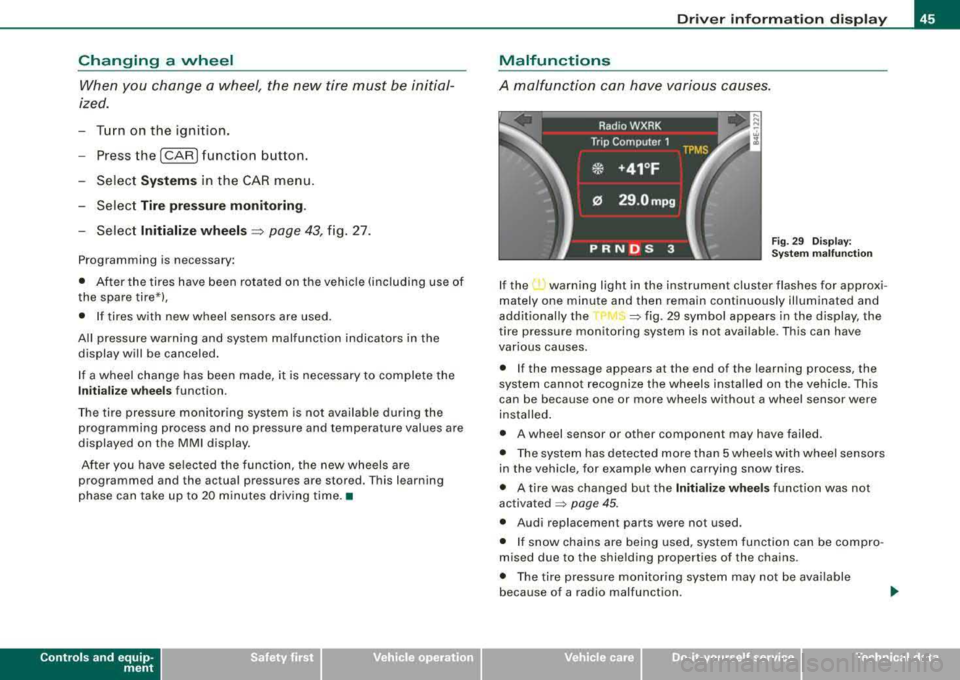
A malfunction can have various causes.
Fig. 29 Display:
Syste m malfunction
If the ...., warning light in the instrument cluster flashes for approxi
mately one minute and then remain continuously illuminated and
additional ly the
=> fig. 29 symbol appears in the display, the
tire pressure monitoring system is not available. This can have
various causes.
• If the message appears at the end of the learning process, the
system cannot recognize the wheels installed on the vehicle. This
can be because one or more wheels without a wheel sensor were
insta lled .
• A wheel sensor or other component may have failed.
• The system has detected more than 5 wheels with wheel sensors
in the vehicle, for example when carrying snow tires.
• A tire was changed but the
Initialize wheels function was not
activated
=> page 45.
• Audi replacement parts were not used.
• If snow chains are being used, system function can be compro
mised due to the shielding properties of the chains.
• The tire pressure monitoring system may not be available
because of a radio malfunction.
Vehicle care I I irechnical data
Page 48 of 404
Driver inf ormation displ ay
• Transmitters with the same frequency, such as radio head
phones in the vehic le or rad io equipment, can cause a temporary
disruption of the system through excessive electromagnetic fields .
• Elimi nate the in terference if possible/if you can and then re-start
the
Initi alize w heel s function . If the warning light comes on again,
you shou ld con tact your autho rized Audi dea ler im mediately to have
the prob lem corrected .
• Do not use commerc ial ly avai lab le tire sea lants . O therwise, t he
e lectrica l components of the tire pressure monitoring system wi ll
n o longer work properly and the sensor for the tire p ressure moni
toring system wi ll have to be replaced by a qua lified workshop. •
Page 83 of 404
ture on the windshield. The rain sensor wiper intervals depend on
t he sensitivi ty setting as well as vehic le speed . Dur ing brief s tops,
wiper motion wil l adjust in re lation to the amount of rain on the
windshield .
During br ief stops, e.g. at a red light, wiper mot ion wil l auto mati
ca lly be reduced to the next lower speed . Wipers a lready turning at
low speed. change to i nterm ittent w ip ing.
When the ignition is turned on, the washer jets are heated .
With the low beam headlights switched on, p ull the wiper lever
towards you only briefly to clean the windshield. Ho ld ing the w iper
lever wou ld a lso engage the headlight washer system each time you
clean the w inds hie ld and wou ld dra in t he washer flu id reservoir
pr ematurely .
& WARNING
• Wiper bl ade s are cruc ial for safe driving! Only when they are in
good condition are they able to clear the window s properly to
provide uncompromising visibilit y. Worn or damaged wiper blades
are a safety hazard
::::> page 82 , "In stalling new wiper blade s"!
• The rain sensor is only designed to a ssist and support the
driver . It r em ains entirely th e driver' s respon sibility to monitor
outside weather condit ions and to manually activate the wipers as
s oon a s rain or drizzle reduces visibility through the windshield.
• The windshield mu st not be treated with water-repellent mate
rials . They c an in crea se gl are under poor visibility condition s such
as wetness , darkness , or when the sun is low on the horizon. In
addition , they can cau se the wind shield wipers to chatter.
0 Note
In free zing or near freezing conditions:
• Always check that the wiper b lades are not frozen to the glass
be fore you turn the w ipe rs on. Loosen a wiper b lade w hich is frozen
Controls and equip ment
Clea r vision
in place before operating the wipers to prevent damage to the wiper
bl ade or the wiper motor.
• Do not use the wipers to clear a frosted window. Using the
wipers as a conve nien t ice scraper will des troy the wiper blades .
• Before you take your vehic le to an automatic car wash, make sure
you have the w inds hield w iper system switched o ff (lever in p osition
O), otherwise the windshield wiper system could get damaged in the
car was h if it should suddenly come o n.
[ i ] Tips
• Make sure the washer flu id reservo ir in the engine compartmen t
is topped off before going on a long trip . Look
up:::> page 323 for
check ing and f illing the washer conta iner.
• I f you sw itch off the ignition with the windshield wiper lever st ill
in the inte rval wi pe pos ition and t hen com e back a wh ile la ter a nd
drive off, the rain sensor wil l reactivate itself after the vehicle speed
has e xceeded 4 mph (6 km/h) .
• Worn or dirty windshie ld wiper b lades cause smearing which
ca n affect t he opera tion of the ra in senso r. Check the condi tion of
your windshield wiper b lades regu lar ly . •
Headlight washer system
The he adlight washer sy stem cle ans the he adlig h ts.
-Oper ate the win dshiel d w ip er/was her sy stem G) wit h th e
hea dlights t urned o n by ho ld ing th e l ever fo r lo nge r than
on e seco nd ::::.,
page 80, fig. 76.
The washe r jets extend f orward out of the fron t bumper dr iven by
water pressure to spray the front head lights with water .
You should inspect the head lights regu lar ly (for examp le when refu -
e ling) a nd c lean o ff any sol id dirt or i nsects from the lenses.
~
Page 187 of 404
Adaptiv e Air Su spension 11!11
-------------------------------------=------=-------
Ad apt iv e Air Suspension
Adaptive Air Suspension and
Damping
Description
Adaptive Air Suspension and damping can be regulated
and they adapt automatically to a request from the driver
and the driving situation at the time.
Adaptive Air Suspension is an electronica lly contro lled springing
and damping system. T his chassis system makes it eas ier on the
driver by adapting to the particu lar situation through imperceptible
control processes.
The
Ad apti ve Air Suspen sion component regu lates ground c lear
ance depending on vehicle speed, load condition and driver input .
Acce lerat ing to a speed above a predetermined limit wil l make the
vehic le lower i tself. On the other hand, driving more slowly results
in the vehic le rais ing again at specific speeds .
T he
d amp in g component provides individual contro l of the
damping forces. For examp le, with damping characteristics set to
provide greater comfort, damping is set somewhat harder for a brief
period only as required, for example, when going around a curve or
over rough road surfaces as well as when brak ing.
S ett ing s
Adaptive Air Suspension provides the driver with the opportunity to
set the chassis characteristics a lso to their individua l preference .
With the driving modes
standard, automatic and dynamic the driver
has three chassis settings availab le, ranging from comfort to sporty.
In addition,
lift provides a fourth mode wh ich can be selecting for
driving over poor stretches of
road~ page 186, "Chassis Contro ls" .
The modes are se t in MMI
~ page 188.
Controls and equip ment
On vehicles equipped with the sport su sp en sion Adaptive Air
Suspension -Sport *, there is genera lly more emphasis on a sporty
chassis sett ing. Settings range from comfortable to firm
~ page 187, "Sport Chassis Contro ls".
0 Note
• Whenever you park your vehicle, always make sure there is
adequate c learance above and be low the vehicle . The height of the
parked vehicle can change as the result of temperature fluctuations,
changes in l oad condition and c hanges in the driv ing m ode (ground
c learance).
• Mount the tie -down cha ins/cab les over the running surface
(circumference) of the tires . Never secure the vehicle by the axle, the
suspens ion stru ts or the front or rear towline eye . For tec hn ica l
reasons , the pressure in the suspension struts may change during
the transport and this wil l adversely affect vehicle handling.
• To prevent damage to the vehic le underbody, remember that
your vehicle is not a n off -road vehicle, even in the lift mode . The
ground clearance is insufficient for this type of operation .
• If you are going to tow a tra iler, you mus t activate the trailer oper
ation
mode~ page 189 .
[ i ] Tip s
Before you can raise your vehic le using the vehicle jack (for
examp le, when changing a flat tire) you must activate the jacking
mode
~ page 188 . •
Page 201 of 404
________________________________________________ D_r_iv _ i
_ n..; g::;_ S_ a_ fe---' ly'---_JIII
Important things to do before driving
Safety is everybody's job! Vehicle and occupant safety
always depends on the informed and careful driver.
For your safety and the safety of your passengers, before
driving always:
- Make sure that all lights and signals are operat ing
correctly.
- Make sure that the tire pressure is correct.
- Make sure that all windows are clean and afford good
visibility to the outside.
- Secure all luggage and other items
carefully => page 109.
-Make sure that nothing can interfere with the pedals.
- Adjust front seat, head restraint and mirrors correctly for your height .
- Instruct passengers to adjust the head restraints
according to their height.
- Make sure to use the right child restraint correctly to
protect
children => page 243, "Child Safety".
- Sit properly in your seat and make sure that your passen
gers do the
same => page 86, "General recommenda
tions".
- Fasten your safety belt and wear it properly. Also instruct
your passengers to fasten their safety belts properly
=> page 209. •
Controls and equip
ment Safety first
Vehicle operation
What impairs driving safety?
Safe driving is directly related to the condition of the
vehicle, the driver as well as the driver's ability to concen
trate on the road without being distracted.
The driver is responsible for the safety of the vehicle and all
of its occupants. If your ability to drive is impaired, safety
risks for everybody in the vehicle increase and you also
become a hazard to everyone else on the road
=>& .There
fore:
Do not let yourself be distracted by passengers or by
using a cellular telephone .
NEVER drive when your driving ability is impaired (by
medications, alcohol, drugs, etc.).
- Observe all traffic laws, rules of the road and speed limits
and plain common sense .
- ALWAYS adjust your speed to road, traffic and weather
conditions.
- Take frequent breaks on long trips. Do not drive for more
than two hours at a stretch.
- Do NOT drive when you are tired, under pressure or when
you are stressed .
& WARNING
Impaired driving safety increases the risk of serious personal
injury and death whenever a vehicle is being used. •
Vehicle care Do-it-yourself service Technical data
Page 270 of 404
lll.___l_n _t _e _ll _ig=- e_n _ t_ te_ c_h _n_ o_ lo...; g'"'-=- y ___________________________________________ _
Intelligent technology
Notice about data recorded by
vehicle control modules
Your vehicle is not equipped with an Event Data Recorder (EDRl,
installed by some manufacturers for the express purpose of
capturing data for retrieval after an accident or crash event . EDR's
are sometimes called "crash recorders".
Some state laws restrict the retrieva l or downloading of data stored
by EDR's that were insta lled in a vehicle for the express purpose of
retrieving data after an accident or cras h event without the owner's
consent.
Although your vehicle is not equipped with an EDR, it is equipped
with a number of electronic control modules for various vehicle systems such as, for example, engine function, emission contro l, as
we ll
as for the a irbags and safety belts.
These electronic control modules also record vehic le-related data
dur ing norma l ve hicle opera tion for diagnost ic and repair purposes .
The recording capacity of the electronic control modules is limited
t o data (no sound is recorded) and only a small amount of data is
actua lly recorded over a very limited period of time and stored when
a system fault or other condition is sensed by a control unit. Some
of the data then stored may relate to vehic le speed, d irection,
braking as we ll as restraint system use and performance in the
event of a crash o r other condition . Stored data can only be read and
downloaded with special equipment. •
Electronic Stabilization Program (ESP)
General information
The ESP improves the vehicle stability.
I~
" "'
( ~ 1~ IA I 3-)
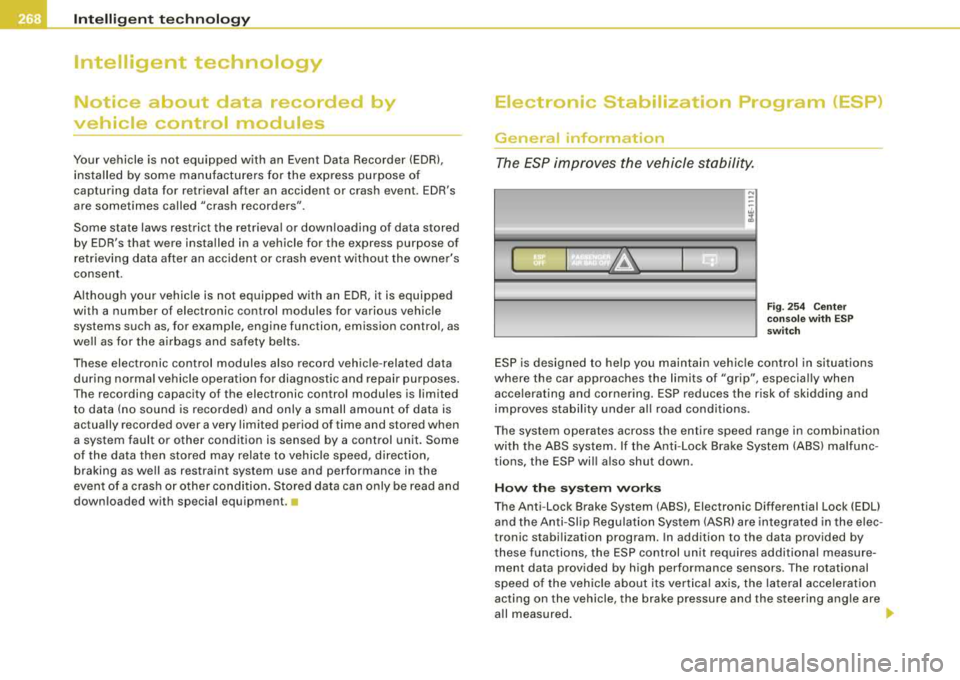
Fi g. 25 4 Cen ter
co nso le w it h ES P
sw itch
ESP is designed to he lp you maintain vehic le control in situations
where the car approaches the limits of "grip", especia lly when
acce lerating and cornering . ESP reduces the risk of skidding and
improves stabil ity under al l road conditions.
T he system operates across the entire speed range in combination
with the ABS system. If the Ant i-Lock Brake System (ABS) malfunc
tions, the ESP wi ll also shut down .
How the syste m w ork s
The Anti -Lock Brake System (ABS), Electronic Differential Lock (EDU
and the Anti-Sl ip Regulation System (ASR) are integrated in the e lec
tronic stabi lization program. In addition to the data provided by
t hese functions, the ESP control unit requires additional measure
ment data provided by high performance sensors . The rotational
speed of the veh ic le about its vertica l axis, the lateral acce lerat ion
acting on the vehicle, the brake pressure and the steering angle are
a ll measured . _,,,,
Page 271 of 404
____________________________________________ ln_t_ e_ l_ li _,..g "- e_ n
_ t_t_e _ c_ h_ n_o _l_o _....g ,_,y'-_IJIII
T he direction in which the driver wishes to travel is determined with
t he aid of the steering angle and vehicle speed and is con tinua lly
compared with the actual behavior of the vehicle. If the two do not
match, for example, when the vehic le starts hydrop laning on a wet
road, ESP will automatically brake the appropriate whee l to correct
the prob lem.
The vehicle is then stabi lized by the forces act ing on the whee l
during braking. If the vehicle is
oversteering (rear tends to skid out
of the turn), the brakes are mainly app lied on the whee l that is on
the outside of the curve. In the case of a vehicle that is
understeering
(tendency to s lide out of the curve), t he brakes are applied a t the
rear wheel that is on the inside of the curve. An acoustic signal indi
cates when ESP brake app lication cuts in
=> & .
The system operates across t he entire speed range in comb inat ion
with the ABS system
=> page 272 . If the Anti -Lock Brake System
(ABS) malfunctions, the ESP wi ll be out of act ion as well.
Ac tivation
When you turn on the eng ine, ESP will automatically be activated
and wil l perform a self -test.
The system can be activated or deactivated by pressing the but ton
=> page 268, fig. 254 . The warning light comes on when the system
is switched off
=> page 18.
Normally, the ESP s hould always be on, however, it may be advanta
geous to turn off the system in certain special cases when some
degree of wheel spin is des ired such as:
• when driving with snow chains
• whe n driving in deep snow or on a loose surface (to allow the
whee ls to dig in to reach firm ground)
• whe n trying to
"rock" the vehicle free whe n it has become stuck.
T he system should be reactivated once you are no longer in such
situations .
Both the ABS and EDS systems are still functioning even if the ESP
is switched off .
Controls and equip
ment Safety first Vehicle operation
& WARNING
The Ele
ctron ic Stabiliz ation Pr ogram i s ne verthele ss subje ct to the
laws of phy sic s. It is p articularl y important to pay attention to this
fa ct on wet and slipper y ro ad s. It i s therefore important th at you
alway s adapt your dr iving to the condit ion of the road and traffic
c ondition s. Do not allo w the in crea sed safety pro vided by the Ele c
tronic Stabilization Program system to lull you into a ccepting
a ddition al safety ri sk s.
•
Electronic differential lock (EDL)
The elec tronic d ifferen tial lock moni tors the rotation al
s p eed of the drive wheels.
G en era l not es
The elect ronic d ifferential lock (EDU helps the ca r to start mov ing,
accelerate and c limb a grad ient on surfaces providing poor or
a lmost no grip . Without EDL, this would be difficult, if not impos
s ib le.
How the syst em works
The EDL operates automatical ly. It monitors the rotationa l speed of
t he drive wheels on an ax le with the he lp of the ABS senso rs
=> page 272. If a not iceable difference in rotational speed between
the drive wheels on one axle is detected (e.g. on slippery ground
on
one side),
the spinning w heel is bra ked, thereby transferring power
to the other drive wheel or wheels (a ll -whee l drive) . This is done up
t o a speed of ab out 60 mph (100 km/h). N oises from the brake
system signal that wheel spin is being control led .
Dri ving off
When driving off, always be sure to keep road conditions in mind as
you accelerate. I f one drive wheel spins because it is on a sur face
with less grip, gradual ly increase the pressure on the accelerator
pedal unt il the car star ts to move . The whee l less able to t ra nsfer
power spins.
.,,
Vehicle care Do-it-yourself service Technical data
Page 274 of 404
-Intelligent technology
P:V:1--------=-- --=-=-------------
& WARNING
• Never let the vehi cle roll to a stop with the engine shut off .
• If the brake boo ster i s not working, for example when towing
your vehicle , or because the brake booster has so mehow been
damaged, the brake pedal must be pres sed considerably harder to
make up for the la ck of booster as sistan ce . •
Functioning of Anti-Lock Brake System (ABS)
AB S pre vent s th e wh eels fr o m lo ckin g up un der braking .
The ABS contributes effective ly to ve hicle control s ince it prevents
th e whee ls from
lo cking w hen t he brakes are a ppl ied. This mea ns
that the vehicle remains steerable and is less likely to skid.
With ABS you do not need to pump the brake . Just hold the brake
pedal down.
H owever, do not expect the ABS to shorten braking distance under
all cir cum stances. W hen drivin g on g ravel o r on new ly fallen s now
on top of icy surfac es, bra king distance may be even longer, there
fo re, unde r th ese circum stances, i t is especially i mporta nt th a t yo u
drive slow ly and with great care .
How the ABS system works
An automatic check is made when a speed of about 4 mph (6 km/h)
is reac hed . When this ha p pens, a pumping n oise can be hea rd.
If an indiv idua l wheel begins to rotate too s lowly in relation to
vehic le speed and tends to lock, the ABS automatica lly reduces
brake pressure to prevent that whee l from loc king .
T his automat ic adjustment process wil l cause a
slight vibration of
th e br ak e pe dal a nd some noises to ale rt you th at ve hic le sp eed
must be adapted to existing road and traffic conditions.
& WARNING
Although the ABS is very effe ctive , always remember that braking
capability is limited by tire traction. Alway s adjust your driving
speed a ccording to the road and traffi c conditions . Do not let the
extra safety afforded by the ABS tempt you into taking extra risks.
The ABS cannot overcome the laws of physics.
[ i ] Tips
• I f ABS is not funct io ni ng properl y, a wa rn ing li ght will co me o n.
See ~ page 21.
• I f a fault occurs in the A BS, the EDL is also not functioning. This
i s indica ted by the ABS wa rn ing l igh t.•
Brake assistant
The brake assis tant is desig ned to ach ieve the o ptim um
brakin g eff ec t.
The br ake assistan t helps to in cr eas e the effec tive b raki ng pow er
and thus to achieve a shorter stopping distance . If the driver
p re sses the b rake pe dal very q uick ly, the brake assistan t auto mati
ca lly boosts the brakin g force to the maximum level, up to th e point
whe re the a nti-lock b rake functi on (AB S) int ervenes to sto p the
w hee ls from loc king . You s hou ld t hen k eep th e br ake pedal pressed
until t he vehicle ha s braked to the required speed . The brake a ssis
t ant s witches itse lf off as soo n as you re lease t he bra ke pedal.
T he b rake assistant will not be ope rative if there is a malfunction in
th e ABS .
& WARNING
Please remember that the accident risk always increases if you
drive too fast , especially in corners or on a slippery road , or if you
follow the vehicle ahead of you too closely . Increased risk of an
~
Page 285 of 404
____________________________________________________ T_r_a _i_l e_ r_t_ o _ w_ i
_ n...; g=- -•
Operating instructions
M ax im um tra iler weig ht
A trailer for your vehicle is limited to a typ ical c lass 1 or class 2
trailer.
T ra ile r l oad d is tributi on
Be sure the load in the trailer is he ld securely in place to prevent it
from shifting forward, backward or s ideways .
Never a llow a pass enger to r ide in a trailer:::::, & in "Driving instruc
t ions" .
Engin e coo lin g sys te m
Tow ing a trai ler makes the engine work harder. It is important that
the cooling system's performance is up to the additiona l load. Make
sure that the coo ling system has enough fluid .
Tire press ure
When towing a trailer, inflate the tires of your veh icle to t he co ld tire
pressure listed under "Full load" on the labe l located either on the
driver's side B -pil lar (visible when the door is open) or inside the fuel
filler flap . Inflate trailer tires to trai ler and tire manufacturers' spec
ifications.
L ig ht s
The head light settings should be checked wit h the trai ler attached
before driving off. Check to make sure both vehicle and trai ler lights
are working properly .
Safe ty c ha in s
Be s ure trailer safe ty chains are properly connected from the trailer
to the hitch on the vehicle. Leave enough slack in the chains to
permit turning corners . When yo u insta ll safety chains, make sure
they will not drag on the road when you are driving.
T he chains should cross under the trailer tongue to prevent it from
dropping in case of separat ion from the hitch.
Controls and equip
ment Safety first
Vehicle operation
0 Note
If you are go ing to tow a trai ler, you must activate the tra iler opera
tion
mode :::::, page 189, "Towing a Trailer". •
Driving instructions
Driving with a trailer always requires extra care and
consideration.
To obtain the best possib le handling of ve hicle and trailer,
p lease note t he following :
- Do not tow a loaded trailer when your car itself is not
loaded.
- Be especia lly careful whe n passing other vehic les .
- Observe speed limits .
- Do not drive at the maximum permiss ible speed .
- Always apply brakes early.
- Monitor t he temperature ga uge .
W eight d istr ibu tion
Towing a loaded trailer with an empty car results in a highly
unstable d istribution of weight. If this cannot be avoided, drive at
very low speeds only to avoid the risk of losing steering control.
A "balanced" rig is easier to operate and control. This means that
t he tow vehicle should be loaded to the extent possible and permis
sib le, while keeping the trailer as light as possib le under the circum
stances . Whenever possible, transfer some cargo to the luggage
compartment of the tow vehicle whi le observing tongue load
requirements and vehicle loading considera tions .
.,,.
Vehicle care Do-it-yourself service Technical data
Page 292 of 404
___ C_ le_ a_n _i_n ~g _ a_ n_ d
__ p_r _o _t _e _c_ t_ i_o _n ___________________________________________ _
0 Note
• Never try to remove dirt, mud or dust if the surface of the vehicle
is dry. Never use a dry cloth or sponge, since this could scratch your
vehicle 's paint or windows.
• Never wash your car in bright sunlight. Drops of water act as
magnifying lenses and may damage your paint.
• When you wash your car in the winter: if you rinse your vehicle
wi th a hose, be ca reful not to aim the stream of wa ter direc tly at
locks, or at door or hatch openings -they can freeze shut.
• Never use sponges designed to remove insects, or any kitchen
scouring sponges or similar products. They can damage your paint
finish .
• Never use a dry cloth or sponge to clean the headlights. Only use
wet cloths or sponges to prevent sc ratches . It is best to use soapy
water .
~ For the sake of the environment
In the interest of the environment, the vehicle should only be
washed in special wash bays. •
Washing your vehicle with a power washer
Cleaning the exterior of your car with a high-pressure
power washer is safe as long as you observe a few simple
rules.
- Before using the power washer, make sure you have read
and understood the WARNINGS :::>
& in "General infor
mation" on
page 288.
- Always follow the operating instructions for the power
washer. - Make
sure that the jet on the spray hose produces a "fan
shaped spray".
- Do
not hold the spray nozzle too close to soft materials.
When cleaning the vehicle w ith a power washer always follow the
operating instructions. This applies particularly to the
operating
pressure
and the spraying distance. Maintain a sufficient distance
to soft materials such as rubber hoses and sound/vibration dead
ening materials (particularly on the underside of the engine hood).
Do not use a jet which sprays water in a
direct stream or one that
has a
rotating jet.
Water temperature should no t exceed 140 °F (60 °Cl.
& WARNING
Never wash tires with a jet that sprays water in a direct stream.
This could cause invisible damage to the tires and weaken them,
even if the spray is from a relatively long distance and for a short
time. Damaged and weakened tires can fail and cause accidents
and personal injury .
0 Note
To avoid damaging your vehicle, always make sure that there is
sufficient distance between the spray head and soft materials like
rubber hoses, plastic parts and sound-deadening materials . Never
aim the spray head at the same point for a long time. This also
applies to cleaning headlights and painted bumpers . Remember:
the closer the nozzle is to the surface of the material , the greater the
stress on the material. •