transmission AUDI S8 2008 User Guide
[x] Cancel search | Manufacturer: AUDI, Model Year: 2008, Model line: S8, Model: AUDI S8 2008Pages: 404, PDF Size: 52.7 MB
Page 279 of 404
______________________________________________ D_ ri_v _ i_ n _, g..,_ a_ n_d _ e_ n_ v_i_ro _ n_ m_ e_ n_t __ lll
Driving and environment
The first 1,000 miles (1,500 km) and
afterwards
New engine
The engine needs to be run-in during the first 1,000 miles
(1,500 km).
For the first 600 miles (1,000 kilometers):
Do not use full throttle.
- Do not drive faster than 3/4 of the top speed marked on
the speedometer.
- Avoid high engine speeds .
From 600 to 1,000 miles (1,000 to 1,500
kilometers):
- Speeds can gradually be increased to the maximum
permissible road or engine speed.
During and after break-in period
-Do not rev the engine up to high speeds when it is cold.
This applies whether the transmission is in N (Neutral) or
1n gear.
After the break-in period
- Do not exceed maximum engine speed under any
circumstances.
- Upshift into the next higher gear
before reaching the red
area at the end of the tachometer
scale => page 12.
Controls and equip
ment Safety first
Vehicle operation
During the first few hours of driving, the engine's internal friction is
higher than later when all the moving parts have been broken in.
How well this break-in process is done depends to a considerable
extent on the way the vehicle is driven during the first 1,000 miles
(1,500 kilometers).
0 Note
Extremely high engine speeds are automatically reduced. However,
these rpm limits are programmed for an engine well run-in, not a
new
engine.
~ For the sake of the environment
Do not drive with unnecessarily high engine speeds -upshifting
early saves fuel, reduces noise and protects the environment .•
New tires
If your vehicle is running on new tires, drive particularly
careful for the first 350 miles (500 kilometers) after fitting.
& WARNING
New tires tend to be slippery and must also be "broken-in". Be
sure to remember this during the first 350 miles (500 kilometers).
Brake
gently. Avoid following closely behind other vehicles or
other situations that might require sudden, hard braking.
•
Vehicle care Do-it-yourself service Technical data
Page 287 of 404
____________________________________________________ T_r_a _i_l e_ r_t_ o _ w_ i
_ n...; g=- -•
-Wit h chocks i n place, slowly release the brakes until the
wheel chocks absorb the load .
-Turn the wheels towards the curb.
-Apply the parking brake.
-Move the selector lever to P.
When rest arting after p arking :
-Apply the foot brake.
-Start the engine.
-Move the se lector lever to D.
-Re lease the parking brake and slowly pull out and away
f rom the whee l chocks .
-Stop and have someone retr ieve the wheel chocks .
[ i] Tip s
If you move the se lector lever of the automatic transmission to P
b efor e applying th e parking brak e and b efor e blocki ng th e wheels ,
you may have to use more force later to move the lever out of the
P
position .•
Controls and equip ment Safety first Vehicle operation
Vehicle care Do-it-yourself service Technical data
Page 301 of 404
_____________________________________________ C_ l_ e _a_ n_ in~ g_a
_ n_d_ p_ r_ o_ t
_ e_ c_t _io _ n __ fflll
•
from fading . Slight color variations will develop in normal use and
are not an indication of material deterioration.
0 Note
• Never use chemical solvents (e.g. lighter fluid, turpentine),
waxes, shoe polish or similar products on Alcantara® surfaces.
• To avoid damage, have stubborn stains removed by a commer
cial cleaning specialist.
• Do not use brushes, stiff sponges or similarly abrasive cleaning
aids. •
Safety belts
Only well-maintained safety belts work reliably when
needed.
- Keep belts clean.
- For cleaning, use a mild soap and water solution. Let
belts dry thoroughly and away from direct sunlight.
- Do not allow inertia reel safety belts to retract before
they are completely dry.
- Check the condition of your safety belts
regularly.
Heavily soiled safety belts may not retract properly.
& WARNING
Damaged safety belts can break in a crash.
• Anything that might damage your safety belts could mean that
you and your passengers would not be adequately protected in an
accident.
• Safety belt performance depends on correct installation. Never
remove belts from the vehicle to clean them.
&, WARNING (continued)
• Do not use chemical cleaning agents, bleach or dyes. They have
corrosive properties which weaken the webbing.
• When cleaning your safety belts, inspect them for damage. If
you discover damage, see your Audi dealer.
• Always read and heed all WARNINGS and other information
=> page 288. •
Engine compartment
Be especially careful when cleaning the engine compart
ment.
Always switch off the ignition before cleaning the engine => &,.
Plenum panel
Remove leaves from the plenum panel in front of the windshield
under the engine hood. This prevents the water drain holes from
becoming blocked, and it prevents debris from entering the vehicle
interior through the heating and ventilation ducts.
Corrosion protection
The engine compartment and transmission have been corrosion
protected at the factory.
Good anti-corrosion treatment is very important, particularly in the
winter. If the vehicle is frequently driven on salt treated roads, the
entire engine compartment and plenum panel should be thor
oughly cleaned at the end of winter and retreated to prevent salt
damage. At the same time, the underside of the vehicle should be
washed as well.
If the engine compartment is cleaned at any time with grease
removing solutions
11 , or if you have the engine washed, the anti
corrosion treatment is almost always removed as well. It is therefore .,_
11 Use only the correct cleaning solut ions. Never use gasoline or diesel fuel.
Vehicle care
Page 327 of 404
Tires and wheels -
----------------
•
& WARNING (continued)
crashes and serious personal injuries . Have worn or damaged tires
replaced immediately.
• Tires age even if they are not being used and can fail suddenly,
especially at high speeds. Tires that are more than 6 years old can
only be used in an emergency and then with special care and at
low speed.
Glossary of tire and loading terminology
Accessory weight
means the combined weight (in excess of those standard items
which may be replaced) of automatic transmission, power steering,
power brakes, power windows, power seats, radio, and heater, to
the extent that these items are available as factory-installed equip
ment (whether installed or not).
Aspect ratio means the ratio of the height to the width of the tire in percent.
Numb ers of 55 or lower indicate a low sidewall for improved
steering response and better overall handling on dry pavement.
Bead
means the part of the tire that is made of steel wires, wrapped or
reinforced by ply cords and that is shaped to fit the rim.
Bead separation
means a breakdown of the bond between components in the bead.
Cord
means the strands forming the plies in the tire.
& WARNING (continued)
• Never mount used tires on your vehicle if you are not sure of
their
"previous history." Old used tires may have been damaged
even though the damage cannot be seen that can lead to sudden
tire failure and loss of vehicle control.
• If you notice unusual vibration or if the vehicle pulls to one side
when driving, always stop as soon as it is safe to do so and check
the wheels and tires for damage.
•
Cold tire inflation pressure
means the tire pressure recommended by the vehicle manufacturer
for a tire of a designated size that has not been driven for more than
a couple of miles (kilometers) at low speeds in the three hour period
before the tire pressure is measured or adjusted.
Curb weight
means the weight of a motor vehicle with standard equipment
including the maximum capacity of fuel, oil, and coolant, air condi
tioning and additional weight of optional equipment.
Extra load tire
means a tire design to operate at higher loads and at higher infla
tion pressures than the corresponding standard tire. Extra load tires
may be identified as
"XL", "xi", "EXTRA LOAD", or "RF" on the side
wall.
Gross Axle Weight Rating
("GAWR")
means the load-carrying capacity of a single axle system, measured
at the tire -ground interfaces.
Gross Vehicle Weight Rating
( " GVWR")
means the maximum total loaded weight of the vehicle.
Vehicle care
Page 363 of 404
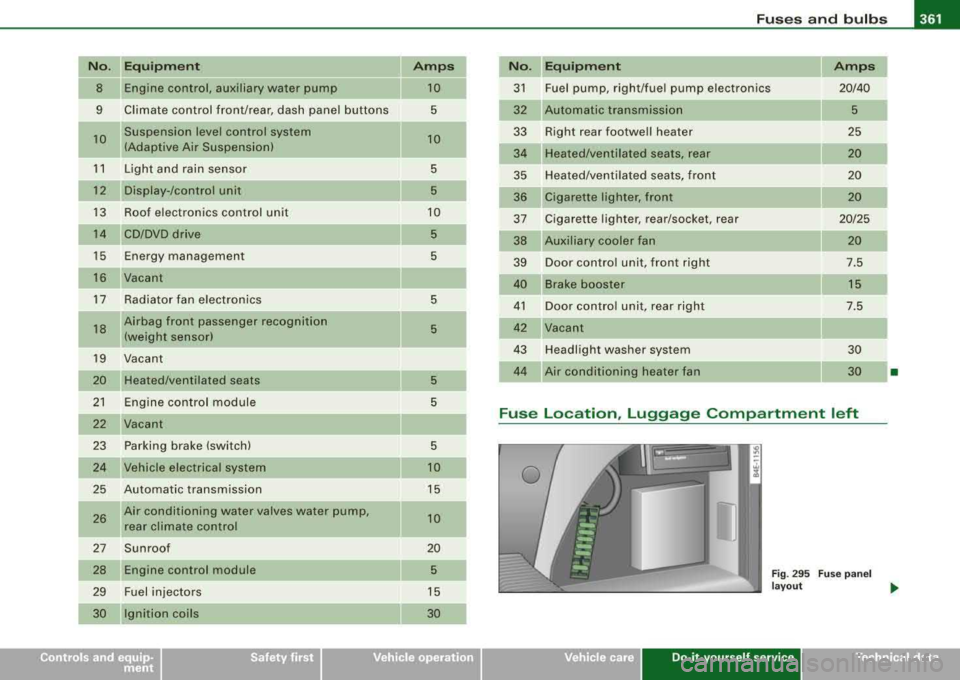
_________________________________________________ F_ u_ s_ e_s _ a_n _d_ b_ u
_ lb_ s _ __,_
-
No . II Equipm ent
8 Engine control, auxiliary water pump
9
10 C
limate control front /rear, dash panel buttons
Suspension level control system
(Adaptive Air Suspension)
11 Light and rain sensor
1 2 Display -/control unit
13 Roof electronics control unit
CD/DVD d rive
15 Energy managemen t
16 Vacant
17 Radiator fan e lectronics
18 Airbag front passenger recognition
(weight sensor)
19 Vacant
20 Heated/ventilated seats
21 Engine control module
22 Vacant
23 Parking brake (switch)
24 Vehicle electrical syste m
25
26
27
Automatic transmission Air condi tioning water valves wate r pump,
rea r climate control
Sunroof
28 Engine control module
29 Fuel injectors
30 Ignition coils
Amps
10
5
1 0
5
5
10
5
5
5
5
5
5
5
1 0
15
10
20
5
1 5
30
-
No . Equipm ent
31 Fuel pump , right/fue l pump e lectronics
32 Automatic transmission
33
34
Right rear footwe ll heater
Heated/ventila ted seats, rear
35 Heated/ventilated seats, front
36 Cigarette lighter, front
37 Cigarette lighter, rear/socket, rear
38 Auxil iary cooler fan
39 Door contro l unit, front right
40 Brake booster
41 Door contro l unit, rear right
42 Vacant
43 Headlight washer system
44 A ir co nditioning heater fan
Amps
20/40
5
25
20
20
20
20/25 20
7.5
1 5
7.5
30
30 •
Fuse Location , Luggage Compartment left
0
Fig . 2 95 Fuse pan el
l a you t _.
Vehicle care Do-it-yourself service irechnical data
Page 367 of 404
________________________________________________ E=..:.; m:..:.:: e:.:.r.::g ~e::.:..: n:.:c ~y~ s:: i:.:t .=u :.:a:. t:: i:.:o :.:n..:.:: s~_JIIII
fl::. WARNING (continued)
• Before you check anything in the engine compartment, always
read and heed all
WARNINGS~ page 299, "Engine compartment".
0 Note
• Applying a higher voltage booster battery will cause expensive
damage to sensitive electronic components, such as control units,
relays, radio, etc .
• There must be no electrical contact between the vehicles as
otherwise current could already start to flow as soon as the positive
( + ) terminals are connected.
[ i) Tips
• The discharged battery must be properly connected to the
vehicle's electrical system. When jump starting or charging the battery , never connect the negative ground cable to the battery
negative post because the battery manager system must be able to
detect the battery's state of charge. Always connect the negative
ground cable to the negative ground post of the battery manager
control unit .•
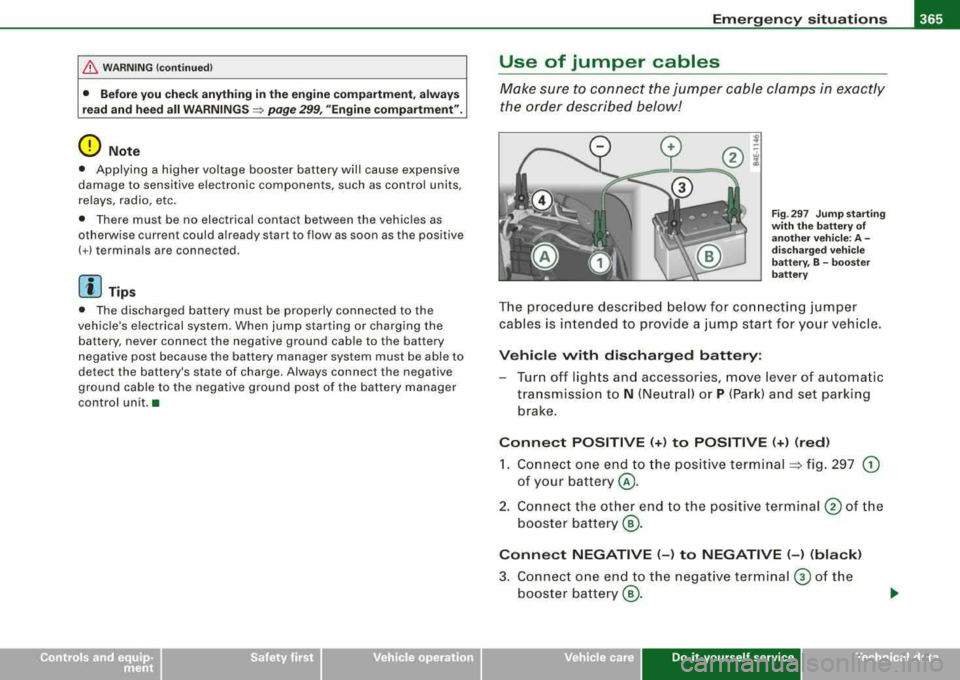
Use of jumper cables
Make sure to connect the jumper cable clamps in exactly
the order described below!
Fig. 297 Jump starting
with the battery of
another vehicle: A -
discharged vehicle
battery, B -booster
battery
The procedure described below for connecting jumper
cables is intended to provide a jump start for your vehicle.
Vehicle with discharged battery:
-Turn off lights and accessories, move lever of automatic
transmission to
N (Neutral) or P (Park) and set parking
brake.
Connect POSITIVE (+) to POSITIVE (+) (red)
1. Connect one end to the positive terminal => fig. 297 G)
of your battery @.
2. Connect the other end to the positive terminal
@ of the
booster battery
@.
Connect NEGATIVE (-) to NEGATIVE (-) (black)
3. Connect one end to the negative terminal @ of the
booster battery
@.
Vehicle care Do-it-yourself service irechnical data
Page 368 of 404
____ E_m _ e_r-=g =- e_ n_c ..: y,_ s_ i_ t _u _a_ t_ i_ o _ n_ s ______________________________________________ _
4. Connect the other end to the negative ground post of the
battery manager control unit located next to the battery.
Starting the engine
-Start the engine of the vehicle with the booster battery.
Run the engine at a moderate speed.
- Start engine with discharged vehicle battery in the usual
manner .
- If the engine fails to start: do not keep the starter
cranking for longer than 10 seconds. Wait for about 30
seconds and then try again.
- With engine running, remove jumper cables from both vehicles in the exact
reverse order.
The battery is vented to the outside to prevent gases from entering
the vehicle interior . Make sure that the jumper clamps are well
connected with their metal ports in full contact with the battery
terminals.
& WARNING
To avoid serious personal injury and damage to the vehicle, heed all warnings and instructions of the jumper cable manufacturer. If
in doubt, call for road service.
• Jumper cables must be long enough so that the vehicles do not
touch.
• When connecting jumper cables, make sure that they cannot
get caught in any moving parts in the engine compartment.
• Before you check anything in the engine compartment, always
read and heed all
WARNINGS ~ page 299, "Engine compartment".
0 Note
Improper hook -up of jumper cables can ruin the generator. •
Always connect POSITIVE(+) to POSITIVE(+), and NEGATIVE(-) to
NEGATIVE( -) ground post of the battery manager control unit.
• Check that all screw plugs on the battery cells are screwed in
firmly. If not, tighten plugs prior to connecting clamp on negative
battery terminal.
• Please note that the procedure for connecting a jumper cable as
described above applies specifically to the case of your vehicle
being jump started. When you are giving a jump start to another
vehicle, do not connect the negative(-) cable to the negative(-)
terminal on the discharged
battery @~ page 365, fig. 297. Instead,
securely connect the negative(-) cable to either a solid metal
component that is firmly bolted to the engine block or to the engine
block itself. If the battery that is being charged does not vent to the
outside, escaping battery gas could ignite and explode! •
Emergency towing with commercial
tow truck
General hints
Your Audi requires special handling for towing.
The following information is to be used by commercial tow truck
operators who know how to operate their equipment safely.
• Never tow your Audi, towing will cause damage to the engine
and transmission.
• Never wrap the safety chains or winch cables around the brake
lines.
• To prevent unnecessary damage, your Audi must be transported
with a flat bed truck.
• To load the vehicle on to the flat bed, use the towing loop found
in the vehicle tools and attach to the front or rear anchorage
~ page 367 and ~ page 368 . .,,_
Page 372 of 404
lffll....__E_ m_ e_r -=g :....e_ n
_ c-=y _ s_ i_t _u _a _t_ i_o _n_ s _______________________________________________ _
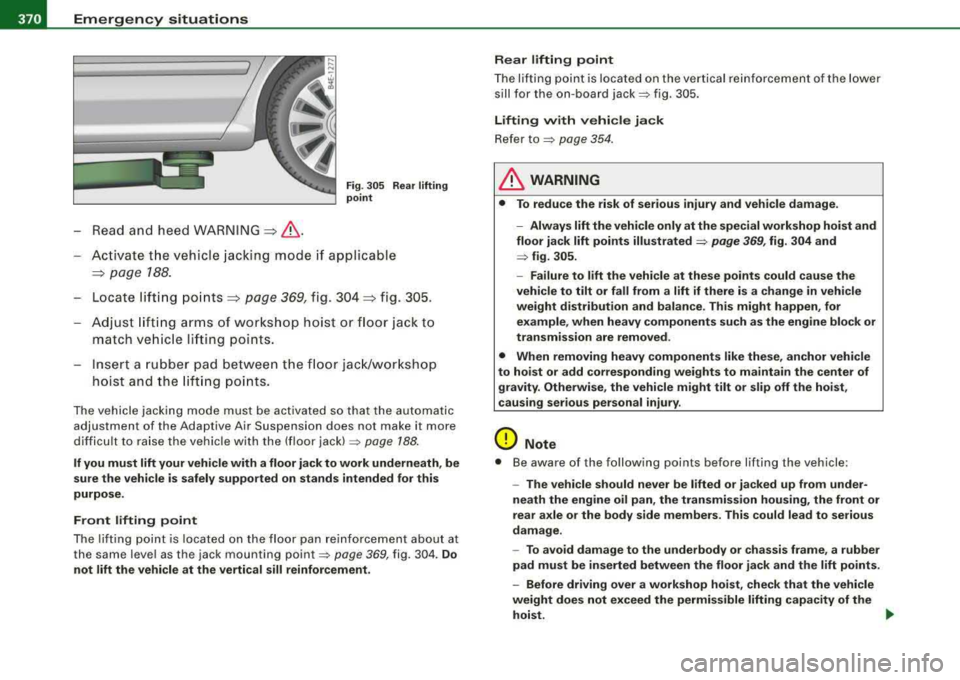
-Read and hee d WARNI NG =:> & .
Fig. 305 Re ar lifting
point
Ac tivate t he vehicle jackin g mode if a pp licable
=:> p age 188 .
-Loc ate lift ing po in ts=:> page 369 , fig. 3 04 =:> fig. 3 05.
Ad just lift in g a rms of works hop hoi st or floor jack t o
match ve hicle li ftin g points.
Ins ert a ru b be r pad betwe en the floor jack/work shop
h o ist and t he li ftin g poin ts.
The vehicle jacki ng m ode mus t be ac tiva ted so that the au tomatic
adjustment of the Adaptive Air Suspension does not make it more
d ifficu lt to ra ise the vehic le w ith the (floor
jac k) => page 188 .
If you must lift your vehicle with a floor jack to work underneath , be
sure the vehicle is safely supported on stands intended for this
purpo se.
Front lifting point
T he lif ti ng po int is locat ed o n th e floor pan re inforc ement abou t at
the same level as the jack mounting
point => page 3 69, fig. 304. Do
not lift the vehicle at the vertical sill reinforcement. Rear lifting point
Th
e lif tin g po int is loca ted o n the vertical re info rce ment of the l ower
s ill for t he o n-board
jack=> fig . 305.
Lifting with vehicle jack
Refer to => page 354.
& WARNING
• To reduce the risk of serious injury and vehicle damage.
-Always lift the vehicle only at the special workshop hoist and
floor ja ck lift points illustrated
=> page 369 , fig. 304 and
=> fig . 305.
- Failure to lift the vehicle at these points could cause the
vehicle to tilt or fall from a lift if there is a change in vehicle
weight distribution and balance. This might happen , for
example , when heavy components such as the engine block or
transmission are removed .
• When removing heavy components like these, anchor vehicle
to hoist or add corresponding weights to maintain the center of gravity. Otherwise , the vehicle might tilt or slip off the hoist,
c ausing serious personal injury .
0 Note
• Be awar e of the following points before lifting the vehicle :
-The vehicle should never be lifted or jacked up from under
neath the engine oil pan , the transmission housing , the front or
rear axle or the body side members . This could lead to serious
damage .
-To avoid damage to the underbody or chassis frame , a rubber
pad must be inserted between the floor jack and the lift point s.
- Before driving over a workshop hoist, check that the vehicle
weight does not exceed the permissible lifting capacity of the
hoid . ~
Page 376 of 404
llffl,...__G_ e_ n_ e_r_a _ l_ i
_ n_ f_ o_ rm_ a
_ t_io _ n _______________________________________________ _
General information
Explanation of technical data
Some of the technical data listed in this manual requires
further explanation .
The technical data for your vehicle is listed in the charts starting on
=> page 378. This section provides general information, notes and
restrictions which app ly to this data. •
Vehicle identification
The key data is given on the vehicle identification number
(VIN) pla te and the vehicle data st icker.
F ig. 306 V ehicle Iden ti
f ic ation Numb er (VIN )
p la te: locatio n on
dri ver's s ide das h
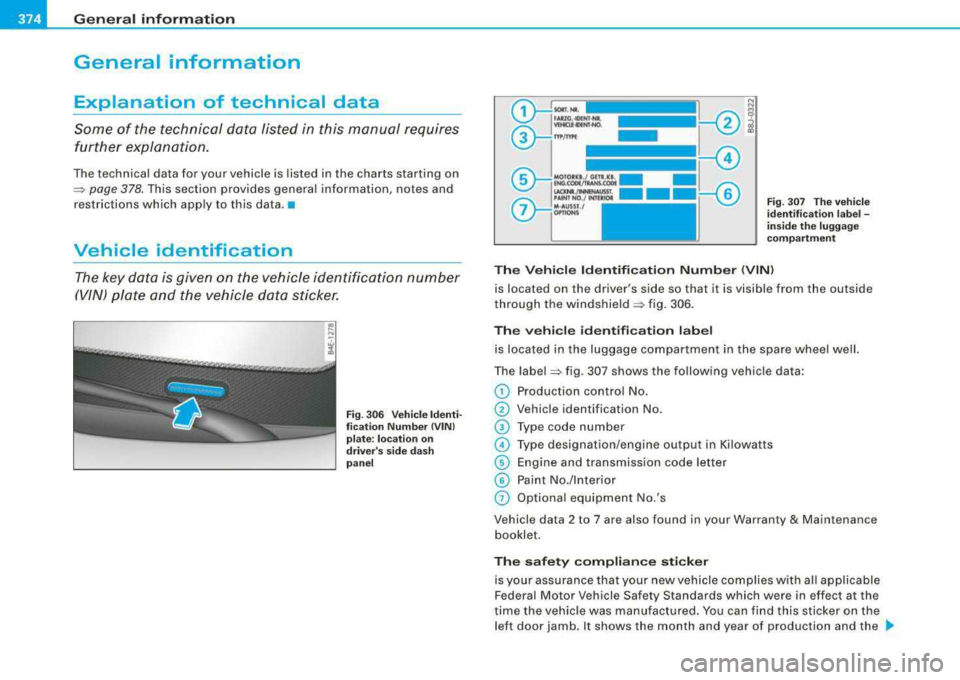
p anel Fig
. 307 The vehi cle
i d e ntifi cat ion la bel -
i n side the lugga ge
com partme nt
The Vehicle Ident ification Numb er (V IN)
is located on the driver's side so that it is visible from the outside
through the
windshie ld => fig . 306 .
The veh icle i de ntifi cation l ab el
is located in the luggage compartment in the spare whee l well.
The
l abel=> fig . 307 shows the following vehic le data :
0 Production contro l No.
G) Vehicle identification No.
G) Type code number
© Type designation/engine output in Ki lowatts
© Engine and transmission code letter
© Paint No./lnterior
0 Optiona l equipment No.'s
Vehicle data 2 to 7 are also found in your Warranty
& Maintenance
booklet.
Th e s afety c ompliance sticker
is your assurance that your new vehicle complies with all app licable
Federa l Motor Vehicle Safety Standards which were in effect at the
time the vehicle was manu factured. You can find this sticker on the
left door jamb . It shows the month and year of production and the .,_
Page 384 of 404
___ C_ o_n_ s_ u_m _ e_ r_ ln_ f_o _r_m _ a_ t_ i_o _n ______________________________________________ _
&, WARNING (continued )
• The engine compartment of any motor vehicle is a potentially
hazardous area . Never reach into the area around or touch the
radiator fan . It is temperature controlled and can switch on
suddenly -even when the engine is off and the ignition key has
been removed . The radiator fan switches on automatically when
the coolant reaches a certain temperature and will continue to run until the coolant temperature drops .
• Always remove the ignition key before anyone gets under the
vehi cle .
• Always support your vehicle with safety stands if it is neces
sary to work underneath the vehicle . The jack suppl ied with the
vehicle is not adequate for this purpose and could collapse causing serious personal injury .
• If you must work underneath the vehicle with the wheels on
the ground , always make sure the vehicle is on level ground , that
the wheels are always securely blocked and that the engine
cannot be started .
• Always make sure the transmission selector lever (automatic
transmission) is in
"P " (Park position ) and the park brake is firmly
applied.
W For the sake of the environment
• Cha ng ing the eng in e sett ings will adverse ly aff ect em iss ion
levels . This is detrimenta l to the environment and increases fuel
c o nsu mp tion .
• Always observe environmenta l regu lations when disposing of
o ld eng ine oil, u sed b ra ke flu id, d irty e ng in e coo la nt, spe nt batter ies
or worn out tires.
• Undeployed airba g modul es and pret ensioners might be classi
fied as Perchlorate Material -special handling may apply, see
www .dtsc.ca .gov/ haza rdouswast e/p erc hlor ate . W hen the vehicle or
parts of the restraint s ystem including airbag modules safety be lts
w it h p ret en sio ner s are scra p pe d, a ll ap pl icable l aw s and reg ula- tions must be observed
. Your authorized Audi dea ler is familiar with
th ese re q ui re me nts a nd we reco mmend th at you h ave your dea le r
perform this serv ice for you .•
Additional accessories,
modifications and parts replacement
Additional accessories and parts
replacement
Always consult an author ized Audi dealer before
pu rcha sing a ccess ories .
Your vehicle incorporates the latest safety design featu res ensuring
a high sta nd ard of ac tive a nd pass iv e sa fet y.
T his sa fety could be compromised by non -approved chang es to th e
veh ic le . Fo r th is reason, if pa rts have to be replaced, please o bse rve
the followi ng po ints wh en insta lling addi tio na l acc essor ies:
A pprove d Audi accesso ries and genuine A udi parts are avai lable
fr om autho rized Aud i d eale rs.
T hese deale rs also have the necessary fac ilities, tools and tra ined
spec ial is ts to ins tal l the part s and accesso rie s prope rly.
L1}. WARNING
Using the wrong spare parts or using non -approved accessories
can cause serious personal injury.
• Use only accessories expressly approved by Audi and genuine
Audi spare parts
• These parts and accessories have been specially designed to
be used on your vehicle .
• Never install accessories such as telephone cradles or
beverage holders on airbag covers or within the airbag deploy-