instrument panel AUDI S8 2008 Owner's Manual
[x] Cancel search | Manufacturer: AUDI, Model Year: 2008, Model line: S8, Model: AUDI S8 2008Pages: 404, PDF Size: 52.7 MB
Page 246 of 404
11111 Child Safety
------!....------------------------------
&, W ARNING (continued )
• Alway s inst all rear-facing child safety seats on the rear seat .
• If you mu st in sta ll a rear ward f acing child safet y seat on the
front pa ssenger seat in exceptional circum stan ces and the
PASSENGER AIR BAG OFF light doe s not come on and stay on,
immediately inst all the rear-facing child safety seat in a rear
s eating po sition and ha ve the airbag sy stem inspe cted immedi
atel y by your Audi de aler .
& WARNING
If, in exceptional circumstance s, you mu st in stall a forward -facing
c hild re straint o n the fr ont p assenger 's seat:
• Alway s make sure the forward -fa cing s eat ha s been de signed
a nd cert ified by it s m anufa cturer for use on a front seat w ith a
pa ssenger front and side airbag.
• Always follow the manufacturer's instruct ions provided with
the child safety seat or carrier.
• Alway s move the pa ssenger seat into it s re armost position in
the seat' s fore and aft adju stment range , as far aw ay from the
ai rbag as possibl e befo re installing the ch ild restr aint . The ba ck
rest mu st be adjusted to an upright po sition.
• Alway s m ake sure that the PASSENGER AIR BAG OFF l ight
c ome s on and stays on all the time whenever the ignition is
sw it c hed on . •
Advanced front airbag system and children
Your vehicle is equipped with an "Advanced Airbag System" in
compl iance with U nited States Federa l Motor Vehicle Safety Stan
dard { FMVSSl 208 as applicable at the time your vehicle was manu
factured. T
he Advanced Airbag system in your vehicle has been certified to
meet the " low -risk" requirements for 3 and 6 year -old chi ldre n on
the passenger side and smal l adults on the driver side . The low risk
deployment criteria are intended to reduce the risk of injury through
interaction with the airbag that can occur, for example, by being too
close to the steering wheel and instrument panel when the airbag
inflates. In addition, the system has been certified to comply with
the "suppression" requirements of the Safety Standard, to turn off
the front airbag for infants up to 12 months who are restra ined on
the front passenger seat in child restraints that are listed in the
Standard.
Even though your vehic le is equipped with an Advanced Airbag
system, al l ch ildren, especially those 12 years and you nger, should
a lways ride in the back seat properly restrained for their age and
size . The airbag on the passenger side makes the front seat a poten
tia lly dangerous p lace for a ch ild to ride. The front seat is not the
safest p lace for a child in a forward -facing child safety seat . It can be
a very dangerous p lace for an infant or a larger ch ild in a rearward
facing seat. •
Advanced Airbags and the weight-sensing
mat in the front seat
The Advanced Airbag Sys tem in your vehicle detects the presence
of an infant or child in a chi ld restra int on the front passenger seat
using the weight -sensing mat in the seat cushion and the sensor
below the safety belt latch on the front passenger seat that measures the tension on the safety belt.
T he weigh t-sensing mat measures total weight o f the chi ld and the
child safety seat and a child blanket on the front passenger seat . T he
weig ht o n the fr ont passenger seat is rela ted to the desig n of the
chi ld restraint and its "footprint", the size and shape of the bottom
of the child restraint as it sits on the seat . The weight of a child
restraint and its "footprint" vary for different kinds of child
~
Page 256 of 404
lllffl __ C_h_ i_ld _ S_ a_ f_ e_ t_, y'-------------------------------------------------
&, WARNING (continued )
• If the backrest is not securely latched , the child and the child
restraint will be thrown forward together with the backrest and
will strike parts of the vehicle interior. The child can be seriously
injured or killed.
• Never install rear-facing child safety seats or infant carriers on
the front passenger seat . A child will be seriously injured and can
be killed when the passenger airbag inflates .
• The inflating airbag will hit the child safety seat or infant
carrier with great force and will smash the child safety seat and
child against the backrest, center arm rest, door or roof .
• Always install rear-facing child safety seats or infant carriers on
the rear seat.
• Forward-facing child safety seats or infant carriers installed on
the front passenger's seat may interfere with the deployment of
the airbag and cause serious injury to the child .
• It is safer to install a forward -facing child safety seat on the rear
seat.
• Always read and heed all WARNINGS whenever using a child
restrained in a vehicle is being used
=> page 243 . Special precau
tions apply when installing a child safety seat on the front
passenger seat
=> page 220 , "Child restraints on the front seat -
some important things to know ".
& WARNING
Always take special precautions if you must install a forward or
rearward-facing child restraint on the front passenger's seat in
exceptional situations:
• Whenever a forward or rearward -facing child restraint is
installed on the front passenger seat , the PASSENGER AIR BAG
OFF light must come on and stay on whenever the ignition is
switched on .
&, WARNING (continued )
• If the PASSENGER AIR BAG OFF light does not come on and stay
on, perform the checks described
=> page 229, " Monitoring the
Advanced Airbag System ".
• Take the child restraint off the front passenger seat and install
it properly at one of the rear seat positions if the PASSENGER AIR
BAG OFF light does not stay on whenever the ignition is switched
on .
• Improper installation of child restraints can reduce their effec
tiveness or even prevent them from providing any protection .
• An improperly installed child restraint can interfere with the
airbag as it deploys and seriously injure or even kill the child.
• Always carefully follow the manufa cturer's instructions
provided with the child safety seat or carrier .
• Never place additional items on the seat that can increase the
total weight registered by the weight-sensing mat and can cause injury in a crash.
& WARNING
Forward-facing child restraints:
• Always make sure the forward -fa cing seat has been designed
and certified by its manufacturer for use on a front seat with a
passenger front and side airbag .
• Never put the forward-facing child restraint up , against or very
near the instrument panel.
• Always move the passenger seat into its rearmost position in
the seat's fore and aft adjustment range , as far away from the
airbag as possible before installing the forward-facing child
restraint. The backrest must be adjusted to an upright position .
• Make sure that the PASSENGER AIR BAG OFF light comes on
and stays on all the time whenever the ignition is switched on.
..,_
Page 298 of 404
___ C_ le_ a_n _i_n ~g _ a_ n_ d
__ p_r _o _t _e _c_ t_ i_o _n ___________________________________________ _
wards, use copious amounts of clean water to remove the
rema ining detergen t. App ly the water with a damp cloth or sponge
and pat the fabric dry with an absorbent, dry c loth .
Stains from chocolate or makeup should have detergent paste (e.g .
ox -ga ll soap) rubbed into them. A fterwards, remove the soap w ith
water (damp sponge).
A lcohol can be used to treat stains from grease, o il, lipstick or a ba ll
point pen . Melted grease or dye must be patted off using absorbent
mater ial. It may be necessary to retreat the areas w ith de tergent
paste and water .
In the case of genera l soiling of the upho lstery and cover material,
we recommend h iring a spec ialist that has the equ ip m ent to c lean
the seat covers and other fabric surfaces by shampooing and spray
extraction .
& WARNING
Always read and heed all WARNING S and the information
=> page 288 .
[ i] Tip s
Open Ve lcro fasteners on your clothing can damage the seat cover.
Please make sure that Velcro fasteners a re c losed .•
Plastic parts and instrument panel
A lways use a c lean cloth mo istened in clear water to clean these
areas . For persistent dirt use an Audi approved solvent-free plastic
cleaner/protectant .
& WARNING
Solvents can ch ange the propertie s of some plasti cs and make it
harder for the airbag to deploy.
& W AR NING (continued )
• Never clean the instrument panel or the surface of airbag
module s with cle aning pr oduct s that contain sol vent s.
• Product s containing solvent s will make the surface of this part
porou s.
• Seriou s injurie s can result if plastic parts come loo se when the
a irbag i s deployed .
• Alway s re ad and heed all WARNING S and other information
=> page 288.
0 Note
Cleaning agents containing solvents wil l attack the material and can
change the way it behaves .•
Ap plies to vehicles : w ith natu ra l l eathe r
Natural leather
Audi makes great eff orts to maintai n the properti es,
n at ural look and feel of interior leather.
General
We offer many different types of leat her on our veh icles . M ost are
different types of nappa leather, which has a smooth surface and
comes in va rious co lors .
T he intens ity of the color determines the visua l c h aracteristics and
appearance. If the surface of the leather has a typica l natural look,
then t he leat her is a nappa leather that has been left in a re lative ly
natural condition. This leather offers particu lar ly good comfort and
breathes well. F ine ve ins, closed gra ins, insect bites, skin folds, and
subt le variations in color remain visib le. These characterist ics
dem onstra te that the material is natura l.
Natura l nappa leather is not covered by a color fin ish . It is therefore
more sensitive to soiling and wea r, which is something you need to
.,.
Page 308 of 404
111'1...__C_ h_ e_c _k _ i_n ..::g ,_ a_n_ d_ f_il _li _n....: g=-- --------------------------------------------
Checking and filling
Engine hood
Releasing the engine hood
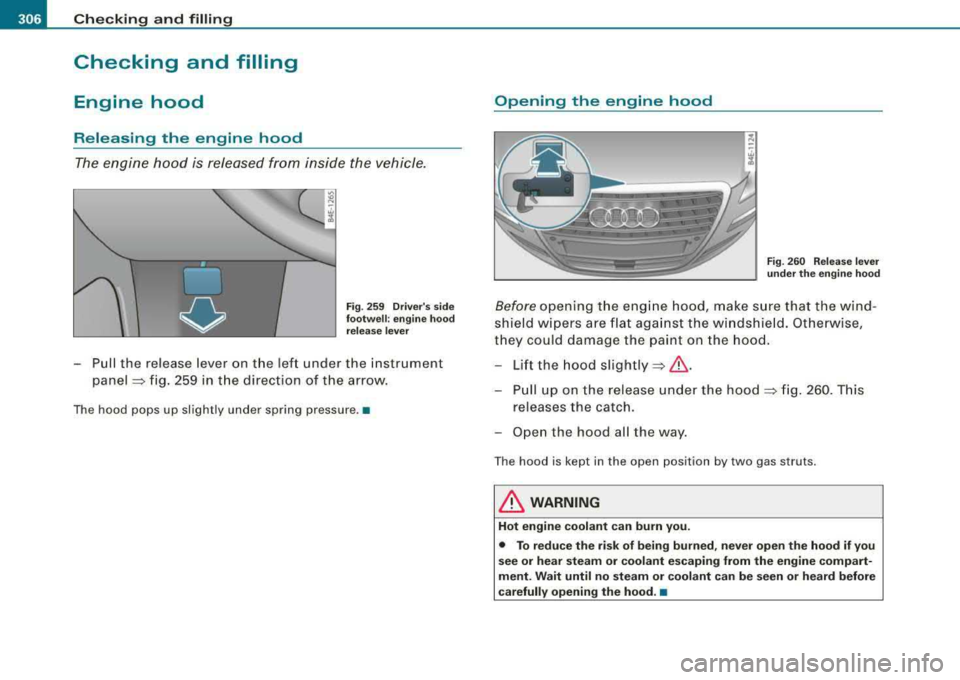
The engine hood is released from inside the vehicle.
Fig. 259 Driver's side
footwell: engine hood
release lever
-Pull the release lever on the left under the instrument
panel ~ fig. 259 in the direct ion of the arrow.
The hood pops up slight ly under spring pressure. •
Opening the engine hood
Fig. 260 Release lever
under the engine hood
Before opening the engine hood, make sure that the wind
shie ld wipers are flat against the windshield. Otherwise,
they could damage the paint on the hood.
Li ft the hood
slightly~ &.
-Pull up on the release under the hood:=} fig. 260. Thi s
releases the catch.
-Open the hood all the way.
The hood is kept in the open position by two gas struts.
& WARNING
Hot engine coolant can burn you.
• To reduce the risk of being burned , never open the hood if you
see or hear steam or coolant escaping from the engine compart
ment . Wait until no steam or coolant can be seen or heard before
carefully opening the hood . •
Page 360 of 404
1111....__F_ u_ s_ e_s _ a_n _ d_ b_ u_lb _ s _______________________________________________ _
Fuses and bulbs
Fuses
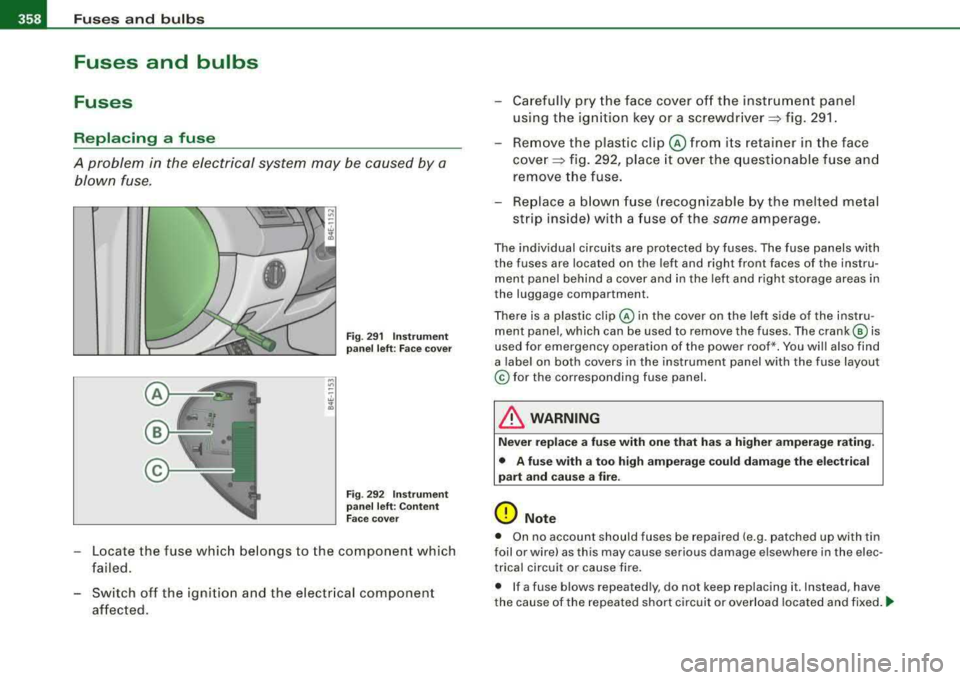
Repl ac ing a fu se
A problem in the electrical system may be caused by a
blown fuse.
F ig . 29 1 I nstrume nt
pa nel l eft : Face cov er
Fi g. 29 2 I nstru m ent
p an el l eft : C ont en t
F ac e cove r
- Locate the fuse which belongs to the component which
failed.
- Switch off the ignition and the electr ical component
affected. -
Carefully pry the face cover off the instrument panel
using t he ign ition key or a screwdriver=> fig . 29 1.
- Remove the plastic
clip @ from i ts retain er in the face
cove r=> fig. 292, place it over the questionable fuse an d
remove the fuse.
- Re place a b low n fuse (recog nizable by the melted metal
s tri p inside) with a fuse of the
same amperage.
The individual circuits are protected by fuses. The fuse panels with
the fuses are located on the left and right front faces of the instru
ment panel behind a cover and in the left and right storage areas in
the luggage compartment.
There is a plastic
c lip @ in the cover on the left side of the instru
ment panel, which can be used to remove the fuses . The
crank @ is
used for emergency operation of the power roof *. You wi ll also find
a labe l on both covers in the instrument panel w ith the fuse layout
© for the corresponding fuse panel.
& WARNING
Nev er r ep la ce a fu se with one tha t has a hi gher amperage rating.
• A fuse w ith a to o high amper ag e cou ld dam age th e ele ctrical
part and c au se a fire .
0 Note
• On no account should fuses be repaired (e .g. patched up with tin
foil or wire) as th is may cause serious damage elsewhere in the elec
trical circuit or cause fire .
• If a fuse blows repeatedly , do not keep replacing it. Instead, have
the cause of the repeated short circuit or overload located and fixed
. ...
Page 361 of 404
_________________________________________________ F_ u_ s_ e_s _ a_n _d_ b_ u
_ lb_ s _ __.11111
[ i J Tips
You are well advised to keep a supply of spare fuses in your vehicle.
Fuses with the proper ampere ratings are available at your Audi
dealer. •
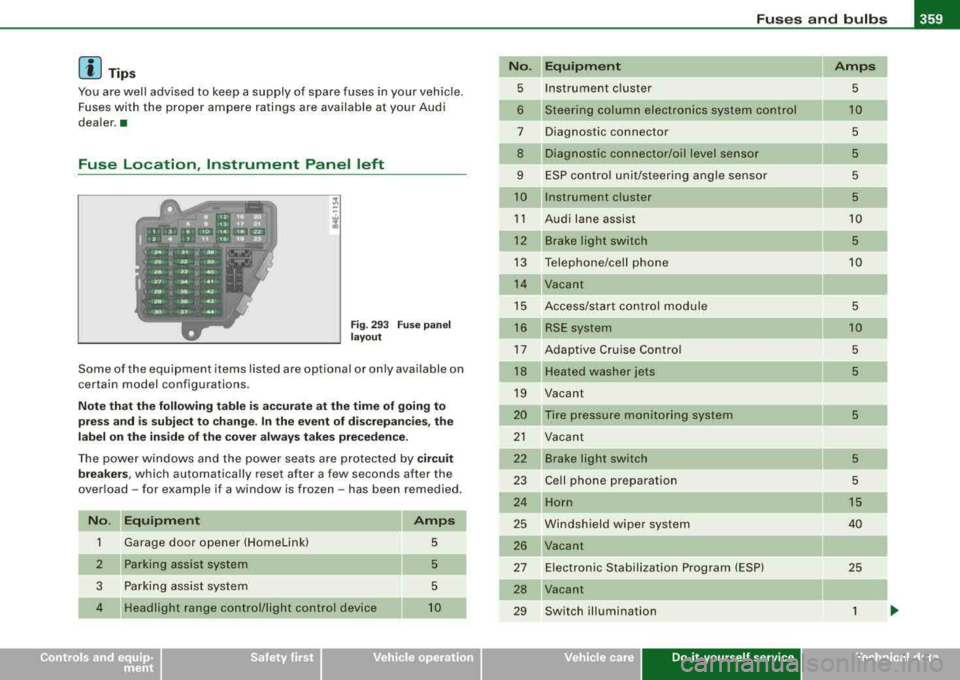
Fuse Location , Instrument Panel left
Fig . 293 Fuse panel
layout
Some of the equipment items listed are optional or only available on
certain model configurations.
Note that the following table is accurate at the time of going to
press and is subject to change. In the event of discrepancies, the
label on the inside of the cover always takes precedence.
The power windows and the power seats are protected by circuit
breakers, which automatically reset after a few seconds after the
overload -for example if a window is frozen -has been remedied.
No. Equipment
1 Garage door opener (Homelinkl 5
2
Parking assist system 5
3
Parking assist system 5
4
Headlight range control/light control device 10
No.
5
6
7
8
9
10
11
12
13
14
15
16
17
18
19
20
21
22
23
24
25
26
27
28
29
Equipment Amps
Instrument cluster 5
Steering column electronics system control 10
Diagnostic connector 5
Diagnostic connector/oil level sensor 5
ESP control unit/steering angle sensor 5
Instrument cluster 5
Audi lane assist 10
Brake light switch 5
Telephone/cell phone 10
Vacant
Access/start control module
5
RSE system 10
Adaptive Cruise Control 5
Heated washer jets 5
Vacant
Tire pressure mon itoring system
5
Vacant
Brake light switch
5
Cell phone preparation 5
Horn 15
Windshield wiper system 40
Vacant Electronic Stabilization Program (ESP)
25
Vacant
Switch illumination
1
Vehicle care Do-it-yourself service irechnical data
Page 362 of 404
111!1....__F_ u_ s_ e_s _ a_n _ d_ b_ u_lb _ s _______________________________________________ _
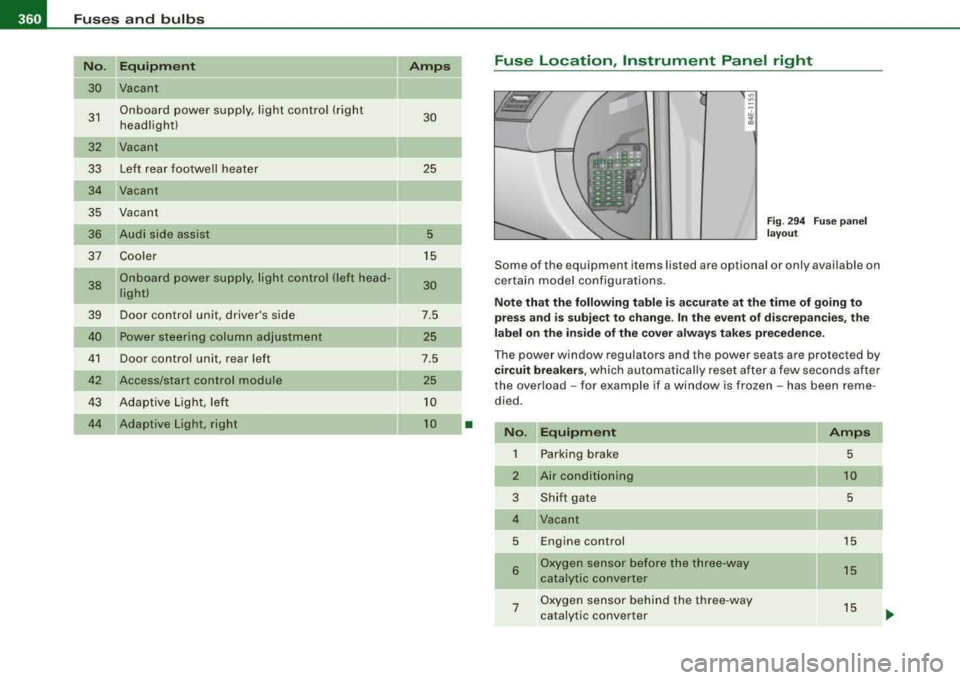
No. Equipm ent
30 Vacant
31
32
33
34
35
36
37
38
39
40
On board power supply, light control (right headlight)
Vacant L eft rear footwell heater
Vacant
Vacant
Audi side assist Cooler
Onboard power supply, light control (left head light)
Door control unit, driver 's side
Power ste ering column adjustment
41 Door control unit, rear left
Amps
30
25
5
15
30
7.5
25
7.5
25 42 Access/start control module
43 Adaptive Light, left ______ _,., __
--44 Adaptive Light, right 10 10
.
•
Fuse Location
, Instrument Panel right
Fig. 29 4 Fuse pa nel
lay ou t
Some of the equipment items listed are optional or only available on
certain model configurations.
Not e th at th e follo wing t able is acc urate at th e tim e o f going to
pr ess and is s ubject t o c hange . In th e event o f di screp ancies, the
la bel on the in side of the cov er a lways ta k es prece de nce.
The power window regulators and the power seats are protected by
cir cuit br eak ers, which automatically reset after a few seconds after
the over load -for example if a window is frozen - has been reme
died .
No. Equipm ent
1 Parking brake
2
3
4
5
6
7
Air conditioning Shi ft gate
Vacant
Engine control
Oxygen senso r before the three-way
catalytic converter
Oxygen sensor behind the three-way
catalytic converter
Amp s
5
10
5
15
15
15
-
Page 390 of 404
___ A_ l-=- p _ h_ a_ b_e _t_ ic _ a_l _in _ d_e_ x ____________________________________________ _
Electromechanical parking brake ... 134
Fluid reservoir . . . . . . . . . . . . . . . . . . . 317
How does moisture or road sal t affect the
brakes? ....................... 270
Malfunction ..... ... ... .. .... .... . 30
Warning/indicator lights ... .... .... 22
Worn brak e pads symbol ..... .. .... 34
Break -in period . . . . . . . . . . . . . . . . . . . . . 277
B rake pads .. ...... .... ......... . 278
Tires ..... .. .. .... .... ......... . 277
Bu lbs ... .... .... .... ....... .... ... 362
Bumper cover Caution when parking near a parking bar -
rier or curb ...... ... .... .... ... 135
C
Ca lifornia Proposition 65 Warning 308
Battery specific . . . . . . . . . . . . . . . . . . 321
Capacit ies .. .... .... .... .... ... .... 378
Car care . .... .... .... .... .... .... .. 288
Int erior .. .... .... .... .... ...... . 295
P lastic and vinyl .. .... .... ... .... 292
Weatherstrips ...... ... .. ...... .. 293
Car carrier Transporting your vehicle ........ . 369
Care of exterior . .... .... .... .... .... 288
Cargo area
See Loading the luggage compartment ..
205
Cargo net .... .... .... .... ... .... ... 101
Catalyt ic converter . . . . . . . . . . . . . . . . . . 278 Central locking
Emergency locking . . . . . . . . . . . . . . . . 54
Changing a flat tire ...... .... ... .. .... 45
Changing a wheel .... ..... .. .... .... 351
Changing engine oi l .. .... .... .... ... 313
Chassis Undercoating ... .. .... .... .... ... 294
See also Adaptive Aur Suspension . .. 185
CHECK button .... .... .... ..... .. .... 15
Checking Engine coolant level ... .... ..... .. 315
Checking tire pressure ... .. .... .... .. 331
Child restraints Danger of using child restraints in the front seat ... ....... ...... .... .. 220
What types o f child restraint anchors are
avai lable? ... ....... ...... .... .. 256
Where can I get additional information
about child r estraints? ...... ... .. 257
Child safety ...... .. . ... .... ... . 243, 248
Additiona l information ............ 262
Booster seat ... .... ... .... .... ... 251
Convertible child safety seat .... ... 249
Conv ert ible locking r etractor ... .... 253
Guidance fixtures for lower anchorages
259
Important safety instructions for using
child safety seats ..... .. .... .... 246
Important things to know when driving with children . .... .... .... ...... 243
Infant seat .... .... .... .... ... ... 248
Installing a child restrain t using the
LATCH system ...... ...... ..... . 261 Mounting and releasing the anchorage
hook .......................... 262
Older children and safety belts ..... 252
Safety belts and older children .... . 252
Tether anchors .. ...... .... ... .. . 262
Tether strap ........... .... .... .. 263
Which restraint system should my older chi ld wear? .................. .. 252
Child safety lock
Rear doors (mechanical! ...... .... .. 58
Rear doors (power) .... .... .... .... 58
Child safety seat .. .... .... ...... .... 248
Convertible locking r etractor .... ... 253
How do I properly insta ll a chi ld safety
seat in my vehicle? .. ........ .... 246
Installing .. .. .. .... .... ..... .. ... 253
LATCH system ................... 261
Safety instructions .. ...... .... ... 246
Cigarette I ig hter . . . . . . . . . . . . . . . . . . . . 107
Cleaning Alcantara (synthetic suede) .... .... 298
Engine compartment ...... .... ... 299
Fab rics and fabric coverings ... .... 295
Instrument panel ...... ....... .... 296
Interior ... .... .... .... .... .... .. 295
Leather ... .... .... .... ..... .. ... 297
MMI display .............. .... ... 295
MMI terminal ...... .... ..... .. ... 295
Plastic and viny l ... .... .... ....... 292
P lastic parts ..................... 296
Safety belts ... .... .... ... .... ... 299
Trim strips . ....... .... ... .... ... 291
trim strips . ....... .... ....... .... 292
Lower anchorages ........... ..... 258 Cleaning and protection ............. 288