instrument panel AUDI S8 2008 User Guide
[x] Cancel search | Manufacturer: AUDI, Model Year: 2008, Model line: S8, Model: AUDI S8 2008Pages: 404, PDF Size: 52.7 MB
Page 221 of 404
__________________________________________________ A_ i_ r _b _a-' g=- s_ y=- s_t _e _m __ lfflll
r ep air costs or ev e n the lac k of veh icle dama ge is not necessari ly an
indicati on of w heth e r an air b ag s houl d infla te or not .
I t is not poss ib le to def in e a ran ge of v ehicle sp ee ds t hat w il l cover
eve ry po ssible kind and ang le of impact that wil l a lway s trigger the
a ir b ags , s in ce t he cir cum stanc es w ill vary c onsid era bly be tw een
one co llision and another . Important factors inc lude , for example,
th e nat ure ( hard or soft) of the o bject w hic h the car h its, the a ng le
of impact, ve hicle speed, etc. The front airbags wi ll also not inflate
in side or rea r co lli s io ns, or i n ro ll-ov ers .
Always remember : Airbags w ill d eploy only onc e, an d on ly in c ertain
k inds of coll isi ons. Your s afe ty b elt s a re a lway s the re to o ffer prot ec
t ion in th ose s ituat io ns in whi ch airba gs are not su pposed to deplo y,
or whe n th ey hav e a lready dep lo yed; for ex am ple, wh en your v ehi cle
s tr ik es or i s struc k by another a ft e r th e fir st c ollis ion .
T his is just one of the reasons why a n airbag is a su pple mentary
r es traint and is not a sub stitut e for a sa fe ty b elt. T he ai rbag s ystem
w ork s most eff ect ively wh en us ed w ith the saf ety be lts . T herefore,
alw ay s pr operly w ea r y ou r safe ty b e lts ~ page 2 09.
& WARNING
Sitting too close to the steering wheel or instrument panel will
decrease the effectiveness of the airbags and will increase the risk
of personal injury in a collision.
• Never sit closer than 10 inches (25 cm) to the steering wheel or
instrument panel.
• If you cannot sit more than 10 inches (25 cm ) from the steering
wheel , investigate whether adaptive equipment may be available
to held you reach the pedals and increase your seating distance
from the steering wheel.
• If you are unrestrained , leaning forward, sitting sideways or out
of position in any way, your risk of injury is much higher .
• You will also receive serious injuries and could even be killed if
you are up against the airbag or too close to it when it inflates -
even with an Advanced Airbag.
Controls and equip ment Safety first
Vehicle operation
&, WARNING (continued )
• To reduce the risk of injury when an airbag inflates, always
wear safety belts
properly ~ page 213, "Safety belts ".
• Always make certain that children age 12 or younger always
ride in the rear seat . If children are not properly restrained , they
may be severely injured or killed when an airbag inflates.
• Never let children ride unrestrained or improperly restrained in
the vehicle . Adjust the front seats properly .
• Never ride with the backrest reclined .
• Always sit as far as possible from the steering wheel or the
instrument panel
~ page 200.
• Always sit upright with your back against the backrest of your
seat.
• Never place your feet on the instrument panel or on the seat .
Always keep both feet on the floor in front of the seat to help prevent serious injuries to the legs and hips if the airbag inflates .
• Never recline the front passenger's seat to transport objects.
Items can also move into the area of the side airbag or the front
airbag during braking or in a sudden maneuver. Objects near the
airbags can become projectiles and cause injury when an airbag
inflates .
& WARNING
Airbags that have deployed in a crash must be replaced.
• Use only original equipment airbags approved by Audi and
installed by a trained technician who has the necessary tools and
diagnostic equipment to properly repla ce any airbag in your
vehicle and assure system effectiveness in a crash .
• Never permit salvaged or recy cled airbags to be installed in
your vehicle. •
Vehicle care Do-it-yourself service Technical data
Page 223 of 404
as defined in the elec tronic control unit~ page 230 , "PA SSENGER
AI R BAG OFF ligh t".
A lways r em ember, a ch ild seat or infant carrier install ed on th e front
seat may be st ruck and knocked out of position by the rap idly
i n fl ating pass enger's airbag in a fr ontal co llisio n. T he airb ag co uld
greatly reduce the effectivenes s of the chi ld restraint and even seri
ously inju re t he c hild duri ng i nflatio n .
F or this reason, and because the bac k seat is the safest place for
chi ldr en -w hen pro perly res traine d acc ording to th eir age an d size
- w e stron gly recomm end that c hildren a lways sit in th e bac k seat
~ page 243, "C hil d Safe ty" .
& WARNING
A child in a rearward -facing child seat installed on the front
passenger seat will be seriously injured and can be killed if the
front airbag inflates - even with an Advanced Airbag System.
• The inflating airbag will hit the child seat or infant car rier with
great force and will smash the child seat and child against the
backrest , center arm rest, door or roof .
• Always install rear-facing child seats on the rear seat.
• If you must install a rearward facing child seat on the front
passenger seat because of exceptional circumstances and the
PASSENGER AIR BAG OFF light does not come on and stay on,
immediately install the rear-facing child seat in a rear seating posi
tion and have the airbag system inspected by your Audi dealer.
• Forward -facing child seats installed on the front passenger's
seat may interfere with the deployment of the airbag and cause
serious personal injury to the child .
& WARNING
If, in exceptional circumstances, you must install a forward-facing
child restraint on the front passenger's seat:
Controls and equip ment Safety first
Vehicle operation
Airbag system
&, WARNING (continued )
• Always make sure the forward-facing seat has been designed
and certified by its manufacturer for use on a front seat with a
passenger front and side airbag .
• Never put the forward-facing child restraint up against or very
near the instrument panel .
• Always move the passenger seat into its rearmost position in
the seat's fore and aft adjustment range, as far away from the
airbag as possible before installing the forward-facing child
restraint. The backrest must be adjusted to an upright position .
• Make sure that the PASSENGER AIR BAG OFF light comes on
and stays on all the time whenever the ignition is switched on.
& WARNING
To reduce the risk of serious injury, make sure that the PASSENGER
AIR BAG OFF light will be displayed whenever a child restraint is
installed on the front passenger seat and the ignition is switched
on.
• If the PASSENGER AIR BAG OFF light does not stay on , perform
the checks described
~ page 229 , "Monitoring the Advanced
Airbag System" .
• Take the child restraint off the front passenger seat and install
it properly at one of the rear seat positions if the PASSENGER AIR
BAG OFF light does not stay on .
• Have the airbag system inspected by your Audi dealer immedi
ately .
• Always carefully follow instructions from child restraint manu
facturers when installing child restraints .
& WARNING
If, in exceptional circumstances, you must install a forward or
rearward -facing child restraint on the front passenger's seat:
Vehicle care Do-it-yourself service Technical data
Page 225 of 404
Airbag system -
--------------=---=--
& WARNING (continued)
• Airbag work most effectively when used with properly worn
safety belts.
• Therefore, always wear your safety belts and make sure that
everybody in your vehicle is properly restrained.
& WARNING
A person on the front passenger seat, especially infants and small
children, will receive serious injuries and can even be killed by
being too close to the airbag when it inflates.
• Although the Advanced Airbag System in your vehicle is
designed to turn off the front passenger airbag if an infant or a
small child is on the front passenger seat, nobody can absolutely
guarantee that deployment under these special conditions is
impossible in all conceivable situations that may happen during
the useful life of your vehicle.
• The Advanced Airbag System can deploy in accordance with
the
"low risk" option under the U.S. Federal Standard if a child that
is heavier than the typical one-year old child is on the front
passenger seat and the other conditions for airbag deployment
are met.
• Accident statistics have shown that children are generally safer
in the rear seat area than in the front seating position.
• For their own safety, all children, especially 12 years and
younger, should always ride in the back properly restrained for
their age and size. •
Advanced front airbag system
Your vehicle is equipped with a front Advanced Airbag System in
compliance with United States Federal Motor Vehicle Safety Stan
dard 208 as applicable at the time your vehicle was manufactured.
Controls and equip ment Safety first Vehicle operation
The
front Advanced Airbag System supplements the safety belts to
provide additional protection for the driver's and front passenger's
heads and upper bodies in frontal crashes . The airbags inflate only
in frontal impacts when the vehicle deceleration is high enough.
The front Advanced Airbag System for the front seat occupants is
not a substitute for your safety belts . Rather, it is part of the overall
occupant restraint system in your vehicle. Always remember that
the airbag system can only help to protect you, if you are sitting
upright, wearing your safety belt and wearing it properly. This is why
you and your passengers must always be properly restrained, not
just because the law requires you to be.
The Advanced Airbag System in your vehicle has been certified to
meet the "low risk" requirements for 3 and 6 year -old children on the
passenger side and very small adults on the driver side. The low risk
deployment criteria are intended to help reduce the risk of injury
through interaction with the front airbag that can occur, for
example, by being too close to the steering wheel and instrument
panel when the airbag inflates.
In addition, the system has been certified to comply with the
"suppression" requirements of the Safety Standard, to turn off the
front airbag for infants 12 months old and younger who are
restrained on the front passenger seat in child restraints that are
listed in the
Standard=> page 245, "Child restraints and Advanced
Airbags".
"Suppression" requires the front airbag on the passenger side to be
turned off if:
• a child up to about one year of age is restrained on the front
passenger seat in one of the rear-facing or forward-facing infant
restraints listed in Federal Motor Vehicle Safety Standard 208 with
which the Advanced Airbag System in your vehicle was certified. For
a listing of the child restraints that were used to certify your
vehicle's compliance with the US Safety
Standard => page 245,
• weight less than a threshold level stored in the control unit is
detected on the front passenger seat.
~
Vehicle care Do-it-yourself service Technical data
Page 227 of 404
Airbag system -
--------------=---=--
& WARNING (continued)
• If you must install a rearward facing child seat on the front
passenger seat because of exceptional circumstances and the
PASSENGER AIR BAG OFF light does not come on and stay on,
immediately install the rear-facing child seat in a rear seating posi
tion and have the airbag system inspected by your Audi dealer.
& WARNING
If, in exceptional circumstances, you must install a forward-facing
child restraint on the front passenger's seat:
• Always make sure the forward-facing seat has been designed
and certified by its manufacturer for use on a front seat with a
passenger front and side airbag.
• Never put the forward-facing child restraint up against or very
near the instrument panel.
• Always move the passenger seat into its rearmost position in
the seat's fore and aft adjustment range, as far away from the
airbag as possible, before installing the forward-facing child
restraint. The backrest must be adjusted to an upright position.
• Make sure that the PASSENGER AIR BAG OFF light comes on
and stays on all the time whenever the ignition is switched on. •
Advanced Airbag System components
The front passenger seat in your vehicle has a lot of very important
parts of the Advanced Airbag System in it. These parts include the
weight -sensing mat, sensors, wiring, brackets, and more. The func
tion of the system in the front passenger seat is checked by the elec
tronic control unit when the ignition is on. The control unit monitors
the Advanced Airbag System and turns the airbag indicator light on
when a malfunction in the system components is detected. The
function of the airbag indicator light is described in greater detail below . Because the front passenger seat contains important parts
Controls and equip
ment Safety first Vehicle operation
of the Advanced Airbag System, you must
take care to prevent it
from being damaged. Damage to the seat may prevent the
Advanced Airbag for the front passenger seat from doing its job in
a crash.
The front Advanced Airbag System consists of the
following:
• Crash sensors in the front of the vehicle that measure vehicle
acceleration/deceleration to provide information to the Advanced
Airbag System about the severity of the crash.
• An electronic control unit, with integrated crash sensors for front
and side impacts. The control unit "decides" whether to fire the
front airbags based on the information received from the crash
sensors. The control unit also "decides" whether the safety belt
pretensioners should be activated.
• An Advanced Airbag with gas generator for the driver inside the
steering wheel hub.
• An Advanced Airbag with gas generator inside the instrument
panel for the front passenger.
• A weight -sensing mat under the upholstery padding of the front
passenger seat cushion that measures the total weight on the seat.
The information registered is sent continuously to the electronic
control unit to regulate deployment of the front Advanced Airbag on
the passenger side .
• An airbag monitoring system and indicator light in the instru
ment
cluster => page 229.
• The PASSENGER AIR BAG OFF light comes on and stays on in the
center of the instrument
panel => page 230, fig. 233 and tells you
when the front Advanced Airbag on the passenger side has been
turned off .
• A sensor below the safety belt latch for the front seat passenger
to measure the tension on the safety belt . The tension on the safety
belt and the weight registered by the weight-sensing mat help the
control unit
"decide" whether the front airbag for the front
passenger seat should be turned off or
not=> page 220, "Child
restraints on the front seat
-some important things to know". .,_
Vehicle care Do-it-yourself service Technical data
Page 230 of 404
__ ....!:,A~i'.!. r !::b :!a ~g:L.: s~ y~ s:!: t::.:: e~ m'..!.!.. ______________________________________________ _
or the low er parts of the body . Front airbags only supplement th e
th re e po int safe ty b elts in som e front al c ollis ions in which the
vehic le dece lerat ion is h igh enou gh to deploy the a irba gs.
Front airbags will not deploy:
• if the ignition is switched off when a crash occurs,
• i n sid e coll is io ns,
• in r ear- e nd collisi ons ,
• in ro llovers,
• when th e cras h de cele ration meas ured b y th e a irba g sys tem is
less than the mini mum threshold needed for a irbag deployme nt as
r egi stere d by th e ele ctr on ic con trol uni t.
The front passenger airbag will also not deploy :
• when th e front p asseng er seat is not occ upi ed ,
• when the weight on the front pas senge r seat a s sensed by the
A dvance d Airb ag Syste m indicates t hat th e fr on t airb ag on the
passenger side has to be t urned off b y the e lectronic control unit
(the PASSENGER AIR BAG OFF li g ht come s on and s tays o nl.
& WARNING
Sitting in the wrong position can increase the risk of serious injury
in crashes .
• To reduce the risk of injury when the airbags inflate , the driver
and passengers must always sit in an upright position , must not
lean against or place any part of their body too close to the area
where the airbags are located.
• Oc cupants who are unbelted , out of position or too close to the
airbag can be seriously injured by an airbag as it unfolds with
great force in the blink of an eye
=> page 220.
& WARNING
A child in a rearward -facing child seat installed on the front
passenger seat will be seriously injured and can be killed if the
front airbag inflates - even with an Advanced Airbag System .
• The inflating airbag will hit the child seat or infant carrier with
great force and will smash the child seat and child against the
backrest , center arm rest , door or roof .
• Always install rear-facing child seats on the rear seat.
• If you must install a rearward facing child seat on the front
passenger seat because of exceptional circumstances and the
PASSENGER AIR BAG OFF light does not come on and stay on ,
immediately install the rear-facing child seat in a rear seating posi
tion and have the airbag system inspected by your Audi dealer.
& WARNING
Objects between you and the a irbag will increase the risk of injury
in a crash by interfering with the way the airbag unfolds or by
being pushed into you as the airbag inflates.
• Never hold things in your hands or on your lap when the vehicle
is in use.
• Never transport items on or in the area of the front passenger
seat. Objects could move into the area of the front airbags during
braking or other sudden maneuver and become dangerous projec
tiles that can cause serious personal injury if the airbags inflate.
• Never place or attach accessories or other objects (such as cup
holders, telephone brackets, large , heavy or bulky objects) on the
doors , over or near the area marked
"AIRBAG " on the steering
wheel , instrument panel , seat backrests or between those areas
and yourself . These objects could cause injury in a crash, espe
cially when the airbags inflate .
• Never recline the front passenger's seat to transport objects .
Items can also move into the area of the side airbag or the front
airbag during braking or in a sudden maneuver. Objects near the .,_
Page 234 of 404
__ .....;.A..;.;.;. ir.;;b ;..; a;;;;. g=... s;;;.!. y.;;s ..;;t ..;;e ;.;.m.;..;... ________________________________________________ _
&, W ARNING (continued )
• A tight tether or other strap on a rearward-facing child restraint
attached to the front passenger seat can put too much pres sure
on the weight-sensing mat in the seat and reg ister more weight
than is actually on the seat. The heavier weight registered can
make the system work as though an adult were on the seat and
deploy the Advanced Airbag when it must be suppressed causing
serious or even fatal injury to the child .
• If, in exceptional circumstances, you must install a forward
facing child restraint on the front passenger seat , always move the
seat into its rearmost position in the seat's fore and aft adjust
ment range , as far away from the a irbag as possible. The backrest
must be adjusted to an upright position. Make sure that the
PASSENGER AIR BAG OFF light comes on and stays on all the time
whenever the ignition is switched on .
& WARNING
• If the PASSENGER AIR BAG OFF light does not go out when an
adult is sitting on the front passenger seat after tak ing the steps
described above, make sure the adult i s properly seated and
restrained at one of the rear seating positions .
• Have the airbag system inspected by your Audi dealer before
transporting anyone on the front passenger seat .
[ i] Tips
If the we ight -sens ing mat in the front passenger seat detects an
e mp ty s eat, th e front air bag o n the pass enge r sid e wil l be tur ned
off, and PASSENGER AIR BAG OFF will stay on.•
Repair, care and disposal of the airbags
Parts of the airbag system are insta lled at many different places o n
yo ur Au di. In stal li n g, r emo vin g, s ervic ing or rep airi ng a part i n an area of the vehicle can damage a part of an airbag system and
p re vent that sys tem from wor king pr operly in a c ollis ion.
Th ere are some important th ings you hav e to know to ma ke sure
that t he effectivenes s of the system will not be impai red and that
discar ded co mponents do not ca use injury o r po llut e the enviro n
ment .
& WARNING
Improper care , servicing and repair procedures can increase the
risk of personal injury and death by preventing an airbag from
deploying when needed or deploying an airbag unexpectedly:
• Never cover , obstruct , or change the steering wheel horn pad
or airbag cover or the instrument panel or modify them in any way .
• Never atta ch any objects su ch as cup holders or telephone
mountings to the surfaces covering the airbag units .
• For cleaning the horn pad or instrument panel, use only a soft,
dry cloth or one moistened with plain water. Solvents or cleaners
could damage the airbag cover or change the stiffness or strength
of the material so that the airbag cannot deploy and protect prop
erly .
• Never repair , adjust, or change any parts of the airbag system .
• All work on the steering wheel, instrument panel , front seats or
electrical system (including the installation of audio equipment ,
cellular telephones and CB radios , etc .I must be performed by a
qualified technician who has the training and special equipment
necessary .
• For any work on the airbag system, we strongly recommend
that you see your authorized Audi dealer or qualified workshop .
• Never modify the front bumper or parts of the vehicle body .
• Always make sure that the side airbag can inflate without inter-
ference :
~
Page 236 of 404
___ A_ ir_b _a_ g;::;_ s-=-- y_s _t _e _m _________________________________________________ _
& WARNING
Changing the vehicle's su spension includ ing use of un approved
tire -rim combinations can change Advanced Airbag performance
and increase the ris k of serious pe rsonal injury in a crash .
• Never install suspen sion components that do not have the
same performance chara cteristi cs as the components or iginally
installed on your vehicle.
• Never use tire-r im combinations that have not been approved
by Audi.
& WARNING
Items stored between the safety belt buckle and the center
c onsole can cause the sensors in the buc kle to send the wrong
information to the electroni c control module and prevent the
Advanced Airbag System from working properly .
• Always make sure that nothing can interfere with the safety
belt buckles and that they are not obstructed .
W For the sake of the environment
Undeployed airbag modules and pretensioners might be c lassified
as Pe rchlora te Mat erial -s pecia l handling may a pply, see
www.dtsc.ca.gov/hazardouswaste/perchlorate. When the vehicle or
par ts o f the res train t syst em inclu ding airbag mod ules sa fety be lts
with pretensioners are scrapped, all applicable laws and regu la
tions must be o bse rved. You r au thor ize d A udi d ealer is fami liar wi th
these requirements and we recommend that you have you r dea ler
perfo rm this service for you. •
Knee airbags
Description of knee airbags
Th e a irba g sys tem ca n prov id e suppl emen tal prot ect ion
t o pro perly res tra ined front s eat occ upa nts.
0
Fig . 2 34 Dri ver' s
airba g
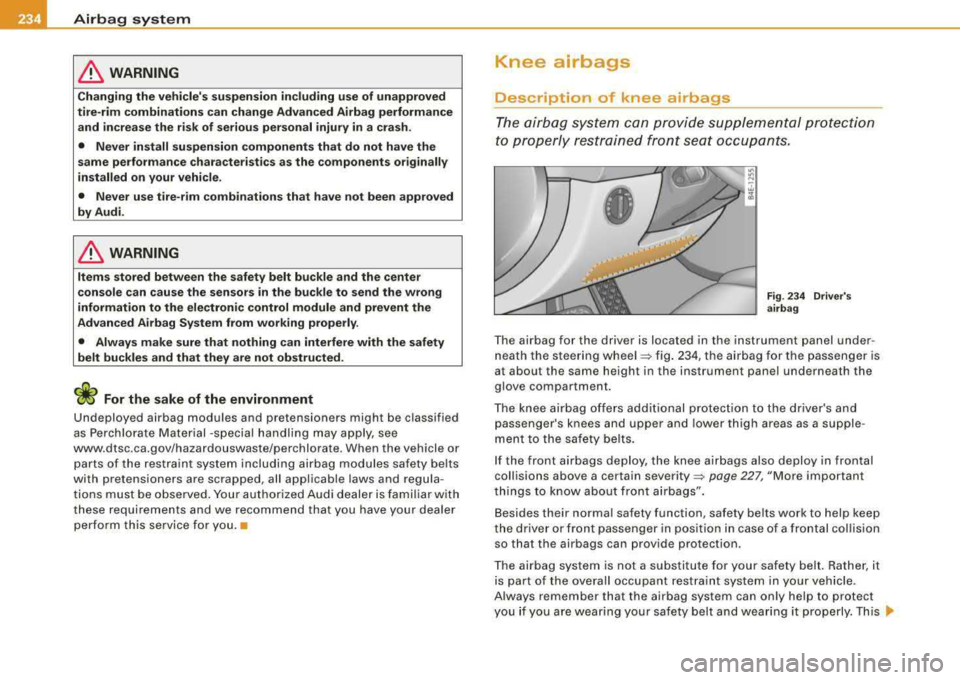
The airbag for the driver is located in the instrument panel under
neath the steering
whee l=> fig . 234 , the airbag for the passenger is
at about the same height in th e instrument panel und erneath the
glove compartment.
T he k nee air bag offer s addi tio nal pr otec tion to the driver 's a nd
passenger 's knees and upper and lower thi gh areas as a supple
me nt to t he safet y belts.
I f the front airbags deploy , the knee airbags also deploy in frontal
collisions above a certain
se verity => page 227, "M ore important
thi ngs to know about fron t a irba gs" .
B esides their normal safety function, safety be lts wor k to help keep
th e drive r o r fr on t pas seng er in pos itio n in case of a fro ntal co llis io n
so that the airbags can provide protection .
T he airbag system is not a su bstitute for your safety belt . Rathe r, it
i s part o f the overa ll occupa nt res traint system i n yo ur veh icl e.
A lwa ys re member that the airbag system can on ly help to protect
you if you a re weari ng your safe ty belt and wea ring it p roperly . T hi s
liJ,,
Page 237 of 404
is why you should always wear your saf ety belt, not just because the
l a w requires you to do
so => page 209, "Genera l notes" .
The safety belt buckle for the driver and front seat passenger have switches that tell the airbag control module if the safety belt is
being used or not. If the sa fety bel t is being used, the knee airbag
will deploy at a s lightly higher rate of deceleration than if the belt is
not be ing used . Therefore, in a par ticular collision, it is possib le that
an airbag will not deploy at a seating position where the safety belt
is be ing used but will inflate at the position where the safety belt is
not being used .
Remember too, airbags will deploy only once and only in ce rtain
kinds o f accidents -your safety be lts are always there to o ffer
protection in those accidents in wh ich airbags are not supposed to
deploy or when they have already deployed, for examp le when you r
vehic le strikes or is struc k by another after the first collision.
T his is just one of the reasons why an ai rbag is not a subs titute for
the safety be lt. The airbag system works most effectively when used
with the safety belts. Therefore, a lways wear your safety belts
correctly.
I t is important to remember that while the supplemental airbag
system is designed to reduce the like lihood o f ser ious injuries, other
injuries, for example, swelling, bruising, and minor abrasions can
a lso be associated with airbags.
The kn ee airbag system bas ically consists of:
• T he electro nic control module
• T wo inflatable airbags (ai rbag and gas generato r), one for the
driver and one for the front passenger
• T he airbag indicator light in the instrument panel
The kn ee airbag system will not deploy :
• whe n the ignit ion is turned off
• in front -end collisions when the deceleration measured by the
control uni t is too low
• in side collisions
Airb ag syst em
• in rear -end co llisions
• in ro llovers
• in the event of a system malfunction (warning/indicator light illu
minated)=> page 19 .
& WARNING
• Safety belts and the airbag sy stem ca n only provide protec tion
when oc cupants are in the proper seating po sition
=> page 227 .
• If the airbag indi cator light comes when the vehi cle is b eing
u sed , have the system in spected immediately by your authorized
Audi dealer . The airbag may not work properl y when the vehicle
acceleration in a side colli sion is high enough to deploy the a irbag.
See
also => page 19. •
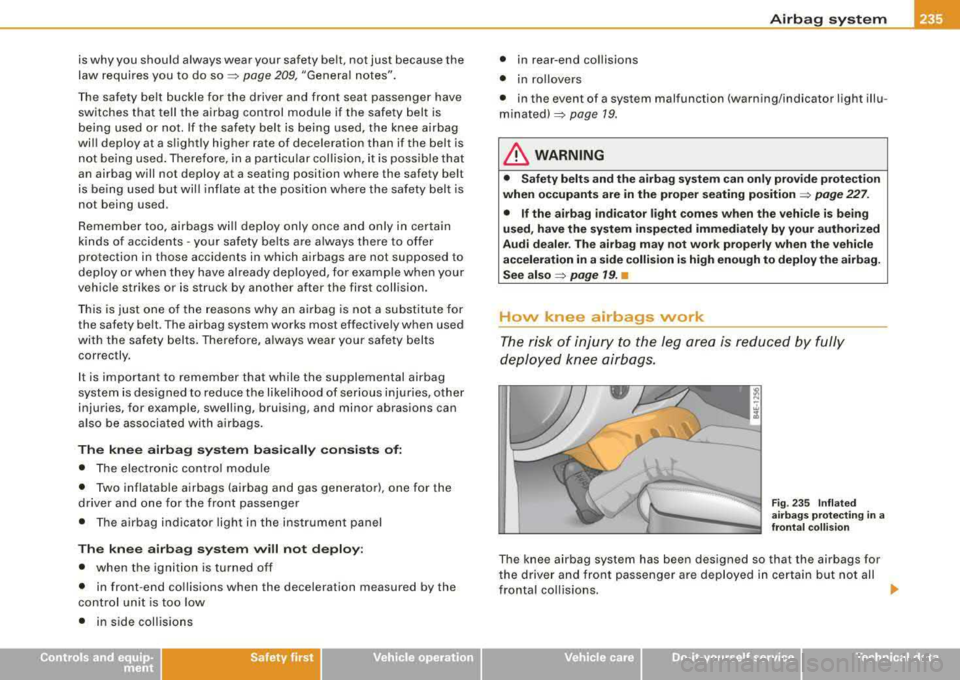
How knee airbags work
The risk of injury to the leg are a is reduce d by fully
depl oye d knee air ba gs.
-
Fig . 235 I nfl ate d
airba gs prot ecting in a
frontal colli sio n
The knee airbag system has been designed so that the airbags for
t he drive r and front passenger a re deployed in certain but not all
frontal col lisions.
ill-
Vehicle care I I Technical data
Page 238 of 404
___ A_ ir_b _ a_ g=- s-a. y_s _t _e _m _________________________________________________ _
If the front airbags deploy, the knee airbags also dep loy in frontal
c oll is ions above a ce rtain sever ity.
When the system is deployed, the airbags start to fi ll with a prope l
lant gas, and inflate between the lower part of the inst rument pane l
and t he dr iver a nd t he lowe r part o f th e instrument pane l and t he
front
passenge r=> page 227 , fig. 232 .
Al tho ug h t hey a re not a soft p illow, t hey ca n "cushion" th e im pact
and in th is way they can he lp to r educe th e ris k of injury to the lower
e xtr em it ie s.
A ll thi s takes place insta nta ne ous ly, so fast t hat m any peop le do n't
even rea lize that t he ai rbags have deployed. The ai rbags a ls o inflate
wi th a gre at de al o f fo rc e an d it is impo rta nt for occu pant safet y th at
not hing s hou ld be in t heir wa y when they dep lo y.
Fu lly in flate d ai rb ags in co mbin ati on w ith p ro perly w orn s afety b elt s
s low down and limit the occupant's for ward mov eme nt and he lp to
r e duc e th e risk .•
Important safety instructions on the knee
airbag system
A irbags a re only s uppl emen tal rest raints. A lway s w ear
safety belts co rrectly and rid e in a p rope r seat ing po sition .
There i s a lo t th at you and yo ur pass eng ers m ust kno w and do t o
he lp th e safet y be lts and ai rbags to p rovide supp lemental protec
ti on.
& WARNING
An inflating knee airbag can cause serious injury. Wearing safety
belts incorrectly and improper seating positions increase the risk
of serious personal injury and death whenever a vehicle is being
used .
• The airbag system cannot protect you properly if you are
seated too close to any of the airbag locations . When adjusting
& WARNING (continued)
their seat positions, it is important that both the driver and the
front passenger keep their upper bodies and knees at the
following minimum safe distances :
- 1
O inches (25 cm) between the chest and the steering
wheel/instrument panel .
- 4 inches (10 cm) between the knees and the lower part of the instrument panel.
• The risk of personal injury increases if you lean forward or to
the side, or if the seat is improperly positioned and you are not
wearing your safety belt . The risk increases even more should the
airbag deploy .
• Always make sure that the knee airbag can inflate without
interference . Objects between yourself and the airbag can
increase the risk of injury in an accident by interfering with the
way the airbag deploys or by being pushed into you as the airbag
deploys.
- No persons (children) or animals should ride in the footwell
in front of the passenger seat . If the airbag deploys, this can
result in serious or fatal injuries .
- No objects of any kind should be carried in the footwell area
in front of the driver's or passenger's seat. Bulky objects (shop
ping bags , for example) can hamper or prevent proper deploy
ment of the airbag . Small objects can be thrown through the
vehicle if the airbag deploys and injure you or your passengers .
• Make sure there are no cracks , deep scratches or other damage
in the area of the instrument panel where the knee airbags are
located.
• If children are incorrectly seated , their risk of injury increases in
the case of an accident
=> page 243 , "Child Safety". •
Page 242 of 404
___ A_ ir_b _a_ g;::;_ s-=-- y_s _t _e _m _________________________________________________ _
& WARN ING (c ontinued)
- Alwa ys hav e w ork on the do ors done by an auth ori zed Audi
de ale r or qualified work shop . •
Side curtain airbags (SIDEGUARD™)
Description of SIDEGUARD™ airbags
The SIDEGUARD™ airbag system can provide supple
mental protection t o properly restrained occupants.
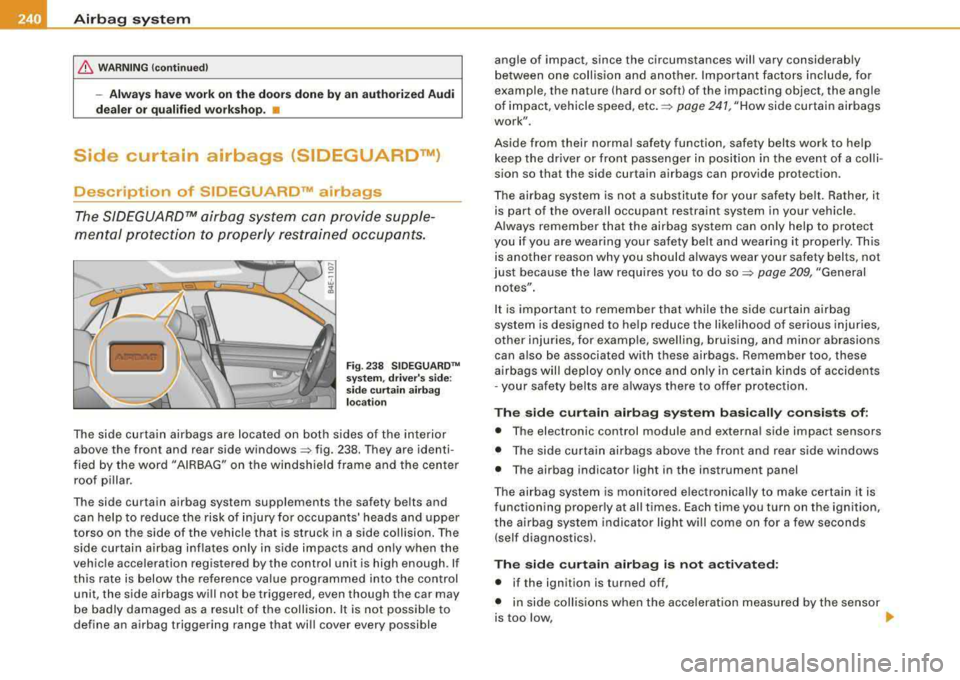
Fig . 23 8 SIDEG UARD ™
s y st em , dri ve r's si de:
s id e c urt a in airb ag
l oca tio n
The side curtain airbags are located on both sides of the interior
above the front and rear side
windows=> fig. 238 . They are identi
fied by the word "AIRBAG" on the windshield frame and the center
roof pillar .
The side curtain airbag system supplements the safety belts and can help to reduce the risk of injury for occupan ts' heads and upper
torso on the side of the vehicle that is struck in a s ide collision. The
side curtain airbag inflates only in side impacts and on ly when the
vehic le acceleration registered by the control unit is high enough . If
this rate is below the reference value programmed into the con trol
unit, the side airbags wi ll not be triggered , even though the car may
be badly damaged as a result of the collision . It is not possib le to
define an airbag triggering range that will cover every possible angle of impact, since the circumstances will vary considerab
ly
be tween one collision and another . Important factors include, for
example, the nature (hard or soft) of the impacting object, the ang le
of impact, vehicle speed,
etc .=> page 241 , "How side curtain airbags
work" .
Aside from their normal safety function, safety belts work to help keep the dr iver or front passenger in position in the event of a colli
sion so tha t the side curtain airbags can provide protection .
The airbag system is not a substitute for you r safety belt. Rathe r, it
is part of the overa ll occupant restrain t system in your vehicle .
A lways remember that the airbag system can only help to protect
you if you are wearing your safety belt and wearing it properly. This
is another reason why you should always wear your safety belts, not
just because the law requires you to do
so => page 209, "General
notes".
I t is important to remember that while the side curtain airbag
system is designed to he lp reduce the like lihood of serious injuries,
other injuries, for examp le, swelling, bruising, and minor abrasions
can a lso be associated with these airbags. Remember too, these
airbags will deploy only once and only in certain kinds of accidents
-your safety belts are a lways there to offer protection.
The side curta in airbag system ba sically con sist s of:
• The electronic control module and externa l side impact sensors
• The side curtain airbags above the front and rear side windows
• T he airbag indicator light in the instrument panel
The airbag system is mo nitored elec tronica lly to make certain it is
functioning proper ly at all times . Each time you turn on the ignition,
the airbag system indicator light wi ll come on for a few seconds
(self diagnostics).
T he sid e curtain airbag i s not act ivated:
• if the ignition is turned off,
• in side collisions when the acce leration measured by the sensor
is too low ,
.,_