fold seats AUDI S8 2008 Owners Manual
[x] Cancel search | Manufacturer: AUDI, Model Year: 2008, Model line: S8, Model: AUDI S8 2008Pages: 404, PDF Size: 52.7 MB
Page 95 of 404
'
~
--~ _
- _-----:::: =---1 ~
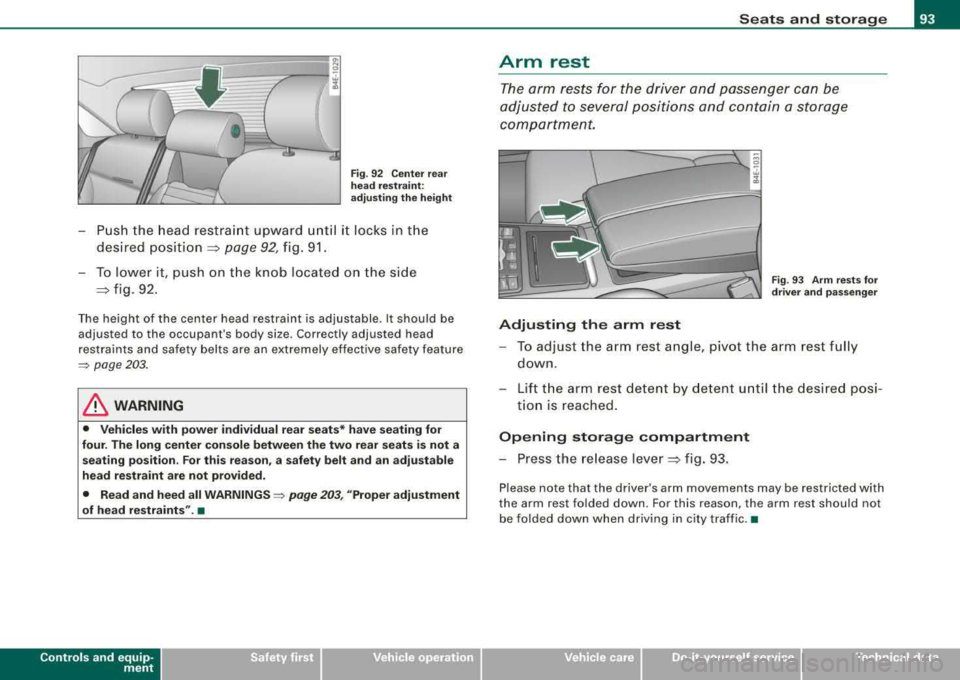
Fig. 92 Center rear
head restraint:
adjusting the height
- Push the head restraint upward until it locks in the
desired
position =:> page 92, fig. 91.
- To lower it, push on the knob located on the side
=:> fig. 92.
The height of the center head restraint is adjustable . It should be
adjusted to the occupant's body size. Correctly adjusted head
restraints and safety belts are an extremely effective safety feature
=> page 203.
& WARNING
• Vehicles with power individual rear seats* have seating for
four. The long center console between the two rear seats is not a
seating position . For this reason, a safety belt and an adjustable
head restraint are not provided.
• Read and heed all WARNINGS =>
page 203, "Proper adjustment
of head restraints". •
Contro ls a nd eq uip
ment
Seats and storage
Arm rest
The arm rests for the driver and passenger can be
adjusted to several positions and contain a storage
compartment.
"' 0
-. w ;l!i
Fig . 93 Arm rests for
driver and passenger
Adjusting the arm rest
-To adjust the arm rest angle, pivot the arm rest fully
down.
- Lift the arm rest detent by detent until the desired posi-
tion is reached .
Opening storage compartment
- Press the release lever =:> fig. 93.
Please note that the driver's arm movements may be restricted with
the arm rest folded down. For this reason, the arm rest should not
be folded down when driving in city traffic. •
Vehicle care
I I irechnical data
Page 104 of 404
___ S_ e_ a_t _s _a_ n_d _ s_t _o _r_ a...; g::::.... e ______________________________________________ _
The mounting hooks are spring-loaded and will return to their
normal position when not in use.
& WARNING
For strength-related reasons, the mounting hooks can only be
used to secure objects weighing up to 10 lb .
15 kgl. Heavier objects
will not be adequately secured -there is a risk of injury. •
Applies to ve hicles : w ith ski sack
Ski sack
Use the ski sack to transport and protect skis and other
long, light items in the passenger compartment.
0 •------0
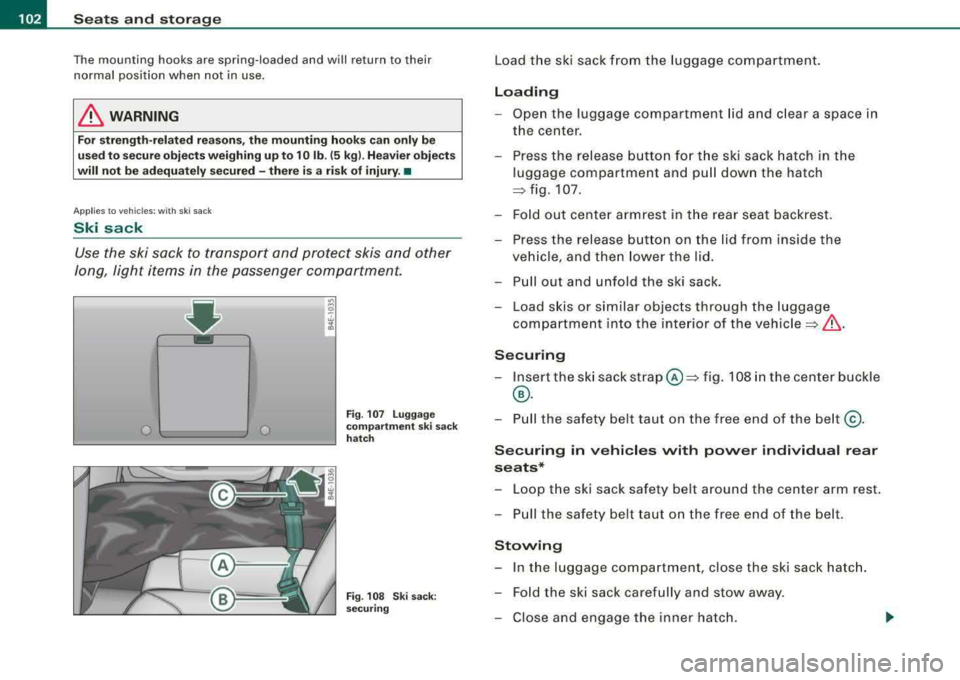
Fig . 107 Luggage
compartment ski sack
hatch
Fig . 108 Ski sack:
securing
Load the ski sack from the luggage compartment.
Loading
- Open the luggage compartment lid and clear a space in
the center.
- Press the release button for the ski sack hatch in the
luggage compartment and pull down the hatch
~ fig. 107.
- Fold out center armrest in the rear seat backrest.
- Press the release button on the lid from inside the vehicle, and then lower the lid.
- Pull out and unfold the ski sack.
- Load skis or similar objects through the luggage
compartment into the interior of the
vehicle=}& .
Securing
-Insert the ski sack strap@=} fig. 108 in the center buckle
®·
- Pull the safety belt taut on the free end of the belt@.
Securing in vehicles with power individual rear
seats*
Loop the ski sack safety belt around the center arm rest.
- Pull the safety belt taut on the free end of the belt.
Stowing
-In the luggage compartment, close the ski sack hatch.
- Fold the ski sack carefully and stow away.
- Close and engage the inner hatch.
Page 114 of 404
-
Seats and storage
----=---------------
Coat hooks
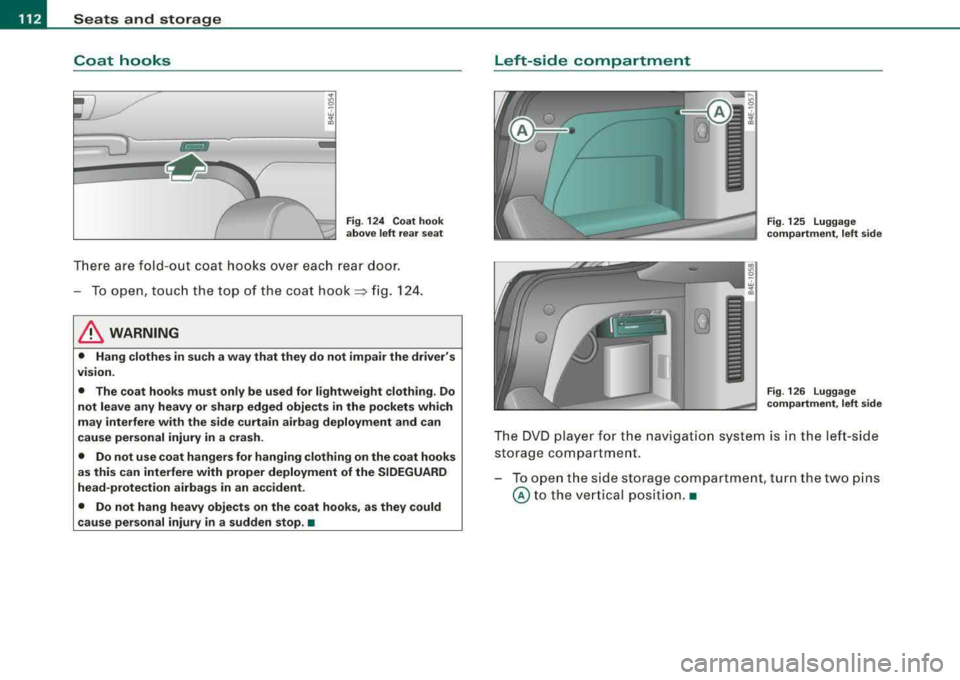
Fig. 124 Coat hook
above left rear seat
There are fold -out coat hooks over each rear door.
-To open, touch the top of the coat hook=> fig. 124.
& WARNING
• Hang clothes in such a way that they do not impair the driver's
v1s1on.
• The coat hooks must only be used for lightweight clothing. Do
not leave any heavy or sharp edged objects in the pockets which
may interfere with the side curtain airbag deployment and can
cause personal injury in a crash.
• Do not use coat hangers for hanging clothing on the coat hooks
as this can interfere with proper deployment of the SIDEGUARD
head-protection airbags in an accident.
• Do not hang heavy objects on the coat hooks, as they could
cause personal injury
in a sudden stop. •
Left-sid e compartment
Fig. 125 Luggage
compartment, left side
Fig . 126 Luggage
compartment, left side
The DVD player for the nav igation system is in the left-side
storage compartment .
- To open the side storage compartment, turn the two pins
© to the vertical position.•
Page 203 of 404
& WARNING (continued)
• Always adjust the driver's seat and the steering wheel so that
there are at least 4 inches (10 cm) between the knees and the
lower part of the instrument panel .
• Always hold the steering wheel on the outside of the steering
wheel rim with your hands at the 9 o'clock and 3 o'clock positions
to help reduce the risk of personal injury if the driver's airbag inflates .
• Never hold the steering wheel at the 12 o'clock position or with
your hands at other positions inside the steering wheel rim or on
the steering wheel hub. Holding the steering wheel the wrong way
can cause serious injuries to the hands, arms and head if the
driver's airbag inflates
• Pointing the steering wheel toward your face decreases the
ability of the supplemental driver's airbag to protect you in a colli
sion .
• Always sit in an upright position and never lean against or
place any part of your body too close to the area where the airbags
are located.
• Before driving, always adjust the front seats and head
restraints properly and make sure that all passengers are properly
restrained .
• Never adjust the seats while the vehicle is moving. Your seat
may move unexpectedly and you could lose control of the vehicle.
• Never drive with the backrest reclined or tilted far back! The
farther the backrests are tilted back, the greater the risk of injury due to incorrect positioning of the safety belt and improper
seating position.
• Children must always ride in child seats
=> page 243. Special
precautions apply when installing a child seat on the front
passenger seat
=> page 218 . •
Controls and equip
ment Safety first
Vehicle operation
Driving Safely
Proper seating position for the front
passenger
The proper front passenger seating position is important
for safe, relaxed driving.
For your own safety and to reduce the risk of injury in the
event of an accident, we recommend that you adjust the
seat for the front passenger to the follow ing position:
- Move the front passenger seat back as far as possible.
There must be a minimum of 10 inches (25 cm) between
the breastbone and the instrument
panel=> &.
-Adjust the angle of the seatback so that it is in an upright
position and your back comes in full contact with it
whenever the vehicle is moving.
- Adjust the head restraint so that the upper edge is as
even with the top of your head as possible but not lower
than eye level and so that it is as close to the back of your
head as
possible => page 203.
-Keep both feet flat on the floor in front of the front
passenger seat.
- Fasten and wear safety belts
correctly =:> page 213.
For detailed information on how to adjust the front passenger's
seat, see
=> page 86 .
& WARNING
Front seat passengers who are unbelted, out of position or too
close to the airbag can be seriously injured or killed by the airbag
as it unfolds. To help reduce the risk of serious personal injury : ..,_
Vehicle care Do-it-yourself service Technical data
Page 204 of 404
___ D_ r
_ i_v _i_n ..;::g :;_ S_ a_ f_ e_, ly'----------------------------------------------------
&, WARNING (continued)
• Passengers must always sit in an upright position and never
lean against or place any part of their body too close to the area
where the airbags are located.
• Passengers who are unbelted, out of position or too close to the
airbag can be seriously injured by an airbag as it unfolds with
great force in the blink of an eye.
• Always make sure that there are at least 10 inches
125 cm)
between the front passenger's breastbone and the instrument
panel.
• Always make sure that there are at least 4 inches 110 cm)
between the front passenger's knees and the lower part of the
instrument panel.
• Each passenger must always sit on a seat of their own and
properly fasten and wear the safety belt belonging to that seat.
• Before driving, always adjust the front passenger seat and
head restraint properly.
• Always keep your feet on the floor in front of the seat. Never
rest them on the seat, instrument panel, out of the window, etc.
The airbag system and safety belt will not be able to protect you properly and can even increase the risk of injury in a crash.
• Never drive with the backrest reclined or tilted far back! The
farther the backrests are tilted back, the greater the risk of injury
due to incorrect positioning of the safety belt and improper
seating position.
• Children must always ride in child seats
=> page 243. Special
precautions apply when installing a child seat on the front
passenger
seat => page 218. •
Proper seating positions for passengers in
rear seats
Rear seat passengers must sit upright with both feet on
the floor consistent with their physical size and be prop
erly restrained whenever the vehicle is in use.
To reduce the risk of injury caused by an incorrect seating
position in the event of a sudden braking maneuver or an
accident, your passengers on the rear bench seat must
always observe the following :
- Adjust the head restraint so that the upper edge is as
even with the top of your head as possible but no lower
than eye level
=> page 203.
- Keep both feet flat in the footwell in front of the rear seat .
- Fasten and wear safety belts
properly => page 213.
-Make sure that children are always properly restrained in
a child restraint that is appropriate for their size and age
=> page 243.
& WARNING
Passengers who are improperly seated on the rear seat can be
seriously injured in a crash.
• Each passenger must always sit on a seat of their own and
properly fasten and wear the safety belt belonging to that seat.
• Safety belts only offer maximum protection when the safety
belts are properly positioned on the body and securely latched. By
not sitting upright, a rear seat passenger increases the risk of
personal injury from improperly positioned safety belts!
• Always adjust the head restraint properly so that it can give
maximum protection. •
Page 229 of 404
If the electronic control unit registers a crash of medium severity,
the first s tage of the airbag deploys followed by the second stage at
a much later time in the crash sequence -regardless of whether the
safety be lt is being used or not . In higher severity crashes as regis
tered by the e lectronic control unit , both the first and second stages
deploy almost at the same time .
On the passenger side, regardless of sa fety belt use, the airbag w ill
be turned off if the weight on the passenger seat is less than the
a m ount program med in the e lectronic control unit . The front airbag
on the passenger side w ill also be turned off if one of the chi ld seats
that has been cer tified unde r Federal Motor Vehicle Safety Standard
208 has been recogni zed on the seat . The
PASSENGER AIR BAG OFF
light comes on and stays on to tell you when the front Adva nced
Airbag on the passenger side has been turned
off~ page 220 ,
"Child restraints on the front seat -some important things to
know ".
& WARNING
T o reduce the risk of injury when an airbag inflate s, alwa ys w ear
safety belts properly.
• If you are u nrestra ined , leaning forward , sitting sideway s or out
of position in any way , your risk of injury is much higher .
• You
will also re ce ive serious injur ie s and could even be killed if
you are up again st the airbag or too close to it when it inflate s -
ev en with a n Advan ced
Airbag ~ page 218. •
Airbag syst em
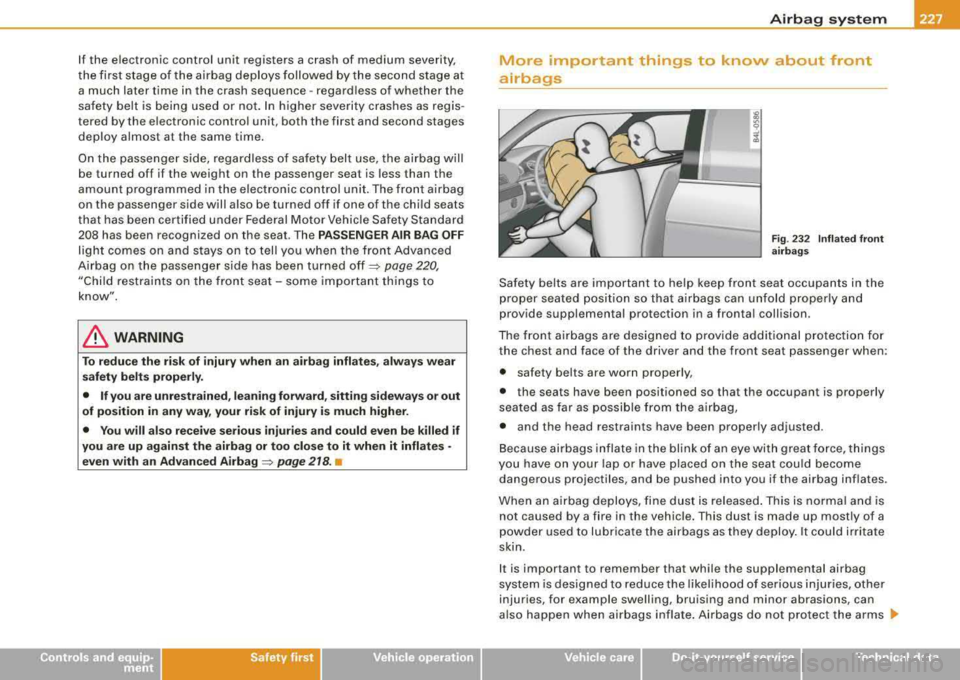
More Important things to know about front
airbags
Fi g. 2 32 In fl ated front
airba gs
Safety be lts are important to he lp keep front seat occupants in the
proper seated position so tha t airbags can unfold properly and
provide supplementa l protection in a fronta l collision.
The front air bags are designed to provide addi tional p rotecti on for
the chest and face of the driver and the front seat passenger when :
• safety belts are worn properly ,
• the seats have been positioned so that the occupant is properly
seated as far as possi ble fr om the a irbag,
• and the head restraints have been properly adjusted .
Because airbags inflate in the blink of an eye with grea t force , things
you have on your lap or have p laced on the seat cou ld become
dangerous projectiles , and be pushed into you if the airbag inflates .
When an airbag deploys, fine dus t is released . This is norma l and is
not caused by a fire in the vehicle. This dust is made up mostly of a
powde r used to lubrica te the airbags as they d eploy . It could irri tate
skin .
I t is important to remember that while the supplemental airbag
system is designed to reduce the likel ihood of serious injuries, other
injuries, for example swelling , bruising and minor abrasions, can
a lso happen when ai rbags inflate . Airbags do no t pro tect the arms
~
Vehicle care I I irechnical data
Page 230 of 404
__ ....!:,A~i'.!. r !::b :!a ~g:L.: s~ y~ s:!: t::.:: e~ m'..!.!.. ______________________________________________ _
or the low er parts of the body . Front airbags only supplement th e
th re e po int safe ty b elts in som e front al c ollis ions in which the
vehic le dece lerat ion is h igh enou gh to deploy the a irba gs.
Front airbags will not deploy:
• if the ignition is switched off when a crash occurs,
• i n sid e coll is io ns,
• in r ear- e nd collisi ons ,
• in ro llovers,
• when th e cras h de cele ration meas ured b y th e a irba g sys tem is
less than the mini mum threshold needed for a irbag deployme nt as
r egi stere d by th e ele ctr on ic con trol uni t.
The front passenger airbag will also not deploy :
• when th e front p asseng er seat is not occ upi ed ,
• when the weight on the front pas senge r seat a s sensed by the
A dvance d Airb ag Syste m indicates t hat th e fr on t airb ag on the
passenger side has to be t urned off b y the e lectronic control unit
(the PASSENGER AIR BAG OFF li g ht come s on and s tays o nl.
& WARNING
Sitting in the wrong position can increase the risk of serious injury
in crashes .
• To reduce the risk of injury when the airbags inflate , the driver
and passengers must always sit in an upright position , must not
lean against or place any part of their body too close to the area
where the airbags are located.
• Oc cupants who are unbelted , out of position or too close to the
airbag can be seriously injured by an airbag as it unfolds with
great force in the blink of an eye
=> page 220.
& WARNING
A child in a rearward -facing child seat installed on the front
passenger seat will be seriously injured and can be killed if the
front airbag inflates - even with an Advanced Airbag System .
• The inflating airbag will hit the child seat or infant carrier with
great force and will smash the child seat and child against the
backrest , center arm rest , door or roof .
• Always install rear-facing child seats on the rear seat.
• If you must install a rearward facing child seat on the front
passenger seat because of exceptional circumstances and the
PASSENGER AIR BAG OFF light does not come on and stay on ,
immediately install the rear-facing child seat in a rear seating posi
tion and have the airbag system inspected by your Audi dealer.
& WARNING
Objects between you and the a irbag will increase the risk of injury
in a crash by interfering with the way the airbag unfolds or by
being pushed into you as the airbag inflates.
• Never hold things in your hands or on your lap when the vehicle
is in use.
• Never transport items on or in the area of the front passenger
seat. Objects could move into the area of the front airbags during
braking or other sudden maneuver and become dangerous projec
tiles that can cause serious personal injury if the airbags inflate.
• Never place or attach accessories or other objects (such as cup
holders, telephone brackets, large , heavy or bulky objects) on the
doors , over or near the area marked
"AIRBAG " on the steering
wheel , instrument panel , seat backrests or between those areas
and yourself . These objects could cause injury in a crash, espe
cially when the airbags inflate .
• Never recline the front passenger's seat to transport objects .
Items can also move into the area of the side airbag or the front
airbag during braking or in a sudden maneuver. Objects near the .,_
Page 258 of 404
__ _:C~ h~il ~d !.._ S~ a~fe ~t~ y~ ------------------------------------------
&, WARNING (continued)
• Always buckle the child safety seat firmly in place even if a
child is not sitting in it. A loose child safety seat can fly around
during a sudden stop or in a crash .
• Always make sure the seat backrest to which the child restraint
is installed is in an upright position and securely latched into place
and cannot fold forward. Otherwise, the seat back with the child
safety seat attached to it could fly forward in the event of an acci
dent or other emergency situation.
• Always read and heed all WARNINGS whenever using a child
restrained in a vehicle is being used
=> page 243. Special precau
tions apply when installing a child safety seat on the front
passenger seat
=> page 220, "Child restraints on the front seat -
some important things to know".•
Deactivating the convertible locking retractor
The convertible locking retractor for child restraints will
be deactivated automatically when the belt is wound all the way back into the retractor.
-Press the red button on the safety belt buckle. The belt
tongue will pop out of the buckle.
- Guide the belt all the way back into its stowed position.
Always let the safety belt retract completely into its stowed position.
The safety belt can now be used as an ordinary safety belt without
the convertible locking retractor for child restraints.
If the convertible locking retractor should be activated inadvert
ently, the safety belt must be unfastened and guided completely
back into its stowed position to deactivate this feature. If the
convertible locking retractor is not deactivated, the safety belt will
gradually become tighter and uncomfortable to wear.
& WARNING
Improperly installed child safety seats increase the risk of serious
personal injury and death in a collision.
• Never unfasten the safety belt to deactivate the convertible
locking retractor for child restraints while the vehicle is moving.
You would not be restrained and could be seriously injured in an
accident.
• Always read and heed all WARNINGS whenever using a child
restrained in a vehicle is being used
=> page 243. Special precau
tions apply when installing a child safety seat on the front
passenger seat
=> page 220, "Child restraints on the front seat -
some important things to know" .•
Additional Information
What types of child restraint anchors are
available and how are they related to child
safety?
For years, child restraints have been installed using the safety belts
already present in every vehicle.
Since September
1, 1999, child restraint manufacturers have been
providing tether straps that attach the top of the child restraint to
the vehicles structure, on most of their forward-facing systems in order to comply with U .S . Federal regulations for child restraint
performance in a crash. Vehicle manufacturers are required to
phase -in tether anchorages for attachment of the tether strap in
their U.S. vehicles beginning September 1, 1999.
The combination of the tether anchorages and the lower anchor
ages is now generally called the
LATCH system for "Lower Anchor
and Tether for Children".
~
Page 262 of 404
--~C:!:h ~i~
ld ~ S~a ~f ~e ~t ,rY ____________________________________________ _
Installing the guidance fixtures
- Push down on the seat cushion so that the lower anchor
ages are visible.
- Hold the guidance fixture with the part number facing downward and push it in the direction of the arrow onto
the
anchorage => page 259, fig. 248.
- Make sure that each of the two guidance fixtures per seat snaps into place.
Removing the guidance fixtures
- Remove the child restraint according the child restraint manufacturer's instructions.
- Push down on the seat cushion so that the lower anchor
ages are visible.
- Pull off the guidance fixtures from the lower anchorages.
-Always remove the guidance fixtures and keep them in a
safe place when not in use.
You may find it easier to install child restraints equipped with hooks
attached to straps without the guidance fixtures in place . If this is
the case, remove the guidance fixtures by pulling them off the
anchorages. However, the guidance fixtures can help you to locate
the
LATCH anchorages.
& WARNING
Improper use of tether anchorages or lower anchorages can cause
serious personal injury in a crash.
• Always carefully follow the child restraint manufacturer's
instructions for proper installation and use of child restraint
systems.
& WARNING (continued)
• Never use the LATCH or tether anchorages to attach safety
belts or other kinds of occupant restraints.
• Child restraint tether attachments and lower attachments are
only designed to secure a child restraint that has been equipped
to use these anchorages.
• Tether anchorages and lower anchorages are designed to with
stand only those loads imposed by correctly fitted child restraints.
Under no circumstances can they be used safely for adult or child
safety belts or harnesses.
• Never mount more than one child restraint to a single tether or
to a lower anchorage point. Attaching two child restraints to a
single anchorage point can cause the anchorage to fail and cause
serious personal injury in a crash.
0 Note
• Remove the guidance fixtures before folding the rear seatback to
prevent damaging the seat cushion.
• If you leave the guidance fixtures installed for several days, they
could leave a mark on the upholstery on the seat cushion and back
rest in the area that the guidance fixtures were installed. The uphol
stery would also be permanently stretched around the guidance
fixtures . This applies especially to leather seats.
[ i] Tips
• Always remove the guidance fixtures when not in use .
• Please keep the guidance fixtures in a safe place with the vehicle
when not in use. •
Page 299 of 404
_____________________________________________ C_ l_ e _a_ n_ in~ g_a
_ n_d_ p_ r_ o_ t
_ e_ c_t _io _ n __ ffllll
•
consider if children, animals or other factors might prove to be
particularly hard on the leather.
By contrast, leather types that are covered by a colored finish layer
are more durable. This has a positive effect on the leather's resis
tance to wear and soiling in daily use. On the other hand, the typica l
characteristics of natural leather are barely or not apparent.
However, this does not mean that the leather itself is of inferior
quality .
Care and handling
Because of the exclusive nature of the types of leather that Audi
uses and their unique properties (such as sensitivity to oi ls, grease,
soiling,
etc.I, you will need to be somewhat careful with these
leathers, and a certain type of care is required. For example, dark
clothing materials can discolor leather seats (especially if such
clothing is damp and was not dyed correctly). Dust and dirt particles
in pores, folds, and seams can have an abrasive effect and can
damage the leather surface as we ll as weaken seams.
The leather shou ld be c leaned regularly as needed . After having
been used for a relatively long time, your leather seats will acquire
a rich aged finish. This is a characteristic of natural leather and a
sign of true quality.
In order to maintain the value of this natura l product over the life of
your vehicle, you should follow the recommendations below :
0 Note
• To keep your leather from bleaching out, do not allow it to be
exposed to bright sunlight for long periods of time . If you have to
leave the vehicle parked outside for long periods, cover the leather
to protect it from direct exposure to sunlight.
• Sharp objects on clothing, such as zippers, rivets or sharp pieces
on belts can leave permanent scratches or scrape marks on the
surface of the leather.
[ i] Tips
• After each time you clean the leather and at regular intervals, use
a leather preservative creme that contains UV -blockers and that
works into the leather . This creme wil l nourish and moisturize the
leather, helping it to breathe and stay supple . It also helps to build
up a protective coating on the surface .
• Clean the leather every 2 -3 months, and clean any areas that get
soiled.
• Remove fresh marks made by ballpoint pens, ink, lipstick, shoe
polish, etc . as soon as possible .
• Preserve the color of the leather as needed by using a special
colored leather care creme to touch up areas of uneven color. •
Applies to ve hic les : with na tu ra l le at he r
Cleaning and caring for leather upholstery
and trim
Natural leather requires special care and attention.
Normal cleaning
- Clean soiled areas with a slightly moistened cotton or
woolen cloth.
More stubborn dirt
- More stubborn dirt can be removed using a cloth satu
rated with a mild soap solution (2 tablespoons mild
liquid soap) .
- Never allow the soap solution to saturate the leather, and
make certain that no water soaks into the seams .
- Wipe off the soap solution with a soft, dry cloth.
.,_
Vehicle care