spare wheel AUDI S8 2008 Owners Manual
[x] Cancel search | Manufacturer: AUDI, Model Year: 2008, Model line: S8, Model: AUDI S8 2008Pages: 404, PDF Size: 52.7 MB
Page 6 of 404
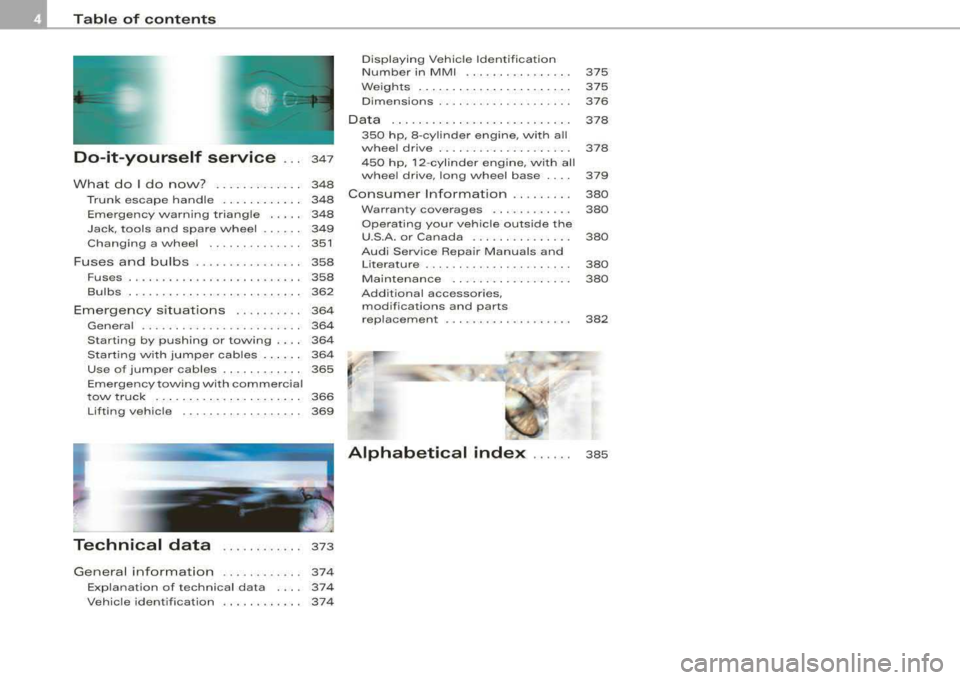
Table of contents
Do-it-yourself service ... 347
What do I do now? . . . . . . . . . . . . . 348
Trunk escape handle . . . . . . . . . . . . 348
Emergency warning triang le . . . . . 348
Jack, tools and spare wheel . . . . . . 349
Changing a wheel . . . . . . . . . . . . . . 351
Fuses and bulbs . . . . . . . . . . . . . . . . 358
Fuses . . . . . . . . . . . . . . . . . . . • . . . . . . 358
Bu lbs . . . . . . . . . . . . . . . . . . . . . . . . . . 362
Em ergency s ituat ions . . . . . . . . . . 36 4
Gener al . . . . . . . . . . . . . . . . . . . . . . . . 364
Sta rting by pushing or towing . . . . 364
Start ing with jumper cab les . . . . . . 364
Use of jumper cab les . . . . . . . . . . . . 365
Em erge ncy towing with commercia l
t ow truck . . . . . . . . . . . . . . . . . . . . . . 366
Lifting vehicle . . . . . . . . . . . . . . . . . . 369
Technical data
General information
373
37 4
Expla nation of technical data . . . . 374
Vehic le ident ificat ion . . . . . . . . . . . . 374 Displaying Vehic
le Identifica tion
Number in MMI . . . . . . . . . . . . . . . . 375
Weights . . . . . . . . . . . . . . . . . . . . . . . 375
Dim ensio ns . . . . . . . . . . . . . . . . . . . . 376
Data . . . . . . . . . . . . . . . . . . . . . . . . . . . 3 78
350 hp, 8 -cylinder engine, with all
whee l dr ive . . . . . . . . . . . . . . . . . . . . 378
450 hp, 12-cylinder engine , wi th all
whee l drive, long wheel base . . . . 379
Consumer Information . . . . . . . . . 380
Warran ty coverages . . . . . . . . . . . . 380
Operating you r veh icle outs ide the
U.S.A. or Canada . . . . . . . . . . . . . . . 380
Audi Serv ice Repair Manuals and
Literature . . . . . . . . . . . . . . . . . . . . . . 380
Maintenance . . . . . . . . . . . . . . . . . . 380
Ad ditional accessor ies,
mod ificat ions and parts
rep lacement . . . . . . . . . . . . . . . . . . . 382
Alphabetical index . . . . . . 385
Page 43 of 404
failure. Under-inflation also reduces fue l efficiency and tire tread
life, and may affect the veh ic le's handling and stopping abi lity.
Please note that the TPMS is not a substitute for proper tire mainte
nance, and it is the driver's responsibi lity to maintain correct tire
pressure, even if under-inflation has not reached the leve l to tr igger
illumination of the TPMS low tire pressure tellta le.
Your veh icle has a lso been equipped with a TPMS malfu nction indi
cator to indicate when the system is not operating properly . The
TPMS malfunction indicator is combined w ith the low tire press ure
telltale . When the system detects a ma lfunction , the telltale wi ll
fl ash for approximately one minute and then remain continuously
illum inated . This sequence will continue upon subsequent vehicle
start -ups as long as the ma lfunction exists.
When the ma lfunctio n indicator is i llum inated, the system may not
be ab le to detect or signa l low tire pressure as intended . TPMS
malfunctions may occ ur for a var iety of reasons, i nclud ing the
installation of replacement or alternate tires or wheels on the
vehic le that prevent the TPMS from f unctioning proper ly . Always
check the TPMS malfunction tellta le after replac ing one or more
t ires or whee ls on yo ur ve hicle to ens ure t hat the replacement or
a lternate tires and wheels allow the T PMS to continue to function
proper ly. •
Introduction
The tire pressure monit oring system m onitors air pressure
in all four road wheels and the spare tire* while the
vehicle is movin g.
As soon as the tire pressure moni toring system se nses a signi ficant
loss of air pressure in one or severa l tires, text messages and yellow
symbo ls appear in the inst rume nt cluster d isplay to aler t t he driver .
T he
(l) warning light in the instrument c luster comes on when the
t ire is sig nificant ly underinflated
=> page 20 .
Controls and equip
ment
Driver information di splay
The warning light U) also i lluminates in the case of a system
mal fu ncti on.
The system continuous ly receives rad io signa ls from sensors
located inside each tire .
Be aware that t ire p ressu re is also dependen t on the tempera ture of
the tire . For every
18 °F (1 O °C) increase in tire temperature, tire pres
sure increases by about 1 .5 psi (0 .1 bar). The tire warms up wh ile the
vehicle is moving and t ire pressure rises . So you should adjust tire
pressure only when the t ires are
cold, when the temperature of the
tires is roughly the same as the ambient air temperature .
I n order to keep the tire pressure monitoring system properly cali
brated, tire pressure on all four tires and on the spare tire* should
be checked at regular intervals, adjusted if n ecessary and saved in
the proper setti ng (recommended
pressure) => page 44.
The tire pressure is shown on the tire pressure label. On USA vehi
cles, the tire pressure labe l is located on the drive r's s ide B -p ill ar. On
Canada vehicles, the tire pressure labe l is located either on the
driver's side B -pillar o r inside the fuel fi ller flap. The t ire press ure
label l ists t he recommended cold tire inflat io n pressures for t he
vehic le at its maximum capacity weight and the tires that were on
your ve hicle at the time it was manufactured . For recommended tire
pressures for normal load condit ions, please see chapter
=> page 328 .
The current temperatures and pressure of your tires can be viewed
in the M MI
=> page 43 .
& WARNING
• When the tire pre ssure monitoring system warning light i s lit ,
one or more of your tires is signifi cantly under -infl ated . You should
stop and check your tires a s soon a s po ssible , and inflate them to
the proper pre ssure a s indi cated on the vehi cle' s tire pre ssure
label
=> page 328 . Driving on a significantly under -inflated tire
ca use s the tire to o verheat and can lead to tire failure. Under -infla -
~
Page 44 of 404
Driver information display
& WARNING (continued)
tion also is likely to impair the vehicle's handling and stopping
ability.
• Do not adjust tire pressure when tire temperature is excessive .
This could lead to serious tire damage and even cause the tire to
burst, with the additional danger of an accident.
W For the sake of the environment
Driving with under -inflated tires reduces fuel efficiency and tire
tread life.
[ i) Tips
• Each tire, including the spare*, should be checked monthly when
cold and set to the recommended inflation pressure as specified on
the tire pressure label
=> page 328.
• The tire pressure monitoring system helps the driver to keep an
eye on tire pressures. But the driver still has the responsibility for
maintaining the correct tire pressure .
• Tire pressure must only be adjusted when the temperature of the
tires is about the same as ambient air temperature.
• When tires are replaced, the sensors and valves should not be
detached or exchanged. Only the valve core needs to be replaced
and, if necessary, the valve and the wheel electronics replaced.
• If you should put different wheels and tires on your vehicle (e .g.
winter wheels and tires), you must be certain that the wheels and
tires are compatible with the tire pressure monitoring system .
Otherwise the system will register a malfunction and a fault
message will be displayed. For more information, contact your
authorized Audi dealer.
• Adjust the tire pressure and store the pressure in the tire pres
sure monitoring system to the load you are
carrying => page 328. •
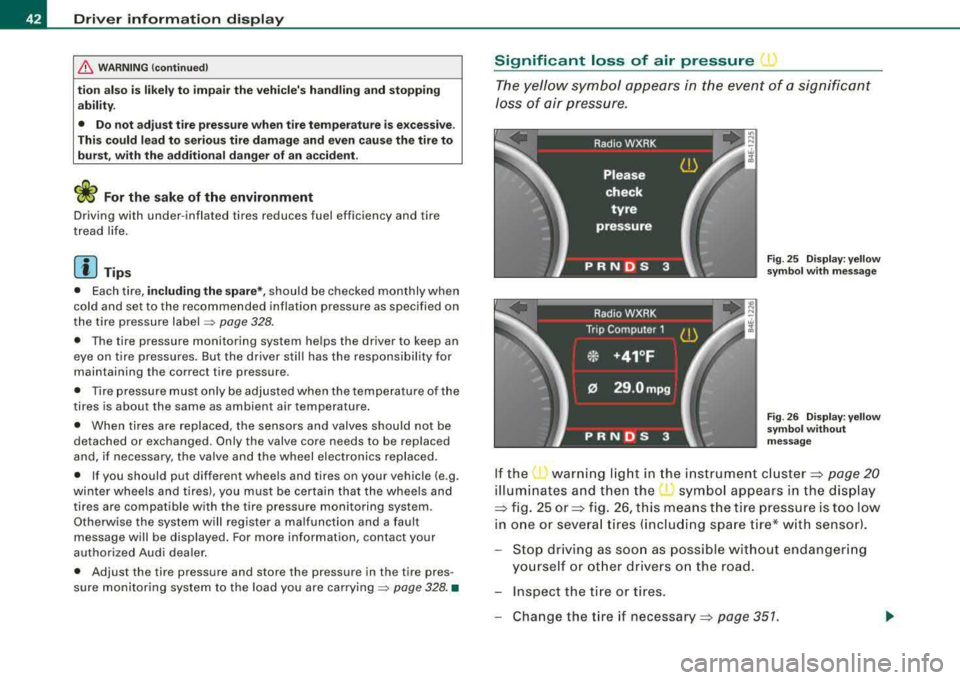
Significant loss of air pressure ( )
The yellow symbol appears in the event of a significant
loss of air pressure.
Fig . 25 Display: yellow
symbol with message
Fig . 26 Display: yellow
symbol without
message
If the warning light in the instrument cluster:::::, page 20
illuminates and then the ( symbol appears in the display
:::::, fig. 25 or:::::, fig. 26, this means the tire pressure is too low
in one or several tires (including spare tire* with sensor).
Stop driving as soon as possible without endangering
yourself or other drivers on the road.
- Inspect the tire or tires.
Change the tire if
necessary:::::, page 351.
Page 45 of 404
The j warning light in the instrument cluster comes on when the
tire is significantly underinflated.
In addition, the tire symbo l
) appears in the display together with
the message
Please check tire pressure => page 42, fig. 25.
Af ter a few seconds, the message disappears again:::>
page 42,
fig. 26. If you would like to show the message again, press the
!CHECK] button.
[ i] Tips
• In the case of an intentional loss of air pressure, for example,
when re-adjusting tire pressure, this has to be stored again after
wards =>
page 44.
• Current information about tire pressures and temperatures can
be scanned in MMI =>
page 43.
• Tire pressure must only be adjusted when the temperature of the
tires is about the same as ambient a ir temperature .
• The yellow symbol disappears, when the tire pressure is
corrected and the new pressure is stored in the system=>
page 44.
• After changing a wheel you have to adjust the tire pressures on
all whee ls . In addition, you must then initialize the new tire pres
sures in the tire pressure monitoring system =>
page 45.
• If your vehicle is equipped with a spare tire* with a wheel sensor,
the tire will be monitored and the display
symbols => page 42, fig. 25
or=>
page 42, fig. 26 will appear if the pressure is too low.•
Controls and eq uip
ment
Driver information display
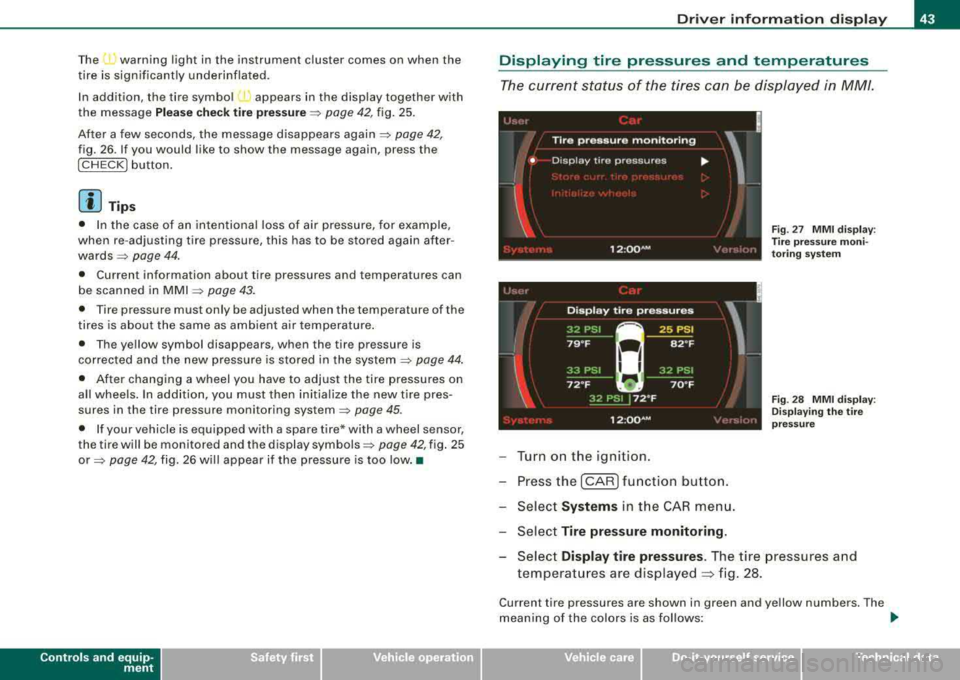
Displaying tire pressures and temperatures
The current status of the tires can be displayed in MM/.
'
!
Tire pressure monitoring
• Disp lay tire pressures ...
I
Fig . 27 MMI display :
T ire pres sure moni
toring system
12 :QQ AM
Turn on the ignition.
Press the
I CAR I function button.
Select
Systems in the CAR menu.
Select
Tire pressure monitoring .
,. •I
Fig. 28 MMI display:
Displaying the tire
pressure
Select Display tire pressures . The tire pressures and
temperatures are displayed
~ fig. 28.
Current tire pressures are shown in green and yellow numbers. The
meaning of the colors is as follows:
~
Vehicle care I I irechnical data
Page 47 of 404
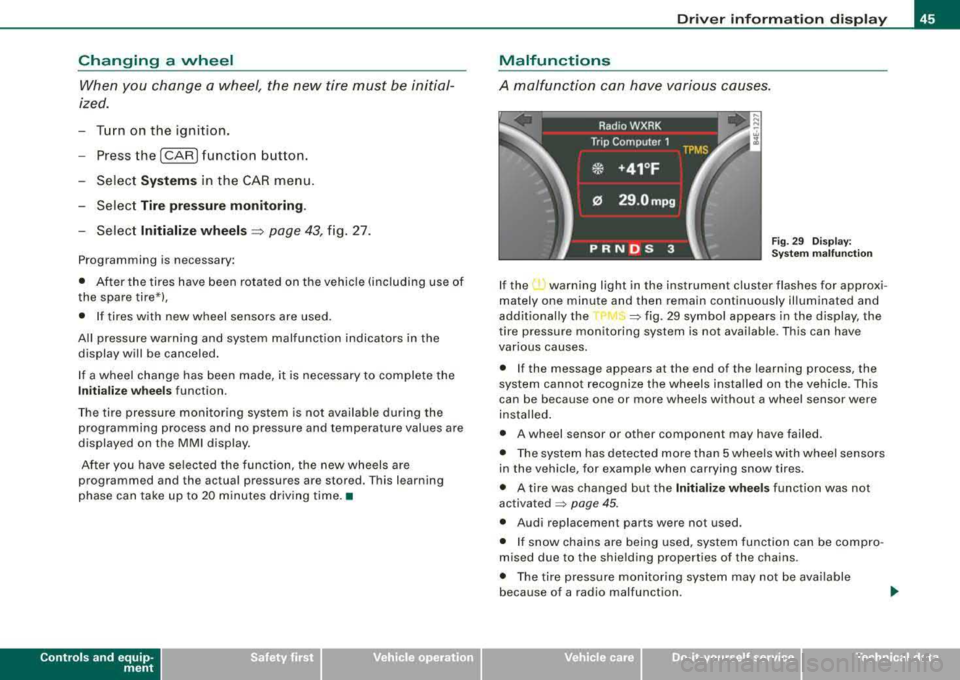
Changing a wheel When you change a wheel, the new tire must be initial
ized.
Turn on the ignition.
Press the
I CAR I function button.
- Select
Systems in the CAR menu .
- Selec t
Tire pressure monitoring .
-Select Initialize wheels ~ page 43, fig. 27.
Programming is necessary:
• After the tires have been rotated on the vehicle (including use of
the spare tire*),
• If tires with new wheel sensors are used.
All pressure warning and system malfunction indicators in the
display will be canceled.
If a wheel change has been made, it is necessary to complete the
Initialize wheels function.
Th e tire pressure monitoring system is not available dur ing the
programming process and no pressure and temperature values are
displayed on the MMI display.
After you have selected the funct ion, the new wheels are
programmed and the actual pressures are stored. This learning
phase can take up to 20 minutes driving time.•
Contro ls a nd eq uip
ment
Driver information display
Malfunctions
A malfunction can have various causes.
Fig. 29 Display:
Syste m malfunction
If the ...., warning light in the instrument cluster flashes for approxi
mately one minute and then remain continuously illuminated and
additional ly the
=> fig. 29 symbol appears in the display, the
tire pressure monitoring system is not available. This can have
various causes.
• If the message appears at the end of the learning process, the
system cannot recognize the wheels installed on the vehicle. This
can be because one or more wheels without a wheel sensor were
insta lled .
• A wheel sensor or other component may have failed.
• The system has detected more than 5 wheels with wheel sensors
in the vehicle, for example when carrying snow tires.
• A tire was changed but the
Initialize wheels function was not
activated
=> page 45.
• Audi replacement parts were not used.
• If snow chains are being used, system function can be compro
mised due to the shielding properties of the chains.
• The tire pressure monitoring system may not be available
because of a radio malfunction.
Vehicle care I I irechnical data
Page 332 of 404
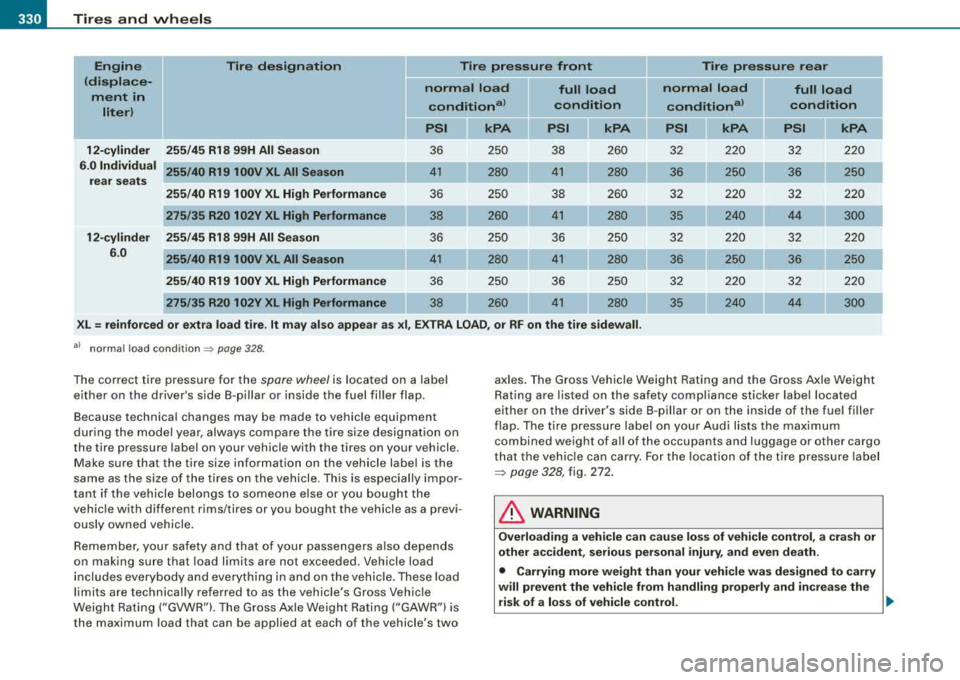
___ T_ ir_e _s_ a_n_ d_ w_ h
_ e_e_ l_ s _______________________________________________ _
Engine Tire designation Tire pressure front Tire pressure rear
( displace-
normal load full load normal load
full load
ment in
liter)
condition al condition conditiona l condition
kPA PSI kPA PSI kPA PSI
12-cylinder
255/45 R18 99H All Season 36 250 38 260 32 220 32 220
6.0 Individual
255 /40 R19 100V XL All Season 41 280 4 1 280 36 250 36 250
rear seats
255/40 R19 100V
XL High Performance
36 2
50
38 260 3
2 220 32 2 20
275 /35 R20 102Y
XL High Performance 38 41 280 35 2 40 44 300
12 -cylinder 255 /45 R18 99H All Season 36 250 36 250 32 220 32 220
6 .0
255 /40 R19 100V XL All Season 4 1
280 4
1
280 36 250 36 250
255 /40 R19 100V
XL High Performance
36 250 36 250 32 2 20 32 220
275 /35 R20 102Y XL High Performance 38 260 4 1 280 35 240 44 300
XL = reinforced or extra load tire . It may also appear as xi , EXTRA LOAD , or RF on the tire sidewall .
al norma l load cond ition => page 328.
The co rrect tire pressure for the spare wheel is located on a label
either on the driver 's s ide 8-pillar or inside t he fue l fil ler flap.
Because technica l changes may be made to vehicle equipment
du ring t he mode l year, always co mpare the tire si ze desig nati on on
the tire pressure label on your vehicle with the tires on your vehicle .
M ake s ure t hat the tire si ze info rmat ion o n the ve hicle labe l is the
same as the size of the tires on the vehicle . T his is especial ly impor
t an t if t he vehicle bel ongs t o so me one e lse o r yo u boug ht the
vehic le with different rims/tires or you bought the vehicle as a previ
ously owned ve hicle.
Reme mber, you r safety and that of y our passengers a ls o depe nds
on making su re that load limits are not exceeded. Vehicle load
i nc ludes every body and everyt hin g in and o n th e veh icle . T hese load
limits are technically referred to as the vehicle's Gross Veh ic le
Weig ht Ratin g ("GVWR"). T he Gro ss Axle Weigh t Ra tin g ("GAWR") is
the maximum load that can be applied at each of the vehicle's two axles
. The Gross Vehic le We ight Rating and the Gross Axle Weight
Rating are l isted on the safety compl iance sticker labe l located
either on the driver's side 8 -pillar or on the inside of the fuel filler
fl ap . T he t ire p ressure label on you r A ud i lists t he m axi mum
combined weight of a ll of the occupants and luggage or other cargo
th at the v ehicle can carry . Fo r the locati on of the t ire press ure la be l
=> page 328, fig . 27 2.
& WARNING
Overloading a vehicle can cause loss of vehicle control , a crash or
other accident, serious per sonal injury , and even death .
• Carrying more weight than your vehicle was designed to carry
will prevent the vehicle from handling properly and increase the risk of a loss of vehicle control. ...,
Page 333 of 404
Tires and wheels Ill
----------------
•
& WARNING (continued )
• The brakes on a vehicle that has been overloaded may not be
able to stop the vehi cle within a safe distance .
• Tires on a vehicle that has been overloaded can fail suddenly
c au sing lo ss of control and a cra sh.
• Always make sure that the total load being transported -
including the we ight of a trailer hitch and the tongue weight of a
loaded trailer -does not make the vehicle heavier than the
v ehicle's Gross Vehicle Weight Rating .
& WARNING
• Incorrect tire pressures and /or underinflation can lead to a
serious or fatal accident.
• Incorre ct tire pressures and /or underinflation cause in creased
tire wear and can affect the handling of the vehicle .
• Incorrect tire pressures and /or underinflation can also lead to
sudden tire failure, including a blowout and sudden deflation,
c ausing loss of vehi cle control.
•
Checking tire pressure
The c orrect tire pressu re f or the tires ori gina lly installe d
on your vehicle is lis ted on the ti re pressure la bel loca ted
either on driver's side 8-pillar or inside the fuel filler flap.
The rec omme nded ti re p ressu res a re on the tire pr essure la be l an d
in the
table~ page 328, "Co ld tire inflation pressure". This means
t ha t th e pres su re m us t be c hecked a nd adjus ted w he n t he ti re has
not been driven for more than a couple of miles (kilometers) at low
speeds du rin g the p revio us th ree hou rs . Ai r in t he tires ex pand s
when the tire heats up as a resu lt of internal fr iction as it flexes in
use. The tire pressure is hig her when the tire has warmed up than
when it is "co ld ." I
t is the inflation pressure in a "cold" t ire that counts . Therefore, you
s h oul d never le t air ou t of a warm ti re to matc h "Co ld t ire in fl ati on
pressure"
recommendations~ pa ge 328 . The tires wou ld then be
u nde rinflate d and could fail sud denly .
The t ire pressure label o n your Au di lists the recomme nded cold t ire
inflation press ures at maximum capacity for the new, origina l equip
m ent tires t hat we re on yo ur vehicle at t he t ime it was manufac
tured. For the location of the
labe l~ page 328, fig . 272.
M ost tires lose a ir natu rally ove r ti m e. T hey can a lso lose so me air if
you drive ov er a pothole or h it a curb while parkin g. It is usually not
pos sible to see whe the r the rad ial tir es use d today are unde rin flated
just by look in g at t hem .
T herefore, be sure to chec k tire pressures at least once a month and
a lways be fore go ing o n a lo ng trip . Make su re to take the nu mber o f
people and the amount of luggage into account when ad justing tire
pr ess u re fo r a trip -even one t hat you wou ld not conside r to be
" long ."
See~ page 333, "Tires and vehic le load limits" for more
i mp ort ant i nfor mati on .
A lways use a n accu rate ti re p ressure gauge w hen c hec kin g a nd
adjusting inflation pressures . Chec k all of the tires and be sure not
t o fo rget t he spare t ire . If the pressu re i n an y tire is too high when
the tire is "co ld," let air out of the tire slow ly with the edge of the tire
ga uge and kee p checking the press ure u ntil y ou r each th e pr essu re
that is correct for the load (passengers and luggage) and kind of
d riv in g yo u plan to do .
I f the pressure in any tire is too low, note the difference between the
pressure in the cold tire and the pressure you need and add the air
t hat you need to r each the correct pressure for the veh ic le load
(passengers and luggage) for the tires on your vehicle as listed on
t he o n you r vehicl e and i n thi s m anua l a n d t he kind of driving yo u
p lan to do.
Never exceed the maximum inflation pressure listed on the tire
sidewall for any reason .
Remember that the vehic le manufacturer, not the tire manufacturer,
deter mines the correc t tire pressure for the ti res on your vehicle.
~
Vehicle care
Page 339 of 404
Tires a nd wh eels -
----------------
•
0
©
U.S. DOT tire identification number
Sever snow cond itions
Ti re ply composition and materials used
Maximum load rating
Treadwear, traction and temperature grades
@ Maximum permissible inflation pressure
The tires and rims are essentia l parts of the vehicle 's design. The
tires and rims approved by Audi are special ly matched to the char
acteristics of the vehic le and can make a major contribution to good
road hold ing and safe handling when in good cond ition and prop
erly inf lated
=> .&, .
We recommend tha t all work on tires and wheels be performed by
an authorized Audi dea ler . They are familiar with recommended
procedures and have the necessary special too ls and spare parts as
we ll as the proper facilities for disposing of the old tires.
Authori zed Audi dea lers have the necessary information about tech
n ical requirements for insta lling or changing tires and rims.
R ep lac ing t ires and wh eels
Tires shou ld be replaced at least in pairs and not individual ly (for
examp le both front tires or both rear tires together).
Be sure to read and heed the informat ion to the tire pressure mon i
toring
system => page 338.
Always buy replacement radial tires t hat have the same specifica
tions as the tires approved for your vehicle by Audi. Rep lacement
tires must always have the same load rating specification as the
origina l equipment or approved optional t ires listed in the table
=> page 328.
Audi -approved specification tires are specially matched to your
vehicle and its load limits, and can contribute to the important road- holding, driving characteristics, and safety of the vehicle
. The table
(=> page 328) lists specificat ions of the tires approved for the Audi
models covered by your Owner's Literature .
The tire pressure labe l located either on driver's side 8 -pil lar or
ins ide the fuel fi ller
flap( => page 328, fig. 273) lists the specifica
tions of the original equipment tires installed on your vehicle at the
t ime it was manufactured.
Federa l law requires tire manufacturers to place standardized infor
mation on the sidewa ll of all
tires => page 336, fig . 276. This informa
tion identifies and describes the fundamental characteristics, the quality grade of the tire and a lso provides a tire identification
number for sa fety standard cert ificat ion and in case of a recall.
T ire s pec ificat ion s
Knowledge of tire specifications makes it easier to choose the
correct tires . Radial tires have the tire specifications marked on the
sidewall, for example :
255/45 R 18 99 H
This contains the fo llowing information:
P Indicates the tire is for passenger cars (where applicable)
255 Nominal tire width in mm of the tire from sidewall edge to side -
wa ll edge. In general, the larger the number, the wider the tire
45 Height/width ratio in percent (aspect ratio)
R Tire construction: Radial
18 Rim diameter code (in inches)
99 Load rat ing code
H Speed rat ing letter code
XL (or "xi", "EXTRA LOAD" or "RF") indicates that the tire is a "Rein
forced" or an "Extra Load" tire
M +S (or "M/S") Indicates tha t the tire has some mud and snow capa
bility
The tires could a lso have the information of direction of rotation
=> page 324.
Vehicle care
Page 341 of 404
________________________________________________ T_ i
_ r_e _s_ a_n_ d_ w_ h_ e_e _ l_s __ l'III
•
• T he batt ery inside of the tire pressure sensor has a l imited
s er vice l ife.
• Al ways drive with the va lve stem ca ps sec ure ly m ounted. We
r ec om mend u sin g fa ctor y in sta lle d v alv e stem caps. Ask your autho
rized Audi d ealer to replac e lost valve stem caps .
T he in stalla tio n of replacement ti res with steel cord body plies i n
th e tire s id ewal l may cause malfunct ion of the tire pressure moni
toring sy ste m, and is not recommended (c ord mate ria l infor mation
i n mo lded on the tire s idewa ll).
Al ways check your tir e pressure monitor ing system indicator after
r eplac ing on e o r m ore tire s on y our vehi cle. If the tire pressu re
monitorin g system indicator flashes, or is on, your system is not
w orki ng pr ope rly. You r rep lace ment tir e mi ght be in co m pati ble w ith
your t ire pr essure monitoring system, or some component of the
t ir e pr ess ure m oni to ring sys te m m ay be damaged .
& WARNING
• Using incorrect or unmatched tires and / or wheels or improper
tire and wheel combinations can lead to loss of control , collision
and serious personal injury .
• Always use tires , rims and wheel bolts that meet the specifica
tions of original factory -installed tires or other combinations that
have been specifically approved by the vehi cle manufacturer .
• Tires age even if they are not being used and can fail suddenly,
espe cially at high speeds . Tires that are more than 6 years old can
only be used in an emergency and then with special care and at
lower speeds .
• Never mount used tires on your vehicle if you are not sure of
their "previous history ." Old used tires may have been damaged
even though the damage cannot be seen that can lead to sudden
tire failure and loss of vehicle control.
• All four wheels must be fitted with radial tires of the same type ,
size (rolling cir cumference ) and the same tread pattern . Driving
&, WARNING (continued )
with different tires reduces vehicle handling and can lead to a loss
of control.
• If the spare tire is not the same as the tires that are mounted
on the vehicle
-for example with winter tires -only use the spare
tire for a short period of time and drive with extra care . Refit the
normal road wheel as soon as safely possible.
• Never drive faster than the maximum speed for which the tires
on your vehicle are rated because tires that are driven faster than
their rated speed can fail suddenly.
• Overloading tires cause heat build -up , sudden tire failure,
including a blowout and sudden deflation and loss of control.
• Temperature grades apply to tires that are properly inflated and
not over or underinflated.
• For techni cal reasons it is not always possible to use wheels
from other vehicles -in some cases not even wheels from the
same vehicle model.
• If you install wheel trim discs on the vehicle wheels , make sure
that the air flow to the brakes is not blocked . Reduced airflow to
the brakes can them to overheat , increasing stopping distances
and causing a collision.
• Run flat tires may only be used on vehicles that were equipped
with them at the factory . The vehicle must have a chassis designed
for run flat tires and a factory-installed tire pressure monitoring
system that indicates a loss of tire pressure. Incorrect use of run
flat tires can lead to vehicle damage or accidents . Check with an
authorized Audi dealer or tire specialist to see if your vehicle can
be equipped with run flat tires . If run flat tires are used , they must
be installed on all four wheels . Mixing tire types is not permitted.
0 Note
• Fo r tec hnica l reaso ns, i t is not gene rally p oss ibl e to use the
whee l rims from other vehicles . T his can hold true for wheels of t he
sa me v ehicl e typ e.
Vehicle care
Page 342 of 404
___ T_ ir_e _s_ a_n_ d_ w_ h
_ e_e_ l_ s _______________________________________________ _
• If the spare tire is different from the tires that you have mounted
on your vehicle (for example winter tires or wide profile tires), then
use the spare tire for a short period of time only and drive with extra
care . Replace the flat tire with the tire matching the others on your
vehicle as soon as possible.
• If you should put different wheels and tires on your vehicle (e.g.
winter wheels and tires), you must be certain that the wheels and
tires are compatib le with the tire pressure monitoring system.
Otherwise the system will register a malfunction and a fault message will be displayed. For more information, contact your Audi
dea ler.
0 Note
• When installing new tires, be careful not to damage the valves or
tire pressure monitoring system sensors.
• Never drive without the va lve stem cap. The valves could get
damaged.
• If the sensors must be replaced, then the valve must also be
replaced at the same time.
For the sake of the environment
Dispose of o ld tires in accordance with the loca l requirements. •
Uniform tire quality grading
• Tread wear
• Traction AA A B C
• Temperature A B C
Qua lity grades can be found where applicable on the tire side wal l
between tread shoulder and maximum section width
=> page 336,
fig. 276.
For example: Tread wear 200, Traction AA, Temperature A.
All passenger car tires must conform to Federal Safety Require
ments in addit ion to these grades.
Tread wear
The tread wear grade is a comparative rating based on the wea r rate
of the tire when tested under contro lled conditions on a specified
government test course.
For example, a tire graded 150 wou ld wear one and one half (1 1/2)
times as well on the government course as a tire graded 100.
The relative performance of tires depends upon the actua l condi
tions of their use, however, and may depart significantly from the
n orm due to variations in driving habits, service practices and differ
ences in road characteristics and climate .
Traction
The traction grades, from highest to lowest, are AA, A, Band C.
T hose grades represent the tire's ability to stop on wet pavement as
measured under contro lled conditions on specified government
t est surfaces o f asphalt and concrete. A tire marked C may have
poor traction performance
=:> & .
Temperature
The temperature grades are A (the highest), B, and C, representing
t he tire's resistance to the genera tion of heat and its abi lity to dissi
pate heat when tested under control led conditions on a specified
indoor laboratory test wheel.
Sustained high temperature can cause the mater ial of the tire to
degenerate and reduce tire life, and excessive temperature can lead
to sudden tire
failure=> &.
The grade C corresponds to a leve l of performance which a ll
passenger car tires must meet under the Federal Motor Vehicle
Safety Standard No. 109. Grades Band A represent higher levels of
performance on the laboratory test whee l than the minimum
required by law.
~