belt AUDI S8 2009 User Guide
[x] Cancel search | Manufacturer: AUDI, Model Year: 2009, Model line: S8, Model: AUDI S8 2009Pages: 408, PDF Size: 91.63 MB
Page 96 of 408
Seats and storage
Seat memory
Driver's seat memory
The seat adjustment settings for four drivers can be
stored using the memory buttons in the driver's door .
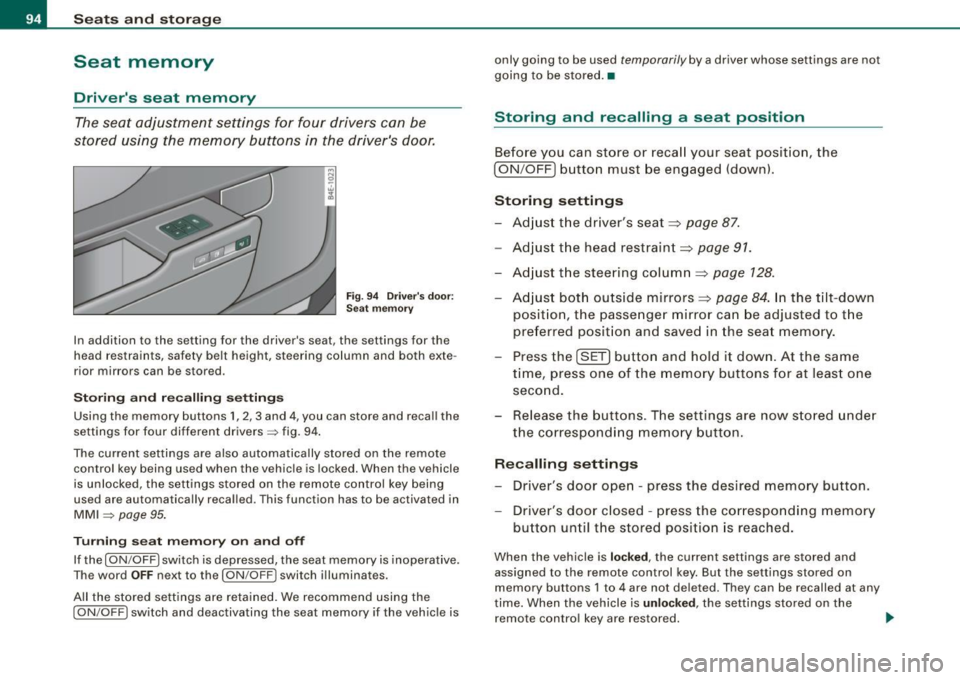
Fig. 94 Driver's door:
Seat memory
In addition to the setting for the driver's seat, the settings for the
head restraints, safety belt height, steering column and both exte
rior mirrors can be stored .
Storing and recalling settings
Using the memory buttons 1, 2 , 3 and 4, you can store and recall the
settings for four different drivers=> fig. 94.
The current settings are also automatically stored on the remote control key being used when the vehicle is locked. When th e vehicle
is unlocked, the settings stored on the remote control key being
used are automatically recalled . Th is function has to be activated in
MMI => page 95.
Turning seat memory on and off
If the [ ON /OFF I switch is depressed, the seat memory is inoperative.
The word
OFF next to the [ON /OFF ! switch illuminates.
All the stored settings are retained. We recommend using the
[ ON /OFF! switch and deactivating the seat memory if the vehicle is only going to be used
temporar
ily by a driver whose settings are not
going to be stored. •
Storing and recalling a seat position
Before you can store or recall your seat position, the
[ ON /OFF] button must be engaged (down) .
Storing settings
- Adjust the driver's seat=>
page 87.
-Adjust the head restraint=> page 91.
-Adjust the steering column=> page 128.
-Adjust both outside mirrors=> page 84. In the tilt-down
position, the passenger mirror can be adjusted to the
preferred position and saved in the seat memory.
- Press the [SET] button and hold it down. At the same
time, press one of the memory buttons for at least one
second.
- Release the buttons. The settings are now stored under
the corresponding memory button.
Recalling settings
- Driver's door open - press the desired memory button .
- Driver's door closed - press the corresponding memory
button until the stored position is reached.
When the vehicle is locked, the current settings are stored and
assigned to the remote control key. But the settings stored on
memory buttons 1 to 4 are not deleted. They can be recalled at any
time. When the vehicle is
unlocked , the settings stored on the
remote control key are restored. .,_
Page 99 of 408
Rear window shelf
You can place li gh t a rticles of cl othing on the re ar
w indow shelf behind the sea tbac k.
& WARNING
When dr iv ing , do not leave any hard objects on the rear w indow
s helf or allow your pet to sit on the shelf . They could be come a
hazard for vehicle oc cup ants in the event of sudden bra king or a
c rash .
[ i ] Tips
• A vent slot is located between t he shel f and the rear w indow . Do
not block the vent with any items you may place on the rear window
she lf.
• Do not place bulky items on the rear window shelf as they could
restrict or block the driver's vision in the rear view mirro r.•
Con tro ls and eq uip
ment
Seats and storag e
Individual rear seats
Applies to ve hicles : w ith ind iv id ual rea r sea ts
Controls
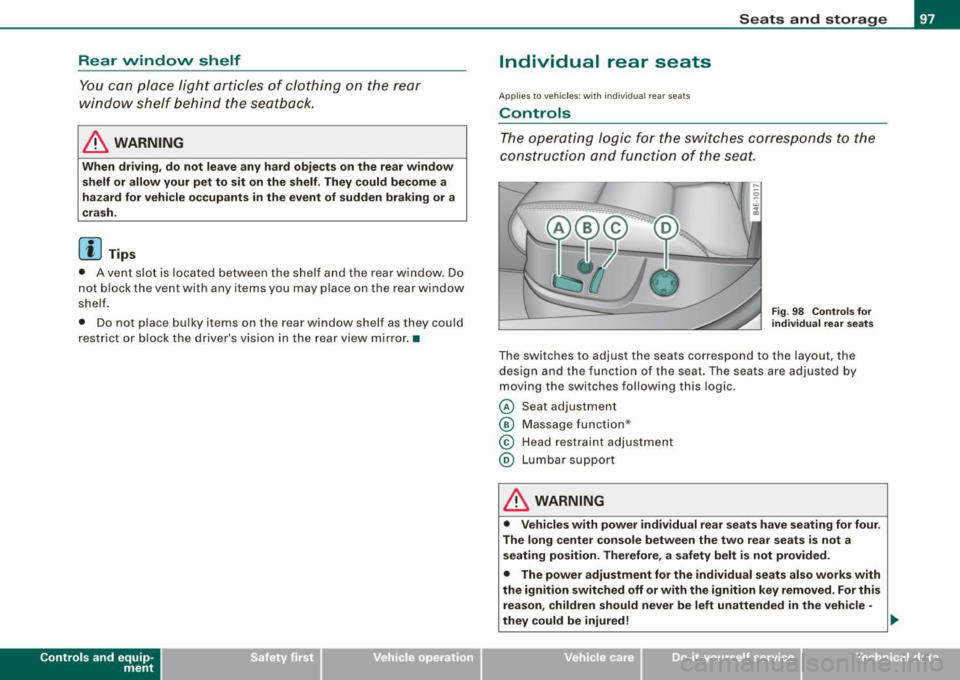
The operating logic for the switches corresponds to the
construction and function of the seat.
Fi g. 9 8 Co ntrols fo r
individual r ear seats
The switches to adjust the seats correspond to the layout, the
design and the function of the seat. The seats are adjusted by
moving the switches following this logic .
@ Seat adjustment
@ Massage function *
© Head restraint adjustment
@ Lumbar support
& WARNING
• Vehicl es with power individual rear se ats have seating for four .
The long center co nsole between the two rear se ats is not a
s eating po sition. Th erefore , a safety belt i s not provided.
• The power adjustment for the individual seats al so works with
the ignition switched off or with the ignition key removed . For this
re ason , children should never be left unattended in the vehi cle -
they could be injured!
~
Vehicle care I I irechnical data
Page 100 of 408
Seats and storage
& WARNING (continued )
• Exercise caution when adjusting the seats . Unsupervised or
ca reless seat adjustment can p inch fingers or ha nds causing
injuries .•
Ap plies t o vehic les : w it h ind iv id ual rear se at s
Seat adjustment
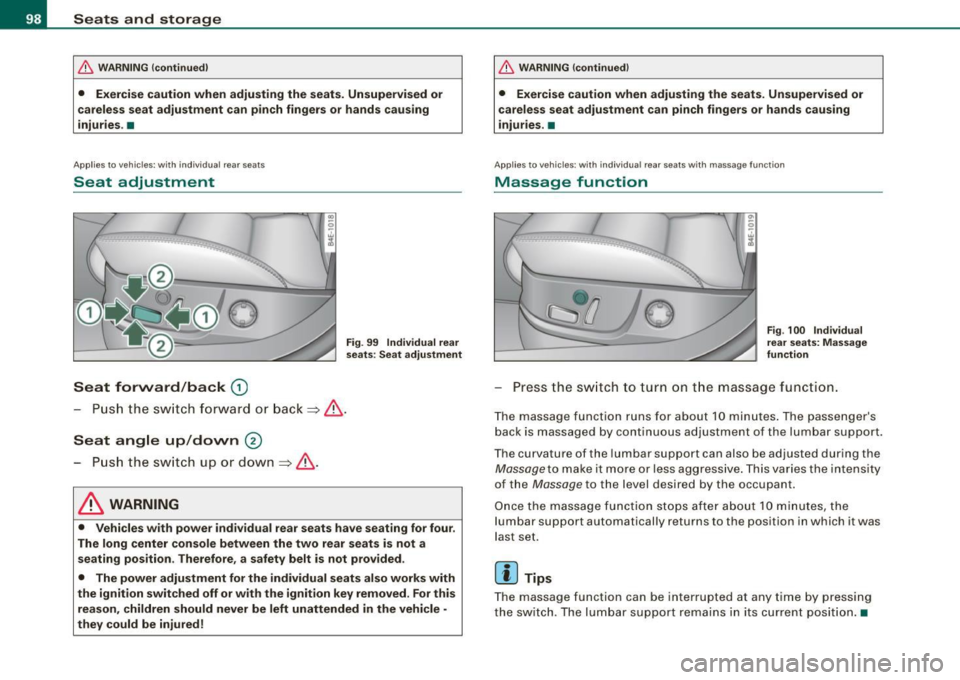
Seat forward/back G)
Fig . 99 Individual rear
seat s: Seat adju stment
- Push t he swi tch forwa rd or ba ck => & .
Seat angle up /down @
- Push th e sw itch u p or do wn => & .
& WARNING
• Vehicles with power individual rear seats have seating for four .
The long center console between the two rear seats is not a seating position . Therefore, a safety belt is not provided .
• The power adjustment for the individual seats also works with
the ignition switched off or with the ignition key removed . For this
reason , children should never be left unattended in the vehicle •
they could be injured !
& WARNING (continued )
• Exercise caution when adjusting the seats. Unsupervised or
careless seat adju stment can pinch fingers or hands causing
injuries. •
Applies t o vehic les : w it h in d iv id ual re ar sea ts with m ass ag e func tion
Massage function
F ig . 100 Individual
rear seats: Massage
function
Pr ess th e swi tch to t urn on t he massag e function.
T he massage function runs fo r about 10 minutes . T he pa ssenge r's
bac k is massaged by continuous ad justment of the lumbar support .
T he curvature of the lumbar suppo rt can also be ad justed during the
Mas sage to mak e it mo re or less aggr ess ive . T hi s var ies t he in tens ity
of the
Massage to the level desired by the occupa nt.
O nce the mas sage func tio n stops afte r abou t 10 m inut es, the
l umbar support automatically returns to t he position in which it was
l a st se t.
[ i ] Tips
T he m ass age function can be interrupted at a ny tim e by pre ssi ng
the switc h. T he lum bar support r emains i n its cu rren t po sit io n.•
Page 104 of 408
• ..__S_ e_ a_t _s _ a_n _d_ s_ t_ o _ r_ a_ g=- e ______________________________________________ _
The mounting hooks are spring-loaded and will return to their
normal position when not in use.
& WARNING
For strength-related reasons, the mounting hooks can only be
used to secure objects weighing up to 10 lb .
15 kgl. Heavier objects
will not be adequately secured -there is a risk of injury. •
Applies to vehi cles : wi th sk i sa ck
Ski sack
Use the ski sack to transport and protect skis and other
long, light items in the passenger compartment.
O •----0
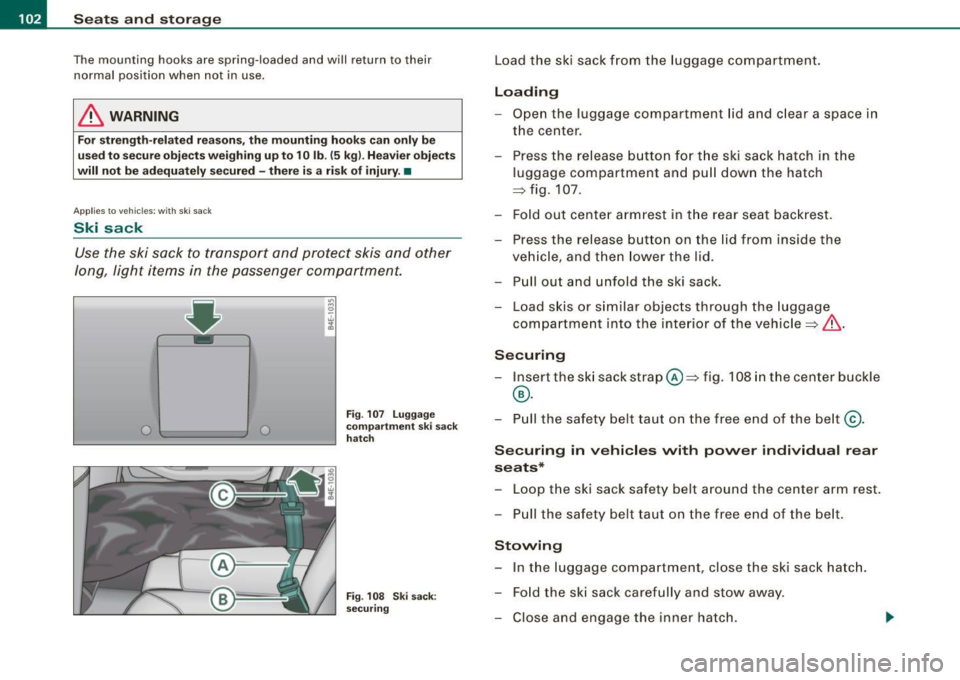
Fig . 107 Luggage
compartment ski sack
hatch
Fig . 108 Ski sack:
securing
Load the ski sack from the luggage compartment.
Loading
- Open the luggage compartment lid and clear a space in
the center.
- Press the release button for the ski sack hatch in the
luggage compartment and pull down the hatch
~ fig. 107.
- Fold out center armrest in the rear seat backrest.
- Press the release button on the lid from inside the
vehicle, and then lower the lid.
- Pull out and unfold the ski sack.
- Load skis or similar objects through the luggage
compartment into the interior of the vehicle~& .
Securing
- Insert the ski sack strap@~ fig. 108 in the center buckle
®·
- Pull the safety belt taut on the free end of the belt@.
Securing in vehicles with power individual rear
seats*
Loop the ski sack safety belt around the center arm rest.
- Pull the safety belt taut on the free end of the belt .
Stowing
- In the luggage compartment, close the ski sack hatch.
- Fold the ski sack carefully and stow away.
- Close and engage the inner hatch.
Page 105 of 408
__________________________________________________ S_ e_ a_t _s _ a_n_ d_ s_ t_ o _r_a ..;:g::... e __ _
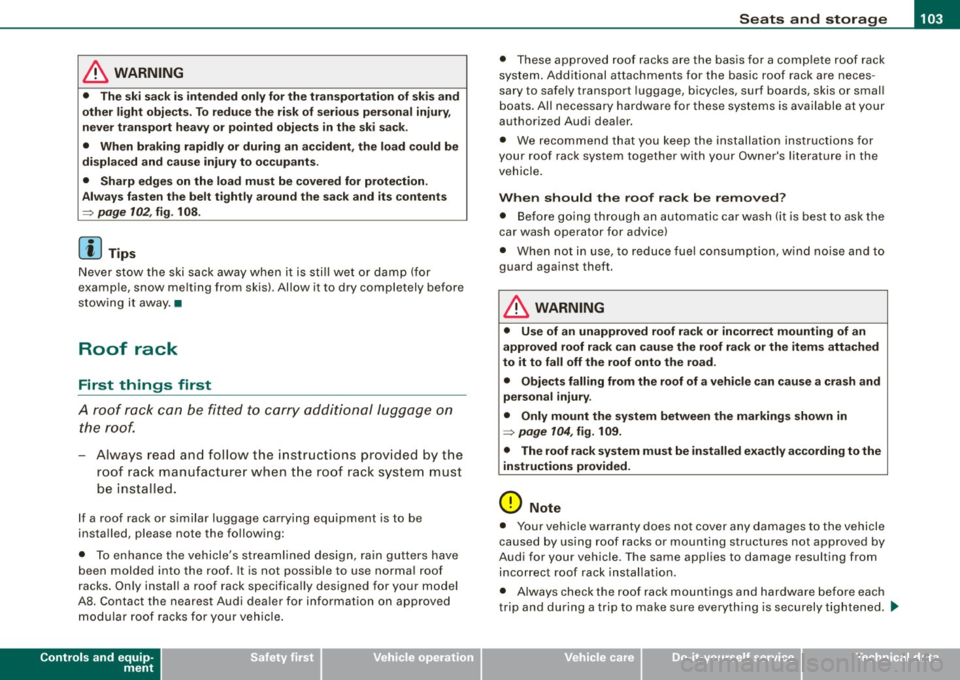
& WARNING
• The ski sack is intended only for the transportation of ski s and
other light objects . To reduce the risk of serious per sonal in jury,
neve r tran sport heavy or pointed objects in the ski sa ck.
• When braking rapidly or during an accident , the load could be
d is pl ac ed and cau se inju ry to o ccupants .
• Sharp edges on the load mu st be covered for protection.
Always f asten the belt t ightly around th e sa ck and it s contents
=> pag e 102 , fig. 108.
[ i J Tips
Never stow the ski sack away when i t is sti ll wet or damp (for
examp le, snow me lting from skis) . Allow it to dry completely before
stowing it away. •
Roof rack
First things first
A roof rack can be fitted to carry addi tio nal luggage on
the roof.
- Always read and follow the i nstructions provided by the
roof rac k manufacture r w hen t he roof rack system must
be installed.
I f a roof rack or similar luggage carrying equipment is to be
insta lled, please note the following:
• To enhance the vehicle's streaml ined design, rain gu tters have
been molded into the roof. It is not possible to use norma l roof
racks . Only instal l a roof rack sp ecifically designed f or your mo del
A8. Contact the nearest Audi dea ler for information on approved
m odula r roof racks for your veh icle .
Controls and equip
ment
• T hese approved roof racks are the basis for a comp lete roof rack
sys tem . Add itio nal attachments for the basic roof rack are neces
sary to safe ly transport luggage, bicycles, surf boards, skis or smal l
boats. All necessary hardware fo r these systems is available at your
authorized Audi dea ler.
• We reco mmend t hat you keep the installation i nstructi ons for
your roof rack system together with your Owner's literature in the
vehicle .
When should the ro of r ac k be remo ved ?
• Before g oing th rough an a uto matic car wash (it is bes t to ask the
car wash operator for advice)
• When not i n use, to reduce fue l consumption, wind noise and to
guard against theft.
& WARNING
• Use of an unapproved roof r ack or in corre ct mounting of an
a pp roved roof r ack can c ause the roof rack or the ite ms attached
to it to fall off the roof onto the road .
• Obje cts falling from the roof of a veh icle c an c ause a cras h and
personal inj ury .
• Onl y mount the sy stem between the marking s shown in
=> page 104 , fig. 109.
• The roof ra ck sy stem must be installed e xa ctly a ccording to the
instruction s provided .
0 Note
• Your vehicle warranty does not c over any damages t o the vehicle
caused by using roof racks or mounting structures not approved by
Audi for your vehicle. The same applies to damage resulting from
incorrect roof rack installation.
• Always check t he r oof rack m ount ings and hardware before eac h
trip and during a trip to make sure everything is securely tightened . .,,
I • •
Page 202 of 408
........ _o_ r_iv _i_ n""' g::;._ S_ a_f _e _ly =---------------------------------------------------
Driving Safely
General notes
Safe driving habits
Please remember -safety first!
This chapter contains important information , tips, instructions and
warnings that you need to read and observe for your own safety, the
safety of your passengers and others. We have summarized here
what you need to know about safety belts, airbags, child restraints as well as child safety. Your safety is for us
priority number 1. Always
observe the information and warnings in this section -for your own
safety as well as that of your passengers.
The information in this section applies to all model versions of your
vehicle. Some of the features described in this sections may be
standard equipment on some models, or may be optional equip
ment on others. If you are not sure, ask your authorized Audi dealer.
& WARNING
• Always make sure that you follow the instructions and heed
the WARNINGS in this Manual. It is in your interest and in the interest of your passengers.
• Always keep the complete Owner's Literature in your Audi
when you lend or sell your vehicle so that this important informa
tion will always be available to the driver and passengers.
• Always keep the Owner's literature handy so that you can find
it easily if you have questions. •
Safety equipment
The safety features are part of the occupant restraint
system and work together to help reduce the risk of injury
in a wide variety of accident situations.
Your safety and the safety of your passengers should not be left to
chance. Advances in technology have made a variety of features
available to help reduce the risk of injury in an accident. The
following is a list of just a few of the safety features in your Audi:
• sophisticated safety belts for driver and all passenger seating
positions,
• safety belt pretensioners,
• safety belt force limiters for the front seats,
• safety belt height adjustment systems for the front seats,
• front airbags,
• knee airbags for the front seats
• side airbags in the front seats and outer rear seats,
• side curtain airbags,
• special LATCH anchorages for child restraints,
• head restraints for each seating position,
• adjustable steering column.
These individual safety features, can work together as a system to
help protect you and your passengers in a wide range of accidents.
These features cannot work as a system if they are not always correctly adjusted and correctly used.
Safety is everybody's responsibility! •
Page 203 of 408
__________________________________________________ D _r_iv _ in_ g~ S_ a_f _e _l_ y __ llll
Important things to do before driving
Safety is everybody's job! Vehicle and occupant safety
always depends on the informed and careful driver.
For your safety and the safety of your passengers, before
driving always:
-Make sure that all lights and signals are operat ing
correctly.
- Make sure that the tire pressure is correct.
- Make sure that all windows are clean and afford good
visibility to the outside.
- Secure all luggage and other items carefully~
page 109.
-Make sure that noth ing can interfere w ith the pedals.
- Adjust front seat, head restraint and mirrors correctly for your height .
- Instruct passengers to adjust the head restraints
according to their height.
- Make sure to use the right ch ild restraint correctly to
protect children ~
page 245, "Child Safety ".
- Sit properly in your seat and make sure that your passen
gers do the same~
page 86, "General recommenda
tions".
- Fasten your safety belt and wear it p roperly. Also instruct
your passengers to fasten the ir safety belts properly
~ page 217. •
Controls and equip
ment Safety first
Vehicle operation
What impairs driving safety?
Safe driving is directly related to the condition of the
vehicle, the driver as well as the driver's ability to concen
trate on the road without being distracted.
The driver is responsible for the safety of the vehicle and all
of its occupants. If your ability to drive is impaired, safety
risks for everybody in the vehicle increase and you also
become a hazard to everyone else on the road ~& .There
fore:
Do not let yourself be distracted by passengers or by
using a cellular telephone .
NEVER drive when your driving ability is impaired (by
medications, alcohol, drugs, etc.).
- Observe all traffic laws, rules of the road and speed limits
and plain common sense .
- ALWAYS adjust your speed to road, traffic and weather
conditions.
- Take frequent breaks on long trips. Do not drive for more
than two hours at a stretch.
- Do NOT drive when you are tired, under pressure or when
you are stressed .
& WARNING
Impaired driving safety increases the risk of serious personal
injury and death whenever a vehicle is being used. •
Vehicle care Do-it-yourself service Technical data
Page 204 of 408
-Driving Safely --=------'---------------
Proper occupant seating positi
·ons
Proper seating position for the driver
The proper driver seating position is important for safe,
relaxed driving.
"' N
;
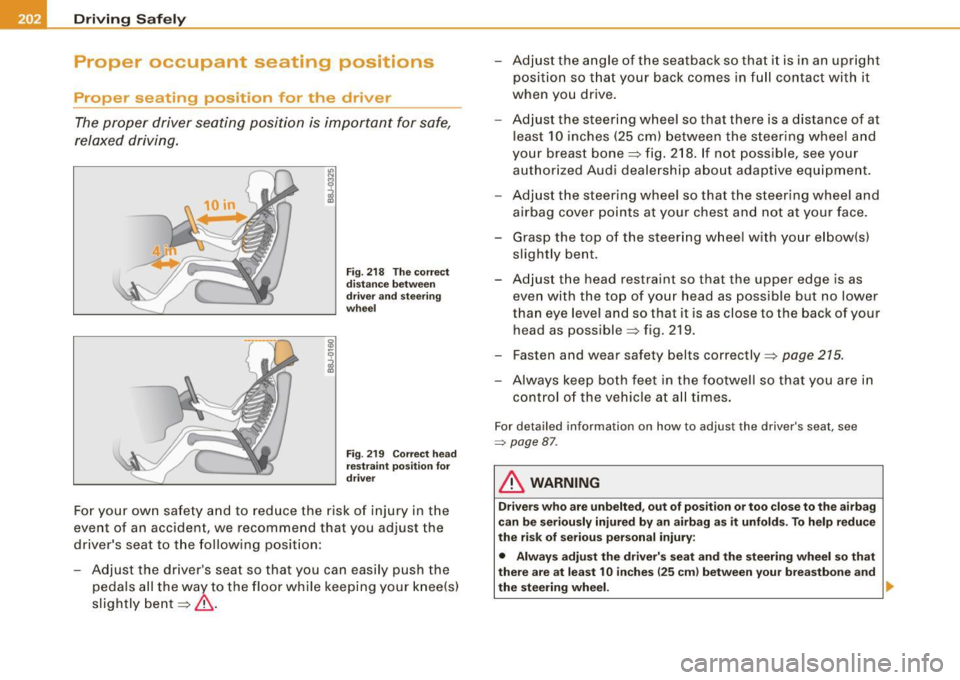
Fig. 218 The correct
distance between
driver and steering
wheel
Fig . 219 Correct head
restraint position for
driver
For your own safety and to reduce the risk of injury in the
event of an accident, we recommend that you adjust the
driver's seat to the following position:
- Adjust the driver's seat so that you can easily push the
pedals all the way to the floor while keeping your knee(s)
slightly bent=:>& . - Adjust the angle of the seatback so that it is in an upright
position so that your back comes in full contact with it
when you drive.
- Adjust the steering wheel so that there is a distance of at
least 10 inches (25 cm) between the steering wheel and
your breast bone=:> fig. 218. If not possible, see your
authorized Audi dealership about adaptive equipment.
- Adjust the steering wheel so that the steering wheel and
airbag cover points at your chest and not at your face.
- Grasp the top of the steering wheel with your elbow(s)
slightly bent.
- Adjust the head restraint so that the upper edge is as even with the top of your head as possible but no lower
than eye level and so that it is as close to the back of your
head as possible =:> fig . 219.
- Fasten and wear safety belts correctly=:>
page 215.
- Always keep both feet in the footwell so that you are in
control of the vehicle at all times.
For detailed information on how to adjust the driver's seat, see
=> page 87 .
& WARNING
Drivers who are unbelted, out of position or too close to the airbag
can be seriously injured by an airbag as it unfolds. To help reduce
the risk of serious personal injury:
• Always adjust the driver's seat and the steering wheel so that
there are at least 10 inches
125 cm) between your breastbone and
the steering wheel. ..
Page 205 of 408
________________________________________________ D_r_iv _ i _n_ g~ S_ a_ fe_ ly __ l!III
& WARNING (continued)
• Always adjust the driver's seat and the steering wheel so that
there are at least 4 inches (10 cm) between the knees and the
lower part of the instrument panel.
• Always hold the steering wheel on the outside of the steering
wheel rim with your hands at the 9 o'clock and 3 o'clock positions
to help reduce the risk of personal injury if the driver's airbag inflates .
• Never hold the steering wheel at the 12 o'clock position or with
your hands at other positions inside the steering wheel rim or on
the steering wheel hub. Holding the steering wheel the wrong way
can cause serious injuries to the hands, arms and head if the
driver's airbag inflates
• Pointing the steering wheel toward your face decreases the
ability of the supplemental driver's airbag to protect you in a colli
sion .
• Always sit in an upright position and never lean against or
place any part of your body too close to the area where the airbags
are located.
• Before driving, always adjust the front seats and head
restraints properly and make sure that all passengers are properly
restrained .
• Never adjust the seats while the vehicle is moving. Your seat
may move unexpectedly and you could lose control of the vehicle.
• Never drive with the backrest reclined or tilted far back! The
farther the backrests are tilted back, the greater the risk of injury due to incorrect positioning of the safety belt and improper
seating position.
• Children must always ride in child seats
=> page 245. Special
precautions apply when installing a child seat on the front
passenger seat
=> page 220. •
Controls and equip
ment Safety first
Vehicle operation
Proper seating position for the front
passenger
The proper front passenger seating position is important
for safe, relaxed driving.
For your own safety and to reduce the ris k of injury in the
event of an accident, we recommend that you adjust the
seat for the front passenger to the following pos ition:
- Move the front passenger seat back as far as possible.
There must be a minimum of 10 inches (25 cm) between
the breastbone and the instrument panel =>
&.
- Adjust the angle of the seatback so that it is in an upright
position and your back comes in full contact with it
whenever the vehicle is moving.
- Adjust the head restraint so that the upper edge is as
even with the top of your head as possible but not lower
than eye level and so that it is as close to the back of your
head as possible =>
page 205.
-Keep both feet flat on the floor in front of the front
passenger seat.
- Fasten and wear safety belts correctly=:>
page 215.
For detailed information on how to adjust the front passenger's
seat, see => page 86.
& WARNING
Front seat passengers who are unbelted, out of position or too
close to the airbag can be seriously injured or killed by the airbag
as it unfolds. To help reduce the risk of serious personal injury : .,
Vehicle care Do-it-yourself service Technical data
Page 206 of 408
lffll..,___D_ r_iv _i_ n""' g::;._ S_ a_f _e _ly =---------------------------------------------------
& WARNING (continued)
• Passengers must always sit in an upright position and never
lean against or place any part of their body too close to the area
where the airbags are located.
• Passengers who are unbelted, out of position or too close to the
airbag can be seriously injured by an airbag as it unfolds with
great force in the blink of an eye .
• Always make sure that there are at least 10 inches (25 cm)
between the front passenger's breastbone and the instrument
panel.
• Always make sure that there are at least 4 inches (10 cm)
between the front passenger's knees and the lower part of the
instrument panel .
• Each passenger must always sit on a seat of their own and
properly fasten and wear the safety belt belonging to that seat .
• Before driving, always adjust the front passenger seat and
head restraint properly.
• Always keep your feet on the floor in front of the seat. Never
rest them on the seat, instrument panel, out of the window, etc .
The airbag system and safety belt will not be able to protect you properly and can even increase the risk of injury in a crash .
• Never drive with the backrest reclined or tilted far back! The
farther the backrests are tilted back, the greater the risk of injury
due to incorrect positioning of the safety belt and improper
seating position.
• Children must always ride in child seats :::::,
page 245. Special
precautions apply when installing a child seat on the front
passenger seat
=:> page 220. •
Proper seating positions for passengers in
rear seats
Rear seat passengers must sit upright with both feet on
the floor consistent with their physical size and be prop
erly restrained whenever the vehicle is in use.
To reduce the risk of injury caused by an incorrect seating
position in the event of a sudden braking maneuver or an
accident, your passengers on the rear bench seat must
always observe the following:
- Adjust the head restraint so that the upper edge is as
even with the top of your head as possible but no lower
than eye level
=> page 205.
- Keep both feet flat in the footwell in front of the rear seat.
Fasten and wear safety belts properly =>
page 215.
Make sure that children are always properly restrained in
a child restraint that is appropriate for their size and age
=>
page 245.
& WARNING
Passengers who are improperly seated on the rear seat can be
seriously injured in a crash.
• Each passenger must always sit on a seat of their own and
properly fasten and wear the safety belt belonging to that seat.
• Safety belts only offer maximum protection when the safety
belts are properly positioned on the body and securely latched. By
not sitting upright , a rear seat passenger increases the risk of
personal injury from improperly positioned safety belts!
• Always adjust the head restraint properly so that it can give
maximum protection. •