brake fluid AUDI S8 2009 User Guide
[x] Cancel search | Manufacturer: AUDI, Model Year: 2009, Model line: S8, Model: AUDI S8 2009Pages: 408, PDF Size: 91.63 MB
Page 292 of 408
___ C_ le_ a _ n_i_n ~g _ a_ n_ d __ p_r _o _t _e _c_ t_ i_o _n ___________________________________________ _
Cleaning and protection
General information
Regular care preserves vehicle value.
Any automobile is exposed to industrial fumes, corrosive road salt,
muddy dog feet, etc . A well cared for Audi can look like new many
years a fter purchase. Regu lar a nd correct ca re will co ntribu te to
maintaining the beauty and value of your Audi.
Furthermore, good care may be a condition for substantiating a
war ranty claim should co rros ion damage or paint defect s occur .
Your authorized Audi dealer has a variety of dedicated vehicle- care
product s
and can adv ise whic h ones to use for clea ning the e xter ior
and interior of your vehicle.
Whethe r you use p roducts recommended by Audi or other c ommer
cia lly availab le cleaning agents , please make sure you apply them
correctly.
& WARNING
• Cleaning agents may be poisonous. Keep them out of the reach
of ch ildren .
• Heed all caution label s.
• Always read directions on the contai ner before using any
product. Follow the di rection s carefully .
• Most chemical cleaners are concentrated and have to be
d iluted.
• Use spot removing fluids only in well ventilated area s.
• Do not use gasoline , kerosene , die sel fuel , nail polish remover
or other volatile fluids . They may be toxic , flammable or hazardous
in other way s. Do not wash , wa x or dry the vehicle w ith the igni
tion on or the engine running.
& WARNING (continued )
• Do not clean the under side s of chassis , fenders , wheel cove rs,
etc . without protecting your hands and arms. You may cut yourself
on sharp -edg ed metal parts .
• Moisture and ice on brakes may impair braking effi ciency
=> page 272 , "General info rmation ". Test the brake s carefully each
time you wa sh the vehicle.
~ For the sake of the environment
Se lect only enviro nmenta lly friend ly c leaning products . Leftover
clean ing products should not disposed of in the household waste. •
Care of exterior
Washing
Frequen t washing pro tects the vehi cle.
Th e bes t protection against envi ronmental influences is frequent
washing and waxing . How often this is required depends on:
• Ho w much the vehic le is used
• Where the vehic le is parked (garage, in the open under trees,
etc.)
• T he seasonal and weather conditions
• Environmenta l influences
T he longer bird droppings, insects, tree resin, road and industrial
gri me, tar, soot, road salt and ot her materials rema in on the ve hicle
body, the more lasting their destruc tive effects will be . High temper
atu res caused by exp osu re to in tense s un ligh t inte nsify the c orro -
sive effect, particularly when humidity is high as well.
~
Page 311 of 408
_____________________________________________ C_ h_ e .=....= c..:..k :..:.in :....:..:= g:.....= a..:..n .:....:d::......:. f.:..:il .:..:li ..:..n ::.:g:!....-_11111
•
Closing the engine hood
- Pull the hood down until the pressure from the struts is
reduced .
- Let the hood
drop down and latch in place. Do not try to
push it shut;
it may fail to engage => &.
& WARNING
A hood that is not completely latched could fly up and block your
view while driving.
• When you close the engine hood, check it to make sure the
safety catch has properly engaged. The hood should be flush with
the surrounding vehicle body parts.
• If you notice while driving that the hood is not secured prop
erly, stop at once and close it. •
Working in the engine compartment
Be especially careful whenever you work in the engine
compartment.
Whenever you must perform any work in the engine compartment,
for example checking and filling different fluids, there is a risk of injury, burns and accidents. To prevent personal injury always
observe the following WARNINGS. The engine compartment of any
vehicle is a hazardous area
~ & .
& WARNING
To help avoid injury, before you check anything under the hood :
• Turn off the engine.
• Remove the ignition key.
• Apply the parking brake .
& WARNING (continued)
• Move selector lever to "P" (Park).
• Always let the engine cool down. Hot components will burn
skin on contact.
• To reduce the risk of being burned, never open the hood if you
see or hear steam or coolant escaping from the engine compart
ment. Wait until no steam or coolant can be seen or heard before
carefully opening the hood.
• Keep children away from the engine compartment .
• Never spill fluids on hot engine components. They can cause a
fire.
• Never touch the radiator fan. The auxiliary electric fan is
temperature controlled and can switch on suddenly.
• Never open the coolant reservoir cap when the engine is still
warm . The coolant system is pressurized and hot coolant could
spray out.
• Protect your face, hands and arm from steam or hot engine
coolant by placing a thick rag over the cap when you open the
coolant reservoir.
• If work on the fuel system or the electrical system is necessary :
- Always disconnect the battery.
- Never smoke or work near heaters or open flames . Fluids in
the engine compartment could start a fire.
- Keep an approved fire extinguisher immediately available.
• To avoid electrical shock and personal injury while the engine
is running or being started, never touch:
- Ignition cables
- Other components of the high voltage electronic ignition system.
• If you must perform a check or repair with the engine running: -First, fully apply the parking brake, move selector lever to "P"
(Park). .,
Vehicle care
I t •
Page 312 of 408
___ C_h_ e_ c_k _in --== g'-- a_n _d_ f_il _li _n ..:::g:::..- ___________________________________________ _
& WARNING (continued )
-Always u se extreme caution to prevent cloth ing , jewelry, or
long hair from getting caught in the radiator fan , V-belt s or
other moving parts , or from contacting hot parts . Tie back hair
before starting , and do not wear clothing that will hang or
droop into the engine .
• Minimize exposure to emis sion and chemical hazards
::::> & .
& WARNING
California Proposition 65 W arn ing :
• Engine exhaust , some of its constituents , and certain vehicle
c omponents cont ain or emit chemicals known to the State of Cali
fornia to cause cancer and birth defects and reproductive harm. In addition , certain fluids contained in vehi cles and certa in products
of component wear contain or emit chemicals known to the State
of California to cause cancer and birth defect s or other reprodu c
tive harm.
• Battery posts , terminals and related ac cessories conta in lead
and lead compounds , chemicals known to the State of California
to cause cancer and reproductive harms. Wash hands after
handling.
0 Note
When adding f luids, always make sure that they are poured into the
proper container or filler ope ning, otherwise serious damage to
vehic le systems wi ll occur .
ci> For the sake of the environment
To detect leaks in time, inspect the vehicle floor pan from under
n eath regularly. If you see spots fro m oil o r o th e r v eh icle flu ids, hav e
your vehicle inspected by an author iz ed Audi dea le r. •
Engine compartment
Ap plies to vehi cle s: w ith 8 -c yli nd er e ng in e
Engine compartment overview : 8-cylinder
engine
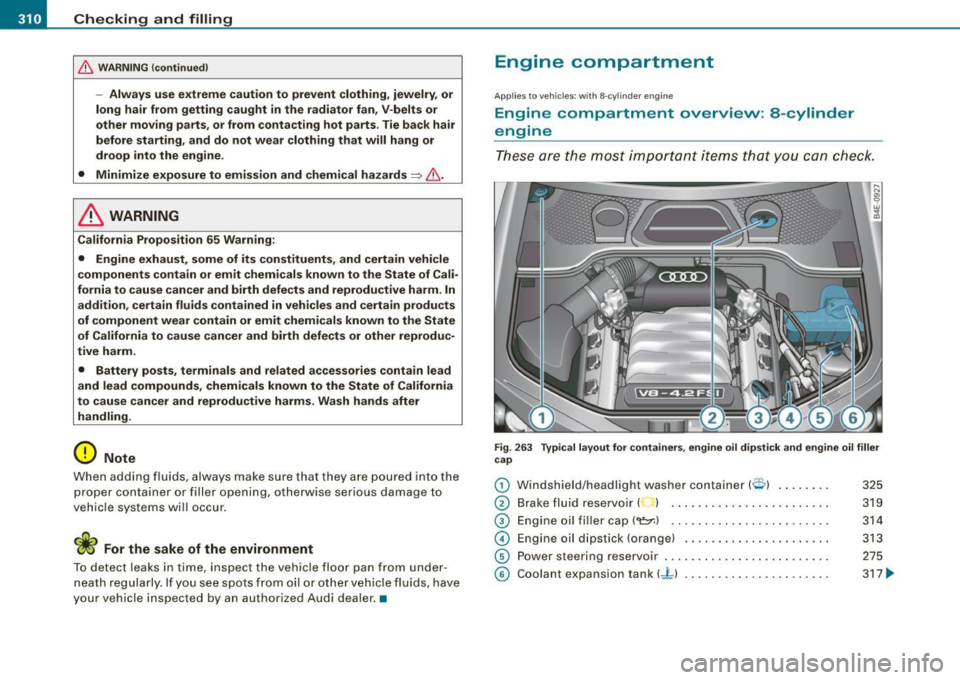
T hese are the mos t impor tant items th at you c an ch eck .
Fig. 26 3 Typical l ayout for containe rs, engine o il d ip stic k and engine oil fille r
c a p
G) Winds hield/headlight washer containe r(<;;;> ) .. ..... .
0 Brake fluid reservoir ( l) .. .. .. .. ...... .... ... .. .
© En gine oil filler cap ('I::?:) .. .. .... ...... .... ... . _ .
© Engine oil d ipstick (orange) .... ..... ........ .... .
© Power st eering r eservoir ...... ........ ... ......• .
© Coolant expansion tank (- L l ... ...... .... ... .... . .
325
319
314
31 3
275
317 ..
Page 313 of 408

Checking and filling -
------------- ----=-----= =-----...J
& WARNING
Before y ou che ck an ything in the eng ine comp artment , alw ays
read and heed all WARNING S
~ & in "W orkin g in the engin e
c ompartment " on
page 309. •
App lies to ve hic les : with 1 2-cy lin d er engine
Engine compartment overview : 1 2-cylinder
engine
These are the most important items tha t you can check.
Fig . 264 Typical layo ut fo r c ontain ers, engi ne oil dip st ick a nd e ngine o il filler
ca p
G) Windshield/head light washer container ( Q ) . . . . . . . . 325
@ Brake fluid reservoir ( l . . . . . . . . . . . . . . . . . . . . . . . . 319
© Engine oi l dipstick (orange) . . . . . . . . . . . . . . . . . . . . . . 313
© Engine oil fi ller cap ('t=:11) .. .. ... ... .... .. .. ... .. . .
© Coolan t expansion tank(_}_ ) ... ........ .... ... ... .
& WARNING
Before you check anything in th e engine co mpartment , alw ays
r e a d and heed all WARNIN GS
~ & in " Worki ng i n t he engin e
c ompartm ent " on
page 309.
[ i ] Tip s
The coo lant expansion tank is located under a cover .•
Engine oil
Engine oil specifications
314
317
The engine oil us ed in your Audi needs the right kind of
oil.
Th e engin e in your Audi is a soph isticat ed pow erplant that was built
to exacting specifications . This engine needs the right kind of
e ngine o il that meets specifications regarding quality and v iscosity
so that it can run smoothly and re liably. Choosing the righ t oil and
changing o il wi thin the time and mileage interva ls printed in your
vehicle's Warranty
& Ma intenance book let matte rs a lot more today
than it did years ago . Audi has developed a special quality standard
for engine oil that wil l help assure that your vehicle's engine wi ll get
the lub rication it needs for proper operation .
Modern engin e lubrication has taken a quantum leap in the last few
years . Many syn thetic oils ava ilable today provide better engine
lubrica tion that can outlas t traditional petroleum-based oils,
making them a smart choice for use throughout the life of your Audi.
Whether you use synthetic or petroleum -based engine oil , the oil
that you use must conform to Audi's oi l quality standard VW 502 00
ti,,,
Vehic le care I I Technical data
Page 321 of 408
Checking and filling 111111 _______________________________ =..:..:..::...:::...:...:~:....:...;_.:....::___--:::-------J
& WARNING !continued )
• Antifr eeze is po isonous. Always store antifreeze in it s original
c ontainer and well out of the re ach of children .
• If you drain the coolant, it must be caught and safely stored in
a proper co ntainer cle arly m arked "poi son ".
0 Note
• Coolant po llutes the environment and cou ld cause an engine
fire. Excess coolant will be forced out through the pressure relief
valve in the cap when the engine becomes hot.
• I f, in an emergency, only wa ter can be added, the correct ratio
between water and antifreeze=>
page 316 must be restored as soon
as possib le .
W For the sake of the environment
Drained coolant should not be reused. A lways dispose of used
coolant while observing all environ mental regula tions . •
Radiator fan
The radiator fan switches on au tomatically by i tself.
T he radiator fan is driven by the engine via the V-belt. The viscous
clutch regulates the speed of the fan according to the temperature
of the coo lan t.
An auxiliary electric radiator fan * switches on and off depending on
coolant tem perature and o ther vehic le opera ting condi tions.
After you switch the engine off , the auxiliary fan can continue
running for up to 10 minutes -even with the ignition off. It can even
switch on again later by itself=>&, if
• the temperature of the engine coolant rises due to the heat
bu ild -up from the engine i n the engine c ompar tment, or •
the engine compartment heats up because the vehicle is parked
in intense sunligh t.
& WARNING
• To reduce the ri sk of personal injury never touch the radiator
f a n .
• The aux iliary electric fan i s te mperature controlled and can
switch on suddenly even when the engine is not running .
• The au xiliary radiato r fan switche s on automatic ally when th e
eng ine coolant reache s a certain temperature and
will continue to
r un until the coo lant tempe rature drop s. •
Brake fluid
Checking brake fluid level
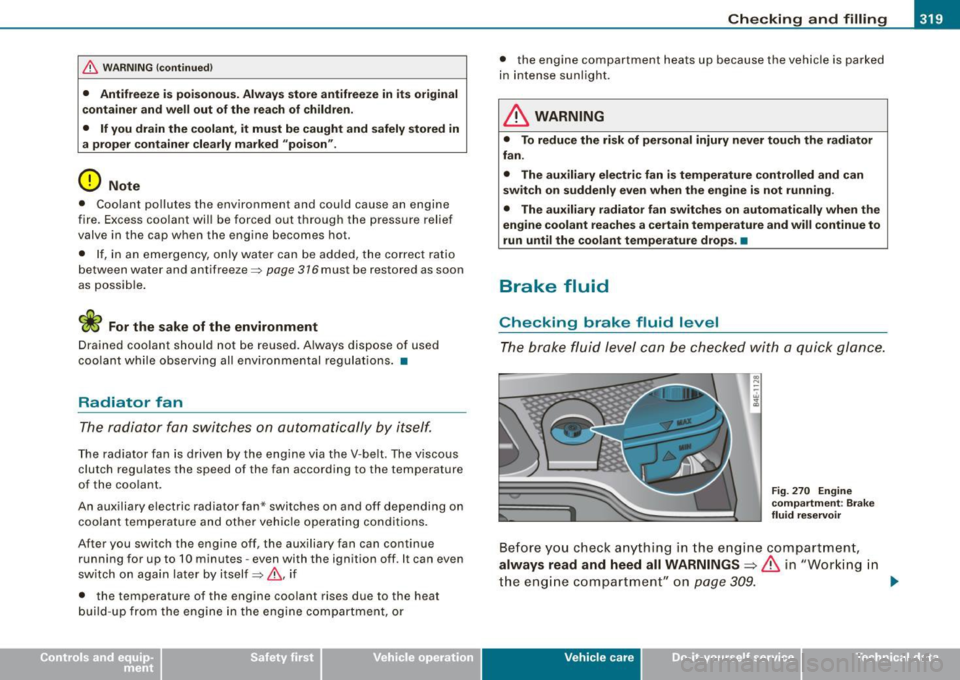
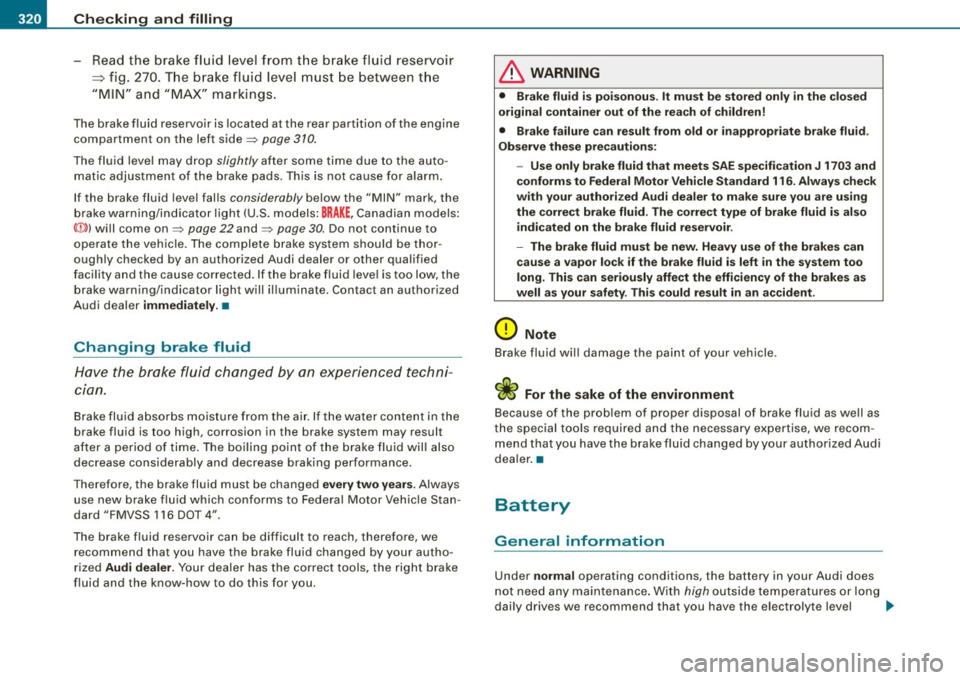
T he brake fluid level can be checked with a quick glance.
-w ;:;
Fig . 270 Engin e
c o mpartm ent: B ra ke
fluid r ese rvo ir
Before you check anything in the e ngine comp artmen t,
always read and heed all WARNINGS:::::> & in "Working in
t h e engi ne compartment" on
page 3 09. .,_
Vehicle care I I irechnical data
Page 322 of 408
-~_C_ h_e _c _ k_ i_n ...:::g::;...._ a_n_ d_ f_ i_ll _in -'g:::;.._ ___________________________________________ _
-Read the brake fluid level from the brake fluid reservoir
=> fig. 270. The brake fluid level must be between the
"MIN" and "MAX" markings.
The brake fluid reservoir is located at the rear partition of the engine
compartment on the left side~ page 310.
The fluid level may drop slightly after some time due to the auto
matic adjustment of the brake pads. This is not cause for alarm.
If the brake fluid level falls considerably below the "MIN" mark, the
brake warning/indicator light (U.S. models:
BRAKE , Canadian models:
«D> l will come on~ page 22 and~ page 30. Do not continue to
operate the vehicle. The complete brake system should be thor
oughly checked by an authorized Audi dealer or other qualified
facility and the cause corrected. If the brake fluid level is too low, the
brake warning/indicator light will illuminate. Contact an authorized
Audi dealer
immediately. •
Changing brake fluid
Have the brake fluid changed by an experienced techni
cian.
Brake fluid absorbs moisture from the air. If the water content in the
brake fluid is too high, corrosion in the brake system may result
after a period of time. The boiling point of the brake fluid will also
decrease considerably and decrease braking performance.
Th erefore, the brake fluid must be changed
every two years. Always
use new brake fluid which conforms to Federal Motor Vehicle Stan
dard "FMVSS 116 DOT 4".
The brake fluid reservoir can be difficult to reach, therefore, we
recommend that you have the brake fluid changed by your autho
rized
Audi dealer. Your dealer has the correct tools, the right brake
fluid and the know-how to do this for you.
& WARNING
• Brake fluid is poisonous. It must be stored only in the closed
original container out of the reach of children!
• Brake failure can result from old or inappropriate brake fluid .
Observe these precautions:
-Use only brake fluid that meets SAE specification
J 1703 and
conforms to Federal Motor Vehicle Standard 116. Always check
with your authorized Audi dealer to make sure you are using
the correct brake fluid. The correct type of brake fluid is also
indicated on the brake fluid reservoir .
- The brake fluid must be new. Heavy use of the brakes can
cause a vapor lock if the brake fluid is left in the system too
long. This can seriously affect the efficiency of the brakes as
well as your safety . This could result in an accident .
0 Note
Brake fluid will damage the paint of your vehicle.
~ For the sake of the environment
Because of the problem of proper disposal of brake fluid as well as
the special tools required and the necessary expertise, we recom
mend that you have the brake fluid changed by your authorized Audi
dealer. •
Battery
General information
Under normal operating conditions, the battery in your Audi does
not need any maintenance. With high outside temperatures or long
daily drives we recommend that you have the electrolyte level .,_
Page 328 of 408
-~_T_ ir_e_ s_ a_ n_d _ w_ h_ e_e _l_s _________________________________________________ _
Tires and wheels
Tires
General notes
Tires may be the least appreciated and most abused parts
of a motor vehicle.
Tires may be the least appreciated and most abused parts of a
motor vehicle. Tires are, however, one of the most important parts
of a vehicle, particu larly considering the comparatively small patch
of rubber on each tire that assures that all -important contact
between you, your vehic le and the road.
Maintaining the correct tire pressure, making sure that your vehicle
and its tires do not have to carry more weight than they can safely
handle, avoiding damage from road hazards and regularly inspecting tires for damage inc luding cuts, s lashes irregular wear
and overa ll condition are the most important things that you can do
to help avoid sudden tire failure including tread separation and
blowouts.
A vo iding d am age
If you have to drive over a curb or similar obstac le, drive very slowly
and as close as possible at a right angle to the curb.
A lways keep chemica ls including grease, oi l, gaso line and brake
fluid off the tires.
Inspect the ti res regu larly for damage (cuts, cracks or b listers, etc.l .
Remove any foreign bodies embedded in the treads.
Storing tir es
Mark tires when you remove them to indicate the direction of rota
t ion. This ensures you to be able to mount them correctly when you
reinstal l them. When removed, the wheels or tires shou
ld be stored in a coo l, dry
and preferably dark place.
S tore tires in a vertical pos it ion if they a re not mounted on r ims, in
a horizonta l position if they are mounted on rims.
New tir es
New tires have to be broken in=>&.
The tread depth of new ti res may vary, according to the type and
make of tire and the tread pattern.
H idd en damage
Damage to tires and rims is often not readily visible. If you notice
unusual vibration or the vehicle pu lls to one s ide, this may indicate
that one of the tires has been damaged . The tires must be checked
immediately by an authorized Audi dealer or qualified workshop .
Unidire cti ona l t ires
A unidirectional tire can be identif ied by arrows on the sidewa ll, that
point in the direction the tire is designed to rotate . You must fo llow
t he specified directio n of rotation . This is necessary s o that these
tires can develop their optimum characteristics regarding grip, road noise, wear and hydrop laning resistance . For more information
=>
page 359.
& WARNING
New t ires o r ti re s th at a re old , worn or d am aged cann ot pro vid e
maximum cont rol and braking ability .
• New tires te nd to be slippery and mu st be bro ken in . To redu ce
the ri sk o f lo sin g co ntro l, a collis ion and serious per sonal injurie s,
dri ve w ith special care f or the fi rst 350 m ile s ( 560 km l.
• Driving w ith w orn or damaged tire s can lead to lo ss of control ,
sudd en tir e fa ilure , inc ludi ng a blowout a nd sudden defl atio n, ..,_
Page 337 of 408
Tires and wheels -
----------------
•
0 Note
Driving without valve stem caps can cause damage to the tire
valves. To prevent this, always make sure that factory installed valve
stem caps on all wheels are securely mounted on the valve .
W For the sake of the environment
Underinflated tires will also increase the fuel consumption. •
Tires and vehicle load limits
There are limits to the amount of load or weight that any vehicle and
any tire can carry . A vehicle that is overloaded will not handle well
and is more difficult to stop. Overloading can not only lead to loss
of vehicle control, but can also damage important parts of the
vehicle and can lead to sudden tire failure, including a blowout and
sudden deflation that can cause the vehicle to crash.
Your safety and that of your passengers also depends on making
sure that load limits are not exceeded. Vehicle load includes every
body and everything in and on the vehicle. These load limits are
technically referred to as the vehicle's
Gross Vehicle Weight Rating
("GVWR"l.
The "GVWR" includes the weight of the basic vehicle, all factory
installed accessories, a full tank of fuel, oil , coolant and other fluids
plus maximum load. The maximum load includes the number of
passengers that the vehicle is intended to carry ("seating capacity")
with an assumed weight of 150 lbs (68 kg) for each passenger at a
designated seating position and the total weight of any luggage in
the vehicle. If you tow a trailer, the weight of the trailer hitch and the
tongue weight of the loaded trailer must be included as part of the
vehicle load.
The
Gross Axle Weight Rating ("GAWR"l is the maximum load that
can be applied at each of the vehicle's two axles. The
Gross Vehicle Weight Rating and the Gross Axle Weight Rating
are listed on the safety compliance sticker label located either on
the driver's side 8-pillar or on the inside of the fuel filler flap. Your
Audi has 5 seating positions, 2 in the front and 3 in the rear for total
seating capacity of 5. Vehicles with power individual rear seats*
have 4 seating positions, 2 in the front and 2 in the rear for total
seating capacity of 4. Each seating position has a safety belt
~ page 211, "Safety belts".
The fact that there is an upper limit to your vehicle's Gross Vehicle
Weight Rating means that the total weight of whatever is being
carried in the vehicle (including the weight of a trailer hitch and the
tongue weight of the loaded trailer) is limited. The more passengers
in the vehicle or passengers who are heavier than the standard
weights assumed mean that less weight can be carried as luggage.
The tire pressure label on your Audi also lists the maximum
combined weight of all of the occupants and luggage or other cargo
that the vehicle can carry. For the location of the label
~ page 330,
fig. 274.
& WARNING
Overloading a vehicle can cause loss of vehicle control, a crash or
other accident, serious personal injury, and even death.
• Carrying more weight than your vehicle was designed to carry
will prevent the vehicle from handling properly and increase the
risk of the loss of vehicle control.
• The brakes on a vehicle that has been overloaded may not be
able to stop the vehicle within a safe distance.
• Tires on a vehicle that has been overloaded can fail suddenly,
including a blowout and sudden deflation, causing loss of control
and a crash.
• Always make sure that the total load being transported -
including the weight of a trailer hitch and the tongue weight of a
loaded trailer -does not make the vehicle heavier than the
vehicle's Gross Vehicle Weight Rating. •
Vehicle care
I t •
Page 340 of 408
___ T_ i_ r_e _s_ a_ n_ d_ w_ h_ e_ e _ ls _________________________________________________ _
Incorrect wheel alignment
Incorrect wheel alignment can cause excess ive tire wea r, im pairing
the safety of the vehic le. If tires show excessive wear, have the
whee l alignment c hecked by an au th o rize d Audi deale r or qualifie d
wo rkshop.
All Wheel Drive
Vehicles with quattro® must always have tires of the same size, c ons truc tion and tread type. F or details see
~ p age 275 .
& WARNING
Sudden tire failure can lead to los s of control, a crash and serious
personal injury !
• Never drive a vehicle when the tread on any tire is worn down
to the wear indicators .
• Worn tires are a safety hazard, they do not grip well on wet
roads and increase your risk of "hydroplaning " and loss of control .
• Always keep chemicals that can cause tire dam age , such as
grease, oil , gasoline and brake fluid aw ay from tires .
• Tires age even if they are not being used and can fail suddenly ,
especially at high speeds. Tires that are more than 6 years old can
only be used in an emergency and then with special care and at
lower speeds .
• Never mount used tires on your vehicle if you are not sure of
their "previous history." Old used tires may have been damaged
even though the damage cannot be seen that can lead to sudden
tire failure and los s of veh icle control. •
New tires and replacing tires and wheels
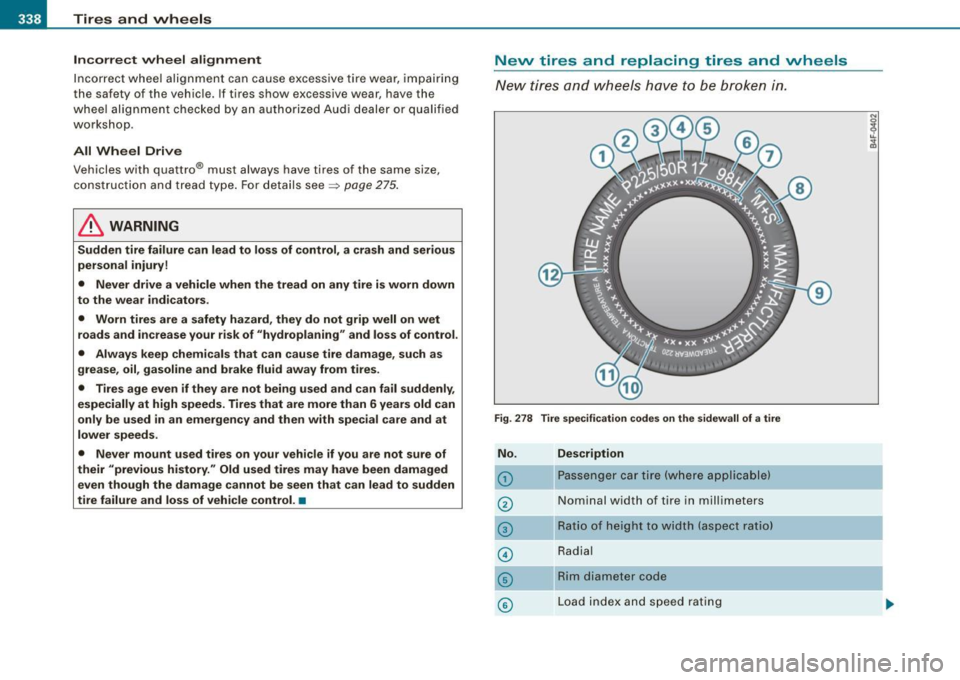
New t ires and wheels h ave t o be broke n in.
Fig . 278 T ir e specif ication cod es on the sidewall of a tir e
No.
©
0
©
©
©
©
Description
Passenger car tire (where applicable)
Nominal width of tire in millimeters
Ratio of height to width (aspect ratio)
Radial
Rim diameter code
L o ad in dex and s peed ra ting
Page 393 of 408
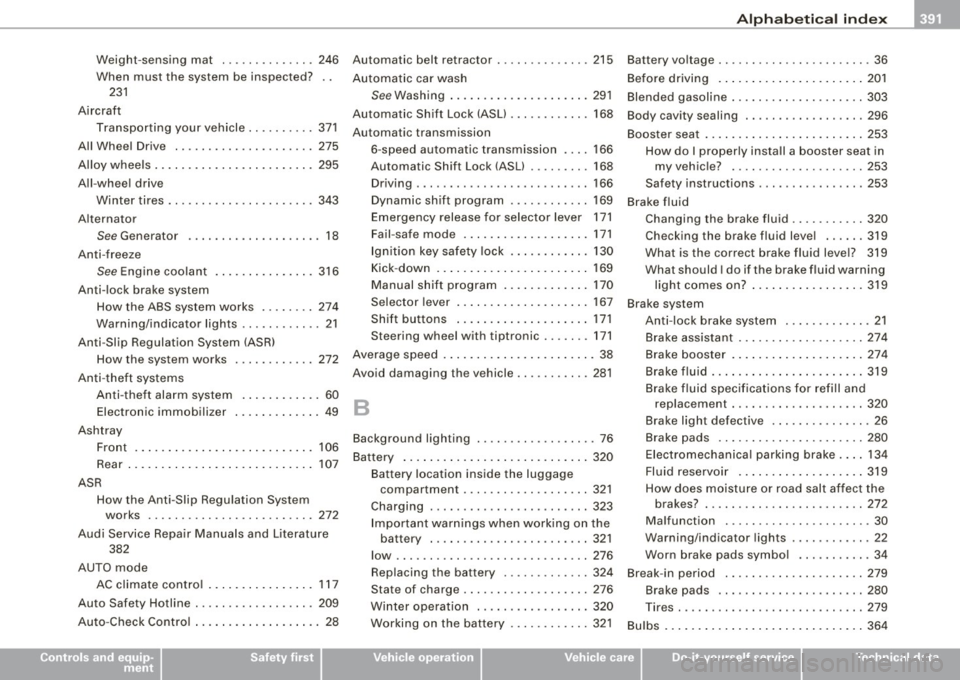
______________________________________________ A_ l_,_ p _h_ a_ b_e _t_i c_ a _ l _in _ d_e _ x __ _
Weight-sensing mat .... .... . ... .. 246
When must the system be inspected?
231
Aircraft Transporting your vehicle .. .... .... 371
All Wheel Drive .. .... ....... .... .... 275
Alloy wheels ... .... .... .... ... .... .. 295
All -whee l drive
Winter tires .. ..... ... .... ..... .. . 343
A lternator
See Generator .... .... ... ..... ... . 18
Anti-freeze
See Engine coolant . ...... ..... .. . 316
Anti-lock brake system How the ABS system works . .... ... 274
Warning/indicator lights ... ... .... .. 21
Anti -Slip Regulation System (ASR)
How the system works ............ 272
An ti-t heft systems
Anti -theft ala rm system ...... .... .. 60
Electronic immob ilizer ... .. .... .... 49
Ashtray Front ... ...... ...... .... ..... ... 106
Rear .... ... .. .... .... ... .... .... 107
ASR How the Anti-Slip Regulation System works .. .... .... .... ... .... .... 272
Audi Service Repair Manua ls and Literature
382
AUTO mode AC climate con tro l .. .. .... ... .... . 1 17
Auto Safety Hotline . .... ........ .... . 209
Auto -Check Contro l .... ... .. .... .... .. 28
Controls and equip
ment Safety first
Automatic belt
retractor ... .. ...... ... 215
Automatic car wash
See Washing ..... .... .... .... .... 291
Au tomatic Shift Lock (ASU .... .... .... 168
Automatic transmission 6-speed automatic transmission .... 166
Automatic Shift Lock (ASU .... ... .. 168
Driving ............. ............ . 166
Dynamic sh ift program .... ........ 169
Emergency release for selector lever 171
Fa il- safe mode . ...... .... .... .... 171
I gnition key safety lock . ...... .... . 130
Kick -d ow n .... .... .... .... ... .... 169
Manual shift program ... .. .... .... 170
Selector lever .... .... .... .... .... 1 67
Shift buttons ... .. .... .... .... ... 1 71
Steering wheel with tiptronic .. .... . 171
Average speed . ...... .... .... .... ... . 38
Avoid damaging the vehicle .. ..... ... . 28 1
B
Background ligh ting . .... ...... ... .... 76
Battery ... .. .... ... .... .... .... .... 320
Battery location inside the luggage compartment ...... .... ... .. .... 32 1
Charging ........................ 323
I mpo rta nt warn ings when work ing o n the
battery . .... .... .... ........ ... 32 1
low ............................. 276
Replacing the battery ....... .... .. 324
State of charge ... .... .... .... .... 276
Winter operation . .... .... .... .... 320
Working on the battery .... .... .... 321 Battery vo
ltage . ... .... .. .... .... .... . 36
Before driving ... .... .... ..... .. .... 201
Blended gasoline . .... .... .... ...... . 303
Body cavity sealing .. .... .... .... ... . 296
Boos ter seat ... .. .... .... ... .... .... 253
How do I properly insta ll a b ooster sea t in
my vehic le? ............... ..... 253
Safety instructions .... .......... .. 253
Brake fluid Changing the brake fluid ... .... .... 320
Checking the brake fluid level .. ... . 319
What is the correct brake fluid level? 319
What should I do if the brake f luid warning
light comes on? ... .. .... .... .... 319
Brake system Ant i-lock brake system . ..... .. .... . 21
Brake assistant .... .... .... ....... 27 4
Brake booster ..... .... ... .... .... 274
Brake fluid .... .... .... ... .... .... 319
Brake f luid specificat ions for re fill and
replacement . .... .... .... ...... . 320
Brake light defective ... ...... ...... 26
Brake pads ....... .... .... .... ... 280
Electromechanica l parking brake .... 134
Fluid reservoir .. ...... ..... .. .... 319
How does m oisture or road salt affec t the
brakes? . .... .... .... ....... .... 272
Malfunction ............ ... .. ..... 30
Warning/indicator lights .... .... .... 22
Worn brake pads symbol ........... 34
Break -in period .. .... .... .... .... ... 279
Brake pads ... .... .... .... ...... . 280
Tires . .... .... .... .... ... .... .... 279
Bu lbs . ... .... .... .... ... .... ...... . 36 4
Vehicle operation Vehicle care Do-it-yourself service Technical data