change wheel AUDI S8 2009 User Guide
[x] Cancel search | Manufacturer: AUDI, Model Year: 2009, Model line: S8, Model: AUDI S8 2009Pages: 408, PDF Size: 91.63 MB
Page 288 of 408
___ T_ r _a_ il_e _r_ t_ o_ vv_ in__... g,_ __________________________________________________ _
Speed
The higher the speed, the more difficult it becomes for the driver to
control the rig. Do not drive at the maximum permissible speed. Reduce your speed even more if load, weather or wind conditions
are unfavorable -particularly when going downhi ll.
Reduce vehicle speed
im med ia tel y if the trailer shows the slightest
sign of swaying.
Do not try to s top the swayi ng by accelerating.
Observe speed limits. In some areas, speeds for vehicles towing
trai lers are lower than for regular vehicles .
Always apply brakes ear ly. When driving downhill, shift into a lower
gear to use the engine braking effect to slow the vehicle. Use of the
brakes a lone can cause them to overheat and fail.
C ool ant t emp era tur e
The coolant temperature gauge=> page 12 must be observed care
fully. If the needle moves close to the upper end of the scale, reduce
speed immed iately and/or turn off the air conditioner.
If the coolant temperature warning light in the instrument cluster
starts flashing
- F- , pull off the road, stop and let the engine idle for
about two minutes to prevent heat build-up.
& WARNING
A nyo ne n ot properly re str aine d in a moving vehi cle i s at a mu ch
g re ater ri sk in an accident . Never let any on e r ide in y our car who
is n ot pr operl y wea ring th e re stra ints pr ovided b y Audi . •
Trailer towing tips
Important to know
Your vehicle handles differently when towing a trailer because of
the additional weight and different weight distribution. Safety, performance and economy will greatly depend on how carefully you
l
oad your trailer and operate your r ig.
Before you actually tow your trailer, practice turning, stopping and
backing up in an area away from traffic . Keep practicing unti l you
have become comp letely familiar with the way your vehicle-trai ler
combination behaves and responds.
Back ing up is difficult and requires practice. Backing up with a
trailer generally requires steering action opposite to that when backing up your vehic le without a tra iler.
Ma intain a greater distance between your veh ic le and the one in
front of you . You will need more room to stop. To compensate for
the trai ler, you w ill need a larger than norma l turning radius.
When passing, remember that you cannot accelerate as fast as you nor mally wou ld because of the added load . Make su re you have
enough room to pass. After passing, allow plenty of room for your
trai ler befo re changing lanes again .
Avoid jerky starts, sharp turns or rapid lane changes.
[ i ] T ips
• Do not tow a trailer during the break -in period of your vehicle.
• I f you tow a trailer, your Audi may require more frequent main te
nance due to the extra load=>
page 382. •
Parking on a slope
Do n ot park on a slope with a trailer. If it cann ot be
avoi ded, do so only after d oing the followi ng:
When p arking :
-Apply the foot brake.
- Have someone p lace chocks under both the vehicle and
the trailer wheels. ._
Page 330 of 408
-~_T_ ir_e_ s_ a_ n_d _ w_ h_ e_e _l_s _________________________________________________ _
Groove
means the space between two adjacent tread ribs.
Load rating (code)
means the maximum load that a tire is rated to carry for a given
inflation pressure . You may not find this information on all tires
because it is not required by law.
Maximum load rating
means the load rating for a tire at the maximum permissible infla
tion pressure for that tire.
Maximum loaded vehicle weight
means the sum of:
(a) Curb weight
(b) Accessory weight
(c) Vehicle capacity weight, and
(d) Production options weight
Maximum (permissible) inflation pressure
means the maximum cold inflation pressure to which a tire may be
in flated. Also called "maximum inflation pressure ."
Normal occupant weight
means 150 lbs. (68 kilograms) times the number of occupants
seated in the vehicle up to the total seating capacity of your vehicle.
Occupant distribution
means distribution of occupants in a vehicle .
Outer diameter
means the overall diameter of an inflated new tire.
Overall width
means the linear distance between the exteriors of the sidewalls of
an inflated tire, including elevations due to labeling, decorations, or
protective bands or ribs .
Ply
means a layer of rubber -coated parallel cords.
Production options weight
means the combined weight of those installed regular production
options weighing over 5 lbs. (2.3 kg) in excess of those standard
items which they replace, not previously considered in curb weight
or accessory weight, including heavy duty brakes, ride levelers, roof rack, heavy duty battery, and special trim.
Radial ply tire
means a pneumatic tire in which the ply cords that extend to the
beads are laid at substantially 90 degrees to the centerline of the
tread.
Recommended inflation pressure
see =:> page 327, "Cold tire inflation pressure".
Reinforced tire
means a tire design to operate at higher loads and at higher infla
tion pressures than the corresponding standard tire. Reinforced
tires may be identified as "XL", "xi", "EXTRA LOAD", or "RF" on the
sidewall.
Rim
means a metal support for a tire or a tire and tube assembly upon
which the tire beads are seated .
Rim diameter
means nominal diameter of the bead seat. If you change your wheel
size, you will have to purchase new tires to match the new rim diam
eter.
Rim size designation
means rim diameter and width.
Rim width
means nominal distance between rim flanges .
Page 333 of 408
Tires and wheels -________________ w-.
•
pressure label lists the recommended cold tire inflation pressures
for the vehicle at its maximum capacity weight and tires that were
on your vehicle at the time it was manufactured.
If you wish to improve comfort when operating the vehicle at
normal load (up to 3 occupants), you can adjust tire pressures to
those specified for normal vehicle load. Before operating the vehicle
at maximum load , you must increase the tire pressures to those
specified for maximum vehicle load
=> &.
Bear in mind that the tire pressure monitoring system* can only
monitor the tire pressures you have stored. The system does not
recognize the load condition of your vehicle .
The effec tiveness of the tire pressure mon itoring system* will be
impaired if you store normal load pressures but then operate the
vehicle at its maximum load=>&. See the
illustration=>
page 330, fig. 274 for the location of the label
either o n driver's side 8-pillar or inside the fuel filler flap (color of
the actual label and exact location on the vehicle will vary slight ly).
Note that the following tab le is accurate at the time of going to
press and is subject to change. In the event of discrepancies, the t ire
pressure label (On USA vehicles, the tire pressure label is located on
the driver's side 8-pillar. On Canada vehicles, the tire pressure label
is located either on the driver 's side 8-pillar or inside the fuel fil ler
flap) always takes precedence.
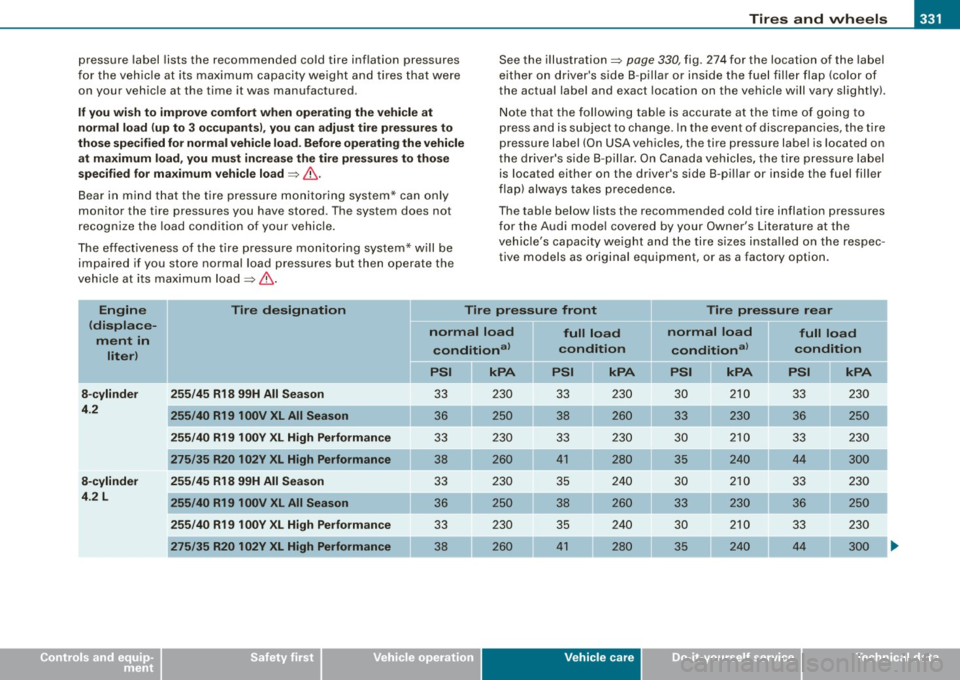
The table below lists the recommended cold tire inflation pressures
for the Audi mode l covered by your Owner's Literature at the
vehicle's capacity weight and the tire sizes installed on the respec
tive models as original equipment, or as a factory option.
Engine
(displace
ment in
liter) Tire designation
Tire pressure front Tire pressure rear
8-cylinder
4.2
8-cylinder
4 .2 L 255/45 R18 99H All Season
255/40 R19100V
XL All Season
255/40 R19
1 00Y XL High Performance
275/35 R20 102Y XL High Performance
255/45 R18 99H All Season
255/40 R19 100V XL All Season
255/40 R19 1 00Y XL High Performance
275/35 R20 102Y XL High Performance
normal load conditional
kPA
33 230
36 250
33 230
38 260 33 230
36 250
33 230
38 260
full load
condit ion
PSI
33 230
38 260
33 230
41 280
35 240
38 260
35 240
41 280
Vehicle care
normal load full load
conditional condition
kPA PSI kPA
30
210
33 230
33 230 36 250
30 210 33 230
35 240
44 300
30 210 33 230
33 230 36 250
30 210
33 230
35 240 44 300
I t •
Page 334 of 408
-Tires and wheels
PW-------------------
Engine II Tire designation Tire pressure front Tire pressure rear
( displa ce-
normal load full load normal load
full load
ment in
liter) condition
al condition
conditional condition
PSI
I I kPA PSI
kPA PSI II kPA II PSI II kPA
12-cylinder
255/45 R18 99H All Season 36 250 38 260 32 220 32 220
6 .0 Individual
rear seats 255
/40 R19 100V XL All Season 41 41 280 36 250 36 250
255 /40 R19 100Y
XL High Performance
36 250
38 260 32
220 32 220
275 /35 R20 102Y
XL High Performance 38 41 280 35 2 40 4 4 300
12 -cylinder 255 /45 R18 99H All Season 36 250 36 250 32 220 32 220
6 .0
255/40 R19 100V XL All Season 41
280 41 280 36 250 36 250
255 /40 R19 100V
XL High Performance 36 250 36 250 32 2 20 32 220
275 /35 R20 102Y XL High Performance
38 260 41 280 35 240 44 300
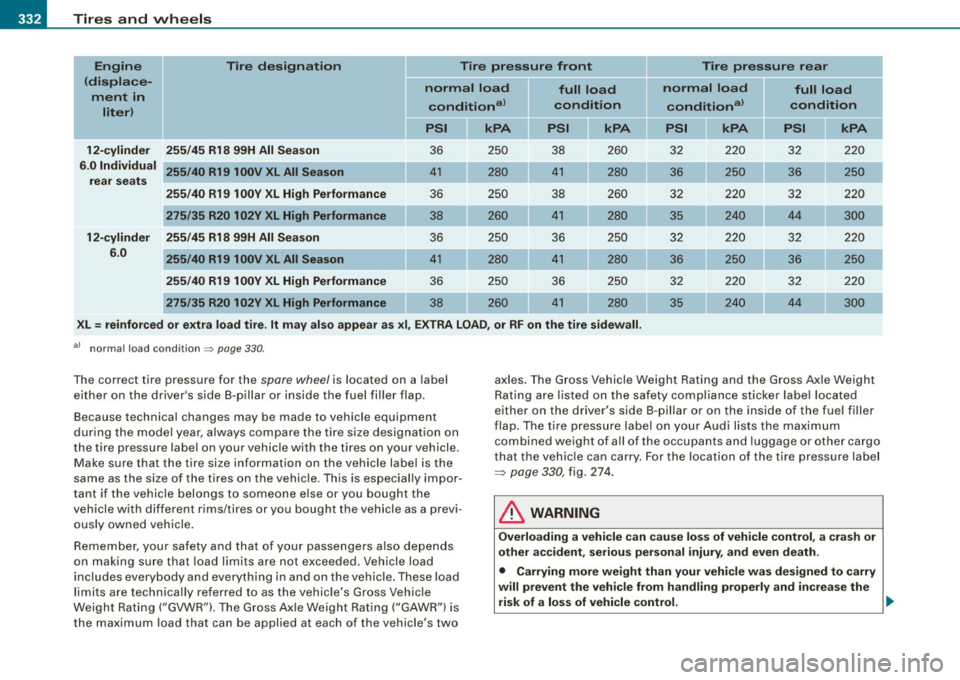
XL = reinforced or extra load tire . It may also appear as xi , EXTRA LOAD , or RF on the tire sidewall .
al norm al l oad cond it ion => pag e 330.
The cor rect tire pressure for the spare wheel is located on a label
either on the driver 's side B -pillar o r inside the fue l fil ler flap .
Because technica l changes may be mad e to vehicle equipmen t
du ring the mo del year, always co mpare the tire si ze designa tion on
the tire pressure label on your vehicle with the tires on your vehicle .
Make sure t hat the t ire size info rmati on on t he veh icle labe l is the
same as the size of the tires on the vehicle . This is especially impor
tan t if the vehicle bel ongs t o some one e lse or you boug ht the
vehic le with different rims/tires or you bought the vehicle as a previ
ously owned ve hicle.
Reme mbe r, you r safety an d that of your passengers a ls o depe nds
on making sure tha t load limi ts are not exceed ed. Vehicle load
inc ludes everybody and everyt hin g in an d on th e vehicle . T h ese load
limits are technical ly referred to as the vehicle's Gross Vehicle
Weigh t Ra ting ("GVWR"). The Gro ss Axle Weigh t Ra tin g ("GAWR") is
the maximum load that can be applied at each of the vehicle's two axles
. The G ross Vehic le We ight Rating and the Gross Axle Weight
Rat ing are lis ted on the safety compliance sticker labe l located
either on the driver 's side 8 -pillar or on the inside of the fue l fi ller
fl ap . The ti re p ressure label on you r Aud i lists the maximum
combined weight of a ll of the occupants and luggage or other cargo
th at th e vehic le can carry . Fo r the location o f the t ire pressure labe l
=> page 330, fig. 274.
& WARNING
Overload ing a vehicle can cause loss of vehicle control , a crash or
other accident, serious personal injury , and even death .
• Carrying more weight than your vehicle was des igned to carry
will prevent the vehicle from handling properly and increase the
risk of a loss of vehicle control . .,_
Page 336 of 408
-Tires and wheels
---------------------------------------------
It is important to ch eck the ti re pressure when the tires are cold .
• Read the req uire d tire p re s su re from the tire press ure la b el. On
USA vehicles, the tire p ressure label is located on the driver's side
8 -p illar. On Canada vehic les, the tire p ressure label is located either
on the driv er's sid e 8-pill ar or ins ide t he fuel fill er flap.
• Tur n the va lve stem cap c ounte r-cl ockwise to rem ove it fr om t he
tire valv e.
• Place th e a ir p re s sur e ga uge on th e valve .
• Th e tire pressures should only be checked and adjusted when
th e tires are col d. The s lig htly raise d pres sures of wa rm tires m ust
not be r educ ed .
• Adjus t the tire pre ssu re to the l oad you are carrying.
• Reinstal l the valve stem cap on the valve.
When should
I check the tire pressure?
The correc t tir e pr ess ure is especiall y important a t hi gh speeds . The
pressu re should the re fore be checked at l east once a mont h an d
a lways bef ore sta rting a j ourn ey . D o not for get to chec k the ti re pr es
su re for the s pare wh eel
::::> page 352.
When should I adjust the tire pressures?
Adjust the tire pr essure to the load you are carrying . After changing
a whee l or re plac ing w hee ls you have to adj ust th e tire pre ssu res on
a ll whee ls. I n ad ditio n, you must t hen stor e the ne w tire pr essu res
in t he tire pres sure mon it o ring system *=> page
41.
& WARNING
Incorrect tire pressures and /or underinflation can lead sudden tire
failure, loss of control, collision , serious personal injury or even
death .
• When the warning symbol appears in the instrument
cluster, stop and inspect the tires .
& WARNING (continued)
• Incorrect tire pressure and /or underinflation can cause
increased tire wear and can affect the handling of the vehicle and
stopping ability .
• Incorrect tire pressures and/or underinflation can also lead to
sudden tire failure , including a blowout and sudden deflation,
causing loss of vehicle control .
• The driver is responsible for the correct tire pressures for all
tires on the vehicle. The applicable pressure values are located on
a sticker on the driver's side B-pillar or on the inside of the fuel
filler flap.
• Only when all tires on the vehicle are filled to the correct pres
sure , the tire pressure monitoring system* can work corre ctly.
• The use of incorrect tire pressure values can lead to accidents
or other damage . Therefore it is essential that the driver observe
the specified tire pressure values for the tires and the correct pres
sures for the function of the tire pressure mon itoring system* .
• Always inflate tires to the recommended and correct tire pres
s ure before driving off .
• Driving with underinflated tires bend more , letting them get
too hot resulting in tread separation , sudden tire failure and loss
of control.
• Excessive speed and /overloading can cause heat build-up ,
s udden tire failure and loss of control.
• If the tire pressure is too low or too high, the tires will wear
prematurely and the vehicle will not handle well.
• If the tire is not flat and you do not have to change a wheel
immediately , drive at reduced speed to the nearest service station
to check the tire pressure and add air as required. _..
Page 355 of 408

What do I do now? Ill
---------------~.;______
•
-Disengage and lower the floor panel before you close the
luggage compartment lid again.
Storing the replaced wheel
-Place the replaced wheel inside the spare wheel well in
the luggage compartment.
Tighten the knurled retaining screw clockwise to secure
the wheel in place.
- Disengage and lower the floor panel before you close the
luggage compartment lid again.
& WARNING
Loose items in the passenger compartment can cause serious
personal injury during hard braking or in an accident .
• Never store the spare wheel or jack and tools in the passenger
compartment.
• Always store all jacking equipment, tools, and the spare wheel
in the luggage compartment.
• Tighten the knurled retaining screw for the spare wheel
securely.
[ i] Tips
Check the inflation pressure of the spare tire periodically to keep the
tire ready for use. •
Changing a wheel
Before changing a wheel
Observe the following precautions for your own and your
passenger's safety when changing a wheel.
- After you experience a tire failure, pull the car well away
from moving traffic and try to reach level ground before
you stop
~ & .
- All passengers should leave the car and move to a safe
location (for instance, behind the guardrail) ~& .
- Engage the parking brake to prevent your vehicle from
rolling unintentionally ~& .
- Move selector lever to position P
~ &.
-If you are towing a trailer: unhitch the trailer from your
vehicle.
- Take the jack and the spare tire out of the luggage
compartment~
page 351.
& WARNING
You or your passengers could be injured while changing a wheel if
you do not follow these safety precautions:
• If you have a flat tire, move a safe distance off the road. Turn off
the engine, turn the emergency flashers on and use other warning
devices to alert other motorists.
• Make sure that passengers wait in a safe place away from the
vehicle and well away from the road and traffic.
• To help prevent the vehicle from moving suddenly and possibly
slipping off the jack, always fully set the parking brake and block
the wheel diagonally opposite the wheel being changed. When one ..,
Do-it -yourself service
Page 356 of 408
1111 What do I do now? ..._ __________________________________________ _
& WARNING (continued )
front wheel is lifted off the ground , placing the Automatic Trans
mission in "P" (Park) will
not prevent the vehicle from moving.
• Before you change a wheel, be sure the ground is level and firm.
If necessary , use a sturdy board under the jack.
• After installing the spare wheel, make sure that you replace the
flat tire/wheel in its storage area properly and tighten the knurled
retaining screw securely.
[ i J Tips
Before changing the wheel, you must activate the jacking mode, so
that the automatic controls for the Adaptive Air Suspension do not
make it more difficult to lift the vehicle with the jack =>
page 791. •
Changing a wheel
When you change a wheel, follow the sequence described
below step-by-step and in exactly that order.
1. Activate the vehicle jacking mode~ page 191.
2. Remove the decorative wheel cover*. For more details
see also
~ page 355, "Decorative wheel covers" or
~ page 355, "Wheels with wheel bolt caps" .
3. Loosen the
wheel bolts ~ page 356.
4. Locate the proper mounting point for the jack and align
the jack below that point~
page 356.
5. Lift the car with the jack~ page 356.
6. Remove the wheel with the flat tire and then install the
spare
~ page 358 .
7. Tighten all wheel bolts lightly. 8.
Lower the vehicle with the
jack.
9. Use the wheel bolt wrench and
firmly tighten all wheel
bolts
~ page 356.
10. Replace the decorative wheel cover*.
11. Deactivate the vehicle jacking mode~ page 191.
& WARNING
Always read and follow all WARNINGS and information :::::> 6 in
" Raising the vehicle" on
page 356 and => page 359. •
After changing a vvheel
A wheel change is not complete without the doing the
following.
- Store and secure the wheel you replaced in the spare
wheel well.
- Replace the tools and the jack in their proper location.
- Check the
tire pressure on the spare wheel immediately
after mounting it.
- As soon as possible , have the
tightening torques on all
wheel bolts checked with a torque wrench. The correct tightening torque is 90 ft lb (120 Nm) .
- Have the flat tire
replaced as soon as possible.
[ i J Tips
• If you notice that the wheel bolts are corroded and difficult to
turn while changing a tire, they should be replaced before you check
the tightening torque. .,_
Page 361 of 408

_______________________________________________ W_ h_ a_t _ d_ o_ l _d _o_ n_ o _ w_ ? __ fflll
•
hub. Remove all dirt from these surfaces before remounting the
whee l.•
Tires with unidirectional tread design
Tires with unidirectional tread design must be mounted
with their tread pa ttern pointed in the ri ght direction.
Using a spar e tire with a tread pattern intended for u se
in a sp ecific di rec tion
When using a spare tire with a tread pattern intended fo r use in a
specific direction, p lease note the following:
• The direction of rotation is ma rked by an arrow on the side of the
tire .
• I f the spare tire has to be insta lled in the incorrect direction, use
the spare tire only temporarily since the tire wi ll not be able to
achieve its optimum performance characteristics with regard to
aquaplaning, noise and wear.
• We recommend that you pay particular attention to this fact
during wet weather and that you adjust you r speed to match road
conditions .
• Replace the flat tire with a new one and have it installed on your
veh ic le as soon as possible to restore the handling advantages of a
un idirectional tire. •
Notes on wheel changing
Please read the information :::::, page 338, "New tires and replacing
tires and whee ls" if you are going to use a spare tire which is
di fferent from the t ires on your veh ic le.
After you change a tire :
• Check the tire pre ssure on the spare immediately after installa
tion . • Have the wheel bolt t
ighten ing torque che cked with a torque
wrench as soon as possible by your authorized Audi dealer or a qualified service station .
• With steel and alloy wheel rim s, the wheel bolts are correctly
tighte ned at a torque of 90 ft lb (120 Nm ).
• If you noti ce that the wheel bolt s are corroded and difficult to
turn while changing a ti re , they should be replaced before you che ck
the tightening torque .
• Replace the flat t ire with a new one and have it installed on your
vehicle as soon a s possible . Remount the whee l cover.
Until then , dri ve with extra care and at reduced speed s.
& WARNING
• If you are going to equip your vehi cle w ith tires or r ims which
differ from those which were factory in stalled , then be sure to read
the information :::::,
page 338, uNew tires and repla cing tires and
wheel s".
• Always mak e sure the d am aged wheel or e ven a flat t ire and
the jack and tool kit are properl y secured in the luggage compart
ment and are not loose in the pass enger compartment .
• In an a ccident or sudden maneuver they could fly forward ,
injur ing anyone in the vehicle .
• Alway s store damaged wheel , ja ck and tools securely in the
luggage comp artment . Otherwise , in an accident or sudden
m aneuv er they could fly forward , cau sing injury to pas senger s in
the veh icle .
• Do not use commercially available ti re sea lants. Othe rwise, the
ele ctri cal component s of t he tire pres sure mon itor ing system * will
no longer wo rk properly and the sen sor for the tire pre ssure moni
tor ing s ystem* w ill have to be replaced by a qualified workshop . •
Do-it -yourself service
Page 382 of 408

___ D_ a_t _a ________________________________________________________ _
Data
Applies to vehi cle s: wi th 8 -cy lin der eng ine a nd all whee l dri ve
350 hp, a-cylinder engine, with all wheel drive
Engin e data
Maximum output SAE net
Maximum torque SAE net
No. of cy linders
Dis placement
Stroke
Bore
Compression ratio
Fuel
D im ensi on s (ap prox.)
Length (with licence plate bracket)
Width (across mirrors) Height (unloaded)
Turning circle diameter (curb to curb)
Ca pacitie s (a pprox.)
Fuel t ank
-Total capacity
- Reserve (of total capacity)
Wind shield and h eadlight washer fluid cont aine r
Engine oil
with filter change hp@rpm
lb
-ft@ rpm
CID (cm
3 )
in (mm)
in (mm)
350@6800
325@3500
8 cylinder
254 (4163)
3.65 (92.8)
3 .33 (84.5)
12.5: 1
Premium unleaded (91 AKI) Recommended for maximum engine performance . Fur
ther details =:>
page 303, "Gasoline"
in (mm)
in (mm)
in (mm)
ft. (ml
A8 = 199.3 (5062)
A8 = 79 .8 (2028)
A8 = 56.9 (1444)
A8 = 41.0 (12.5)
gal (liters)
gal (liters)
quarts (liters)
quarts (liters)
A8 L = 204 .4 (5192)
A8 L = 79 .8 (2028)
A8 L = 57.3 (1455)
A8 L =41.7 (12.7)
23.8 (90.0)
2.4 (9.0)
5 .1 (4.8)
9.6(9. 1)
•
Page 386 of 408
___ C_ o_n_ s_ u_m _ e_ r_ ln_ f_o _r_m _ a_ t_ i_o _n ______________________________________________ _
& WARN ING (continued )
• The engine compartment of any motor vehicle is a potentially
hazardous area . Never rea ch into the area around or to uch the
radiator fan . It is temperature controlled and can sw itch on
suddenly -even when the engine is off and the ignition key has
been removed . The radiator fan switches on automatically when
the coolant reaches a certain temperature and will continue to run until the coolant tempe rature drops .
• Always remove the ignition key before anyone gets under the
vehi cle .
• Always support your vehicle with safety stands if it is neces
sary to work underneath the vehicle . The jack suppl ied with the
vehicle is not adequate for this purpose and could collap se
causing serious personal injury .
• If you must work underneath the vehicle with the wheels on
the ground, always make sure the veh icle is on level ground , that
the wheels are always securely blocked and that the engine
cannot be sta rted .
• Always make sure the tr ansmission selector lever (automatic
transmission) is in "P" (Park position ) and the p ark brake is firmly
applied.
W For the sake of the environment
• Cha ng ing the e ngin e sett ings will a dverse ly aff ect em iss ion
levels. This is detrimenta l to the environment and increases fuel
co nsump tion .
• Always observe environmenta l regu lations when disposing of
o ld eng ine oil, u sed bra ke flu id, d irty eng ine coo la nt, spent batter ies
or worn out tires.
• Undeployed airbag modul es and pretensioners might be classi
fied as Perchlorate Material -specia l handling may apply, see
www .d tsc.ca .gov/ hazardouswaste/pe rc h lora te . W hen t he vehicle or
parts of the restraint s ystem including airbag modules safety be lts
with pre tensio ners are sc ra p pe d, a ll ap pl ica ble laws and reg ula- tions must be observed. Your authorized Audi dea
ler is familiar with
t hese requi reme nts and we reco mmend th at you h ave your dealer
perform th is serv ice for you. •
Additional accessories,
modifications and parts replacement
Additional accessories and parts
replacement
A lways consult an author ized Audi dea ler before
pur chasin g access orie s.
Y our vehicle incorporates the latest safety design featu res ensuring
a hi gh standa rd of active a nd passive sa fety .
T his saf ety could be com promised by non -approved changes to th e
vehic le . Fo r thi s reason, i f parts have to be replaced, p lease obse rve
th e fo llow ing po ints wh en insta lling add it io na l acc essories:
Approved Audi accessories and genuine Audi parts are avai lable
from autho rized Audi dea lers .
T hese dealers also have the necessary faci lities, tools and trained
spec ia lists to ins tal l the part s and accessorie s prope rly.
& WARNING
Using the wrong spare parts or using non -approved accessories
can cause serious personal injury.
• Use only accessorie s expressly approved by Audi and genuine
Audi spare parts
• These parts and accessories have been specially designed to
be used on your vehicle .
• Never install accessories such as telephone cradles or
beverage holders on airbag covers or within the airbag deploy-