fuel pressure AUDI S8 2009 User Guide
[x] Cancel search | Manufacturer: AUDI, Model Year: 2009, Model line: S8, Model: AUDI S8 2009Pages: 408, PDF Size: 91.63 MB
Page 315 of 408
Checkin g and fillin g -
--------------~-
•
the form of Service or Repair Orders that all schedu led maintenance
was performed in a time ly manner .•
Engine oil consumption
The engine in your vehicle depends on an adequate
amount of oil to lubricate and cool all of its moving parts.
In order to provide effective lubrication and cool ing of internal
engine components, all internal combustion engines consume a
certain amount of oil. Oil consumption varies from engine to engine
and may change significantly over the life of the engine. Typically,
engines with a specified break -in period (see~
page 279) consume
more oil during the break-in period than they consume after oi l
consumption has stabi lized .
Unde r normal conditions, the rate of oil consumption depends on
the quality and viscosity of the oil, the RPM (revolutions per minute)
at which the engine is operated, the ambient temperature and road
conditions . Further factors are the amount of oil dilution from water
condensation or fuel residue and the oxidation level of the o il. As
any engine is subject to wear as mileage builds up, the oil consump
tio n may increase over time unt il rep lacement of worn components
may become necessary.
With all these variables coming into play, no standard rate of oil
consu mption can be estab lished or specified. There is no a lternative
to regular and frequent checking of the oil level, see Note .
If the yellow engi ne oil level warning symbol in the instrume nt
cluster lights up, you should check the oil level as soon as
poss ible
with the oil dipstick~ page 313 . Top off the oil at your
earliest convenience~
page 314.
& WARNING
Before you che ck anything in the eng ine comp artment , alw ay s
read and heed all WARNINGS
~ & in "Working in the engine
c ompartment " on
page 309 .
0 Note
Driving with an insufficie nt o il level is l ikely to cause severe damage
to the engine.
[ i ] Tip s
• The oil pressure warning displ ay ce,. is not an indi cat or of the oil
level . Do not rely on it. Instead , check the oil level in your engine at
regular interv als , prefe rably ea ch time you refuel , and always before
going on a long trip.
• If you have the impression your engine consumes excessive
amoun ts of oi l, we recommend tha t you consult your Audi dealer to
have the cause of your concern properly diagnosed . Keep in mind
that the accurate measureme nt of oil consumption requires great
care and may take some time. Your Audi dealer has instructions
about how to measure oil consumption accurately. •
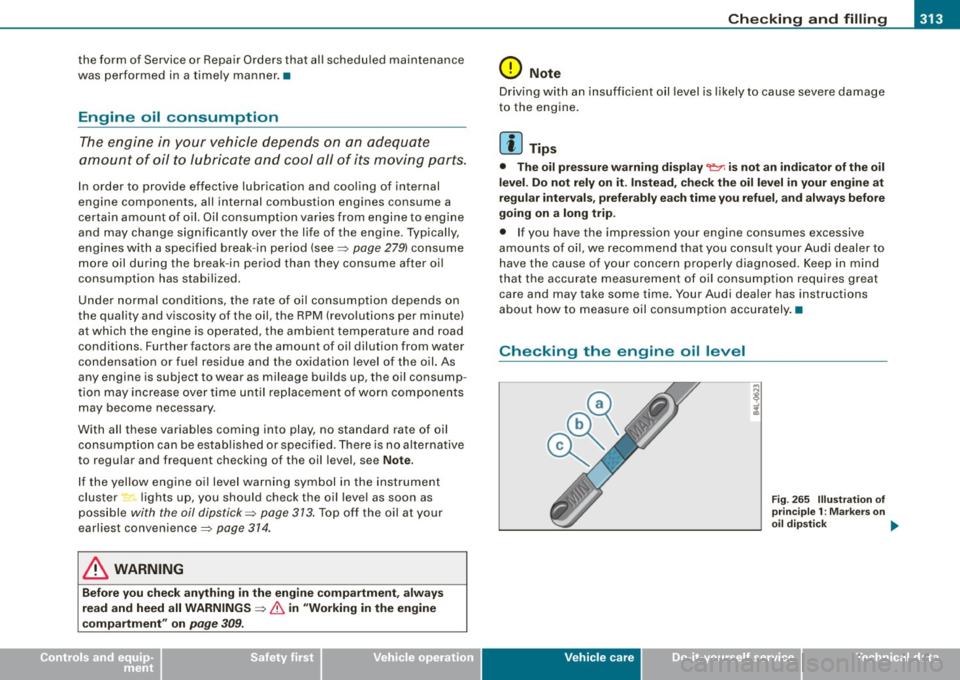
Checking the engine oil level
Vehicle care I t •
Fig. 2 65 Illu stra tion of
pri nciple 1 : Mar ker s on
oi l d ips tick ...
Page 331 of 408
Tires a nd wh eels 111111 ________________________________ ::..:..:....::.=.....::.:..:..:..::..:___:__ _ ___:,___
•
Sidewa ll
means that portion of a tire between the tread and bead.
Speed ra ting
extended periods of time. The ratings range from 93 mph (150 km/h)
t o 186 mph (298 km/h) =>
page 340. You may not find this informa
tion on all tires because it is not required by law.
The speed rating letter code, where applicab le, is molded on the tire
sidewa ll and indicates the maximum perm issible road speeds=>
&
in "Winter tires" on page 343.
T ire pre ssu re m onit orin g sys te m *
means a system that detects when one or more of a vehicle's tires
are under inflated and illuminates a low tire pressure warning tell
tale.
Tre ad
means that portion of a tire that comes into contact with the road .
Tread sepa ra ti on
means pu lling away of the tread from the tire carcass.
Tr ea dw ear indi cato rs ( TW I)
means the projections with in the principal grooves designed to give
a visual indication of the degrees of wear of the tread . See
~ page 337, "Tread Wear Indicator (TWI)" for more information on
measuring tire wear.
U ni form Tire Q ua lity G radin g
is a tire information system developed by the United States National
Highway Traffic Safety Administration (N HTSA) that is designed to
help buyers make re lative comparisons among tires. The UTQG is
not a safety rating and not a guarantee that a tire will last for a
prescribed number of miles (kilometers) or perform in a certain way .
I t simply gives tire buyers additional information to combine with
other considerations, such as price, brand loya lty and dealer recom -mendations
. Under UTQG, tires are graded by the tire manufac
t urers in three areas : treadwear, traction, and temperature res is
tance. The UTQG information on the tires, molded into the sidewal ls .
U .S . DOT Tir e Identifi cation Numb er (TIN )
This is the tire's "ser ia l number" It begins with the letters "DOT" and
indicates that the tire meets a ll federa l standards . The next two
numbers or letters indicate t he plant where it was manufact ured,
and the last four numbers represent the week and year of manufac
ture. For example,
DOT ... 2 20 7 ...
means that the tire was produced in the 22th week of 2007 . The
other numbers are marketing codes that may or may not be used by
the tire manufacturer . This information is used to contact
consumers if a tire defect requires a reca ll.
V ehi cle ca pac ity w eig ht
means the rated cargo and luggage load plus 150 lbs . (68 kilograms)
times the vehicle's total seating capacity as listed on the label
located either on the d river's side 8 -pillar or on the inside of the fuel
filler flap.
V eh icle max imum load on the tire
means that load on an individual tire that is determined by distrib
uting t o each ax le its share of the max imum loaded vehic le weight
and dividing by two.
V ehicle normal load on the tire
means that load on an individual tire that is determined by distrib
uting t o each ax le its share of the curb weight, accessory weig ht,
and normal occupant weight (distributed in accordance with table
below =>
page 330) and dividing by two . _.,
Vehicle care I t •
Page 332 of 408
___ T_ i_ r_e _s_ a_ n_ d_ w_ h_ e_ e _ ls _________________________________________________ _
Occupant loading and distribution for vehicle normal load for various designated seating capacities
Designated seating capacity , num
ber of occupants
4
5
Cold tire inflation pressure
Vehicle no rmal load, number of
oc cupants
2
3
Occupant distribution in a normally
loaded vehicl e
2 in front
2 in front, 1 in b ack sea t
Tire pressure affects the overall handling, performance and safety of a vehicle.
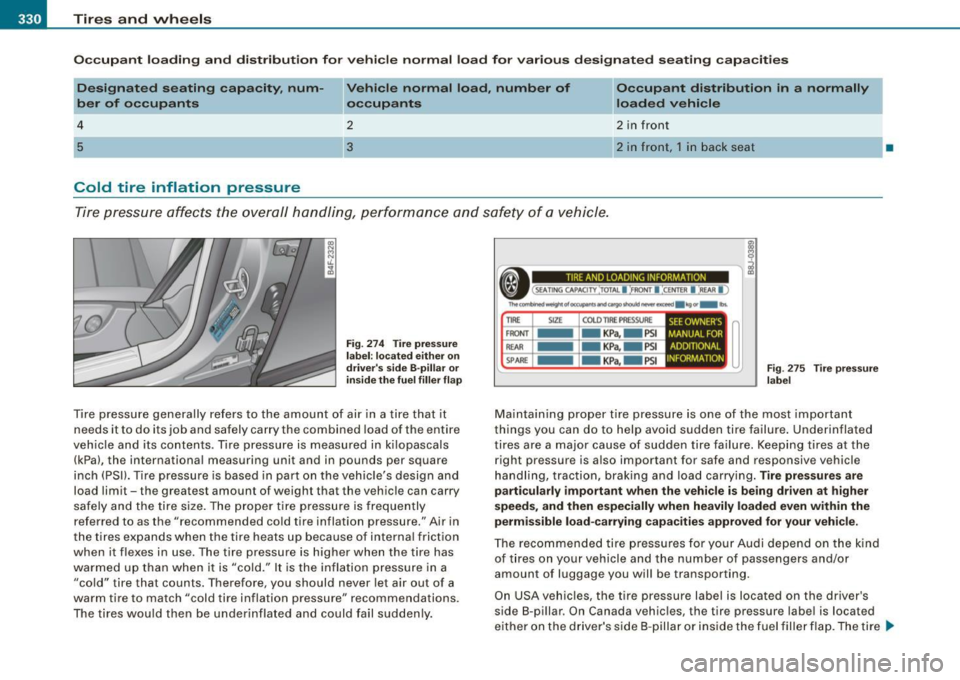
Fig. 274 Tire pressure
label: located either on
driver 's side B-pillar or
inside the fuel filler flap
T IRE AND LOADING INFORMATION
T IRE SIZE COLD TIRE PRESS URE
FR ONT -KPa, - PSI
REAR -KPa, - PSI
I.:: SPARE -KPa, -PSI Fig . 275 Tire pressure
label
Maintaining proper tire pressure is one of the most important
things you can do to help avoid sudden tire failure. Underinflated
tires are a major cause of sudden tire failure. Keeping tires at the
right pressure is also important for safe and responsive vehicle
handling, traction, braking and load carrying. Tire pressures are
particularly important when the vehicle is being driven at higher
speeds, and then especially when heavily loaded even within the
permissible load-carrying capacities approved for your vehicle.
The recommended tire pressures for your Audi depend on the kind
of tires on your vehicle and the number of passengers and/or
amount of luggage you will be transporting.
•
Tire pressure generally refers to the amount of air in a tire that it
needs it to do its job and safely carry the combined load of the entire
vehicle and its contents . Tire pressure is measured in kilopascals
(kPa), the international measuring unit and in pounds per square
inch (PSI). Tire pressure is based in part on the vehicle's design and
load limit -the greatest amount of weight that the vehicle can carry
safely and the tire size. The proper tire pressure is frequently
referred to as the "recommended cold tire inflation pressure ." Air in
the tires expands when the tire heats up because of internal friction
when it flexes in use. The tire pressure is higher when the tire has
warmed up than when it is "cold." It is the inflation pressure in a
"cold" tire that counts. Therefore, you should never let air out of a
warm tire to match "cold tire inflation pressure " recommendations .
The tires would then be underinflated and could fail suddenly. On
USA vehicles, the tire pressure label is located on the driver's
side 8-pillar . On Canada vehicles, the tire pressure label is located
either on the driver's side 8 -pillar or inside the fuel filler flap . The tire
i.,.
Page 333 of 408
Tires and wheels -________________ w-.
•
pressure label lists the recommended cold tire inflation pressures
for the vehicle at its maximum capacity weight and tires that were
on your vehicle at the time it was manufactured.
If you wish to improve comfort when operating the vehicle at
normal load (up to 3 occupants), you can adjust tire pressures to
those specified for normal vehicle load. Before operating the vehicle
at maximum load , you must increase the tire pressures to those
specified for maximum vehicle load
=> &.
Bear in mind that the tire pressure monitoring system* can only
monitor the tire pressures you have stored. The system does not
recognize the load condition of your vehicle .
The effec tiveness of the tire pressure mon itoring system* will be
impaired if you store normal load pressures but then operate the
vehicle at its maximum load=>&. See the
illustration=>
page 330, fig. 274 for the location of the label
either o n driver's side 8-pillar or inside the fuel filler flap (color of
the actual label and exact location on the vehicle will vary slight ly).
Note that the following tab le is accurate at the time of going to
press and is subject to change. In the event of discrepancies, the t ire
pressure label (On USA vehicles, the tire pressure label is located on
the driver's side 8-pillar. On Canada vehicles, the tire pressure label
is located either on the driver 's side 8-pillar or inside the fuel fil ler
flap) always takes precedence.
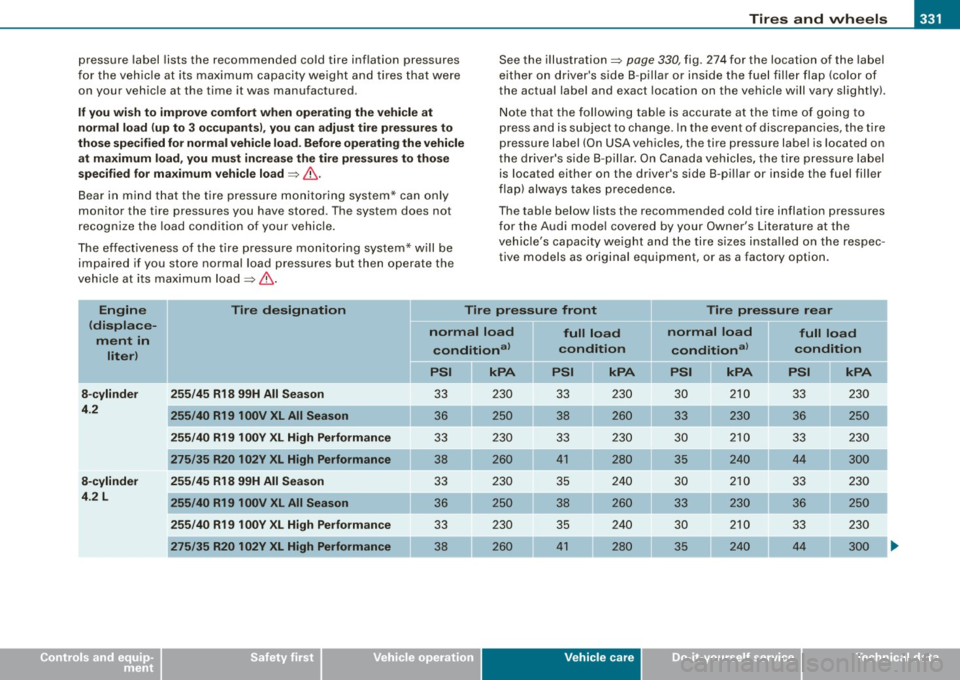
The table below lists the recommended cold tire inflation pressures
for the Audi mode l covered by your Owner's Literature at the
vehicle's capacity weight and the tire sizes installed on the respec
tive models as original equipment, or as a factory option.
Engine
(displace
ment in
liter) Tire designation
Tire pressure front Tire pressure rear
8-cylinder
4.2
8-cylinder
4 .2 L 255/45 R18 99H All Season
255/40 R19100V
XL All Season
255/40 R19
1 00Y XL High Performance
275/35 R20 102Y XL High Performance
255/45 R18 99H All Season
255/40 R19 100V XL All Season
255/40 R19 1 00Y XL High Performance
275/35 R20 102Y XL High Performance
normal load conditional
kPA
33 230
36 250
33 230
38 260 33 230
36 250
33 230
38 260
full load
condit ion
PSI
33 230
38 260
33 230
41 280
35 240
38 260
35 240
41 280
Vehicle care
normal load full load
conditional condition
kPA PSI kPA
30
210
33 230
33 230 36 250
30 210 33 230
35 240
44 300
30 210 33 230
33 230 36 250
30 210
33 230
35 240 44 300
I t •
Page 335 of 408
Tires and wheels -
----------------
•
& WARNING (continued)
• The brakes on a vehicle that has been overloaded may not be
able to stop the vehicle within a safe distance.
• Tires on a vehicle that has been overloaded can fail suddenly
causing loss of control and a crash.
• Always make sure that the total load being transported -
including the weight of a trailer hitch and the tongue weight of a
loaded trailer -does not make the vehicle heavier than the
vehicle's Gross Vehicle Weight Rating.
& WARNING
• Incorrect tire pressures and/or underinflation can lead to a
serious or fatal accident.
• Incorrect tire pressures and/or underinflation cause increased
tire wear and can affect the handling of the vehicle.
• Incorrect tire pressures and/or underinflation can also lead to
sudden tire failure, including a blowout and sudden deflation,
causing loss of vehicle control. •
Checking tire pressure
The correct tire pressure for the tires originally installed
on your vehicle is listed on the tire pressure label located
either on driver's side 8-pillar or inside the fuel filler flap.
The recommended tire pressures are on the tire pressure label and
in the table~
page 330, "Cold tire inflation pressure".This means
that the pressure must be checked and adjusted when the tire has
not been driven for more than a couple of miles (kilometers) at low
speeds during the previous three hours. Air in the tires expands
when the tire heats up as a result of internal friction as it flexes in
use. The tire pressure is higher when the tire has warmed up than
when it is "cold ." It
is the inflation pressure in a "cold" tire that counts. Therefore, you
should never let air out of a warm tire to match "Cold tire inflation
pressure" recommendations~
page 330. The tires would then be
underinflated and could fail suddenly.
The tire pressure label on your Audi lists the recommended cold tire
inflation pressures at maximum capacity for the new, original equip
ment tires that were on your vehicle at the time it was manufac
tured. For the location of the label
~ page 330, fig. 274.
Most tires lose air naturally over time. They can also lose some air if
you drive over a pothole or hit a curb while parking. It is usually not possible to see whether the radial tires used today are underinflated
just by looking at them.
Therefore, be sure to check tire pressures at least once a month and
always before going on a long trip. Make sure to take the number of
people and the amount of luggage into account when adjusting tire
pressure for a trip -even one that you would not consider to be
"long ." See~
page 335, "Tires and vehicle load limits" for more
important information.
Always use an accurate tire pressure gauge when checking and
adjusting inflation pressures . Check all of the tires and be sure not
to forget the spare tire . If the pressure in any tire is too high when
the tire is "cold," let air out of the tire slowly with the edge of the tire
gauge and keep checking the pressure until you reach the pressure
that is correct for the load (passengers and luggage) and kind of
driving you plan to do.
If the pressure in any tire is too low, note the difference between the
pressure in the cold tire and the pressure you need and add the air
that you need to reach the correct pressure for the vehicle load
(passengers and luggage) for the tires on your vehicle as listed on
the on your vehicle and in this manual and the kind of driving you
plan to do.
Never exceed the maximum inflation pressure listed on the tire
sidewall for any reason.
Remember that the vehicle manufacturer, not the tire manufacturer,
determines the correct tire pressure for the tires on your vehicle. .,,_
Vehicle care I t •
Page 336 of 408
-Tires and wheels
---------------------------------------------
It is important to ch eck the ti re pressure when the tires are cold .
• Read the req uire d tire p re s su re from the tire press ure la b el. On
USA vehicles, the tire p ressure label is located on the driver's side
8 -p illar. On Canada vehic les, the tire p ressure label is located either
on the driv er's sid e 8-pill ar or ins ide t he fuel fill er flap.
• Tur n the va lve stem cap c ounte r-cl ockwise to rem ove it fr om t he
tire valv e.
• Place th e a ir p re s sur e ga uge on th e valve .
• Th e tire pressures should only be checked and adjusted when
th e tires are col d. The s lig htly raise d pres sures of wa rm tires m ust
not be r educ ed .
• Adjus t the tire pre ssu re to the l oad you are carrying.
• Reinstal l the valve stem cap on the valve.
When should
I check the tire pressure?
The correc t tir e pr ess ure is especiall y important a t hi gh speeds . The
pressu re should the re fore be checked at l east once a mont h an d
a lways bef ore sta rting a j ourn ey . D o not for get to chec k the ti re pr es
su re for the s pare wh eel
::::> page 352.
When should I adjust the tire pressures?
Adjust the tire pr essure to the load you are carrying . After changing
a whee l or re plac ing w hee ls you have to adj ust th e tire pre ssu res on
a ll whee ls. I n ad ditio n, you must t hen stor e the ne w tire pr essu res
in t he tire pres sure mon it o ring system *=> page
41.
& WARNING
Incorrect tire pressures and /or underinflation can lead sudden tire
failure, loss of control, collision , serious personal injury or even
death .
• When the warning symbol appears in the instrument
cluster, stop and inspect the tires .
& WARNING (continued)
• Incorrect tire pressure and /or underinflation can cause
increased tire wear and can affect the handling of the vehicle and
stopping ability .
• Incorrect tire pressures and/or underinflation can also lead to
sudden tire failure , including a blowout and sudden deflation,
causing loss of vehicle control .
• The driver is responsible for the correct tire pressures for all
tires on the vehicle. The applicable pressure values are located on
a sticker on the driver's side B-pillar or on the inside of the fuel
filler flap.
• Only when all tires on the vehicle are filled to the correct pres
sure , the tire pressure monitoring system* can work corre ctly.
• The use of incorrect tire pressure values can lead to accidents
or other damage . Therefore it is essential that the driver observe
the specified tire pressure values for the tires and the correct pres
sures for the function of the tire pressure mon itoring system* .
• Always inflate tires to the recommended and correct tire pres
s ure before driving off .
• Driving with underinflated tires bend more , letting them get
too hot resulting in tread separation , sudden tire failure and loss
of control.
• Excessive speed and /overloading can cause heat build-up ,
s udden tire failure and loss of control.
• If the tire pressure is too low or too high, the tires will wear
prematurely and the vehicle will not handle well.
• If the tire is not flat and you do not have to change a wheel
immediately , drive at reduced speed to the nearest service station
to check the tire pressure and add air as required. _..
Page 337 of 408
Tires and wheels -
----------------
•
0 Note
Driving without valve stem caps can cause damage to the tire
valves. To prevent this, always make sure that factory installed valve
stem caps on all wheels are securely mounted on the valve .
W For the sake of the environment
Underinflated tires will also increase the fuel consumption. •
Tires and vehicle load limits
There are limits to the amount of load or weight that any vehicle and
any tire can carry . A vehicle that is overloaded will not handle well
and is more difficult to stop. Overloading can not only lead to loss
of vehicle control, but can also damage important parts of the
vehicle and can lead to sudden tire failure, including a blowout and
sudden deflation that can cause the vehicle to crash.
Your safety and that of your passengers also depends on making
sure that load limits are not exceeded. Vehicle load includes every
body and everything in and on the vehicle. These load limits are
technically referred to as the vehicle's
Gross Vehicle Weight Rating
("GVWR"l.
The "GVWR" includes the weight of the basic vehicle, all factory
installed accessories, a full tank of fuel, oil , coolant and other fluids
plus maximum load. The maximum load includes the number of
passengers that the vehicle is intended to carry ("seating capacity")
with an assumed weight of 150 lbs (68 kg) for each passenger at a
designated seating position and the total weight of any luggage in
the vehicle. If you tow a trailer, the weight of the trailer hitch and the
tongue weight of the loaded trailer must be included as part of the
vehicle load.
The
Gross Axle Weight Rating ("GAWR"l is the maximum load that
can be applied at each of the vehicle's two axles. The
Gross Vehicle Weight Rating and the Gross Axle Weight Rating
are listed on the safety compliance sticker label located either on
the driver's side 8-pillar or on the inside of the fuel filler flap. Your
Audi has 5 seating positions, 2 in the front and 3 in the rear for total
seating capacity of 5. Vehicles with power individual rear seats*
have 4 seating positions, 2 in the front and 2 in the rear for total
seating capacity of 4. Each seating position has a safety belt
~ page 211, "Safety belts".
The fact that there is an upper limit to your vehicle's Gross Vehicle
Weight Rating means that the total weight of whatever is being
carried in the vehicle (including the weight of a trailer hitch and the
tongue weight of the loaded trailer) is limited. The more passengers
in the vehicle or passengers who are heavier than the standard
weights assumed mean that less weight can be carried as luggage.
The tire pressure label on your Audi also lists the maximum
combined weight of all of the occupants and luggage or other cargo
that the vehicle can carry. For the location of the label
~ page 330,
fig. 274.
& WARNING
Overloading a vehicle can cause loss of vehicle control, a crash or
other accident, serious personal injury, and even death.
• Carrying more weight than your vehicle was designed to carry
will prevent the vehicle from handling properly and increase the
risk of the loss of vehicle control.
• The brakes on a vehicle that has been overloaded may not be
able to stop the vehicle within a safe distance.
• Tires on a vehicle that has been overloaded can fail suddenly,
including a blowout and sudden deflation, causing loss of control
and a crash.
• Always make sure that the total load being transported -
including the weight of a trailer hitch and the tongue weight of a
loaded trailer -does not make the vehicle heavier than the
vehicle's Gross Vehicle Weight Rating. •
Vehicle care
I t •
Page 341 of 408
________________________________________________ T_ i _r_e _s_ a_n_ d_ w_ h_ e_e _ l_s __ lR
•
0
-
©
®
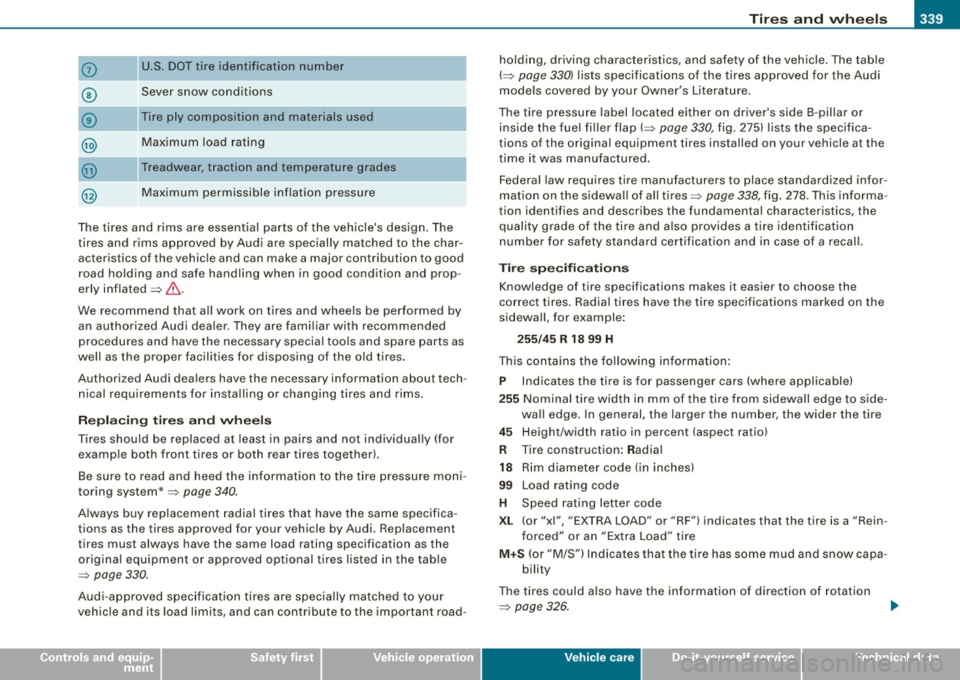
U.S. DOT ti re identification number
Sever snow conditions
Tire ply composition and materials used
Maximum load rating
Treadwear , traction and temperature grades
@ Maximum permissible inflation pressure
The tires and rims are essential parts of the vehicle 's design. The
tires and rims approved by Audi are specially matched to the char
acteristics of the vehicle and can make a major contribution to good
road hold ing and safe handling when in good cond ition and prop
erly inflated =>& .
We recommend that a ll work on tires and wheels be performed by
an authorized Audi dealer. They are familiar with recommended
procedures and have the necessary special tools and spare parts as
well as the proper facilities for d isposing of the old tires.
Authorized Audi dea lers have the necessary info rmation about tech
nical requirements for insta lling or changing tires and rims.
R epl ac ing tires and wheels
Tires shou ld be replaced at least in pairs and not individually (for
examp le both front tires or both rear tires together).
Be sure to read and heed the information to the tire pressure moni
toring system*=>
page 340.
Always buy replacement radial tires that have the same specifica
tions as the tires approved for your vehicle by Audi. Rep lacement
tires must always have the same load rating specification as the
origina l equipment or approved optional t ires listed in the table
=>
page 330.
Audi -appr oved spec ification tires are spec ially matched to your
vehicle and its load limits, and can contribute to the important road- holding, driving characteristics, and safety of the vehicle
. The table
(=>
page 330) l ists specifications of the tires approved for the Audi
models covered by your Owner's Literature.
The tire pressure labe l located either on driver's side 8 -pi llar or
inside the fuel fi ller flap(=>
page 330, fig. 275) lists the specifica
tions of the original equipment tires installed on your vehicle at the
ti me it was manufactured.
Federa l law requires tire manufacturers to place standardized infor
mation on the sidewa ll of all tires =>
page 338, fig . 278. This informa
t ion identifies and describes the fundamental characteristics, the
qua lity grade of the ti re and also provides a tire identification
number for safety standard certificat ion and in case of a recal l.
Tire specificat ions
Knowledge of tire specifications makes it easier to choose the
co rrect t ires . Radial tires have the tire specifications marked on the
sidewall, for example:
255 /45 R 18 99 H
This contains the following informat ion:
P Indicates the ti re is for passenger cars (where applicab le)
255 No minal tire width i n mm of the tire fro m sidewall edge to side -
wa ll edge. In general, the larger the number, the wider the tire
45 Height/width ratio in percent (aspect ratio)
R Tire construction: Radial
18 Rim diameter code (in inches)
99 Load rating code
H Speed rating lette r code
XL (or "xi", "EXTRA LOAD" or "RF") indicates that the tire is a "Rein
forced" or an "Extra Load" ti re
M +S (o r "M/S") Indicates that the tire has some mud and snow capa
bility
The tires could a lso have the information of direct ion of rotation
=>
page 326.
Vehicle care I t •
Page 396 of 408

___ A_l.:,. p _h_ a_ b_e _t _i c_ a_l _i n_ d_e _x ____________________________________________ _
Driver information display
Driver information messages .. .... . 29
Introduction . ....... ... .. .... .... . 24
Open door or rear lid warning .. .... . 26
Outs ide temperature disp lay .... .... 25
Sound system display ... .. .. . .... . 25
Driver In forma tion Sys tem
Digital speedometer . . . . . . . . . . . . . . . 25
Driver's seat . . . . . . . . . . . . . . . . . . . . . . . . 87
Driver's seat memory . . . . . . . . . . . . . . . . . 94
Activating remote contro l key . ..... . 95
Recalling a seat position ...... .... . 94
Storing a seat position . ...... ..... . 94
Driving messages .................... 29
Driving safely ... .... ... .... ... .. ... 200
Driving time . .... .... .... .... .... .... 38
Dupl icate key . ........ ... .... .... ....
47
DVD player for navigation system . . . . . 112
E
Easy entry feature 129
Elect romechanica l parking brake
Emergency braking .... .... ... .... 136
Malfunction .. .... .... .... ... .... 136
Operation . . . . . . . . . . . . . . . . . . . . . . . 134
Parking . . . . . . . . . . . . . . . . . . . . . . . . . 135
Releasing and app lying .. .... ..... 134
Starting off with a trailer . .... ..... 136
Warning /indicator lights . .......... 22
Electronic differential lock (EDU How the system works . . . . . . . . . . . . 271
Warning/indicator lights . .... ..... . 21 Electronic immobili
ze r .. .. .... ..... 14 , 49
Electronic power control (EPC) warning/indicator light ... ..... 18
Electronic speed limiter .... .... .... ... 28
Electronic stabi li z ation program (ESP)
How the system works ....... .... . 270
Wa rning/indicator ligh ts ........... 18
Emergency braking . .......... .. ... . 136
Emergency closing Power sunroof . ... .... .... .... . 66 , 67
Emergency flasher . . . . . . . . . . . . . . . . . . . 73
Warning/indicator ligh ts ........... 19
Emergency locking . . . . . . . . . . . . . . . . . . . 54
Emergency locking of doors .. ... ... .. . 54
Emerg ency starting . ...... .. ... .... . 366
Emergency towing .. ... .. ... .. .. .... 368
Emergency warning triangle .. ... .... . 350
Energy management ... .. ..... ... ... 276
Battery power . . . . . . . . . . . . . . . . . . . 277
Driver no tification . . . . . . . . . . . . . . . . 277
Engine 4.2 1, 8-cylinder (350 hp) .... ... .... 310
6.0 I, 12 -cylinder (450 hp) . ...... ... 311
Compartment ... .... .... .... 3 10,311
Coolant . .. ...... ... ........ .. ... 316
Hood . .... .... .... .... ........ .. 308
Starting .. .... ... ..... ... ... 129, 130
Starting wi th jumper cables ... .... 366
Stopping ............ .... .... .... 131
Engine compartment ... .... .... ..... 310
Safety instructions .......... .... . 309
Working the engine compartment .. 309 Engine coolant
.. .. .. .. .. .... .... ... 316
Adding coolant ... .... .... .... ... 318
Checking the engine coolant level .. 317
Expans ion tank .... ... .... .... ... 317
Malfunction symbol ... .... .... .... 31
Radiator fan .... . ...... .... .. ... . 319
Temperature gauge ... .... .... .. .. 12
Engine data .. ..... .. . ... ... . .. .. .. . 380
Engine hood Closing ... .. .... .... .. .. . ... ... . 309
How to release the hood . . . . . . . . . . 308
Engine oil ... ..... .... .... .. . ... ... . 311
Adding ..... .... .... .. .. . ... ... . 314
Additives . ... .... .... .. .. . ... .... 314
Changing .... .... .... ... . ... .... 315
Checking the engine oil leve l ....... 313
Indications and conditions requir ing extra
checking .... .... .... ... .... ... 313
Oil consumption . ...... .. .. ... .. . 313
Oil grades ..... ... ... ...... ... .. . 311
Oil level symbol .. ........ .... ... .. 35
Pressure malfunction ...... .... .. . . 32
Recommended oil check intervals . . 313
Sensor defec tive . . . . . . . . . . . . . . . . . . 35
Speci fication and viscosity .. .... ... 311
Engine speed limitation . ... .. ... .... .. 35
Environment Break -in period ....... ........... 279
Catalytic converter .... ..... ...... 280
Disposing of your vehic le battery ... 324
Driving at high speeds ... .... ... .. 281
Driving to minimize pollution and noise . 281
Fuel .. ...... ....... ...... .... ... 305
Page 403 of 408

________________________________________________ A_l.,_p _h_ a_ b_e _ t_ i_ c _a _l_ i_n _d_ e_ x __ _
Storage . . . . . . . . . . . . . . . . . . . . . . . . . . . . 109
Compartments in the door trim panels .
111
Compartments in the rear doors ... . 111
Cupholder .. ...... .... ...... .... . 105
Cupholder rear cente r armrest .. ... 105
Glove compartment ............... 109
Luggage compartment ........ .... 112
Ski sack . . . . . . . . . . . . . . . . . . . . . . . . . 102
Sma II objects . . . . . . . . . . . . . . . . . . . . 110
Sun shade .......... ....... .... .... . 78
Sun visors .......................... 77
Switches
Emergency flashers ................
73
Power sunroof .... ... ... ... .. ... .. 65
Rear window defogger .... ........ 124
Symbols
Red ......... .... ....... .... .....
30
Ye llow ........................... 34
T
Tachometer ..... .... .... ............ 13
Technical modifications ...... ...... .. 385
Temperature
Climate controls .. .... .... ..... ...
117
Setting for the driver's and front passen-
ger's side ......................
117
Tether strap ............. ........... 265
Securing the upper tether strap 266
The first 1,000 miles (1,500 km) and
afterwards .....................
279
Tie -down eyelets ................ 100, 209
Controls and equip ment Safety first
Tips
for the environment
Saving fuel ... ... .... ...... ......
104
Using the air conditioner only when
necessary ......... ...... .... .. .
. . ® t1ptronic ......................... .
Au tomatic Shift Lock (ASU ... ... .. .
123
166
168
Driving ........ .... ... .... ....... 166
Dynamic shift program ...... ...... 169
Fail -safe mode ......... ...... .... 171
Kick -down .. ...... .... .... ..... .. 169
Manual shift program ..... .... .... 170
Selector lever .................... 167
Tire pressure ... .... ... .. .... .... ... 333
Tire pressure monitoring system ....... 41
Displaying tire pressures .... ..... .. 44
Initialize wheels ........... ....... . 45
Learning process ...... ....... ..... 44
Loss of air pressure ............. 20, 43
Malfunctions ... .. .... .... ....... . 46
Tires and vehicle load limits .. .. .. .... 335
Tires and wheels
Checking tire pressure ... .. .... ...
333
Cold tire inflation pressure ......... 330
Dimensions ...................... 338
General notes ...... .............. 326
Glossary of tire and loading terminology
327
New tires and wheels ........ .... . 338
Replacing ..... .. .... .... .... .... 339
Snow chains .......... .... .... ... 344
Ti re pressure monitoring system .... 340
Tires and vehicle load limits ........ 335
Wheel bolts ... .... .... ..... .. .... 345
Winter tires ........... ...... ..... 343
Tires/Wheels
Low aspect ratio tires ... .. .... ....
345
Tools .............................. 352
Torn or frayed safety belts ........ .... 214
Sensors ............ · · · · · · · · · · · · · 340 Touch -up paint ... .. .... .... .... .... 294
Storing tire pressures ..... .... .... . 44 Towing
Tires and wheels .................
340 Tow truck procedures ............. 368
Valves ...... ....... ...... .... ... 340 Towing hitch
Tire service life ........ .... ... .. ....
337 Audi parking system ... ...... .... . 183
Tires .... ...... ......... .... ....... 326 Towing loop ........................ 369
Replacing ....................... 340 front .... ... .. .... .... ..... .. .... 369
Service life ........ .. ....... ..... 337 rear ... ... .... ....... ...... ..... 370
speed rating letter code ..... ...... 340 Trailer towing ....................... 284
Tire manufacturing date .. ........ . 340
Tire specifications . .... ........... 339
Tread depth .......... .... ... .... 337
Uniform tire quality grading .... .... 342
Winter tires ........ ... .... .... ... 343
Operating instructions . .... ....... 285
Technical requirements . ...... 284, 285
Trailer towing tips ........ .... .... 286
Train
Transporting your vehicle .. ........
371
Vehicle operation Vehicle care Do-it-yourself service Technical data