seat adjustment AUDI S8 2009 User Guide
[x] Cancel search | Manufacturer: AUDI, Model Year: 2009, Model line: S8, Model: AUDI S8 2009Pages: 408, PDF Size: 91.63 MB
Page 99 of 408
Rear window shelf
You can place li gh t a rticles of cl othing on the re ar
w indow shelf behind the sea tbac k.
& WARNING
When dr iv ing , do not leave any hard objects on the rear w indow
s helf or allow your pet to sit on the shelf . They could be come a
hazard for vehicle oc cup ants in the event of sudden bra king or a
c rash .
[ i ] Tips
• A vent slot is located between t he shel f and the rear w indow . Do
not block the vent with any items you may place on the rear window
she lf.
• Do not place bulky items on the rear window shelf as they could
restrict or block the driver's vision in the rear view mirro r.•
Con tro ls and eq uip
ment
Seats and storag e
Individual rear seats
Applies to ve hicles : w ith ind iv id ual rea r sea ts
Controls
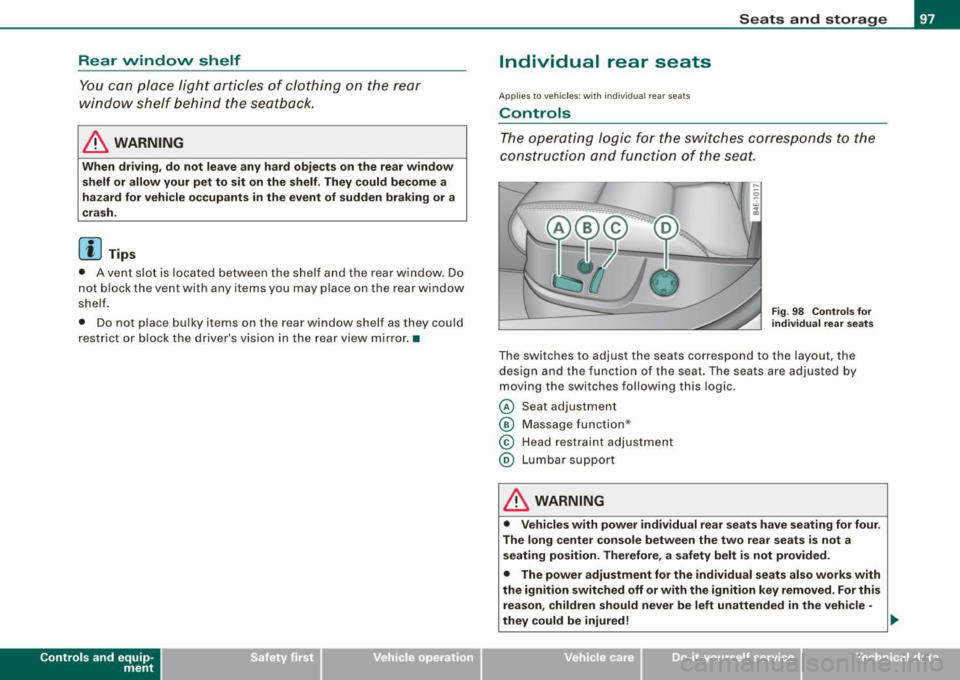
The operating logic for the switches corresponds to the
construction and function of the seat.
Fi g. 9 8 Co ntrols fo r
individual r ear seats
The switches to adjust the seats correspond to the layout, the
design and the function of the seat. The seats are adjusted by
moving the switches following this logic .
@ Seat adjustment
@ Massage function *
© Head restraint adjustment
@ Lumbar support
& WARNING
• Vehicl es with power individual rear se ats have seating for four .
The long center co nsole between the two rear se ats is not a
s eating po sition. Th erefore , a safety belt i s not provided.
• The power adjustment for the individual seats al so works with
the ignition switched off or with the ignition key removed . For this
re ason , children should never be left unattended in the vehi cle -
they could be injured!
~
Vehicle care I I irechnical data
Page 100 of 408
Seats and storage
& WARNING (continued )
• Exercise caution when adjusting the seats . Unsupervised or
ca reless seat adjustment can p inch fingers or ha nds causing
injuries .•
Ap plies t o vehic les : w it h ind iv id ual rear se at s
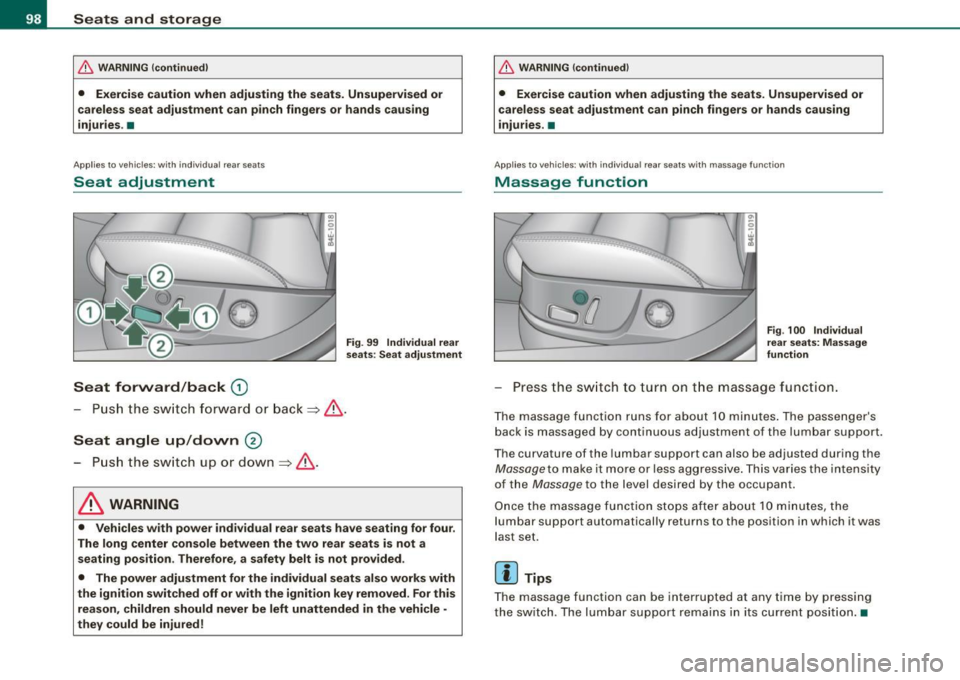
Seat adjustment
Seat forward/back G)
Fig . 99 Individual rear
seat s: Seat adju stment
- Push t he swi tch forwa rd or ba ck => & .
Seat angle up /down @
- Push th e sw itch u p or do wn => & .
& WARNING
• Vehicles with power individual rear seats have seating for four .
The long center console between the two rear seats is not a seating position . Therefore, a safety belt is not provided .
• The power adjustment for the individual seats also works with
the ignition switched off or with the ignition key removed . For this
reason , children should never be left unattended in the vehicle •
they could be injured !
& WARNING (continued )
• Exercise caution when adjusting the seats. Unsupervised or
careless seat adju stment can pinch fingers or hands causing
injuries. •
Applies t o vehic les : w it h in d iv id ual re ar sea ts with m ass ag e func tion
Massage function
F ig . 100 Individual
rear seats: Massage
function
Pr ess th e swi tch to t urn on t he massag e function.
T he massage function runs fo r about 10 minutes . T he pa ssenge r's
bac k is massaged by continuous ad justment of the lumbar support .
T he curvature of the lumbar suppo rt can also be ad justed during the
Mas sage to mak e it mo re or less aggr ess ive . T hi s var ies t he in tens ity
of the
Massage to the level desired by the occupa nt.
O nce the mas sage func tio n stops afte r abou t 10 m inut es, the
l umbar support automatically returns to t he position in which it was
l a st se t.
[ i ] Tips
T he m ass age function can be interrupted at a ny tim e by pre ssi ng
the switc h. T he lum bar support r emains i n its cu rren t po sit io n.•
Page 101 of 408
Applies to vehi cles : wi th in d ivi dual rear seats
Head restraint adjustment
-..... .
··-
Fig . 101 Individual
rear seats : Head
restraint adjustment
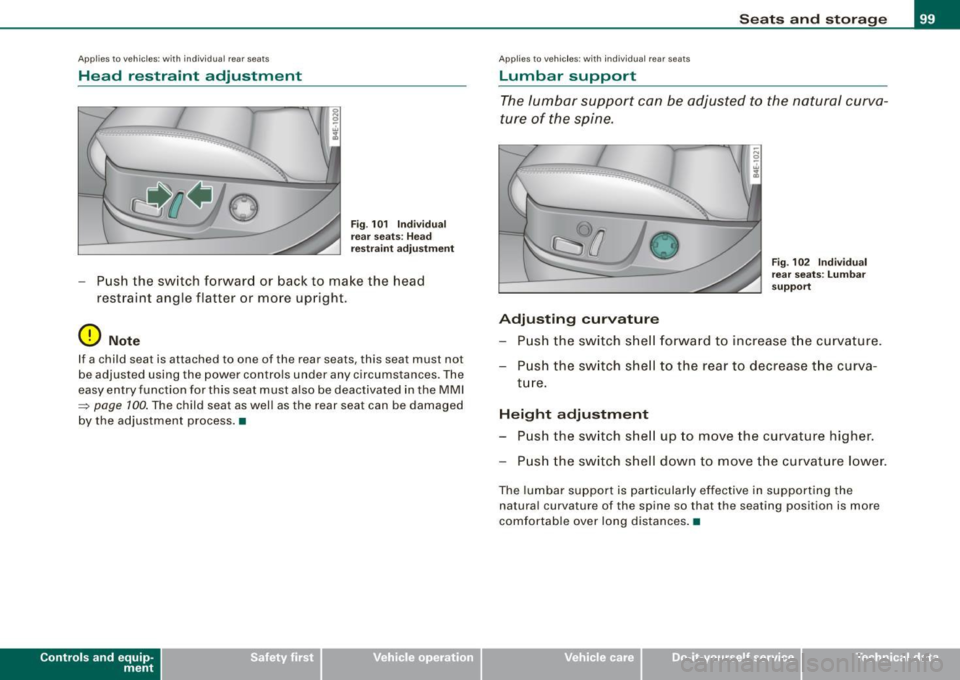
-Push the switch forward or back to make the head
restraint angle flatter or more upright.
0 Note
If a child seat is attached to one of the rear sea ts, this seat must no t
be adjusted using the power controls under any circumstances. The
easy entry function forth is seat must also be deactivated in the MMI
~ page 100. The child seat as well as the rear seat can be damaged
by the adjustment process. •
Con tro ls and eq uip
ment
Seats and storage
A pp lies to veh icles : wi th in di vidua l rear seats
Lumbar support
The lumbar support can be adjusted to the natural curva
ture of the spine.
0
Adjusting curvature
Fig. 102 Individual
rear seats : Lumbar
support
Push the switch shell forward to increase the curvature.
Push the switch shell to the rear to decrease the curva
ture.
Height adjustment Push the switch shell up to move the curvature higher.
Push the switch shell down to move the curvature lower.
The lumbar support is particularly effective in supporting the
natural curva ture of the spine so that the seating position is more
comfortable over long distances. •
Vehicle care
I I irechnical data
Page 102 of 408
• ..__S_ e_a _ t_ s_ a_ n_ d_ s_t _o _r_ a-' g==- e ________________________________________________ _
Applies to ve hicles : w it h indi vid ual r ear se ats
Settings in the MMI
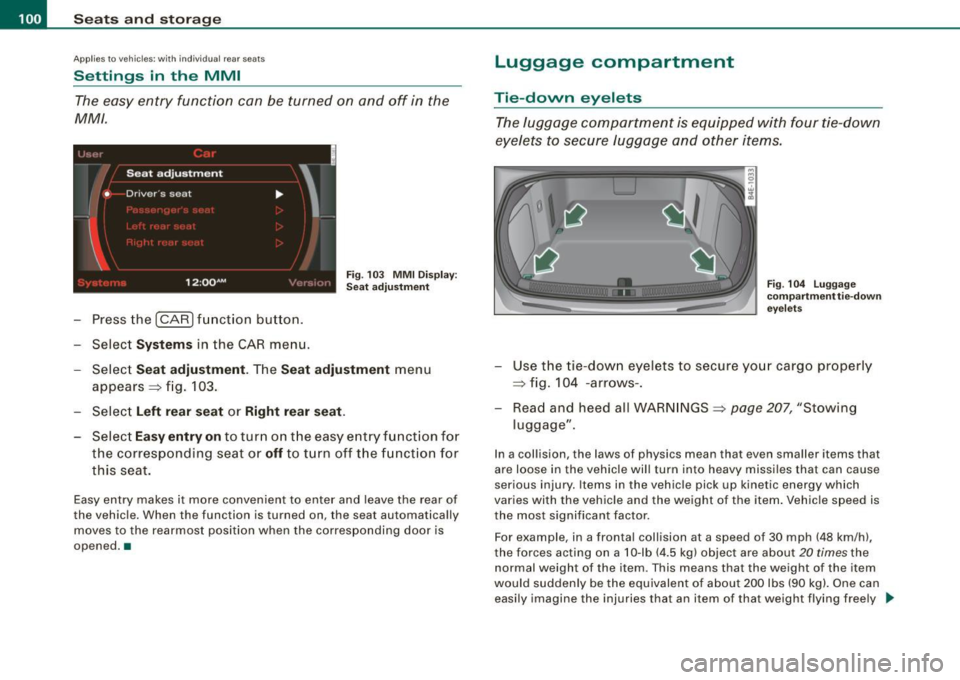
The easy entry function can be turned on and off in the
MM/.
J' ', ' r I
Seat adjustment
'
• Driver 's seat ...
I I
12 :QQ AM Fig . 103 MMI Disp lay:
Seat ad justment
- Press the I CAR I fun ction button .
- Selec t
Systems in the CAR menu.
Select
Seat adjustment . Th e Seat adju stment menu
appears => fig. 103.
Sele ct
Left r ear seat or Right r ear seat .
-Select Easy entry on to tur n on t he easy e ntry fu nction for
the c orresp onding seat or
off to t urn off t he fu nction for
this seat.
Easy entry makes it more convenient to enter and leave the rear of
the vehic le, When the function is turned on, the seat au tomatically
moves to the rearmost position when the corresponding door is
opened, •
Luggage compartment
Tie-down eyelets
The luggage compartment is equ ip p ed with f our tie -down
eyelets to secure luggage and other items.
Fig. 10 4 Lu ggage
co mp artm ent tie- dow n
e ye let s
- Use the tie-dow n eyelets to secure yo ur cargo properly
=> fig . 104 -arrows- .
- Read and heed all WAR NINGS=>
page 207, "Stowing
luggage".
In a collision , the laws of physics mean that even smaller items that
are loose in the vehicle will turn into heavy missiles that can cause
serious injury. Items in the vehicle pick up kinetic energy which
varies with the vehic le and the weight of the item . Vehicle speed is
the most significant factor.
For example , in a frontal collision at a speed of 30 mph (48 km /h) ,
the forces acting on a 10-lb (4 .5 kg) object are abou t
20 times the
normal weight of the item . This means that the weight of the item
would suddenly be the equivalent of about 200 lbs (90 kg). One can
easily imagine the injuries that an i tem of that weight flying free ly
I),
Page 121 of 408
_________________________________________________ W_ a_ r_ m __ a_n_ d_ c_ o_ld _ __. 1111111
Ap plies to vehicles: with heated rear se ats
Heated rear seats
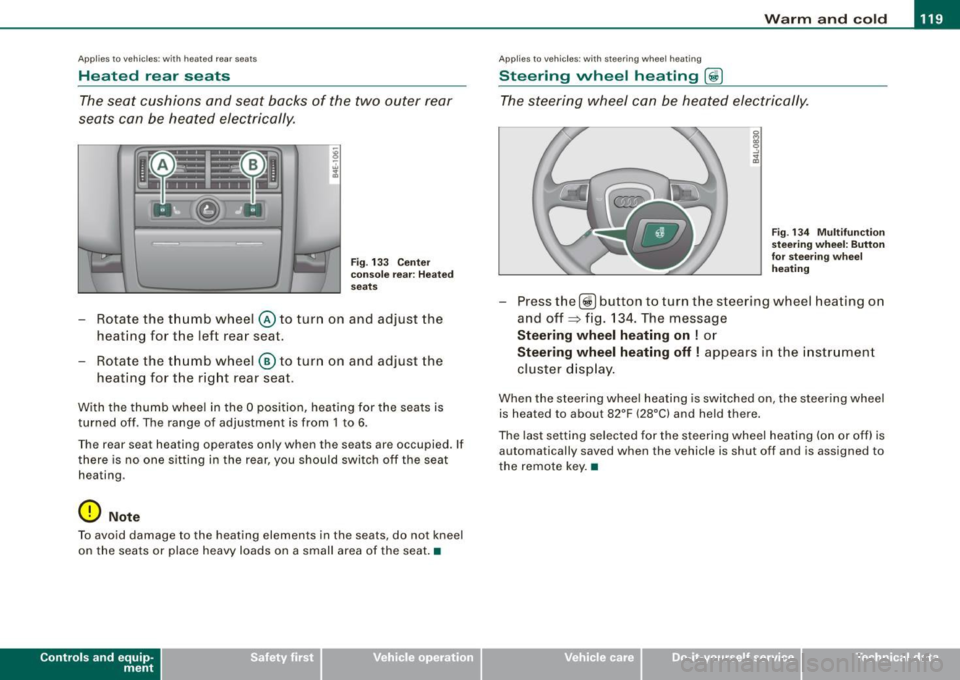
The seat cushions and seat backs of the two outer rear
seats can be heated electrically.
' ' ' 1 · ' ' --
------ ------~ ~
I I I I I I
Fig . 133 Center
console rear : Heated
seats
- Rotate the thumb wheel @ to turn on and adjust the
heating for the left rear seat.
- Rotate the thumb wheel
® to turn on and adjust the
heating for the right rear seat.
With the thumb wheel in the O position, heating for the seats is
turned off . The range of adjustment is from 1 to 6.
The rear seat heating operates only when the seats are occupied. If
there is no one sitting in the rear, you should switch off the seat
heating .
0 Note
To avoid damage to the heating elements in the seats , do not kneel
on the seats or place heavy loads on a small area of the seat. •
Contro ls and eq uip
ment
Ap plies to vehicle s: with ste erin g w heel heatin g
Steering wheel heating @
The steering wheel can be heated electrically.
Fig . 134 Multifunction
steering wheel: Button
for steering wheel
heating
Press the[@!] button to turn the steer ing wheel heating on
and off~ fig. 134. The message
Steering wheel heating on ! or
Steering wheel heating off! appears in the instrument
cluster display.
When the steering wheel heating is switched on , the steering wheel
is heated to about 82°F (28°C) and held there.
The last setting selected for the steering wheel heating (on or off) is
automatically saved when the vehicle is shut off and is assigned to
the remote key. •
Vehicle care I I irechnical data
Page 127 of 408
Warm and cold -
-------------------'
Rear climate controls
Applies to vehic les: with rear a ir condition ing
Controls
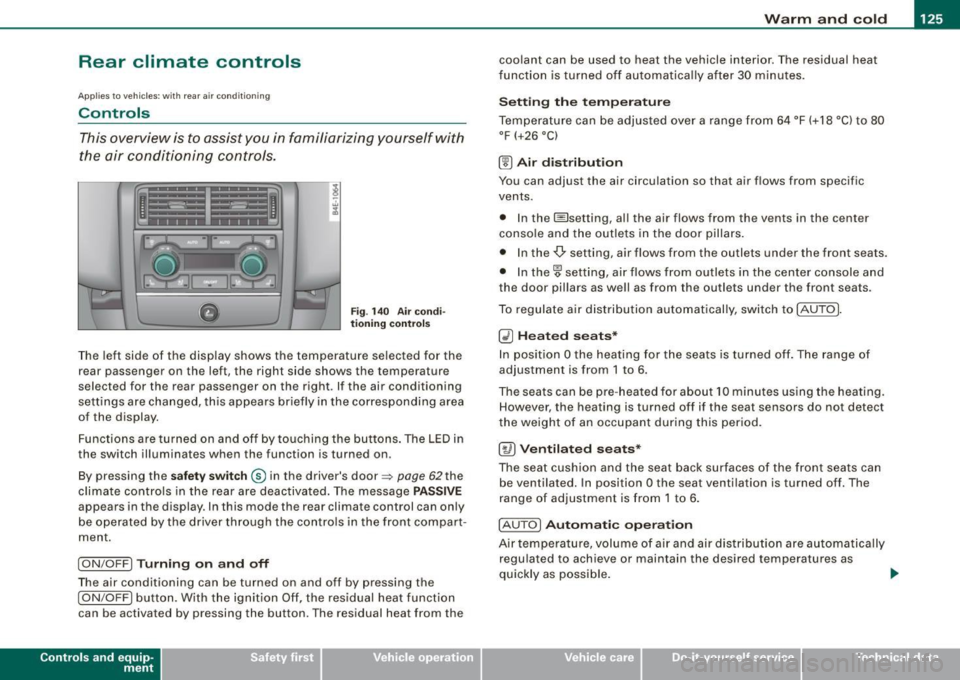
This overview is to assist you in familiarizing yourself with
the air conditioning controls .
Fig. 140 Air condi
tioning control s
The left side of the display shows the temperature selected for the
rear passenger on the left, the right side shows the temperature
selected for the rear passenger on the right. If the air conditioning
settings are changed, this appears briefly in the corresponding area
of the display.
Functions are turned on and off by touching the buttons . The LED in
the switch illuminates when the function is turned on .
By pressing the
safety switch ® in the driver's door=> page 62the
climate controls in the rear are deactivated. The message
PASSIVE
appears in the display. In this mode the rear climate control can on ly
be operated by the driver through the contro ls in the front compar t
ment.
I ON/OFF] Turning on and off
The air conditioning can be turned on and off by pressing the
I ON/OFF] button. With the ignition Off, the residual heat function
can be activated by pressing the button. The residual heat from the
Con tro ls and eq uip
ment
coolant can be used to heat the vehicle interior. The residual heat
fun ction is turned off automatica lly after 30 minu tes.
Setting the temperature
Temperature can be adjusted over a range from 64 °F (+18 °C) to 80
°F
(+26 °C)
® Air distribution
You can adjust the air circulation so that air flows from specific
vents.
• In the I isetting, al l the air flows from the vents in the center
conso le and the outle ts in the door pillars.
• In the-,!) setting, air flows from the outlets under the front seats.
• In the~ setting, air flows from outlets in the center console and
the door pil lars as we ll as from the outlets under the front seats.
To regulate air distribution automatically, switch to !AU TO].
~ Heated seats*
In position O the heating for the seats is turned off. The range of
adjustment is from 1 to 6.
The seats can be pre-heat ed for about 10 minutes using the heating.
However, the heating is turned off if the seat sensors do not detect
the weight of an occupant during this period.
[~ ) Ventilated seats*
The seat cushion and the seat back surfaces of the front seats can
be ventila ted. In position
O the seat ventilation is turned off. The
range of adjustment is from 1 to 6.
! AUTO]
Automatic operation
Air tempe rature, volume of air and air distribution are automatically
regulated to achieve or maintain the desired temperatures as
quickly as possible.
~
Vehicle care I I irechnical data
Page 130 of 408
• ..__O_ n_ t_ h _e _ ro_ a_d __________________________________________________ _
On the road
Steering
Adjusting steering wheel position
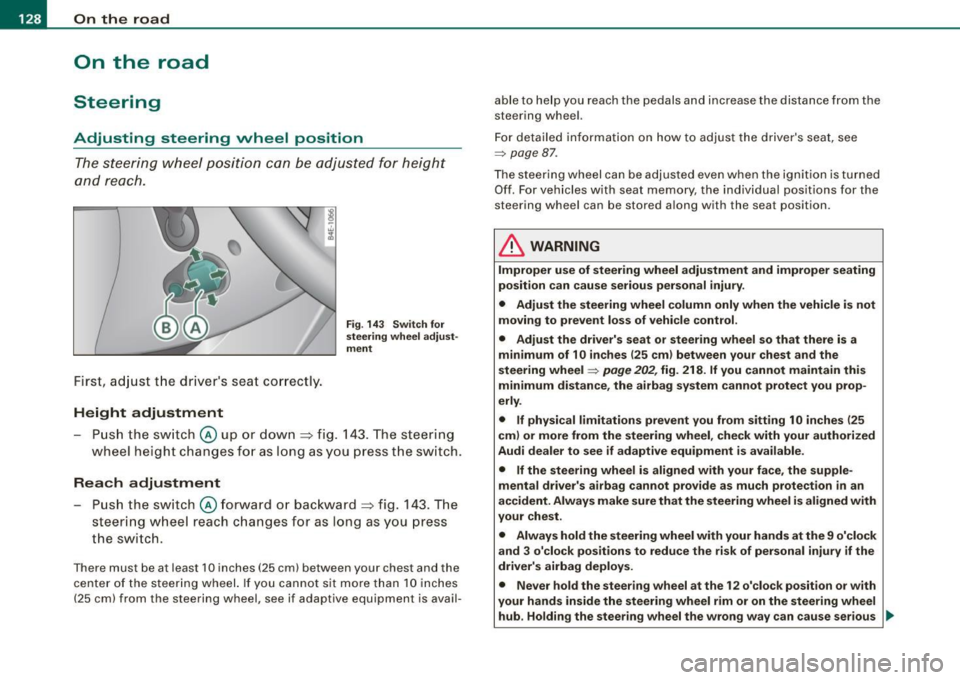
The steering wheel position can be adjus ted for height
and reach .
First, adjust t he driver's seat correctly .
Height adjustment
Fig. 14 3 Sw itch for
s te erin g whe el adj ust
m en t
- Pu sh the sw itch @ up or down ~ fig. 143 . The steering
wheel height changes for as l ong as y ou p ress t he sw itch.
Rea ch adjustment
Push the switch @forward o r bac kward ~ fig. 143 . The
steering wheel reach changes for as long as you press
the switch.
There must be at least 10 inches (25 cm) between your chest and the
center of the steer ing wheel. If you cannot sit more than 10 inches
(25 cm) from the steering wheel, see if adaptive equipment is avail- able to help you reach the pedals and increase the distance from the
steering wheel.
For detailed
in formation on how to adjust the driver's seat , see
::::;, page 87 .
The steering wheel can be adjusted even when the ignition is turned
Of f. For vehicles w ith seat memory, the individual positions for the
steering wheel can be stored a long with the seat position.
& WARNING
Improper u se of steering wheel adju stment and improper seating
po sition can cau se se rious per sonal inju ry .
• Adjust the steering wheel column only when the vehicle is not
mo ving to prevent los s of vehi cle control.
• Adjust the driver' s seat or steering wheel so that there is a
mi nimum of 10 in ch es (25 cm ) bet ween your chest and the
s teering wheel
=:> page 202 , fig. 218 . If you cannot maintain this
minimum di sta nce , the airbag sy stem can not prote ct you prop
erly .
• If physical limitations prevent you from s itting 10 inche s (25
cm ) or more from the st eering wheel , check with your authori zed
Audi dealer to see if adapti ve equipment i s available .
• If the steering wheel i s aligned with your face, the sup ple
mental drive r's airbag cannot pr ovide a s mu ch pr otection
in an
ac cident. Alway s make sure that the steerin g wheel i s aligned with
your che st .
• Alway s hold the steering wheel with your hand s at the 9 o'clock
a nd 3 o'clock positions to redu ce the ri sk of person al injury if the
driv er's airbag deploys.
• Never hold the steer ing wheel at the 1 2 o' clock po sition or with
your hand s insid e the steering wheel rim or on the steering wheel
hub . Holding the steering wheel the wrong wa y can cau se ser ious ..,,
Page 202 of 408
........ _o_ r_iv _i_ n""' g::;._ S_ a_f _e _ly =---------------------------------------------------
Driving Safely
General notes
Safe driving habits
Please remember -safety first!
This chapter contains important information , tips, instructions and
warnings that you need to read and observe for your own safety, the
safety of your passengers and others. We have summarized here
what you need to know about safety belts, airbags, child restraints as well as child safety. Your safety is for us
priority number 1. Always
observe the information and warnings in this section -for your own
safety as well as that of your passengers.
The information in this section applies to all model versions of your
vehicle. Some of the features described in this sections may be
standard equipment on some models, or may be optional equip
ment on others. If you are not sure, ask your authorized Audi dealer.
& WARNING
• Always make sure that you follow the instructions and heed
the WARNINGS in this Manual. It is in your interest and in the interest of your passengers.
• Always keep the complete Owner's Literature in your Audi
when you lend or sell your vehicle so that this important informa
tion will always be available to the driver and passengers.
• Always keep the Owner's literature handy so that you can find
it easily if you have questions. •
Safety equipment
The safety features are part of the occupant restraint
system and work together to help reduce the risk of injury
in a wide variety of accident situations.
Your safety and the safety of your passengers should not be left to
chance. Advances in technology have made a variety of features
available to help reduce the risk of injury in an accident. The
following is a list of just a few of the safety features in your Audi:
• sophisticated safety belts for driver and all passenger seating
positions,
• safety belt pretensioners,
• safety belt force limiters for the front seats,
• safety belt height adjustment systems for the front seats,
• front airbags,
• knee airbags for the front seats
• side airbags in the front seats and outer rear seats,
• side curtain airbags,
• special LATCH anchorages for child restraints,
• head restraints for each seating position,
• adjustable steering column.
These individual safety features, can work together as a system to
help protect you and your passengers in a wide range of accidents.
These features cannot work as a system if they are not always correctly adjusted and correctly used.
Safety is everybody's responsibility! •
Page 207 of 408
__________________________________________________ D _r_iv _ in_ g=- S_ a_f _e _l ___ y __ lffllll
Proper adjustment of head restraints
Correctly adjusted head restraints are an important part
of your vehicle's occupant restraint system and can help
to reduce the risk of injuries in accident situations.
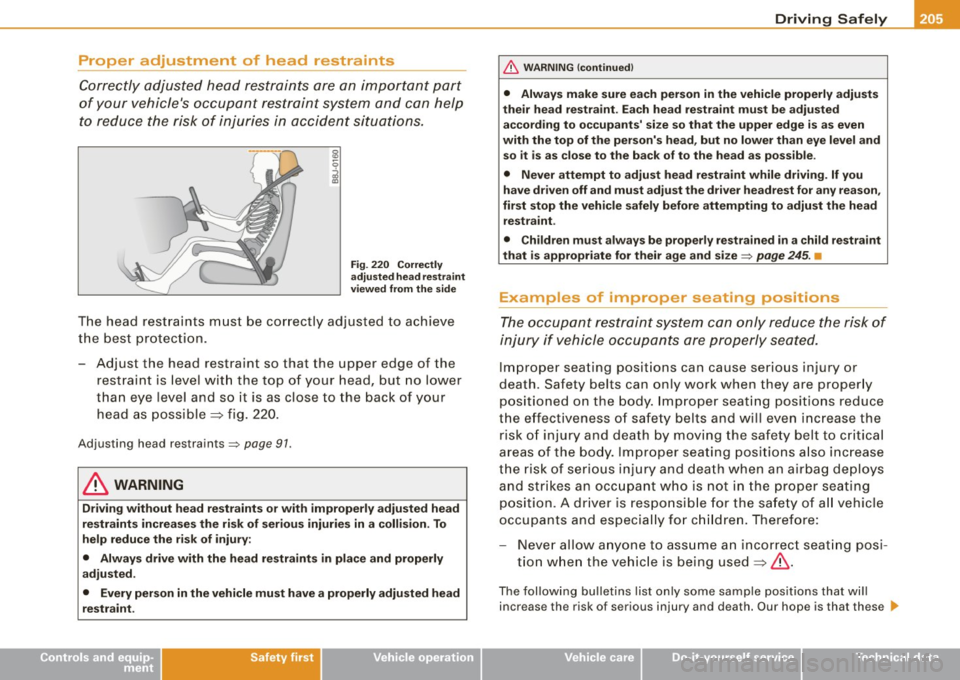
Fig. 220 Correctly
adjusted head restraint
viewed from the side
The head restraints must be correctly adjusted to achieve
the best protection.
-Adjust the head restraint so that the upper edge of the
restraint is level with the top of your head, but no lower
than eye level and so it is as close to the back of your
head as possible ~ fig. 220.
Adjusting head restraints=> page 91.
& WARNING
Driving without head restraints or with improperly adjusted head
restraints increases the risk of serious injuries in a collision . To
help reduce the risk of injury :
• Always drive with the head restraints in place and properly
adjusted.
• Every person in the vehicle must have a properly adjusted head
restraint.
Controls and equip ment Safety first Vehicle operation
& WARNING (continued)
•
Always make sure each person in the vehicle properly adjusts
their head restraint. Each head restraint must be adjusted
according to occupants' size so that the upper edge is as even
with the top of the person's head, but no lower than eye level and
so it is as close to the back of to the head as possible .
• Never attempt to adjust head restraint while driving. If you
have driven off and must adjust the driver headrest for any reason,
first stop the vehicle safely before attempting to adjust the head
restraint.
• Children must always be properly restrained in a child restraint
that is appropriate for their age and size
=> page 245. •
Examples of improper seating positions
The occupant restraint system can only reduce the risk of
injury if vehicle occupants ore properly seated.
Improper seating positions can cause serious injury or
death . Safety belts can only work when they are properly
positioned on the body. Improper seating positions reduce
the effectiveness of safety belts and will even increase the
risk of injury and death by moving the safety belt to critical
areas of the body. Improper seating positions also increase
the risk of serious injury and death when an airbag deploys
and strikes an occupant who is not in the proper seating
position. A driver is responsible for the safety of all vehicle
occupants and especially for children. Therefore:
- Never allow anyone to assume an incorrect seating posi
tion when the vehicle is being used~& .
The following bulletins list only some sample positions that will
increase the risk of serious injury and death. Our hope is that these .,_
Vehicle care Do-it-yourself service Technical data
Page 218 of 408
-Safety belts -----=-----------------------------------------
Automatic safety belt retractors
Every safety belt is equipped with an automatic belt retractor on the
shoulder bel t. This featu re locks the bel t when the belt is pulled out
fast, during hard braking and in an accident. The belt may also lock
when you drive up or down a steep hill or through a sharp curve. During normal driving the bel t lets you move freely.
Safety belt pretensioners
The safety belts are equipped with a belt pretensioner that helps to
tighten the safety belt and remove slack when the pretensioner is
activated. The function of the pretensioner is monitored by a
warning light=> page
19.
Switchable locking feature
Every safe ty belt excep t the one on the driver seat is equipped with
a switchable locking feature that
must be used when the safety belt
is used to attach a child seat. Be sure to read the important informa
tion about this feature => page
255.
& WARNING
Improperly positioned safety belts can cause serious injury in an
accident=>
page 216, "Safety belt position" .
• Safety belts offer optimum protection only when the seat back
is upright and belts are properly positioned on the body.
• Never
attach the safety belt to the buckle for another seat.
Attaching the belt to the wrong buckle will reduce safety belt
effectiveness and can cause serious personal injury.
• A passenger who is not properly restrained can be seriously
injured by the safety belt itself when it moves from the stronger
parts of the body into critical areas like the abdomen.
• Always lock the convertible locking retractor when you are
securing a child seat in the vehicle => page
257. •
Safety belt position
Correct belt position is the key to getting maximum
protection from safety belts.
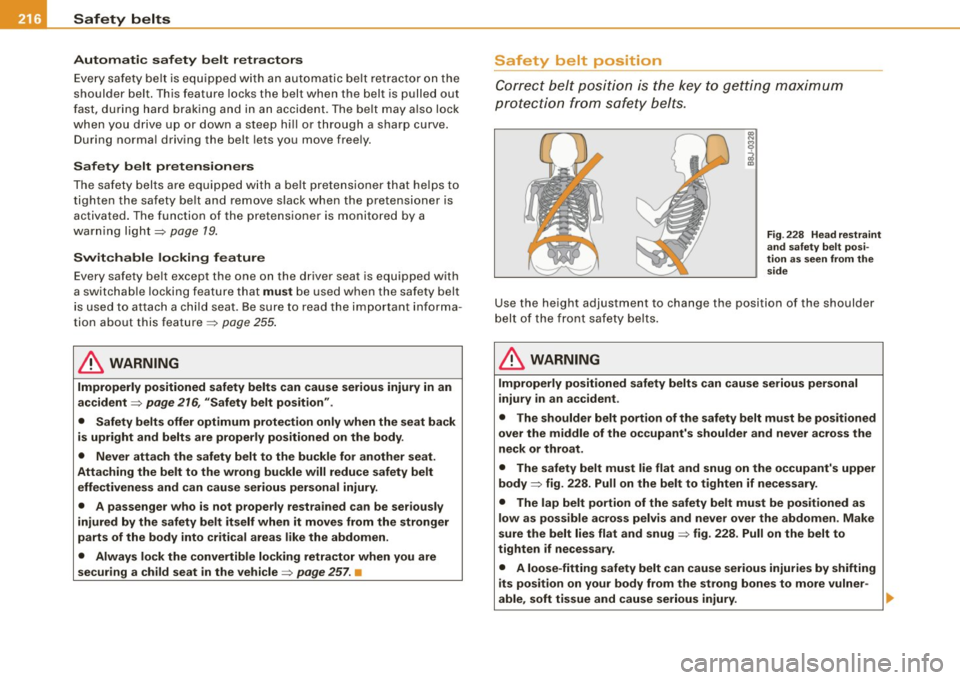
Fig . 228 Head restraint
and safety belt posi
tion as seen from the
side
Use the height adjustment to change the position of the shoulder
belt of the front safety belts.
& WARNING
Improperly positioned safety belts can cause serious personal
injury in an accident .
• The shoulder belt portion of the safety belt must be positioned
over the middle of the occupant's shoulder and never across the
neck or throat.
• The safety belt must lie flat and snug on the occupant's upper
body => fig. 228. Pull on the belt to tighten if necessary.
• The lap belt portion of the safety belt must be positioned as
low as possible across pelvis and never over the abdomen. Make
sure the belt lies flat and snug => fig. 228. Pull on the belt to
tighten if necessary.
• A loose-fitting safety belt can cause serious injuries by shifting
its position on your body from the strong bones to more vulner -
able, soft tissue and cause serious injury.
~