warning AUDI S8 2009 Owners Manual
[x] Cancel search | Manufacturer: AUDI, Model Year: 2009, Model line: S8, Model: AUDI S8 2009Pages: 408, PDF Size: 91.63 MB
Page 369 of 408

________________________________________________ E_ m ___ e_r.::g ~e ___ n_c ~y:.- s;_ i_t _u :...:a:..:. t.:.: i...:o :...:n...:..:. s _ __,J_
& WARNING !continued)
• Before you check anything in the engine compartment, always
read and heed all WARNINGS~ page 301, "Engine compartment".
0 Note
• Applying a higher voltage booster battery will cause expensive
damage to sensitive electronic components, such as control units,
relays, radio, etc .
• There must be no electrical contact between the vehicles as
otherwise current could already start to flow as soon as the positive
(+) terminals are connected.
[ i) Tips
• The discharged battery must be properly connected to the
vehicle's electrical system. When jump starting or charging the
battery , never connect the negative ground cable to the battery
negative post because the battery manager system must be able to
detect the battery's state of charge. Always connect the negative
ground cable to the negative ground post of the battery manager
control unit .•
Use of jumper cables
Make sure to connect the jumper cable clamps in exactly
the order described below!
Fig. 299 Jump starting
with the battery of
another vehicle: A -
discharged vehicle
battery, B -booster
battery
The procedure described below for connecting jumper
cables is intended to provide a jump start for your vehicle.
Vehicle with discharged battery:
-Turn off lights and accessories, move lever of automatic
transmission to
N (Neutral) or P (Park) and set parking
brake.
Connect POSITIVE (+) to POSITIVE (+) (red)
1. Connect one end to the positive terminal~ fig . 299 G)
of your battery @.
2. Connect the other end to the positive terminal
@ of the
booster battery
@.
Connect NEGATIVE (-) to NEGATIVE (-) (black)
3. Connect one end to the negative terminal @ of the
booster battery
@.
Vehicle care Do-it-yourself service irechnical data
Page 370 of 408
111!1.___E_ m_ e_r -=g :...e_ n _ c-=y _ s_ i_t _u _a _t_ i_o _n_ s _______________________________________________ _
4. Connect the other end t o the negative ground post of t he
battery manager contro l un it located next to t he batte ry.
Start in g the engin e
-Start the engine of the vehicle with the booster battery .
Run the engine at a moderate speed.
- Start eng ine w ith discharged ve hicle battery in t he usual
manner .
- If the e ngine fa ils to sta rt: do not keep the starter
cranking for longer than 10 seconds . Wait for about 30
seconds and then try aga in .
- With e ngine running, remove jumper cables from both
ve hic les in the exac t
reverse order.
The battery is vented to the outside to prevent gases from entering
the vehicle interior . Make sure that the jumper clamps are well
connected with their metal parts in full contact with the battery
termina ls .
& WARNING
To avo id seri ous pe rsonal injur y and d am age to the veh icle, heed
all warning s and ins truct ion s of the jumper cable manufa cturer . If
in doubt , call for road ser vic e.
• Jump er cable s mu st be long enough so that the vehicle s do not
tou ch .
• When connecting jumper c able s, make sure th at the y cannot
g et ca ught in an y mov ing par ts in the engine compa rt me nt.
• Befor e you che ck anything i n the en gine com partment , alwa ys
re ad and heed all WARNINGS=>
page 301 , "Engin e com partm ent ".
0 Note
Improper hook -up of jumper cables can ruin the generator. •
Always connect POS ITIVE( +) to POSITIVE(+), and NEGAT IVE( -) to
NEGAT IVE( -) ground post of the battery manager con trol unit.
• Check that al l screw plugs on the battery cells are screwed in
firm ly . If not, tighten plugs prior to connecting clamp on negative
battery terminal.
• Please note that the procedure for connect ing a jumper cable as
described above applies specifical ly to the case of your vehicle
being jump started. When you are giving a jump start to another
vehicle, do not connect the negative(-) cable to the negative(-)
t erminal on the discharged battery@=> page 367, fig. 299. Ins tead,
securely connect the negative (-l cable to either a solid meta l
component that is firmly bo lted to the engine block or to the engine
block itself. If the battery that is being charged does not vent to the
outside, escap ing battery gas could ignite and explode! •
Emergency towing with commercial
tow truck
General hints
Your Audi requires special handling for t owing.
T he fol lowing information is to be used by commercial tow truck
operators who know how to operate their equipment safely .
• Never t ow y our Audi , tow ing w ill ca use damage to t he en gin e
and tran sm iss ion .
• Never w ra p the safe ty c hai ns or winch ca bles a ro und th e bra ke
line s.
• To prevent un nece ssa ry d ama ge, your Audi must b e tr ansported
wi th a flat bed tru ck .
• To lo ad the vehi cle on to th e flat bed , us e the to wing loop fo und
in the vehicle tool s and a tt ac h to the front or rear anchorage
=> page 369 and=> page 370 . ~
Page 371 of 408
________________________________________________ E_ m_ e_r .::g :...e_ n _ c_,y'-- s_ i_t _u _a_ t_ i_o _n_ s _---Jffllll
& WARNING
A vehicle being towed is not safe for passengers. Never allow
anyone to ride in a vehicle being towed, for any reason. •
Towing loops
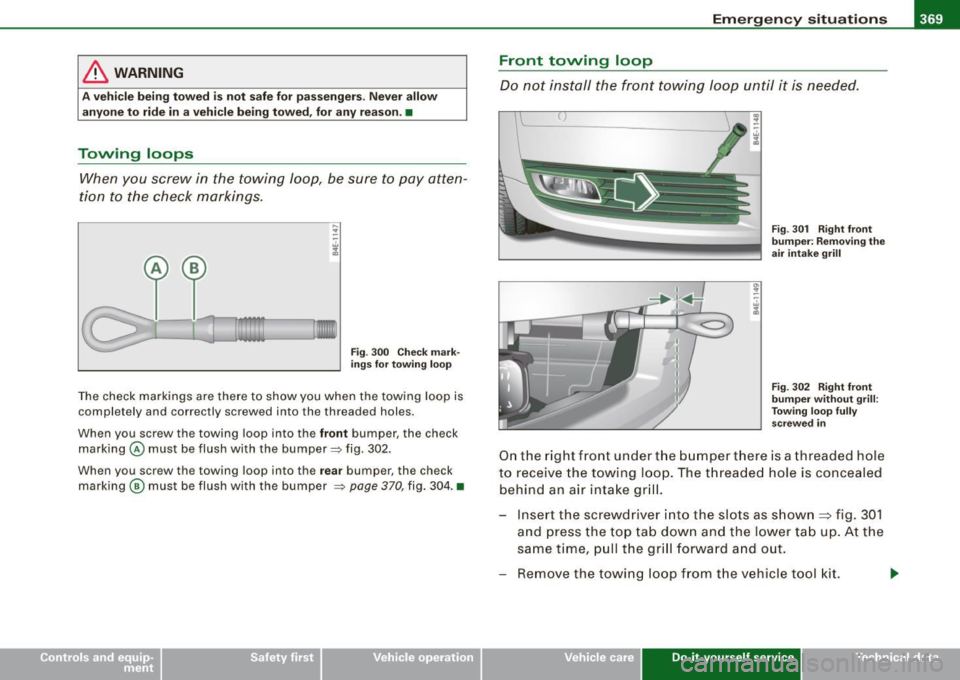
When you screw in the towing loop, be sure to pay atten
tion to the check markings.
Fig. 300 Check mark
ings for towing loop
The check markings are there to show you when the towing loop is
completely and correctly screwed into the threaded holes.
When you screw the towing loop into the
front bumper, the check
marking @ must be flush with the bumper~ fig. 302.
When you screw the towing loop into the
rear bumper, the check
marking @ must be flush with the bumper
~ page 370, fig. 304. •
Front towing loop
Do not install the front towing loop until it is needed.
Fig. 301 Right front
bumper: Removing the
air intake grill
Fig. 302 Right front
bumper without grill:
Towing loop fully screwed in
On the right front under the bumper there is a threaded hole
to receive the towing loop. The threaded hole is concealed
beh ind an air intake grill.
- Insert the screwdriver into the slots as shown
::::> fig. 301
and press the top tab down and the lower tab up. At the
same time, pull the grill forward and out.
- Remove the towing loop from the vehic le tool kit.
~
Vehicle care Do-it-yourself service irechnical data
Page 372 of 408
lllffll.,___E_ m _ e _r.;:g '-e_ n_ c-=y _ s_ i_t _u _a _t_ i_o _n_ s _______________________________________________ _
- Screw the towing loop tightly into the threaded hole as
far as it will go. The check mark must be flush with the
bumper=>
page 369, fig. 302.
When it is no longer needed, unscrew the towing loop and put it
back into the vehicle toolkit. Be sure to have the towing loop stored
in the vehicle at all times.
When installing the grill for the air duct, be sure that the tabs on the grill are first inserted into their guides on the vehicle by the
foglamp. Then push the grill into position.
& WARNING
If you do not screw the towing loop completely, it could come out
of the threaded hole while the vehicle is being towed causing
damage to the vehicle and possible serious personal injury. •
Rear towing loop
Do not install the rear towing loop until it is needed.
0
Fig. 303 Rear bumper:
cover
"'
Fig. 304 Rear bumper:
towing loop inserted
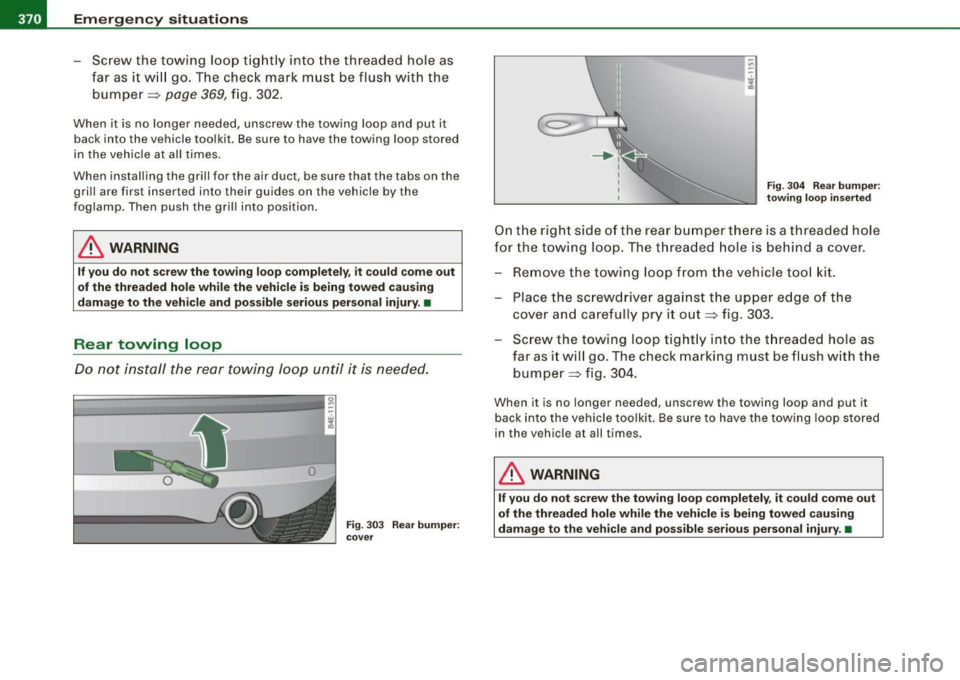
On the right side of the rear bumper there is a threaded hole
for the towing loop. The threaded hole is behind a cover.
- Remove the towing loop from the vehicle tool kit.
- Place the screwdriver against the upper edge of the cover and carefully pry it out=> fig. 303.
- Screw the towing loop tightly into the threaded hole as far as it will go. The check marking must be flush with the
bumper => fig. 304.
When it is no longer needed, unscrew the towing loop and put it
back into the vehicle toolkit. Be sure to have the towing loop stored
in the vehicle at all times.
& WARNING
If you do not screw the towing loop completely, it could come out
of the threaded hole while the vehicle is being towed causing
damage to the vehicle and possible serious personal injury. •
Page 374 of 408
-Emergency situations PV:f...__---=---=---------------
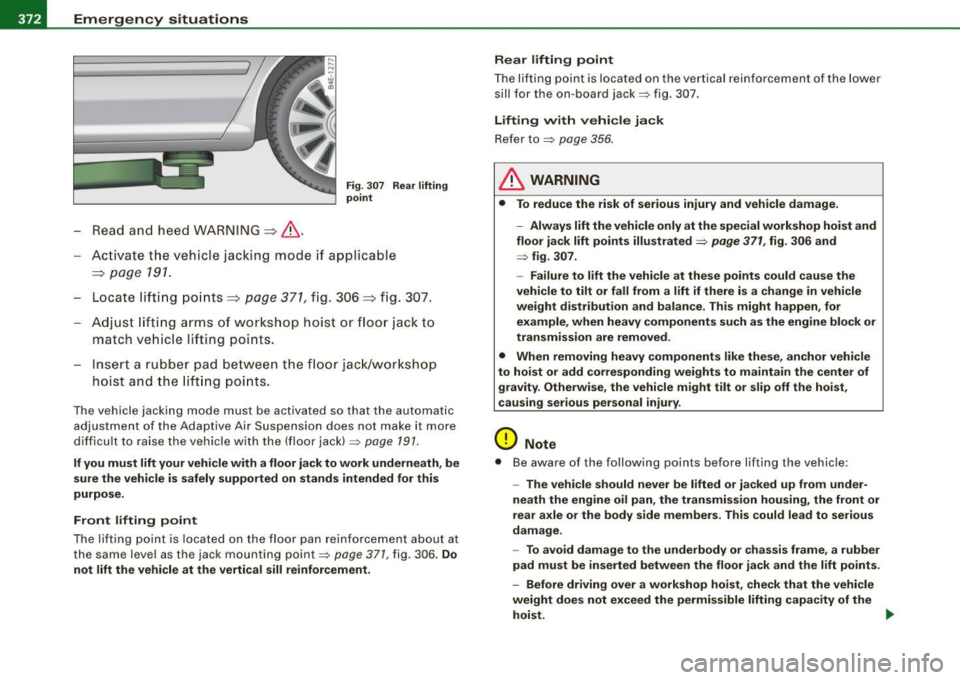
-Read and hee d W ARNI NG =:> & .
Fig. 30 7 Re ar lifting
point
Ac tiv ate t he vehicle jackin g mode if a pp licable
=:>
p age 19 1.
-Locat e lifting po in ts =:> page 371, fig. 3 06 =:> fig . 3 07 .
Ad ju st li ftin g a rms of works hop hoi st or floor jack t o
m atch v ehicle li ftin g poi nts.
In sert a r ub be r pad between the floor jack /wo rk sh op
h o ist and t he li ftin g poin ts.
The vehicle jac kin g m ode m ust be ac tiva ted so that the a utomatic
adjustment of the Adaptive Air Suspension does not make it more
d iffic ult to ra ise the vehic le w ith the ( floor jack) => page 19 1.
If you must lift your vehicle with a floor jack to work underneath , be
sure the vehicle is safely supported on stands intended for this
purpose.
Front lifting point
Th e lif ti ng po int is locat ed o n th e floo r pan re inf orc emen t abou t at
the same leve l as t he jack mounting point => page 371, fig. 306 . Do
not lift the vehicle at the vertical sill reinforcement. Rear lifting point
Th e lif tin g po int is loc ated on t he ver tical re infor ce ment o f the lo wer
s ill for t he on -boa rd jack=> fig . 3 07 .
Lifting with vehicle jack
R efer to => page
356 .
& WARNING
• To reduce the risk of serious injury and vehicle damage .
- Always lift the vehicle only at the special workshop hoist and
floor jack lift points illustrated
=> page 371 , fig . 306 and
=> fig. 307.
- Failure to lift the vehicle at these points could cause the
vehicle to tilt or fall from a lift if there is a change in vehicle
weight distribution and balance. This might happen , for
example, when heavy components such as the engine block or
transmission are removed .
• When removing heavy components like these, anchor vehicle
to hoist or add corresponding weights to maintain the center of gravity. Otherwise , the vehicle might tilt or slip off the hoist,
causing serious personal injury .
0 Note
• Be awar e of the following points be fore liftin g the vehicle :
- The vehicle should never be lifted or jacked up from under
neath the engine oil pan , the transmission housing , the front or
rear axle or the body side members . This could lead to serious
damage .
- To avoid damage to the underbody or chassis frame, a rubber
pad must be inserted between the floor jack and the lift points .
- Before driving over a workshop hoist, check that the vehicle
weight does not exceed the permissible lifting capacity of the hoist . _..
Page 379 of 408
_________________________________________________ G_ e_ n_ e_r _a _l_ i_n _f_o _ r_ m_ a_ t _i _o _ n __ PII
vehicle identification number of your vehicle (perforation) as well as
the Gross Vehicle Weight Rating (GVWR) and the Gross Axle Weight
Rating (GAWRl.
The high voltage warning label is located on the lock carrier.
The spark ignition system complies with the Canadian standard ICES-002. •
Displaying Vehicle Identification
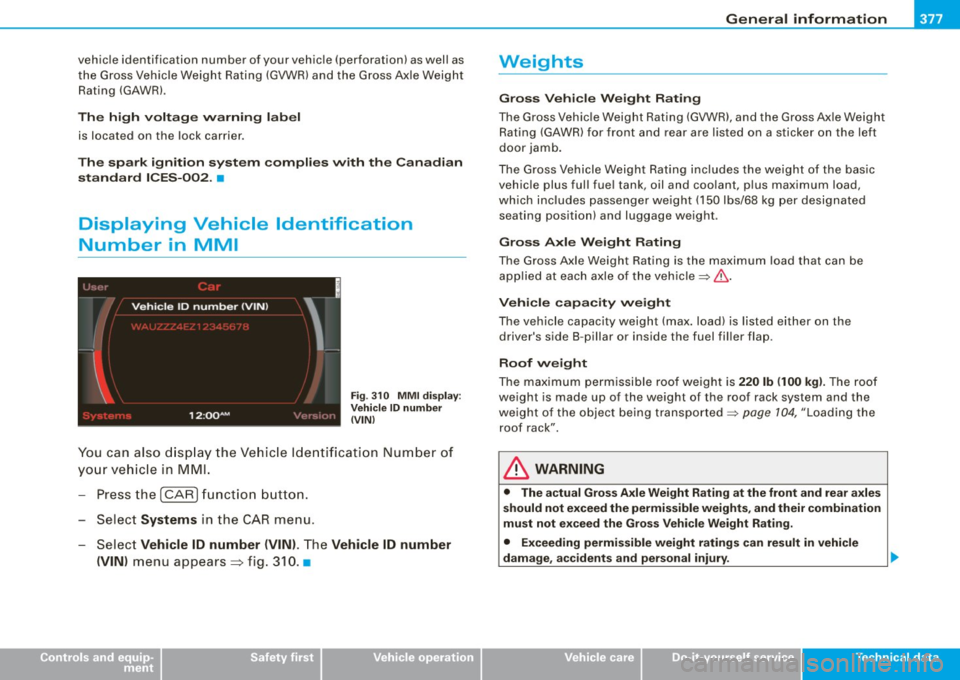
Number in MMI
Fig. 310 MMI display:
Vehicle ID number
(VIN)
You can also display the Vehicle Identification Number of
your vehicle in MMI.
- Press the
(CARI function button.
- Select Systems in the CAR menu.
- Select Vehicle ID number (VIN). The Vehicle ID number
(VIN) menu appears ~ fig. 310. •
Controls and equip
ment Safety first Vehicle operation
Weights
Gross Vehicle Weight Rating
The Gross Vehicle Weight Rating (GVWR), and the Gross Axle Weight
Rating (GAWR) for front and rear are listed on a sticker on the left
door jamb.
The Gross Vehicle Weight Rating includes the weight of the basic
vehicle plus full fuel tank, oil and coolant, plus maximum load,
which includes passenger weight (150 lbs/68 kg per designated
seating position) and luggage w eight .
Gross Axle Weight Rating
The Gross Axle Weight Rating is the maximum load that can be
applied at each axle of the vehicle~& .
Vehicle capacity weight
The vehicle capacity weight (max. load) is listed either on the
driver's side B -pillar or inside the fuel fill er flap .
Roof weight
The maximum permissible roof weight is 220 lb (100 kg). The roof
weight is made up of the weight of the roof rack system and the
weight of the object being transported~ page 104, "Loading the
roof rack".
& WARNING
• The actual Gross Axle Weight Rating at the front and rear axles
should not exceed the permissible weights, and their combination
must not exceed the Gross Vehicle Weight Rating.
• Exceeding permissible weight ratings can result in vehicle
damage, accidents and personal injury.
Vehicle care Do-it-yourself service Tec hn ica l da ta
Page 385 of 408
_______________________________________________ C _o_ n _ s_u _ m_ e_ r_l_n _f_o _ r_ m_ a_ t _i _o _ n __ lllll
re liabi lity . For detailed vehicle maintenance consult your Warranty &
M ain tena nce booklet .
Under diff icult operating condition s, for example at extreme ly low
outside temperatures, in very dusty regions, when towing a trai ler
very frequently, e tc ., som e serv ice work shou ld be p erfo rm ed
between the intervals specifie d. T his applies particu lar ly to:
• oil ch ang es, a nd
• cleaning or replacing the air filter.
<£> For the sake of the environment
By regularl y maintaining your vehicle, you help make su re that emis
s io n sta n da rds are ma intained, thus minimi zing a dvers e effe cts on
the environment. •
Important considerations for you and your
vehicle
The inc reasing use of elect ronics, sophisticated fue l injection and
e mi ssio n con tro l sy stems, a nd the gene ra lly i ncreas ing tec hn ica l
complexity of today's automobiles, have steadily reduced the scope
o f mai nte na nce a nd repairs wh ic h can be carr ied ou t by veh ic le
owners.
Also, safety and environmental concerns p lace very strict
l im it s o n the nat ure o f rep ai rs a nd adju stmen ts to engine a nd tra ns
m ission parts which an owner can perform.
M aintena nce, adj ust m ent s and repairs u sua lly require special t ool s,
t est ing dev ices and o ther equipment ava ilab le to sp ecia lly trained
workshop personne l in order to assure p rope r performance, reli
ab ilit y and sa fety o f the vehicle a nd its many sys tems.
I mproper maintenance, adjustments and repairs can impair the
ope ra ti on a nd reliabil ity o f your vehi cle a nd even vo id your ve hicle
warranty. Therefore, proof of servicing in accordance with the main
t e nance sch ed ule may be a con diti on for upholding a poss ibl e
warranty claim made within the warranty period.
Controls and equip ment Safety first Vehicle operation
Above a
ll, operational safe ty can be adverse ly affected, creating
u nn ece ssary risks for you a nd your passenge rs .
I f in doubt about any servicing, have it done by your authorized Audi
dea ler or any other properly equipped and qualified workshop. We
str on gly ur ge you to g ive your au thorized Au di dea ler t he o pportu
nity to perform al l scheduled maintenance and necessary repairs.
Your dealer has t he facil ities, origina l pa rts and tra ined spec ialis ts
to keep your vehic le running proper ly.
Performing limited maintenance yourself
The fo llowing pages descr ibe a limited numbe r of procedu res wh ic h
ca n be perf ormed o n you r vehicle wi th ord ina ry tools, sho uld the
need arise and trained personne l be unavailab le. Befo re performing
any of t hese proc edures, a lways thor oug hly read all of the ap pli
cable text and carefu lly fo llow the instruct ions given. Always rigor
ously observe the
WARNINGS provid ed .
Before you check anything in the engine compartment , al ways read
and heed all WARNINGS~
& and~ & in "Working in the engine
compa rtme nt" on
page 309.
& WARNING
• Serious personal injury may occur as a result of improperly
performed maintenance , adjustments or repairs .
• Always be extremely careful when working on the veh icle .
Always follow commonly accepted safety practices and general c ommon sense . Never risk personal injury .
• Do not attempt any of the maintenance, checks or repairs
descr ibed on the following pages if you are not fully fam iliar with
these or other procedures with respect to the vehicle , or are uncer
tain how to pro ceed .
• Do not do any work without the proper tools and equipment.
Have the necessary work done by your authorized Audi dealer or
another properly equipped and qualified workshop . _,.
Vehicle care Do-it-yourself service Tec hn ica l da ta
Page 386 of 408
___ C_ o_n_ s_ u_m _ e_ r_ ln_ f_o _r_m _ a_ t_ i_o _n ______________________________________________ _
& WARN ING (continued )
• The engine compartment of any motor vehicle is a potentially
hazardous area . Never rea ch into the area around or to uch the
radiator fan . It is temperature controlled and can sw itch on
suddenly -even when the engine is off and the ignition key has
been removed . The radiator fan switches on automatically when
the coolant reaches a certain temperature and will continue to run until the coolant tempe rature drops .
• Always remove the ignition key before anyone gets under the
vehi cle .
• Always support your vehicle with safety stands if it is neces
sary to work underneath the vehicle . The jack suppl ied with the
vehicle is not adequate for this purpose and could collap se
causing serious personal injury .
• If you must work underneath the vehicle with the wheels on
the ground, always make sure the veh icle is on level ground , that
the wheels are always securely blocked and that the engine
cannot be sta rted .
• Always make sure the tr ansmission selector lever (automatic
transmission) is in "P" (Park position ) and the p ark brake is firmly
applied.
W For the sake of the environment
• Cha ng ing the e ngin e sett ings will a dverse ly aff ect em iss ion
levels. This is detrimenta l to the environment and increases fuel
co nsump tion .
• Always observe environmenta l regu lations when disposing of
o ld eng ine oil, u sed bra ke flu id, d irty eng ine coo la nt, spent batter ies
or worn out tires.
• Undeployed airbag modul es and pretensioners might be classi
fied as Perchlorate Material -specia l handling may apply, see
www .d tsc.ca .gov/ hazardouswaste/pe rc h lora te . W hen t he vehicle or
parts of the restraint s ystem including airbag modules safety be lts
with pre tensio ners are sc ra p pe d, a ll ap pl ica ble laws and reg ula- tions must be observed. Your authorized Audi dea
ler is familiar with
t hese requi reme nts and we reco mmend th at you h ave your dealer
perform th is serv ice for you. •
Additional accessories,
modifications and parts replacement
Additional accessories and parts
replacement
A lways consult an author ized Audi dea ler before
pur chasin g access orie s.
Y our vehicle incorporates the latest safety design featu res ensuring
a hi gh standa rd of active a nd passive sa fety .
T his saf ety could be com promised by non -approved changes to th e
vehic le . Fo r thi s reason, i f parts have to be replaced, p lease obse rve
th e fo llow ing po ints wh en insta lling add it io na l acc essories:
Approved Audi accessories and genuine Audi parts are avai lable
from autho rized Audi dea lers .
T hese dealers also have the necessary faci lities, tools and trained
spec ia lists to ins tal l the part s and accessorie s prope rly.
& WARNING
Using the wrong spare parts or using non -approved accessories
can cause serious personal injury.
• Use only accessorie s expressly approved by Audi and genuine
Audi spare parts
• These parts and accessories have been specially designed to
be used on your vehicle .
• Never install accessories such as telephone cradles or
beverage holders on airbag covers or within the airbag deploy-
Page 387 of 408
_______________________________________________ C _o_ n _ s_u _ m_ e_ r_l_n _f_o _ r_ m_ a_ t _i _o _ n __ lllll
& WA RNIN G (continu ed )
ment zone s. Do ing so will in creas e the risk of injur y if airb ags are
trig ger ed in an accident!
• Before you che ck anyth ing in the engine comp artme nt, a lwa ys
re ad and heed all WARNIN GS=>
page 301 .
0 Note
• If items other than ge nuine Audi spare parts, add -on equ ipment
and accessory items are used or if repair work is not performed
according to specified methods, this can resu lt in severe damage to
your vehicle's engine and body (such as corrosion) and adverse ly
affect your vehicle's war ranty.
• T he innovative a luminium concept of your Audi A8 means that all
servicing, repairs or other work on the vehic le body mus t be carried
out exc lusively by an Audi workshop.
• I f emergency repairs must be performed e lsewhere, have the
vehicle examined by an authorized Audi dealer as soon as possible.
• The manufacturer cannot be held liable for damage which occurs
due to failure to comply with these stipu lations. •
Technical Modifications
Our guidelines must be complied with when technical
modifications are made.
A lways c onsult an authorized Audi dealer before starting work on
any modifications.
T his will he lp ensure that vehicle function, performance and safety
are no t impa ired =>& .
Attempting to work on electronic components and the software used with them can cause malfunctio ns. Because o f the way elec
tronic components are interconnected with each other, such
malfunctions can also have an adverse affect on other systems that
Controls and equip ment Safety first Vehicle operation
are not directly involved.
This means that you risk both a substantial
reduction in the operat ional safety of your vehicle and an increased
wear of vehicle parts => & .
Authorized Audi dealers wi ll perform this work in a professional and
competent manner or, in special cases, refer you to a pro fess ional
company that specializes in such modifications.
& WARNING
Improper repair s and modifications c an change the way vehicle
s y stems work and cau se seriou s per sonal injury .
0 Note
If emergency repairs must be perfor med e lsewhere, have the
vehic le examined by an authorized Audi dea ler as soon as
possible. •
Declaration of Compliance ,
Telecommunication or Electronic Systems
Ra dio Fre quency Devices and R adio comm unic ation
E quipment User Manual N otic e.
The manufacturer is not responsible for any radio or TV interference
caused by unauthorized modificat io n s to this equi pment .
Device s
The followi ng devices each comp ly w ith FCC Part 15 .19, FCC 15.21
and RSS-Gen Issue 1:
• Adaptive C ruise Contro l
• Convenience key
• Aud i side assist
• Cell phone package
• Electronic immobilizer
Vehicle care Do-it-yourself service Tec hn ica l da ta
Page 392 of 408
__ _!_A~ l~p~ h~ a~ b~e~ t:!:ic~a~ l _!:i n~ d~e~ x~ --------------------------------------------
A
Accessories . . . . . . . . . . . . . . . . . . . . . . . . 384
Adaptive Air Suspension .... ... .. .... 188
automatic mode ...... .... ....... 189
Description ... ... ... ..... .... ... 188
dynamic mode ................... 189
Jacking mode when changing a flat tire .
191
lift mode ...... ..... .... .... .... . 189
Setting the driving modes .. .... ... 191
Sport Chassis Controls . . . . . . . . . . . . 190
standard mode ... .... .... .... ... 189
Trailer towing mode ... .... .... ... 192
Warning/indicator lights ........ 20, 21
Adaptive Cruise Control . ... .. .... ... .
Changing speed .... .... .... .... .
Driver information .............. .
Driving in traffic .. .... .... ..... . .
Error messages ................. .
Open road ......... ............ .
Override ........ ............... .
Request for driver to assume control
Save speed ..................... .
Setting distance .. .... .... .... .. .
Setting time interval . ... .. .... ... .
Settings . ... .... .... .... ....... .
Specia l driving situations . ....... . 139
142
146
140
148
140
140
140
142
144
144
150
150
Status messages . . . . . . . . . . . . . . . . . 148
Switching on and off ... .. .... ... . 141
System limitations .... ....... ... .
Temporarily turning off ....... ... .
warning/indicator lights ... .... ... . 150
143
146 Adaptive Light
.......... .... .... .... . 72 System error message . ...... .... . 186
defective .. .... .... .... ..... .. .... 36 Towing hitch .. .... .... ...... .... 183
Adding Air conditioning
Engine coolant ... ....... .... .... .
318
See Climate controls 114
Engine oil . .... .... .... ... .... .. .
314 Airbag system .... .... .... ..... . 220, 240
Windshield washer fluid .... .... .. .
325 Advanced Airbag System ...... .... 224
Additional accessories .......... .. ... 384
Additives Engine oil . .... ...... ... .. .... ... 314
Adjustable steering col lumn .. ..... ... 128
Adjusting Front seats .... ...... .... .... .... . 86
Instrument cluster i llumination . .... . 15
Steering column . ........... .... .
128
Advanced Parking System with rear view camera
Adjusting the chimes -option 1 . ... 183
Adjusting the chimes -option 2 ... . 184
front and back with visual display and
rear -view camera . . . . . . . . . . . . . . . 173
General information ......... ..... 173
Notes on distance irnformation ... .. 182
Parking next to obstacles . . . . . . . . . . 181
Rear -view camera -parking mode 1 . 178
Rear -view camera -parking mode 2 . 179
Rear -view camera (Rear View) ...... 176
Rear -view camera coverage area . . . . 177
Rear -view camera tips . . . . . . . . . . . . 186
Special parking situations .. .... ... 181
Switching the rear-view camera on and off ............................ 185
sw itching the visual display on and off
185 Advanced Airbag System components .
..
227
Care .. .... .... .... .... ... .... ... 234
Child restraints 247
Children ... .... .... ... .......... 246
Components (front airbags) . .... ... 227
Danger of fitting a child seat on the front passenger seat ............... .. 222
Disposal ............ .. ...... .... 234
Front airbags .. ............ .. 224, 225
How do the front airbags work? . ... 229
How many airbags does my vehicle have? 227
How the Advanced Airbag System compo
nents work together . . . . . . . . . . . . . 228
Important safety instructions on the knee
airbag system .................. 238
Important things to know .......... 220
Indicator light .... ......... ...... 231
Knee airbags 236
Monitoring .. .... .... .... .... .... 231
PASSENGER AIR BAG OFF light ... .. 232
Repairs ..... .... .... .. .. . ... ... .
Safety instructions .. .... .... .... .
Side airbags . .... .... .... .... ... . 234
233
239
Side curtain airbags .... ... .... ... 242
Warning/indicator lights ........... . 19