fuel AUDI S8 2009 Owner's Guide
[x] Cancel search | Manufacturer: AUDI, Model Year: 2009, Model line: S8, Model: AUDI S8 2009Pages: 408, PDF Size: 91.63 MB
Page 285 of 408
The engine and catalytic converter have to reach their optimal oper
ating temperature to reduce fuel consumption and noxious emis
sions effectively.
Just after starting, a cold engine in a mid -size car only achieves a
fuel economy of 6-8 miles per gallon (30-401/100 km). After about a
half a mile, fuel economy climbs to 12 mpg (201/100 kml. After about
2.5 miles (4 km), the engine is at its proper operating temperature
and fuel economy has reached a normal level. So you can see that
you should avo id short tr ips whenever possible.
The outside temperature is also critical in this regard. Your car
consumes more fuel in the winter than in the summer. •
Controls and equip ment Safety first Vehicle operation
Driving
and environment
Vehicle care Do-it-yourself service Technical data
Page 287 of 408
Operating instructions
Max im um tra iler weight
A trailer for your vehicle is limited to a typical class 1 or class 2
trailer.
T ra ile r l oa d di stributio n
Be sure the load in the trailer is he ld securely in place to prevent it
from shifting forward, backward or sideways .
Never allo w a passe nger to r ide in a tr aile r~ & in "Driving instruc
tions" .
Engin e c oolin g sys te m
Towing a trailer makes the eng ine work harder. It is important that
the cooling system's performance is up to the additiona l load. Make
sure that the coo ling system has enough fluid .
Tire pr ess ure
When towing a trailer, inflate the tires of your vehicle to the co ld tire
pressure listed under "Full load" on the labe l located either on the
driver's side B -pil lar (visible when the door is open) or inside the fuel
filler flap . Inflate trai ler tires to trai ler and tire manufacturers' spec
ifications.
L ig ht s
The head light settings should be checked wit h the trai ler attached
before driving off. Check to make sure both vehicle and trai ler lights
are working properly .
Safe ty c ha in s
Be sure traile r safety chains are properly connected from the trailer
to the hitch on the vehicle. Leave enough slack in the chains to
perm it turning corners . When you i nsta ll safety chains, make sure
they will not drag on the road when you are driving.
T he chains should cross under the trailer tongue to prevent it from
dropping in case of separat ion from the hitch.
Controls and equip
ment Safety first Vehicle operation
Tr
aile r t owing
0 Note
If you are going to tow a trai ler, you must activate the trailer opera
tion mode ~
page 192, "Towing a Trailer". •
Driving instructions
Driving with a trailer always requires extra care and
consideration.
To obtain the best possible handling of veh icle and trailer,
please note t he following :
- Do not tow a loaded trailer when your car itself is not
loaded.
Be espec ia lly careful whe n passing other vehicles.
- Observe s peed limits .
Do not drive at the maximum permiss ible speed .
Always apply brakes ear ly.
Moni tor t he temperature ga uge.
Weight distr ibution
Towing a loaded trailer with an empty car results in a highly
unstable distr ibution of weight. If this cannot be avoided, drive at
very low speeds only to avoid the risk of losing steering control.
A "balanced" rig is easier to operate and control. This means that
the tow vehicle should be loaded to the extent possible and perm is
s ib le, while keeping the trailer as light as possib le under the circum
stances . Whenever possible, transfe r so me cargo to t he luggage
compartment of the tow vehicle whi le observing tongue load
requirements and vehicle loading considera tions . .,
Vehicle care Do-it-yourself service Technical data
Page 292 of 408
___ C_ le_ a _ n_i_n ~g _ a_ n_ d __ p_r _o _t _e _c_ t_ i_o _n ___________________________________________ _
Cleaning and protection
General information
Regular care preserves vehicle value.
Any automobile is exposed to industrial fumes, corrosive road salt,
muddy dog feet, etc . A well cared for Audi can look like new many
years a fter purchase. Regu lar a nd correct ca re will co ntribu te to
maintaining the beauty and value of your Audi.
Furthermore, good care may be a condition for substantiating a
war ranty claim should co rros ion damage or paint defect s occur .
Your authorized Audi dealer has a variety of dedicated vehicle- care
product s
and can adv ise whic h ones to use for clea ning the e xter ior
and interior of your vehicle.
Whethe r you use p roducts recommended by Audi or other c ommer
cia lly availab le cleaning agents , please make sure you apply them
correctly.
& WARNING
• Cleaning agents may be poisonous. Keep them out of the reach
of ch ildren .
• Heed all caution label s.
• Always read directions on the contai ner before using any
product. Follow the di rection s carefully .
• Most chemical cleaners are concentrated and have to be
d iluted.
• Use spot removing fluids only in well ventilated area s.
• Do not use gasoline , kerosene , die sel fuel , nail polish remover
or other volatile fluids . They may be toxic , flammable or hazardous
in other way s. Do not wash , wa x or dry the vehicle w ith the igni
tion on or the engine running.
& WARNING (continued )
• Do not clean the under side s of chassis , fenders , wheel cove rs,
etc . without protecting your hands and arms. You may cut yourself
on sharp -edg ed metal parts .
• Moisture and ice on brakes may impair braking effi ciency
=> page 272 , "General info rmation ". Test the brake s carefully each
time you wa sh the vehicle.
~ For the sake of the environment
Se lect only enviro nmenta lly friend ly c leaning products . Leftover
clean ing products should not disposed of in the household waste. •
Care of exterior
Washing
Frequen t washing pro tects the vehi cle.
Th e bes t protection against envi ronmental influences is frequent
washing and waxing . How often this is required depends on:
• Ho w much the vehic le is used
• Where the vehic le is parked (garage, in the open under trees,
etc.)
• T he seasonal and weather conditions
• Environmenta l influences
T he longer bird droppings, insects, tree resin, road and industrial
gri me, tar, soot, road salt and ot her materials rema in on the ve hicle
body, the more lasting their destruc tive effects will be . High temper
atu res caused by exp osu re to in tense s un ligh t inte nsify the c orro -
sive effect, particularly when humidity is high as well.
~
Page 305 of 408
•
Fuel supply and filling your fuel tank
Gasoline
Fuel supply Using the right fuel helps keep the environment clean and
prevents engine damage.
Fuel r ecomm end ati on
The fuel recommended for your vehic le is unl eade d prem ium grade
gaso line . See also ~
page 380, "Data". Audi recommends using TOP
T IER Detergent Gasoline with a minimum octane rating of 91 AKI (95
RON). For more information on TOP TIER Detergent Gaso line, please
go to the official website (www.toptiergas .com).
The recommended gasoline octane rating for your engine can also be found on a label located on the inside of the fuel fille r flap. This
rating may be specified as AK I or RON .
Your vehic le may also be operated us ing unleaded regular gasoline
with a minimum octane rating of 87 AKl/91 RON . However, using 87
AKl/9 1 RON octane fuel will slightly reduce engine performance.
Use unle ad ed ga so line only . Unleaded gaso line is avai lable
throughout the USA, Canada, and in most European countries. We
recommend that you do not take your vehicle to areas or countr ies
where un leaded gasoline may not be available .
For more information on refueling your vehicle, see~
page 304.
Octane ra tin g
Octane rating indicates a gaso line's ability to resist engine
damaging "knock" caused by premature ignition and detonation.
Therefore, buying the correct grade of gaso line is very important to
help prevent possible engine damage and a loss of engine perfor
mance.
F ue l supply and fillin g you r fu el tank
Gasoline most common ly used in the United States and Canada has
the following octane ratings that can usua lly be found on the filler
pump:
• Premium Grade : 91 -96 AKI
• Regular Grade: 87 -90 AKI
Explanation of the abbreviations:
AKI = Anti Knock Index= (R +M)/2 = (RON +MON)/2
RON = Research Octane Number
MON
= M otor Octane Number .
0 Note
• Do not use any fue l with octane ratings lower than 87 AKI or 91
RON otherwise expensive engine damage will occur .
• Do
not use leaded gasoline. The use of leaded gasoline w ill
severe ly damage your vehicle's catalytic converter and its abi lity to
control exhaust emissions. •
Blended gasoline
Use of g aso line containing alco hol or M TB E ( meth yl
t er tiary butyl e ther )
You may use unleaded gasoline blended with alcohol or MTBE
(commonly referred to as oxygenates) if the blended mixture meets
the follow ing criteria:
Bl end of g asoline m eth anol (wood al coho l or methyl alc oh ol)
• Anti-knock index must be 87 AKI or higher .
• Blend must contain no more than 3% methanol.
• Blend must contain more than 2% co-solvents.
Vehicle care I t •
Page 306 of 408

Fuel supply and filling your fuel tank
Blend of gasoline and ethanol (grain alcohol or ethyl alcohol}
• Anti-knock index must be 87 AKI or higher.
• Blend must not contain more than 10% ethanol.
Blend of gasoline and MTBE
• Anti-knock index must be 87 AKI or higher.
• Blend must contain not more than 15% MTBE.
Seasonally adjusted gasoline
Many gasoline grades are blended to perform especially well for
winter or summer driving. During seasonal change -over, we suggest
that you fill up at busy gas stations where the seasonal adjustment
is more likely to be made in time.
0 Note
• Methanol fuels which do not meet these requirements may
cause corrosion and damage to plastic and rubber components in
the fuel system.
• Do not use fuels that fail to meet the specified criteria in this
chapter.
• If you are unable to determine whether or not a particular fuel
blend meets the specifications, ask your service station or its fuel
supplier.
• Do not use fuel for which the contents cannot be identified.
• Fuel system damage and performance problems resulting from
the use of fuels different from those specified are not the responsi
bility of Audi and are not covered under the New Vehicle or the
Emission Control System Warranties.
• If you experience a loss of fuel economy or driveability and
performance problems due to the use of one of these fuel blends,
we recommend that you switch to unblended fuel. •
Gasoline additives
A major concern among many auto manufacturers is carbon
deposit build-up caused by the type of gasoline you use.
Although gasoline grades differ from one manufacturer to another,
they have certain things in common. All gasoline grades contain
substances that can cause deposits to collect on vital engine parts,
such as fuel injectors and intake valves. Although most gasoline
brands include additives to keep engine and fuel systems clean,
they are not equally effective.
Audi recommends using TOP TIER Detergent Gasoline. For more
information on TOP TIER Detergent Gasoline, please go to the offi
cial website (www.toptiergas.com).
After an extended period of using inadequate fuels, carbon deposit
build-ups can rob your engine of peak performance.
(D Note
Damage or malfunction due to poor fuel quality is not covered by
the Audi New Vehicle Limited Warranty. •
Fuel tank
Fuel filler neck
The fuel filler neck is located on the right rear side panel behind the
fuel filler flap.
If the power locking system should fail, you can still open the flap
manually - for detailed instructions see=>
page 307.
You can find the fuel tank capacity of your vehicle in Technical Data
=> page 380. .,_
Page 307 of 408
The labe l on the inside of the fuel filler flap tel ls you the correct fuel
fo r your vehicle . For mo re information about fuel specifications, see
=> page 303.
Your vehicle fuel tank has an onboard refuelling vapor recovery
sys tem. Th is feature helps to prevent fue l vapors from escapin g
from the tank and polluting the environment wh ile you refue l your
veh ic le . I n order to fill the tank properly while protecti ng the envi
ronment, please follow this refuel ing procedure carefully .
& WARNING
Under normal operating conditions , never carry additional fuel
c ontainers in your car . Ga s canisters and other containers used to
transport fuel can be dangerous . Such conta iners , full or empty,
may leak and could cause a fire in a collision . If you mu st transport
fuel to use for your l awn mower , snow blower , etc. , be very c areful
and always ob serve local and state laws regarding the u se , tran s
port ation and storage of su ch fuel containers . Make certain the
c ontainer meets industry standard s (ANSI/ASTM F852 -86 1.
0 Note
Neve r d rive your vehicle until the fuel tank is completely emp ty . The
irregular supp ly of fuel can cause misfiring . Gasoline could enter
t he e xhaus t system and damage the cataly tic converter. •
Fuel supply and filling your fuel tank
Refuelling
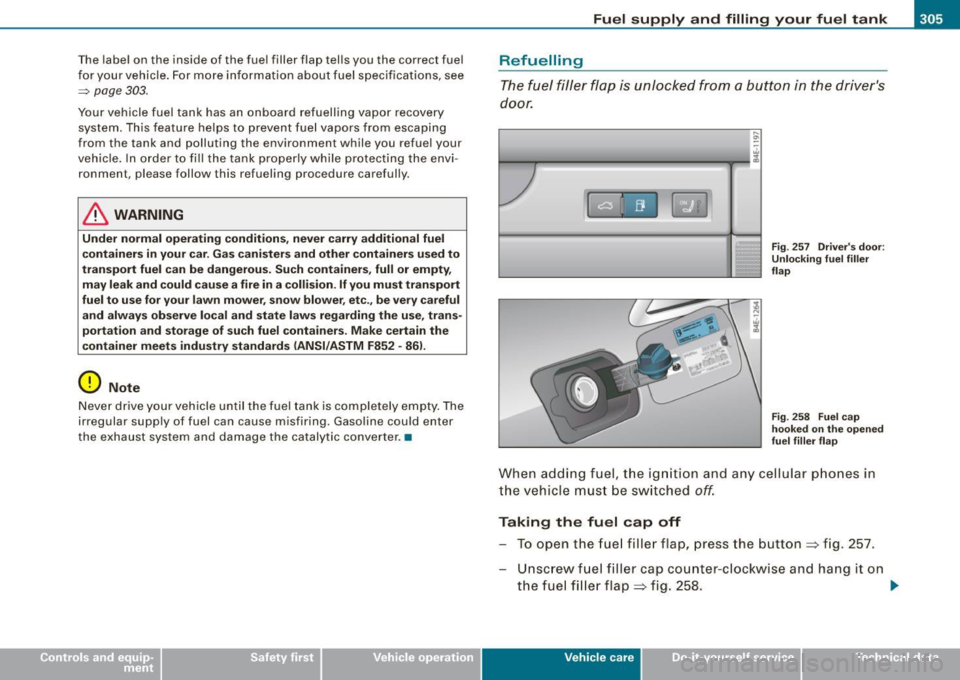
The fuel filler fl ap is unl ocked f rom a but ton i n the driver' s
d oor.
,._
"'
Fig . 25 7 Driver 's do or:
Unlo cking fuel filler
flap
F ig . 25 8 Fue l cap
ho oked on th e op ened
fuel filler flap
W hen a dding f uel, the ig nitio n and a ny c ellu lar phones in
th e ve hicl e m ust b e sw it c hed
off.
Taking the fuel cap off
To open t he fue l fille r flap, press the button~ fig. 257 .
Unsc rew f ue l filler cap co unter-c lockwise and hang it on
the fue l fi ller flap ~ fig. 258 . ..,
Vehicle care I I irechnical data
Page 308 of 408
Fuel supply and filling your fuel tank Refuelling procedure
- Insert the fuel nozzle from the gasoline pump into the
fuel filler neck as far as it will go.
- Select a medium refuelling rate so that the nozzle switches off automatically when the tank is full.
Putting the fuel cap back on
- After filling your tank, twist the fuel filler cap clockwise
until you hear a definite click.
Close the fuel filler flap.
To avoid fuel spilling or evaporating from the fuel tank always close
fuel filler cap properly and completely. An improperly closed fuel
filler cap may also cause the MIL lamp=>
page 27to come on.
& WARNING
Improper refueling or handling of fuel can cause fire, explosion
and severe burns.
• Fuel is highly flammable and can cause severe burns and other
injuries.
• Failure to shut the engine off while refueling and/or to insert
the pump nozzle fully into the fuel filler neck could cause fuel to spray out of filler neck or to overflow. Fuel spray and overflowing
fuel can cause a fire.
• Never use a cellular telephone while refueling . The electromag
netic radiation can cause sparks that can ignite fuel vapors and
cause a fire.
• Never get back into your vehicle while refueling. If in excep
tional circumstances you must get back in your vehicle while refu
eling, make certain that you close the door and touch metal to
discharge static electricity before touching the filler nozzle again.
Static electricity can cause sparks that can ignite fuel vapors
released during refueling .
& WARNING (continued)
• Never smoke or have an open flame anywhere in or near your
vehicle when refueling or filling a portable fuel container.
• For your safety, we strongly recommend that you do not travel
with a portable fuel container in your vehicle. The container, full or
empty may leak and could cause a fire, especially in a crash.
• If, under exceptional circumstances, you must transport a
portable fuel container, please observe the following:
-Never fill a portable fuel container while it is anywhere in or
on the vehicle (for example, in the luggage compartment, or on
the trunk). Static electricity can build up while filling and can
ignite fuel vapors causing a fire.
- Always place a portable fuel container on the ground before
filling.
- Always keep the filler nozzle completely inside the portable
container before and during filling.
- If filling a portable container made of metal, the filler nozzle
must always be in contact with the container. This will help
prevent static electricity from discharging and cause a fire.
- Never spill fuel inside the vehicle or luggage compartment. Fuel vapors are highly flammable .
- Always observe local and state/provincial laws regarding the
use, storage and transportation of fuel containers.
- Make certain the fuel container meets industry standards
(ANSI / ASTM F852-86l.
0 Note
If any fuel has spilled onto the car, it should be removed immedi -
ately to prevent damage to the paint. _.,
Page 309 of 408
<£> For the sake of the environment
As soon as the correctly operated nozzle switches off automatically
for the first time, the tank is full. Do not try to add more fuel because
fuel may spill out. In addition, the expansion space in the fuel tank
will be filled -causing the fuel to overflow when it becomes warm
and pollute the environment.
[ i] Tips
• Running your engine while refuelling may cause vapors to
escape or even cause fuel to spill out of the tank. This would then
shut off the fuel nozzle before the tank is full.
• Do not refuel your vehicle with the ignition turned on . The fuel
gauge may otherwise not indicate the correct fuel level after
refuelling. •
Unlocking the fuel filler flap by hand
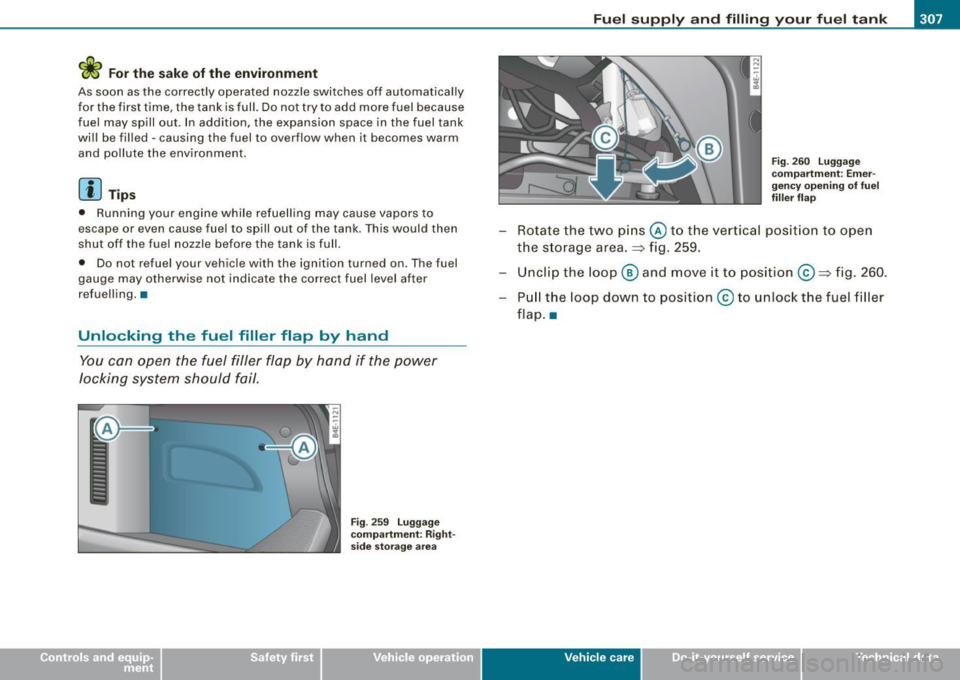
You can open the fuel filler flap by hand if the power
locking system should fail.
Fig . 259 Luggage
compartment : Right
side storage area
Fuel supply and filling your fuel tank
Fig. 260 Luggage
compartment : Emer
gency opening of fuel
filler flap
- Rotate the two pins @ to the vertical position to open
the storage area. ::::;, fig. 259.
- Unclip the loop @ and move it to position ©::::;, fig.
260.
- Pull the loop down to position © to unlock the fuel filler
flap. •
Vehic le care I I irechnical data
Page 311 of 408
_____________________________________________ C_ h_ e .=....= c..:..k :..:.in :....:..:= g:.....= a..:..n .:....:d::......:. f.:..:il .:..:li ..:..n ::.:g:!....-_11111
•
Closing the engine hood
- Pull the hood down until the pressure from the struts is
reduced .
- Let the hood
drop down and latch in place. Do not try to
push it shut;
it may fail to engage => &.
& WARNING
A hood that is not completely latched could fly up and block your
view while driving.
• When you close the engine hood, check it to make sure the
safety catch has properly engaged. The hood should be flush with
the surrounding vehicle body parts.
• If you notice while driving that the hood is not secured prop
erly, stop at once and close it. •
Working in the engine compartment
Be especially careful whenever you work in the engine
compartment.
Whenever you must perform any work in the engine compartment,
for example checking and filling different fluids, there is a risk of injury, burns and accidents. To prevent personal injury always
observe the following WARNINGS. The engine compartment of any
vehicle is a hazardous area
~ & .
& WARNING
To help avoid injury, before you check anything under the hood :
• Turn off the engine.
• Remove the ignition key.
• Apply the parking brake .
& WARNING (continued)
• Move selector lever to "P" (Park).
• Always let the engine cool down. Hot components will burn
skin on contact.
• To reduce the risk of being burned, never open the hood if you
see or hear steam or coolant escaping from the engine compart
ment. Wait until no steam or coolant can be seen or heard before
carefully opening the hood.
• Keep children away from the engine compartment .
• Never spill fluids on hot engine components. They can cause a
fire.
• Never touch the radiator fan. The auxiliary electric fan is
temperature controlled and can switch on suddenly.
• Never open the coolant reservoir cap when the engine is still
warm . The coolant system is pressurized and hot coolant could
spray out.
• Protect your face, hands and arm from steam or hot engine
coolant by placing a thick rag over the cap when you open the
coolant reservoir.
• If work on the fuel system or the electrical system is necessary :
- Always disconnect the battery.
- Never smoke or work near heaters or open flames . Fluids in
the engine compartment could start a fire.
- Keep an approved fire extinguisher immediately available.
• To avoid electrical shock and personal injury while the engine
is running or being started, never touch:
- Ignition cables
- Other components of the high voltage electronic ignition system.
• If you must perform a check or repair with the engine running: -First, fully apply the parking brake, move selector lever to "P"
(Park). .,
Vehicle care
I t •
Page 315 of 408
Checkin g and fillin g -
--------------~-
•
the form of Service or Repair Orders that all schedu led maintenance
was performed in a time ly manner .•
Engine oil consumption
The engine in your vehicle depends on an adequate
amount of oil to lubricate and cool all of its moving parts.
In order to provide effective lubrication and cool ing of internal
engine components, all internal combustion engines consume a
certain amount of oil. Oil consumption varies from engine to engine
and may change significantly over the life of the engine. Typically,
engines with a specified break -in period (see~
page 279) consume
more oil during the break-in period than they consume after oi l
consumption has stabi lized .
Unde r normal conditions, the rate of oil consumption depends on
the quality and viscosity of the oil, the RPM (revolutions per minute)
at which the engine is operated, the ambient temperature and road
conditions . Further factors are the amount of oil dilution from water
condensation or fuel residue and the oxidation level of the o il. As
any engine is subject to wear as mileage builds up, the oil consump
tio n may increase over time unt il rep lacement of worn components
may become necessary.
With all these variables coming into play, no standard rate of oil
consu mption can be estab lished or specified. There is no a lternative
to regular and frequent checking of the oil level, see Note .
If the yellow engi ne oil level warning symbol in the instrume nt
cluster lights up, you should check the oil level as soon as
poss ible
with the oil dipstick~ page 313 . Top off the oil at your
earliest convenience~
page 314.
& WARNING
Before you che ck anything in the eng ine comp artment , alw ay s
read and heed all WARNINGS
~ & in "Working in the engine
c ompartment " on
page 309 .
0 Note
Driving with an insufficie nt o il level is l ikely to cause severe damage
to the engine.
[ i ] Tip s
• The oil pressure warning displ ay ce,. is not an indi cat or of the oil
level . Do not rely on it. Instead , check the oil level in your engine at
regular interv als , prefe rably ea ch time you refuel , and always before
going on a long trip.
• If you have the impression your engine consumes excessive
amoun ts of oi l, we recommend tha t you consult your Audi dealer to
have the cause of your concern properly diagnosed . Keep in mind
that the accurate measureme nt of oil consumption requires great
care and may take some time. Your Audi dealer has instructions
about how to measure oil consumption accurately. •
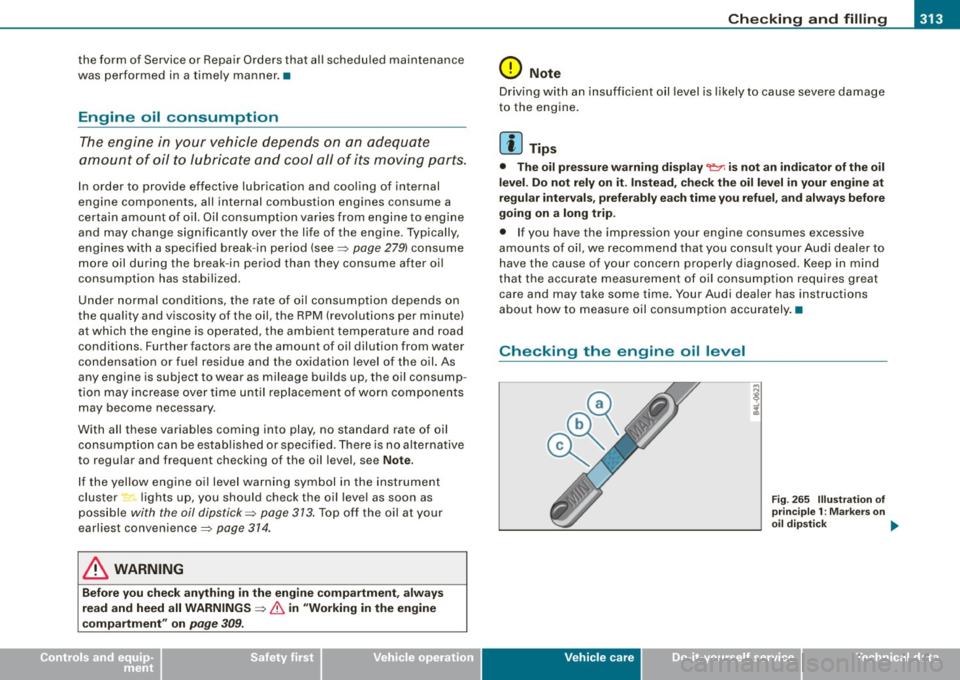
Checking the engine oil level
Vehicle care I t •
Fig. 2 65 Illu stra tion of
pri nciple 1 : Mar ker s on
oi l d ips tick ...