lock AUDI S8 2009 Repair Manual
[x] Cancel search | Manufacturer: AUDI, Model Year: 2009, Model line: S8, Model: AUDI S8 2009Pages: 408, PDF Size: 91.63 MB
Page 170 of 408
• ..__A_ u_ t _o_ m_ a_ t_ i_ c _ t_r _a _n_ s_ m_ is_ s_io _ n ________________________________________________ _
Select R only when the vehicle is at a full stop and the engine is
running at idle speed=>
& in "Driving the automatic transmission"
on
page 166.
Before you move the selector lever to R, press both the button in the
handle of the selector lever
and the brake pedal at the same time.
When the ignition is on, the backup lights illuminate when the
selector lever is moved into
R.
N -Neutral
The transmission is in neutral in this position. Shift to this position
for standing with the brakes applied =>
page 168 .
When the vehicle is stationary or at speeds below 3 mph (5 km/h),
you must always apply the footbrake before and while moving the
lever out of
N.
D -Normal position for driving forward
Position Dis for normal city and highway driving. It ranges from zero
to top speed and all six gears shift automatically, depending on
engine load, driving speed and automatically selected shift
programs.
When the vehicle is stationary or at speeds below 3 mph (5 km/h),
you must always apply the foot brake before and while moving the
lever to
D out of N.
In certain circumstances it may be advantageous to temporarily
switch to the manual shift program to manually select gear ratios to
match specific driving conditions=>
page 170.
S -Sport position
Select this position for sportier performance. In this position, the
transmission will not upshift as soon, allowing the vehicle to use the increased power available at higher engine speeds to achieve live
lier acceleration.
When the vehicle is stationary or at speeds below 3 mph (5 km/h),
you must always apply the foot brake before and while moving the lever to
S out of N.
& WARNING
Read and follow all WARNINGS => & in "Driving the automatic
transmission" on
page 166.
0 Note
Coasting downhill with the transmission in N and the engine not
running will result in damage to the automatic transmission and
possibly the catalytic converter. •
Automatic Shift Lock (ASL)
Automatic shift lock prevents you from accidentally
shifting into a forward gear or into reverse, thus causing the vehicle to move unintentionally.
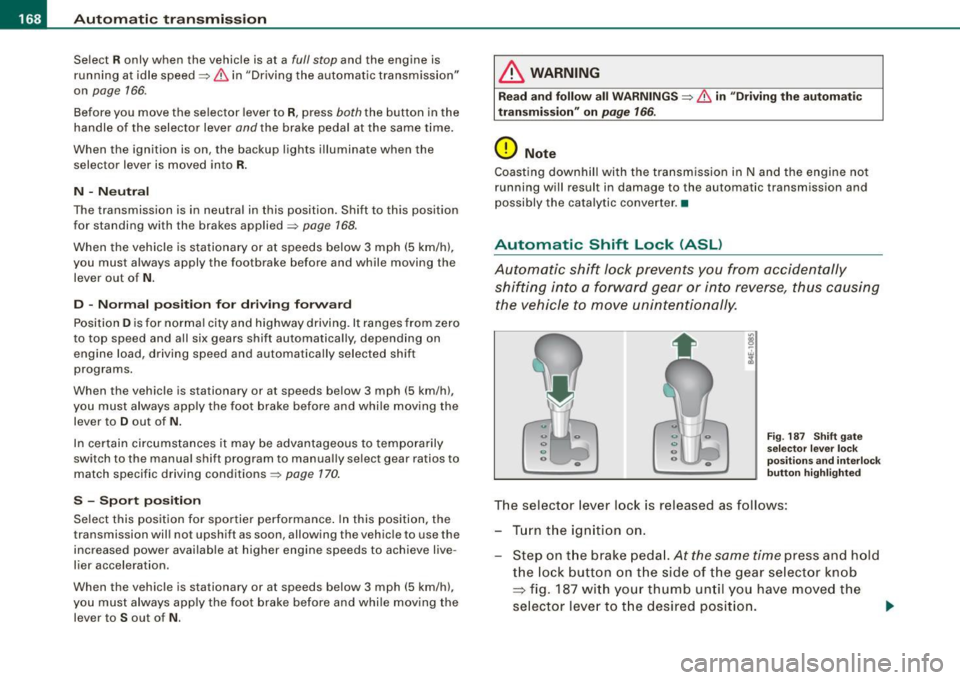
Fig. 187 Shift gate
selector lever lock
positions and interlock
button highl ighted
The selector lever lock is released as follows:
- Turn the ignition on.
Step on the brake pedal.
At the same time press and hold
the lock button on the side of the gear selector knob
=> fig. 187 with your thumb until you have moved the
selector lever to the desired position.
~
Page 171 of 408
_______________________________________________ A_ u_t _o _ m_ a_ t _i_ c_ t_r _a _n _ s_ m __ is_s_ i _o _ n __ lfflll
Autom ati c selec to r l eve r lock
The se lector lever is locked in the P and N positions when the igni
tion is turned on. To move the lever from these positions the driver
must depress the brake pedal. As a reminder to the driver, the
follow ing warning appears in the instrument cluster disp lay when
the selector is in
P and N:
When stationary app ly foot brake while s electing gear
A time delay e lement prevents the selector lever from locking when
it is moved through the
N position (going from R to Dl. The locking
e lement will lock the selector lever if the lever is left in N (Neutral)
for more than approximately 1 second, without the brake peda l
being pressed.
At speeds above about 3 mph (5 km/h) the Automatic Shift Lock is
automatically deactivated in the
N posi tion .
Interl ock button
The lock button on the selector lever prevents the lever from being
accidentally shifted into certain positions. Pressing this button
deactivates the selector leve r lock. Dependi ng on the direction of
the shift, the selector lever locks at different positions. The positions
are highligh ted in the illus trati on =>
page 168, fig . 187.
Igniti on k ey saf ety in te rlo ck
The key canno t be removed from the ignition un less the selector
lever is in the
P park position. When the ignition key is removed, the
selector lever wil l be l ocked in the
P posi tion .•
Kick -down
T he kick-down feature allows the vehicle to genera te
maximum accelera tion.
When you press the acce lerator pedal beyond the resistance point
that is reached at ful l throttle, the transmission wi ll select a lower
gear ratio based on vehic le speed and engine RPM . The engine RPM
wil l be control led to produce maximum vehic le acceleration as long
Controls and equip
ment
as you continue to press the acce lerator pedal beyond this resis
t ance poin t.
& WARNING
Be careful when u sing the ki ck -down feature on slippery road s.
Rapid acceleration ma y cause the vehicle to skid . •
Dynamic shift program (DSP)
T he aut omatic tr ans mission is electro nically c ontrolle d.
The transmission is se lf adapting and will automaticall y select the
b est shi ft program su ited to the driving conditio ns and driving style.
The transmission will select one of the
e conomy programs when
you drive at a s teady speed or a g radually changing speed without
heavy acceleration. This achieves optimum fuel efficiency, with ear ly
upshifting and delayed downshifting .
The trans mission will au tomatically select the
sporty shift progra ms
when you drive at higher speeds, or with heavy acce leration and
frequent ly cha nging speeds . Upshifts ar e delayed t o make f ull use
of engine power . Downshifting takes place at higher engine speeds
than in t he ec onomy p rograms .
The selection of the most su itable shift program is a continuous,
automatic process . The driver can a lso make the transmission
sw itch to a sporty progra m by
quickly pressing down the gas peda l.
This causes the transmission to shift down to a lower gear to
achiev e rapid acc elerati on, e.g . fo r q uickly pass ing another vehicle .
You do not need to press the gas pedal into the kick-down range.
After the transm ission has upshifted, the original progra m is
selected according to your driving sty le.
An additiona l shift program allows the automatic transmission to
select the proper gear fo r uph ill and downhi ll gradients.
This prevents the transmission from upshifting and downshifting unnecessa rily o n hills . The transm ission wi ll shift down to a lower _,.
I • •
Page 173 of 408
Automatic transmi ssio n -
------------------'
Applies to vehi cles : wi th tip troni c-st eerin g wh eel
Steering wheel with tiptronic ®
The shift buttons on the steering wheel allow the driver to
shift gears manually.
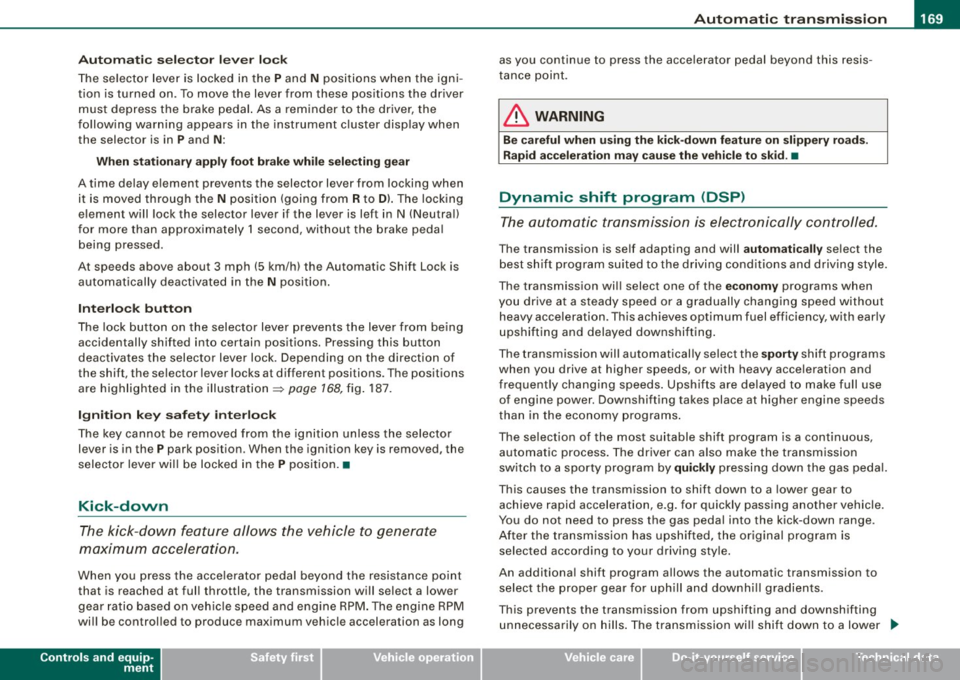
F ig . 190 Steering
whee l: S hift butt ons
- To downshift, touch the button on the left Q .
- To upshift , touch the button on t he right G) .
The shift buttons are activated when the selector lever is in D, Sor
in the manual shift program (tip tronic) .
Of course, you can continue to use the manual shift program with
the selector lever on the center console .•
Fail-safe mode
If tiptronic® suffers a malfunction, the fail-safe mode
maintains minimum driveability.
In the event of particular system malfunctions, the automatic trans
mission switches to the fail -safe mode. This is s ignalled by all the
segments in the display illuminating or going out .
You can continue to move the selector lever to all positions. The manual shift program (tiptronic) is switched off in the fail-safe
mode .
Contro ls and eq uip
ment
In selector lever positions D and Sand in the manual shift program ,
the transmission remains in 3rd gear if 1st, 2nd or 3rd gear was engaged previous ly. The transmission remains in 5th gear, if 4th, 5th
or 6th gear was engaged previously .
The next time you drive off or start the engine, 3rd gear is engaged .
You can continue to use reverse gear . But the electronic lockout for
reverse gear is turned off .
0 Note
If the transmission switches to fail -safe mode, you should take the
vehicle to an au thori zed Audi dea lership as soon as possib le to have
t he condition corrected .•
Emergency release for selector lever
If the vehicle's power supply fails, the selector lever can
be released in an emergency.
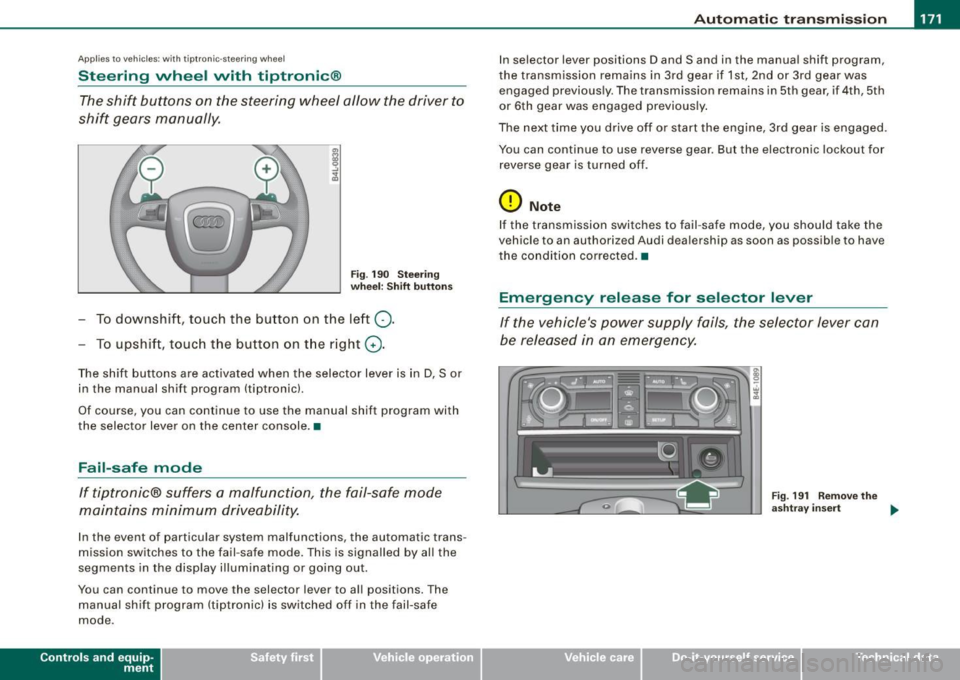
Fig . 19 1 Rem ove th e
as htray i nser t
~
Vehicle care I I Technical data
Page 174 of 408
-Autom
atic tran smi ssi on
..__ ______________ _
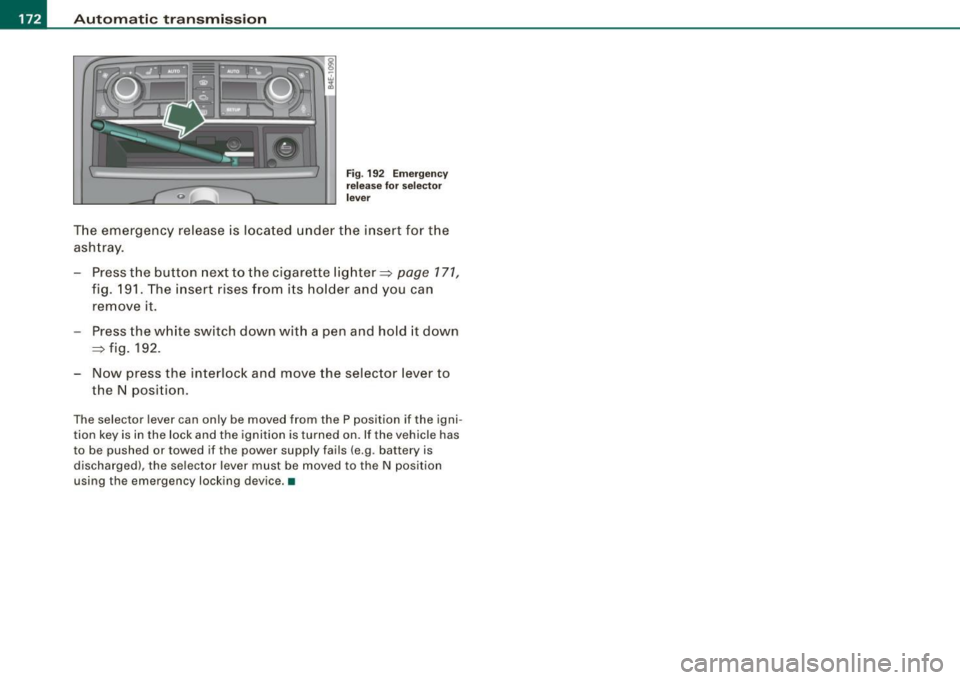
Fig. 192 E merge ncy
re lease for sel ecto r
l ever
T he emergency release is located under the insert for the
ashtray.
- Press t he button next to the cigarette lighter=>
page 171,
fig. 191 . The insert rises from its holder and you can
remove it .
Press the white switch down with a pen and hold it down
=> fig . 192.
- Now press the interlock and move the selector lever to
the N position.
The selector lever can only be moved from the P position if the igni
tion key is in the lock and the ignition is turned on. If the vehicle has
to be pushed or towed if the power supply fails (e.g . battery is
discharged), the selector lever must be moved to the N position
using the emergency locking device. •
Page 205 of 408
________________________________________________ D_r_iv _ i _n_ g~ S_ a_ fe_ ly __ l!III
& WARNING (continued)
• Always adjust the driver's seat and the steering wheel so that
there are at least 4 inches (10 cm) between the knees and the
lower part of the instrument panel.
• Always hold the steering wheel on the outside of the steering
wheel rim with your hands at the 9 o'clock and 3 o'clock positions
to help reduce the risk of personal injury if the driver's airbag inflates .
• Never hold the steering wheel at the 12 o'clock position or with
your hands at other positions inside the steering wheel rim or on
the steering wheel hub. Holding the steering wheel the wrong way
can cause serious injuries to the hands, arms and head if the
driver's airbag inflates
• Pointing the steering wheel toward your face decreases the
ability of the supplemental driver's airbag to protect you in a colli
sion .
• Always sit in an upright position and never lean against or
place any part of your body too close to the area where the airbags
are located.
• Before driving, always adjust the front seats and head
restraints properly and make sure that all passengers are properly
restrained .
• Never adjust the seats while the vehicle is moving. Your seat
may move unexpectedly and you could lose control of the vehicle.
• Never drive with the backrest reclined or tilted far back! The
farther the backrests are tilted back, the greater the risk of injury due to incorrect positioning of the safety belt and improper
seating position.
• Children must always ride in child seats
=> page 245. Special
precautions apply when installing a child seat on the front
passenger seat
=> page 220. •
Controls and equip
ment Safety first
Vehicle operation
Proper seating position for the front
passenger
The proper front passenger seating position is important
for safe, relaxed driving.
For your own safety and to reduce the ris k of injury in the
event of an accident, we recommend that you adjust the
seat for the front passenger to the following pos ition:
- Move the front passenger seat back as far as possible.
There must be a minimum of 10 inches (25 cm) between
the breastbone and the instrument panel =>
&.
- Adjust the angle of the seatback so that it is in an upright
position and your back comes in full contact with it
whenever the vehicle is moving.
- Adjust the head restraint so that the upper edge is as
even with the top of your head as possible but not lower
than eye level and so that it is as close to the back of your
head as possible =>
page 205.
-Keep both feet flat on the floor in front of the front
passenger seat.
- Fasten and wear safety belts correctly=:>
page 215.
For detailed information on how to adjust the front passenger's
seat, see => page 86.
& WARNING
Front seat passengers who are unbelted, out of position or too
close to the airbag can be seriously injured or killed by the airbag
as it unfolds. To help reduce the risk of serious personal injury : .,
Vehicle care Do-it-yourself service Technical data
Page 210 of 408
111 ....... _o_ r_iv _i_ n""' g::;._ S_ a_f _e _ly =---------------------------------------------------
& WARNING
Improperly stored luggage or other items can fly through the
vehicle causing serious personal injury in the event of hard braking or an accident. To help reduce the risk of serious personal injury:
• Always put objects, for example, luggage or other heavy items
in the luggage compartment.
• Always secure objects in the luggage compartment using the
tie-down hooks and suitable straps.
& WARNING
Heavy loads will influence the way your vehicle handles. To help
reduce the risk of a loss of control leading to serious personal
injury :
• Always keep in mind when transporting heavy objects, that a
change in the center of gravity can also cause changes in vehicle
handling:
-Always distribute the load as evenly as possible.
- Place heavy objects as far forward in the luggage compart-
ment as possible.
• Never exceed the Gross Axle Weight Rating or the Gross
Vehicle Weight Rating specified on the safety compliance sticker on the left door jamb. Exceeding permissible weight standards
can cause the vehicle to slide and handle differently.
• Please observe information on safe driving
~ page 200.
& WARNING
To help prevent poisonous exhaust gas from being drawn into the
vehicle, always keep the rear lid closed while driving.
• Never transport objects larger than those fitting completely
into the luggage area because the rear lid cannot be fully closed.
& WARNING (continued)
• If you absolutely must drive with the rear lid open, observe the
following notes to reduce the risk of poisoning :
- Close all windows,
- Close the power roof,
- Open all air outlets in the instrument panel,
- Switch off the air recirculation,
- Set the fresh air fan to the highest speed.
& WARNING
Always make sure that the doors, all windows , the power roof and
the rear lid are securely closed and locked to reduce the risk of
injury when the vehicle is not being used.
• After closing the rear lid, always make sure that it is properly
closed and locked .
• Never leave your vehicle unattended especially with the rear lid
left open. A child could crawl into the vehicle through the luggage
compartment and close the rear lid becoming trapped and unable
to get out . Being trapped in a vehicle can lead to serious personal
injury.
• Never let children play in or around the vehicle.
• Never let passengers ride in the luggage compartment. Vehicle
occupants must always be properly restrained in one of the
vehicle's seating positions.
[ i] Tips
Air circulation helps to reduce window fogging. Stale air escapes to
the outside through vents in the trim panel, on the left side of the
luggage compartment. Be sure to keep these slots free and open. •
Page 218 of 408
-Safety belts -----=-----------------------------------------
Automatic safety belt retractors
Every safety belt is equipped with an automatic belt retractor on the
shoulder bel t. This featu re locks the bel t when the belt is pulled out
fast, during hard braking and in an accident. The belt may also lock
when you drive up or down a steep hill or through a sharp curve. During normal driving the bel t lets you move freely.
Safety belt pretensioners
The safety belts are equipped with a belt pretensioner that helps to
tighten the safety belt and remove slack when the pretensioner is
activated. The function of the pretensioner is monitored by a
warning light=> page
19.
Switchable locking feature
Every safe ty belt excep t the one on the driver seat is equipped with
a switchable locking feature that
must be used when the safety belt
is used to attach a child seat. Be sure to read the important informa
tion about this feature => page
255.
& WARNING
Improperly positioned safety belts can cause serious injury in an
accident=>
page 216, "Safety belt position" .
• Safety belts offer optimum protection only when the seat back
is upright and belts are properly positioned on the body.
• Never
attach the safety belt to the buckle for another seat.
Attaching the belt to the wrong buckle will reduce safety belt
effectiveness and can cause serious personal injury.
• A passenger who is not properly restrained can be seriously
injured by the safety belt itself when it moves from the stronger
parts of the body into critical areas like the abdomen.
• Always lock the convertible locking retractor when you are
securing a child seat in the vehicle => page
257. •
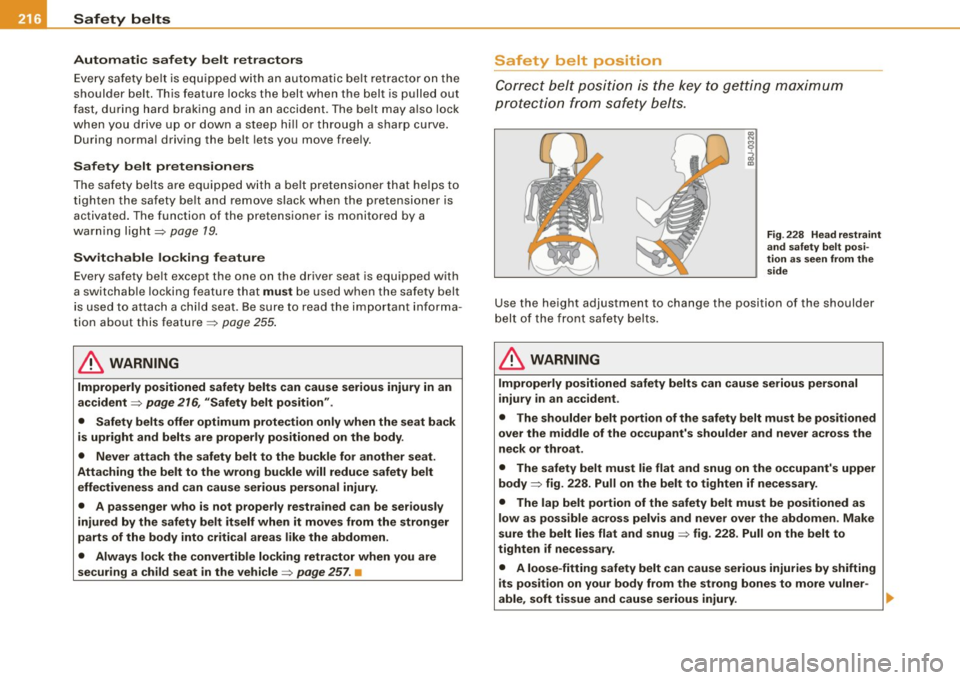
Safety belt position
Correct belt position is the key to getting maximum
protection from safety belts.
Fig . 228 Head restraint
and safety belt posi
tion as seen from the
side
Use the height adjustment to change the position of the shoulder
belt of the front safety belts.
& WARNING
Improperly positioned safety belts can cause serious personal
injury in an accident .
• The shoulder belt portion of the safety belt must be positioned
over the middle of the occupant's shoulder and never across the
neck or throat.
• The safety belt must lie flat and snug on the occupant's upper
body => fig. 228. Pull on the belt to tighten if necessary.
• The lap belt portion of the safety belt must be positioned as
low as possible across pelvis and never over the abdomen. Make
sure the belt lies flat and snug => fig. 228. Pull on the belt to
tighten if necessary.
• A loose-fitting safety belt can cause serious injuries by shifting
its position on your body from the strong bones to more vulner -
able, soft tissue and cause serious injury.
~
Page 234 of 408
-Airbag system PW,._____ -=--=-----------------
PASSENGER AIR BAG OFF light
1~ J,
i
( ~ I :."!l.t.~ A I ~ )
Fig. 235 Sectio n fr om
th e i nstrument panel:
PAS SENGER AIR BAG
OFF light
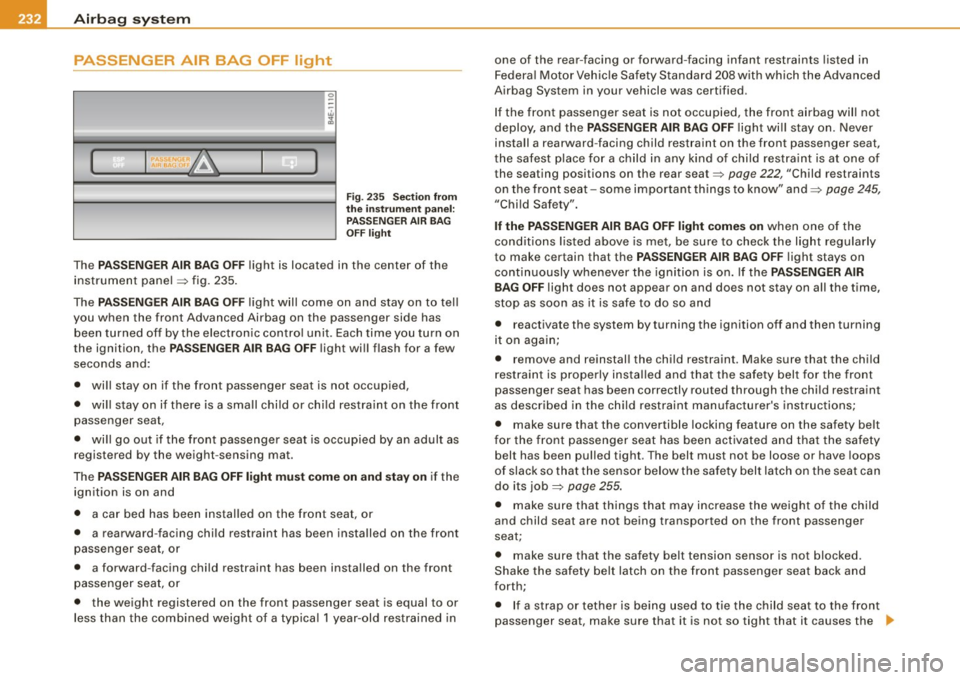
The PASSENGER AIR BAG OFF light is located in the center of the
instrument pane l => fig.
235 .
The PASSENGER AIR BAG OFF light will come on and stay on to tel l
you when the front Advanced Airbag on the passenger side has
been turned off by the electronic contro l unit . Each time you turn on
the ignition, the
PAS SENGER AIR BAG OFF light wi ll flash for a few
seconds and :
• will stay on if the front passenger seat is not occupied,
• will stay on if there is a small chi ld or chi ld restraint on the front
passenger seat ,
• will go out if the front passenger seat is occupied by an adult as
registered by the weight -sensing mat .
The
PASSENGER AIR BAG OFF light must come on and stay on if the
ignition is on and
• a car bed has been installed on the front seat, or
• a rearward-facing child restraint has been installed on the front
passenger seat, or
• a forward-facing child restraint has been insta lled on the front
passenger seat, or
• the weight registered on the front passenger seat is equal to or
less than the combined weight of a typical 1 year-old restrained in one of the rear
-facing or forward-facing infant restraints listed in
Federa l Motor Vehicle Safety Standard 208 with which the Advanced
Airbag System in your vehicle was certified .
I f the front passenger seat is not occupied, the front airbag wil l not
deploy, and the
PASSENGER AIR BAG OFF li ght wi ll stay on. Never
install a rearward -facing child restraint on the front passenger seat,
the safest place for a child in any kind of child restraint is at one o f
the seating posi tions on the rear seat=>
page 222, "Child restraints
o n the front seat -some important things to know" and=>
page 245,
"Chi ld Safety".
If the PASSENGER AIR BAG OFF light comes on when one of the
conditions listed above is met , be sure to check the light regularly
to make certain that the
PASSENGER AIR BAG OFF light stays on
continuously whenever the ignition is on. If the
PASSENGER AIR
BAG OFF
light does not appear on and does not stay on all the time,
stop as soon as it is safe to do so and
• reactivate the system by turning the ignition off and then turning
it on again;
• remove and reinstal l the child restraint. Make sure that the child
restraint is properly insta lled and that the safety belt for the front
passenger seat has been correctly routed through the child restraint
as described in the child restraint manufacturer's instructions;
• make sure that the convertible locking feature on the safety belt
for the front passenger seat has been activated and that the safety
belt has been pulled tight . The belt must not be loose or have loops
of slack so that the sensor below the safety belt latch on the seat can
do its job =>
page 255.
• make sure that things that may increase the weight of the child
and child seat are not being transported on the front passenger
seat;
• make sure that the safety belt tension sensor is not blocked .
Shake the safety belt latch on the front passenger seat back and
forth;
• If a strap or tether is being used to tie the child seat to the front
passenger seat, make sure that it is not so tight that it causes the .,_
Page 250 of 408
___ C_h_ i_ ld _ S_ a_ f_ e_ t_y ____________________________________________ _
C. Forward-facing convertible child restraint systems,
manufactured on or after September 1, 2004:
• Britax Roundabout 161
• Britax Expressway
• Century Encore 4612
• Century STE 1000 4416
• Cosco Olympian 02803
• Cosco Touriva 02519
• Evenflo Horizon V 425
• Evenflo Medallion 254
• Safety First Comfort Ride 22-400
& WARNING
To reduce the risk of serious injury, make sure that the PASSENGER
AIR BAG OFF light comes on and stays on whenever a child
restraint is installed on the front passenger seat and the ignition
is switched on.
• Take the child restraint off the front passenger seat and install
it properly at one of the rear seat positions if the PASSENGER AIR
BAG OFF light does not stay on.
• Have the airbag system inspected by your authorized Audi
dealer immediately.
[ i] Tips
The child seats listed in categories A to C have been tested by Audi
only for the Advanced Airbag function. •
Important safety instructions for using child
safety seats
Correct use of child safety seats substantially reduces the
risk of injury in an accident!
As the driver, you are responsible for the safety of every
body in the vehicle, especially children:
- Always use the right child safety seat for each child and
always use it properly ::::>
page 250.
-Always carefully follow the child safety seat manufac
turer's instructions on how to route the safety belt prop
erly through the child safety seat.
- When using the vehicle safety belt to install a child safety
seat, you must first activate the convertible locking
retractor on the safety belt to prevent the child safety
seat from moving ::::>
page 255.
-Push the child safety seat down with your full weight to
get the safety belt really tight so that the seat cannot
move forward or sideways more than one inch (2.5 cm).
- If a strap or tether is being used to tie the child safety
seat to the front passenger seat, make sure that it is not
so tight that it causes the weight-sensing mat to
measure more weight than is actually on the seat.
Always remember: Even though your vehicle is equipped with an
Advanced Airbag system, all children, especially those 12 years and
younger, should always ride in the back seat properly restrained for
their age and size. _,,
Page 252 of 408
___ C_h_ i_ld _ S_ a_ f_ e_ t-= y'------------------------------------------------
& WARNING (continued)
-Always move the front passenger seat into the rearmost
position of the passenger seat's fore and aft adjustment range,
and as far away from the airbag as possible before installing
the child restraint.
- Always make sure that nothing prevents the front
passenger's seat from being moved to the rearmost position in
its fore and aft adjustment range .
- Always make sure that the backrest is in the upright posi
tion.
• Always buckle the child safety seat firmly in place even if a
child is not sitting in it. A loose child safety seat can fly around
during a sudden stop or in a collision.
• Always read and heed all WARNINGS whenever using a child
restrained in a vehicle is being used=>
page 211, "Safety belts",
=> page 220, "Airbag system" and=> page 245, "Child Safety".
& WARNING
To reduce the risk of serious injury, make sure that the PASSENGER
AIR BAG OFF light comes on and stays on whenever a child
restraint is installed on the front passenger seat and the ignition
is switched on.
• Take the child restraint off the front passenger seat and install
it properly at one of the rear seat positions if the PASSENGER AIR
BAG OFF light does not stay on.
• Have the airbag system inspected by your authorized Audi
dealer immediately. •
Child safety seats
Infant seats
Babies and infants up to about one year old and 22 lbs or
10 kg need special rearward-facing child restraints that
support the back, neck and head in a crash.
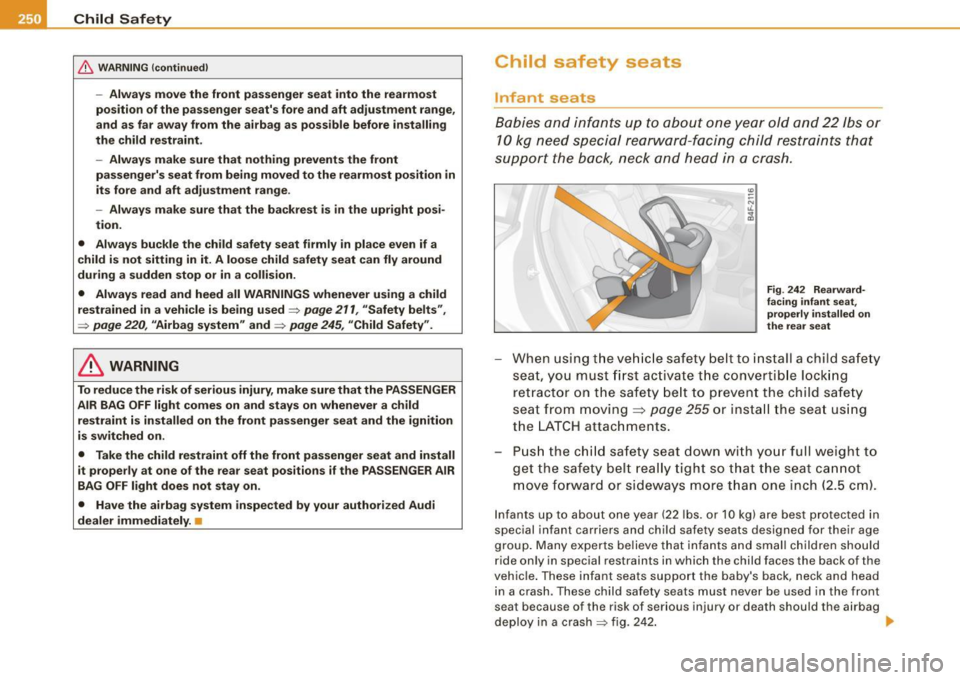
Fig . 242 Rearward
facing infant seat,
properly installed on
the rear seat
-When using the vehicle safety belt to install a child safety
seat, you must first activate the convertible locking
retractor on the safety belt to prevent the child safety
seat from moving~
page 255 or install the seat using
the LATCH attachments.
- Push the child safety seat down with your full weight to
get the safety belt really tight so that the seat cannot
move forward or sideways more than one inch (2.5 cm).
Infants up to about one year (22 lbs. or 10 kg) are best protected in
special infant carriers and child safety seats designed for their age
group. Many experts believe that infants and small children should
ride only in special restraints in which the child faces the back of the
vehicle. These infant seats support the baby's back, neck and head
in a crash . These child safety seats must never be used in the front
seat because of the risk of serious injury or death should the airbag
deploy in a crash=> fig. 242. ..