service AUDI S8 2009 Repair Manual
[x] Cancel search | Manufacturer: AUDI, Model Year: 2009, Model line: S8, Model: AUDI S8 2009Pages: 408, PDF Size: 91.63 MB
Page 363 of 408
_________________________________________________ F_ u_ s_ e_s _ a_n _d_ b_ u _ lb_ s _ __._
[ i J Tip s
You are wel l advised to keep a supply of spare fuses in your vehic le.
Fuses with the proper ampere ratings are available at your Audi
dealer. •
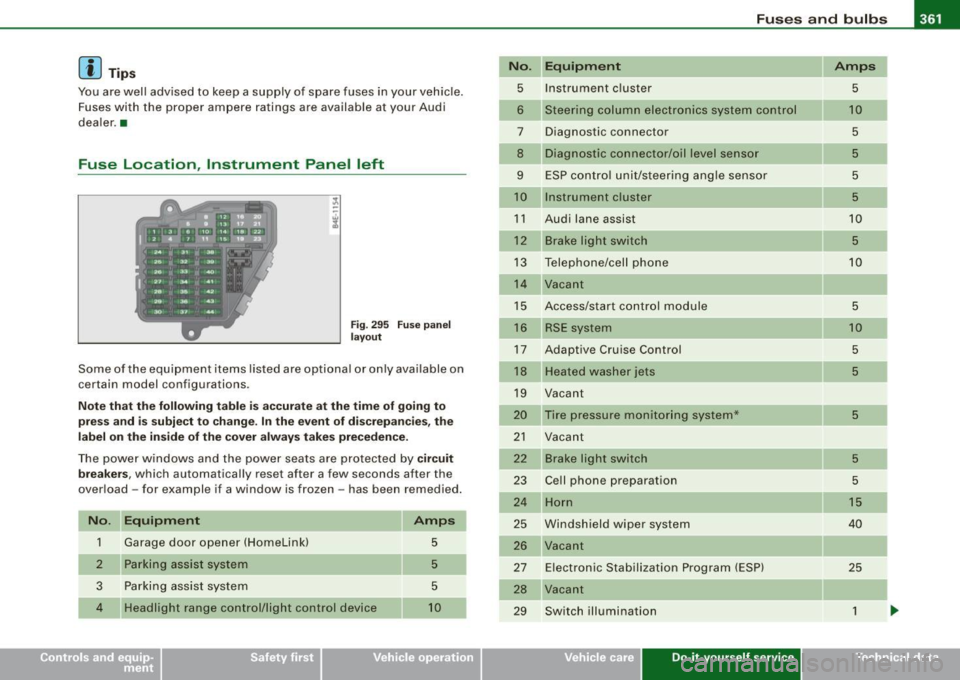
Fuse Location , Instrument Panel left
F ig. 295 Fuse pan el
l ayout
Some of the equipment items listed are optiona l or only available on
certain model configurations.
No te t hat th e fo llow ing t able is acc urate a t the time o f goin g to
p re ss an d is s ubject to c hang e. In the e vent of di screpancies, the
lab el on the insi de of th e cover alwa ys ta kes prece dence .
The power windows and the power seats are protected by cir cui t
bre akers,
which automatically reset after a few seconds after the
over load -for example if a window is frozen -has been remedied .
N o. Equipm ent
1 Garage door opener (HomeLinkl 5
Parking assist system 5
3
Parking assist system 5
4
Headlight range control/light control device 10
No .
5
6
7
8
9
10
11
12
13
14
15
16
17
18
19
20
21
22
23
24
25
26
27
28
29
Equipm ent Amps
Instrument c luster
5
Steering column electronics system control 1 0
Diagnostic connector 5
Diagnostic connector/oil level sensor 5
ESP contro l unit/steering angle sensor 5
Instrument cluster 5
Audi lane assist 10
Brake light switch 5
Telephone/cell phone 10
Vacant
Access/start control module
5
RSE system 10
Adaptive Cruise Control 5
Heate d washer jets 5
Vacant
Tire pressure monitoring system*
5
Vacant
Brake light switch
5
Ce ll phone preparation 5
Horn 1 5
Windshield wiper system 40
Vacant
E lectronic Stabilization Program (ESP)
25
Vacant
Switch illumination
1
Vehicle care Do-it-yourself service irechnical data
Page 365 of 408
_________________________________________________ F_ u_ s_ e_s _ a_n _d_ b_ u _ lb_ s _ __.11111
No. II Equipment
8 Engine control, auxiliary water pump
9
10
11
12
13
Climate control front /rear, dash panel buttons
Suspension leve l control system
(Adaptive Air Suspension)
Light and rain sensor
Display-/control unit
Roof electronics control unit
CD/DVD drive
15 Energy managemen t
16 Vacant
17 Radiator fan electronics
18 Airbag front passenger recognition
(weight sensor)
19 Vacant
20 Heated/ventilated seats
21 Engine control module
22 Vacant
23 Parking brake (switch)
24 Vehicle electrical system
25
26
27
Automatic transmission Air conditioning water valves water pump, rear climate control
Sunroof
28 Engine control module
29 Fuel injectors
30 Ignition coils Amps
10
5
10
5
5
10
5
5
5
5
5
5
5
10
15
10
20
5
15
30 No. Equipment
31 Fuel pump, right/fuel pump electronics
32 Automatic transmission
33 Right rear footwell heater
34 Heated/ventilated seats, rear
35 Heated/ventilated seats, front
36 Cigarette l ighter, front
37 Cigarette lighte r, rear/socket, rear
38 Auxiliary cooler fan
39 Door control unit, front right
40 Brake booster
41 Door control unit, rear right
42 Vacant
43 Headlight washer system
44 Air conditioning heater fan Amps
20/40
5
25
20
20
20
20/25 20
7.5
15
7.5
30
30
•
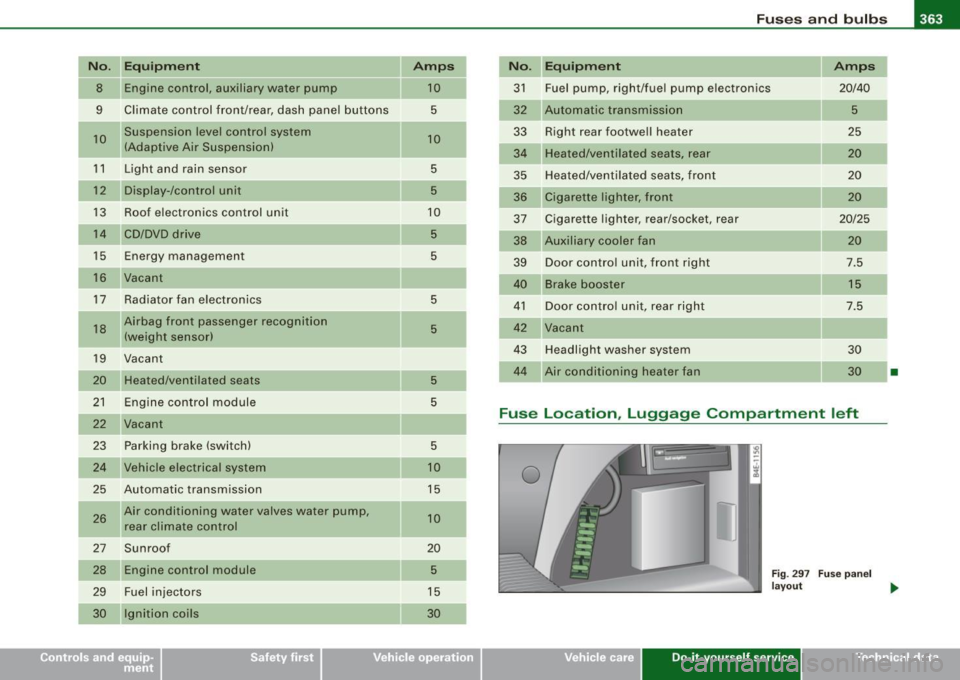
Fuse Location , Luggage Compa rtment left
0
Fig . 297 Fuse panel
layout _.
Vehicle care Do-it-yourself service irechnical data
Page 367 of 408
_________________________________________________ F_ u_ s_ e_s _ a_n _ d_ b_ u_lb _ s __ llll
•
erl y put back to g eth er to help pr eve nt brea kage of parts and long
te rm dam age fro m water that can enter h ous ing s th at h ave not
been properly resealed.
F or y our safety , we reco mmend that you have your autho rized A udi
dea ler rep lace any b ulbs for you, s ince you r deale r has the proper
tools, the correct bu lbs and the expertise.
Gas discharge lamps (Xenon lights):
D ue to the hi gh e lectrical voltage, have the bu lbs replaced by a qual
ified techn ic ian. Headlights wi th Xenon light can be ide ntifie d by the
h igh voltage s tic ke r.
& WARNING
Contact with high-voltage components of the ele ctri cal system
and improper replacement of gas discharge (Xenon) headlight
bulbs can cause ser ious personal injury and death .
• Xenon bulbs are pressurized and can explode when being
changed .
• Changing Xenon lamps requires the special training, instruc
tions and equipment .
• Only an authorized Audi dealer or other qualified workshop
should change the bulbs in gas discharge lamps .
& WARNING
There are parts with sharp edges on the openings and on the bulb
holders that can cause serious cuts.
• If you are uncertain about what to do, have the work performed
by an authorized Audi dealer or other qualified workshop. Serious
personal injury may result from improperly performed work.
[ i ] Tips
• I f you must replace the light bulbs yourse lf , always remember
tha t the e ngi ne compartmen t of an y ve hic le i s a hazardous area to work in. Always read and heed al
l WARNINGS=>
page 301, " E ngine
c om partm ent" =>& .
• I t is best to ask your authorized Audi dealer whenever you need
to ch ang e a bul b.•
Do-it -yourself service
Page 369 of 408

________________________________________________ E_ m ___ e_r.::g ~e ___ n_c ~y:.- s;_ i_t _u :...:a:..:. t.:.: i...:o :...:n...:..:. s _ __,J_
& WARNING !continued)
• Before you check anything in the engine compartment, always
read and heed all WARNINGS~ page 301, "Engine compartment".
0 Note
• Applying a higher voltage booster battery will cause expensive
damage to sensitive electronic components, such as control units,
relays, radio, etc .
• There must be no electrical contact between the vehicles as
otherwise current could already start to flow as soon as the positive
(+) terminals are connected.
[ i) Tips
• The discharged battery must be properly connected to the
vehicle's electrical system. When jump starting or charging the
battery , never connect the negative ground cable to the battery
negative post because the battery manager system must be able to
detect the battery's state of charge. Always connect the negative
ground cable to the negative ground post of the battery manager
control unit .•
Use of jumper cables
Make sure to connect the jumper cable clamps in exactly
the order described below!
Fig. 299 Jump starting
with the battery of
another vehicle: A -
discharged vehicle
battery, B -booster
battery
The procedure described below for connecting jumper
cables is intended to provide a jump start for your vehicle.
Vehicle with discharged battery:
-Turn off lights and accessories, move lever of automatic
transmission to
N (Neutral) or P (Park) and set parking
brake.
Connect POSITIVE (+) to POSITIVE (+) (red)
1. Connect one end to the positive terminal~ fig . 299 G)
of your battery @.
2. Connect the other end to the positive terminal
@ of the
booster battery
@.
Connect NEGATIVE (-) to NEGATIVE (-) (black)
3. Connect one end to the negative terminal @ of the
booster battery
@.
Vehicle care Do-it-yourself service irechnical data
Page 371 of 408
________________________________________________ E_ m_ e_r .::g :...e_ n _ c_,y'-- s_ i_t _u _a_ t_ i_o _n_ s _---Jffllll
& WARNING
A vehicle being towed is not safe for passengers. Never allow
anyone to ride in a vehicle being towed, for any reason. •
Towing loops
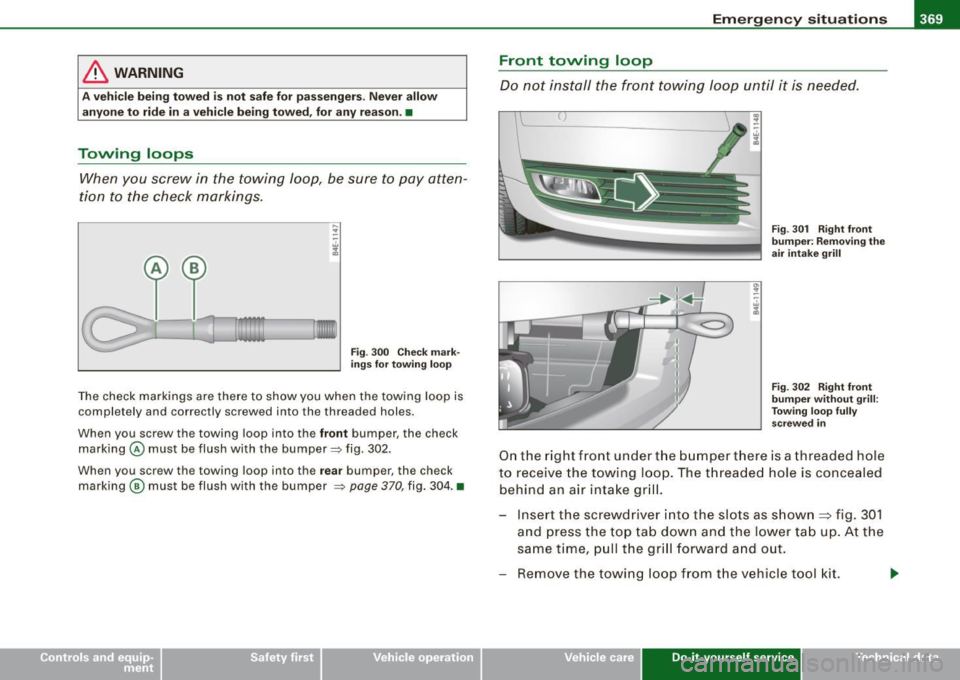
When you screw in the towing loop, be sure to pay atten
tion to the check markings.
Fig. 300 Check mark
ings for towing loop
The check markings are there to show you when the towing loop is
completely and correctly screwed into the threaded holes.
When you screw the towing loop into the
front bumper, the check
marking @ must be flush with the bumper~ fig. 302.
When you screw the towing loop into the
rear bumper, the check
marking @ must be flush with the bumper
~ page 370, fig. 304. •
Front towing loop
Do not install the front towing loop until it is needed.
Fig. 301 Right front
bumper: Removing the
air intake grill
Fig. 302 Right front
bumper without grill:
Towing loop fully screwed in
On the right front under the bumper there is a threaded hole
to receive the towing loop. The threaded hole is concealed
beh ind an air intake grill.
- Insert the screwdriver into the slots as shown
::::> fig. 301
and press the top tab down and the lower tab up. At the
same time, pull the grill forward and out.
- Remove the towing loop from the vehic le tool kit.
~
Vehicle care Do-it-yourself service irechnical data
Page 373 of 408
Emerge ncy situ ation s -
----------------=-~----
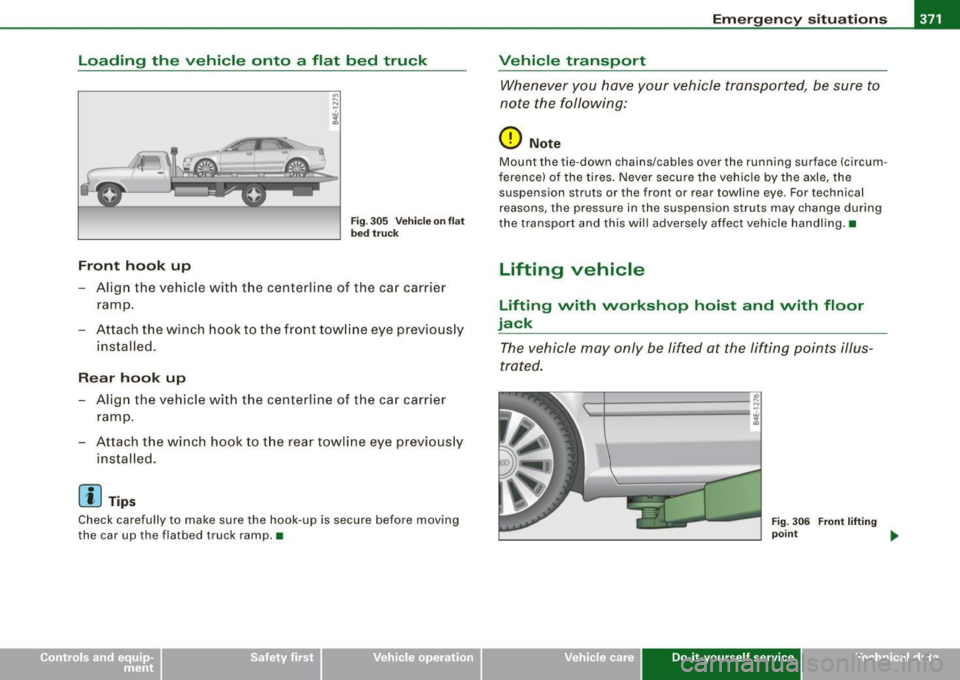
Loading the vehicle onto a flat bed truck
Front hook up
"' .... N
Fig. 305 Ve hic le on flat
bed truck
- Align the vehicle with the centerline of the car carrier
ramp .
- Attach the winch hook to the front towline eye previous ly
installed .
Rea r hook up
- Align the vehicle with the centerline of the car carrier
ramp .
- Attach the winch hook to the rear towline eye previously
installed.
[ i ] T ip s
Check carefully to make sure the hook -up is secure before moving
the car up the flatbed truck ramp. •
Vehicle transport
Whenever you have your vehicle transported, be sure to
note the following:
0 Not e
Mount the tie-down chains/cables over the running surface (circum
ference) of the tires. Never secure the vehic le by the axle, the
suspension struts or the front or rear towline eye. For technical
reasons, the pressure in the suspension struts may change during
the transport and this wil l adversely affect vehicle handling .•
Lifting vehicle
Lifting with workshop hoist and with floor
jack
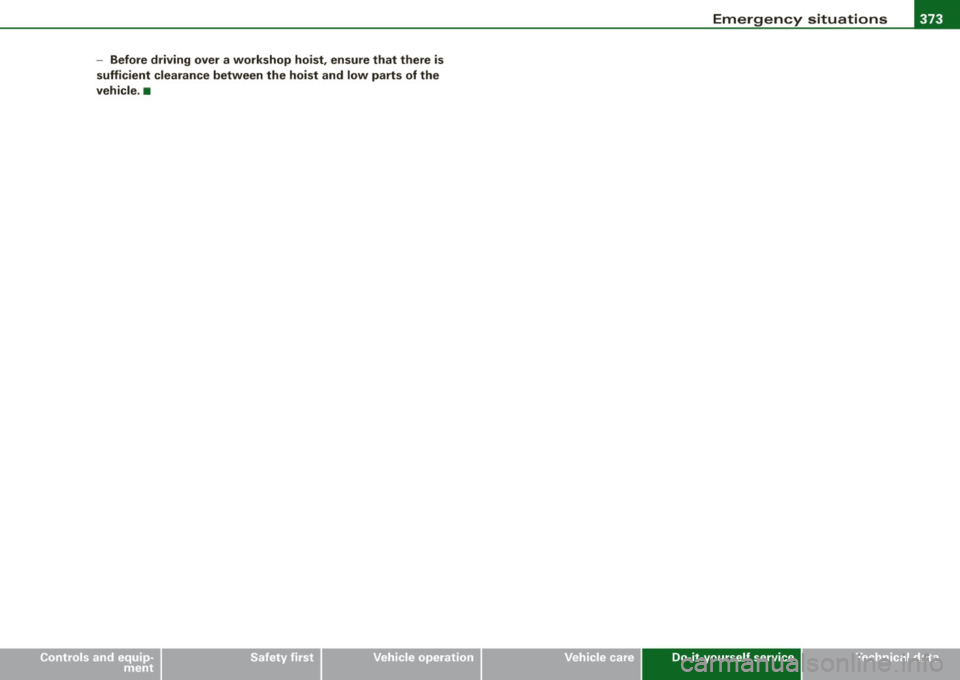
The vehicle may only be lifted at the lifting points illus
trated .
--1------------- ~
'-l.=c==;;;;;;;;;;= ==-cl i
Fig. 30 6 Fron t lift ing
poi nt
~
Vehicle care Do-it-yourself service irechnical data
Page 375 of 408
Emergency situations -
-------------=--=----
•
-Before driving over a workshop hoist, ensure that there is
sufficient clearance between the hoist and low parts of the
vehicle. •
Do-it-yourself service
Page 379 of 408
_________________________________________________ G_ e_ n_ e_r _a _l_ i_n _f_o _ r_ m_ a_ t _i _o _ n __ PII
vehicle identification number of your vehicle (perforation) as well as
the Gross Vehicle Weight Rating (GVWR) and the Gross Axle Weight
Rating (GAWRl.
The high voltage warning label is located on the lock carrier.
The spark ignition system complies with the Canadian standard ICES-002. •
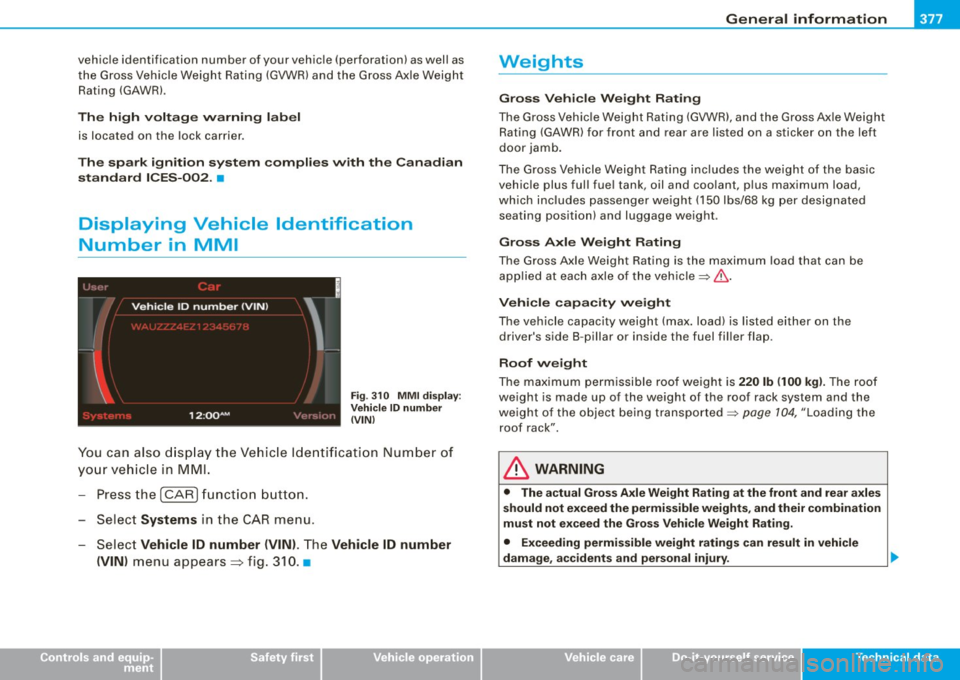
Displaying Vehicle Identification
Number in MMI
Fig. 310 MMI display:
Vehicle ID number
(VIN)
You can also display the Vehicle Identification Number of
your vehicle in MMI.
- Press the
(CARI function button.
- Select Systems in the CAR menu.
- Select Vehicle ID number (VIN). The Vehicle ID number
(VIN) menu appears ~ fig. 310. •
Controls and equip
ment Safety first Vehicle operation
Weights
Gross Vehicle Weight Rating
The Gross Vehicle Weight Rating (GVWR), and the Gross Axle Weight
Rating (GAWR) for front and rear are listed on a sticker on the left
door jamb.
The Gross Vehicle Weight Rating includes the weight of the basic
vehicle plus full fuel tank, oil and coolant, plus maximum load,
which includes passenger weight (150 lbs/68 kg per designated
seating position) and luggage w eight .
Gross Axle Weight Rating
The Gross Axle Weight Rating is the maximum load that can be
applied at each axle of the vehicle~& .
Vehicle capacity weight
The vehicle capacity weight (max. load) is listed either on the
driver's side B -pillar or inside the fuel fill er flap .
Roof weight
The maximum permissible roof weight is 220 lb (100 kg). The roof
weight is made up of the weight of the roof rack system and the
weight of the object being transported~ page 104, "Loading the
roof rack".
& WARNING
• The actual Gross Axle Weight Rating at the front and rear axles
should not exceed the permissible weights, and their combination
must not exceed the Gross Vehicle Weight Rating.
• Exceeding permissible weight ratings can result in vehicle
damage, accidents and personal injury.
Vehicle care Do-it-yourself service Tec hn ica l da ta
Page 381 of 408
_________________________________________________ G_ e_ n_ e_r _a _l_ i_n _f_o _ r_ m_ a_ t _i _o _ n __ lllll
Controls and equip
ment Safety first
Vehicle operation Vehicle care Do-it-yourself service Tec hn ica l da ta
Page 383 of 408
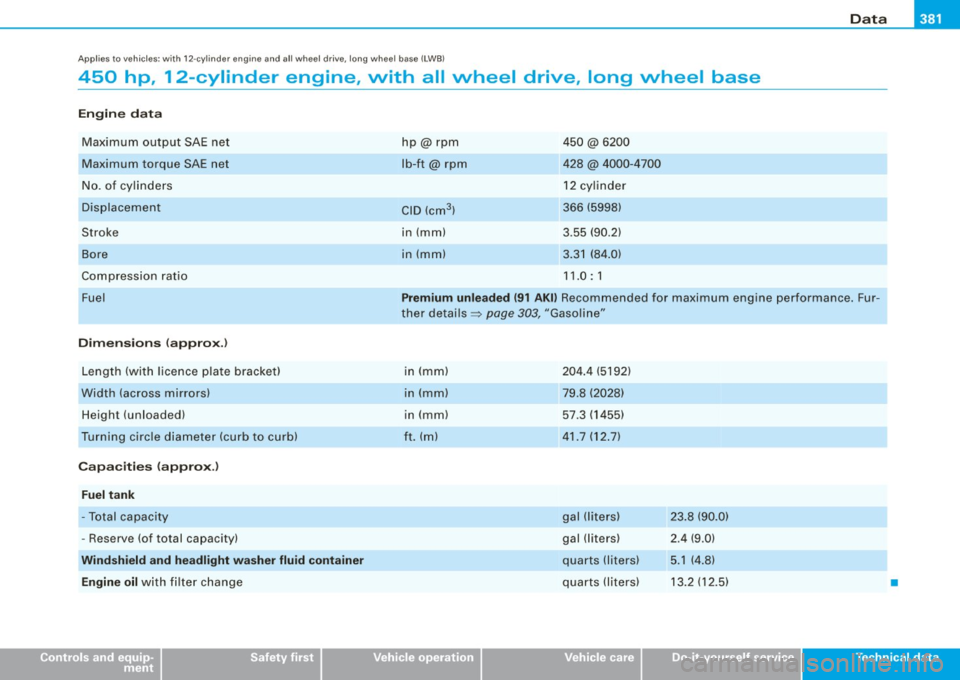
_______________________________________________________ D_ a _ t_a __ lllll
Ap plies to vehic les : w it h 12-c ylinde r en gine a nd a ll whee l dr ive, lo ng wheel base (L WBl
450 hp , 12-cylinder engine , with all wheel drive , long wheel base
Engine data
Maximum ou tput SAE net
M aximum torque SAE net
No . of c ylind ers
D isplac eme nt
Stroke
Bore
Co mpress ion ratio
Fuel
Dimensions (approx .)
Leng th (wi th lice nce plate bracke t)
Width (ac ross m irrors)
Height (unloaded)
Tu rning circle d ia m ete r (cu rb to cu rb)
Capacities (approx .>
Fuel tank
- Tot al capac ity
- Reserve (of total capacity)
Windshield and headlight washer fluid container Engine oil wit h filter ch ange hp@rpm
lb-ft@ rpm
CID (c
m
3
)
in (mm)
in (m m) 45
0@ 6200
428 @ 4000-47 00
1 2 cy linde r
366 (5998)
3 .55 (90.2)
3 .3 1 (84 .0)
11. 0: 1
Premium unleaded 191 AKO Recommended for maximum engine performance . Fur
t her details =>
pa ge 303, "Ga soli ne"
in ( mm)
i n (mm)
in (mm)
f t. Im ) 20
4.4 (519 2)
79.8 (2028)
57.3 (1 455)
4 1.7 (12 .7)
gal (liter s)
gal (liters)
qua rts (liters)
qua rts (liters) 2
3 .8 (90 .0)
2. 4 (9 .0)
5.1 ( 4.8)
13 .2 (12. 5)
•
Controls and equip
ment Safety first Vehicle operation
Vehicle care Do-it-yourself service Tec hn ica l da ta