service AUDI S8 2009 Workshop Manual
[x] Cancel search | Manufacturer: AUDI, Model Year: 2009, Model line: S8, Model: AUDI S8 2009Pages: 408, PDF Size: 91.63 MB
Page 323 of 408
Checking and filling -
---------------------=----"=---------
checked by a service facility. The electrolyte level should also be
checked each time the battery is charged =>
page 323.
Have the battery checked when you take your vehicle in for service.
You are well advised to replace a battery that is older than 5 years.
With certain types of airbag deployment, the battery is discon
nected from the vehicle electrical system for safety reasons=>.& in
"Repair, care and disposal of the airbags" on
page 234.
Disconnecting the battery terminals
Some vehicle functions (power window regulators, for example) are
lost if the battery terminals are disconnected. These functions have
to be relearned after the battery terminals are connected again. To
prevent this, the battery should only be disconnected from the
vehicle electrical system when absolutely necessary for repairs .
Vehicles not driven for long periods If you do not drive your vehicle over a period of several days or
weeks, electrical components are gradually cut back or switched off.
This reduces energy consumption and maintains starting capability
over a longer period
=> page 276.
Be aware that when you unlock your vehicle, some of the conve
nience functions may not operate, such as the Convenience key*,
the remote control or the power seat adjustment. The convenience
functions will be available again when you turn on the ignition and
start the engine.
Winter operation During the winter months, battery capacity tends to decrease as
temperatures drop. This is because more power is also consumed
while starting, and the headlights, rear window defogger, etc., are
used more often.
Avoid unnecessary power consump tion, particularly in city traffic or
when traveling only short distances. Let your authorized Audi dealer
check the capacity of the vehicle battery before winter sets in
=> page 323. A well charged battery will not only prevent starting
problems when the weather is cold, but will also last longer.
[ i] Tips
If your vehicle is left standing for several weeks at extremely low
temperatures, the vehicle battery should be removed and stored
where it will not freeze. This will prevent it from being damaged and
having to be replaced.•
Working on the battery
Be especially careful when working on or near the battery.
Fig . 271 Luggage
compartment: Right·
side storage compart
ment
Fig . 272 Luggage
compartment : Battery
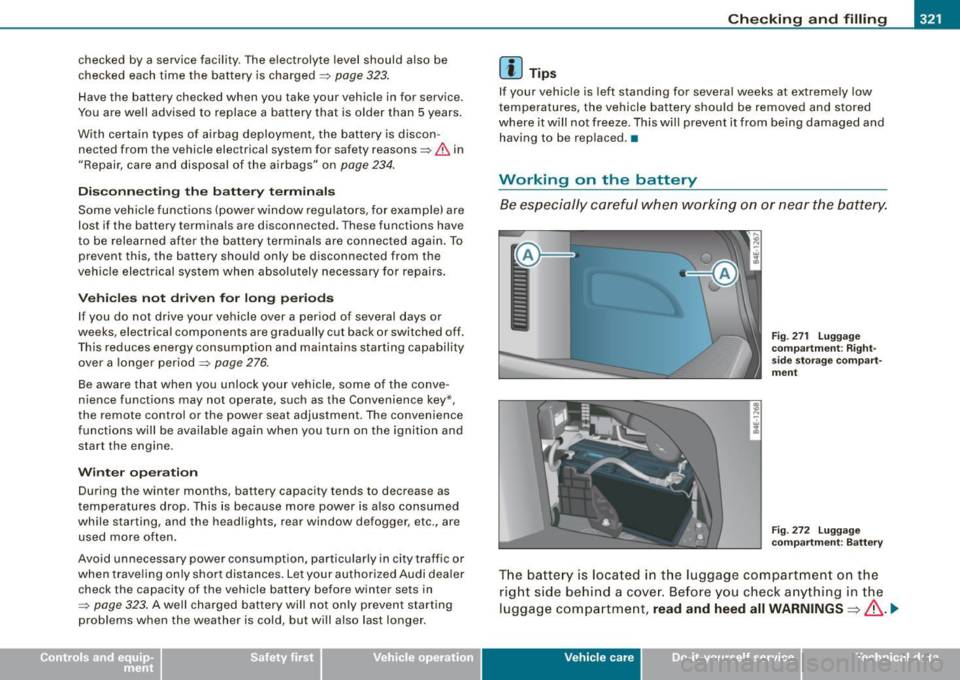
The battery is located in the luggage compartment on the
right side behind a cover. Before you check anything in the
luggage compartment,
read and heed all WARNINGS=>& . .,_
Vehic le care I I irechnical data
Page 336 of 408
-Tires and wheels
---------------------------------------------
It is important to ch eck the ti re pressure when the tires are cold .
• Read the req uire d tire p re s su re from the tire press ure la b el. On
USA vehicles, the tire p ressure label is located on the driver's side
8 -p illar. On Canada vehic les, the tire p ressure label is located either
on the driv er's sid e 8-pill ar or ins ide t he fuel fill er flap.
• Tur n the va lve stem cap c ounte r-cl ockwise to rem ove it fr om t he
tire valv e.
• Place th e a ir p re s sur e ga uge on th e valve .
• Th e tire pressures should only be checked and adjusted when
th e tires are col d. The s lig htly raise d pres sures of wa rm tires m ust
not be r educ ed .
• Adjus t the tire pre ssu re to the l oad you are carrying.
• Reinstal l the valve stem cap on the valve.
When should
I check the tire pressure?
The correc t tir e pr ess ure is especiall y important a t hi gh speeds . The
pressu re should the re fore be checked at l east once a mont h an d
a lways bef ore sta rting a j ourn ey . D o not for get to chec k the ti re pr es
su re for the s pare wh eel
::::> page 352.
When should I adjust the tire pressures?
Adjust the tire pr essure to the load you are carrying . After changing
a whee l or re plac ing w hee ls you have to adj ust th e tire pre ssu res on
a ll whee ls. I n ad ditio n, you must t hen stor e the ne w tire pr essu res
in t he tire pres sure mon it o ring system *=> page
41.
& WARNING
Incorrect tire pressures and /or underinflation can lead sudden tire
failure, loss of control, collision , serious personal injury or even
death .
• When the warning symbol appears in the instrument
cluster, stop and inspect the tires .
& WARNING (continued)
• Incorrect tire pressure and /or underinflation can cause
increased tire wear and can affect the handling of the vehicle and
stopping ability .
• Incorrect tire pressures and/or underinflation can also lead to
sudden tire failure , including a blowout and sudden deflation,
causing loss of vehicle control .
• The driver is responsible for the correct tire pressures for all
tires on the vehicle. The applicable pressure values are located on
a sticker on the driver's side B-pillar or on the inside of the fuel
filler flap.
• Only when all tires on the vehicle are filled to the correct pres
sure , the tire pressure monitoring system* can work corre ctly.
• The use of incorrect tire pressure values can lead to accidents
or other damage . Therefore it is essential that the driver observe
the specified tire pressure values for the tires and the correct pres
sures for the function of the tire pressure mon itoring system* .
• Always inflate tires to the recommended and correct tire pres
s ure before driving off .
• Driving with underinflated tires bend more , letting them get
too hot resulting in tread separation , sudden tire failure and loss
of control.
• Excessive speed and /overloading can cause heat build-up ,
s udden tire failure and loss of control.
• If the tire pressure is too low or too high, the tires will wear
prematurely and the vehicle will not handle well.
• If the tire is not flat and you do not have to change a wheel
immediately , drive at reduced speed to the nearest service station
to check the tire pressure and add air as required. _..
Page 339 of 408
Tires and wheels -_______________ _____.
Tire service life
The service life of tires depends on a lot of different things
including proper installation and balancing, correct tire
pressure and driving style.
_/l
l '-------- ,)
Tread Wear Indicator (TWI)
Fig. 276 Tire tread:
tread wear indicators
(TWI)
Fig . 277 Rotating tires
for more even wear
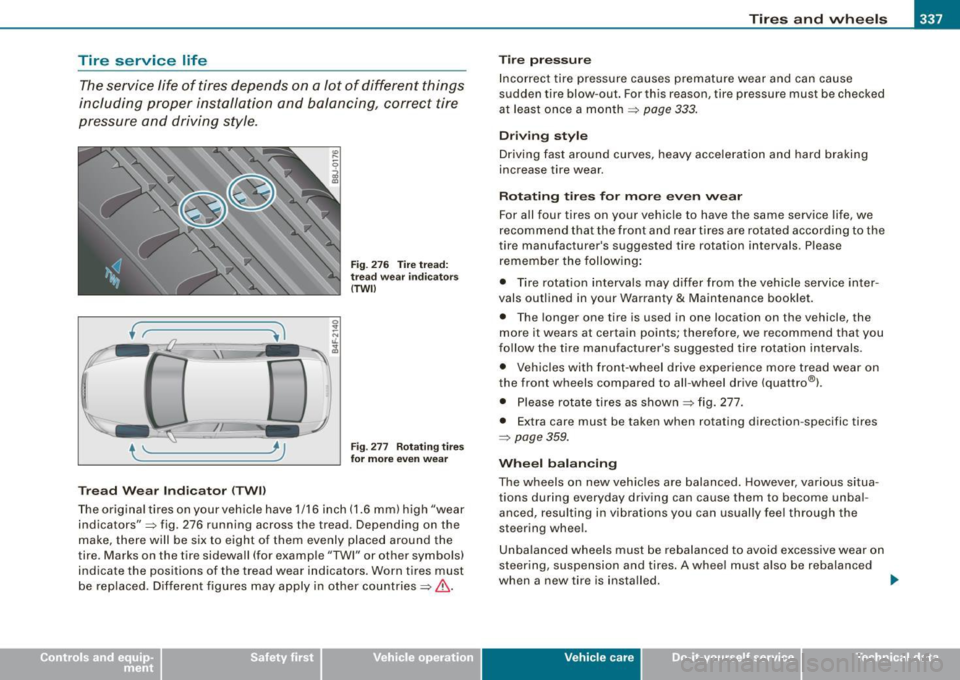
The original tires on your vehicle have 1/16 inch (1.6 mm) high "wear
indicators":::::, fig. 276 running across the tread. Depending on the
make, there will be six to eight of them evenly placed around the
tire. Marks on the tire sidewall (for example "TWI" or other symbols)
indicate the positions of the tread wear indicators. Worn tires must
be replaced. Different figures may apply in other countries.:::::,&.
Tire pressure
Incorrect tire pressure causes premature wear and can cause
sudden tire blow-out. For this reason, tire pressure must be checked
at least once a month .:::::,
page 333.
Driving style
Driving fast around curves, heavy acceleration and hard braking
increase tire wear.
Rotating tires for more even wear
For all four tires on your vehicle to have the same service life, we
recommend that the front and rear tires are rotated according to the
tire manufacturer's suggested tire rotation intervals. Please
remember the following:
• Tire rotation intervals may differ from the vehicle service inter
vals outlined in your Warranty
& Maintenance booklet.
• The longer one tire is used in one location on the vehicle, the
more it wears at certain points; therefore, we recommend that you
follow the tire manufacturer 's suggested tire rotation intervals .
• Vehicles with front-wheel drive experience more tread wear on
the front wheels compared to all-wheel drive (quattro®l .
• Please rotate tires as shown .:::::, fig. 277.
• Extra care must be taken when rotating direction -specific tires
:::::, page 359.
Wheel balancing
The wheels on new vehicles are balanced. However, various situa
tions during everyday driving can cause them to become unbal
anced, resulting in vibrations you can usually feel through the
steering wheel.
Unbalanced wheels must be rebalanced to avoid excessive wear on
steering, suspension and tires. A wheel must also be rebalanced
when a new tire is installed. _,,
Vehicle care I I Technical data
Page 343 of 408
__________________________________________________ T_ ir_e_ s_ a_ n_d _ w_ h_ e_ e_l_s __ _
•
• T he battery inside of the tire pressure sensor has a limited
service life.
• Always drive with the va lve stem caps securely mounted. We
recommend using fac tory insta lled valve stem caps . Ask your autho
rized Audi dealer to replace lost valve stem caps .
T he installation of replacement tires with steel cord body plies in
the tire sidewall may cause malfunction of the tire pressure moni
toring system *, and is not recommended (cord material info rmation
i n molded on the t ire sidewa ll).
A lways check your tire pressure monitoring system * indicator after
replac ing one or more tires on you r veh ic le . If t he tir e pressure
monitoring system * indicator f lashes, or is on, your system is not
wo rking pr ope rly. Your re place ment tire might be i nco m patible wit h
your tire pr essure monitoring system *, or some component of the
t ir e pr ess ure moni toring system * m ay be da maged.
& WARNING
• Using incorrect or unmatched tires and / or wheels or improper
tire and wheel combinations can lead to los s of control , collision
and serious personal injury .
• Alway s use tires , rims and wheel bolts that meet the specifica
tions of original fa ctory -installed tires or other combination s that
have been specifically approved by the vehi cle manufacturer .
• Tires age even if they are not being used and can fail suddenly,
espe cially at high speeds . Tire s that a re more than 6 years old can
only be used in an emergency and then with special care and at
lo wer speeds .
• Never mount used tire s on your vehicle if you are not sure of
their "previous history ." Old used tires may have been dam aged
even though the damage cannot be seen that can lead to sudden
ti re failure and lo ss of vehicle control.
• All four wheels must be fitted with radial tires of the same type ,
size (rolling cir cumference ) and the same tread pattern . Driving
& W ARNING (continued )
with different tires redu ces vehicle handling and can lead to a loss
of control.
• If the spare tire is not the same as the tires that are mounted
on the vehicle -for example with winter tires -only use the spare
tire for a short period of time and dri ve with extra care . Refit the
normal road wheel as soon a s safely pos sible.
• Never drive faster than the ma ximum speed for which the tires
on your vehicle are rated because tires that are driven faster than
their rated speed can fail suddenly .
• Overloading tires cause heat build -up , su dden tire failure ,
includ ing a blowout and sudden deflation and loss of control.
• Temperature grades apply to tires that are properly inflated and
not over or underinflated .
• For te chni cal reasons it is not always po ssible to use wheels
from other vehicles -in some cases not even wheels from the
same vehicle model.
• If you install wheel trim discs on the vehicle wheels , make sure
that the air flow to the brakes is not blo cked . Redu ced airflow to
the brake s can them to overheat , increa sing stopping distances
and causing a collision.
• Run flat tires may only be used on vehicles that were equipped
with them at the fa ctory . The vehicle mu st have a cha ssi s designed
for run flat tires and a factory -installed tire pressure monitoring
s ystem* that indicates a lo ss of tire pressure . Incorrect use of run
flat tires can lead to vehicle damage or accident s. Check with an
authorized Audi dealer or tire specialist to see if your vehicle can
be equipped with run fl at tires . If run flat tires are used , they must
be installed on all four wheels . Mi xing tire types is not permitted.
0 Note
• Fo r techn ica l reaso ns, i t is no t genera lly p oss ibl e to use the
whee l rims from other vehicles . T his can hold true for wheels of the
sa me vehicle type. ..,.
Vehicle care
I t •
Page 344 of 408
-~_T_ ir_e_ s_ a_ n_d _ w_ h_ e_e _l_s _________________________________________________ _
• If the spare tire is different from the tires that you have mounted
o n your vehi cle (for e xample winter tires or wide profile tires), then
use the spare tire for a short period of time on ly and drive with extra
care . Replace the f lat tire with the tire matching the others on your
vehicle as soon as possible.
• If you should put different wheels and tires on your vehicle (e.g.
winter wheels and tires), you must be certain that the wheels and
tires are compatible with the tire pressure monitoring system* .
Otherwise the system will register a ma lfunction and a fault
message will be displayed . For more information, contact your Audi
dea ler.
0 Note
• When installing new tires, be careful not to damage the valves or
tire pressure monitoring system* sensors.
• Never drive without the va lve stem cap. The valves could get
damaged.
• If the sensors must be replaced, then the valve must also be
replaced at the same time.
c£> For the sake of the environment
Dispose of old tires in accordance with the loca l requirements. •
Uniform tire quality grading
• Tread wear
• Traction AA A B C
• Temperature A B C
Qua lity grades can be found where applicable on the tire side wal l
between tread shoulder and maximum section width
=> page 338,
fig. 278.
For e xample: Tread wear 200 , Traction AA, Temperature A.
All passenger car tires must conform to Federal Safety Require
ments in addit ion to these grades.
Tread w ea r
The tread wear grade is a comparative rating based on the wear rate
of the tire when tested under contro lled conditions on a specified
government test course.
For example, a tire graded 150 wou ld wear one and one half (1 1/2)
times as well on the government course as a tire graded 100.
The relative performance of tires depends upo n the actua l condi
tions of their use, however, and may depart significantly from the
n orm due to variations in d riving habi ts, service practices and differ
ences in road characteristics and climate.
Tra ction
The traction grades, from highest to lowest, are AA, A, Band C.
Those grades represent the tire's ability to stop on wet pavement as
measured under contro lled conditions on specified government
t est surfaces of asphalt and concrete . A tire marked C may have
poor traction performance => & .
Temperature
The temperature grades are A (the highest), 8, and C, representing
the tire's resistance to the generation o f heat and its abi lity to dissi
pate heat when tested under control led conditions on a specified
indoor laboratory test wheel.
Sustained high temperature can cause the mater ial of the tire to
degenerate and reduce tire life, and excessive temperature can lead
to sudden tire failure=>&.
T he grade C corresponds to a leve l of performance which a ll
passenger car tires must meet under the Federal Motor Vehicle
Safety Standard No. 109. Grades Band A represent higher levels of
p er formance on the la b ora tory test whee l than t he mi nimum
required by law.
~
Page 353 of 408
What do I do now? -
------------------
[ i J Tips
If you no longer have your original warning triang le and need to
equip your vehicle with a new one, contact your authorized Audi
dealer for a replacement .•
Jack, tools and spare wheel
Jack
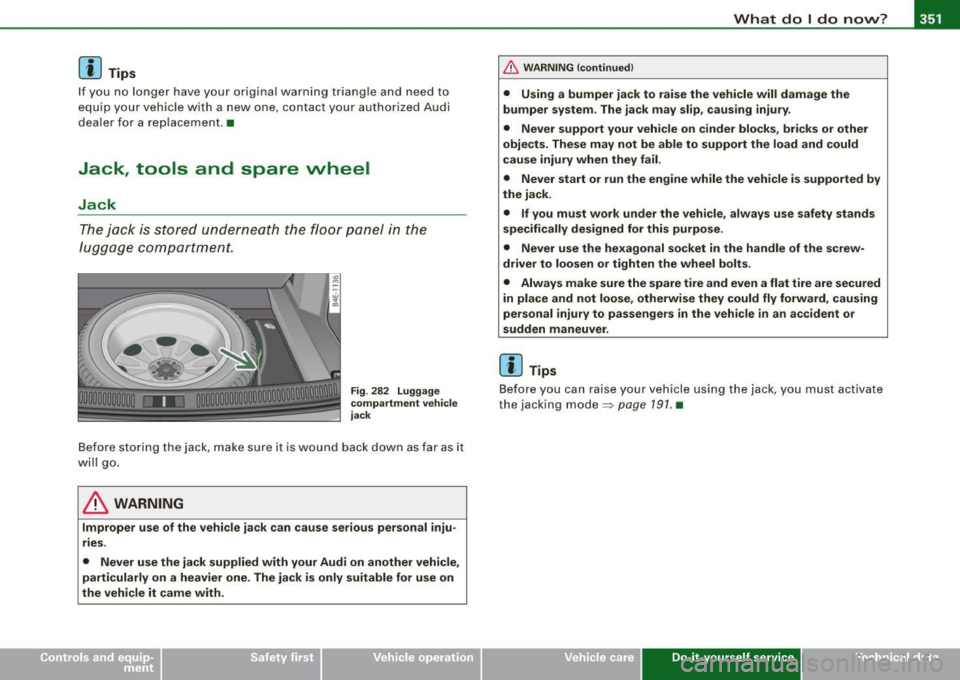
The jack is stored underneath the floor panel in the
luggage compartment.
Fig . 282 Luggage
compartment vehicle
jack
Before stori ng the jack, make sure it is wound back down as far as it
will go.
& WARNING
Improper use of the vehicle jack can cause serious personal inju
ries.
• Never use the jack supplied with your Audi on another vehicle,
particularly on a heavier one. The jack is only suitable for use on
the vehicle it came with.
& WARNING (continued)
• Using a bumper jack to raise the vehicle will damage the
bumper system. The jack may slip, causing injury.
• Never support your vehicle on cinder blocks, bricks or other
objects. These may not be able to support the load and could
cause injury when they fail.
• Never start or run the engine while the vehicle is supported by
the jack.
• If you must work under the vehicle, always use safety stands
specifically designed for this purpose .
• Never use the hexagonal socket in the handle of the screw
driver to loosen or tighten the wheel bolts.
• Always make sure the spare tire and even a flat tire are secured
in place and not loose, otherwise they could fly forward , causing
personal injury to passengers in the vehicle in an accident or
sudden maneuver .
[ i J Tips
Before you can raise your vehicle using the jack, you must activate
the jacking mode~
page 191. •
Vehicle care Do-it-yourself service irechnical data
Page 355 of 408

What do I do now? Ill
---------------~.;______
•
-Disengage and lower the floor panel before you close the
luggage compartment lid again.
Storing the replaced wheel
-Place the replaced wheel inside the spare wheel well in
the luggage compartment.
Tighten the knurled retaining screw clockwise to secure
the wheel in place.
- Disengage and lower the floor panel before you close the
luggage compartment lid again.
& WARNING
Loose items in the passenger compartment can cause serious
personal injury during hard braking or in an accident .
• Never store the spare wheel or jack and tools in the passenger
compartment.
• Always store all jacking equipment, tools, and the spare wheel
in the luggage compartment.
• Tighten the knurled retaining screw for the spare wheel
securely.
[ i] Tips
Check the inflation pressure of the spare tire periodically to keep the
tire ready for use. •
Changing a wheel
Before changing a wheel
Observe the following precautions for your own and your
passenger's safety when changing a wheel.
- After you experience a tire failure, pull the car well away
from moving traffic and try to reach level ground before
you stop
~ & .
- All passengers should leave the car and move to a safe
location (for instance, behind the guardrail) ~& .
- Engage the parking brake to prevent your vehicle from
rolling unintentionally ~& .
- Move selector lever to position P
~ &.
-If you are towing a trailer: unhitch the trailer from your
vehicle.
- Take the jack and the spare tire out of the luggage
compartment~
page 351.
& WARNING
You or your passengers could be injured while changing a wheel if
you do not follow these safety precautions:
• If you have a flat tire, move a safe distance off the road. Turn off
the engine, turn the emergency flashers on and use other warning
devices to alert other motorists.
• Make sure that passengers wait in a safe place away from the
vehicle and well away from the road and traffic.
• To help prevent the vehicle from moving suddenly and possibly
slipping off the jack, always fully set the parking brake and block
the wheel diagonally opposite the wheel being changed. When one ..,
Do-it -yourself service
Page 357 of 408
What do I do now? -
------------------
• Drive at re duced speed until you have the tightening torques
checked .a
A pplies to ve hic les: wit h deco rat ive w heel covers
Decorative wheel covers
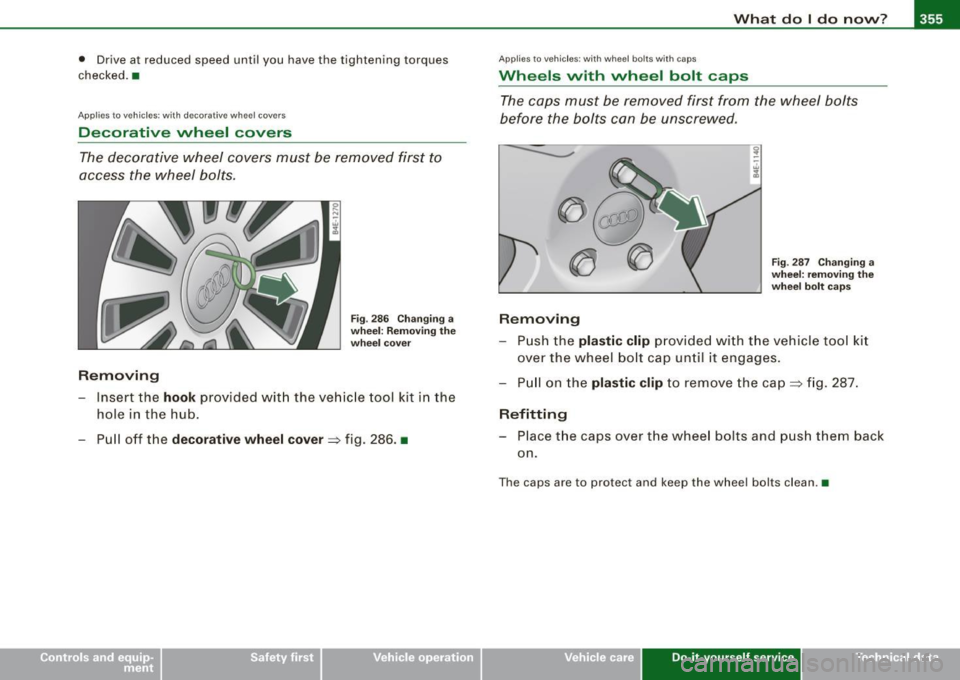
The decorative wheel covers must be removed first to
access the wheel bolts.
Removing
Fig . 286 Changing a
wheel: Removing the
wheel cover
- Insert the hook provided with the vehicle tool kit in the
hole in the hub.
Pull off the decorative wheel cover~ fig . 286. •
App lies to veh ic les: w ith whee l bo lts with caps
Wheels with wheel bolt caps
The caps must be removed first from the wheel bolts
before the bolts can be unscrewed .
Removing
Fig. 287 Changing a
wheel: removing the
wheel bolt caps
-Push the plastic clip provided with the vehicle tool kit
over the w heel bolt cap until it engages.
- Pull on the plastic clip to remove the cap ~ fig. 287.
Refitting
- Place the caps over the wheel bolts and push them back
on.
The caps are to pro tect and ke ep the wheel bolts clean. •
Vehicle care Do-it-yourself service irechnical data
Page 359 of 408
_____________________________________________ W_ h_ a_t _d_ o_l _ d_o _ n_o_ w_ ? _ __._
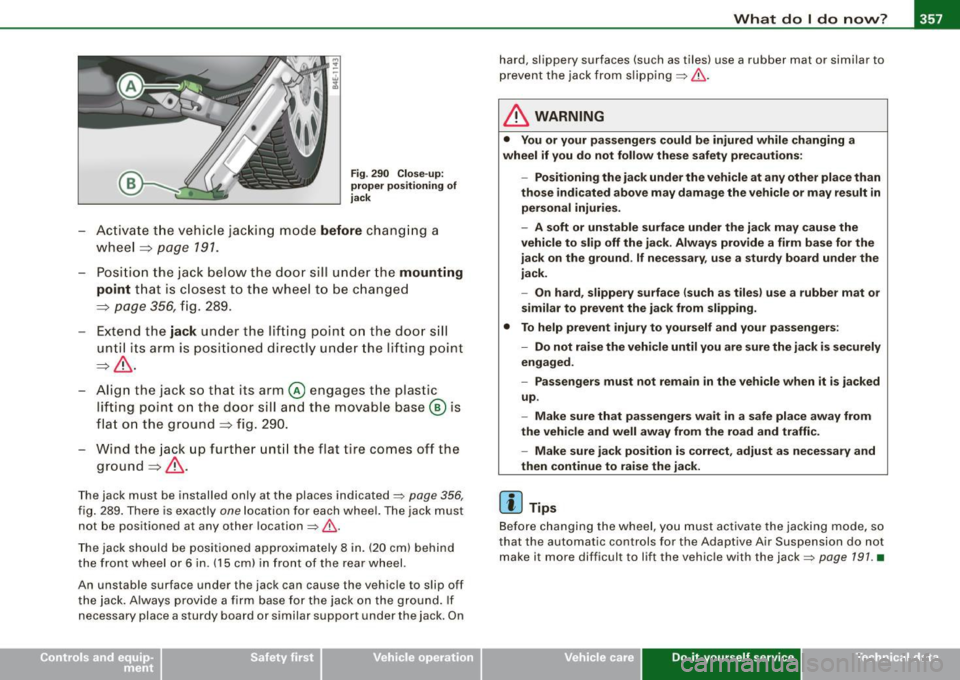
Fig . 290 Close-up :
proper positioning of
jack
- Act iva te the ve hicle ja cking mode before c ha ngin g a
wheel ==>
page 19 1.
- Posi tio n th e jack below th e doo r sill und er t he mounting
point
that is clos est to the w hee l to be cha nged
==>
p age 356 , fig. 289.
- Exten d the
jack und er the li fting po int on the doo r sill
un til it s arm is po sitio ned d irect ly und er t he l if tin g p oint
==> & .
- Align the j ack so th at its a rm
@ en gag es th e plastic
lif ting point on the door si ll and th e mova ble base ® is
flat on the groun d==> fig. 290 .
- Wind th e jack up furt her u ntil the flat tir e co mes off the
gr oun d==> & .
The jack must be installed only at the places indicated~ page 356,
fig. 289 . Th ere is e xactly on e loca tion for e ach w heel. The jack m ust
not b e positioned at any oth er locatio n~ & .
T he jac k should be pos it ioned ap pro xim ately 8 in . (2 0 cm) be hind
the front wh eel or 6 i n. (1 5 c m) in fr ont o f the r ear w heel.
A n unstab le su rface unde r th e jac k can cause the vehicle to slip off
the jack. A lw ay s pro vi de a firm bas e for th e ja ck on the grou nd. If
necessary place a sturdy board or similar s up port under the jack. On ha
rd, sl ippery surfaces (suc h as til es) us e a ru bber mat or similar to
prevent th e ja ck fr om slippin g~ & .
& WARNING
• You or your passengers could be injured while changing a
wheel if you do not follow these safety precautions:
-Positioning the jack under the vehicle at any other place than
those indicated above may damage the vehicle or may result in
personal injuries.
- A soft or unstable surface under the jack may cause the
vehicle to slip off the jack . Always provide a firm base for the
jack on the ground . If necessary , use a sturdy board under the
jack .
- On hard , slippery surface (such as tiles ) use a rubber mat or
similar to prevent the jack from slipping.
• To help prevent injury to yourself and your passengers :
- Do not raise the vehicle until you are sure the jack is securely
engaged .
- Passengers must not remain in the vehicle when it is jacked
up .
- Make sure that passengers wait in a safe place away from
the vehicle and well away from the road and traffic .
- Make sure jack position is correct, adjust as necessary and
then continue to raise the jack.
[ i ] Tips
Be for e changi ng th e whee l, yo u m ust ac tiv ate the jac king mode , so
that the automat ic controls for t he Adapt ive Air Suspension do not
make it more diffic ult to lift the vehi cle with the jack~
page 191. •
Vehicle care Do-it-yourself service irechnical data
Page 361 of 408

_______________________________________________ W_ h_ a_t _ d_ o_ l _d _o_ n_ o _ w_ ? __ fflll
•
hub. Remove all dirt from these surfaces before remounting the
whee l.•
Tires with unidirectional tread design
Tires with unidirectional tread design must be mounted
with their tread pa ttern pointed in the ri ght direction.
Using a spar e tire with a tread pattern intended for u se
in a sp ecific di rec tion
When using a spare tire with a tread pattern intended fo r use in a
specific direction, p lease note the following:
• The direction of rotation is ma rked by an arrow on the side of the
tire .
• I f the spare tire has to be insta lled in the incorrect direction, use
the spare tire only temporarily since the tire wi ll not be able to
achieve its optimum performance characteristics with regard to
aquaplaning, noise and wear.
• We recommend that you pay particular attention to this fact
during wet weather and that you adjust you r speed to match road
conditions .
• Replace the flat tire with a new one and have it installed on your
veh ic le as soon as possible to restore the handling advantages of a
un idirectional tire. •
Notes on wheel changing
Please read the information :::::, page 338, "New tires and replacing
tires and whee ls" if you are going to use a spare tire which is
di fferent from the t ires on your veh ic le.
After you change a tire :
• Check the tire pre ssure on the spare immediately after installa
tion . • Have the wheel bolt t
ighten ing torque che cked with a torque
wrench as soon as possible by your authorized Audi dealer or a qualified service station .
• With steel and alloy wheel rim s, the wheel bolts are correctly
tighte ned at a torque of 90 ft lb (120 Nm ).
• If you noti ce that the wheel bolt s are corroded and difficult to
turn while changing a ti re , they should be replaced before you che ck
the tightening torque .
• Replace the flat t ire with a new one and have it installed on your
vehicle as soon a s possible . Remount the whee l cover.
Until then , dri ve with extra care and at reduced speed s.
& WARNING
• If you are going to equip your vehi cle w ith tires or r ims which
differ from those which were factory in stalled , then be sure to read
the information :::::,
page 338, uNew tires and repla cing tires and
wheel s".
• Always mak e sure the d am aged wheel or e ven a flat t ire and
the jack and tool kit are properl y secured in the luggage compart
ment and are not loose in the pass enger compartment .
• In an a ccident or sudden maneuver they could fly forward ,
injur ing anyone in the vehicle .
• Alway s store damaged wheel , ja ck and tools securely in the
luggage comp artment . Otherwise , in an accident or sudden
m aneuv er they could fly forward , cau sing injury to pas senger s in
the veh icle .
• Do not use commercially available ti re sea lants. Othe rwise, the
ele ctri cal component s of t he tire pres sure mon itor ing system * will
no longer wo rk properly and the sen sor for the tire pre ssure moni
tor ing s ystem* w ill have to be replaced by a qualified workshop . •
Do-it -yourself service