belt AUDI S8 2009 Manual PDF
[x] Cancel search | Manufacturer: AUDI, Model Year: 2009, Model line: S8, Model: AUDI S8 2009Pages: 408, PDF Size: 91.63 MB
Page 267 of 408
& WARNING
Improper installation of child restraints will increa se the r is k of
injury and death in a crash .
• Improper use of child restraint anchors (tether anchors) could
lead to injury in a colli sion. The anchor s are designed to withstand
only tho se load s impo sed by correctly fitted child restraints .
• Never mount two child restraint systems on one LATCH lower
anchor point .
• Never attach two child restraint sy stems to one tether strap or
tether anchorage .
• Always follow the instructions provided by the manufacturer of
the child restraint you intend to install in your Audi .
• Never use child restraint tether anchorages to secure safety
belts or other kinds of occupant restraint s.
• Never atta ch a tether strap to a tie -down hook in the luggage
compartment.
• Never secure or attach any luggage or other items to the LATCH
lower anchorages or to the tether anchors .
• If a tether or other strap is used to attach a child restraint to the
front passenger seat , make sure that it is not so tight , that it
c auses the weight -sensing mat to measure more weight than is
actually on the seat.
• The heavier weight registered can make the system work as
though an adult were on the seat and deploy the Advanced Airbag
when it must be suppressed causing serious or even fatal injury to
the child. •
Safety first
Child Safety
Tether strap
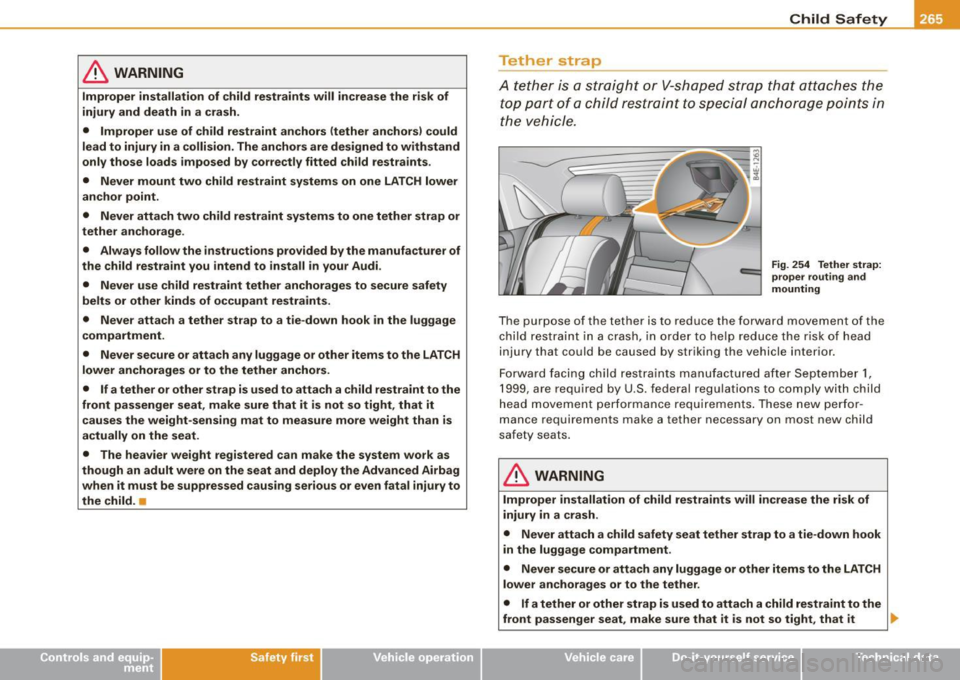
A tethe r is a straight or V-sh aped s trap t hat at taches the
top part of a chil d re str aint to s peci al anc ho ra ge poin ts in
t h e vehicle.
Fig . 254 Tether strap:
prope r routing and
mounting
The p urpose of the tether is to reduce the forward movement of the
c hi ld r estraint in a crash, in orde r to he lp redu ce th e risk o f head
injury that could be caused by striking the vehicle interior.
F o rw ard facing c hild res train ts manufact ure d after Sep te mb er 1,
1999, are required by U.S . federal re gulations to comply with child
head m ovement performance requ iremen ts . These new pe rfo r
mance requirements make a tether necessary on most new child
safety seats .
& WARNING
Improper installation of child restraints will increase the risk of
injury in a crash .
• Never attach a child safety seat tether strap to a tie -down hook
in the luggage compartment .
• Never secure or attach any luggage or other items to the LATCH
lower anchorages or to the tether .
• If a tether or other strap is used to attach a child restraint to the
front passenger seat, m ake sure that it is not so tight , that it •
I .
Vehicle care I I irechnical data
Page 272 of 408
___ ln_ t _e_ ll-'"ig ...,_ e_ n_t _t_ e_ c_ h _ n_o _ l_o _,.g= y,_ __________________________________________ _
Intelligent technology
Notice about data recorded by
vehicle control modu les
Your vehicle is not equipped with an Event Data Recorder (EDR),
installed by some manufacturers for the express purpose of
capturing data for retrieval after an accident or crash event . EDR's
are sometimes called "crash recorders" .
Some state laws restrict the retrieva l or downloading of data stored
by EDR's that were insta lled in a vehicle for the express purpose of
retrieving data after an accident or crash event without the owner's
consent.
Although your vehicle is not equipped with an EDR, it is equipped
with a number of electronic control modules for various vehicle systems such as, for example, engine function, emission control, as
well as for the airbags and safety belts.
These electronic control modules also record vehicle-related data during norma l vehicle operation for diagnost ic and repair purposes .
The recording capacity of the electronic control modules is limited
to data (no sound is recorded) and only a small amount of data is
actually recorded over a very limited period of time and stored when
a system fault or other condition is sensed by a control unit. Some
of the data then stored may relate to vehicle speed, direction, braking as well as restraint system use and performance in the
event of a crash or other condition . Stored data can only be read and
down loaded with special equipment .•
Electron ic Stabilizat ion Program (ESP)
General =nformation
The ESP improves the vehicle stability.
I~
"' " "'
- -
( ra I 5£ IA I -3, )
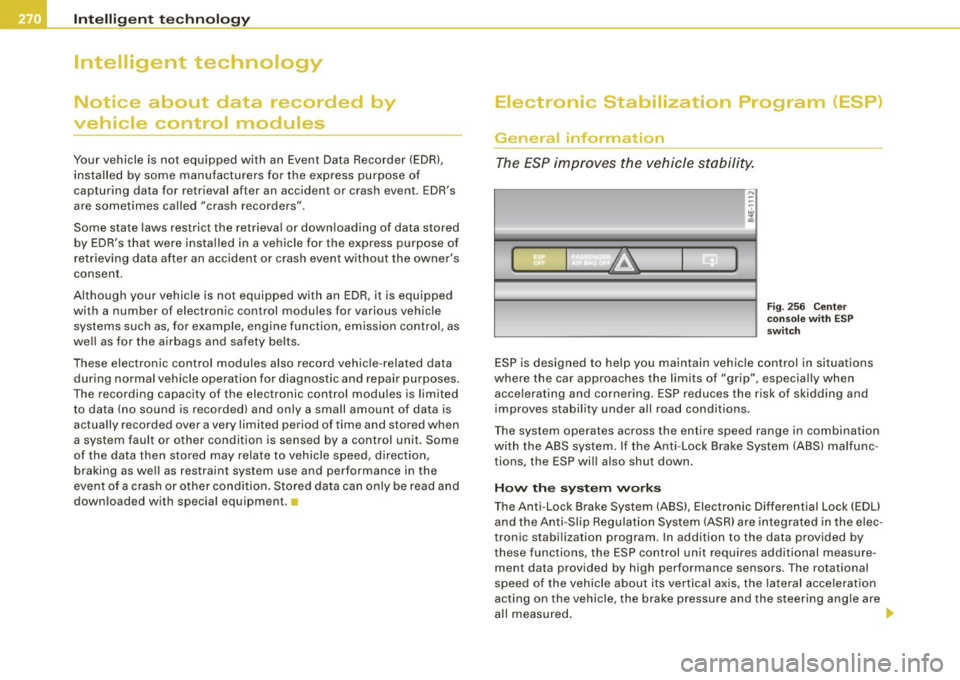
Fi g. 256 C ente r
co nso le w it h ES P
swi tch
ESP is designed to he lp you maintain vehic le control in situations
where the car approaches the limits of "grip", especia lly when
accelerating and cornering. ESP reduces the risk of skidding and
improves stabil ity under all road conditions .
T he system operates across the entire speed range in combination
with the ABS system. If the Anti-Lock Brake System (ABS) malfunc
tions, the ESP wil l also shut down .
How th e sys te m w ork s
The Anti -Lock Brake System (ABS) , Electronic Differential Lock (EDU
and the Anti-Slip Regulation System (ASR) are integrated in the e lec
tronic stabi lization program . In addition to the data provided by
these functions, the ESP control unit requires additional measure ment data provided by high performance sensors . The rotational
speed of the vehic le about its vertical axis, the lateral acce leration
acting on the vehicle, the brake pressure and the steering angle are
a ll measured .
Page 301 of 408
_____________________________________________ C_ l_ e _a_ n_ in_ g_a _ n_d_ p_ r_ o_ t _e_ c_t _io _ n __ lfll
•
consider if children, anima ls or other factors m ight prove to be
partic ularly hard on the leather.
By contrast, leather types that are covered by a colored finish layer
are more durable. This has a positive effect on the leather 's resis
tance to wear and soiling in da ily use. On the ot her hand, the typica l
characteristics of natural leather are barely or not apparent.
However, this does not mean that the leather itself is of inferior
quality .
Care and h andling
Because of the exclusive nature of the types of leather that Audi
uses and their unique properties (such as sensitivity to oils, grease,
soiling, etc.l, you will need to be somewhat careful with these
lea thers, and a cer tain type of care is requ ired . For example, dark
clothing materials can discolor leather seats (especial ly if such
clothing is damp and was not dyed correctly). Dust and dirt par ticles
in pores , folds, and seams can have an abrasive effect and can
damage the leather surface as well as weaken seams .
The leather shou ld be c leaned regularly as needed . After having
been used for a relatively long time , your leather seats will acquire
a rich aged finish . This is a characteristic of natural leather and a
sign of true qua lity.
I n order to maintain the value of this natural p roduc t over the life of
your vehic le, you should fo llow the recommendations below :
0 Note
• To keep your leather from b leaching out, do not allow it to be
exposed to bright sun light for long per iods of time . If you have to
leave the vehicle parked outside for long periods, cover the leather
to protect it from direct exposure to sunlight.
• Sharp ob jects on c lothing, such as zippers, rivets or sharp pieces
on belts can leave permanent scratches or sc rape marks on the
surface of t he leather.
[ i ] Tip s
• After each time you clean the leathe r and at regular intervals, use
a leather preservative creme that contains UV -blockers and that
works into the leather . This creme wil l nour ish and moisturize the
leather, helping it to breathe and stay supple . It a lso helps to build
up a protect ive coating on the sur face .
• Clean the leather every 2 -3 months, and c lean any areas that get
soiled.
• Remove fresh marks made by ballpoint pens, ink, lipstick, shoe
polish, etc . as soon as possible .
• Preserve the co lor of the leather as needed by using a special
colored leather care creme to touch up areas of uneven co lor. •
App lies to ve hic les : w ith n atura l le at he r
Cleaning and caring for leather upholstery
and trim
Natural leather requires special care and atten tion .
Normal cleaning
Clean so iled areas wi th a slightly mo is tened cot to n or
woole n cloth.
More stubborn dirt
- More stub born dirt can be removed using a cloth satu
rated wi th a mild soap solut io n (2 tab lespoons mild
liq uid soap) .
- Neve r allow the soap solution to sa turate the leathe r, and
make certain that no water soaks i nto the seams .
Wipe off the soap solution with a soft, dry cloth. .,,
Vehicle care I t •
Page 303 of 408
_____________________________________________ C_ l_ e _a_ n_ in_ g_a _ n_d_ p_ r_ o_ t _e_ c_t _io _ n __ _
•
prevent it from fading. Slight color variations will develop in normal
use and are not an indication of material deterioration.
0 Note
• Never use chemical solvents (e.g. lighter fluid, turpentine),
waxes, shoe polish or similar products on Alcantara ® surfaces.
• To avoid damage, have stubborn stains removed by a commer
cial cleaning specialist.
• Do not use brushes, stiff sponges or similarly abrasive cleaning
aids .•
Safety belts
Only well-maintained safety belts work reliably when
needed.
- Keep belts clean.
- For cleaning, use a mild soap and water solution . Let
belts dry thoroughly and away from direct sunlight .
- Do not allow inertia reel safety belts to retract before
they are completely dry.
- Check the condition of your safety belts
regularly.
Heavily soiled safety belts may not retract properly.
& WARNING
Damaged safety belts can break in a crash.
• Anything that might damage your safety belts could mean that
you and your passengers would not be adequately protected in an
accident.
• Safety belt performance depends on correct installation. Never
remove belts from the vehicle to clean them.
& WARNING (continued)
• Do not use chemical cleaning agents, bleach or dyes. They have
corrosive properties which weaken the webbing.
• When cleaning your safety belts, inspect them for damage. If
you discover damage, see your Audi dealer.
• Always read and heed all WARNINGS and other information
~ page290. a
Engine compartment
Be especially careful when cleaning the engine compart
ment.
Always switch off the ignition before cleaning the engine ~ &.
Plenum panel
Remove leaves from the plenum panel in front of the windshield
under the engine hood. This prevents the water drain holes from
becoming blocked, and it prevents debris from entering the vehicle
interior through the heating and ventilation ducts.
Corrosion protection
The engine compartment and transmission have been corrosion
protected at the factory.
Good anti -corrosion treatment is very important, particularly in the
winter. If the vehicle is frequently driven on salt treated roads, the
entire engine compartment and plenum panel should be thor
oughly cleaned at the end of winter and retreated to prevent salt
damage. At the same time, the underside of the vehicle should be
washed as well.
If the engine compartment is cleaned at any time with grease
removing solutions
2 l, or if you have the engine washed, the anti
corrosion treatment is almost always removed as well. It is therefore .,_
21 Use only th e correct cleaning solut ions. N ev er us e gasolin e or di ese l fu el.
Vehicle care I t •
Page 312 of 408
___ C_h_ e_ c_k _in --== g'-- a_n _d_ f_il _li _n ..:::g:::..- ___________________________________________ _
& WARNING (continued )
-Always u se extreme caution to prevent cloth ing , jewelry, or
long hair from getting caught in the radiator fan , V-belt s or
other moving parts , or from contacting hot parts . Tie back hair
before starting , and do not wear clothing that will hang or
droop into the engine .
• Minimize exposure to emis sion and chemical hazards
::::> & .
& WARNING
California Proposition 65 W arn ing :
• Engine exhaust , some of its constituents , and certain vehicle
c omponents cont ain or emit chemicals known to the State of Cali
fornia to cause cancer and birth defects and reproductive harm. In addition , certain fluids contained in vehi cles and certa in products
of component wear contain or emit chemicals known to the State
of California to cause cancer and birth defect s or other reprodu c
tive harm.
• Battery posts , terminals and related ac cessories conta in lead
and lead compounds , chemicals known to the State of California
to cause cancer and reproductive harms. Wash hands after
handling.
0 Note
When adding f luids, always make sure that they are poured into the
proper container or filler ope ning, otherwise serious damage to
vehic le systems wi ll occur .
ci> For the sake of the environment
To detect leaks in time, inspect the vehicle floor pan from under
n eath regularly. If you see spots fro m oil o r o th e r v eh icle flu ids, hav e
your vehicle inspected by an author iz ed Audi dea le r. •
Engine compartment
Ap plies to vehi cle s: w ith 8 -c yli nd er e ng in e
Engine compartment overview : 8-cylinder
engine
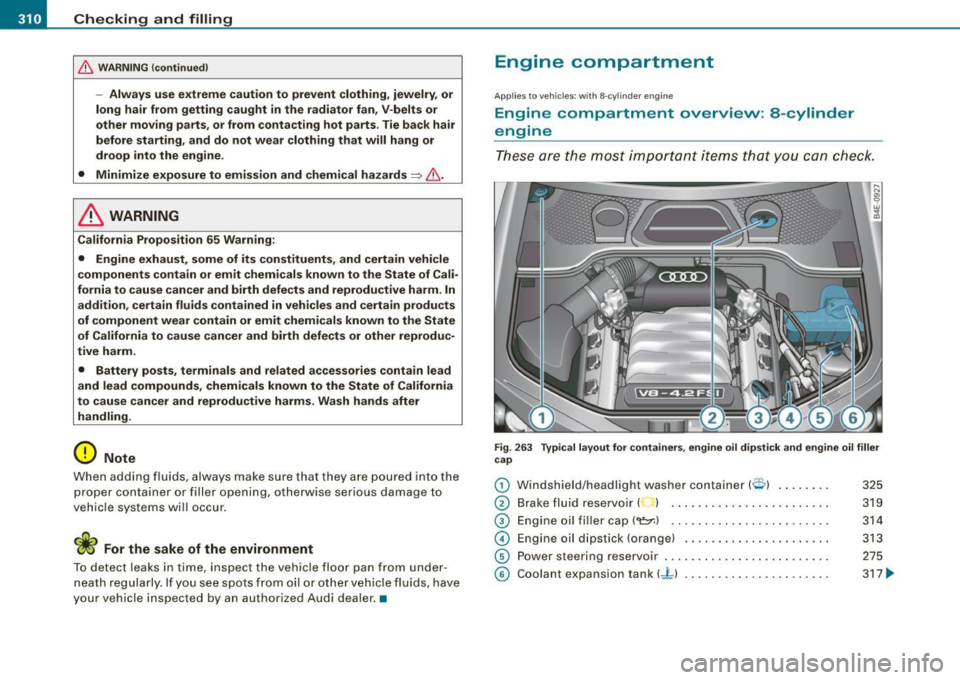
T hese are the mos t impor tant items th at you c an ch eck .
Fig. 26 3 Typical l ayout for containe rs, engine o il d ip stic k and engine oil fille r
c a p
G) Winds hield/headlight washer containe r(<;;;> ) .. ..... .
0 Brake fluid reservoir ( l) .. .. .. .. ...... .... ... .. .
© En gine oil filler cap ('I::?:) .. .. .... ...... .... ... . _ .
© Engine oil d ipstick (orange) .... ..... ........ .... .
© Power st eering r eservoir ...... ........ ... ......• .
© Coolant expansion tank (- L l ... ...... .... ... .... . .
325
319
314
31 3
275
317 ..
Page 321 of 408
Checking and filling 111111 _______________________________ =..:..:..::...:::...:...:~:....:...;_.:....::___--:::-------J
& WARNING !continued )
• Antifr eeze is po isonous. Always store antifreeze in it s original
c ontainer and well out of the re ach of children .
• If you drain the coolant, it must be caught and safely stored in
a proper co ntainer cle arly m arked "poi son ".
0 Note
• Coolant po llutes the environment and cou ld cause an engine
fire. Excess coolant will be forced out through the pressure relief
valve in the cap when the engine becomes hot.
• I f, in an emergency, only wa ter can be added, the correct ratio
between water and antifreeze=>
page 316 must be restored as soon
as possib le .
W For the sake of the environment
Drained coolant should not be reused. A lways dispose of used
coolant while observing all environ mental regula tions . •
Radiator fan
The radiator fan switches on au tomatically by i tself.
T he radiator fan is driven by the engine via the V-belt. The viscous
clutch regulates the speed of the fan according to the temperature
of the coo lan t.
An auxiliary electric radiator fan * switches on and off depending on
coolant tem perature and o ther vehic le opera ting condi tions.
After you switch the engine off , the auxiliary fan can continue
running for up to 10 minutes -even with the ignition off. It can even
switch on again later by itself=>&, if
• the temperature of the engine coolant rises due to the heat
bu ild -up from the engine i n the engine c ompar tment, or •
the engine compartment heats up because the vehicle is parked
in intense sunligh t.
& WARNING
• To reduce the ri sk of personal injury never touch the radiator
f a n .
• The aux iliary electric fan i s te mperature controlled and can
switch on suddenly even when the engine is not running .
• The au xiliary radiato r fan switche s on automatic ally when th e
eng ine coolant reache s a certain temperature and
will continue to
r un until the coo lant tempe rature drop s. •
Brake fluid
Checking brake fluid level
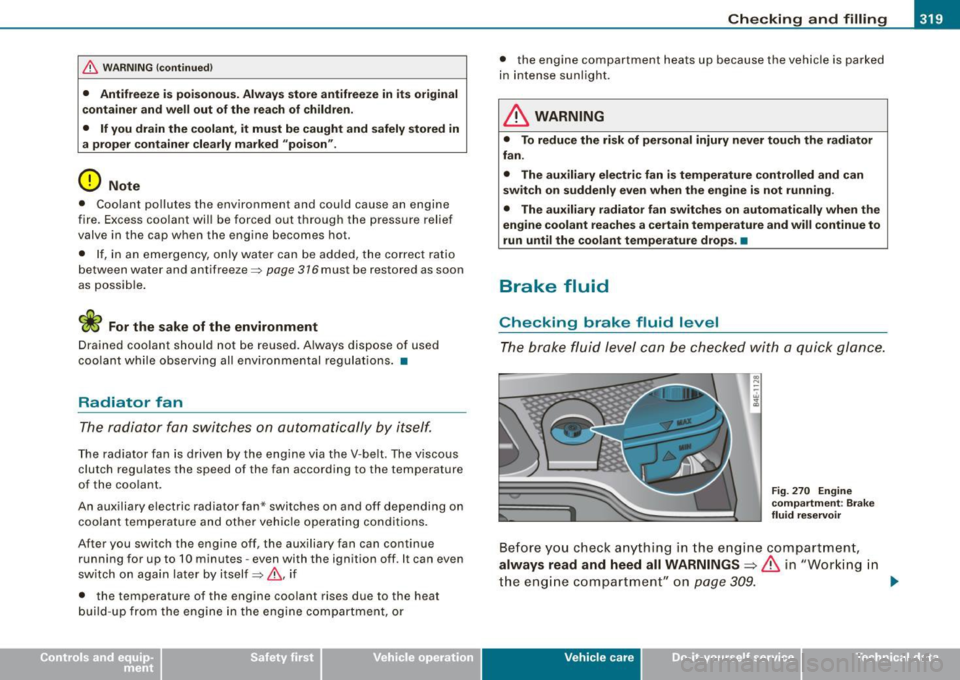
T he brake fluid level can be checked with a quick glance.
-w ;:;
Fig . 270 Engin e
c o mpartm ent: B ra ke
fluid r ese rvo ir
Before you check anything in the e ngine comp artmen t,
always read and heed all WARNINGS:::::> & in "Working in
t h e engi ne compartment" on
page 3 09. .,_
Vehicle care I I irechnical data
Page 337 of 408
Tires and wheels -
----------------
•
0 Note
Driving without valve stem caps can cause damage to the tire
valves. To prevent this, always make sure that factory installed valve
stem caps on all wheels are securely mounted on the valve .
W For the sake of the environment
Underinflated tires will also increase the fuel consumption. •
Tires and vehicle load limits
There are limits to the amount of load or weight that any vehicle and
any tire can carry . A vehicle that is overloaded will not handle well
and is more difficult to stop. Overloading can not only lead to loss
of vehicle control, but can also damage important parts of the
vehicle and can lead to sudden tire failure, including a blowout and
sudden deflation that can cause the vehicle to crash.
Your safety and that of your passengers also depends on making
sure that load limits are not exceeded. Vehicle load includes every
body and everything in and on the vehicle. These load limits are
technically referred to as the vehicle's
Gross Vehicle Weight Rating
("GVWR"l.
The "GVWR" includes the weight of the basic vehicle, all factory
installed accessories, a full tank of fuel, oil , coolant and other fluids
plus maximum load. The maximum load includes the number of
passengers that the vehicle is intended to carry ("seating capacity")
with an assumed weight of 150 lbs (68 kg) for each passenger at a
designated seating position and the total weight of any luggage in
the vehicle. If you tow a trailer, the weight of the trailer hitch and the
tongue weight of the loaded trailer must be included as part of the
vehicle load.
The
Gross Axle Weight Rating ("GAWR"l is the maximum load that
can be applied at each of the vehicle's two axles. The
Gross Vehicle Weight Rating and the Gross Axle Weight Rating
are listed on the safety compliance sticker label located either on
the driver's side 8-pillar or on the inside of the fuel filler flap. Your
Audi has 5 seating positions, 2 in the front and 3 in the rear for total
seating capacity of 5. Vehicles with power individual rear seats*
have 4 seating positions, 2 in the front and 2 in the rear for total
seating capacity of 4. Each seating position has a safety belt
~ page 211, "Safety belts".
The fact that there is an upper limit to your vehicle's Gross Vehicle
Weight Rating means that the total weight of whatever is being
carried in the vehicle (including the weight of a trailer hitch and the
tongue weight of the loaded trailer) is limited. The more passengers
in the vehicle or passengers who are heavier than the standard
weights assumed mean that less weight can be carried as luggage.
The tire pressure label on your Audi also lists the maximum
combined weight of all of the occupants and luggage or other cargo
that the vehicle can carry. For the location of the label
~ page 330,
fig. 274.
& WARNING
Overloading a vehicle can cause loss of vehicle control, a crash or
other accident, serious personal injury, and even death.
• Carrying more weight than your vehicle was designed to carry
will prevent the vehicle from handling properly and increase the
risk of the loss of vehicle control.
• The brakes on a vehicle that has been overloaded may not be
able to stop the vehicle within a safe distance.
• Tires on a vehicle that has been overloaded can fail suddenly,
including a blowout and sudden deflation, causing loss of control
and a crash.
• Always make sure that the total load being transported -
including the weight of a trailer hitch and the tongue weight of a
loaded trailer -does not make the vehicle heavier than the
vehicle's Gross Vehicle Weight Rating. •
Vehicle care
I t •
Page 393 of 408
______________________________________________ A_ l_,_ p _h_ a_ b_e _t_i c_ a _ l _in _ d_e _ x __ _
Weight-sensing mat .... .... . ... .. 246
When must the system be inspected?
231
Aircraft Transporting your vehicle .. .... .... 371
All Wheel Drive .. .... ....... .... .... 275
Alloy wheels ... .... .... .... ... .... .. 295
All -whee l drive
Winter tires .. ..... ... .... ..... .. . 343
A lternator
See Generator .... .... ... ..... ... . 18
Anti-freeze
See Engine coolant . ...... ..... .. . 316
Anti-lock brake system How the ABS system works . .... ... 274
Warning/indicator lights ... ... .... .. 21
Anti -Slip Regulation System (ASR)
How the system works ............ 272
An ti-t heft systems
Anti -theft ala rm system ...... .... .. 60
Electronic immob ilizer ... .. .... .... 49
Ashtray Front ... ...... ...... .... ..... ... 106
Rear .... ... .. .... .... ... .... .... 107
ASR How the Anti-Slip Regulation System works .. .... .... .... ... .... .... 272
Audi Service Repair Manua ls and Literature
382
AUTO mode AC climate con tro l .. .. .... ... .... . 1 17
Auto Safety Hotline . .... ........ .... . 209
Auto -Check Contro l .... ... .. .... .... .. 28
Controls and equip
ment Safety first
Automatic belt
retractor ... .. ...... ... 215
Automatic car wash
See Washing ..... .... .... .... .... 291
Au tomatic Shift Lock (ASU .... .... .... 168
Automatic transmission 6-speed automatic transmission .... 166
Automatic Shift Lock (ASU .... ... .. 168
Driving ............. ............ . 166
Dynamic sh ift program .... ........ 169
Emergency release for selector lever 171
Fa il- safe mode . ...... .... .... .... 171
I gnition key safety lock . ...... .... . 130
Kick -d ow n .... .... .... .... ... .... 169
Manual shift program ... .. .... .... 170
Selector lever .... .... .... .... .... 1 67
Shift buttons ... .. .... .... .... ... 1 71
Steering wheel with tiptronic .. .... . 171
Average speed . ...... .... .... .... ... . 38
Avoid damaging the vehicle .. ..... ... . 28 1
B
Background ligh ting . .... ...... ... .... 76
Battery ... .. .... ... .... .... .... .... 320
Battery location inside the luggage compartment ...... .... ... .. .... 32 1
Charging ........................ 323
I mpo rta nt warn ings when work ing o n the
battery . .... .... .... ........ ... 32 1
low ............................. 276
Replacing the battery ....... .... .. 324
State of charge ... .... .... .... .... 276
Winter operation . .... .... .... .... 320
Working on the battery .... .... .... 321 Battery vo
ltage . ... .... .. .... .... .... . 36
Before driving ... .... .... ..... .. .... 201
Blended gasoline . .... .... .... ...... . 303
Body cavity sealing .. .... .... .... ... . 296
Boos ter seat ... .. .... .... ... .... .... 253
How do I properly insta ll a b ooster sea t in
my vehic le? ............... ..... 253
Safety instructions .... .......... .. 253
Brake fluid Changing the brake fluid ... .... .... 320
Checking the brake fluid level .. ... . 319
What is the correct brake fluid level? 319
What should I do if the brake f luid warning
light comes on? ... .. .... .... .... 319
Brake system Ant i-lock brake system . ..... .. .... . 21
Brake assistant .... .... .... ....... 27 4
Brake booster ..... .... ... .... .... 274
Brake fluid .... .... .... ... .... .... 319
Brake f luid specificat ions for re fill and
replacement . .... .... .... ...... . 320
Brake light defective ... ...... ...... 26
Brake pads ....... .... .... .... ... 280
Electromechanica l parking brake .... 134
Fluid reservoir .. ...... ..... .. .... 319
How does m oisture or road salt affec t the
brakes? . .... .... .... ....... .... 272
Malfunction ............ ... .. ..... 30
Warning/indicator lights .... .... .... 22
Worn brake pads symbol ........... 34
Break -in period .. .... .... .... .... ... 279
Brake pads ... .... .... .... ...... . 280
Tires . .... .... .... .... ... .... .... 279
Bu lbs . ... .... .... .... ... .... ...... . 36 4
Vehicle operation Vehicle care Do-it-yourself service Technical data
Page 394 of 408
___ A_l.:,. p _h_ a_ b_e _t _ic _ a_l _in _ d_e _x ____________________________________________ _
Bumper cover
Caution when parking near a parking bar -
rier or curb ...... ... .... .. .. ...
135
C
Ca lifornia Proposition 65 Warning ..... 310
Battery specific . . . . . . . . . . . . . . . . . . 323
Capac1t1es .. .... .... .... .... ... .... 380
Car care . ... ... ...... ....... .... ... 290
Int erior .. ... ... .. ... ... .. ...... . 297
Plastic and vinyl .. ............... 294
Weatherstrips ..... .. .. .. ...... .. 295
Car carrier
Transporting your vehicle ........ .
371
Care of exterior ...... ............... 290
Cargo a rea
See Loading the luggage compartmen t ..
207
Cargonet .... .... .... ....... ...... . 101
Catalytic conv erter . . . . . . . . . . . . . . . . . . 280
Centra l locking
Emergency locking .... .... .. . .... .
54
Certification . . . . . . . . . . . . . . . . . . . . . . . 385
Changing a flat tire ...... .... .... .... 45
Changing a wheel . ... .... .... ...... . 353
Chang ing engine oil .. .... .... .... ... 315
Chassis
Undercoating . . . . . . . . . . . . . . . . . . . .
296
See also Adaptive Air Suspension . . . 188
CHECK button . . . . . . . . . . . . . . . . . . . . . . . 15
Ch ecking
Engine coolant level .. .. ........ ..
317
Checking tire pressure ... .... .. .. .. .. 333
Child restraints
Danger of using child restraints in the
front seat . ......... .... ... .. ...
222
What types of chi ld restraint anchors are
available? .... .... .... .... .... ..
258
Wher e can I get add itional informat ion
about child restraints? ... .. .. ....
259
Child safety .. .... ..... .. .... ... 245, 250
Additiona l information . .... ....... 264
Booster sea t ........ ........ .... . 253
Convertible chi ld safety seat .... ... 251
Convertible locking retractor ... .... 255
Guidance fixtures for lower anchorages
261
Important safety instructions for using
chi ld safety seats .. . ............
248
Important things to know when driving
with children ....... .... ... .. ...
245
Infant seat . ... ...... ......... ... 250
Installing a child restraint using the
LATCH system ............ ... ...
263
Lower anchorages ........... .... . 260
Mounting and releasing the anchorage
hook .. ...... ............. .....
264
Older children and safety belts 254
Saf ety bel ts and ol dler children ... .. 254
Teth er anchors ...... ........ ... . 264
Te th er s trap ... ...... .. ...... .... 265
Which restraint system should my older
child wear? ....... ... ..........
254
Child safety lock
Rear doors (mecha nical) ...... ... ...
57
Rea r doors (powe r) . . . . . . . . . . . . . . . . 58
Child safety seat ...... .... .... ..... . 250
Conver tible locking retractor .... ... 255
How do I properly ins ta ll a child safe ty
seat in my vehicle? .. ...... ......
248
Installing .. .. .. .... .... ... .... ... 255
LATCH system . .... .... ... .... ... 263
Safety instruct ions . .. ... .... .... . 248
Cigarette I ig hter . . . . . . . . . . . . . . . . . . . . 107
Cleaning
Alcantara (synthetic suede) . .......
300
Engine compartment .. .... .... ... 301
Fabrics and fabric coverings ... .... 297
Instrument panel ................. 298
Interior ........... .... .... ...... 297
Leather ... .... .... ........... .. . 299
MMI display .......... .... .... ... 297
MMI terminal ...... ....... .... .. . 297
Plastic and viny l ... .... .... .... ... 294
Plastic parts . ...... ... ... ... ... .. 298
Sa fe ty b elt s . . . . . . . . . . . . . . . . . . . . . 301
Trim strips .......... .... ... .. .. . 293
trim s trips . ........ ... ........... 294
Cleaning and protection ............. 290
Climate controls ...... .... .. .. .... .. 114
Air distribution .. ......... .... .. . 120
Air outlets ..... .... .... .... ..... . 122
Air outlets (rear) ...... .. .. .... .... 122
Air recirculation ... ... .. .......... 121
AUTO (standard setting) .. .... ... .. 117
Basic settings .. .... .... ... .... ... 126
Center a ir vent . ...... .. ...... .... 127
Contro ls .. .. ..... ... .. ...... .... 116
Defrosting /defogging . ....... ... .. 120
Description ..... ... .... ..... ... .. 114
Page 398 of 408

___ A_l.:,. p _h_ a_ b_e _t _ic _ a_l _in _ d_e _x ____________________________________________ _
H
Head restraints . . . . . . . . . . . . . . . . . . . . . 205
Adjusting ....................... 205
Comfort head restraints ....... .... . 91
Front seats . . . . . . . . . . . . . . . . . . . . . . . 91
Rear seats . . . . . . . . . . . . . . . . . . . . . . . 92
Headlight range control . . . . . . . . . . . . . . . 36
Headlights ... .... ... .... .... ...... .. 69
Adaptive Light .... .... .... ...... .. 72 Hood
Opening 308
Release lever . . . . . . . . . . . . . . . . . . . . 308
Horn .. ...... ............ ....... .... 11
How many a irbags does my vehicle have? ..
227
How often should I check my tire pressures?
334
How safety belt pretensioners work .... 218
Hydroplaning ........ .... .... ...... 338 Instrumen
ts and controls
General illustration ................ 11
Illumination ...................... 15
Instrument cluster .. .... ..... .. .... 12
Int erior lights
Background lighting .... ... ........ 76
Front ............................ 74
Rear ...... .... ... ..... .. . .. .. .... 75
Intermittent wiping
Rain sensor ... .... .... ...... .... . 80
Defective . . . . . . . . . . . . . . . . . . . . . . . . 26
Front fog lights . . . . . . . . . . . . . . . . . . . 71
I J
Switching off ..................... 69
Switching on ...... ....... ........ 69
Washer reservoir . . . . . . . . . . . . . . . . . 325
Washer system . . . . . . . . . . . . . . . . . . . 81
Xenon headlights . . . . . . . . . . . . . . . . . 69
Heated Front seats . . . . . . . . . . . . . . . . . . . . . . 118
Rear seats . . . . . . . . . . . . . . . . . . . . . . 119
Windshield ...................... 123
Heated outside mirrors . . . . . . . . . . . . . . . 84
Heated seats Front . . . . . . . . . . . . . . . . . . . . . . . . . . . 118
Rear seats . . . . . . . . . . . . . . . . . . 119, 125
Heated steering wheel ............... 119
Heated washer jets
Wiper and washer system . . . . . . . . . . 80
Heavy clothing and safety belts ....... 214
High beam . . . . . . . . . . . . . . . . . . . . . . . 69, 73
Warning/indicator lights . .... . ... .. 19
High voltage warning label ... .... .... 376
Homelink® universal remote control .. 194 Ignition key
129 Jack
351
Ignition lock .. .... .... .... .... .... .. 129 Jumper cables .. ...... .... .... .... .. 367
Malfunction .. .... .... ... .... ..... 33 Jump-starting .... .... .... .... ...... 366
Ignition lock posit ions .......... ..... 129
Immobilizer ......................... 14 K
Important things to do before driving .. 201
Improperly worn safety be lts ......... 218
Indicator light
Airbag system ............... 231, 232
PASSENGER AIR BAG OFF ......... 232
Key ...... .... .... .... ... ....... .... 47
Battery replacement master key ... .. 48
Coded settings ................... 114
Emergency key .................... 47
Key replacement .................. 47
Indicator lights ....... ... ........ .... 16
Master key ....................... 47
Infant seat ........... ........ .... .. 250
Valet key ...... .... ............... 47
How do I properly install an infant seat in Key coded settings
my vehicle? .. ...... ....... .. ... 250
Climate controls .. .......... ..... 114
Safety instructions .............. . 250
Installing a child safety seat Safety belts . . . . . . . . . . . . . . . . . . . . . 255 Keyless
entry remote control . .......... 48
Kick-down .... ....... .... ... .... ... 169