wheel AUDI S8 2009 Manual PDF
[x] Cancel search | Manufacturer: AUDI, Model Year: 2009, Model line: S8, Model: AUDI S8 2009Pages: 408, PDF Size: 91.63 MB
Page 343 of 408
__________________________________________________ T_ ir_e_ s_ a_ n_d _ w_ h_ e_ e_l_s __ _
•
• T he battery inside of the tire pressure sensor has a limited
service life.
• Always drive with the va lve stem caps securely mounted. We
recommend using fac tory insta lled valve stem caps . Ask your autho
rized Audi dealer to replace lost valve stem caps .
T he installation of replacement tires with steel cord body plies in
the tire sidewall may cause malfunction of the tire pressure moni
toring system *, and is not recommended (cord material info rmation
i n molded on the t ire sidewa ll).
A lways check your tire pressure monitoring system * indicator after
replac ing one or more tires on you r veh ic le . If t he tir e pressure
monitoring system * indicator f lashes, or is on, your system is not
wo rking pr ope rly. Your re place ment tire might be i nco m patible wit h
your tire pr essure monitoring system *, or some component of the
t ir e pr ess ure moni toring system * m ay be da maged.
& WARNING
• Using incorrect or unmatched tires and / or wheels or improper
tire and wheel combinations can lead to los s of control , collision
and serious personal injury .
• Alway s use tires , rims and wheel bolts that meet the specifica
tions of original fa ctory -installed tires or other combination s that
have been specifically approved by the vehi cle manufacturer .
• Tires age even if they are not being used and can fail suddenly,
espe cially at high speeds . Tire s that a re more than 6 years old can
only be used in an emergency and then with special care and at
lo wer speeds .
• Never mount used tire s on your vehicle if you are not sure of
their "previous history ." Old used tires may have been dam aged
even though the damage cannot be seen that can lead to sudden
ti re failure and lo ss of vehicle control.
• All four wheels must be fitted with radial tires of the same type ,
size (rolling cir cumference ) and the same tread pattern . Driving
& W ARNING (continued )
with different tires redu ces vehicle handling and can lead to a loss
of control.
• If the spare tire is not the same as the tires that are mounted
on the vehicle -for example with winter tires -only use the spare
tire for a short period of time and dri ve with extra care . Refit the
normal road wheel as soon a s safely pos sible.
• Never drive faster than the ma ximum speed for which the tires
on your vehicle are rated because tires that are driven faster than
their rated speed can fail suddenly .
• Overloading tires cause heat build -up , su dden tire failure ,
includ ing a blowout and sudden deflation and loss of control.
• Temperature grades apply to tires that are properly inflated and
not over or underinflated .
• For te chni cal reasons it is not always po ssible to use wheels
from other vehicles -in some cases not even wheels from the
same vehicle model.
• If you install wheel trim discs on the vehicle wheels , make sure
that the air flow to the brakes is not blo cked . Redu ced airflow to
the brake s can them to overheat , increa sing stopping distances
and causing a collision.
• Run flat tires may only be used on vehicles that were equipped
with them at the fa ctory . The vehicle mu st have a cha ssi s designed
for run flat tires and a factory -installed tire pressure monitoring
s ystem* that indicates a lo ss of tire pressure . Incorrect use of run
flat tires can lead to vehicle damage or accident s. Check with an
authorized Audi dealer or tire specialist to see if your vehicle can
be equipped with run fl at tires . If run flat tires are used , they must
be installed on all four wheels . Mi xing tire types is not permitted.
0 Note
• Fo r techn ica l reaso ns, i t is no t genera lly p oss ibl e to use the
whee l rims from other vehicles . T his can hold true for wheels of the
sa me vehicle type. ..,.
Vehicle care
I t •
Page 344 of 408
-~_T_ ir_e_ s_ a_ n_d _ w_ h_ e_e _l_s _________________________________________________ _
• If the spare tire is different from the tires that you have mounted
o n your vehi cle (for e xample winter tires or wide profile tires), then
use the spare tire for a short period of time on ly and drive with extra
care . Replace the f lat tire with the tire matching the others on your
vehicle as soon as possible.
• If you should put different wheels and tires on your vehicle (e.g.
winter wheels and tires), you must be certain that the wheels and
tires are compatible with the tire pressure monitoring system* .
Otherwise the system will register a ma lfunction and a fault
message will be displayed . For more information, contact your Audi
dea ler.
0 Note
• When installing new tires, be careful not to damage the valves or
tire pressure monitoring system* sensors.
• Never drive without the va lve stem cap. The valves could get
damaged.
• If the sensors must be replaced, then the valve must also be
replaced at the same time.
c£> For the sake of the environment
Dispose of old tires in accordance with the loca l requirements. •
Uniform tire quality grading
• Tread wear
• Traction AA A B C
• Temperature A B C
Qua lity grades can be found where applicable on the tire side wal l
between tread shoulder and maximum section width
=> page 338,
fig. 278.
For e xample: Tread wear 200 , Traction AA, Temperature A.
All passenger car tires must conform to Federal Safety Require
ments in addit ion to these grades.
Tread w ea r
The tread wear grade is a comparative rating based on the wear rate
of the tire when tested under contro lled conditions on a specified
government test course.
For example, a tire graded 150 wou ld wear one and one half (1 1/2)
times as well on the government course as a tire graded 100.
The relative performance of tires depends upo n the actua l condi
tions of their use, however, and may depart significantly from the
n orm due to variations in d riving habi ts, service practices and differ
ences in road characteristics and climate.
Tra ction
The traction grades, from highest to lowest, are AA, A, Band C.
Those grades represent the tire's ability to stop on wet pavement as
measured under contro lled conditions on specified government
t est surfaces of asphalt and concrete . A tire marked C may have
poor traction performance => & .
Temperature
The temperature grades are A (the highest), 8, and C, representing
the tire's resistance to the generation o f heat and its abi lity to dissi
pate heat when tested under control led conditions on a specified
indoor laboratory test wheel.
Sustained high temperature can cause the mater ial of the tire to
degenerate and reduce tire life, and excessive temperature can lead
to sudden tire failure=>&.
T he grade C corresponds to a leve l of performance which a ll
passenger car tires must meet under the Federal Motor Vehicle
Safety Standard No. 109. Grades Band A represent higher levels of
p er formance on the la b ora tory test whee l than t he mi nimum
required by law.
~
Page 345 of 408
________________________________________________ T_ i _r_e _s_ a_n_ d_ w_ h_ e_e _ l_s __ lllll
•
& WARNING
The tr action grade ass igned to this t ire i s based on straight -ahead
braking traction tests, and does not include acceleration,
c ornering , hydroplaning or peak tra ction chara cteristic s.
& WARNING
The temperature grade for this t ire is established for a tire that is
properly inflated and not overloaded. Excessive speed , underinfla
tion , or ex ces sive loading , either separately or in combination , can
c ause heat buildup and possible tire failure . •
Winter tires
W inter tires c an im prove vehicle handli ng on snow and
ice. At t emperatures belo w 45 °F (7 ° C) we re comme nd
cha ngi ng to wint er tires.
In some heavy snow areas, local governments may require true
winter o r "snow" tires, those with very deeply cut tread. These tires
shou ld on ly be used in pairs and be i nstalled on all four wheels .
M ake sure you purchase snow tires that are the same size and
co nstruction type as t he o the r tires on your vehicle .
I f your vehicle is equipped with all -wheel drive *, this will improve
t raction d uring win te r dr iving, eve n with the s ta n dard ti res .
However, we strongly recommend that you always equip a ll four
w hee ls on you r vehic le wi th cor rec tly fit ted w inter tires o r all-season
t ir es, when w inter road co nditions ar e expected . T his also improves
the vehicle 's br aking perfo rmance and reduces stopping distances.
Summer tires p rov ide less gr ip on ice a nd sno w.
Winter tires (snow tires) must a lways be fitted on all four whee ls .
Compatible ti re pres sure monito ring sensors * must be insta lled on
all four wi nte r tires fo r the t ire pressu re mon ito ring system* to fu n c
tion proper ly ~
page 34 0.
Ask your authorized Audi dealer or qualified workshop for permitted
winter tire sizes. Use only ra d ial winter tires .
Winter tires lose their effectiveness when the tread is worn down to
a depth of 0 .157 inch ( 4 mm).
Only d rive wi th winter tires und er w inter cond itio ns. Summer t ires
handle better when there is no snow or ice on the roads and the
t empe ra tu re i s above 4 5 °F (7 °C) .
I f you have a f lat tire, see notes on spare whee l
~ page 338.
Please a lways remember that winter tires may have a lower speed
r ati ng tha n the ti res orig in ally installed o n yo ur veh icl e at the time
it was manufactured . P lease see~
page 340, "Speed rating (letter
c od e)" for a l isti ng of th e speed ratin g le tter codes a nd the
maximum speed at which the tires can be driven.
The s peed ra ting letter code( ~
page 329) is on the side wa ll of the
t ir e ~
page 338 .
& WARNING
Winter tires have ma ximum speed limits that may be lower than
your vehicle's maximum speed . Always know the maximum speed
before driving off . Never drive faster than the speed permitted for
your specifi c winter tires. This will cause damage to the tires
leading to an accident and serious personal injury to you and your
passengers .
& WARNING
Driving faster than the maximum speed for which the winter tires
on your vehicle were designed can cause tire failure including a
blowout and sudden deflation , loss of control , crashes and serious
personal injuries. Have worn or damaged tires replaced immedi
ately.
• Winter tires have maximum speed rating that may be lower
than your vehicle's maximum speed.
Vehicle care
I t •
Page 346 of 408
-~_T_ ir_e_ s_ a_ n_d _ w_ h_ e_e _l_s _________________________________________________ _
& WARN ING (continued )
• Never drive fa ster than the speed for which the winter or other
tires in stalled on your vehi cle a re rated.
& WARNING
Always adjust your driving to the road and t raffic condit ions .
Never let the good acceleration of the winter tires and all -wheel
drive tempt you into tak ing extra risks. Always remember :
• When braking , an all -wheel drive vehicle handles in the same
way as a front drive vehicle .
• Drive carefully and reduce your speed on icy and slippery ro ads ,
even winter tires cannot help under bla ck ice conditions.
c£> For the sake of the environment
Use summer tires when weather conditions permit. They are
quieter, d o not wea r as qu ick ly a nd r educe fuel cons ump tio n.•
Snow chains
Sn ow chains may be fitte d only to th e fron t w hee ls, and o nly t o
certain tire sizes . Ask your authorized Audi dealer on which tire
s iz es snow c hains can be used .
If you are going to use snow cha ins , then you must instal l them on
the front wheels at least.
The snow chains must have low-pro file l inks and mus t n ot be thicker
than 0.53 inch ( 13.5 mm), including the lock.
Remove wheel cen ter c ove rs a nd trim discs be fore putti ng snow
chains on your vehic le~
0 . For safety reasons cover caps must
then be fitted ove r the wheel bo lts . These are avai lable from autho
rized Audi dealers.
& WARNING
Using the wrong snow chain s for your vehicle or installing them
incorrectly can in crease the risk of loss of control leading to
serious personal injury .
• Snow chains are available in different size s. Alway s make sure
to follo w the instructions pro vided by the snow chain manufac
turer.
• When dr iving with snow ch ains never drive faster than the
speed permitted for your specific snow chains .
• Always observe local regulations .
0 Note
• Remove snow chains before driving on roads not covered with
snow to av oid da maging t ires a nd weari ng the snow cha ins dow n
unnecessari ly.
• Snow cha ins, wh ic h come into d irect contact wit h the wheel rim ,
can scratch or damage it. Therefore, make sure that the snow chains
a re suitab ly cove red. Check the p osit io n of the snow cha ins a fter
driving a few yards and correct if neccessary. Follow the instructions
from t he s now cha in manufac turer w he n do ing so .
• I f the Adaptive Air Suspension should malfunction , do not
mo unt or us e snow chains becaus e th e veh icle will be extre m ely
l ow . If you do drive with snow chains on while the vehicle is at this
l evel, the s now c hai ns mig ht s ever ely da mag e th e wheel house and
other parts of the vehicle.
[ i ] Tips
Where snow chains are mandatory on certain roads, this norma lly
a lso app lies to veh ic les wi th A ll Wheel Drive .•
Page 347 of 408
Tires and wheels 1111111 ________________________________ ::..:..:....::.=.....::.:..:..:..::..:___:__ _ ___:,___
•
Wheel bolts
Wheel bolts mus t alwa ys be tighte ned to t he correct
to rq ue .
The design of wheel bo lts is matched to the factory installed rims. If
di fferent r ims are fitted , th e cor rect whe el bo lts wi th the rig ht l ength
and c orrec tly shaped bolt heads must be used . This ens ures that
w he els a re fitted se cur ely and th at the bra ke syste m functi ons
correctl y.
In cer ta in c ircums tances, yo u ma y not use w hee l bolts fr om a
differ ent vehicle - even if it is the same model~
page 384 .
& WARNING
Improperly tightened or maintained wheel bolts can become loose
causing loss of control, a collision and serious personal injury.
• Always keep the wheel bolts and the threads in the wheel hubs
clean so the wheel bolts can turn easily and be properly tightened .
• Never grease or oil the wheel bolts and the threads in the wheel
hubs. They can become loose while driving if greased or oiled,
even if tightened to the specified torque .
• Only use wheel bolts that belong to the rim being installed .
• Never use different wheels bolts on your vehicle.
• Always maintain the correct tightening torque for the wheel
bolts to reduce the risk of a wheel loss .
If the tightening torque of
the wheel bolts is too low, they can loosen and come out when the
vehicle is moving . If the tightening torque is too high, the wheel
bolts and threads can be damaged and the wheel can become
loose .
0 Note
The s pecified torque for the wheel bolts is 90 ft lb ( 120 N m) with a
to lerance o f± 7,4 ft lb(± 1 0 Nm). Torque whee l bolt s diago nally.
After chang ing a whee l, the torque must be checked as soon as possible with a torque wrench
-preferably by an authorized Audi
d e aler o r qua lifi ed wo rksho p.•
Low aspect ratio tires
You r A ud i is fac tory-eq uippe d w ith low aspect ra tio tire s. T hese tire s
have been thorough ly t ested and b een se lected specifica lly for your
mod el for thei r su p erb pe rf or manc e, r oad f eel an d ha nd ling under
a variety of driving con ditions . As k your authorized Audi d ealer for
m ore de ta ils.
The low aspect rat io o f th ese t ires is indicated by a numer al of 55 or
less in the t ire's size designation. The numeral rep resents the ratio
o f t he t ire's s idewa ll he ig ht in rel ati on to it s tread w idt h ex pressed
in percentage . Conventiona l tires have a height/width ratio of 60 or
mo re.
The performan ce of low -aspe ct-ratio tires is particularly sensitive to
improper inflation pressure . It is therefore important that low
aspect ratio tires are inflated to the specified pressure and that the
inflat ion pressure is regularly checked and ma intained. Tire pres
sures should be checked at least once a month and always before a
long trip~
page 333, "Checking tire pressure" .
What you can do to avoid tire and rim damage L ow aspect ratio tires can be damaged mo re easily by impact with
po tho les, cu rbs, gull ies o r rid ges o n th e road, particular ly if the t ire
is underinf lated .
I n or der to mini mize th e occurrence of i mpac t da mag e to t he tires
of your vehicle, we recommend that you observe the fol lowing
pr ecaut ions :
• Always ma intain recom mended inflatio n pr essu res . C heck you r
ti re p ressu re eve ry 2,000 mi les (3,000 k m) and add a ir if neces sary .
• D rive carefully on roads with potho les, deep gullies or ridges.
T he impact from d riving th rough or ove r such obstac les can
da mage y our tires. I mpact with a cu rb m ay a lso cause damage to
your tire s. ..,
Vehicle care
I t •
Page 353 of 408
What do I do now? -
------------------
[ i J Tips
If you no longer have your original warning triang le and need to
equip your vehicle with a new one, contact your authorized Audi
dealer for a replacement .•
Jack, tools and spare wheel
Jack
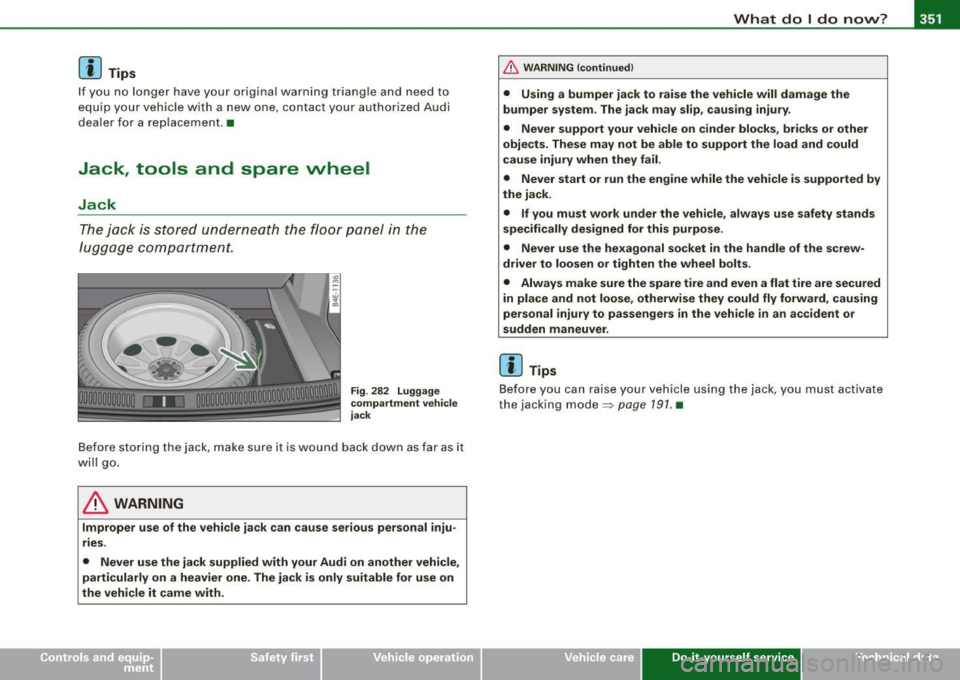
The jack is stored underneath the floor panel in the
luggage compartment.
Fig . 282 Luggage
compartment vehicle
jack
Before stori ng the jack, make sure it is wound back down as far as it
will go.
& WARNING
Improper use of the vehicle jack can cause serious personal inju
ries.
• Never use the jack supplied with your Audi on another vehicle,
particularly on a heavier one. The jack is only suitable for use on
the vehicle it came with.
& WARNING (continued)
• Using a bumper jack to raise the vehicle will damage the
bumper system. The jack may slip, causing injury.
• Never support your vehicle on cinder blocks, bricks or other
objects. These may not be able to support the load and could
cause injury when they fail.
• Never start or run the engine while the vehicle is supported by
the jack.
• If you must work under the vehicle, always use safety stands
specifically designed for this purpose .
• Never use the hexagonal socket in the handle of the screw
driver to loosen or tighten the wheel bolts.
• Always make sure the spare tire and even a flat tire are secured
in place and not loose, otherwise they could fly forward , causing
personal injury to passengers in the vehicle in an accident or
sudden maneuver .
[ i J Tips
Before you can raise your vehicle using the jack, you must activate
the jacking mode~
page 191. •
Vehicle care Do-it-yourself service irechnical data
Page 354 of 408
-What do I do novv? Pffl..._ _____________________ _
Tools
The vehicle tools are stored in the luggage compartment
lid.
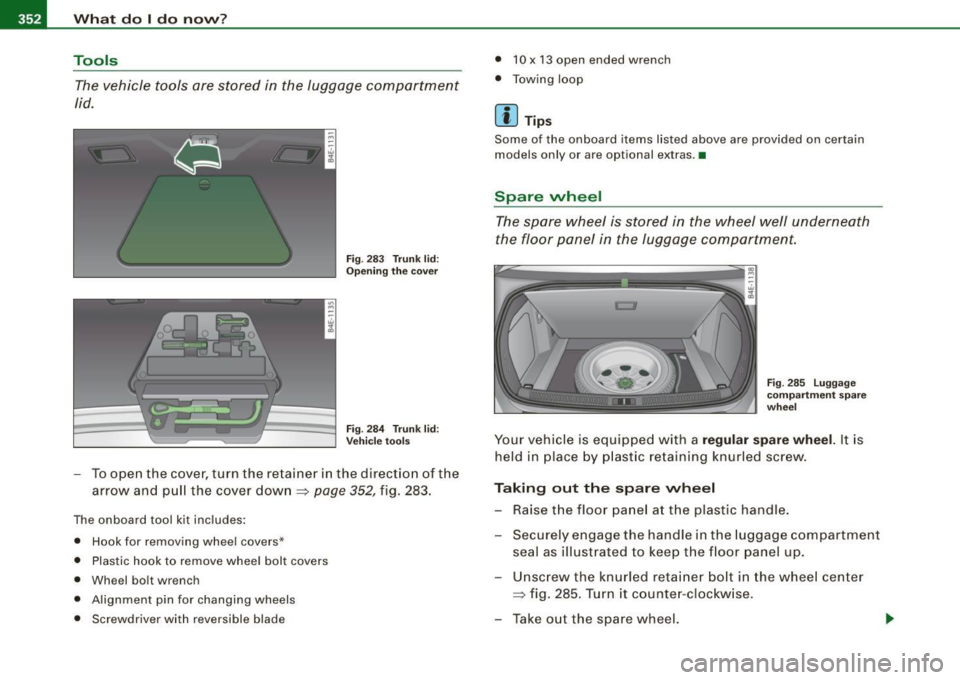
Fig. 283 Trunk lid:
Opening the cover
Fig. 284 Trunk lid:
Vehicle tools
-To open the cover, turn the retainer in the direction of the
arrow and pull the cover down
=> page 352, fig. 283.
The onboard tool kit includes:
• Hook for removing wheel covers *
• Plastic hook to remove wheel bolt covers
• Whe el bolt wr ench
• Alignment pin for changing wheels
• Screwdriver with reversible blade •
10 x 13 open ended wrench
• Towing loop
[ i] Tips
Some of the onboard items listed above are provided on certain
models only or are optional extras .•
Spare wheel
The spare wheel is stored in the wheel well underneath
the floor panel in the luggage compartment.
Fig. 285 Luggage
compartment spare
wheel
Your vehicle is equipped with a regular spare wheel. It is
held in place by plastic retaining knurled screw.
Taking out the spare vvheel
- Raise the floor panel at the plast ic handle.
- Securely engage the handle in the luggage compartment
seal as illustrated to keep the floor panel up.
- Unscrew the knurled retainer bolt in the wheel center
=> fig. 285. Turn it counter-clockwise.
- Take out the spare wheel.
Page 355 of 408

What do I do now? Ill
---------------~.;______
•
-Disengage and lower the floor panel before you close the
luggage compartment lid again.
Storing the replaced wheel
-Place the replaced wheel inside the spare wheel well in
the luggage compartment.
Tighten the knurled retaining screw clockwise to secure
the wheel in place.
- Disengage and lower the floor panel before you close the
luggage compartment lid again.
& WARNING
Loose items in the passenger compartment can cause serious
personal injury during hard braking or in an accident .
• Never store the spare wheel or jack and tools in the passenger
compartment.
• Always store all jacking equipment, tools, and the spare wheel
in the luggage compartment.
• Tighten the knurled retaining screw for the spare wheel
securely.
[ i] Tips
Check the inflation pressure of the spare tire periodically to keep the
tire ready for use. •
Changing a wheel
Before changing a wheel
Observe the following precautions for your own and your
passenger's safety when changing a wheel.
- After you experience a tire failure, pull the car well away
from moving traffic and try to reach level ground before
you stop
~ & .
- All passengers should leave the car and move to a safe
location (for instance, behind the guardrail) ~& .
- Engage the parking brake to prevent your vehicle from
rolling unintentionally ~& .
- Move selector lever to position P
~ &.
-If you are towing a trailer: unhitch the trailer from your
vehicle.
- Take the jack and the spare tire out of the luggage
compartment~
page 351.
& WARNING
You or your passengers could be injured while changing a wheel if
you do not follow these safety precautions:
• If you have a flat tire, move a safe distance off the road. Turn off
the engine, turn the emergency flashers on and use other warning
devices to alert other motorists.
• Make sure that passengers wait in a safe place away from the
vehicle and well away from the road and traffic.
• To help prevent the vehicle from moving suddenly and possibly
slipping off the jack, always fully set the parking brake and block
the wheel diagonally opposite the wheel being changed. When one ..,
Do-it -yourself service
Page 356 of 408
1111 What do I do now? ..._ __________________________________________ _
& WARNING (continued )
front wheel is lifted off the ground , placing the Automatic Trans
mission in "P" (Park) will
not prevent the vehicle from moving.
• Before you change a wheel, be sure the ground is level and firm.
If necessary , use a sturdy board under the jack.
• After installing the spare wheel, make sure that you replace the
flat tire/wheel in its storage area properly and tighten the knurled
retaining screw securely.
[ i J Tips
Before changing the wheel, you must activate the jacking mode, so
that the automatic controls for the Adaptive Air Suspension do not
make it more difficult to lift the vehicle with the jack =>
page 791. •
Changing a wheel
When you change a wheel, follow the sequence described
below step-by-step and in exactly that order.
1. Activate the vehicle jacking mode~ page 191.
2. Remove the decorative wheel cover*. For more details
see also
~ page 355, "Decorative wheel covers" or
~ page 355, "Wheels with wheel bolt caps" .
3. Loosen the
wheel bolts ~ page 356.
4. Locate the proper mounting point for the jack and align
the jack below that point~
page 356.
5. Lift the car with the jack~ page 356.
6. Remove the wheel with the flat tire and then install the
spare
~ page 358 .
7. Tighten all wheel bolts lightly. 8.
Lower the vehicle with the
jack.
9. Use the wheel bolt wrench and
firmly tighten all wheel
bolts
~ page 356.
10. Replace the decorative wheel cover*.
11. Deactivate the vehicle jacking mode~ page 191.
& WARNING
Always read and follow all WARNINGS and information :::::> 6 in
" Raising the vehicle" on
page 356 and => page 359. •
After changing a vvheel
A wheel change is not complete without the doing the
following.
- Store and secure the wheel you replaced in the spare
wheel well.
- Replace the tools and the jack in their proper location.
- Check the
tire pressure on the spare wheel immediately
after mounting it.
- As soon as possible , have the
tightening torques on all
wheel bolts checked with a torque wrench. The correct tightening torque is 90 ft lb (120 Nm) .
- Have the flat tire
replaced as soon as possible.
[ i J Tips
• If you notice that the wheel bolts are corroded and difficult to
turn while changing a tire, they should be replaced before you check
the tightening torque. .,_
Page 357 of 408
What do I do now? -
------------------
• Drive at re duced speed until you have the tightening torques
checked .a
A pplies to ve hic les: wit h deco rat ive w heel covers
Decorative wheel covers
The decorative wheel covers must be removed first to
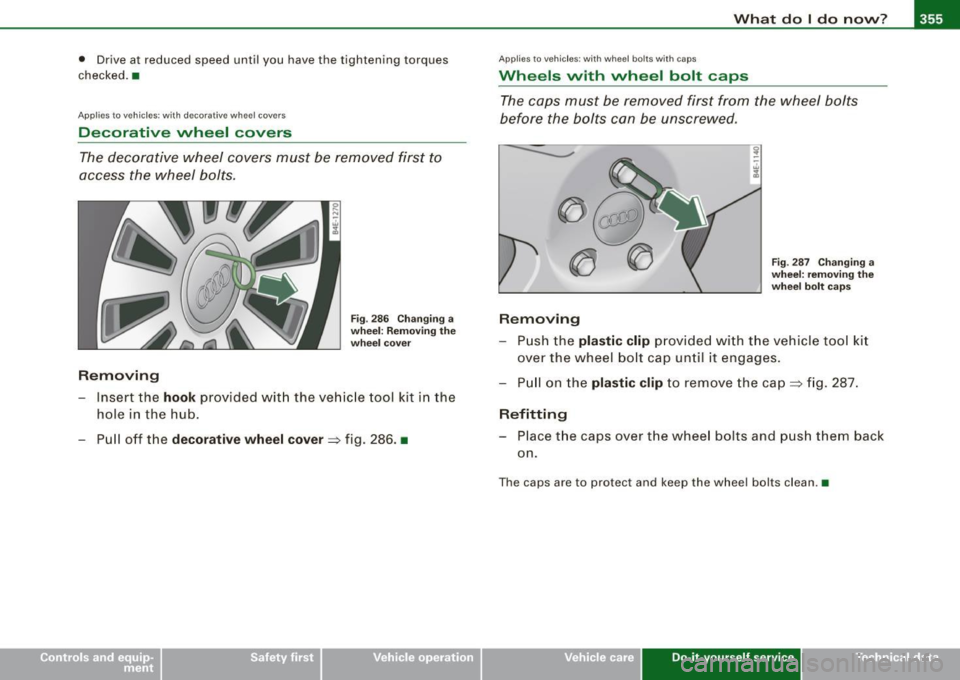
access the wheel bolts.
Removing
Fig . 286 Changing a
wheel: Removing the
wheel cover
- Insert the hook provided with the vehicle tool kit in the
hole in the hub.
Pull off the decorative wheel cover~ fig . 286. •
App lies to veh ic les: w ith whee l bo lts with caps
Wheels with wheel bolt caps
The caps must be removed first from the wheel bolts
before the bolts can be unscrewed .
Removing
Fig. 287 Changing a
wheel: removing the
wheel bolt caps
-Push the plastic clip provided with the vehicle tool kit
over the w heel bolt cap until it engages.
- Pull on the plastic clip to remove the cap ~ fig. 287.
Refitting
- Place the caps over the wheel bolts and push them back
on.
The caps are to pro tect and ke ep the wheel bolts clean. •
Vehicle care Do-it-yourself service irechnical data