fuel cap AUDI S8 2010 User Guide
[x] Cancel search | Manufacturer: AUDI, Model Year: 2010, Model line: S8, Model: AUDI S8 2010Pages: 384, PDF Size: 90.95 MB
Page 312 of 384
___ T_ i_ r _e _s_ a_n_ d_ w_ h_ e_e_ l_ s _______________________________________________ _
Occ up ant loading and distribution for vehi cle normal load for various d esignated seating capacit ies
Designated seating capacity, num- Vehicle normal load , number of Occupant distribution in a nor
mally loaded vehicle
ber of occupants occupants
4
5
Cold tire inflation pressure
2
3
2 in front
2 in front, 1 in back seat
Tire pressure affects the overall handling, performance and safety of a vehicle.
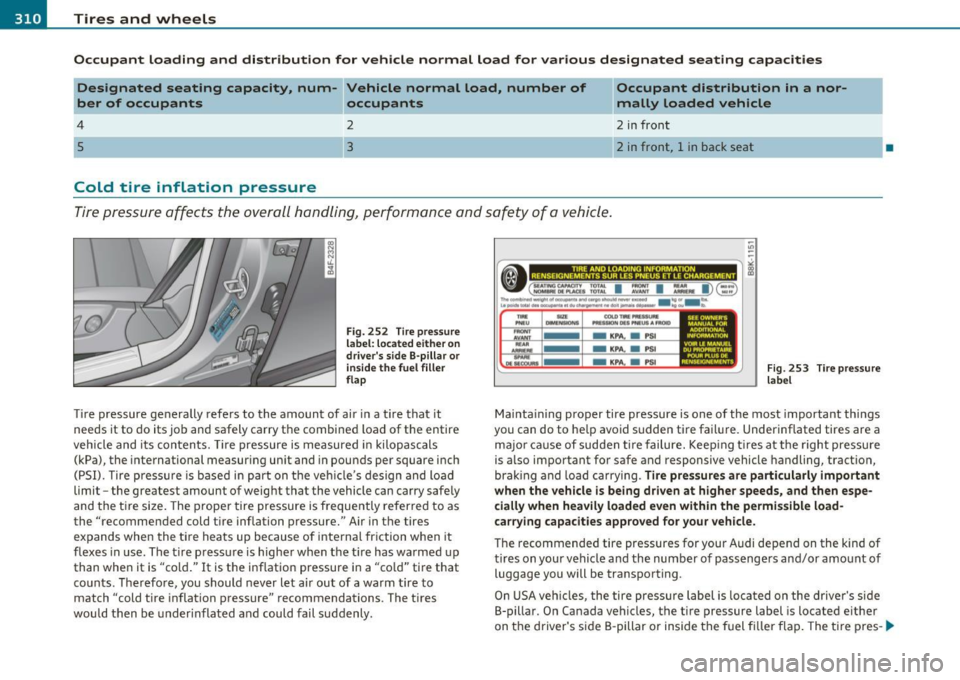
Fig. 252 Ti re pre ssure
l a bel : lo cate d eit he r o n
driver 's s ide B-pilla r or
in sid e t he fue l fill er
flap
TVIE' I IU COl.D 'nRI! MCUUM
PNIU DIMCNIIONII PMIIION Dtl "*lit A f:11101>
....
·-.. OIIICOUM
- KPA,. PSI
- KPA,. PSI
- KPA,. PSI
Fig. 2 53 Tire pre ssure
lab el
Ma inta in ing p roper tire pressure is one of the most important th ings
you can do to he lp avoid sudden tire fa ilure. Underinflated tires are a
ma jo r ca use of sudden t ire failure. Keep ing t ires a t the right pressu re
is a lso important for safe and responsive vehicle handling, tract ion,
bra king and loa d ca rry ing .
Tire pre ssures are particularly important
when the vehicle is be ing dr iven at higher speeds, and then espe
cially when he avily loaded even within the permi ssible load·
carr ying capacities approved for your veh icle.
Th e recommended tire pressures for your Audi depend on the kind of
tires on your vehicle and the number of passengers and/or amount of luggage you will be transporting.
O n USA veh icles, the tire pressure label is lo cated on the drive r's side
8-pillar. On Canada vehicles, the t ire pressure label is located either
•
T ir e pressure ge nera lly refers to the amount of air in a t ire that it
needs it to do its job and safely carry the combined load of the entire
veh icle and i ts conten ts. Tir e pressure is measured in kilopascals
(kPa), the international measur ing unit and in pounds per square inch
(PSI) . Tire press ure is based in part on the veh icle 's design and load
limit -the greatest amount of weight that the vehicle can carry safe ly
and the t ire size . The proper tire pressure is frequently referred to as
the "recommended cold t ire inflation pressure." Air in the tires
expands when the ti re hea ts up because of i nterna l fr iction when it
flexes in use. The ti re p ressu re is highe r when the t ire has wa rmed up
than when it is "cold ." It is the inflation pressure in a "co ld" tire that
co unts . Therefo re, you should never let air out of a warm tire to
match "cold tire inflation pressure" recommendations . The t ires
would then be under inflated and could fail suddenly.
on the driver's side 8-pillar o r inside the fuel f iller flap. The ti re pres- ...
Page 313 of 384

Tires and wheels Ill
----------------
sure label lists the recommended cold tire inflation pressures for the
vehicle at its maximum capacity weight and tires that were on your
vehicle at the time it was manufactured.
If you wish to improve comfort when operating the vehicle at
normal load (up to 3 occupants), you can adjust tire pressures to
those specified for normal vehicle load. Before operating the
vehicle at maximum load, you must increase the tire pressures to
those specified for maximum vehicle load~& .
Bear in mind that the tire pressure monitoring system* can only
mon itor the tire pressures you have stored . The system does not
recognize the load condition of your vehicle.
Th e effectiveness of the tire pressure monitoring system* will be
impaired if you store normal load pressures but then operate the
vehicle at its maximum load~.&, . See the
illustration
~ page 310, fig. 2 52 for the locat ion of the label
either on dr iver's side B-pillar or inside the fuel filler flap (color of the
actual label and exact location on the vehicle will vary slightly) .
Note that the following tab le is accurate at the time of going to press
and is subject to change. In the event of discrepancies , the tire pres
sure label (On USA vehicles, the tire pressure label is located on the
dr ive r's side B -pillar . On Canada veh icles, the tire pressure label is
located either on the dr iver's s ide B-pillar or inside the fue l f ill er flap)
always takes precedence.
The table below lists the recommended cold t ire inflation pressures
for the Audi model covered by your Owner's Literature at the vehicle's
capacity weight and the tire sizes insta lled on the respective models
as original equipment, or as a factory option .
Engine Tire designation Tire pressure front Tire pressure rear
(displace- normal load full load normal load
full load
ment in conditiona> condition conditiona> condition
liter)
PSI kPA PSI kPA
a -cylinder 255/45 Rla 99H All Season
33 230 36 250 30 210 35 240
4.2
255/40 Rl9 l0OV XL All Season 36 250 39 270 33 38 260
255/40 Rl9 l00Y XL High Performance 33 230 36 250 30 210 35 240
265/35 R20 99V XL High Performance 35 240 38 260 32 220 36 250
275/35 R20 102V XL High Performance 38 260 41 280 35 240 44 300
a-cylinder 255/45 Rla 99H All Season 33 230 36 30 210 35 240
4.2 L
255/40 Rl9 l00V XL All Season 36 250 39 270 33 230 38 260
255/40 R19 l00Y XL High Performance 33 230 36 250 30 35 240
275/35 R20 102V XL High Performance 38 260 41 280 35 240 44 300
Safety first Vehicle care Technical data
Page 315 of 384

Tires and wheels -________________ Effll
& WARNING
• Incorr ect tire pressures and /or underinflation can lead to a
s erious or fatal accident .
• Incor rect tire pressures and /or unde rinflation cause increased
tire wear and can aff ect the handling of the vehicle .
• Incorrect tire pressures and /or underinflation can also lead to
sudden tire failure , including a blowout and sudden deflation,
caus ing loss of vehicle cont rol. •
Checking tire pressure
The correct tire pressure for the tires orig in a lly installed
on your vehicle is listed on the tire pressure label located
either on driver 's sid e 8-pillar or inside the fuel filler flap.
The recommended tire pressures a re on the tire p ressure labe l and in
t he table => page 310, "Cold tire infla tion pressure ".This means that
the pressure must be chec ked and adjusted when the tire has not
bee n dr iven for more tha n a coup le of m iles (k ilomete rs) at low
speeds dur ing t he previous three ho urs . Air in t he tires expands when
t he tire hea ts up as a r esu lt of in te rna l fr ic tion as it flexes in use. The
tire pressure is higher when the tire has warmed up than when it is
" ld "
co .
It is the inflation pressu re in a "cold" ti re that counts. Therefore, yo u
sho uld never let air out of a warm tire to matc h "Cold tire inflation
pressure" recommendations=>
page 310. The t ires would then be
underinflated and co uld fail sudden ly.
Th e tire press ure label on your Audi lists the re comme nded cold t ire
inflation pressures at max imum capacity for t he new, origina l equip
ment tire s that were on yo ur vehi cle at t he time it was m anufactu red .
For the location of the label=>
page 310 , fig. 252.
M ost tires lose air nat urally
over time. They can also lose some air if
you d rive
over a potho le or hi t a curb while pa rking. It is usually not
Safety first
poss ible to see whether the radial t ires used today are underinflated
ju st by loo king at th em.
Th erefore, be sure to check t ire pressures a t least once a month and
always before going on a long trip. Make sure to take the n umber of
people a nd t he amount of luggage into account whe n ad justi ng tire
pressure for a tr ip -
even one that you would not consider to be
" long. " See =>
page 314, "Ti res and vehicle load limits" fo r more
important information.
Always use an acc urate t ire pressure ga uge when chec king and
adjust ing inf lation press ures. Check all of the tires and be sure not to
forget the spare tire . If the press ure in any tire is too hig h when the
t ir e is "cold," let air out of the t ire s lowly w it h the edge of the t ire
gauge and keep chec king the pressure u nti l yo u reach the pressure
t ha t is co rre ct for the load (passenge rs an d luggage) a nd kind of
dr iv ing you plan to do.
If the pressure in any ti re is too low, note t he difference betwee n th e
pressure in the co ld tire and the pressure you need and add the a ir
tha t you need to reach the correct p ressu re fo r th e ve hicle load
(passengers a nd luggage) fo r th e tires on yo ur vehicle as listed on the
on your vehicle and in this man ua l and the kind of driving you p lan to
do .
Never e xceed the max imum inflation pressure l isted on the tire
s idewall for any reason.
Remember that the vehicle manufacture r, not the t ire manufacturer,
de termines the correct tire press ure for the t ires on your vehicle.
It is i mport ant to che ck the t ire pressure when t he ti res a re cold.
• Read the required t ire pressure from the t ire pressure label. On
US A veh icles, the tire pressu re labe l is loca ted on the d river's si de B
pillar . On Canada vehicles, the tire pressure label is located either on
t he drive r's side B-pillar or inside the fuel fille r flap.
• Turn the
valve stem cap counter -clockw ise to remove it from the
tire
valve.
• Place the air press ure gauge on the valve. ..,.
Vehicle care Technical data
Page 316 of 384
-~_T_ ir_e_ s_ a_ n_ d_ w_ h_e_ e_ ls _______________________________________________ _
• The tire pr ess ure s sho uld o nly be c hecke d an d adjusted wh en the
t ire s ar e cold . Th e slightly rais ed pr ess ure s of war m tir es mu st not b e
r e d uced .
• Adjust th e tire p re ss ur e to t he load yo u a re ca rr yin g.
• Reinstall the valve stem cap on the valve.
When should I check the tire pressure?
The correct tire press ure is especia lly imp orta nt at high speeds . T he
pr essu re s hou ld t here fo re b e ch ec ked at least onc e a mo nth an d
always be fore sta rting a jo ur ney. Do not fo rget to check the tire pres
su re for th e s pare wheel~
page 33 4.
When should I adjust the tire pressures?
Adjus t the tire pr essur e to th e load yo u are carrying . A ft e r changi ng a
w heel
or replac ing w heels yo u have to adjust the ti re pressures on all
w heels. In addi tio n, yo u mu st then stor e the new tir e press ures in the
tire pressu re monitoring system*~
page 326.
& WARNING
Incorrect tire pressures and/or underinflation can lead sudden tire
failure, los s of control, collision, serious personal injury or even
death.
• When the warning symbol appears in the instrument
cluster , stop and inspect the tires.
• Incorrect tire pressure and/or underinflation can cause
increased tire wear and can affect the handling of the vehicle and
stopping ability.
• Incorrect tire pressures and/or underinflation can also lead to
sudden tire failure, including a blowout and sudden deflation,
causing loss of vehicle control.
• The dr iver is responsible for the correct tire pressures for all
tires on the vehicle. The applicable pressure values are located on
a sticker on the driver 's side 8-pillar or on the inside of the fuel
filler flap .
& WARNING (co ntinued )
• Only when all tires on the vehicle are filled to the correct pres
sure, the tire pressure monitoring* system can work correctly .
• The use of incorrect tire pressure values can lead to accidents or
other damage. Therefore it is essential that the driver observe the
specified tire pressure values for the tires and the correct pres
sures for the function of the tire pressure monitoring system*.
• Always inflate tires to the recommended and correct tire pres
sure before driving off .
• Driving with underinflated tires bend more , letting them get
too hot resulting in tread separation, sudden tire failure and loss
of control.
• Excessive speed and/overloading can cause heat build-up,
sudden tire failure and loss of control.
• If the tire pressure is too low or too high, the tires will wear
prematurely and the vehicle will not handle well.
• If the tire is not flat and you do not have to change a wheel
immediately, drive at reduced speed to the nearest service station
to check the tire pressure and add ai r as required.
0 Note
Dr iv ing witho ut valve stem caps can caus e damage to the tire valves.
T o preven t this, alw ays m ake s ure th at facto ry installe d valv e st em
caps o n all whee ls a re securely mo unted o n the valve.
Tires and vehicle load limits
T here a re lim its to the amount of load or we ight that any veh icle a nd
a ny t ire c an car ry. A veh icle th at is overloade d wi ll not ha n dle we ll an d ...
Page 317 of 384

Tires and wheels -________________ fWII
is mor e difficult to s top . Ov erloadin g can not only lead to loss of
ve hicle cont rol , but can a lso dam ag e im por tant parts of th e veh icl e
and can lead to s udden t ire failur e, incl uding a blowout and sudd en
deflation that can cause the vehicle to c ras h.
You r saf ety an d that o f your p assenger s also d ep end s on maki ng sur e
tha t load limits a re not exceeded. Vehi cle load in cludes everyb ody
a nd every thing in and on the ve hicl e. The se l oad l imi ts are tech nicall y
referred to as the ve hicle's
Gross Vehicle Weight Rating ("GVW R").
Th e "GVWR " includes the we ight of the basic vehicle, all factory
ins talled accessories, a f ull tank of fue l, o il, coola nt and o ther flu ids
plus maxim um loa d. The maxim um loa d i ncludes the number of
pass eng ers that t he v ehicle is inten ded to ca rry ("s eating capa city")
w it h an ass ume d we ight of 150 lbs (68 kg) for each passenger at a
desig nated se ating pos it io n and t he tota l weig ht o f any luggage in
the vehicle . If you tow a tra iler , the weight of t he trailer hitch and t he
t o ngue we ig ht of th e load ed t rail er m ust be i ncluded as p art o f the
vehicle load.
Th e
Gross Axle Weight Rating ("GAW R") is the ma ximu m load that
can be a pplied at each of t he veh icle's two axles.
T he Gross Vehicle Weight Rati ng and the Gross Axle Weight Rat ing
a re list ed on the sa fe ty c ompl iance sticke r label loca te d ei the r on the
driver's side B-pilla r or on the inside of the fuel fille r flap . Your Audi
h as 5 se ating posit ion s, 2 i n the fro nt and 3 in t he re ar for to tal
seating capacity of 5. Ve hicles wit h power ind iv id ual rear s eats* have
4 se ating posi tions, 2 in the front and 2 i n the rea r for tot al sea ting
capacity of 4. Each seat ing pos ition has a safety belt =>
page 197,
"Safety be lts" .
Th e fa ct that th ere is an upper li mit to your ve hicle's Gross Vehicle
We ight Rating means that the total weight o f whatever is being
c ar ried in the vehicle ( including the we igh t o f a t rail er hit ch and the
tongue weight of the loa ded tra ile r) is limited. The mo re passengers
in the vehi cle or p assen gers wh o are he avie r than t he stand ard
we ights assum ed mean t hat less weight ca n be carried as luggage.
Safety first
The tire pressure label on yo ur Aud i also lis ts the maxim um combined
we ight of all of the o ccupant s and lug gage o r oth er c argo that t he
vehicle ca n car ry . For the location o f the label=>
pag e 310, fig. 252 .
& WARNING
Overloading a vehicle can cause loss of vehicle control, a crash or
other accident, serious personal injury, and even death .
• Carrying more weight than your vehicle was designed to carry
will prevent the vehicle from handling properly and increase the risk of the loss of vehicle control.
• The brakes on a vehicle that has been overloaded may not be
able to stop the vehicle within a safe distance.
• Tires on a vehicle that has been overloaded can fail suddenly,
including a blowout and sudden deflation, causing loss of control
and a crash.
• Always make sure that the total load being transported -
including the weight of a trailer hitch and the tongue weight of a
loaded trailer -does not make the vehicle heavier than the
vehicle's Gross Vehicle Weight Rating. •
Determining correct load limit
Use the example below to calculate the
total weight of the passengers and luggage
or other things that you plan to transport so
that you can make sure that your vehicle
will not be overloaded. .,_
Vehicle care Technical data
Page 321 of 384

________________________________________________ T_i_re _ s_ a _ n_d_ w_ h_ e_ e_l_s __ _
0
-
©
®
@
-
@
U.S . DOT tire identification number
Audi Original tire
Sever snow conditions
Tire ply composition and materials used
Treadwear, traction and temperature grades Ma ximum perm issible inflation pressure
The tires and rims are essential parts of the vehicle's design . The tires
and rims approved by Audi are specially matched to the characteris
tics of the vehicle and can make a major contribution to good road
holding and safe handling when in good condition and properly
inflated =>
&.
We recommend that all work on tires and wheels be performed by an
authorized Audi dealer. They are familiar with recommended proce
dures and have the necessary special tools and spare parts as well as
the proper facilities for disposing of the old tires.
Authorized Audi dealers have the necessary information about tech
nical requirements for installing or changing tires and rims.
Replacing tires and wheels
Tires should be replaced at least in pairs and not individually (for
example both front tires or both rear tires together).
Be sure to read and heed the information to the tire pressure moni
toring system* =>
page 320.
Always buy replacement radial tires that have the same specifications
as the tires approved for your vehicle by Audi. Replacement tires must
always have the same load rating specification as the original equip
ment or approved optional tires listed in the table=>
page 310.
Audi-approved specification tires are specially matched to your
vehicle and its load limits, and can contribute to the important road-
Safety first
holding, driving characteristics, and safety of the vehicle. The table
(=>
page 310) lists specifications of the tires approved for the Audi
models covered by your Owner's Literature.
The tire pressure label located either on driver's side B-pillar or inside
the fuel filler flap (=>
page 310, fig. 253) lists the specifications of
the original equipment tires installed on your vehicle at the time it
was manufactured.
Federal law requires tire manufacturers to place standardized infor
mation on the sidewall of all tires=>
page 318, fig. 256. This infor
mation identifies and describes the fundamental characteristics, the
quality grade of the tire and also provides a tire identification number
for safety standard certification and in case of a recall.
Tire specifications
Knowledge of tire specifications makes it easier to choose the correct
tires. Radial tires have the tire specifications marked on the sidewall,
for example:
255/45 R 18 99 H
This contains the following information:
P Indicates the tire is for passenger cars (where applicable)
255 Nominal tire width in mm of the tire from sidewall edge to side-
wall edge. In general, the larger the number, the wider the tire
45 Height/width ratio in percent (aspect ratio)
R Tire construction: Radial
18 Rim diameter code (in inches)
99 Load rating code
H Speed rating letter code
XL (or "xl", "EXTRA LOAD" or "RF") indicates that the tire is a "Rein
forced" or an "Extra Load" tire
M+S (or "M/5") Indicates that the tire has some mud and snow capa
bility
The tires could also have the information of direction of rotation
=>
page 306 .
Vehicle care Technical data
Page 326 of 384
-~_T_ ir_e_ s_ a_ n_ d_ w_ h_e_ e_ ls _______________________________________________ _
& WARNING (conti nued)
personal injuries. Have worn or dam aged tires replaced immedi
ately .
• Winter tires have ma ximum speed rat ing that may be lower
than your vehicle' s maximum speed .
• Never drive faster than the speed for which the winter or other
tires installed on your vehicle are rated.
& WARNING
Always adjust your driving to the road and traffic condit ions.
Never let the good acceleration of the winter tires and all-wheel
drive tempt you into taking extra risks. Always remember:
• When braking, an all-wheel drive vehicle handles in the same
way as a front drive vehicle.
• Drive carefully and reduce your speed on icy and slippery road s,
even winter tires cannot help under black ice conditions.
<£> For the sake of the environment
Use s ummer tires when weather condit ions permit. They a re quieter,
do not we ar as qu ickly and redu ce fuel consum ptio n. •
Snow chains
Snow chains may be fitte d only to the fro nt w heels, and only to
certain tire sizes. Ask your authorized Audi dealer on which tire sizes
snow chains can be used.
If you a re goi ng to use snow c ha ins, then you must insta ll them on the
front wheels at least.
T he snow c hain s m ust have low -profile links and m ust not be thicker
than 0.53 inc h (13 .5 mm), including the lock. Remove wheel center covers a
nd trim d iscs before putting snow
c hains on you r veh icle =>
(D. For sa fe ty reaso ns cove r caps m ust the n
be fitted over the wheel bolts. These are available from a uth orized
Audi dealers.
& WARNING
Using the wrong snow chain s for your vehicle or installing them
incorrectly can increase the risk of loss of control leading to
serious personal injury.
• Snow chains are available in different sizes. Always make sure
to follow the instru ction s provided by the snow chain manufac
tur er.
• When driving with snow chains never drive fa ster than the
speed permitted for your specific snow chains .
• Always observe local regulations.
0 Note
• Remove snow chains before drivi ng on ro ads not covere d wit h
snow to avoid damag ing t ires and wear ing the snow chains down
unnecess aril y.
• Snow chains, which come into direct contact with the wheel rim,
c an scratch o r damage i t. T herefo re, make sure tha t t he s now chains
are suitably covered . Check the pos ition of the snow cha ins afte r
dr iv ing a few yar ds and correct if ne ccess ary. Fo llow the ins truct ion s
from t he snow chai n manufacturer when doing so.
• If the Ad aptive Air Suspe nsio n sho uld ma lf u nct ion, do n ot moun t
or use snow cha ins because the ve hicle wi ll be extremely low. If you
do drive w it h sn ow ch ain s on while the ve hicle i s at t his level , the
snow cha ins m ight severe ly damage the whee lhouse and other pa rts
of the vehi cle.
~
Page 329 of 384

________________________________________________ T_i_re _ s_ a _ n_d_ w_ h_ e_ e_l_s __ __
lation of replacement or alternate tires or wheels on the vehicle that
prevent the TPMS from functioning properly. Always check the TPMS
malfunction telltale after replacing one or more tires or wheels on
your vehicle to ensure that the replacement or alternate tires and
wheels allow the TPMS to continue to function properly .•
App lies to veh icles: with Tire pressure monitoring syste m
Introduction
The tire pressure monitoring system monitors air pres
sure in all four road wheels and the spare tire* while the
vehicle is moving.
As soon as the tire pressure monitoring system senses a significant
loss of air pressure in one or several tires, text messages and yellow
symbols appear in the instrument cluster display to alert the driver.
The
1warning light in the instrument cluster comes on when the tire
is significantly underinflated
=> page 17.
The warning light
L also illuminates in the case of a system malfunc
tion.
The system continuously receives radio signals from sensors located
inside each tire.
Be aware that tire pressure is also dependent on the temperature of
the tire. For every 18 °F (10 °C) increase in tire temperature, tire pres
sure increases by about 1.5 psi (0.1 bar). The tire warms up while the
vehicle is moving and tire pressure rises. So you should adjust tire
pressure only when the tires are
cold, when the temperature of the
tires is roughly the same as the ambient air temperature.
In order to keep the tire pressure monitoring system properly cali
brated, tire pressure on all four tires and on the spare tire* should be
checked at regular intervals, adjusted if necessary and saved in the
proper setting (recommended pressure)=>
page 330.
The tire pressure is shown on the tire pressure label. On USA vehicles,
the tire pressure label is located on the driver's side B-pillar. On
Canada vehicles, the tire pressure label is located either on the
Safety first
driver's side B-pillar or inside the fuel filler flap. The tire pressure
label lists the recommended cold tire inflation pressures for the
vehicle at its maximum capacity weight and the tires that were on
your vehicle at the time it was manufactured. For recommended tire
pressures for normal load conditions, please see chapter
=> page 310.
The current temperatures and pressure of your tires can be viewed in
the MMI
=> page 329.
& WARNING
• When the tire pressure monitoring system warning light is lit,
one or more of your tires is significantly under-inflated. You
should stop and check your tires as soon as possible, and inflate
them to the proper pressure as indicated on the vehicle's tire pres sure label =>
page 310. Driving on a significantly under-inflated
tire causes the tire to overheat and can lead to tire failure. Under
inflation also is likely to impair the vehicle's handling and stop
ping ability.
• Do not adjust tire pressure when tire temperature is excessive.
This could lead to serious tire damage and even cause the tire to
burst, with the additional danger of an accident.
<£> For the sake of the environment
Driving with under-inflated tires reduces fuel efficiency and tire tread
life.
(I) Tips
• Each tire, including the spare*, should be checked monthly when
cold and set to the recommended inflation pressure as specified on
the tire pressure label=>
page 310.
• The tire pressure monitoring system helps the driver to keep an
eye on tire pressures. But the driver still has the responsibility for
maintaining the correct tire pressure. .,,,
Vehicle care Technical data
Page 332 of 384
-~_T_ i_ re _ s_ a_n _ d_ w_ h _e_ e_ ls _________________________________________________ _
• The tire pressure monitoring system helps the driver to keep an
eye on tire pressures. B ut the driver still has the responsibility for
maintaining the correct tire pressure .•
A pplie s to v ehi cle s: w ith Tire pre ssure moni toring syst em
Storing tire pressures
Correct storage of specified pressure is the basic require
ment for reliable tire pressure monitoring.
In order for the tire pressure monitoring system to operate
appropriately, you have to re-save the specified pressures
whenever you adjust tire pressure, for example when the load
condition of your vehicle changes . Proceed as follows:
Corr ecting tir e pr essure
- Check the pressure in the tires (including the spare t ire*) .
- Adjust air pressure as needed in accordance with t he infor -
mation on the label located e ither on the driver's side B
pillar (visible when the door is open), inside the fuel filler
flap and additionally in the manual.
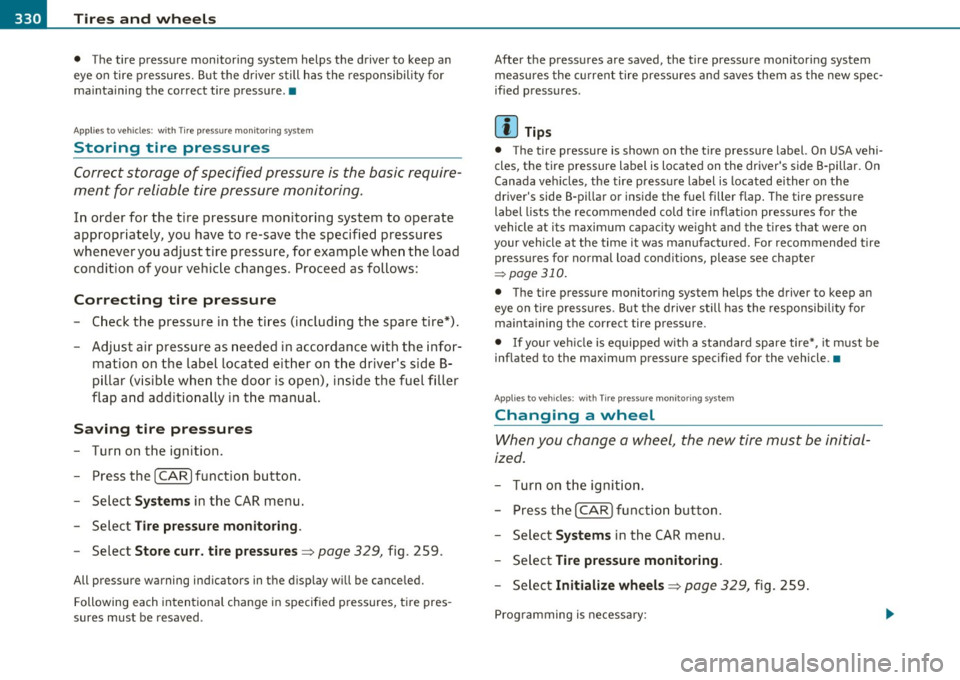
Saving tire p ressures
- Turn on the ignition.
- Press the [
CAR] function button .
- Select
Systems in the CAR menu .
- Select
Tire pressure mon itoring .
-Select Sto re curr. tire pressure s~ page 329, fig . 259 .
All pressure warning indicators in the display will be canceled.
Following each intentional change in specified pressures, tire pres
sures must be resaved . After the
pressures are saved, the tire pressure monitoring system
measures the c urrent tire pressures and saves them as the new spec
ified pressures .
(I] Tips
• The tire pressure is shown on the tire pressure label. On USA vehi
cles, the tire pressure label is located on the driver's side B-pillar. On
Canada veh icles, the tire pressure label is located either on the
driver's side B-pillar or inside the fuel filler flap . The tire pressure
label lists the recommended cold t ire inflation pressures for the
vehicle at its maximum capacity weight and the tires that were on
your vehicle at the time it was manufactured. For recommended tire
pressures for normal load conditions, please see chapter
=> page 310.
• The tire pressure monitoring system helps the driver to keep an
eye on tire p ressures. But the driver still has the responsib ility for
maintaining the correct tire pressure .
• If your veh icle is eq uipped w ith a standard spare ti re*, it must be
inflated to the maximum pressure specified for the vehicle .•
A pp lies to vehicles: with T ire pressu re monitor ing system
Changing a wheel
When you change a wheel, the new tire must be initial
ized.
Turn on the ignit ion .
- Press the
I CAR I function but ton .
- Select
Systems in the CAR menu.
- Select
Tire pre ssure mon itoring .
-Select Initialize wheels~ page 329, fig. 259 .
Programming is necessary:
Page 359 of 384

______________________________________________ G_e_ n_e _ r_ a_ l_ in_ f_o _r_ m_ a_ t_ i _o_ n __ __
The safety compliance sticker
is your assurance that yo ur new vehicle complies with all applicable
Fede ral Motor Veh icle Safe ty Standards which were i n effect at the
time the vehicle was manufact ured . Yo u can fi nd this sticker on the
left doo r jamb.
It shows the mont h and year of prod uct io n and the
vehicle identification number of your veh icle (perforation) as well as
the Gross Vehicle Weight Rating (GV WR) and the Gross Axle Weight
Rating (GAWR).
The high voltage warning label
is located o n the loc k carrier.
The spark ignition system complies with the
Canadian standard ICES-002. •
Weights
Gross Vehicle Weight Rating
The Gross Vehicle Weight Rating (GVWR), and the Gross Axle Weight
Rating (GAWR) for front and rear are listed on a sticker on the left
door jamb.
T he Gross Vehicle Weight Rating includes the weight of the basic
vehicle pl us f ull f uel tank, oil and coo la nt, plus max im um load, whi ch
includes passenger we ight (150 lbs/68 kg per des ignated seating
position) and luggage weight.
Gross Axle Weight Rating
Th e Gross Axle Weight Ra ting is the maximum lo ad that can be
applied at each axle of the vehicle~&.
Vehicle capacity weight
The vehicle capac ity weight (max . load) is listed either on the driver's
side B -pillar or inside the fuel fille r flap .
Safety first
Roof weight
The maxim um permiss ib le roof weight is 220 lb (100 kg ). T he roof
we ight is made up of the weight of the roof rac k system and t he
we ight of the object being transported~
page 94, "Loading the roof
rack".
& WARNING
• The actual Gross A xle Weight Rating at the front and rear a xles
s hould not exceed the permis sible weights , and their combination
must not exceed the Gros s Vehicl e Weight Rat ing .
• Exceeding permi ssible weight ratings can result in vehicle
damage, accidents and personal injury.
0 Note
• T he vehicle capac ity we ight figures apply when the load is distrib
uted evenly i n the vehicle (passengers and lug gage). When trans
porting a heavy load i n the luggage compartment, ca rry the load as
near to the rear axle as possible so that the ve hicle's handling is not
impa ired.
• Do not exceed the max imum permissible axle loads o r the
maximum gross veh icle weight. Always remember that the vehicle's
handling will be affecte d by the extra load. Therefore, adjust your
speed according ly .
• Always observe loca l reg ulat ions. •
Dimensions
The specifications refe r to the basic mode l. Differences may occur
depe nd ing on the mode l type a nd options ordered, for exam ple, t ire
sizes. _.,,
Do-it,yourself service Technical data