emergency towing AUDI S8 2010 Owners Manual
[x] Cancel search | Manufacturer: AUDI, Model Year: 2010, Model line: S8, Model: AUDI S8 2010Pages: 384, PDF Size: 90.95 MB
Page 5 of 384
Pedal area ... ........ ......... 192
S towing luggage .............. 193
Reporting Safety Defects ....... 195
Safety be lts ................... 197
General notes ................. 197
Why safety belts? . . . . . . . . . . . . . 198
Safety belts . . . . . . . . . . . . . . . . . . 201
Safe ty be lt pretensioners . . . . . . . 204
Airbag system ................ 206
Important th ings to know . . . . . . 206
F ront airbags ......... ........ 210
Mon ito ring the Advanced A irbag
Syst em ...................... 217
Knee airbags . . . . . . . . . . . . . . . . . . 2 22
Side airbags . . . . . . . . . . . . . . . . . . 225
Side curtain airbags . . . . . . . . . . . . 228
Child Safety ................... 231
Important things to know ...... 231
Child safety seats . . . . . . . . . . . . . 236
Ins ta lling a ch ild safety seat . . . . 24 1
LAT CH Lower anchorages and
t ethers for chi ldren . . . . . . . . . . . . 244
Add itiona l Informa tion 251
Vehicle operation ...... 252
Intelligent tec hno logy ........ 252
Notice about data recorded by
v e hicl e contro l modu les . . . . . . . . 252
Electronic Stab ili z ati on Program
(ESP) ........................ 252
Braking . . . . . . . . . . . . . . . . . . . . . . 254
Servotronic ® -advanced power
steer ing system ............ ... 257
Dr iving with your quattro® ...... 257
Energy management . . . . . . . . . . . 258
Controls and equip
ment Safety first
Driving and environment
..... 261
The first 1,000 miles (1,500 km)
and afterwards . . . . . . . . . . . . . . . 261
Catalytic converter . . . . . . . . . . . . 262
Avoid damaging the veh icle 263
Dr ivi ng th rough wat er on roads . 263
Operate your veh icle economica lly
and m inimi ze po llution . . . . . . . . 263
Trailer towing ................ 266
Dr iving wi th a traile r . . . . . . . . . . . 266
T railer tow ing tips . . . . . . . . . . . . . 268
Vehicle care .............. 270
Clea nin g and pro tect ion ...... 270
General information . . . . . . . . . . . 270
Care of exterior . . . . . . . . . . . . . . . 270
Care of interior . . . . . . . . . . . . . . . 277
Fuel supply and filling your fuel
tank .......................... 283
Gasol ine . . . . . . . . . . . . . . . . . . . . . 283
F u el tank . . . . . . . . . . . . . . . . . . . . . 284
Checking and filling . . . . . . . . . . . 288
Eng ine hood . . . . . . . . . . . . . . . . . . 288
Eng ine compartment . . . . . . . . . . 290
Engine oil ............... ..... 291
Engine cooling system . . . . . . . . . 296
Brake fluid . . . . . . . . . . . . . . . . . . . 299
Bat tery . . . . . . . . . . . . . . . . . . . . . . 300
W indshield/head light washer
containe r . . . . . . . . . . . . . . . . . . . . 305
Tires and wheels .............. 306
Ti res 306
T ir e pressure monitor ing system 326
Table of contents
Do-it-yourself service
What do I do now? .......... .
Trunk escape handle ......... .
Emergency wa rning tria ngle ... .
Jack, tools and spare wheel ... .
Changing a wheel ........... . .
Fuses and bulbs ............. .
Fuses ...................... .
Bulbs ...................... .
Emergency situations ....... .
General ..................... .
Starting by pushing or towing ..
S tarting with jumper cables ... .
Use of j umper cables ......... .
Emergency towing with
commercial tow truck ........ .
Lifting vehicle ............... .
Technical data
General information
Explanat ion of technical data .. .
Vehicle identification ......... .
We ig hts ... ....... ....... ... .
Dimensions ................. .
Data .......... ......... ...... .
350 hp, 8-cylind er engine, with all
whee l dr ive ................. .
Consumer Information ...... .
Warranty coverages .......... .
Ope rating your vehicle outs ide the
U.S.A. or Canada ............. .
Aud i Se rvice Repair Man uals and
Literature ................... . 332
332
332
332
333
335
342
342
346
348
348
348
3
4 8
349
350
353
356
356
356
356
357
357
360
360
361
361
361
361
Vehicle operation Vehicle care Do-it-yourself service Technical data
Page 66 of 384
Clear vision
(I) Tips
You should t urn on the emergency flashe rs when:
• you are the last vehicle standing in a traffic jam so that any other
vehicles coming can see you, or when
• your vehicle has broken down or yo u are in an emergency situa
tion, or when
• your vehicle is being towed by a tow truck or if you are towing
another vehicle behind you. •
Turn signal ¢¢ and high beam ~D Lever
The lever on the left side of the steering column is used to
operate the turn signals and the high beam as well as the
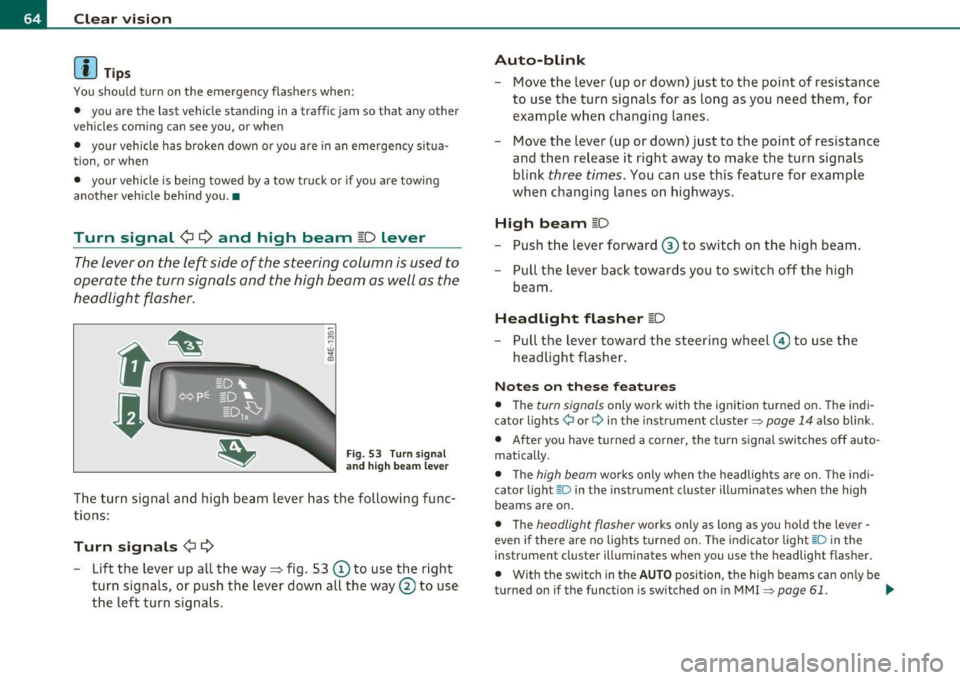
headlight flasher.
F ig. 53 Turn s ig nal
a n d hig h beam le ve r
The turn signa l and high beam lever has the following fu nc
tions:
Turn signals ¢¢
-Lift the lever up all the way~ fig. 53 © to use the right
turn signals, or push the lever down all the way
0 to use
the left turn signals.
Auto -blink
- Move the lever (up or down) just to the point o f resistance
to use the turn signa ls for as long as you need them, for
example wh en changi ng lanes.
- Move the lever (up or down) just to the point of resistance
and then release it right away to make the turn signals
blink
three times . You can use this feature for example
when changing lanes on highways.
High beam [D
- Push t he lever forward ® to switch on the high beam .
- Pull the lever back towards you to switch off the high
beam .
Headlight flasher [D
Pull the lever toward the steeri ng w heel © to use t he
headlight flasher.
Not es on these feature s
• The turn signals only work with the ignition turned on. T he indi
cator lights ¢ or¢ in the inst rument cluster~
page 14 also blink .
• After you have t urned a co rner, the tu rn s ignal switc hes off auto
matically.
• T he
high beam works only when the headligh ts ar e o n. Th e indi
cator light [D in the instrument cluster illuminates when the high
beams are on .
• The
headlight flasher works only as long as you hold the lever -
even if there are no lights turned on. The indi cato r light aD in the
instrument cluster illuminates when you use the headlight flasher.
• With the swi tc h in the
AUTO posi tion, the high beams can o nly be
turned on if the funct ion is switched on in MMI
~ page 61. ..,_
Page 337 of 384
What do I do now? -____________________ .:..::......:..:...___Wi'.'11
- Disengage and lower the floor panel before you close the
luggage compartment lid again.
Storing the replaced wheel
-Place the replaced wheel inside the spare wheel well in the
luggage compartment.
Tighten the knurled retaining screw clockwise to secure
the wheel in place.
- Disengage and lower the floor panel before you close the luggage compartment lid again.
& WARNING
Loose items in the passenger compartment can cause serious
personal injury during hard braking or in an accident.
• Never store the spare wheel or jack and tools in the passenger
compartment.
• Always store all jacking equipment, tools, and the spare wheel
in the luggage compartment.
• Tighten the knurled retaining screw for the spare wheel
securely.
[I] Tips
Check the inflation pressure of the spare tire periodically to keep the
tire ready for use .•
Safety first
Changing a wheel
Before changing a wheel
Observe the following precautions for your own and your
passenger's safety when changing a wheel.
- After you experience a tire failure, pull the car well away
from moving traffic and try to reach
level ground before
you stop ~& .
- All passengers should
leave the car and move to a safe
location (for instance, behind the guardrail)~& .
- Engage the
parking brake to prevent your vehicle from
rolling unintentionally~ &.
- Move
selector lever to position P ~ & .
- If you are towing a trailer: unhitch the trailer from your
vehicle.
- Take the
jack and the spare tire out of the luggage
compartment~
page 333 .
& WARNING
You or your passengers could be injured while changing a wheel if
you do not follow these safety precautions:
• If you have a flat tire, move a safe distance off the road. Turn
off the engine, turn the emergency flashers on and use other
warning devices to alert other motorists.
• Make sure that passengers wait in a safe place away from the
vehicle and well away from the road and traffic.
• To help prevent the vehicle from moving suddenly and possibly
slipping off the jack, always fully set the parking brake and block
the wheel diagonally opposite the wheel being changed. When
one front wheel is lifted off the ground, placing the Automatic ..,
Vehicle care Do-it-yourself service Technical data
Page 350 of 384
111.___E_ m_ e_ r-' g=- e_n_ c=-y _ s_it _ u _ a_t_ i_ o _ n_ s ______________________________________________ _
Emergency situations
General
This section is intended for trained emergency crews and personnel
who have the necessary tools and equipment to perform these
operations. •
Starting by pushing or towing
0 Note
Your vehicle is equipped with an automatic t ransmission . Conse
quently, the e ngine ca nnot be started by push ing or tow ing .•
Starting with jumper cables
I f necess ary, the engine can be started b y connectin g it to
t he bat tery of another vehicle.
If the e ng ine shou ld fa il to start because of a discharged or weak
battery, the batte ry can be connected to t he battery of
another
veh icle, us ing a pair of jumper cables to start the eng ine .
Jumper cables
Use only jumper cables of suffic iently large cross section to carry the
sta rter cur rent s afely . Refer to the m an ufa ct ur er's specificat ions.
Use only j umpe r cab les with
insulated te rmi nal clamps wh ich are
distinct ly marked :
plu s(+) cable i n most cases colored red
minus (-) cable i n most cases colored black .
& WARNING
Batterie s contain el ectricity, acid, and gas . Any of the se can cause
very serious or fatal injury. Follow the inst ructions below for safe
handling of your vehicle 's battery.
• Always shield your eyes and avoid leaning over the battery
whenev er po ssible .
• A discharged battery can freeze at temperatures just below
32 °F (0 °C ). Before connecting a jumper cable, you must thaw the
frozen battery completely, otherwise it could explode.
• Do not allow battery acid to contact eyes or sk in . Flush any
contacted area with water immedi ately .
• Improper use of a booste r battery to start a vehicle may cause
an explosion .
• Vehicle batteries generate e xplosive gases. Keep sparks, flame
and lighted cigarettes away from batterie s.
• Do not try to jump start any vehicle with a low acid level in the
battery.
• The voltage of the booster battery must also have a 12-Volt
rating. The capacity (Ah) of the booster battery should not be
lower than that of the discharged battery . Use of batteries of
different voltage or substantially different "Ah " rating may cau se
an e xplosion and personal injury.
• Never charge a frozen battery . Gas trapped in the ice may cause
an explosion.
• Never charge or use a battery that has been frozen. The battery
c ase may have be weakened .
• Use of batteries of different voltage or substantially different
capacity (Ah) rating may cause an explosion and injury . The
capacity (Ah) of the booster battery should not be lower than that
of the discharged battery. .,_
Page 352 of 384
llffl.___E_ m_ e_r-= g=- e_ n_c-= y'-- s_ i_t _u _a_ t_ i_ o _ n_ s ____________________________________________ _
4. C onn ect the ot her end to the negative ground post of the
battery manager control unit located nex t to the battery .
Starting the engine
-Start the engine o f th e vehicle with the booster battery .
Ru n the engine at a mode rate speed.
- Start engine with discharged vehic le battery in the usua l
manner.
- If the e ngine fai ls to star t: do no t keep the s tarter
crank ing for longer than 10 seconds . Wait for about 30
seconds a nd then try aga in.
- With eng ine runni ng, remove jumper cables from bot h
veh icles in t he exact
reverse order.
T he b att ery is ven ted to the outside to p reve nt gases from en ter ing
the vehicle interior. Make sure that the jumper clamps are well connected wi th their
metal parts in full contact with the battery
terminals.
& WARNING
To avoid serious personal injury and damage to the vehicle, heed
all warnings and in stru ction s of the jumper cable manufa cturer . If
in doubt , call for road service.
• Jumper cable s mu st be long enough so that the vehicle s do not
touch.
• Wh en connecting jumper cables, make sure that they cannot
get caught in any moving part s in the engine compa rtment.
• Before you check anything in the engine compartment, always
read and heed all WARNINGS~
page 281, "Engine compart
ment ".
0 Note
Improper hook-up of jumpe r cables can ruin the generator.
• Always connect POS ITIVE(+) to POS ITIVE(+), and NEGA TIVE(-)
to NEGATIVE (-) ground post of the battery manager co ntrol unit .
• Check t hat all s crew p lugs on t he b attery cells are screwed in
firm ly . If not, tighten plugs pr ior to co nnecting clamp on negative
battery terminal.
• Please note that the procedure for connecting a jumper cable as
descr ibed above appli es specifically to the case o f yo ur vehi cle be in g
jump started. W hen you are giving a jump sta rt to another vehicle, do
not connect the negative (-) cab le to t he negative ( -) termina l on the
discharged battery©~
page 349, fig. 282 . Instead, securely
connect the negative(-) cable to either a solid metal component that
is firmly bolted to t he eng ine b lock o r to the eng ine b lock itself. If the
battery that is being charged does not vent to the outside, escap ing
b attery gas could ignite and exp lode! •
Emergency towing with
commercial tow truck
General hints
Your Audi requires special handling for towing.
Th e fo llow ing in forma tion is to be used by commerci al tow tru ck
operators who know how to operate their equ ipment safely .
• Never to w your Aud i, towing will cause damage to the eng ine
and tran smi ssion .
• Neve r wrap the safety chains or winch cable s around the b rake
lines.
• To prevent unnece ssary damage, your Audi must be transported
with a flat bed truck . _.,
Page 354 of 384
-Emergency situations PW.__-=----='----------------
-Screw the towing loop tightly into the threaded hole as far
as it will go. The check mark must be flush with the bumper=>
page 351, fig. 285.
When it is no longer needed, unscrew the towing loop and put it back
into the vehicle toolkit. Be sure to have the towing loop stored in the
vehicle at all times.
When installing the grill for the air duct , be sure that the tabs on the
grill are first inserted into their guides on the veh icle by the fog lamp.
Then push the grill into position .
& WARNING
If you do not screw the towing loop completely, it could come out
of the threaded hole while the vehicle is being towed causing
damage to the vehicle and possible serious personal injury. •
Rear towing loop
Do not install the rear towing loop until it is needed.
0
Fig. 286 Rear
bumper: cover
"'
Fig. 287 Rear
bumper: towing loop
inserted
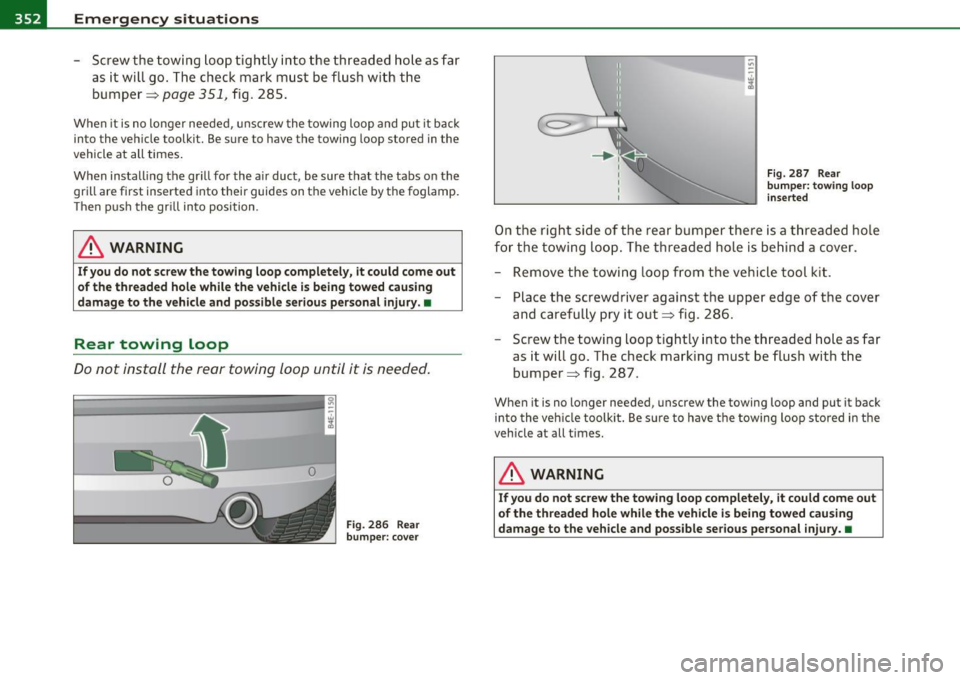
On the right side of the rear bumper there is a threaded hole
for the towing loop. The threaded hole is behind a cover.
- Remove the towing loop from the vehicle tool kit.
- Place the screwdriver against the upper edge of the cover
and carefully pry it out => fig . 286 .
- Screw the towing loop tightly into the threaded hole as far
as it will go. The check marking must be flush with the
bumper => fig. 287.
When it is no longer needed, unscrew the towing loop and pu t it back
into the vehicle toolkit. Be sure to have the towing loop stored in the
vehicle at all times.
& WARNING
If you do not screw the towing loop completely, it could come out
of the threaded hole while the vehicle is being towed causing
damage to the vehicle and possible serious personal injury.•
Page 372 of 384

__ _::_A:!: l~ p::_ h :....:..:: a:.:b::: e::..::. t:.:ic ::a::.: l:....:..: i n~ d:.:e ~ x::.._ ___________________________________________ _
Outside temperature display .... .... 23 Electronic speed limiter .. ...... .... ... 26 Malf u nction symbo l ....... ... . ... . 29
Sound system d isplay .............. 23
Electronic stabili zation prog ram ( ES P) Radiator fan
.................... 299
Dr iver Information System How the system works ...... .... .. 252 T
emperatu re gauge .......... ..... 10
Digita l speedometer .... ... ... .. ... 23 Wa rning/indicator l ights .. . .. .... .. 16 Engine data .. .. .. ...... ... .. .. .. .. 360
Dr ive r's seat .. .. .. .. .. .. .. ... ....... 77 Eme rgency braking . ............... . 12 5 Engine hood
Dr iver 's sea t memory ................. 84 Emergency closing Clos
ing ......................... 289
Act ivat ing remote control key ....... 85 Power su nroof ................. 58, 59 How to release the
hood ........ .. 288
Recalling a seat position ............ 84
Emergency flasher .. ..... ..... .. ... .. 63 Engine oil
.......... .......... ..... 291
Storing a seat position ... .. .. .. .... 84
Warning/indicator l ights .. . .. .... .. 17 Add
ing .... .... .... .. . .. .. .. .. .. 29 4
Dr iv ing messages .................... 27
Eme rgency locking ................. .. 46 Add
itives .... ....... ...... .... .. 294
Dr iv ing safely ... .. .. ............. .. 186
Driving through water . .......... ... . 263
Dr iv ing time . ... .. .. .. .. .. ..... ..... 36
Duplicate key ....................... 39
DVD playe r for navigat ion system ...... 102 Emergency
locking of doors ... .. ...... 46
Emergency st arting .... ..... ... .. .. . 3 48
Emergency towing .................. 350
E me rgency warning triang le ... .. .. .. . 332
E nergy managemen t .. ............. . 258 Cha
nging .... ....... .... .. .. .. .. 295
C hecking the engine oil leve l ... .. .. 293
I n dicat io ns and condi tions requiring ex tra
check ing . .. .. .. .. ............. 293
Oi l co nsumpt ion .. .. ... ... ..... .. 293
Oil grades ...................... 291
E
Battery power ................... 259
Dr ive r no tifica tion . .... ..... ... .. . 259 Oi
l level symbo l ................... 33
Pressu re malfunction .............. 30
Eas y entry feature
118 Engine
4.2 l, 8-cylinder (350 hp) ........ .. 290 Recommended oil check
inte rv a ls . .. 293
Sen sor defective .. .. .. .. .......... 33
Electrome chanical pa rking bra ke
Emergency br aki ng .. .. .. .. .... .. . 12 5
Ma lf u nct ion . .... .... ..... ... . .. . 12 5
Operation ... .. .. .. ... ... .... ... 1 23
Parking ... .. ..... ....... ... . ... 1 24
Releasing and app ly ing . .. .... ..... 123
Sta rting off w ith a trailer .. .. .. .... 125
Warning/ind icator lights . .......... 20
Electroni c dif feren tial loc k (EDL) 6
.0 l , 12-cylinde r (450 hp) ... ... .. . 291
Compa rtme nt .. .. .. .. .. .... . 2 9 0, 29 1
Coolan t ........................ 296
Hood .. ................. .. .. .. . 288
St art ing .. . .. .... .. .. .... .. . 1 18 , 119
Sta rting with jumpeir cab les ... .. .. . 3 48
Stopp ing . .. .. ... .. .. .... .. .. .. . 120
E ngine comp artment ................ 290
Safety ins truct ions .... .. .. .. .. ... 289 Spe
cifica tion and vis cosi ty .. ... .. .. 2 91
Engine speed lim itation ....... ... ... .. 33
Environment Break-in pe riod . ...... ......... .. 261
Catalytic converter .. .... ......... 262
Disposing of your veh icle battery .. .. 304
Dr iv ing at hig h speeds ............ 264
Dr iv ing to mi nimize pollution and noise ..
263
How the system wor ks ... ..... .... 253
Wa rning/indicator lights ... .. ... ... 19
Electron ic immobili ze r ... .. .... .. .. 12, 41 Wor
king the e ng ine compar tment .. 289
Engine coolant ... ... ... ...... .... .. 296
Add ing coolant .................. 298 Fuel
.... ...... ........... .... .. 285
Fuel economy .. .... ....... .... .. 263
Leaks under your vehicle . ......... 289
Electronic power contro l
Checking the engine coo la nt level ... 297
Letting the vehicle stand and warm up
(EPC) warning/ indicator light ........ 16
Expa nsio n tank .................. 297 264
Page 375 of 384

Alphabetical index -________________ fWI
MMI settings ... .. .. .. .. .... ..... 143
Notes on instrument cluster d isplay . 142
LATCH .............. ..... .... .. .. . 244
Description ...................... 245
Guidance fixtures for lower anchorages ..
246
Installing a child restraint ......... 248
Location ................ .... ... . 245
Mounting and releasing the anchorage
hook .. ... . ... .. .. .. .. .... .... . 248
Leather .............. ...... .. .... . 278
Cleaning ............... .. .... .. . 279
Level adjustment
See Adaptive A ir Suspens ion ....... . 176
Lifting jack ... .. ...... ... .. .. .. .. .. . 338
Lifting points ... ................ ... . 353
Lifting vehicle ................. .... . 353
Light sensor defective ................. 34
Lights .............................. 60
Coming home ........... .... .. .. .. 61
Daytime running lights ........ ... .. 61
Emergency flashers .......... .. .. .. 63
Exterior lights .................... 61
Front fog lights .. .. .. .. .... ....... 62
Headlights .. ...... ... ... ... .. .. .. 60
High beam . . . . . . . . . . . . . . . . . . . 60, 64
High beam warning/indicator light ... 17
Leaving home ....... .... .. .. .... .. 61
Rear fog lights ......... ........... 62
Side marke r lights ....... .... .. .. .. 60
Turn signals .................... .. 64
Xenon headlights ................ .. 60
Load ing the luggage compartment . ... . 193
Controls and equip
ment Safety first
Loading the roof rack
... .. ... ... ..... . 94
Locking Power locking switch ............... 45
Rear lid/trunk lid ... ............... 46
Remote control ....... .. .. ........ 43
Using the key ............ .. .. .. .. .
44
Lower universal anchorage bars (Canada) .. .
244
Lower universal anchorages (Canada) .. . 244
Luggage Stowing ... .. .... ............. .. 193
Luggage compartment Cargo net .. .. .. .... .. ... ..... .... 90
DVD player for navigation system ... 102
Side Compartment ... ....... ... .. 102
Side compartment ... .. ... ... ..... 102
Sk i sack .... ............... .... .. . 91
Tie-down eyelets .... .. .. .......... 90
See also Loading the luggage
compartment .................. 193
Lumbar support .................... . 80
M
Maintenance . .... ... .. .... ......... 361
Malfunction Ind icator Lamp (MIL) . . . 18, 25
Massage function ........... .. .. .. .. . 79
Master key ....... .......... .. .. .... . 40
Mileage Average ... ... .... ...... .. ... ... . 36
Instantaneous ................ ... . 36
Mirror Vanity mirror .. .... .. .. .. .. .. .... . 68 Mirrors
Automatic anti -glare adjustment . .... 74
Automatic dimming for the outside mirrors ... .. ................... 74
Interior mirror .................... 74
Outside mirrors .... ............... 74
Recalling position of outside mirrors .. 84
Storing position of outside mirrors ... 84
Monitoring the Advanced Airbag System 217
N
Natural leather ..... .. .............. 278
New tires and wheels .. .. .. ... ....... 318
NHTSA Contacting ........ ............. . 195
Number of seats ............ ..... ... 197
0
Occupant seating positions ......... .. 188
Octane rating .................... .. 283
Odometer ...................... .. .. 12
Oil
See Engine oil ............ .. .. .. . 291
On-Board Diagnostic System (OBD) Data Link Connector (DLC) .......... 26
Electronic speed limiter . ... ....... . 26
Malfunction Indicator Lamp (MIL) . ... 25
Open door or rear lid warning .. .. .. .. .. 24
Opening Power sunroof .................... 57
Vehicle operation Vehicle care Do-it-yourself service Technical data