roof AUDI S8 2010 User Guide
[x] Cancel search | Manufacturer: AUDI, Model Year: 2010, Model line: S8, Model: AUDI S8 2010Pages: 384, PDF Size: 90.95 MB
Page 94 of 384
Seats and storage
Load the ski sack from the luggage compartment .
Loading
-Open the luggage compartment lid and clear a space in
the center .
- Press the release button for the sk i sack hatch in the
luggage compartment and pull down the hatch
~ page 91, fig . 96.
- Fo ld out center armrest in the rear seat backrest .
- Press th e re le ase button on the lid from inside the v ehicle,
and then lower the lid .
- Pull out and unfold the ski sack.
- Load s kis or simi lar objects through t he luggage compart-
ment into the interior of the vehicle~& .
Securing
- Insert the ski sack strap © ~ page 91, fig. 97 in the
center buck le
@ .
- Pull t he sa fety belt taut on the free end of the belt@.
Securing in vehicles with power individual
rear seats*
- Loop the sk i sac k safety belt around the center armrest.
- Pu ll the safety bel t ta ut on the free end of the be lt.
Stowing
- In t he luggage compartme nt, close the ski sack hatch.
- F old the ski sack carefully and stow away.
- Close and engage the inne r hatch .
& WARNING
• The ski s ack is intended only for the transportation of skis and
other light object s. To redu ce the ri sk of serious per sonal injury ,
never transport heavy or pointed objects in the ski sack.
• When braking rapidly or during an accident, the load could be
d isplaced and cause injury to occupants .
• Sharp edg es on the load must be covered for prot ection .
Alw ays f aste n the belt t ightly a round the s ack and its contents
=> page 91 , fig . 97.
[ i ] Tips
N ever stow the ski sack aw ay when it is still we t or damp ( for ex ample ,
snow melt ing from skis). Allow it to dry completely before stow ing it
away .•
Roof rack
First things first
A roof rack can be fitted to carry additional luggage on
the roof.
- A lways read a nd follow the instruct ions provided by the
roof rack manufacturer when the roof rack system must
be ins ta lled.
If a roof rack or simila r luggage carrying equipment is to be installed,
please note the following :
• T o enh ance the vehi cle's st ream lined des ign, rain gu tters have
been molded into the roof. It is not possible to use normal roof racks.
On ly insta ll a roo f rack specifica lly designed fo r your model A 8.
Contact the nearest Audi dea ler for information on approved modular
roof rac ks for your vehicle. .,
Page 95 of 384

• These approved roof racks are the basis for a complete roof rack
system . Additional attachments for the basic roof rack are necessary
to safely transport luggage, bicycles, surf boards, skis or small boats .
All necessary hardware for these systems is ava ilable at your autho
rized Audi dealer .
• We recommend tha t you keep the installation instructions for
your roof rack system together with your Owner's literature in the
vehicle.
When should the roof rack be removed?
• Before going through an automat ic car wash (it is best to ask the
car wash operator fo r advice)
• When not in use, to reduce fuel consumpt ion, wind nois e and to
guard against theft.
& WARNING
• Use of an unapproved roof rack or incorrect mounting of an
approved roof rack can cause the roof rack or the items attached
to it to fall off the roof onto the road.
• Objects falling from the roof of a vehicle can cause a crash and
personal injury.
• Only mount the system between the markings shown in
=> fig. 98.
• The roof rack system must be installed exactly according to the
instructions provided.
0 Note
• Your vehicle warranty does not cover any damages to the vehicle
caused by using roof racks or mounting structures not approved by
Audi for your vehicle . The same applies to damage resulting from
incorrect roof rack installat ion .
• Always check the roof rack mountings and hardware before each
trip and dur ing a trip to make sure everything is sec urely tightened . If
Con tro ls a nd e quip
m en t Vehicle
OP-eration
Seats and storage
necessary, ret ighten the mountings and check the entire system from
time to time.
• After mounting a roof rack system, or when you transport objects
on the roof of your veh icle, the height of the vehicle is naturally
increased. Be careful when driving under low bridges or in parking
garages for example. This could cause damage to the load and even
the vehicle itself . •
Mounting Locations
Safe installation of a roof rack requires that the rack
supports are mounted between the small arrows marked
inside the door frames on all four doors.
Mounting
Fig. 98 Front and rear
markin gs
The roof rack system must be installed exactly according to the
instructions provided.
Mount th e roof racks supports in the side roof mo ldings . Make sure
to position the suppo rts on all four doors between the points marked
by small arrows=> fig. 98 . The markings can only be seen when the
doors are open. •
Vehicle care Do-it-yourselt service iTechnical data
Page 96 of 384
Seats and storage Loading the roof rack
Always dis tribute loads evenly . Make sure anything on
the roof rack is securely tied do wn.
- Always distribute the loads on the roof rack evenly .
- Always attach items to t he roof rac k securely before you
drive
off .
The maximum permissible roof weight is 220 lb (100 kg ). The roof
we igh t is made up of the weight of the roof rack system and the
we ight of the object be ing transported.
When using a roof rack system which has a lower load ca rrying
capac ity, you must not use up the total maxim um permissible load
carrying capacity specified above . Instead, you shou ld load the roof
ra ck system only to the maximum capacity specified by the manufac
turer of the roof rack system.
& WARNING
Weak, damaged or improper straps used to secure items to the
roof rack can fail during hard braking or in a collision and cause
seriou s personal injury.
• Make sure the roof rack is installed ex actly as specified above
~ page 93 .
• Always use suitable mounting straps for se curing items to the
roof rack to help prevent items from shifting or flying forward.
• Items on the roof rack must always be se curely mounted.
• The use of a roof rack can negatively affect the way a vehicle
handles . Ca rgo that is large , heavy, bulky , long o r flat will ha ve a
greater negative influence on the vehicle' s aerodyn amics, center
of gra vity and ove rall handling. Alw ays drive slowly, a void sudden
braking and maneuvers when tran sporting cargo on th e roof of
your veh icle.
& WARNING (contin u ed )
• Never e xceed the maximum permi ssible load carrying capacity
of the roof of your vehicle, the permi ssible a xle weights and the
permissible total weight of your vehicle~
page 3 5 7, "Weights".
• Alway s drive slowly, avoid sudd en braking and maneuv ers
when transporting cargo on the roof of your vehicle.
'£> For the sake of the environment
Sometimes it may be easier to leave a roof rack installed even tho ugh
you a re not using it. Due to the inc reased air resistance your veh icle
w ill unnecessarily use more fuel. Remove the roof rack if you are not
going to use i t. •
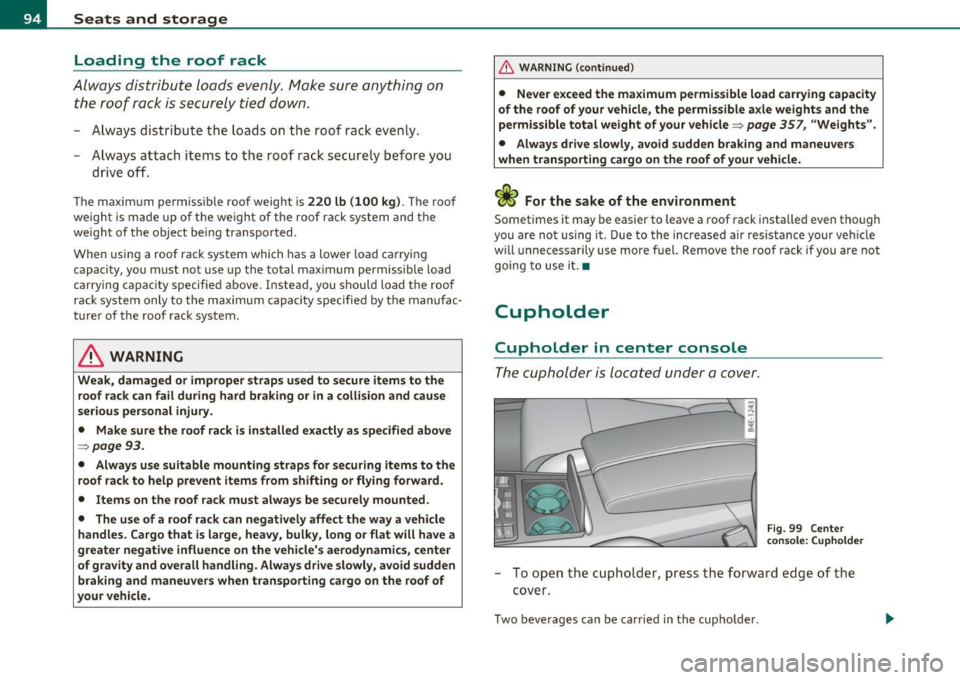
Cupholder
Cupholder in center console
The cupholder is located under a cover.
Fi g. 99 Cente r
c on sole: ( uph old er
- To o pen the cu pholder, p ress the forward edge o f the
cover.
Two beverages can be carried in the cupholde r.
Page 106 of 384
1111....__w __ a _r_ m __ a_n_ d_ c_ o _ l_d _______________________________________________ _
energy are temporarily cut bac k or sw itched off~ page 258. Hea ting
s ys te m s in p artic ula r re quir e a gre at d eal o f energy. If yo u not ic e, f or
example, t hat the s eat *, w indshield* or r ear w indow heat ing is not
heating, they have been temporar ily c ut back or sw itche d off by
energy management. These systems ar e available again as soon as
the e ner gy ba la nce has been restore d.
& WARNING
Reduced visibility is dangerous and can cause accidents.
• For safe driving it is very important that all windows be free of
ice, snow and condensation.
• Completely familiarize yourself with the proper use and func
tion of the heating and ventilation system and especially how to
defog and defrost the windows.
• Never use the windshield wiper/washer system in freezing
weather until you have warmed the windshield first, using the
heating and ventilation sy stem. The washer solution may freeze
on the windshield and reduce visibility.
0 Note
• If yo u su spect that the air cond itio ner has bee n damaged, turn on
ECON and co nta ct an aut horized Audi d eale r t o h ave t he sy st em
inspected.
• Rep airs to th e Audi air con dition er re qu ire speci al te chnical k now l
edge and special tools. Co ntact a n au thor ized A udi dealer for assis
t an ce.
[ i ] Tips
• Keep the a ir in take slots (in fron t of the w ind shield) free from ice,
snow and debris i n order to ma inta in the pro per function of the
climate contro l system. •
Air escapes t hrough vents under t he rear w indow. Whe n placing
i t e m s of cl othi ng on t he lug ga ge c ompartm ent c ove r, ensure th at t he
open ings are not cove red .
• Clima te cont rol w orks mos t effe ctively i f th e wind ow s a nd t he
power roof are closed . H owever, if the inter io r of a par ked ve hicle is
ex trem ely ho t from th e sun' s ra ys, briefly o pening t he windows c an
speed up t he cooling process .•
Page 114 of 384
-Warm and cold .,.,..__ ______________ _
(I) Tips
If the climate control system is operating in cooling mode , air flows
p rima rily from th e outlets in the center console and in the door
pillars . T o ach ieve adequa te cooling, you should never close the
ou tle ts completely. •
Using climate controls economically
Using the climate controls prudently can help save fuel.
When you use the a ir conditioner, e ngine power is reduced
and fuel consumption increa ses. To save fu el, you should use
the air co nditioner o nly when necessary. Also please note the
following points :
If you want to save fuel , activate ECON .
If you are going to drive with the wi ndows open, use ECO N.
~ For the sake of the environment
By reducing t he amount of fuel you use, you also reduce the amou nt
of pollutants emitted into the air .•
A ppli es to vehicl es : w ith sola r sliding /til tin g sunroof
Solar blower fan /solar roof
With sufficient sunlight, the blower fan continues to
operate with solar energy to bring in fresh air after the
ignition has been switched off
The fan motor is operated by solar energy throug h the solar roof after
t he ignition is tur ned off . P lease make certai n that vents @ and ©
are ope n to ach ieve op timal ventilation =:,
page 111, fig. 124.
The venti lation operates on ly with the sunroof closed or in the ti lted
position. If the veh
icle was switched off in the rec irculat ion mode, the air
condi tioning au tomatically sw itches to fresh a ir operation .
Solar operation is not activated at low outside temperatures .•
Windshield defogging/defrosting
A pp lie s t o v eh icles: w it h win dshie ld defo gger/ defrost er
Windshield defogger/defroster ®
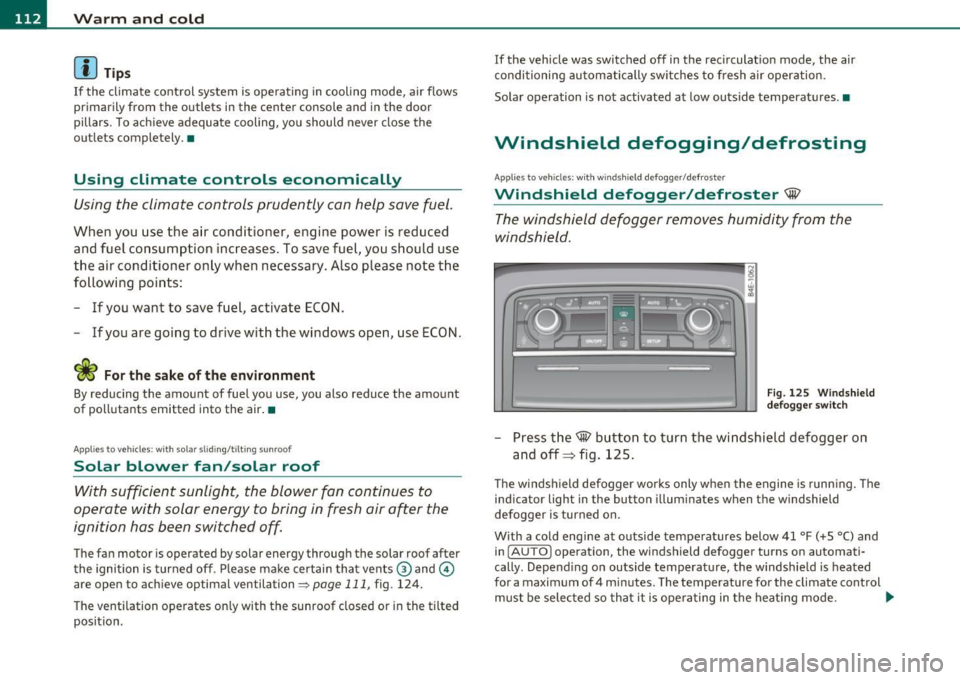
The windshield defogger removes humidity from the
windshield .
Fig. 12 5 Wi ndshie ld
def ogger switch
- Press the~ button to turn the wi ndsh ield defogger on
and off=> fig. 125.
T he windsh ield defogger works only when the engine is runn ing . T he
ind icator light in the button illum inates when the windshield
defogger is turned on.
With a cold engine at outside temperatures below 41 °F (+5 °C) and i n
( AU TO] operation, the windshield defogger turns on automati
cally . Depend ing o n outside temperat ure, the w indshie ld is heated
for a maximum of 4 m inutes. The temperature for the climate control
must be selected so tha t it is ope ra ting in the heat ing mode . .,_
Page 118 of 384

lffll.___w __ a _r_ m __ a_n_ d_ c_ o _ l_d _______________________________________________ _
as the concentration of pollutants in the outside air drops, fresh air is
supplied to the vehicle interior again.
In the event that the windows fog up during automatic air recircula
tion, you must press th e@ button immediately.
Under certain operating conditions, automatic air recirculation is
switched off automatically. With outside temperatures below about
-8 °C and in the ECON mode, automatic air recirculation is limited to
15 seconds. •
Synchronization
One climate control setting for all seats.
With synchronization active, the driver's or the passenger's settings
are adopted for the other seats. All the other settings that were made
are transferred to the other seats. This includes all the climate
control settings right down to the heated seats.
If a different setting is selected at a "synchronized seat", synchroni
zation is cancelled. •
Center air vent
The temperature of the air leaving the center vents can be
changed to differ from the temperature setting.
Fig. 129 MMI display:
Center air vent
The air flow coming from the center vents can be adjusted to be
colder or warmer than the selected set temperature.
In this way you have the opportunity to have the air flow from the
center vents a little warmer or cooler, depending on the time of year.
A little cooler in the summer and a little warmer in the winter. •
Applies to veh icles: w ith rear air conditioning
Rear seat operation
The rear climate controls can be operated from the
driver's area.
With active rear seat operation, the driver or the passenger can
operate the rear climate control system from
his/her controls. •
Applies to veh icles: with solar roof
Solar operation
Depending on the solar irradiation in the vehicle, the fan
will run using solar power to keep fresh air circulating
inside the vehicle, even a~er you switch off the ignition.
-Switch the solar operation to on.
After you switch off the ignition, the fan is operated using so lar
power from the solar roof. Make sure outlets ® and © are open for
maximum ventilation=::;,
page 111, fig. 124.
The ventilation works only if the sunroof is closed or tilted up.
If you turn off the engine while the air recircu lation is on, the air
conditioning automatically switches to fresh air mode.
Solar operation is not activated at low outside temperatures. •
Page 196 of 384
111....__D_ r_iv _i_ n_, g=-- S_ a _ f_e _,Ly _ ______________________________________________ _
in. WARNING
Improperly stored luggage or other items can fly through the
vehicle causing serious personal injury in the event of hard braking
or an accident. To help reduce the risk of serious personal injury:
• Always put objects, for example, luggage or other heavy items
in the luggage compartment.
• Always secure objects in the luggage compartment using the
tie-down hooks and suitable straps.
& WARNING
Heavy loads will influence the way your vehicle handles. To help
reduce the risk of a loss of control leading to serious personal
injury:
• Always keep in mind when transporting heavy objects, that a
change in the center of gravity can also cause changes in vehicle
handling:
-Always distribute the load as evenly as possible.
- Place heavy objects as far forward in the luggage compart-
ment as possible.
• Never exceed the Gross Axle Weight Rating or the Gross Vehicle
Weight Rating specified on the safety compliance sticker on the
left door jamb. Exceeding permissible weight standards can cause
the vehicle to slide and handle differently.
• Please observe information on safe driving
=> page 186.
in. WARNING
To help prevent poisonous exhaust gas from being drawn into the
vehicle, always keep the rear lid closed while driving.
• Never transport objects larger than those fitting completely
into the luggage area because the rear lid cannot be fully closed.
& WARNING (continued)
• If you absolutely must drive with the rear lid open, observe the
following notes to reduce the risk of poisoning:
-Close all windows,
- Close the power roof,
- Open all air outlets in the instrument panel,
- Switch off the air recirculation,
- Set the fresh air fan to the highest speed.
in. WARNING
Always make sure that the doors, all windows, the power roof and
the rear lid are securely closed and locked to reduce the risk of
injury when the vehicle is not being used.
• After closing the rear lid, always make sure that it is properly
closed and locked.
• Never leave your vehicle unattended especially with the rear lid
left open. A child could crawl into the vehicle through the luggage
compartment and close the rear lid becoming trapped and unable
to get out. Being trapped in a vehicle can lead to serious personal
injury.
• Never let children play in or around the vehicle.
• Never let passengers ride in the luggage compartment. Vehicle
occupants must always be properly restrained in one of the
vehicle's seating positions.
(I) Tips
Air circulation helps to reduce window fogging. Stale air escapes to
the outside through vents in the trim panel, on the left side of the
luggage compartment . Be sure to keep these slots free and open.•
Page 211 of 384

_______________________________________________ A_ ir_ b_ a_,,,g ::...-- s~y _s _t_ e _ m ___ _
Always remember, a child seat or infant carrier insta lled on the front
sea t m ay be s truck and kno cked o ut o f p osition by the rapidl y
inflating passenge r's airbag in a frontal coll is io n. The a irbag cou ld
great ly reduce the effect iveness of the c hild restraint and even seri
ously i njure the child dur ing inflat io n.
For this reason, and because the back seat is the safest place for chil
dren -whe n pro perly restra ined a ccording to their age an d siz e -we
strongly recommend that childre n always sit in the back seat
=> page 23 1, "Child S afety".
& WARNING
A child in a rearward -facing child seat installed on the front
passenger seat will be seriously injured and can be killed if the
front airbag inflates - even with an Advanced Airbag System.
• The inflating airbag will hit the child seat or infant carrier with
great force and will smash the child seat and child against the
backrest, center armrest, door or roof.
• Always install rear-facing child seats on the rear seat.
• If you must install a rearward facing child seat on the front
passenger seat because of exceptional circumstances and the PASSENGER AIR BAG OFF light does not come on and stay on,
immediately install the rear-facing child seat in a rear seating
position and have the airbag system inspected by your Audi
dealer .
• Forward-facing child seats installed on the front passenger 's
seat may interfere with the deployment of the airbag and cause
serious personal injury to the child.
& WARNING
If, in exceptional circumstances, you must install a forward-f acing
child restraint on the front passenger's seat:
Controls and equip ment Safety first Vehicle operation
& WARNING
(co ntinued )
• Always make sure the forward-facing seat has been designed
and certified by its manufacturer for use on a front seat with a
passenger front and side airbag.
• Never put the forward -facing child restraint up aga inst or very
near the instrument panel.
• Always move the passenger seat into its rearmost position in
the seat's fore and aft adjustment range, as far away from the
airbag as possible before installing the forward-facing child
restraint. The backrest must be ad justed to an upright position.
• Make sure that the PASSENGER AIR BAG OFF light comes on
and stays on all the time whenever the ignition is switched on.
& WARNING
To reduce the risk of seriou s injury, make sure that the
PASSENGER AIR BAG OFF light will be displayed whenever a child re straint is installed on the front pas senger seat and the ignition
is switched on.
• If the PASSENGER AIR BAG OFF light does not stay on, perform
the checks described=>
page 217, "Monitoring the Advanced
Airbag System ".
• Take the child restra int off the front passenger seat and install
it properly at one of the rear seat positions if the PASSENGER AIR BAG OFF light does not stay on .
• Have th e airbag system inspected by your Audi dealer immedi ·
ately.
• Always carefully follow instructions from child restraint manu·
facturers when installing child restraints .
& WARNING
If, in exceptional circumstances , you must install a forward or
rearward-facing child restraint on the front passenger's seat :
Vehicle care Do-it-yourself service Technical data
Page 214 of 384
-Airbag system
----
--=----------------
When a perso n is detected on the fro nt passenger seat, we ig hi ng
mo re t han t he total we ight of a chi ld t hat i s ab out 1 year old
restra ined in o ne of the rear -facing or forward -fac ing infant
restraints (listed in Fed eral Moto r Vehicle Safety Sta ndard
208 with
w hich the Advanced A irbag System in you r veh icle was cert ified), the
front airbag on the passenge r side may or may not dep loy.
Th e
PASSENGER AIR BAG OFF ligh t co mes on when the ele ct ronic
control un it detects a tota l weight on t he front passenger seat t hat
re qu ires the fron t air bag to be turned of f. If the
PASSENGER AIR
BAG OFF
li ght does not come on, the front a irbag on the passenger
side has not been tu rned of f by the con trol unit and can dep loy i f the
cont rol un it senses an impact that meets the cond itions stored in its
memory.
If the tota l weig ht o n th e fron t passenger seat is more than that of a
typical
1 year-old, but less than the weight of a small adult, the front
a ir bag o n the p assenge r sid e m ay deploy (the
PASSENGER AIR BAG
OFF
lig ht does not come on).
For example , the airbag may deploy if:
• a small ch ild that is heav ie r th an a typ ica l 1 year-o ld child is on the
front passenger seat (regard less of whethe r the chi ld is in one of the
c hild se ats liste d=>
page 23 3),
• a child who has outgrown chi ld rest rai nts is on t he front passenger
se at.
If the front passenger a irbag is turned off, the
PASSENGER AIR BAG
OFF
lig ht in the cen ter of t he ins trume nt panel w ill come on and stay
on.
T he front a irbag on the passenger side may
not deploy (the
PASSENGER AIR BAG OFF light do es not illum inate and s tay lit) if:
• a small a dult or teenager is on the front passenger seat
• a passenger w ho i s not sit ting up rig ht w ith their back against a
non -reclined bac krest with the ir feet on the ve hicle floor in front of
th e seat is o n the fr ont pas senge r seat.
If the front passenge r a irbag dep loys, the Federal Standard requires
t he airbag to mee t the "low risk" deployment c rit er ia to help reduce the risk of in
jury t hrough interaction with the a irbag. "Low r isk"
de ploymen t oc cur s in th o se cra shes that take plac e at l owe r de celer
ations as defined in the elect ronic contro l unit=>
page 217 .
Always remember: Even t hough your ve hicle is eq uipped with
Adv anced Airbags, the safes t pla ce for child ren is prope rly re st rai ned
on the back seat. Please be sure to read the important in formation in
th e sections t hat foll ow and be su re t o hee d all of the WA RNINGS .
& WARNING
To reduce the risk of injury when an airbag inflate s, always wear
safety belts properly.
• If you are unrestrained, leaning forward, sitting sideways or
out of position in any way, your risk of injury is much higher .
• You will also receive serious injuries and could even be killed if
you are up against the airbag or too close to it when it inflates -
even with an Advanced Airbag =>
page 206.
& WARNING
A child in a rearward-facing child seat installed on the front
pa ssenger seat will be seriou sly injured and can be killed if the
front airbag inflates -even with an Advanced Airbag System.
• Although the Advanced Airbag System in your vehicle is
designed to turn off the front airbag when a rearward-facing child
restraint has been installed on the front passenger seat, nobody
can absolutely guarantee that deployment is impossible in all
conceivable situation s that may happen during the useful life of
your vehicle .
• The inflating airbag will hit the child seat or infant carrier with
great force and will smash the child seat and child against the
backrest, center armre st, door , or roof .
• Always install rearward-facing child restraints on the rea r seat .
• If you must install a rearward facing child seat on the front
passenger seat because of exceptional circumstances and the
Page 218 of 384
-L___:_A~ i r'....: b~ a ::::: gL:: s~y -=s ::..:t :.:e :..: m..:..:.. ______________________________________________ _
lower parts of the body . Front airbags supplement the th ree-point
sa fety belts o nly in some fron tal co llis io ns in whi ch the vehicl e decel
eratio n is h igh enough to d eploy the a irbags .
Front airbags will not deploy:
• if the ignition is sw itched off when a cras h occ urs,
• in s ide collisions,
• in rea r-end collisions,
• in rollovers,
• when the cras h deceler ati on me asured by t he airba g sy st em is le ss
than t he m in imum thres hold needed for airbag dep loyment as regis
t ere d by the e lectro nic cont rol uni t.
The front passenger airbag also will not deploy:
• when the front pas se ng er s eat is not occupi ed,
• when the we ight on the front passenge r seat as sense d by the
Adv anced Air bag Sy stem indicat es th at t he fron t a irbag on the
passenger s ide has to be turned off by the e lec tron ic cont rol u nit (the
PASSENGER AIR BAG OFF ligh t com es o n an d st ay s on ).
& WARNING
Sitting in the wrong position can increase the risk of serious injury
in crashes .
• To reduce the risk of injury when the airbags inflate, the driver
and passengers must always sit in an upright position, must not lean against or place any part of their body too close to the area
where the airbags are located.
• Occupants who are unbelted, out of position or too close to the
airbag can be seriously injured by an airbag as it unfolds with
great force in the blink of an eye=>
page 208 .
& WARNING
A child in a rearward-facing child seat installed on the front
passenger seat will be seriously injured and can be killed if the
front airbag inflates - even with an Advanced Airbag System.
• The inflating airbag will hit the child seat or infant carrier with
great force and will smash the child seat and child against the
backrest, center armrest, door or roof.
• Always install rear-facing child seats on the rear seat .
• If you must install a rearward facing child seat on the front
passenger seat because of exceptional circumstances and the
PASSENGER AIR BAG OFF light does not come on and stay on,
immediately install the rear-facing ch ild seat in a rear seating
position and have the airbag system inspected by your Audi
dealer .
& WARNING
Objects between you and the airb ag will increase the risk of injury
in a crash by interfering with the way the airbag unfolds or by
being pushed into you as the airbag inflates.
• Never hold things in your hands or on your lap when the vehicle
is in use.
• Never transport items on or in the area of the front passenger
seat . Objects could move into the area of the front airbags during
braking or other sudden maneuvers and become dangerous
projectiles that can cause se rious personal injury if the airbags
inflate.
• Never place or attach accessories or other objects (such as cup
holders, telephone brackets, large, heavy or bulky objects ) on the
doors , over or near the area marked "AIRBAG" on the steering
wheel, instrument panel, seat backrests or between those areas and yourself. These objects could cause injury in a crash , especially
when the airbags inflate. ..,.