roof AUDI S8 2010 Owner's Manual
[x] Cancel search | Manufacturer: AUDI, Model Year: 2010, Model line: S8, Model: AUDI S8 2010Pages: 384, PDF Size: 90.95 MB
Page 230 of 384

___ A_ i_ r_b _ a_ g=- s_, y"-- s_t _e _m ______________________________________________ _
Side curtain airbags
Description of side curtain airbags
The side curtain airbag system can provide supplemental
protection to properly restrained occupants .
Fig. 220 Side curtain
airbags, driver's side:
s ide curtain airbag
location
The side curtain airbags are located on both sides of the interior
above the front and rear side windows=> fig. 220. They are identified
by the word "AIRBAG" on the windshield frame and the center roof
pillar.
The side curta in airbag system s upplements the safety belts and can
help to reduce the risk of injury for occupants' heads and upper torso
on the side of the vehicle that is struck in a sid e collision . The s ide
curtain a irbag inflates only in side impacts and only when the vehicle
acceleration registered by the contro l unit is high enough . If this rate
is below the reference value programmed into the control unit, the
side airbags will not be triggered, even though the car may be bad ly
damaged as a result of the collision.
It is not possib le to define an
airbag triggering range that will cover every possible angle of impact,
since the circumstances will vary considerably between one collision
and another. Important factors include, for example, the nature
(hard or soft) of the impacting object, the angle of impact, vehicle
speed, etc.=>
page 229, "How side curtain airbags work" . Aside from their normal safety function, safety belts work to help
keep the driver or front passenger in position in the event of a co lli
sion so that the s ide curta in a irbags can provide protection .
The airbag system is not a substitute for your safety belt . Rather, it is
part of the overall occupant restraint system in your veh icle. Always
remember that the airbag system can on ly help to protect you if you
are wear ing your safety belt and wearing it p rop erly . This is another
reason why you should always wear your safety belts , not just because
the law requires you to do so=>
page 197, "Gene ral notes".
It is important to remember that while the side curta in airbag system
is designed to he lp reduce the like lihood of serious injuries, other
injuries , for example, swell ing, bruis ing, and minor abrasions can
also be assoc iated with these airbags upon deployment. Remember
t oo, these airbags wi ll dep loy only once and only in certain kinds of
accidents - your safety belts are always there to offer protection .
The side curtain airbag system basically consists of:
• The electronic control module and external side impact sensors
• The side curtain airbags above the front and rear s ide windows
• Th e airbag indicator light in the instrument panel
The airbag system is mon itored electron ically to make certain it is
functioning properly at all times . Each time you turn on the ignition,
the air bag system indicator light will come on for a few seconds (self
diagnostics).
The side curtain airbag is not activated:
• if the ignition is turned off,
• in side co llisions when the acceleration measured by the sensor is
too low,
• in front-end collisions,
• in rea r-end co llisions,
• in rollovers .
Page 237 of 384

_____________________________________________ C _h_i_ld _ S_ a_ f_ e_ t__. y'--- __
& WARNING
Not using a child safety seat, using the wrong child safety seat or
improperly installing a child restraint increases the risk of serious
personal injury and death.
• All vehicle occupants and especially children must always be
restrained properly whenever riding in a vehicle.
- An unrestrained or improperly restrained child can be injured or killed by being thrown against the inside of the
vehicle or by being ejected from it during a sudden maneuver or impact.
- An unrestrained or improperly restrained child is at much greater risk of injury or death by being struck by an inflating
airbag.
• Commercially available child safety seats are required to
comply with U.S. Federal Motor Vehicle Safety Standard (FMVSS)
213 (in Canada CMVSS 213).
- When buying a child restraint, select one that fits your child and the vehicle.
- Only use child restraint systems that fully contact the flat portion of the seat cushion. The child restraint must not tip or
lean to either side. Audi does not recommend using child
safety seats that rest on legs or tube-like frames. They do not
provide adequate contact with the seat.
- Always heed all legal requirements pertaining to the instal
lation and use of child safety seats and carefully follow the
instructions provided by the manufacturer of the seat you are
using.
• Never allow children under S7 inches (1.5 meters) to wear a
normal safety belt. They must always be restrained by a proper
child restraint system. Otherwise, they could sustain injuries to
the abdomen and neck areas during sudden braking maneuvers or
accidents.
• Never let more than one child occupy a child safety seat.
Controls and equip ment Safety first Vehicle operation
& WARNING
(continued)
• Never let babies or older children ride in a vehicle while sitting
on the lap of another passenger.
-Holding a child in your arms is never a substitute for a child
restraint system.
- The strongest person could not hold the child with the forces
that exist in an accident. The child will strike the interior of the
vehicle and can also be struck by the passenger.
- The child and the passenger can also injure each another in
an accident.
• Never install rear-facing child safety seats or infant carriers on
the front passenger seat . A child will be seriously injured and can
be killed when the passenger airbag inflates - even with an
Advanced Airbag System.
• The inflating airbag will hit the child safety seat or infant
carrier with great force and will smash the child safety seat and
child against the backrest, center armrest, door or roof.
• Always install rear-facing child safety seats or infant carriers
on the rear seat.
• Forward-facing child safety seats installed on the front
passenger's seat can interfere with the airbag when it inflates and
cause serious injury to the child. Always install forward-facing
child safety seats on the rear seat.
• If exceptional circumstances require the use of a forward
facing child restraint on the front passenger's seat, the child's
safety and well -being require that the following special precau
tions be taken:
- Make sure the forward-facing seat has been designed and certified by its manufacturer for use on a front seat with a
passenger front and side airbag.
- Always carefully follow the manufacturer's instructions
provided with the child safety seat or carrier.
Vehicle care Do-it-yourself service Technical data
Page 239 of 384

-Push the child safety seat down with your full weight to
get the safety belt really tight so that the seat cannot
move forward or sideways more than one inch (2.5 cm).
Infants up to about one year (20 lbs. or 9 kg) are best protected in
special infant carriers and chi ld safety seats designed for t heir age
group. Many experts believe that infants and small childr en should
r ide only in spec ia l restra ints in w hich the child faces the back of the
vehicle. These infant seats support the baby's back, neck and head in
a crash=> fig. 222.
The airbag on the passenger side makes the front seat a potentially
dangerous place for a child to ride. The front seat is not the safest
place for a ch ild in a forward-facing child seat.
It is a very dangerous
place for an infant or a large r child in a rear ward-fac ing seat.
& WARNING
Not using a child safety seat, using the wrong child safety seat or
improperly installing a child restraint increases the risk of serious
personal injury and death in a crash.
• Never install rear-facing child safety seats or infant carriers on
the front passenger seat· even with an Advanced Airbag System.
A child will be seriously injured and can be killed when the
inflating airbag hits the child safety seat or infant carrier with
great force and smashes the child safety seat and child against the
backrest, center armrest, door or roof=>
page 208, "Child
restraints on the front seat -some important things to know".
• Always install rear-facing child safety seats or infant carriers
on the rear seat.
• Never install a rear-facing child rest raint in the forward-facing
direction. Such restraints are designed for the special needs of
infants and very small children and cannot protect them properly
if the seat is forward-facing.
• If you must install a rearward facing child safety seat on the
front passenger seat because of exceptional circumstances and
the PASSENGER AIR BAG
OFF light does not come on and stay on,
Safety
first Vehicle OP-eration
Child Safety
& WARNING (continued)
immediately install the rear-facing child safety seat in a rear
seating position and have the airbag system inspected by your
Audi dealer.
• Always read and heed all WARNINGS whenever using a child
restrained in a vehicle is being used=>
page 197, "Safety belts",
=>
page 206, "Airbag system" and => page 231, "Important
things to know ".•
Convertible child safety seat:s
Properly used convertible child safety seats can help
protect toddlers and children over age one who weigh
b etween 20 and 40 lbs. (9 and 18 kg) in a crash.
Vehicle care
Fig . 223 Schematic
overview: installation
of the attachments
applicable to a LATCH
seat
ti,
Do-it-yourselt service iTechnical data
Page 240 of 384
___ C_h _i_ld _ S_ a_ f_ e_ t_,, y'-----------------------------------------------
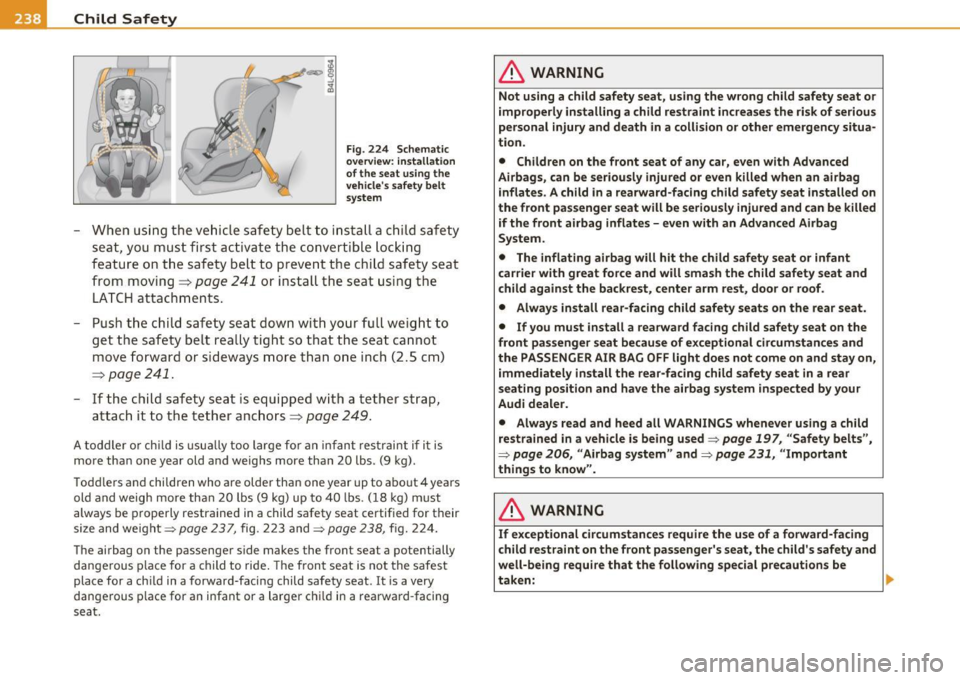
F ig. 22 4 Schema tic
overvie w: insta llatio n
of the seat using the
vehicle's sa fety be lt
sys tem
- When using the vehicle safety belt to insta ll a child safety
seat, you must first activate the convertible lock ing
feature on the safety belt to prevent the child safety seat
from moving~
page 241 or install the seat using the
LA TCH attachments .
- Push the child safety seat down with your full we ight to
get the safety belt really tight so that the seat cannot
move forward or s ideways more than one inch
(2.5 cm)
=>
page 241 .
- If the child safety seat is equipped w ith a tether strap,
attach it to the tether anchors=>
page 249.
A todd le r o r ch ild is usually too large for an i nfant res traint if it is
more than one year old and weighs more than 20 lbs . (9 kg) .
Todd lers and children who are older than one year up to about 4 years
old and weigh more tha n 20 lbs (9 kg) up to 40 lbs. (18 kg) must
always be properly restrained in a child safety seat certif ied for their
size and weight~
page 237, fig. 223 and~ page 238 , fig. 224.
The airbag on the passenger s ide makes the front seat a poten tially
dangerous place for a child to ride . The front seat is not the safest
place for a ch ild in a forward-facing child safety seat . It is a very
dangerous p lace for an infant or a larger chi ld in a rearward -facing
seat .
& WARNING
Not using a child safet y seat , us ing the w rong child safety seat or
improperl y install ing a child re straint in cre a ses the ri sk of seriou s
per sonal injury and death in a c olli sion or oth er em erg ency situa
tion.
• Children on th e front seat of any ca r, ev en with Ad vanced
Airbags , can be seriou sly injured or even killed when an air bag
i nflat es. A child in a re arward-facing child safet y seat installed on
the front pa ssenger seat will be seri ously injured and can be killed
i f the front a irbag inflates -ev en w ith an Advanc ed Airbag
System .
• The inflating airbag will hit th e child saf ety s eat or infant
carrier with grea t fo rce and will sma sh the child safet y seat and
child against the backrest, center arm rest , door or roof .
• Alway s in stall rear-f acing child safety seat s on the rear seat.
• If you must install a r ear ward fa cing ch ild safety seat on the
front p assenger seat becau se of except ional circum stance s and
th e PAS SENGER AIR BAG OF F light d oes not com e on and st ay on,
imm edia tel y i nstall the rear -facing child safet y se at in a re ar
seating position and ha ve the airbag s ystem insp ect ed by y our
Audi de aler.
• Alway s re ad and h eed all WARNINGS when ever u sing a child
re st rained
in a vehicle i s being use d~ page 197, "Safety belts ",
~ page 206 , "Airbag system " a nd ~ page 2 31 , "Important
thing s to know ".
& WARNING
If exc eptional cir cum stan ce s re quire the u se of a forward -f aci ng
c hild re straint on th e front p assenger 's seat, th e child 's saf ety and
w ell-being requ ire that the following sp eci al precauti ons b e
tak en:
11'-
Page 243 of 384

_______________________________________________ C_ h_ il_d _ S_a _ f_ e _ t..,. Y :...._ __
& WA RNING (c on tinued )
• If you mu st install a booster seat on the front pa ssenger seat
becau se of exceptional circumstance s the PASSENGER AIR BAG
OFF light must come on and stay on , whenever the ignition is
switched on.
• If the PASSENGER AIR BAG OFF light does not come on and
stay on, perform the checks described=>
page 217, "Monitoring
the Advanced Airbag System ".
• Take the child re straint off the front pa ssenger seat and install
it p roperly at one of the rear seat positions if the PASSENGER AIR
BAG OFF light does not stay on whenever the ign ition i s switched
on.
• Always read and heed all WARNINGS whenever using a child
restrained in a vehicle i s being used=>
page 197, "Safety belts",
=> page 206, "Airbag sy stem " and => page 231, "Important
things to know ".•
Installing a child safety seat
Securing a child safety seat using a safety
belt
S af ety b elts f or the re ar seats and th e fr on t passen ger
can be lock ed wit h the converti ble locking ret ract or to
properly secu re child safety seats.
The safety be lts emergency lo ck ing re trac tors for the rear seats
safety belts and for the front passenge r's seat safety belt have a
convertib le locking retractor for child rest raints . The safety be lt must
be locked so that belt webbing canno t un reel. The retractor can be
activated to lock the safety be lt and prevent the safety belt webbing
from loose ning up during normal dr iv ing. A child saf ety sea t can only
be properly insta lled when the safety belt is locked so that t he chi ld
and child s afety seat will stay in pla ce.
Controls and equip
ment Safety first Vehicle operation
Always remember:
Even though yo ur vehicle is equipped w ith a n
Adv anced Air bag system, all ch ild ren, espe cially those 12 ye ars and
younger, should always ride in the back seat properly restra ined for
their age and size.
& WARNING
Improperly installed child safety seats increase the risk of seriou s
personal injury and death in a collis ion.
• Alway s make sure that the safety belt retractor is locked when
installing a child safety seat . An unlocked safety belt retractor
c annot hold the child safety seat in place during normal driving or
in a crash .
• Always bu ckle the child safety seat firmly in pla ce even if a
child is not sitting in it. A loose child safety seat can fly around
during a sudden stop or in a colli sion .
• Always make sure that the rear seat backrest to which the
center rear safety belt is attached is securely latched whenever the
rear cente r safety belt is being used to secure a child restraint.
• If the backrest is not securely latched, the child and the child
restraint will be thrown forward together w ith the backrest and
will strike part s of the vehicle interior. The child can be seriou sly
injured or killed .
• Never install rear-facing child safety seat s or infant carriers on
the front passenger seat . A child w ill be seriously injured and can
be killed when the pa ssenger airbag inflates.
• The inflating airbag will hit the child safety seat or infant
carrier with great force and will smash the child safety seat and
child against the backrest, center armrest, door or roof.
• Always install rear-facing child safety seats or infant carriers
on the rear seat .
• Forward-facing child safety seats or infant carriers installed on
the front pas senger' s seat may interfere with the deployment of
the airbag and cause ser iou s injury to the child. .,
Vehicle care Do-it-yourself service Technical data
Page 244 of 384
-Child Safety ------ ~---------------------------------
& WARNING (cont inued)
• It is safer to install a forward-facing child safety seat on the
rear seat.
• Always read and heed all WARNINGS whenever using a child
restrained in a vehicle is being used=>
page 231. Special precau
tions apply when installing a child safety seat on the front
passenger seat=>
page 208, "Child restraints on the front seat -
some important things to know".
& WARNING
Always take special precautions if you must install a forward or rearward-facing child restraint on the front passenger's seat in
exceptional situations:
• Whenever a forward or rearward-facing child restraint is installed on the front passenger seat, the PASSENGER AIR BAG
OFF light must come on and stay on whenever the ignition is
switched on .
• If the PASSENGER AIR BAG OFF light does not come on and
stay on, perform the checks described=>
page 217, "Monitoring
the Advanced Airbag System".
• Take the child restraint off the front passenger seat and install
it properly at one of the rear seat positions if the PASSENGER AIR
BAG OFF light does not stay on whenever the ignition is switched
on.
• Improper installation of child restraints can reduce their effec
tiveness or even prevent them from providing any protection .
• An improperly installed child restraint can interfere with the
airbag as it deploys and seriously injure or even kill the child.
• Always carefully follow the manufacturer's instructions
provided with the child safety seat or carrier.
• Never place additional items on the seat that can increase the
total weight registered by the weight-sensing mat and can cause
injury in a crash .
& WARNING
Forward-facing child restraints:
• Always make sure the forward -facing seat ha s been designed
and certified by its manufacturer for use on a front seat with a
passenger front and side airbag.
• Never put the forward-facing child restraint up, against or very
near the instrument panel.
• Always move the passenger seat into its rearmost position in
the seat's fore and aft adjustment range, as far away from the airbag as possible before installing the forward-facing child
restraint. The backrest must be adjusted to an upright position .
• Make sure that the PASSENGER AIR BAG OFF light comes on
and stays on all the time whenever the ignition is switched on.
& WARNING
Rearward-facing child restraints:
• A child in a rearward-facing child safety seat installed on the
front passenger seat will be seriously injured and can be killed if
the front airbag inflates - even with an Advanced Airbag System.
• The inflating airbag will hit the child safety seat or infant
carrier with great force and will smash the child safety seat and
child against the backrest, center armrest, door or roof.
• Always be especially careful if you must install a rearward
facing child safety seat on the front passenger seat in exceptional
circumstances.
• A tight tether strap on a rearward-facing child restraint
attached to the front passenger seat can put too much pressure on
the weight-mat in the seat and register a heavier weight in the
Advanced Airbag System. The heavier weight registered can make
the system work as though an adult were on the seat and deploy
the Advanced Airbag when it must be suppressed causing serious
or even fatal injury to the child.
Ill-
Page 264 of 384

Driving and environment
New brake pads
Remember that new brake pads do not have a f ull braki ng
e ff e ct during the first 250 miles (400 kilometers) after they
are i nsta lle d.
New bra ke pads have to be "burnished in" before they have opt ima l
grab=> &.
Dur ing the break -in period, you sho uld avoid putting severe loads on
the brakes. Severe loads incl ude, for example, sudden hard braki ng,
in particu lar at very high s peeds or, for examp le, on mountai n passes.
& WARNING
New brake pads don 't have the be st stopping power and must be
" broken -in " during the initial 100 to 150 miles (150 to 200 kilo
meters ) of normal cit y driving. You can compensate for thi s by
pressing th e brak e pedal more firmly. This also applies lat er wh en
new pad s are installed. n
Catalytic converter
It is very important that your emissio n contr ol system
(catalytic converter) is functioning prop erly to ensure
that your vehicle is running in an environmentally sound
manner.
- Always use lead-free gasoline==> page 283, "Fue l su pp ly" .
- Never ru n the tank down a ll th e way to empty .
- Never put too m uch motor oil in your engine==>
page 294,
"Adding engine o il
The catalytic converter is an efficient "clean- up" device bu ilt into the
exha ust syste m of the ve hicle. The cat alytic converte r burns many of
the polluta nts in the exhaust gas before they are released into the
atmosphe re.
Th e e xcl usive use of unleaded fuel is cr itic ally important for the life of
the catalytic converter and proper f unction ing of the engine.
& WARNING
• Do not park or operate the vehicle in areas whe re the hot
exhaust sy stem may come in contact with dry grass, brush, fuel
spill or other material which can cause a fire .
• Do not apply additional undercoating or ru stproofing on or
near the exhaust manifold , exhaust pipes, catalytic conve rter or
heat shield s. During driving, the substance used for undercoating
could overheat and cause a fire .
0 Note
• Be aware that just one tank filling wit h leaded fu el wi ll alrea dy
ser iou sly degrade the performan ce of the ca talyt ic co nve rter.
• Do not exceed the correct engine oil leve l=>
page 294 .
• Do not dr ive unti l the f uel tank becomes complete ly empty. The
eng ine could misfire . Unburned fuel could a lso get into the exha ust
system and th is could cause the catalytic converter to overheat.
• Do not t urn o ff the igni tion whi le the ve hicle is moving.
• Do not continue to operate your vehicle under these conditions, as
o therwi se fuel c an reach the cat alytic c onve rter. Th is cou ld resu lt in
over heating of t he converte r, requiring its rep lacement.
• T o ass ure eff ic ient operat ion of the Emi ssion Co ntro l System:
- Have your vehicle maintained properly and in accordance with
t h e se rvice recommenda tions in your Warranty
& M aintenance
booklet. •
Page 273 of 384

Cleaning and protection -
---------------=---------=----
Under certain circumstances, weekly washing may be necessary.
Under other conditions, a monthly washing and waxing may be
adequate.
After the winter, the underside of the vehicle shou ld be thoroughly
washed, p referably in a profess ional car wash.
& WARNING
Always read and heed all WARNINGS and other information
~page 270. •
Automatic car wash
The vehicle can be washed in almost any modern auto
matic car wash.
Th e vehicle paint is so durable that the vehicle can normally be
washed without problems in an automatic car wash . However, the
effect on the paint depends to a lar ge exten t on the design of the
facility, the filtering of the wash water, the type of wash and care material, etc. If the paint has a dull appearance after going through
the car wash or is scratched, bring this to the attention of the oper
ator immediately . If necessary, use a different car wash.
Before going thro ugh a car wash, be sure to take the usual precau
tions such as closing the windows and power roof. Factory installed
antennas must not be removed.
If you have installed additional accessories on the vehicle -such as
spoilers, roof rack, etc. - it is best to ask the car wash operator if these
should be removed.
& WARNING
Always read and heed all WARNINGS and other information
~page 270. •
Safety first
Washing the vehicle by hand
A lot of water is needed when washing a vehicle by hand.
-Before you star t washing, make sure you have read and
understood the WARNINGS~
& in "General informa
tion" on
page 2 70.
- First soak all dried dirt until it is soft, then rinse it off .
- As you clean your vehicle, start with the roof and work your
way down to the bottom, using a sponge, a sponge glove
or a clean brush.
- Rinse the sponge or the sponge glove often, flush ing it
clean each time .
- Use special car shampoo only for very persistent dirt.
- Rinse the car thoroughly with water.
- Use a chamois leather to gently wipe the exterior dry.
Use a separate sponge for cleaning the wheels, door sills and other
regions exposed to road dirt. In this way, you will not scratch the
paint with coa rse particles imbedded in the sponge the next time you
wash the car.
& WARNING
• Do not clean the underside of the chassis, fenders, wheel
covers, or other hard to reach parts without protecting your hands
and arms. You may cut yourself on sharp-edged metal parts.
• Always read and heed all WARNINGS and other information
~page 270. _..
Vehicle care Technical data
Page 278 of 384
-~_C_ le_ a_n_ i_ n_ g=- a_ n_d___. p_ ro_ t_e _c_ t_ i_o _n ___________________________________________ _
Use only special acid-free cleaners formulated for a lloy r ims . Sa fe
pro ducts are availabl e at your A udi de aler. Never leave t he cle aner on
the rims longe r tha n spec ified on the label. If not rinsed off promptly,
the ac id contained in some cleaners can attack the t hreads on the
w heel bolts.
Never use abrasive or metal po lish ing cleaning agents.
If the protec
t ive coa ting ha s been ch ipped, e.g. by k icked up road dirt, touch it up
as soon as possible.
& WARNING
• Moisture and ice on brakes may affect braking efficiency
=> page 254, "General information ". Test the brakes carefully
each time you wash the vehicle.
• Always read and heed all WARNINGS and other information
=:>page 270 . •
Body cavity sealing
The body cavity sealing does not need to be checked .
All body cavit ies which cou ld be affected by corrosion have been thor
oughly p rotected at the factory .
Th is sea ling does not require any inspection or additiona l treatment.
If any wax sho uld seep ou t of the cavi ty when the ambien t tempera
ture is h igh, it can be removed w it h a plastic scraper and a suitable
so lvent .
& WARNING
Solvents can be dangerous.
• Benzine is flammable and toxic. If you use benzine for
removing the wa x, keep sparks, flame and lighted cigarettes
away. Never dump benzine on the ground, into open st reams or
down sewag e drains.
& WARNING (co ntinued )
• Be su re to observe all safety and environmental regulations.
Follow all instructions on the container.
• Always read and heed all WARNINGS and other information
=:>page 270 . •
Chassis
Hav e the undercoa ting checked fo r damage f rom time to
ti me.
The lower body shell of your Audi is a lso thoroughly protected against
c orrosion .
Any damage to the u nde rcoat ing caused by road ha za rds sho uld be
repaire d promptly.
& WARNING
Too mu ch undercoating in the wrong places can caus e a fire.
• Do not apply additional undercoating or rustp roofing on or
near the exhau st manifold , exhaust pipes, catalytic converter or
heat shields. While dr iving, the substance used for undercoating
c ould overheat and cau se a fire.
• Always read and heed all WARNINGS and other info rmation
=> page 270 . •
E x haust tail pipes
Road s alt and ot her c orrosive mater ials w ill damage the m ate rial in
the exhaust ta il pipes if they a re not cleaned regularly. Do not clean
t he t ail pipes w ith w heel cleaner, p aint polish, chrome po lish or o ther
abrasive cleaners. C lean the tail pipes with car care products that are
sui table for sta inless s teel.
~
Page 294 of 384
lffl) __ C_ h_ e_c _k _i _ n _g ~ a_n _d_ f_i l_ l_i n_ g _________________________________________ _
the formation of harmful deposits, sometimes ca lled "sludge," that
over time can lead to expensive re pairs.
At the time of pr int ing, engine o ils available in the U .S . and Canada
that meet the exacting s pecifications of Audi oil standard VW 502 00
are synthetic engine oils. This does not mean, however, that every
synthetic engine oil will meet Audi oil standard VW 502 00. So a lways
be s ure that you use an approved o il.
To help prevent the format ion of harmful deposits use only oil with
the following specifications printed on the oil container:
Audi oi l stand ard VW 502 00
Oil container labels may carry the specification singly or in comb ina
tion with other designations and o il quality standards.
Vi sco sit y
Engine oils are graded according to their viscosity . The proper
viscos ity grade oil for your eng ine depends on climactic or seasonal
conditions where you drive. You can use oi l with a v iscosity grade of
SAE SW40 across all tempera ture ranges for norma l driving cond i
tions.
However, if engine o il viscosity grade SAE SW40 is not avai lable, you
can a lso use viscos ity grade SAE SW-30 or SAE OW-40 as long as it
meets Audi oil quality standard VW 502 00 specifications .
Be cause eng ine oil that meets the A udi oil standard may not be avail
able everywhere when you need it, we strongly recommend that you
always carry w ith you an extra quart (liter) o f oi l that expressly
conforms to the VW 502 00 specif ication, in case you have to top off
the oi l while on the road.
On ly if the level of the o il is at or be low the min imum mark on the oil
dipstick - and no oil that expressly conforms to Audi oi l standard
VW 502 00 spec ificat ions is ava ilable - may you top off with a high
quality engine oil, preferably synthetic-based, that meets ACEA A3,
ACEA AS or ACEA BS or AP I SL spec ifications, but even then, on ly in
viscos ity grades SAE SW-40, SAE SW-30, or SAE OW-40. However,
dur ing t he entire time between oil change intervals, neve r top off w
ith more tha n a total of 0 .5 qt/liter eng ine o il that does not
con form to Audi o il specification VW 502 00.
For more information abo ut eng ine oil that has been approved for
your vehicle, p lease contact either your authorized Audi dealer or
Audi Customer Relat ions at 1 (800) 822-2834 or v isit our web site at
www.audiusa.com or www .audicanada.ca. Here you will also find a
cur rent list of oils (manufacture rs, brand names e tc.) t hat co nform to
Audi oil standard VW 502 00.
Chan ging the e ngine oil
T he eng ine oil and oil fi lter must be changed according to the mileage
(kilometers) and time interva ls specified in your vehicle's Warranty
&
Maintenan ce boo klet. Do no t exceed these interva ls - harmful
deposits from old eng ine oil can reduce engine performance and can
lead to expensive engine repairs.
Chang ing t he oil at the recommended intervals is so very important
because the lubricating properties of oil decrease gradually d uring
normal veh icle use. If you are not sure when you have your o il
changed, ask your authorized A udi Service Advisor.
Under some circumsta nces the engine oil should even be changed
more frequently. Change oil more often if you drive most ly short
dis tances, ope rate the vehicle in dusty areas or mostly under stop
and-go traffic conditions, or when you use your vehicle where temper
a tures stay below freezi ng point for long periods .
Detergent add itives in the oil will make fres h oil look dark after the
engine has been running for a short t ime . This is normal and is not a
reaso n to cha nge the oil mo re often than recommended.
Damage or malfunctions due to lack of maintenance
It is essentia l that you change your o il at the recommended intervals
using only engine o il that comp lies w it h Aud i oil standard
VW 502 00 . Your Limited New Vehicle Warranty does not cover
damage or ma lfunctions due to fa ilure to follow recommended main
tenance and use requirements as set forth in the Aud i Owner's
Ma nual and W arra nty
& M ai ntenance book let. Your deale r will have
to deny warranty coverage unless you present to the dealer proof in ._