transmission AUDI S8 2010 User Guide
[x] Cancel search | Manufacturer: AUDI, Model Year: 2010, Model line: S8, Model: AUDI S8 2010Pages: 384, PDF Size: 90.95 MB
Page 164 of 384

IIII.___A_ d_v_ a_ n _ c_e _d _ P_ a_ rk_ in--= g'-S -=- y_s_t_ e_ m _________________________________________ _
- Press the switch P1JJ! in the center console=:, page 161,
fig. 177 to activate the Audi parking system manually.
Activation of the acoustic parking system is confirmed by
a brief acknowledgement sound. The indicator light in the
switch lights up.
Deactivation
- If you drive forwards faster than approx. 6 mph (10 km/h), or
- if you switch the ignition off, the entire acoustic parking
assist is automatically deactivated, or
- you can press the switch
Pw! in the center console
=:, page 161, fig. 177 to deactivate the Audi parking
system. The indicator light in the switch goes out.
You have to turn on the acoustic parking assist manually if you wish
to park the vehicle forwards or if you wish to approach an obstacle
forwards and want a distance warning.
The range at which the sensors start to measure is
about :
Front
Rear
Warning tones
side
center
side
center 3 ft (0.90 m)
4 ft (1.20 m)
2 ft (0.60 m)
5.2 ft (1.60 m)
Distance warning is given by chimes which are generated by a signal
generator . The volume and the pitch of the chimes can be adjusted in
the MMI =>
page 171.
Mute
In the case of vehicles with automatic transmission, an acoustic
distance warning is discontinued when the transmission selector lever is moved to the P position
. However, the system remains active.
As soon as the selector lever is moved from the
P position and the
vehicle approaches an obstacle, the acoustic distance warning
resumes.
Driving forward/backward
Distance warning when driving forward/backward is based on detec
tion of an obstacle in the range of the parking assist . As the distance
decreases, the time interval between the audible tones becomes
shorter.
When the distance is less than approx. 1 ft (0.30 m), the tone
becomes continuous. At this point you should stop backing up or
driving forward .
If the distance to an obstacle remains the same, the volume of the
distance warning is gradually reduced after about
4 seconds (does
not apply to the zone for the continuous tone). If you start to
approach the detected obstacle again, the distance warning will
sound at the normal volume again.
Parking
When you select another gear when parking (e.g. reverse/forward),
the warning tones are temporarily suppressed, but the visual display
remains on the MMI display. If you start approaching a detected
obstacle again, the distance warning will sound at the normal volume
again.
Visual display
The segments on the MMI display indicate a change in the distance
between the vehicle and an obstacle . The number of segments
displayed depends on the obstacles in front of or behind the vehicle.
The closer the vehicle comes to the obstacle, the closer the segments
approach the vehicle=>
page 161, fig. 178. When the segment
before last is displayed, the vehicle has reached the collision zone. At
this point you should stop backing up or driving forward=>& .
The image in the visual display can be switched off on the MMI display
=>
page 173 . The acoustic distance warning remains active. .,,
Page 309 of 384

________________________________________________ T_i_re _ s_ a _ n_d_ w_ h_ e_ e_l_s __ l!'II
& WARNING (co ntinued )
• Tires age even if they are not be ing used and can fail suddenly ,
e specially at high speeds . Tires that are more than 6 year s old can
only be used in an emergency and then with special care and at low
s peed .
Glossary of tire and loading terminology
Accessory weight
means the combined weigh t (in excess of those sta ndard items wh ich
may be replaced) of automatic transmission, power steer ing, power
bra kes, powe r win dows, power sea ts, radio, and heate r, to the exte nt
that these items are available as factory-insta lled equipment
(whet her i ns ta lled or no t).
Aspect ratio
means the r atio of t he he ight to t he widt h of the t ire in percent.
N umbers of 55 or lower indicate a low sidewa ll for improved steer ing
res ponse and bet ter over all h andling on dry p avemen t.
Bead
means the part of the t ire that is made of stee l wi res, w rapped or
re in forced by ply cords and that is shaped to fit the rim.
Bead separation
means a brea kdown of the bond between components in the bead.
Cord
means the st rands forming the plies in the ti re.
Safety first
& W ARNING (co ntinued )
• Never mount u sed tires on your vehicle if you are not sure of
their "previous history ." Old u sed tires may have been damaged
eventhoughthedamagecannotbeseenthatcanleadtosudden
tire failure and loss of vehicle control.
• If you notice unusual vibr ation or if the vehicle pulls to one side
when driving, always stop as soon as it is safe to do so and check
the wheels and tires for damage. •
Cold tire inflation pressure
means the t ire pressu re recom mended by the vehicle manufa ctu rer
for a tire of a desig nate d size that has not been driven for more than
a couple of m iles ( kilomete rs) a t low speeds in the t hree hour per io d
before the tire pressu re is measured or adjusted.
Curb weight
means the weight of a moto r vehicle wit h standard equipment
incl uding the max imum ca pac it y of fue l, o il, and coo lan t, air condi
tioning and additiona l weig ht of optional eq uipment.
Extra load tire
means a tire design to operate at higher loads and at higher inflat ion
pressures than t he co rresponding sta ndard t ire. Extra load tires may
be identif ied as "XL", "xl", "EXTRA LOAD", or "RF" on the sidewa ll.
Gross Axle Weight Rating ( "GAWR ")
means the loa d-carrying capac ity of a sing le ax le system, measure d at
the t ire-grou nd interfaces.
Gross Vehicle Weight Rating ("GVWR")
mea ns the maximum tota l loaded we ig ht of the vehicle .
Vehicle care Technical data
Page 347 of 384

________________________________________________ F_ u_s _e_ s_ a_ n_ d_ b_u_ lb_ s _ __.lftll
No. Equipment
9
10
11
13
14
15
16
17
Climate control front/rear, dash panel buttons
Suspension level control system
(Adaptive Air Suspension)
Light and rain sensor
Display-/control unit
Roof electronics control unit
CD/DVD drive Energy management
Vacant
Radiator fan electronics
Airbag front passenger recognition (weight sensor)
19 Vacant
20 Heated/ventilated seats
21 Engine control module
22 Vacant
23 Parking brake (switch)
24 Vehicle electrical system
25
26 Automat
ic transm ission
Air conditioning water valves water pump, rear climate control
27 Sunroof
28 Engine control module
29 Fuel injectors
30 Ignition coils
31 Fuel pump, r ight/fuel pump e lectron ics
Amps
5
10
5
5
10
5
5
5
5
5
5
5
10
15
10
20
5
15
30
20/40
-
Vehicle OP-eration
No ... Equipment
32
33
34
35
36
39
40
41
Automatic transmission
Right rear foo twell heater
Heated/ventilated seats, rear
Heated/venti lated seats, front
Cigarette lighter, front
Cigarette lighter, rear/socket, rear
Auxiliary cooler fan Door cont rol un it, front r ight
Brake booster
Door control un it, rear right
42 Vacant
43 Headlight washer system
Air conditioning heater fan
Amps
5
25
20
20
20
20/25
20
7.5
15
7.5
30
30
•
Fuse Location , Luggage Compartment left
0
Fig . 28 0 Fuse pan el
l a yo ut ..
Vehicle care Do-it-yourself service iTechnical data
Page 351 of 384
_____________________________________________ E_ m___;, e_r-=g ~ e_ n_c,_:!y:.__: s_i:..:t ..:..u :..:a;;,. t.:.; i...: o :..: n...:..:. s _ __,J_
& WARN ING (conti nued)
• Before you check anything in the engine compartment , always
read and heed all WARNINGS~
page 281, "Engine compart
ment ".
0 Note
• App lying a higher vo ltage booster battery will cause expensive
damage to sens itive e lectron ic components, such as contro l units,
relays, radio, etc.
• There must be no electrical contact between the vehicles as other
wise current could already start to flow as soon as the positive(+)
terminals are connected.
[I] Tips
• The discharged battery must be properly connected to the
vehicle's electrical system . When jump starting or charging the
battery, never connect the negative ground cable to the battery nega
tive post because the battery manager system must be able to detect
the battery's state of charge . Always connect the negative ground
cable to the negative ground post of the battery manager control
unit. •
Vehicle OP-eration
Use of jumper cables
Make sure to connect the jumper cable clamps in exactly
the order described below!
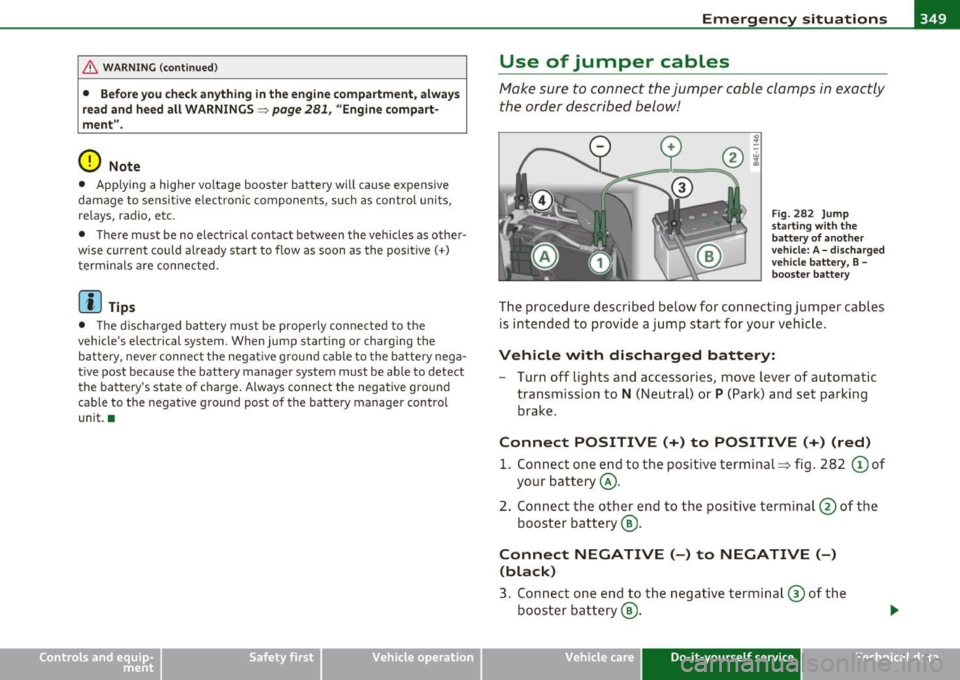
Fig. 282 Jump
starting with the
battery of another
vehicle: A -discharged
vehicle battery, B -
booster battery
The procedure described below for connecting jumper cables
is intended to provide a jump start for your vehicle.
Vehicle with discharged battery:
- Turn off lights and accessories, move lever of automatic
transmission to
N (Neutral) or P (Park) and set parking
brake.
Connect POSITIVE(+) to POSITIVE(+) (red)
1. Connect one end to the positive terminal~ fig. 282 © of
your battery @.
2 . Connect the other end to the positive terminal @ of the
booster battery®·
Connect NEGATIVE(-) to NEGATIVE(-)
(black)
3. Connect one end to the negative terminal® of the
booster battery@.
Vehicle care Do-it-yourself service iTechnical data
Page 356 of 384

lffll.___E_ m_ e_r-= g:.. e_ n_c-= y'-- s_ i_t _u _a_ t_ i_ o _ n_ s ____________________________________________ _
-Read and heed WARN ING=> &.
Fig . 29 0 Rear lift ing
poi nt
- Activa te the vehicle jacking mode if ap plicab le
=>page 179 .
- Locate lift ing poi nts=> page 353, fig . 289 => fig. 290.
- Adj ust lift ing arms of wor kshop ho ist or floor jack to
match vehicle lifting poi nts .
- Inse rt a rub ber pad between th e floor j ac k/wo rksho p hois t
and t he lifting points .
The ve hicle jacking mode mus t be activa ted so that the automa tic
adjustm ent of the Adapt ive A ir Suspens io n does not make it more
diffic ult to raise the vehicle wit h the (floor jack)=>
page 179.
If you must lift your vehicle with a floor jack to work underneath,
be sure the vehicle is safely supported on stands intended for this
purpo se.
Front lifting point
Th e lifting poi nt is loca ted on the floo r pan reinforcemen t about at
the same leve l as the jack mo unting point =>
page 353, fig. 289. Do
not lift the vehicle at the verti cal sill reinfor cement .
Rear lifting point
The li fting point is located on the ve rt ica l reinfo rceme nt of the lower
sill for the on-board jack=> fig. 290.
Lifting with vehicle jack
Refer to=> page 338.
& WARNING
• To reduce the risk of serious injury and vehicle dam age.
- Alway s lift the vehicle only at the special workshop hoist and
floor jack l ift points illustrated =>
page 353, fig. 289 and
=> fig. 290 .
- Failure to lift the vehicle at these points could cause the
vehicle to tilt or fall from a lift if there is a change in vehicle
weight distribution and balance. This might happen, for e xample , when heavy component s such as the engine block or
transmission are removed .
• When removing heavy components like these, an chor vehicle
to hoist or add correspond ing weights to maintain the center of
gravity . Otherwi se , the vehicle might tilt or slip off the hoist,
caus ing serious personal injury.
0 Note
• Be aware of th e following points before lifting th e vehicle :
-The vehicle should neve r be lifted or jacked up from under
neath the eng ine oil pan , the transmission housing , the front or
rear axle or the body side members . This could lead to serious
damage.
- To avoid damage to the underbody or chassis frame, a rubbe r
pad must be inserted between the floor ja ck and the lift points.
- Before driving over a workshop hoist , check that the vehicle
weight does not exceed the permissible lifting capacity of the hoist . _..
Page 358 of 384

___ G_ e_n_ e_r _a _ l_ in_ f_o _r_ m_ a_ t_io _ n _______________________________________________ _
General information
Explanation of technical data
Some of the technical data listed in this manual requires
further explanation.
The technical data for your vehicle is listed in the charts starting on
~ page 360. This section provides general information, notes and
restrictions which apply to this data.•
Vehicle identification
The key data is given on the vehicle identification number
(VIN) plate and the vehicle data sticker.
Fig . 291 Vehicle Iden
tification Number
(V IN) plate: location
on driver's side dash
panel Fig.
292 The vehicle
identification label -
inside the luggage
compartment
The Vehicle Identification Number (VlN)
is locat ed on the driver's sid e so that it is visible from the outside
through the windshield ~ fig . 291. You can also display the Vehicle
Identification Number of your vehicle in the MMI. Select: Function
button [CAR]>
Systems> Vehicle ID number (VIN) .
The vehicle identification label
is located in the luggage compartment in the spare wheel well.
The label ~ fig . 292 shows the following vehicle data:
© Production control No.
@ Vehicle identification No.
® Type code number
@ Type designation/engine output in Kilowatts
© Engine and transmission code letter
© Paint No./lnterior
(j) Optional equipment No.'s
Vehicle data 2 to 7 are also found in your Warranty
& Maintenance
booklet . .,,
Page 369 of 384

___________________________________________ A_ l::.. p _h _a_ b_ e_t _ic _a_ l_ in_ d _ e_x __ nn
We ight-sensing mat .... .. .. .. . ... 232
When must the system be inspected? 217
Aircraft Transporting your vehicle .......... 353
All Wheel Drive ............ .. ...... . 257
Alloy wheels . .... .. .. .. .. .. .. ... ... 275
All-wheel drive
Winter tires ....... .. ............ 323
Alternator See Generator .................... 16
Anti-freeze See Engine coolant ...... .. .. .. ... 296
Anti -lock brake system
How the ABS system works ......... 256
Warning/indicator lights ... .. ..... . 19
Anti-Sl ip Regulation System (ASR)
How the system works . .. .. .. .. .. . 254
Anti-theft systems Anti-theft alarm system ....... ... .. 52
Electronic immobilizer ............. 41
Ashtray Front .............. ...... ........ 96
Rear ........ .. .... .. ... . .. .... .. 96
ASR How the Anti-Slip Regulation System
works ..... .. ... .. ... ... ....... 254
Audi Service Repair Manuals and Literature
361
AUTO mode AC climate control ....... .... .. .. . 106
Auto Safety Hotline ... ... ... . .. ..... 195
Auto-Check Contro l .............. .... . 26 Automatic car wash
See Washing ............... ... .. 271
Automatic Shift Lock (ASL) ... .. .. .. ... 156
Automatic transmission 6-speed automatic transm iss ion .. .. 154
Automatic Sh ift Lock (ASL) ....... .. 156
Dr iv ing ................. ...... .. 154
Dynamic shift program ......... ... 157
Emergency release for selector lever . 159
Fail-safe mode ................ ... 159
lg nition key safety lock .... ..... ... 119
Kick-down . ............ .. ....... 157
Manual shift program .. .. .. .. .. .. . 158
Selector lever ............ ........ 155
Shift buttons ... ...... .. .. .. ..... 159
Steering wheel with tiptronic ...... . 159
Average speed ........... .. .......... 36
Avoid damaging the vehicle .. ....... .. 263
B
Background lighting ... . .. .. .......... 67
Battery . .. .. .. .. .... ............... 300
Battery location inside the luggage
compartment .................. 301
Charging ........................ 303
Important warnings when working on the battery ..... ........... ...... .. 301
low . .. .. .. .. .. ...... .. ......... 258
Rep lacing the battery . ... ......... 304
State of charge ..... .. ........... 258
Winter operation . .... ... ..... .... 300
Working on the battery .... ... .. .. . 301 Before driving
.. .. ... ... ... .... ... .. 187
Blended gasoline ................. .. 283
Body cavity sealing .............. . ... 276
Booster seats ......... ............ . 239
Brake fluid
Changing the brake fluid .......... . 300
Checking the brake fluid level ....... 299
What is the correct brake fluid level?. 299
What should I do if the brake fluid warning
light comes on? . .. .. .. .......... 299
Brake system Anti-lock brake system .. ........... 19
Brake assistant .. .. .. .. .. ...... .. 256
Brake booster ........... ... ..... 256
Brake fluid .. .. .. ................ 299
Brake fluid specificat ions for refill and
repla cemen t .................. . 300
Brake light defective . .... .. .. .. .. .. 24
Brake pads ..................... . 262
Electromechanical parking brake .... 123
Fluid reservoir . .......... ... .. ... 299
How does moisture or road salt affect the
brakes? ... .. ................ .. 254
Malfunction ...................... 28
Warning/indicator lights ... .... .. .. 20
Worn brake pads symbol ........... 32
Break-in period .... . .. .............. 261
Brake pads . ... ................ .. 262
Tires ..... .................... .. 261
Bulbs ............ .... .. .... .... .. . 346
Bumper cover Caution when parking near a parking barri-er or curb . ... ................ .. 124
Automatic belt retractor .......... .. . 201 Battery voltage .. ........... ........ . 34
Controls and equip
ment Safety first Vehicle operation
Vehicle care Do-it-yourself service Technical data
Page 377 of 384

Alphabetical index -________________ fWI
Rear fog lights ..... ....... ... .. .. .. .. 62
Rear lid Automatic operation .............. . 48
Escape handle ... .. .............. 332
Opening and closing .. .. ........... 46
Opening manually ....... .. .... .. .. 47
Rear light
Defective ............... .... ... .. 24
Rear seat Controls .. .. ................. .. .. 87
Easy entry .... ...... .... .. .... .. .. 89
Head restraint adjustment .......... 88
Lumbar support . . . . . . . . . . . . . . . 86, 89
Massage function ....... .... .. .. .. 88
Seat adjustment ........ ....... ... 87
Setting in the MMI ............ ... .. 89
Rear view
See Rear-view camera .......... .. . 161
Rear window defogger .......... .. .. . 113
Rear window shelf .................... 86
Rear-v iew camera .. ...... ...... 161, 164
Park ing mode 1 .. ................ 166
Park ing mode 2 .. ................ 167
Red symbols .............. ...... .. .. 28
Refuelling ... .................. ... . 285
Release lever for hood ....... ... .. .. . 288
Remote control ... .... ... .. .. .... .... 40
Unlocking and locking ... .. .. ....... 43
Remote cont rol garage door opener
(Homelink ®) .......... .. .... .. . 181
Remote rear lid release ............... 46
Repair manua ls ............. ... ..... 361
Controls and equip
ment Safety first
Repairs
Airbag system ................... 220
Replacing Wheel rims . ................. ... 320
Replacing a fuse . .. ............... .. 342
Replacing light bulbs ... .. .... .. .. ... 346
Replacing tires and wheels ............ 319
Reporting Safety Defects ........ ... .. 195
Reset button .. ...... ...... .......... 12
Retractor . ...... ........... ...... .. 201
Rims Cast alloy .. .. ... ... .. ... .... .... 275
Replacing ....... ... .. .. ..... .... 320
Roof rack . .... .. ........... .. .... .. . 92
Loading ..... ........... .. .. .. .. . 94
Mounting locations .... .. .......... 93
Roof weight ................. ... .. .. . 94
s
SAFE ................. ...... ... .. .. . 12
Safe driving habits .. .. ... .. .. .. .. ... 186
Safety belt height adjUJstment ......... 204
Safety belt position .. ...... ......... 202
Safety belt height adjustment .. .. .. 204
Safety belts worn by pregnant women ...
203
Safety belt pretensioner ........... ... 204
Service and disposal .............. 205
Safety belt warn ing light .. .... .. . 18, 197 Safety belts ......
... ... . .. .. .. .. .. . 201
cleaning ............ ... .. .. .. ... 281
Danger to passengers who do not wear a safety belt ......... ... .. .... ... 199
Fastening ....................... 201
Improperly worn . .. .............. 204
Not worn ................ .... .. . 199
Safety belt position .............. . 202
Safety instructions ... . .. .. .. .. .. . 200
Securing child safety seats ... ... .. . 241
Special considerations for pregnant women ...... ...... ... ... ... ... 203
Unfastening .......... .... .... ... 203
Warning/indicator light ...... .... . 197
Why YOU MUST wear them .. .... .. . 197
Worn properly ... ..... ... ... .. .. . 200
Safety compliance sticker ... . ......... 356
Safety equipment ...... ...... .... .. . 186
Safety features for occupant restraint and protection . .. .. .. .... .......... 186
Safety guidelines Seat adjustment .................. 76
Safety instructions
Engine compartment ..... ..... .. . 289
for side curtain airbags .. .......... 229
for using child safety seats ...... .. . 234
for using safety belts ...... .. .. .. . 200
Monitoring the Advanced Airbag System .
219
Safety lock Ignition key, automatic transmission 119
Seat adjustment Adjusting the seatback ............. 79 Driver 's seat .................. .. .. 76
Vehicle operation Vehicle care Do-it-yourself service Technical data
Page 379 of 384

___________________________________________ A_ l::.. p _h _a_ b_ e_t _ic _a_ l_ in_ d _ e_x __ __
T Storing tire pressures .. .. .. ... .... 330 Towing
Tires and wheels .................
320 Tow truck procedures ........ .. ... 350
Tachometer .................... .... . 11 Valves ................... .... ... 320 Towing hitch
Technical modifications .. .. ..........
364 Tire service life .. .............. ..... 317 Audi parking system ...... ..... ... 171
Temperature
Climate controls .......... .. .... .
106
Setting for the d river's and front passen-
ger's side .. ... .. .. .. .. .. .. .... .
106
Tether anchors ............. .... ... . 249
Tether strap .... ........... .. .... .. . 249
The first 1,000 mi les (1,500 km) and
afte rwards .... .... .. .. .. ... ... .
261
Tie-down eyelets .... ... .. ... . .. . 90, 195
T ips for the environment
Saving fue l ............. .... ... ...
94
Using the air conditioner only when
necessary ......... .. .. .. .. .... . 112
tiptronic ® ............ .. .. .. .. .... .
154
Automatic Shift Lock (ASL) ...... ... 156
Driving ......... ... ... ... .. ..... 154
Dynamic shift program ....... .. .. . 157
Fail-safe mode ..... .. .. .. .... .... 159
K ick-down ......... ..... ... .. .. . 157
Manual shift program .......... .. . 158
Selector leve r ......... .. .. .. .... . 155
Tire pressure . ..... ....... ... .. .. .. . 313
Tire pressure monitoring system . ...... 327
Displaying tire pressures ....... .... 329
Initialize wheels .. .. ........... ... 330
Learning process ........ ...... .. . 330
Loss of air pressure .. ......... 17,328
Malfunctions .......... ... .. ..... 331
Sensors ...... ........ .. .. .. .. .. . 320
Controls and equip
ment Safety first
Tir
es . .... ....................... .. 306 T owing loop ........... ...... .. .. .. . 351
Replacing .. .. .. .... ... . .... ..... 320 front . .. .. .. ................. .. . 351
Service life ....... .. .. .. .. .. ..... 317 rear .. .. ........... ...... .... .. . 352
speed rating letter ,code ........... 320 Trailer towing .. .. .................. 266
T ire manufacturing date ........... 320 Operating instructions .. .. .... .... 267
Tire specifications ................ 319 Technical requirements .. .. .. . 266,267
T read depth . ...... .............. 317 Tr ailer towing tips ......... .. .. .. . 268
Uniform tire quality grading . .. ..... 322 Train
Winter tires ................... ..
323 Transporting your vehicle ... ... . .. . 353
T ires and vehicle load Limits ........... 314 Transmission
Tires and wheels
See Automatic transmission ........ 154
Checking tire pressure .. .. .... .... . 313 T ransport Canada ..... ....... ...... . 195
Cold tire inflation pressure ....... .. 310
Dimens ions .. .... ............. ..
318
General notes ................... 306
Glossary of tire and loading terminology .
307
New tires and wheels .... ..... ... . 318
Replacing .. .. .. .... .. .. .... ..... 319
Snow chains .. ........... .... .. .. 324
Transporting your vehicle . .. .......... 353
Tr ead Wear Indicator ( TWI) . ..........
317
Trip computer
Fuel consumption .. ...............
36
Mileage ................. .. .. .. .. 36
Single-trip memory ........ ... ... .. 37
T otal-t rip memory ... ...... .... .. .. 37
Tir e pressure monitoring system .... 320
Tires and vehicle load limits ... .. ... 314
Wheel bolts .. ................ ... 325
Trip odometer .. .. .................. . 12
What does it mean when dEF appears in
the trip odometer display? . ... .. ...
12
Winter tires ..................... 323 Trunk
Tires/Wheels
See Rear lid . .. .. .. ............... 46
Low aspect rat io tires .. .... .. .. .. . 325 Trunk escape handle . ...... .... ...... 332
Tools .... ......................... 334 T urn s ignals ................ ... .. .. .. 64
Torn or frayed safety be lts ... ......... 200 Warning/indicator lights ... .. . ... .. 17
Touch-up paint .. .. .... .. .. .. ... .... 274
Vehicle operation Vehicle care Do-it-yourself service Technical data