weight AUDI S8 2010 Owner's Manual
[x] Cancel search | Manufacturer: AUDI, Model Year: 2010, Model line: S8, Model: AUDI S8 2010Pages: 384, PDF Size: 90.95 MB
Page 234 of 384
lffll.,___C_h_ i_ ld _ S_ a_ f_ e_ t_:!, y :...._ _________________________________________ _
& WARNING (conti nued)
• Always install rear-facing child safet y seat s on the rear seat.
• If you must install a rearward facing child safety seat on the
front passenger seat in exceptional circumstances and the
PASSENGER AIR BAG
OFF light do es not come on and stay on,
immediately in stall the rear-facing child safety seat in a rea r
seating position and have the airbag system inspected immedi
ately by you r Audi deale r.
& WARNING
If, in exceptional circumstances , you must in stall a forward-facing
child restraint on the front passenger' s seat:
• Always make sure the forward-facing seat has been designed
and certified by its manufacturer for use on a front seat with a
pas senger front and side airbag.
• Always follow the manufacturer 's instructions p rovided with
the child safety seat or carrier.
• Always move the passenger seat into its rearmost position
in
the seat's fore and aft adjustment range, as far away from the
airbag as possible before install ing the child restra int . The back
re st must be adju sted to an upright position .
• Always make sure that the PASSENGER AIR BAG OFF light
c omes on and stays on all the time whenever the ignition is
switched on .•
Advanced front airbag system and children
Your vehicle is equipped with an "Advanced Airbag System" in compli
ance wi th Uni ted St ates Federa l Mo to r Vehicle Safety St andar d
(FMVSS) 208 as applicable at the time your veh icle was manufac
tu red . The Advanced A
irbag system in yo ur vehicle has been certif ied to
mee t the "low -r is k" requiremen ts fo r 3-and 6-ye ar old ch ildre n on
t he passenger side and small adults on the dr iver side . The low risk
dep loyment criteria are inten ded to reduce the risk of injury through
interaction with the a irbag t hat can occur, for example, by being too
close to the stee ring wheel an d instr ument panel when the airbag
inflates. In addi tion, the sy stem has been certified to comp ly with t he
"suppression" requirements of the Safety Standa rd, to t urn off the
fron t air bag for infan ts u p to 1 2 months who a re res tra ined on the
front passenger seat in child restrai nts that are listed in the Stan
d ar d.
Even thoug h your vehicle is equipped with an Advanced Airbag
system , a ll ch ildren, especially those 12 years and yo unger, should
always r ide in t he back seat p roperly restrained for t heir ag e and si ze .
Th e ai rbag on the passenge r si de makes the front seat a potentia lly
dange rous p lace for a child to r ide. Th e front seat is not th e safest
place fo r a child in a forward- facing c hild safety seat. It can be a very
d an ge rous p lace for a n infan t or a large r chil d i n a re arwa rd-facing
seat. •
Advanced Airbags and the weight-sensing
mat in the front seat
Th e Advanced A irbag System i n your ve hicle de tects t he p resence o f
an infa nt o r ch ild in a child rest rai nt on the fro nt passenger sea t using
the we ight-sens ing mat in the seat cushion and the senso r be low the
saf ety belt la tch o n th e front passenge r seat tha t measur es t he
tension on the safety belt.
Th e weigh t-sens ing ma t me asures tot al we ight of the child and the
child safety seat and a child blanket on the fro nt passe nger seat . The
we ight on the fro nt passenger se at is re late d t o the desi gn of the
child res traint and i ts "footpri nt", the size and shape of t he bottom
of the ch ild restraint as it sits o n the seat . The weight of a child
restrain t an d its "foo tpr int" vary for differe nt kinds of child res tra ints .,_
Page 235 of 384

-----------------------------------------~C~ h~il ~d ~ S~a _!fe ~ t !;YL __
and for the different models of the same kind of child restraint
offered by child restraint manufacturers.
The weight ranges for the individual types, makes and models of ch ild
restraints that the NHTSA has specified in the Safety Standard
together with the weight ranges of typical infants and typical 1 year
old child have been stored in the control unit of the Advanced Airbag
System. When a child restraint is being used on the front passenger
seat with a typical 1 year-old chi ld, the Advanced Airbag System
compares the weight meas ured by the weight sensing mat with the
information stored in the electronic control unit .
The electronic contro l unit a lso registers the tension on the front
passenger safety belt. The tension on the safety belt for the front
passenger seat will be different for an adult who is properly using the
safety belt as compared to the tension on the belt when it is used to
attach a child restraint to the seat . The sensor below the latch for the
safety belt for the front seat passenger measures the tension on the
belt. The input from this sensor is then used with the weight to
"decide", whether there is a child restraint with a typical 1 year-old
child on the front passenger seat and whether or not the airbag must
be turned off .•
Child restraints and Advanced Airbags
Regardless of the child restraint that you use, ma ke sure that it has
been certified to meet United States Federal Motor Vehicle Safety
Standards and has been ce rtified by its manufacturer for use with an
airbag . Always be sure that the child restraint is properly installed at
one of the rear seating positions. If in exceptional circumstances you
must use it on the front passenger seat, carefully read all of the infor
mation on ch ild safety and Advanced Airbags and heed all of the
app licab le WARNINGS. Make certain that the child restra int is
correctly recognized by the weight-sensing mat inside the front
passenger seat, that the front passenger airbag is turned off and that
the airbag status is always correctly signaled by the
PASSENGER AIR
BAG OFF
light.
Controls and equip ment Safety first Vehicle operation
Many types and models of child restra
ints have been available over
t he years, new models are introduced reg ularly incorpo rating new
and improved designs and older models are taken out of product ion.
Chi ld restraints are not standardized. Child restraints of the same
type typ ically have d ifferent weights and sizes and differe nt 'foot
prints,' the size and shape of the bottom of the child restraint that
sits on the seat, when they are installed on a vehicle seat . These
differences make it virtually impossib le to certify compliance with
t he requirements for advanced airbags with each and every chil d
restra int that has ever been sold in the past or will be sold over the
course of the useful life of your vehicle.
For this reason, the United States Nationa l Highway Traffic Safety
Administration has published a list of specific type, makes and
mode ls of child restra ints that must be used to cert ify compliance of
the Advanced Airbag System in yo ur vehicle with the suppression
requirements of Federal Motor Veh icle Safety Standard 208. These
child restraints are:
A. Car beds, manufactured on or after September 1,
2004:
• Cosco Dream Ride 02-719
B. Rear facing child restraint systems,
manufactured on or after September 1, 2004:
(When the restraint system comes equipped with a removable base,
compliance has to be cert ified with or without the base) .
• Britax Handle with Care 191
• Century Assura 4553
• Century Smart Fit 4543
• Cosco Arriva 02727
• Evenflo Discovery Adjust Right 212
• Evenflo First Choice 204
• Graco Infant 8457
Vehicle care Do-it-yourself service Technical data
Page 236 of 384
ffl,___C_ h_ il_d _ S_a _ f_ e _ t-= y ;....._ ____________________________________________ _
C. Forward-facing convertible child restraint
systems, manufactured on or after September 1,
2004:
• Britax Roundabout 161
• Century Encore 4612
• Century STE 1000 4416
• Cosco Olympian 02803
• Cosco Touriva 02519
• Evenflo Horizon V 425
• Evenflo Medallion 254
• Safety First Comfort Ride 22-400
& WARNING
To reduce the risk of serious injury, make sure that the
PASSENGER AIR BAG OFF light comes on and stays on whenever a
child restraint is installed on the front passenger seat and the ignition is switched on.
• Take the child restraint off the front passenger seat and install
it properly at one of the rear seat positions if the PASSENGER AIR BAG OFF light does not stay on.
• Have the airbag system inspected by your authorized Audi
dealer immediately.
W Tips
The child seats listed in categories A to C have been tested by Audi
only for the Advanced Airbag function. •
Important safety instructions for using
child safety seats
Correct use of child safety seats substantially reduces the
risk of injury in an accident!
As the driver, you are responsible for the safety of everybody
in the vehicle, especially children:
Always use the right child safety seat for each child and
always use it properly~
page 236.
-Always carefully follow the child safety seat manufac
turer's instructions on how to route the safety belt prop
erly through the child safety seat.
- When using the vehicle safety belt to install a child safety
seat, you must first activate the convertible locking retractor on the safety belt to prevent the child safety seat
from moving ~
page 241.
-Push the child safety seat down with your full weight to
get the safety belt really tight so that the seat cannot
move forward or sideways more than one inch (2.5 cm).
- If a strap or tether is being used to tie the child safety seat
to the front passenger seat, make sure that it is not so
tight that it causes the weight-sensing mat to measure more weight than is actually on the seat.
Always remember: Even though your vehicle is equipped with an
Advanced Airbag system, all children, especially those 12 years and
younger, should always ride in the back seat properly restrained for
their age and size . _,,
Page 239 of 384

-Push the child safety seat down with your full weight to
get the safety belt really tight so that the seat cannot
move forward or sideways more than one inch (2.5 cm).
Infants up to about one year (20 lbs. or 9 kg) are best protected in
special infant carriers and chi ld safety seats designed for t heir age
group. Many experts believe that infants and small childr en should
r ide only in spec ia l restra ints in w hich the child faces the back of the
vehicle. These infant seats support the baby's back, neck and head in
a crash=> fig. 222.
The airbag on the passenger side makes the front seat a potentially
dangerous place for a child to ride. The front seat is not the safest
place for a ch ild in a forward-facing child seat.
It is a very dangerous
place for an infant or a large r child in a rear ward-fac ing seat.
& WARNING
Not using a child safety seat, using the wrong child safety seat or
improperly installing a child restraint increases the risk of serious
personal injury and death in a crash.
• Never install rear-facing child safety seats or infant carriers on
the front passenger seat· even with an Advanced Airbag System.
A child will be seriously injured and can be killed when the
inflating airbag hits the child safety seat or infant carrier with
great force and smashes the child safety seat and child against the
backrest, center armrest, door or roof=>
page 208, "Child
restraints on the front seat -some important things to know".
• Always install rear-facing child safety seats or infant carriers
on the rear seat.
• Never install a rear-facing child rest raint in the forward-facing
direction. Such restraints are designed for the special needs of
infants and very small children and cannot protect them properly
if the seat is forward-facing.
• If you must install a rearward facing child safety seat on the
front passenger seat because of exceptional circumstances and
the PASSENGER AIR BAG
OFF light does not come on and stay on,
Safety
first Vehicle OP-eration
Child Safety
& WARNING (continued)
immediately install the rear-facing child safety seat in a rear
seating position and have the airbag system inspected by your
Audi dealer.
• Always read and heed all WARNINGS whenever using a child
restrained in a vehicle is being used=>
page 197, "Safety belts",
=>
page 206, "Airbag system" and => page 231, "Important
things to know ".•
Convertible child safety seat:s
Properly used convertible child safety seats can help
protect toddlers and children over age one who weigh
b etween 20 and 40 lbs. (9 and 18 kg) in a crash.
Vehicle care
Fig . 223 Schematic
overview: installation
of the attachments
applicable to a LATCH
seat
ti,
Do-it-yourselt service iTechnical data
Page 240 of 384
___ C_h _i_ld _ S_ a_ f_ e_ t_,, y'-----------------------------------------------
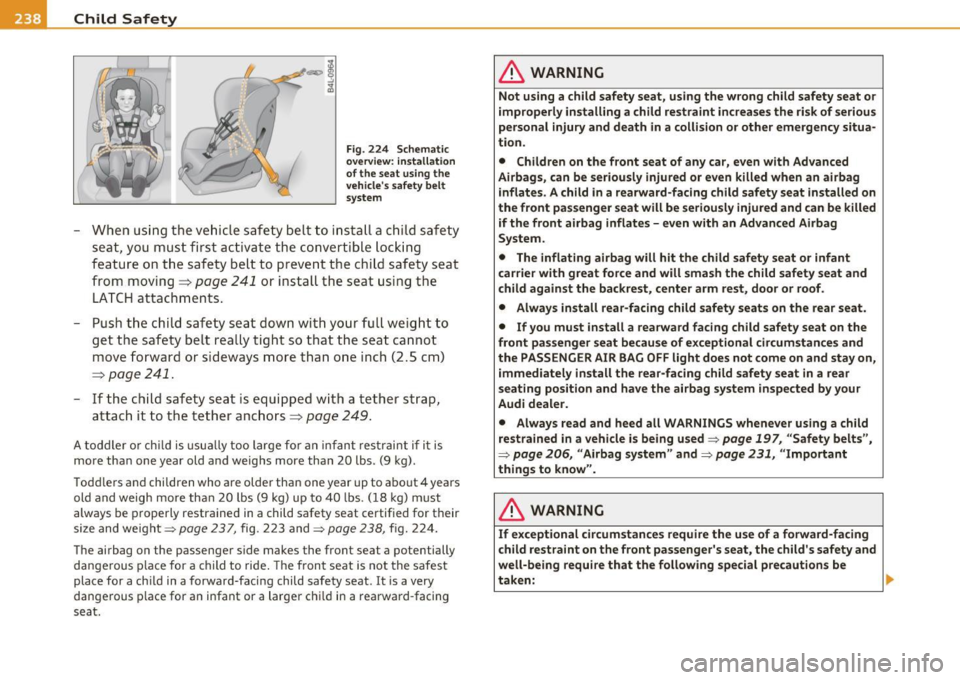
F ig. 22 4 Schema tic
overvie w: insta llatio n
of the seat using the
vehicle's sa fety be lt
sys tem
- When using the vehicle safety belt to insta ll a child safety
seat, you must first activate the convertible lock ing
feature on the safety belt to prevent the child safety seat
from moving~
page 241 or install the seat using the
LA TCH attachments .
- Push the child safety seat down with your full we ight to
get the safety belt really tight so that the seat cannot
move forward or s ideways more than one inch
(2.5 cm)
=>
page 241 .
- If the child safety seat is equipped w ith a tether strap,
attach it to the tether anchors=>
page 249.
A todd le r o r ch ild is usually too large for an i nfant res traint if it is
more than one year old and weighs more than 20 lbs . (9 kg) .
Todd lers and children who are older than one year up to about 4 years
old and weigh more tha n 20 lbs (9 kg) up to 40 lbs. (18 kg) must
always be properly restrained in a child safety seat certif ied for their
size and weight~
page 237, fig. 223 and~ page 238 , fig. 224.
The airbag on the passenger s ide makes the front seat a poten tially
dangerous place for a child to ride . The front seat is not the safest
place for a ch ild in a forward-facing child safety seat . It is a very
dangerous p lace for an infant or a larger chi ld in a rearward -facing
seat .
& WARNING
Not using a child safet y seat , us ing the w rong child safety seat or
improperl y install ing a child re straint in cre a ses the ri sk of seriou s
per sonal injury and death in a c olli sion or oth er em erg ency situa
tion.
• Children on th e front seat of any ca r, ev en with Ad vanced
Airbags , can be seriou sly injured or even killed when an air bag
i nflat es. A child in a re arward-facing child safet y seat installed on
the front pa ssenger seat will be seri ously injured and can be killed
i f the front a irbag inflates -ev en w ith an Advanc ed Airbag
System .
• The inflating airbag will hit th e child saf ety s eat or infant
carrier with grea t fo rce and will sma sh the child safet y seat and
child against the backrest, center arm rest , door or roof .
• Alway s in stall rear-f acing child safety seat s on the rear seat.
• If you must install a r ear ward fa cing ch ild safety seat on the
front p assenger seat becau se of except ional circum stance s and
th e PAS SENGER AIR BAG OF F light d oes not com e on and st ay on,
imm edia tel y i nstall the rear -facing child safet y se at in a re ar
seating position and ha ve the airbag s ystem insp ect ed by y our
Audi de aler.
• Alway s re ad and h eed all WARNINGS when ever u sing a child
re st rained
in a vehicle i s being use d~ page 197, "Safety belts ",
~ page 206 , "Airbag system " a nd ~ page 2 31 , "Important
thing s to know ".
& WARNING
If exc eptional cir cum stan ce s re quire the u se of a forward -f aci ng
c hild re straint on th e front p assenger 's seat, th e child 's saf ety and
w ell-being requ ire that the following sp eci al precauti ons b e
tak en:
11'-
Page 244 of 384
-Child Safety ------ ~---------------------------------
& WARNING (cont inued)
• It is safer to install a forward-facing child safety seat on the
rear seat.
• Always read and heed all WARNINGS whenever using a child
restrained in a vehicle is being used=>
page 231. Special precau
tions apply when installing a child safety seat on the front
passenger seat=>
page 208, "Child restraints on the front seat -
some important things to know".
& WARNING
Always take special precautions if you must install a forward or rearward-facing child restraint on the front passenger's seat in
exceptional situations:
• Whenever a forward or rearward-facing child restraint is installed on the front passenger seat, the PASSENGER AIR BAG
OFF light must come on and stay on whenever the ignition is
switched on .
• If the PASSENGER AIR BAG OFF light does not come on and
stay on, perform the checks described=>
page 217, "Monitoring
the Advanced Airbag System".
• Take the child restraint off the front passenger seat and install
it properly at one of the rear seat positions if the PASSENGER AIR
BAG OFF light does not stay on whenever the ignition is switched
on.
• Improper installation of child restraints can reduce their effec
tiveness or even prevent them from providing any protection .
• An improperly installed child restraint can interfere with the
airbag as it deploys and seriously injure or even kill the child.
• Always carefully follow the manufacturer's instructions
provided with the child safety seat or carrier.
• Never place additional items on the seat that can increase the
total weight registered by the weight-sensing mat and can cause
injury in a crash .
& WARNING
Forward-facing child restraints:
• Always make sure the forward -facing seat ha s been designed
and certified by its manufacturer for use on a front seat with a
passenger front and side airbag.
• Never put the forward-facing child restraint up, against or very
near the instrument panel.
• Always move the passenger seat into its rearmost position in
the seat's fore and aft adjustment range, as far away from the airbag as possible before installing the forward-facing child
restraint. The backrest must be adjusted to an upright position .
• Make sure that the PASSENGER AIR BAG OFF light comes on
and stays on all the time whenever the ignition is switched on.
& WARNING
Rearward-facing child restraints:
• A child in a rearward-facing child safety seat installed on the
front passenger seat will be seriously injured and can be killed if
the front airbag inflates - even with an Advanced Airbag System.
• The inflating airbag will hit the child safety seat or infant
carrier with great force and will smash the child safety seat and
child against the backrest, center armrest, door or roof.
• Always be especially careful if you must install a rearward
facing child safety seat on the front passenger seat in exceptional
circumstances.
• A tight tether strap on a rearward-facing child restraint
attached to the front passenger seat can put too much pressure on
the weight-mat in the seat and register a heavier weight in the
Advanced Airbag System. The heavier weight registered can make
the system work as though an adult were on the seat and deploy
the Advanced Airbag when it must be suppressed causing serious
or even fatal injury to the child.
Ill-
Page 245 of 384

_____________________________________________ C _h_i_ld _ S_ a_ f_ e_ t ... Y'--- __
& WARNING (continued)
• Make sure that the PASSENGER AIR BAG OFF light comes on
and stays on all the time whenever the ignition is switched on.
• If the PASSENGER AIR BAG OFF light does not come on and
stay on, immediately install the rear-facing child safety seat in a
rear seating position and have the airbag system inspected by
your Audi dealer. •
Activating the convertible locking retractor
Use the convertible locking retractor to secure a child
restraint.
Always heed the child safety seat manufacturer 's instruc
tions when installing a child restraint in your vehicle. To acti
vate the convertible locking retractor:
- Place the child restraint on a seat, preferably on the rear
seat .
- Slowly pull the belt
all the way out.
- Route it around or through the child restraint belt path
=>& .
- Push the child safety seat down with your full weight to
get the safety belt really tight.
- Insert the belt tongue into the buckle for that seating
position.
- Guide the safety belt back into the retractor until the belt
lies flat and snug on the child safety seat.
Controls and equip
ment Safety first Vehicle operation
-
You should hear a "clicking" noise as the belt winds back
into the inertia reel. Test the convertible locking retractor
by pulling on the belt. You should no longer be able to pull
the belt out of the retractor. The convertible lock ing
retractor is now activated.
- Make sure that the red release button is facing away from
the child restraint so that it can be unbuckled quickly.
- Pull on the belt to make sure the safety belt is properly
tight and fastened so that the seat cannot move forward
or sideways more than one inch (2.5 cm).
& WARNING
Using the wrong child restraint or an improperly installed child
restraint can cause serious personal injury or death in a crash.
• Always make sure that the safety belt retractor is locked when
installing a child safety seat. An unlocked safety belt retractor
cannot hold the child safety seat in place during normal driving or
in a crash.
• Always buckle the child safety seat firmly in place even if a
child is not sitting in it. A loose child safety seat can fly around
during a sudden stop or in a crash.
• Always make sure the seat backrest to which the child restraint
is installed is in an upright position and securely latched into place
and cannot fold forward. Otherwise, the seat back with the child
safety seat attached to it could fly forward in the event of an acci
dent or other emergency situation.
• Always read and heed all WARNINGS whenever using a child
restrained in a vehicle is being used
=> page 231. Special precau
tions apply when installing a child safety seat on the front passenger seat =>
page 208, "Child restraints on the front seat -
some important things to know". •
Vehicle care Do-it-yourself service Technical data
Page 251 of 384

0 Note
On vehicles with power ind iv id ual rear seats * some criteria mu st be
observed when attaching the child restraint using the
LATCH system:
• To attach the c hild restraint secu rely, the seat must be moved to
the farthest rear position, the seat heig ht set to the lowest pos it io n
and the head res tra int must be adj usted to the ve rt ica l posit io n
=> page 87.
• If a ch ild safe ty seat is attached to one of the rear seats, th is seat
must not be adjusted using the powe r contro ls under a ny circum
st ances. The easy en try fu nction for this se at must a lso be dea cti
vated i n th e M MI
=> page 89. The c hild safety seat as well as the rear
se at can be dam aged by the adjus tment proce ss. •
Tether anchors and tether straps
Fig . 232 Tethe r
anc hors : recess flaps
behind the rear seat
backs
Th e te ther anchors for t he t hree rear se ating p osit io ns a re loca ted in
recesses in the rear window shelf=> fig. 232. Vehicles with power
ind iv id ual rear sea ts* are equippe d wit h two te ther anchors .
A tethe r is a straight o r V-s ha ped strap that att aches the top part of
a ch ild rest raint to special anchorage points in the vehicle .
Th e purpose of the te th er is to reduce the fo rw ar d move men t of the
child rest raint in a crash, in order to help reduce the risk of head injury
th at could be cause d by strik in g th e ve hicle in ter io r.
Safety first Vehicle OP-eration
Child Safety
Forward fac ing ch ild restraints manufactured after September 1,
1 999, are required by U.S. feder al regul ations to comp ly wi th new
child head moveme nt pe rformance requ ireme nts . These new per for
mance re quirements ma ke a tether necessary on most new child
safety seats.
& WARNING
Improper installation of child restra ints will increase the risk of
injury and death in a crash.
• Always follow the instructions provided by the manufacturer
of the child restraint you intend to install in your Audi.
• Improper use of child restraint anchors (including tether
an chor s) can lead to injury in a collision . The anchors are designed
to withstand only those loads imposed by cor rectly fitted child
restraints.
• Never mount two child restraint systems on one LATCH lower
an chor point .
• Never attach two child restraint systems to one tether strap or
tether anchorage .
• Never attach a tether strap to a tie-down hook
in the luggage
c ompartment.
• Never use child restraint tether anchorages to secure safety
belts or other kinds of occupant restraints .
• Never se cure or atta ch any luggage or other items to the LATCH
lower anchorages or to the tether anchors.
• If a tether or other strap is used to attach a child restraint to
the front passenger seat, make sure that it is not so tight , that it
causes the weight-sensing mat to measure more weight than is
actually on the seat .
• The heavier weight registered can make the Advanced Airbag
System work as though an adult were on the seat and deploy the
Advanced Airbag when it must be suppressed causing serious or
even fatal injury to the child .
"°
Vehicle care Do-it-yourselt service iTechnical data
Page 253 of 384

Child Safety -
-------------------"'---
& WARNING (c on tinued )
• A tight tether or other strap on a rearward-facing child
restraint attached to the front pas senger seat can put too much
pressure on the weight-mat in the seat and register a heavier
weight in the Advanced Airbag System. The heavier weight regis
tered can make the system work as though an adult were on the
s eat and deploy the Advan ced Airbag when it must be suppressed
caus ing serious or e ven fatal injury to the child.
• If you must install a rearward facing child safety seat on the
front passenger seat because of exceptional circumstances and
the PASSENGER AIR BAG OFF light does not come on and stay on,
immediately install the rear-facing child safety seat in a rear
seating position and have the airbag system inspected by your
Audi dealer .•
Additional Information
Sources of information about child
restraints and their use
T here are a number of sources of addi tional information about child
restra in t selec tion , in stalla tion and use:
N HTSA a dvises t hat the best ch ild safety s eat is the one that fits you r
child and fits in your vehicle, and that yo u will use co rrectly and
consiste ntly.
Try before you buy!
U .S National Highway Traffic Safety Administration
Tel. : 1-88 8-327- 4236 (T TY: 1-800- 424 -9153)
www.n htsa .gov
National SAFE KIDS Campaign
Tel. : (202) 662-0600
www.safe kids .org
Controls and equip
ment Safety first Vehicle operation Safety BeltSafe U
.S.A
T el. : (800 ) 74 5-SAFE ( Eng lish)
Tel. : (800) 747 -SA NO (Spa nish)
www.carseat.org
Transport Canada Information Centre
T el. : 1 (80 0) 333-037 1 or call 1 (6 13) 99 8-8 616 if you are i n the
Ottawa area
www. tc.gc.c a/ro ads afety
Audi Customer CARE
T el. : (800) 822-2834 •
Vehicle care Do-it-yourself service Technical data
Page 269 of 384

Operating instructions
Maximum trailer weight
A trailer for your vehicle is limited to a typical class 1 or class 2 trailer.
Trailer load distribution
Be sure the load in the trailer is held securely in place to prevent it
from shifting forward, backward or sideways.
Never allow a passenger to ride in a trailer=>
& in "Driving instruc
tions".
Engine cooling system
Towing a trailer makes the engine work harder. It is important that
the cooling system's performance is up to the additional load. Make
sure that the cooling system has enough fluid.
Tire pressure
When towing a trailer, inflate the tires of your vehicle to the cold tire
pressure listed under "Full load" on the label located either on the
driver's side B -pillar (visible when the door is open) or inside the fuel
filler flap. Inflate trailer tires to trailer and tire manufacturers' spec
ifications .
Lights
The headlight settings should be checked with the trailer attached
before driving off. Check to make sure both vehicle and trailer lights
are working properly.
Safety chains
Be sure trailer safety chains are properly connected from the trailer
to the hitch on the vehicle. Leave enough slack in the chains to permit
turning corners . When you install safety chains, make sure they will
not drag on the road when you are driving.
The chains should cross under the trailer tongue to prevent it from
dropping in case of separation from the hitch .
Controls and equip ment Safety first Vehicle operation
Trailer
towingL_,1!:::!:·~-
0 Note
If you are going to tow a trailer, you must activate the trailer opera
tion mode =>
page 179, "Towing a Trailer". •
Driving instructions
Driving with a trailer always requires extra care and
consideration .
To obtain the best possible handling of vehicle and trailer,
please note the following:
- Do not tow a loaded trailer when your car itself is not
loaded.
- Be especially careful when passing other vehicles.
- Observe speed limits.
- Do not drive at the maximum permissible speed.
- Always apply brakes early .
- Monitor the temperature gauge.
Weight distribution
Towing a loaded trailer with an empty car results in a highly unstable
distribution of weight. If this cannot be avoided, drive at very low
speeds only to avoid the risk of losing steering control.
A "balanced" rig is easier to operate and control. This means that the
tow vehicle should be loaded to the extent possible and permissible,
while keeping the trailer as light as possible under the circumstances.
Whenever possible, transfer some cargo to the luggage compart
ment of the tow vehicle while observing tongue load requirements
and vehicle loading considerations.
Vehicle care Do-it-yourself service Technical data