child seat AUDI S8 2010 Workshop Manual
[x] Cancel search | Manufacturer: AUDI, Model Year: 2010, Model line: S8, Model: AUDI S8 2010Pages: 384, PDF Size: 90.95 MB
Page 244 of 384
-Child Safety ------ ~---------------------------------
& WARNING (cont inued)
• It is safer to install a forward-facing child safety seat on the
rear seat.
• Always read and heed all WARNINGS whenever using a child
restrained in a vehicle is being used=>
page 231. Special precau
tions apply when installing a child safety seat on the front
passenger seat=>
page 208, "Child restraints on the front seat -
some important things to know".
& WARNING
Always take special precautions if you must install a forward or rearward-facing child restraint on the front passenger's seat in
exceptional situations:
• Whenever a forward or rearward-facing child restraint is installed on the front passenger seat, the PASSENGER AIR BAG
OFF light must come on and stay on whenever the ignition is
switched on .
• If the PASSENGER AIR BAG OFF light does not come on and
stay on, perform the checks described=>
page 217, "Monitoring
the Advanced Airbag System".
• Take the child restraint off the front passenger seat and install
it properly at one of the rear seat positions if the PASSENGER AIR
BAG OFF light does not stay on whenever the ignition is switched
on.
• Improper installation of child restraints can reduce their effec
tiveness or even prevent them from providing any protection .
• An improperly installed child restraint can interfere with the
airbag as it deploys and seriously injure or even kill the child.
• Always carefully follow the manufacturer's instructions
provided with the child safety seat or carrier.
• Never place additional items on the seat that can increase the
total weight registered by the weight-sensing mat and can cause
injury in a crash .
& WARNING
Forward-facing child restraints:
• Always make sure the forward -facing seat ha s been designed
and certified by its manufacturer for use on a front seat with a
passenger front and side airbag.
• Never put the forward-facing child restraint up, against or very
near the instrument panel.
• Always move the passenger seat into its rearmost position in
the seat's fore and aft adjustment range, as far away from the airbag as possible before installing the forward-facing child
restraint. The backrest must be adjusted to an upright position .
• Make sure that the PASSENGER AIR BAG OFF light comes on
and stays on all the time whenever the ignition is switched on.
& WARNING
Rearward-facing child restraints:
• A child in a rearward-facing child safety seat installed on the
front passenger seat will be seriously injured and can be killed if
the front airbag inflates - even with an Advanced Airbag System.
• The inflating airbag will hit the child safety seat or infant
carrier with great force and will smash the child safety seat and
child against the backrest, center armrest, door or roof.
• Always be especially careful if you must install a rearward
facing child safety seat on the front passenger seat in exceptional
circumstances.
• A tight tether strap on a rearward-facing child restraint
attached to the front passenger seat can put too much pressure on
the weight-mat in the seat and register a heavier weight in the
Advanced Airbag System. The heavier weight registered can make
the system work as though an adult were on the seat and deploy
the Advanced Airbag when it must be suppressed causing serious
or even fatal injury to the child.
Ill-
Page 245 of 384

_____________________________________________ C _h_i_ld _ S_ a_ f_ e_ t ... Y'--- __
& WARNING (continued)
• Make sure that the PASSENGER AIR BAG OFF light comes on
and stays on all the time whenever the ignition is switched on.
• If the PASSENGER AIR BAG OFF light does not come on and
stay on, immediately install the rear-facing child safety seat in a
rear seating position and have the airbag system inspected by
your Audi dealer. •
Activating the convertible locking retractor
Use the convertible locking retractor to secure a child
restraint.
Always heed the child safety seat manufacturer 's instruc
tions when installing a child restraint in your vehicle. To acti
vate the convertible locking retractor:
- Place the child restraint on a seat, preferably on the rear
seat .
- Slowly pull the belt
all the way out.
- Route it around or through the child restraint belt path
=>& .
- Push the child safety seat down with your full weight to
get the safety belt really tight.
- Insert the belt tongue into the buckle for that seating
position.
- Guide the safety belt back into the retractor until the belt
lies flat and snug on the child safety seat.
Controls and equip
ment Safety first Vehicle operation
-
You should hear a "clicking" noise as the belt winds back
into the inertia reel. Test the convertible locking retractor
by pulling on the belt. You should no longer be able to pull
the belt out of the retractor. The convertible lock ing
retractor is now activated.
- Make sure that the red release button is facing away from
the child restraint so that it can be unbuckled quickly.
- Pull on the belt to make sure the safety belt is properly
tight and fastened so that the seat cannot move forward
or sideways more than one inch (2.5 cm).
& WARNING
Using the wrong child restraint or an improperly installed child
restraint can cause serious personal injury or death in a crash.
• Always make sure that the safety belt retractor is locked when
installing a child safety seat. An unlocked safety belt retractor
cannot hold the child safety seat in place during normal driving or
in a crash.
• Always buckle the child safety seat firmly in place even if a
child is not sitting in it. A loose child safety seat can fly around
during a sudden stop or in a crash.
• Always make sure the seat backrest to which the child restraint
is installed is in an upright position and securely latched into place
and cannot fold forward. Otherwise, the seat back with the child
safety seat attached to it could fly forward in the event of an acci
dent or other emergency situation.
• Always read and heed all WARNINGS whenever using a child
restrained in a vehicle is being used
=> page 231. Special precau
tions apply when installing a child safety seat on the front passenger seat =>
page 208, "Child restraints on the front seat -
some important things to know". •
Vehicle care Do-it-yourself service Technical data
Page 246 of 384
lffll.___C_ h_ il_d _ S_a _ f_ e _ t--= y '------------------------------------------------
Deactivating the convertible Locking
retractor
The convertible locking retractor for child restraints will
be deactivated automatically when the belt is wound all
the way back into the retractor .
- Press the red button on the safety be lt buckle . T he belt
tongue will pop out of the buckle.
- G uide the safety belt all the way back into its stowed posi-
t ion.
Always let the safety be lt retract completely into its stowed position .
The safety belt can now be used as a n ord inary safety belt withou t the
convertible locking retractor for c hild rest raints.
If the co nvertible locking retra ctor should be activated inadve rten tly,
the safety be lt must be unfastened and guided completely back into
i t s s towed posi tion to de activa te this fe ature. If the convert ible
locking retractor is not deactivated, the safety belt w ill gradually
become tighter and uncomfortable to wear.
& WARNING
Improperly in stalled child safety seats increase the ri sk of seriou s
personal injury and death in a collision .
• Never unfa sten the safety belt to deactivate the convertible
locking retracto r for child restraints while the vehicle is mo ving.
You would not b e re strained and could be seriously injured in an
accident.
• Alway s read and heed all WARNINGS whenever u sing a child
restrained in a vehicle is being used~
page 231. Special precau
tions apply when installing a child safety sea t on the front
passenger seat~
page 208, "Child restraints on the front seat -
s ome important thing s to know ".•
LATCH Lower anchorages and
tethers for children
Child Restraint System anchors and how
are they related to child safety
To prov ide a simpler and more practicable way to attach the child
restrain t on the vehicle se at, Federal regulat io ns re quire special
lower ancho rages in ve hicles and devices on new chi ld restraints to
a ttac h to the veh icle an chorages.
T he combination of the tether anchorages and the lower anchorages
is now generally called the
LATCH system for " Lower Anc horages and
T ethers fo r Children."
Forward -fac ing ch ild restraints manufactured after September 1,
1 999 , a re requ ired by U.S. federa l reg ulat ions to com ply w ith new
child head movement performance requirements . These new perfor
m an ce req uiremen ts make a tether necessary on most new c hild
seats .
Insta lling a child restraint that req uires a top tether without one can
ser iously impair the performance of the chi ld restra int and its abi lity
to protect the chi ld in a collision. Insta lling a child restraint that
req uires a top te ther w ithout t he top tethe r may be a violation of
state law.
Chi ld restraint manufacturers offer LA TCH lowe r anchorages on their
child seats with hook -on or push -on connectors attached to adj ust
ab le st raps.
In addit ion to the LA TC H l owe r an chorages, these ch ild restrain t
systems usually require the use of tethe r straps to help keep the child
restraint firm ly in pla ce.
& WARNING
Improper in stallation of child re straint s will increase the ri sk of
i njury and death in a crash. .,
Page 247 of 384

& WARNING (co ntinued )
• Always follow the instructions provided by the manufa ctu rer
of the child restraint you intend to install in your vehicle.
• Never install a child re straint without a prope rly a ttached top
tether strap if the child r estraint manufacturer's in structions
require the top tether strap to be used.
• Improper use of child restraint LATCH lower anchorage points
can lead to injury in a collision . The LATCH lower anchorage points
are designed to withstand only those loads imposed by correctly
fitted child restraints .
• Never mount two child rest raint s ystems on one LATCH lower
an chorage point.
• Never secure or attach any luggage or other item to the LATCH
lower anchorages.
[ i ) Tips
• In Canada, the terms "top tether " with " lowe r universa l anchor
ages" (or "lower universal anchorage bars") are used to describe the
system.
• In other countries, the term "ISO FIX" is used to describe the lower
anchorages . •
Safety first Vehicle OP-eration
Location Child Safety
Fi
g. 22 6 Sc hematic
o ve rvi ew : LATCH
anc hora ge poin t lo ca
ti ons
T he illustrat io n shows the seat ing locations in your vehicle whic h are
equipped wi th the lower anc horages system .•
Description
T h e lower anchorag e positions ar e marked for quick
loc ating.
Vehicle care
Fig. 22 7 Rear se at
b ack s: loc ato r buttons
for low er anchorag es ..
Do-it-yourselt service iTechnical data
Page 248 of 384
___ C_h _i_ld _ S_ a_ f_ e_ t_,, y'-----------------------------------------------
Fig. 228 Rear seats :
lower anchorage
bracket lo cation s
Attachment locator markers for lower anchorages
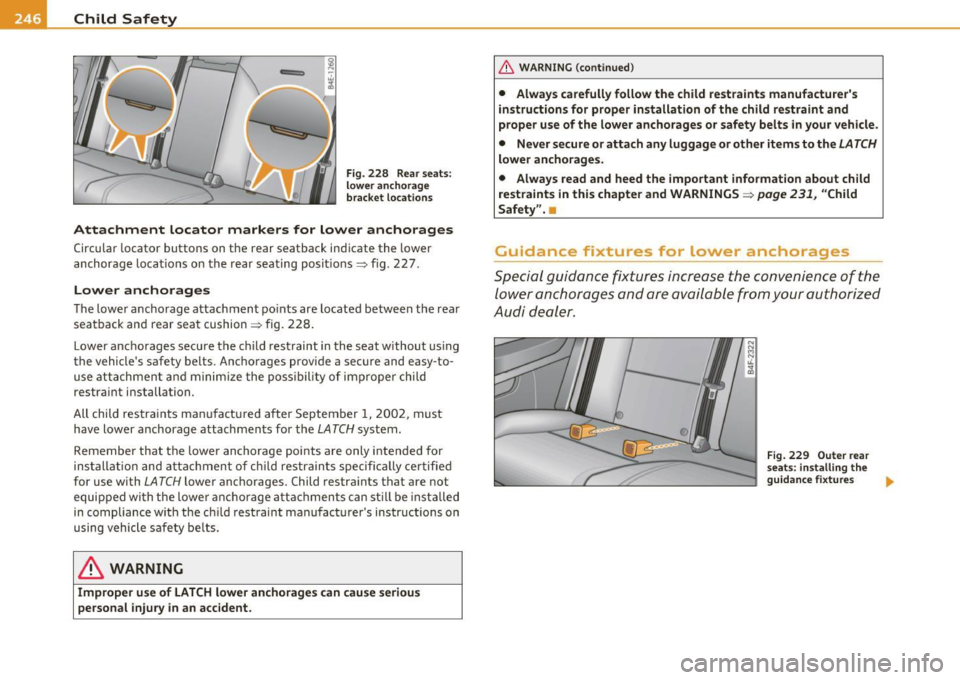
Circular locator buttons on the rear seatback indicate the lowe r
anchorage loca tions on th e r ear seating positions~ fig. 227.
Lower anchorages
T he lower ancho rage a ttachm ent po ints are located between t he rea r
sea tback and rear sea t cushi on
~ fig. 228.
Lower a nch o rage s se cu re the chi ld rest raint in the seat withou t us ing
the vehicle 's safety be lts. Anc ho rages prov ide a secure and easy-to
u se at ta ch men t and mini miz e the pos sibil ity of im proper child
restra int i nstallation.
All child restra in ts ma nufact ured after Septem ber 1, 2 002, must
have low er anchorage attachmen ts for the
L ATCH system .
Remember that the lower anchorage points a re only intended for
ins tallati on and attachm ent of chil d restrain ts s peci ficall y ce rti fie d
for use with
L A TCH lowe r ancho rages. Child restra ints that are not
equi pped wi th the lowe r anchor age a tta ch me nt s ca n s till be ins tal led
in compliance w it h th e c hild restraint manu fac turer 's instructions on
using vehi cle s afety be lts.
& WARNING
Improper use of LATCH lower anchorages can cause seriou s
personal injury in an accident .
& WARNING (co ntinued )
• Always carefully follow the child restraints manufacturer's
instructions for proper installation of the child restraint and
proper use of the lower anchorages or safety belts in your vehicle .
• Never secure or atta ch any luggage or other items to the
LATCH
lower anchorages .
• Always read and heed the important information about child
restraints in this chapter and WARNINGS~
page 231, "Child
Safety ".•
Guidance fixtures far lower anchorages
Sp ecial guid ance fixt ures incr ea se the c on ve ni ence of the
lo we r an cho rages a nd a re avai la b le fro m you r a utho rized
Au di deal er.
Fig. 229 Outer rear
seats : in stalling the
guidance fixture s ..
Page 249 of 384

___________________________________________ C_ h_il _d _ S_a _f _e _t =c,. y __ fl'II
Fig. 230 Close-up:
fitting the guidance
fixture over the lower
anchorage bracket
The lower anchorage attachment points are located on the
rear seats between the seatback and the seat cushion.
Special guidance fixtures increase the convenience of the
lower anchorages and help protect the seat material from
possible damage when installing child restraints.
Installing the guidance fixtures
-Push down on the seat cushion so that the lower anchor
ages are visible.
- Hold the guidance fixture with the part number facing
downward and push it in the direction of the arrow onto
the anchorage ~ fig. 230.
- Make sure that each of the two guidance fixtures per seat
snaps into place.
Removing the guidance fixtures
- Remove the child restraint according the child restraint
manufacturer's instructions.
- Push down on the seat cushion so that the lower anchor
ages are visible.
- Pull off the guidance fixtures from the lower anchorages.
Controls and equip
ment Safety first Vehicle operation
-
Always remove the guidance fixtures and keep them in a
safe place when not in use.
You may find it easier to install child restraints equipped with hooks
attached to straps without the guidance fixtures in place. If this is the
case, remove the guidance fixtures by pulling them off the anchor
ages. However, the guidance fixtures can help you to locate the
LATCH anchorages.
& WARNING
Improper use of tether anchorages or lower anchorages can cause
serious personal injury in a crash.
• Always carefully follow the child restraint manufacturer's
instructions for proper installation and use of child restraint
systems.
• Never use the
LATCH or tether anchorages to attach safety
belts or other kinds of occupant restraints.
• Child restraint tether attachments and lower attachments are
only designed to secure a child restraint that has been equipped to
use these anchorages.
• Tether anchorages and lower anchorages are designed to with
stand only those loads imposed by correctly fitted child restraints.
Under no circumstances can they be used safely for adult or child
safety belts or harnesses.
• Never mount more than one child restraint to a single tether or
to a lower anchorage point. Attaching two child restraints to a single anchorage point can cause the anchorage to fail and cause
serious personal injury in a crash.
0 Note
• Remove the guidance fixtures before folding the rear seatback to
prevent damaging the seat cushion .
• If you leave the guidance fixtures installed for several days, they
could leave a mark on the upholstery on the seat cushion and backrest _.,
Vehicle care Do-it-yourself service Technical data
Page 250 of 384
• .___C_ h_ il_d _ S_a _ f_ e _ t--= y '------------------------------------------------
in the area that the guidance fixtures were installed . The upholstery
would also be permanently stretched around the guidance fixtures.
This applies especially to leather seats .•
Installing a child restraint with LATCH
lower anchorages
Whenever you install a child restraint always follow the
child restraint manufacturer's instructions.
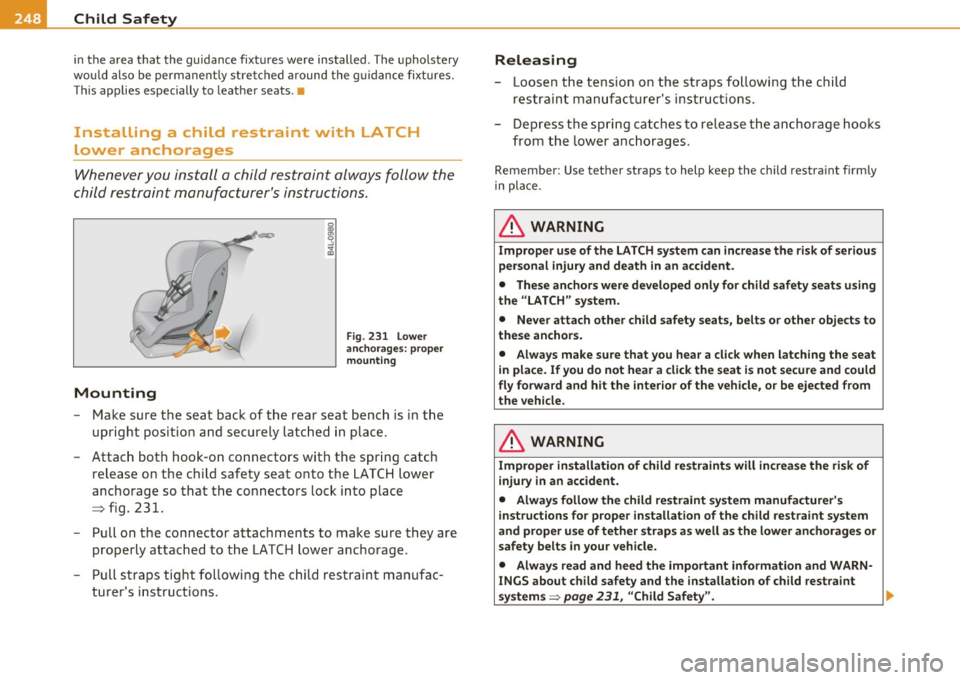
Mounting
Fig. 231 Lower
anchorages: proper
mounting
- Make sure the seat back of the rear seat bench is in the
upright position and securely latched in place.
- Attach both hook-on connectors with the spring catch
release on the child safety seat onto the LATCH lower
anchorage so that the connectors lock into place
~ fig. 231.
- Pull on the connector attachments to make sure they are
properly attached to the LATCH lower anchorage.
- Pull straps tight following the child restraint manufac
turer's instructions.
Releasing
- Loosen the tension on the straps following the child
restraint manufacturer's instructions.
- Depress the spring catches to release the anchorage hooks
from the lower anchorages.
Remember: Use tether straps to help keep the child restraint firmly
in place.
& WARNING
Improper use of the LATCH system can increase the risk of serious
personal injury and death in an accident.
• These anchors were developed only for child safety seats using
the "LATCH" system.
• Never attach other child safety seats, belts or other objects to
these anchors.
• Always make sure that you hear a click when latching the seat
in place. If you do not hear a click the seat is not secure and could
fly forward and hit the interior of the vehicle, or be ejected from
the vehicle.
& WARNING
Improper installation of child restraints will increase the risk of
injury in an accident.
• Always follow the child restraint system manufacturer's
instructions for proper installation of the child restraint system
and proper use of tether straps as well as the lower anchorages or
safety belts in your vehicle.
• Always read and heed the important information and WARN
INGS about child safety and the installation of child restraint
systems ~
page 231, "Child Safety". _,
Page 251 of 384

0 Note
On vehicles with power ind iv id ual rear seats * some criteria mu st be
observed when attaching the child restraint using the
LATCH system:
• To attach the c hild restraint secu rely, the seat must be moved to
the farthest rear position, the seat heig ht set to the lowest pos it io n
and the head res tra int must be adj usted to the ve rt ica l posit io n
=> page 87.
• If a ch ild safe ty seat is attached to one of the rear seats, th is seat
must not be adjusted using the powe r contro ls under a ny circum
st ances. The easy en try fu nction for this se at must a lso be dea cti
vated i n th e M MI
=> page 89. The c hild safety seat as well as the rear
se at can be dam aged by the adjus tment proce ss. •
Tether anchors and tether straps
Fig . 232 Tethe r
anc hors : recess flaps
behind the rear seat
backs
Th e te ther anchors for t he t hree rear se ating p osit io ns a re loca ted in
recesses in the rear window shelf=> fig. 232. Vehicles with power
ind iv id ual rear sea ts* are equippe d wit h two te ther anchors .
A tethe r is a straight o r V-s ha ped strap that att aches the top part of
a ch ild rest raint to special anchorage points in the vehicle .
Th e purpose of the te th er is to reduce the fo rw ar d move men t of the
child rest raint in a crash, in order to help reduce the risk of head injury
th at could be cause d by strik in g th e ve hicle in ter io r.
Safety first Vehicle OP-eration
Child Safety
Forward fac ing ch ild restraints manufactured after September 1,
1 999, are required by U.S. feder al regul ations to comp ly wi th new
child head moveme nt pe rformance requ ireme nts . These new per for
mance re quirements ma ke a tether necessary on most new child
safety seats.
& WARNING
Improper installation of child restra ints will increase the risk of
injury and death in a crash.
• Always follow the instructions provided by the manufacturer
of the child restraint you intend to install in your Audi.
• Improper use of child restraint anchors (including tether
an chor s) can lead to injury in a collision . The anchors are designed
to withstand only those loads imposed by cor rectly fitted child
restraints.
• Never mount two child restraint systems on one LATCH lower
an chor point .
• Never attach two child restraint systems to one tether strap or
tether anchorage .
• Never attach a tether strap to a tie-down hook
in the luggage
c ompartment.
• Never use child restraint tether anchorages to secure safety
belts or other kinds of occupant restraints .
• Never se cure or atta ch any luggage or other items to the LATCH
lower anchorages or to the tether anchors.
• If a tether or other strap is used to attach a child restraint to
the front passenger seat, make sure that it is not so tight , that it
causes the weight-sensing mat to measure more weight than is
actually on the seat .
• The heavier weight registered can make the Advanced Airbag
System work as though an adult were on the seat and deploy the
Advanced Airbag when it must be suppressed causing serious or
even fatal injury to the child .
"°
Vehicle care Do-it-yourselt service iTechnical data
Page 252 of 384
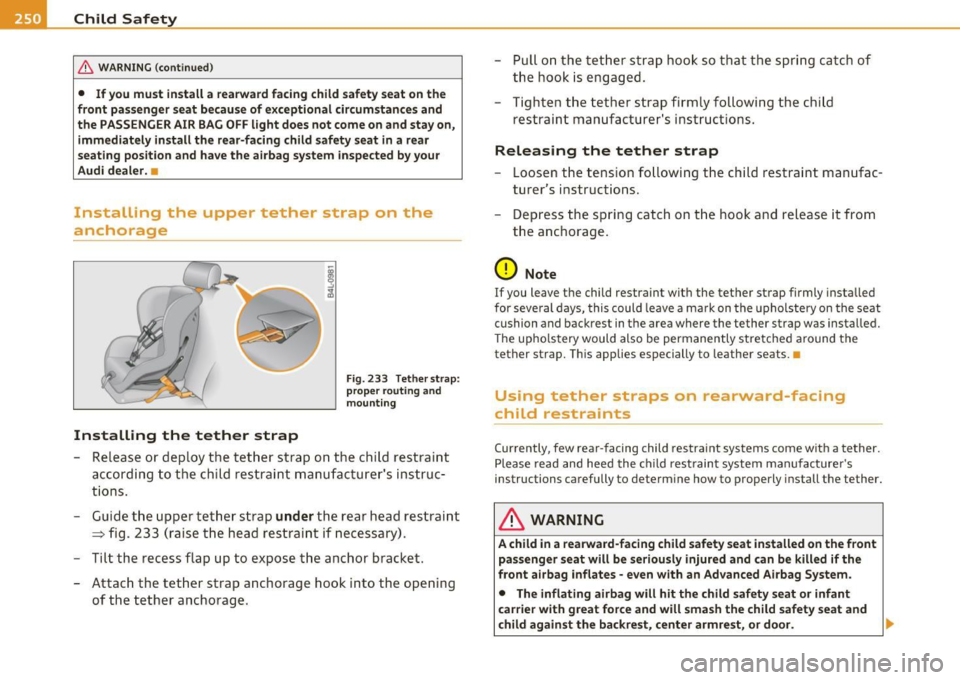
...,. Child Safety Pfl'I ____ _,.__ __________________________ _
& WARNING (continued)
• If you must install a rearward facing child safety seat on the
front passenger seat because of exceptional circumstances and
the PASSENGER AIR BAG OFF light does not come on and stay on,
immediately install the rear-facing child safety seat in a rear
seating position and have the airbag system inspected by your
Audi dealer. •
Installing the upper tether strap on the
anchorage
Installing the tether strap
Fig. 233 Tether strap:
proper routing and
mounting
- Release or deploy the tether strap on the child restraint
according to the child restraint manufacturer's instruc
tions.
- Guide the upper tether strap
under the rear head restraint
=> fig. 233 (raise the head restraint if necessary).
- Tilt the recess flap up to expose the anchor bracket.
- Attach the tether strap anchorage hook into the opening
of the tether anchorage. -
Pull on the tether strap hook so that the spring catch of
the hook is engaged.
- Tighten the tether strap firmly following the child
restraint manufacturer's instructions.
Releasing the tether strap
-Loosen the tension following the child restraint manufac
turer's instructions.
- Depress the spring catch on the hook and release it from
the anchorage.
0 Note
If you leave the child restraint with the tether strap firmly installed
for several days, this could leave a mark on the upholstery on the seat
cushion and backrest in the area where the tether strap was installed.
The upholstery would also be permanently stretched around the
tether strap. This applies especially to leather seats.•
Using tether straps on rearward-facing
child restraints
Currently, few rear-facing child restraint systems come with a tether.
Please read and heed the child restraint system manufacturer's
instructions carefully to determine how to properly install the tether.
& WARNING
A child in a rearward-facing child safety seat installed on the front
passenger seat will be seriously injured and can be killed if the
front airbag inflates -even with an Advanced Airbag System.
• The inflating airbag will hit the child safety seat or infant
carrier with great force and will smash the child safety seat and
child against the backrest, center armrest, or door.
~
Page 253 of 384

Child Safety -
-------------------"'---
& WARNING (c on tinued )
• A tight tether or other strap on a rearward-facing child
restraint attached to the front pas senger seat can put too much
pressure on the weight-mat in the seat and register a heavier
weight in the Advanced Airbag System. The heavier weight regis
tered can make the system work as though an adult were on the
s eat and deploy the Advan ced Airbag when it must be suppressed
caus ing serious or e ven fatal injury to the child.
• If you must install a rearward facing child safety seat on the
front passenger seat because of exceptional circumstances and
the PASSENGER AIR BAG OFF light does not come on and stay on,
immediately install the rear-facing child safety seat in a rear
seating position and have the airbag system inspected by your
Audi dealer .•
Additional Information
Sources of information about child
restraints and their use
T here are a number of sources of addi tional information about child
restra in t selec tion , in stalla tion and use:
N HTSA a dvises t hat the best ch ild safety s eat is the one that fits you r
child and fits in your vehicle, and that yo u will use co rrectly and
consiste ntly.
Try before you buy!
U .S National Highway Traffic Safety Administration
Tel. : 1-88 8-327- 4236 (T TY: 1-800- 424 -9153)
www.n htsa .gov
National SAFE KIDS Campaign
Tel. : (202) 662-0600
www.safe kids .org
Controls and equip
ment Safety first Vehicle operation Safety BeltSafe U
.S.A
T el. : (800 ) 74 5-SAFE ( Eng lish)
Tel. : (800) 747 -SA NO (Spa nish)
www.carseat.org
Transport Canada Information Centre
T el. : 1 (80 0) 333-037 1 or call 1 (6 13) 99 8-8 616 if you are i n the
Ottawa area
www. tc.gc.c a/ro ads afety
Audi Customer CARE
T el. : (800) 822-2834 •
Vehicle care Do-it-yourself service Technical data